
A distributive pronoun is a pronoun that singles out members of a group one at a time, as in each received a separate invitation. Distributive pronoun example sentences with each, every, either, and neither pair the pronoun with a singular verb, from daily routines to school, work, and literature.
What Is a Distributive Pronoun?
A distributive pronoun replaces a noun and refers to individual members of a group rather than to the group as a whole. An indefinite pronoun such as "some" or "many" leaves the count unnamed, while a distributive pronoun narrows the reference to one person or thing at a time.
each / every / either / neither + singular verb
Each of the runners finished the race before the rain started.
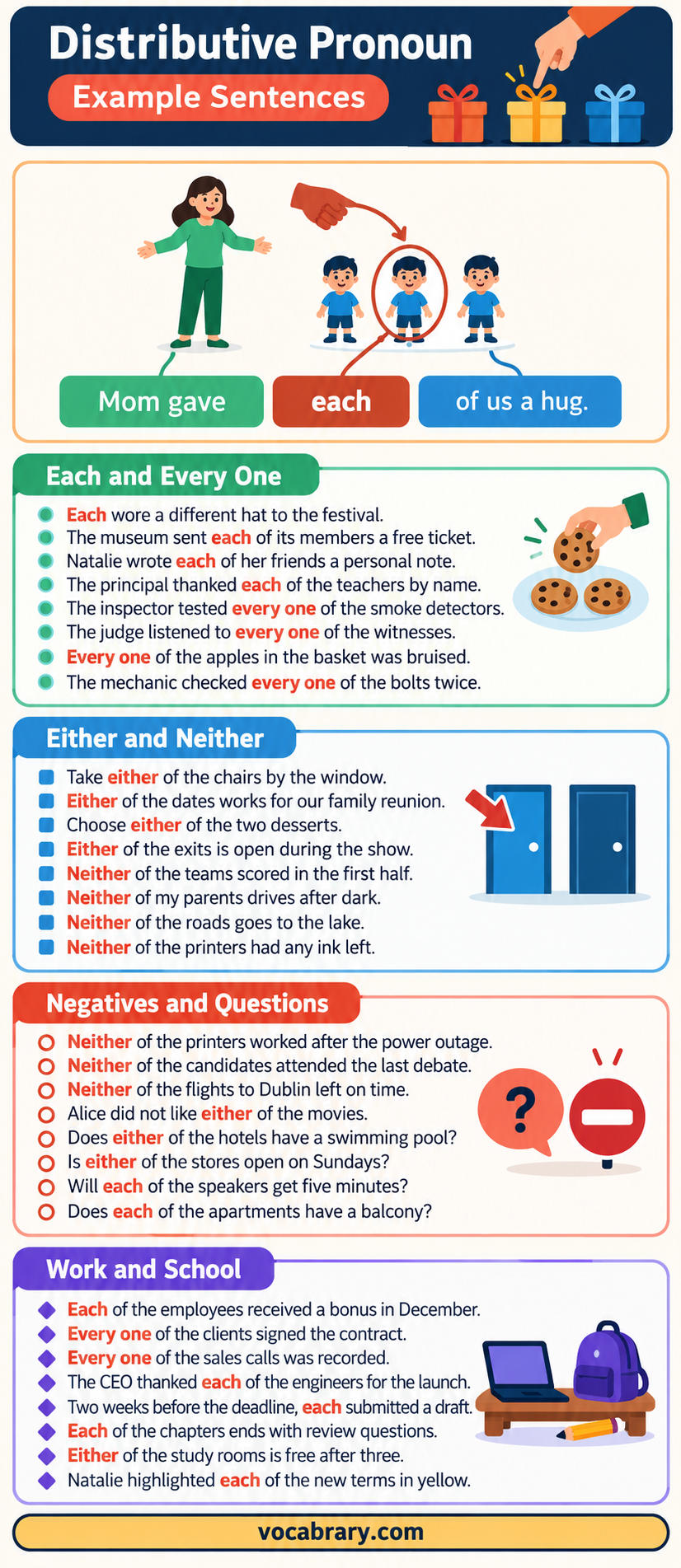
Common Distributive Pronoun Example Sentences
A child’s certificate, a passenger’s boarding pass, and a pair of dresses that both look good are the starting mix, and each, every, either, and neither single out one member at a time.
- Each of the children received a certificate at the end of the school year.
- Every passenger showed a boarding pass before entering the aircraft.
- Either of the dresses looks good on you.
- Neither of the two candidates answered the final question correctly.
- At the potluck dinner, each brought a dish from home.
- Every window in the old farmhouse needed a fresh coat of paint.
- Either will work for tomorrow’s meeting, so pick whichever time suits you.
- Neither of the brothers remembered their grandmother’s birthday.
- From the professor, each of the essays earned a different grade.
- By half past seven, every seat in the concert hall was taken.
- For the trip to Oslo, either of these jackets is warm enough.
- Neither arrived on time for the morning assembly.
- In the spring campaign, each planted a sapling in the park.
- During the ice storm, every house on the street lost power.
- The teacher asked each of the students to read one paragraph aloud.
- Grandma knitted a scarf for each of the grandchildren before winter.
Each, Every, Either, and Neither With a Singular Verb
Receiving a medal after a tournament, paying five euros at the market, and ruling out both answers on a board show how the four pronouns pair with a singular verb in every tense.
| Distributive pronoun | Meaning | Example sentence |
|---|---|---|
| Each | One by one in a group of two or more | Each of the players received a medal after the tournament. |
| Each | One by one, without a noun after it | Each costs five euros at the Saturday market. |
| Every | All members, taken singly | Every student in the class submitted the assignment on time. |
| Every | All members without exception | Every door in the corridor was locked by nine o’clock. |
| Either | One or the other of two | Either of the roads leads to the village square. |
| Either | Any one of two, without a noun after it | Either is fine with me. |
| Neither | Not one and not the other of two | Neither of the answers on the board was correct. |
| Neither | Not one of two, without a noun after it | Neither passed the driving test on the first attempt. |
Sentences With Each
Signing a visitor book, measuring a bridesmaid, and sealing an exam paper one at a time are the deeds "each" turns into grammar. The pronoun takes a singular verb throughout.
- Each of the guests signed the visitor book at the front desk.
- At the gallery, each of the paintings tells a story from the artist’s childhood.
- Our coach gave each of the swimmers a personal training schedule.
- Each costs ten pounds when you buy them loose at the bakery counter.
- We asked each of the neighbours to water one row of the garden while we were away.
- All five letters arrived on different days, and each had a separate postmark.
- The librarian stamped each of the borrowed books before handing them back.
- After the move, each of my cousins settled in a different city.
- On the last day of camp, each picked a song for the road trip playlist.
- The tailor measured each of the bridesmaids before cutting the fabric.
- Overlooking the river, each of the apartments has its own balcony.
- Each wore a different hat to the festival.
- Mr Yilmaz handed each of the trainees a safety manual on the first morning.
- Children at the shelter gave each of the puppies a different name.
- Before the exam, each of the papers was sealed in a brown envelope.
Sentences With Every
Lining up every jar on a shelf, reading every name on a roll call, and inspecting every loaf at a bakery push through the whole group without skipping a member.
- Every student in the biology class brought a notebook and a pencil.
- Within an hour, every ticket for the Saturday show had sold out.
- Priya walks the same route through the park every morning.
- The manager checked every invoice before signing the monthly report.
- On our lane, every house had a cherry tree in the front garden.
- All twelve runners crossed the finish line, and every time was under four hours.
- A new cliffhanger closes every chapter of the novel.
- Teachers at the school attended every staff meeting on Friday afternoon.
- The baker inspected every loaf before placing it on the rack.
- At the wedding, every guest wore white, as the couple had requested.
- Every shelf in the storeroom was stacked to the ceiling with old files.
- Ten marks went to every question on the test.
- In the meadow, every flower turned toward the afternoon sun.
- Our bus was delayed, and so was every other bus on the route.
- Grandma reads every label at the supermarket before putting anything in her trolley.
Sentences With Either
Picking one restaurant or the other, borrowing one umbrella from a pair, and trying one trail at a fork show "either" at work. The pronoun limits the choice to two.
- For lunch, either of the restaurants serves a good meal.
- Take either of the chairs by the window.
- Either of the buses goes to the city centre.
- Tomorrow’s presentation needs one projector, and either will do.
- The mechanic said either of the tyres needs replacing before winter.
- Both applicants meet the requirements, and either of them deserves the scholarship.
- Ravi asked for either of the two scarves at the market stall.
- Either of the dates works for our family reunion.
- The landlord agreed to accept either of the payment plans.
- A signpost at the fork shows that either of the hiking trails leads to the waterfall.
- Under thirty minutes is all either of the recipes takes.
- Video editing runs well on either of these laptops.
- You are free to borrow either of the umbrellas by the door.
- At the family photo, either of the twins is tall enough to reach the top shelf.
Sentences With Neither
Ruling out both teams in the first half, rejecting both flights on a departure board, and refusing both dresses in a shop show "neither" at work. The pronoun denies one and the other of exactly two.
- Neither of the teams scored in the first half.
- On the envelope, neither of the two addresses was correct.
- At the debate, neither wanted to speak first.
- After three hours, neither of the batteries had any charge left.
- Selena tried both dresses, but neither fit properly at the waist.
- The critics dismissed both films, and neither received a positive review.
- For the apple pie, neither of the two recipes called for sugar.
- A yellow card went to both players, yet neither stopped arguing.
- When we arrived at the hotel, neither of the two lifts was working.
- That evening, neither of the flights landed on schedule.
- Neither of my parents drives after dark.
- By the Friday deadline, neither had replied to the email.
- Both buyers offered less, and neither of the offers met the asking price.
- In court, neither of the witnesses remembered the licence plate number.
Distributive Pronouns in Affirmative Sentences
Handing one medal to one swimmer, opening one window in one classroom, and signing one form at one desk are positive deeds, and the distributive pronoun keeps the verb singular in every affirmative line.
- Each of the volunteers planted a tree along the canal path.
- Every child at the party received a balloon and a slice of cake.
- Either of the train routes reaches the coast by noon.
- Neither of the two villages has a petrol station, so drivers fill up in town.
- For finishing ahead of schedule, each earned a bonus.
- In the hallway, every lamp was switched on for the evening reception.
- Both paint swatches look good, and either of these colours matches the curtains.
- Each of the musicians tuned an instrument before the rehearsal started.
- That autumn, every row of the vineyard produced a full harvest.
- Hana checked each of the suitcases and found room for one more book.
- Along the harbour, every market stall sold fresh fish on Saturdays.
- Either of the contracts gives the tenant a twelve-month lease.
Distributive Pronouns in Negative Sentences
Failing to hand in homework, not clearing a road of snow, and missing a fire-escape sign are denials, and "not" or "never" pairs with the distributive pronoun while the verb stays singular.
- Neither of the suspects gave a full statement to the police.
- The building does not have a fire-escape sign on every door.
- On the morning of the bake sale, neither of the ovens worked.
- Frost killed some trees, and not every one in the orchard survived.
- In the local election, neither of the two candidates received enough votes to win the seat.
- Some questions had two correct answers, so not every answer on the paper was a single choice.
- By Monday morning, neither of the roads was cleared of snow.
- Gifts were forgotten by a few guests, and not every person brought one.
- The inspector walked through the second floor and discovered that neither of the two fire extinguishers passed the annual safety check.
- Half the class ran out of time, and not every student finished the worksheet.
- Neither of the pilots noticed the warning light until the co-pilot spoke up.
- Several parcels were late, and not every one arrived before the holiday weekend.
Distributive Pronouns in Questions
Asking which swimmer finished first, which hotel has a pool, and which bakery bakes sourdough are queries, and the distributive pronoun in the question still demands a singular verb.
- Did each of the students hand in the assignment on time?
- Has every member of the club paid the annual fee?
- Does either of the hotels have a swimming pool?
- This morning, did neither of the alarms ring?
- So far, has each of the files been backed up to the server?
- Is every seat on the bus reserved for the school trip?
- Will either of the dentists see a new patient today?
- Before the holiday, did neither of the packages arrive?
- By now, has each of the applicants submitted a reference letter?
- Is every street in the old quarter closed to traffic on Sundays?
- Does either of the bakeries make sourdough bread?
- On Saturday, did neither of the goalkeepers stop the penalty?
Distributive Pronoun Example Sentences for Kids
Sharing one crayon at a time, picking one toy from a pair, and feeding one kitten before the other are deeds a seven-year-old already knows. The distributive pronoun is the only new word.
- Each of the children drew a picture of their pet.
- Every pupil in the class sang the morning song.
- Either of the sweets is yours to pick.
- Neither of the kittens drank the milk.
- Each of the crayons was a different colour.
- Every bird in the tree flew away when the bell rang.
- Either of the toys goes in the big basket.
- Neither of the boys finished the race.
- On sports day, each got a turn on the swing.
- In the storybook, every picture was drawn in bright colours.
- You are free to pick either of the cups for your juice.
- After the party, neither of the balloons floated.
Distributive Pronoun Example Sentences for Students
Revising one chapter at a time, picking one essay prompt from a pair, and rejecting both thesis statements before writing a third are exam-week deeds, and the distributive pronoun adds grammar practice to the revision.
- Each of the paragraphs in the essay needs an opening sentence.
- Every student who enrolled in the course signed a code of conduct.
- Either of the research proposals is acceptable for the dissertation.
- Neither of the sources in the bibliography was published after 2020.
- Each of the lab partners recorded a separate set of readings.
- Every formula on the revision sheet turned up on the final exam.
- Either of the translations is correct, according to the professor.
- Neither of the graphs matched the data in the original study.
- Two weeks before the deadline, each submitted a draft.
- Across the whole campus, every lecture hall has a projector and a whiteboard.
- On Tuesday, either of the elective modules is open for registration.
- By Friday, neither of the tutors was available for a consultation.
Distributive Pronouns and Distributive Adjectives in the Same Sentence
"Each" on its own beside "each contestant," and "neither" on its own beside "neither candidate," show the pronoun and the adjective in a single sentence. More pronoun sentences work through the same two roles.
- Each received a ribbon, yet each contestant also earned a certificate.
- Every visitor signed the guest book, and every signature told a different story.
- Either works for me, but either option needs a deposit.
- Neither passed, and neither candidate plans to retake the exam.
- Each of the bakers won a prize, while each recipe was judged by a different chef.
- Every bench in the park was wet, yet every jogger dropped onto one anyway.
- Either is warm enough, though either jacket costs more than I expected.
- Neither scored, and neither team looked threatening in the second half.
- On the top floor, each of the rooms was painted, and each wall dried within a day.
- Last winter’s frost killed both, and neither survived, so neither rose bush will bloom this spring.
Sentences Rewritten With the Correct Distributive Pronoun
Pairing "were" with each, adding a plural noun after "every," and writing "neither are" instead of "neither is" are the errors a learner needs to catch. The wrong version is in italics beside the corrected one.
- Each of the players was given a locker ✅, wrong as Each of the players were given a locker ❌.
- Neither of the roads is safe after dark ✅, wrong as Neither of the roads are safe after dark ❌.
- Every seat in the row was taken ✅, wrong as Every seats in the row were taken ❌.
- Either of the plans is affordable ✅, wrong as Either of the plans are affordable ❌.
- Neither of the witnesses was called to testify ✅, wrong as Neither of the witnesses were called to testify ❌.
- Each of the paintings has a label ✅, wrong as Each of the paintings have a label ❌.
- Every child in the class was present ✅, wrong as Every children in the class were present ❌.
- Either of the flights departs at noon ✅, wrong as Either of the flights depart at noon ❌.
- On the shelf, neither of the books is mine ✅, wrong as Neither of the books are mine ❌.
- At the lab, each of the cups measures exactly two hundred millilitres ✅, wrong as Each of the cups measure exactly two hundred millilitres ❌.
Related
FAQs
An everyday example is "Each of the neighbors brought a chair to the street party." Another is "Neither of my sisters lives in Boston anymore."
With "each", one example is "The mayor shook hands with each of the firefighters." Another is "The company gave each of its drivers a new uniform."
One example is "The inspector tested every one of the smoke detectors." Another is "After the flood, every one of the books in the basement was ruined."
With "either", one example is "Choose either of the two desserts." Another is "The committee will accept either of the proposals."
For "neither", one example is "Neither of the twins plays the piano." Another is "After the storm, neither of the bridges was safe to cross."
A negative example is "Not every one of the seeds sprouted this spring." Another is "Neither of the candidates attended the last debate."
One question is "Did each of the guests receive an invitation?" Another is "Is either of these seats taken?"
A sentence for kids is "Each of the ducks swam across the pond." Another is "Mom gave each of us a hug."
In school, one example is "Each of the presenters had ten minutes for questions." Another is "Neither of the exams was postponed."
At work, one example is "The accountant checked each of the invoices twice." Another is "Our lawyer reviewed each of the clauses before we signed."
Related: