
A verb is the word class that expresses an action, an event, or a state of the subject and that every complete clause requires, as in Mina painted the fence. One verb belongs to several types at once: paint is an action verb by meaning, a transitive verb by its object, and a regular verb by its past form. Verbs example sentences attach each of those labels to a full clause, so an action verb, a linking verb, and a helping verb are each met in use.
What Is a Verb?
A verb is the word in a clause that expresses an action, an event, or a state of the subject, and every complete sentence needs one. A noun names a person, place, or thing instead, so a walk is a noun while to walk is a verb.
Subject + verb (+ object or complement)
Amara reads every evening, and her brother is a pilot.
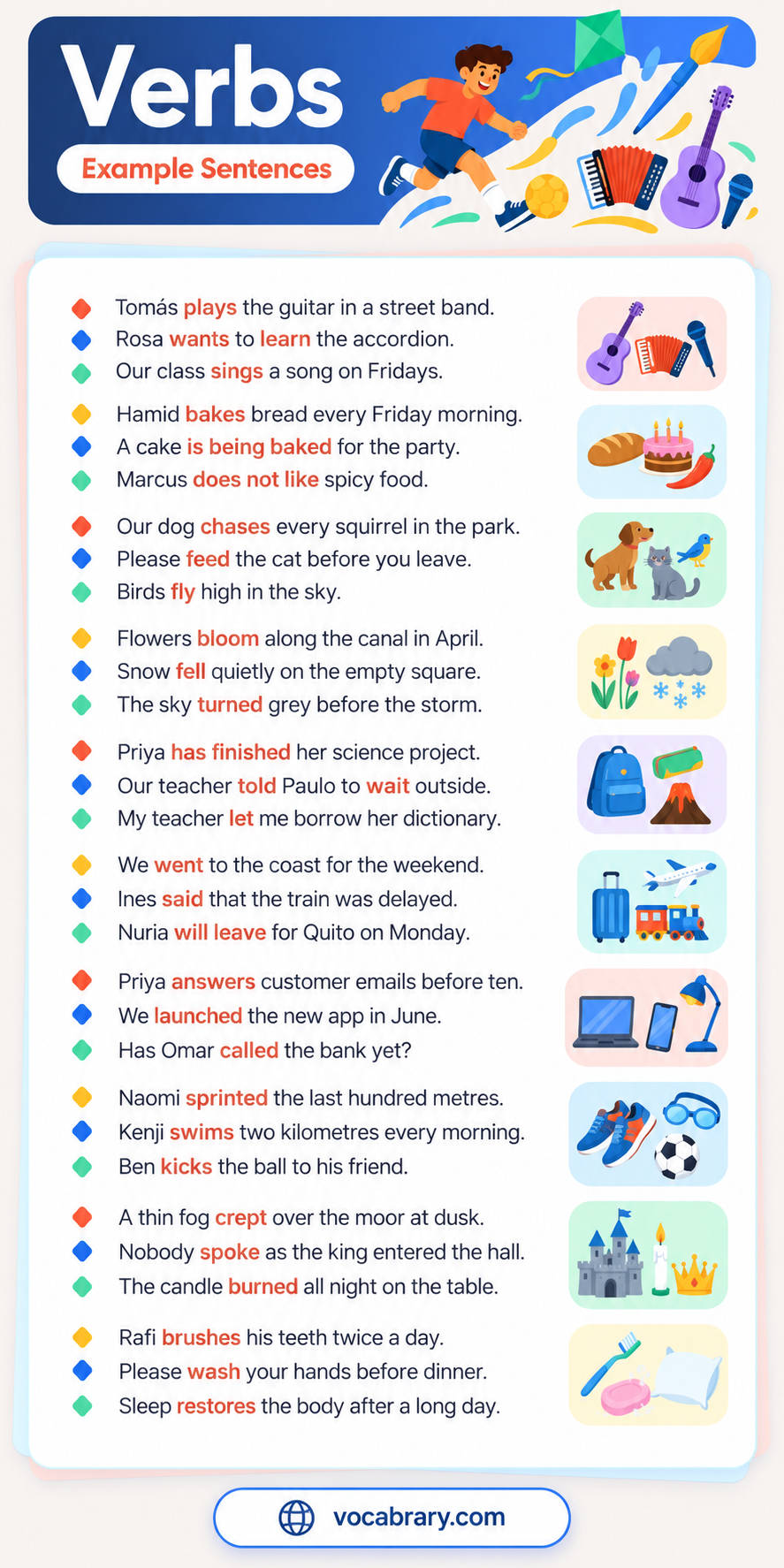
Verbs Example Sentences for Every Verb Type
Meaning, object, form, job in the verb phrase, special pattern, and finiteness are six ways to classify verbs, and one verb belongs to several groups at once. The verb paint is an action verb by meaning, a transitive verb by object, and a regular verb by form.
| Basis of classification | Verb types | Example sentence |
|---|---|---|
| Meaning | Action, linking, and stative verbs | Ada runs daily, the tea tastes bitter, and Pavel owns a bakery. |
| Object | Transitive and intransitive verbs | The tailor shortened the trousers, and the guests arrived. |
| Form | Regular and irregular verbs | Freya jumped the stream and swam the lake. |
| Job in the verb phrase | Main verbs and helping verbs, including modal verbs | The pupils have finished, and Tobias must leave. |
| Special pattern | Causative, perception, and reporting verbs | Mum had the carpet cleaned, we heard the siren, and Idris admitted the mistake. |
| Finiteness | Finite and non-finite verbs | Nia decided to sell her bicycle. |
Modal verbs such as must, should, and would form a separate set of helping verbs and have their own page at modal verbs.
Sentences With Everyday Verbs
Walking to school, cooking dinner, feeling tired and having lunch are everyday verbs. Each one names an action or a state of the subject in front of it.
- Mina paints the fence every spring before the festival.
- The bus leaves the station at eight o’clock.
- Our neighbours grow tomatoes on the balcony.
- Karim walks to school with his younger sister.
- Grandma cooks rice and lentils for the whole family on Sundays.
- Ingrid feels tired after the long flight from Oslo.
- We have lunch in the garden when the weather is warm.
- The river flows past the old mill and into the lake.
- Tomás plays the guitar in a street band.
- Priya has finished her science project.
- Rain fell all night, and the streets were flooded by morning.
- My cousin works in a hospital in Nairobi.
- The baby laughed when the dog sneezed.
- Hana is the captain of the netball team.
- Two students were discussing the poem in the corridor.
- The shop sells fresh bread and olives.
- Yusuf will visit his uncle in Cairo next month.
- Lightning struck the old oak tree behind the church.
Action Verbs in a Sentence
Kicking a ball, slamming a door, whispering a secret and stirring soup are action verbs. This type names something a subject does, whether physical, as in kicking, or mental, as in deciding.
- Leila kicked the stone across the dry riverbed.
- The wind slammed the kitchen door shut.
- Oscar whispered the answer to his neighbour.
- Chef Daniela stirs the soup slowly while the onions soften.
- The toddler climbed onto the sofa and jumped off again.
- Ahmed decided to apply for the scholarship.
- Birds migrate south before the first frost.
- The goalkeeper dived to his left and saved the penalty.
- Wanjiru sketches the harbour from the hilltop.
- Our dog chases every squirrel in the park.
- The council approved the plan for a cycle lane on Thursday.
- Mei solved the riddle in under a minute.
An action verb names what a subject does, while a linking verb names no deed and joins the subject to a word that describes it, as in Mina is calm.
Linking Verb Example Sentences
Soup that tastes salty, a teacher who is patient and a sky that turns grey show linking verbs joining a subject to a word that describes it. Be, become, seem, and the sense verbs do this job.
- The soup tastes too salty for my grandfather.
- Ms Okafor is a patient and generous teacher.
- The sky turned grey before the storm.
- Rafael became a pilot after ten years in the air force.
- That song sounds familiar, but I do not recall the singer.
- The children seem nervous about the first day of school.
- Your new haircut looks wonderful on you.
- The milk went sour in the heat.
- Nadia remained calm throughout the long interview.
- This scarf feels soft against my skin.
- The twins grew taller every summer.
- Everyone stayed quiet while the results were read.
A linking verb differs from an action verb in the work it does, so the soup tastes salty describes the soup, while Mina tastes the soup names an act.
Helping Verb Sentences With Is and Will
Is running, has finished, did not call and will arrive show a helping verb in front of a main verb, forming a tense, a question, or a negative. These helping verbs include the modals, which have their own page at modal verbs.
- Tariq is running in the city marathon on Sunday.
- Dalia has finished her essay on Mozart.
- Lucia did not call her landlord about the leak.
- The delegates will arrive at the hotel before midnight.
- Does Vikram drive to work every day?
- The students were waiting outside the library when it opened.
- My parents had left before the storm began.
- Has the morning post come yet?
- We are going to repaint the hallway in blue.
- Kofi should call his grandmother tonight.
- This chapel was built by monks in the twelfth century.
- Maria would help if she had the time.
A helping verb adds tense, voice, or mood to a main verb, and the main verb expresses the meaning, as in has finished, where has is the helping verb and finished is the main verb.
Transitive Verbs in a Sentence
Baking bread, writing a letter, carrying a suitcase and painting a wall need a direct object, so they are transitive verbs. The object answers the question what or whom after the verb.
- Hamid bakes bread every Friday morning.
- The poet wrote a letter to her publisher.
- Zainab carried the sleeping toddler up the narrow staircase.
- Our neighbours painted the garden wall bright yellow.
- The lawyer read the contract carefully.
- Tomás found a wallet on the number nine bus.
- The council repaired the bridge last winter.
- Sana loves her grandmother’s recipes for lentil soup.
- The technician replaced the cracked screen.
- My teacher praised the whole class after the exam.
- Dmitri borrowed a ladder from his brother-in-law.
- Volunteers planted two hundred trees along the river.
A transitive verb needs a direct object to complete its meaning, while an intransitive verb forms a complete clause without one, as in the baby slept.
Intransitive Verb Sentences With No Object
A puppy that slept, a man who smiled, snow that fell and a train that arrives show intransitive verbs, verbs that form a complete clause with no direct object. A prepositional phrase after the verb adds place or time and is not an object.
- The puppy slept beside the warm radiator.
- Snow fell quietly on the empty square.
- Mr Chen smiled at the shy new student.
- Our train arrives at platform four.
- The old man coughed twice and left the room.
- Fatima waited outside the clinic for an hour.
- Flowers bloom along the canal in April.
- The audience laughed loudly at the joke.
- The candle burned all night on the table.
- Isabel travels to Lima every winter.
- A strange noise came from the attic.
- The ice on the pond melted by noon.
An intransitive verb differs from a transitive verb because no direct object follows it, so the snow melted is complete while the sun melted the snow names an object.
Went and Ate in Irregular Verb Sentences
Went, ate, wrote, bought and spoke are irregular verbs, verbs whose past tense or past participle does not end in -ed. Each form must be learned one verb at a time.
- We went to the coast for the weekend.
- Rosa ate the last slice of lemon cake.
- The author has written twelve novels since 2010.
- Kwame bought a second-hand bicycle from a neighbour.
- Ingrid spoke to the manager about the delay.
- The glass fell off the shelf and broke into pieces.
- Rahul has never flown in a helicopter.
- The children swam across the lake before breakfast.
- Our team has chosen a new captain.
- Yara drove her mother to the airport at dawn.
- Someone has stolen the bell from the church tower.
- The river froze during the coldest week of January.
An irregular verb differs from a regular verb in its past forms, so walk gives walked while go gives went and gone.
Walked and Painted in Regular Verb Sentences
Walked, painted, studied and stopped are regular verbs, verbs that form the past tense and past participle by adding -ed, -d, or -ied. Spelling changes such as the doubled p in stopped follow set patterns.
- We walked along the river until sunset.
- Leon repainted the garage door on a sunny weekend.
- Amira studied marine biology on the coast of South Africa.
- Our minibus stopped beside the petrol station.
- Our neighbours have lived in this street for thirty years.
- Chidi laughed so hard that he dropped his pen.
- The workers have cleaned every classroom in the building.
- Anya planned the surprise party for two weeks.
- Grandpa tried the new recipe and loved it.
- The shop opened early for the holiday crowd.
- Hiroshi has watched that documentary three times.
- Inès carried the groceries up the hill.
A regular verb adds -ed in the past tense and past participle, whereas an irregular verb changes its stem or keeps one form.
Stative Verbs With Know and Own in Sentences
Knowing a password, owning a bicycle shop, loving music and needing a second coat of paint are stative verbs, verbs that describe a state rather than an action. Most of them are not used in continuous tenses, so I know is correct and I am knowing is not.
- Dina knows the password to the shared folder.
- My uncle owns a small bicycle shop in Hanoi.
- Both of my sisters love classical music.
- The bedroom walls need a second coat of paint.
- Pedro believes that the experiment will succeed.
- Your suitcase weighs twenty-two kilos at the airport.
- I understand the question, but I need more time.
- The soup contains peanuts, so Ali cannot eat it.
- The vineyard on the hill belongs to Señora Ruiz.
- Nora hates the noise of the vacuum cleaner.
- This jacket costs more than I expected.
- Our cottage has a stone fireplace and a sunny porch.
A stative verb describes a state, so Dina knows the password reports a condition, while an action verb as in Dina typed the password reports an act.
Causative Verb Sentences With Make and Let
Making a child tidy a room, letting guests park in a courtyard, having a car repaired and getting a roof fixed are causative verbs at work. The subject causes another person to act or causes an action to be done.
- Her mother made Selin tidy the room before dinner.
- The landlord let us park in the courtyard.
- Omar had his car repaired at the garage on Mill Road.
- We got the roof fixed before the rains began.
- Her father made her wear a helmet on the bicycle.
- Marta had the tailor shorten her dress.
- My teacher let me borrow her dictionary.
- Mr Ito got his nephew to translate the letter.
- The film made everyone in the cinema cry.
- Sipho had his photograph taken at the studio.
- Please let the soup cool before you serve it.
- Dad had the plumber check the boiler.
A causative verb makes the object perform or receive a second action, as in made Selin tidy, while an ordinary transitive verb acts on the object alone.
Perception Verb Sentences With See and Hear
Seeing a plane, hearing a bell, smelling smoke and feeling a vibration are verbs of perception, verbs that report what the senses detect. Many of them also take an object plus a bare verb or an -ing form, as in I saw him leave and I saw him leaving.
- Ravi saw a plane cross the evening sky.
- We heard the church bell ringing across the valley.
- Hana smelled smoke and called the fire brigade.
- Leo felt the floor shake during the earthquake.
- Nobody noticed the thief leave through the back door.
- Tess watched the children build a sandcastle.
- I heard her sing in the shower this morning.
- The guard observed two men entering the warehouse.
- Zodwa tasted the sauce and added more salt.
- Did you see him leave the building?
- Mina listened to the rain tapping on the window.
- We spotted a fox crossing the road at dusk.
A verb of perception reports what the senses detect, as in I heard him leave, while a reporting verb passes on what a speaker said, as in he said he would leave.
Reporting Verb Example Sentences
Said, asked, explained, promised and warned are reporting verbs, verbs that pass on what a speaker stated. Each takes its own pattern, so promised to come and explained that are not interchangeable.
- Ines said that the train was delayed.
- The officer asked whether we had seen the car.
- Mr Das explained that the museum closed at five.
- Kemal promised to return the book on Monday.
- The lifeguard warned the swimmers not to go past the red flag.
- Clara suggested taking the earlier bus.
- My brother admitted breaking the vase.
- Dr Mensah advised her patients to drink more water.
- The pilot announced that the flight would land at noon.
- Lena denied taking the keys from the desk.
- The teacher reminded us to hand in the forms.
- Joon mentioned that his sister lives in Busan.
A reporting verb passes on speech or thought, while a verb of perception reports a sound, a sight, or another sensation, so she warned us differs from she saw us.
Sentences With the Five Verb Forms
Walk, walked, walked, walking, and walks are the five forms of a regular verb, and an irregular verb such as go adds the separate forms went and gone. Each form is used in a different position in a sentence.
Base Form Sentences With Open and Learn
Open, learn, drive, and eat are base forms, the dictionary form of a verb with no ending. A base form follows to, a modal verb, or the helper do, opens a command, and is the present form for I, you, we, and they.
- Please open the window before the guests arrive.
- Rosa wants to learn the accordion.
- Tariq will drive us to the harbour tomorrow.
- I do not eat meat on Fridays.
- Why did the lights go out at midnight?
- Students must bring a pencil to the exam.
- My sisters swim every Saturday morning.
- Let the dough rest for an hour.
- Neighbours meet at the café on Thursdays.
Sold and Rang as Past Tense Forms
Sold, rang, wrote, and visited are past tense forms that report a finished event. A regular verb adds -ed, and an irregular verb changes its stem.
- Our grandparents sold their farm in 1998.
- The telephone rang twice and then stopped.
- Behrouz wrote to the embassy about his visa.
- Yesterday the class visited a glass factory.
- She forgot her scarf on the tram.
- The farmers harvested the wheat early this year.
- A cold wind blew across the empty beach.
- Kenji taught English in Seoul for six years.
- The river rose after three days of rain.
Past Participle Sentences With Eaten and Signed
Eaten, finished, chosen, and signed are past participles, the form that follows have in a perfect tense and be in a passive. Regular verbs share one form for the past and the participle, while many irregular verbs do not.
- We have eaten all the plums from the garden.
- The package has arrived at the depot.
- Nobody had seen the comet before midnight.
- The contract was signed by both directors.
- Have you finished the crossword in today’s paper?
- Lina has chosen a blue cover for the album.
- The cathedral was destroyed in a fire and later rebuilt.
- By noon the students had written four pages.
- Amir has already spoken to the landlord.
- These tomatoes were grown without chemicals.
Building and Reading in -ing Form Sentences
Building, shining, reading, and flying are -ing forms, the present participle. It follows a form of be in a continuous tense and also works as a gerund or an adjective.
- The children are building a raft from old planks.
- Sunlight was shining through the cracked blinds.
- I was reading on the balcony when it started to hail.
- Is the kettle boiling yet, or should I wait?
- Dara will be flying to Accra on Wednesday night.
- Two firefighters were climbing the ladder when the wall collapsed.
- We have been waiting since half past nine.
- Birds were singing in the hedge outside my window.
Watches and Carries as -s Forms
Watches, carries, passes, and buzzes are -s forms, the present tense form for he, she, it, and singular nouns. Verbs ending in s, sh, ch, x, z, or a consonant plus o add -es, and a final consonant plus y becomes -ies.
- Leo watches the early news with his coffee.
- The baker carries trays of rolls to the front counter.
- Our printer jams whenever the paper is damp.
- She studies in the library on weekday evenings.
- My uncle fixes bicycles behind his shop.
- The alarm buzzes at half past five every morning.
- A good teacher encourages every pupil.
- Mum goes to the market on Saturdays.
- This train passes through six tunnels before Lyon.
Finite and Non-Finite Verbs in Sentences
A finite verb such as arrives or will leave shows tense and has its own subject. A non-finite verb such as to arrive, arriving, or arrived shows no tense and depends on a finite verb. A full clause needs one finite verb.
Finite Verb Sentences With Arrives and Will Leave
Arrives, were waiting, will leave, and bought are finite verbs, verbs that show tense and have a subject of their own. Commands also use a finite verb, although the subject is understood.
- The ferry arrives at half past four.
- Both goalkeepers were waiting for the whistle.
- Nuria will leave for Quito on Monday.
- Our neighbours bought a caravan last summer.
- The soup in the pot smells wonderful.
- Why did the engine stall on the hill?
- If it rains, the match moves indoors.
- Hand me the torch from the cupboard, please.
Non-Finite Verb Phrases With Infinitives and Participles
To study, swimming, wearing, locked, and having finished are non-finite verbs: infinitives, gerunds, and participles that show no tense of their own and depend on a finite verb in the same sentence.
- Mei hopes to study medicine in Edinburgh.
- Swimming in the lake is forbidden after dark.
- The man wearing the green cap is my uncle.
- Locked out of the flat, Ravi called his brother.
- Rather than wait, Jomo walked home.
- The students were told to read chapter four.
- Having finished the report, Alma left the office.
- I saw the dog jump over the gate.
- Cooking for twelve people takes hours.
- My aim is to win the regional final.
Sentences by Verb Position
Three common verb positions are directly after the subject, at the start of a command, and inside a verb phrase with helpers. The first suits a statement, the second a command, and the third a compound tense.
Verbs After the Subject in Sentences
Birds singing, a committee voting and a bakery closing show the verb directly after its subject. This order is the normal pattern for an English statement.
- Birds sing loudly outside my window at dawn.
- The committee voted after a short debate.
- Our bakery closes at six on weekdays.
- Aisha teaches mathematics at a secondary school in Leeds.
- The twins ran across the car park in the rain.
- Mount Kenya rises above the surrounding plains.
- My phone rings whenever I start a meeting.
- The orchestra tuned its instruments before the concert.
- Santiago repairs antique watches in a tiny shop on Calle Luna.
- The two cousins met at a wedding in Delhi.
Command Sentences Starting With a Verb
Close the window, pass the bread and turn left are commands that begin with the base form of the verb. The subject you is understood but not spoken.
- Close the window before you leave.
- Pass the bread basket to your cousin, please.
- Wait here until the guide arrives.
- Turn left at the second traffic light.
- Please wash your hands before dinner.
- Bring your passport to the interview.
- Never leave a candle burning in an empty room.
- Sit down and open your notebooks.
- Don’t touch the wet paint on the fence.
- Call me when you reach the station.
Verb Phrase Sentences With Helping Verbs
Has been waiting, will be arriving and should have called contain helping verbs in front of the main verb. The main verb comes last in the phrase.
- Dara has been waiting at the bus stop since seven.
- The guests will be arriving around eight.
- Someone should have called the plumber yesterday.
- The soup is being prepared in the kitchen.
- Layla must have left her umbrella on the train.
- We had been working for hours when the power failed.
- The bridge will have been repaired by next summer.
- Pablo could have won the race with a better start.
- They are not going to cancel the festival.
- Nobody has been answering the office phone this morning.
Tense Sentences by Time Frame
Yesterday’s storm, today’s routine and next week’s flight show the three time frames that a verb marks. Tense, together with helping verbs such as will, places an action in the past, the present, or the future.
Past Tense Sentences With Destroyed and Lost
Storms that destroyed greenhouses, phones lost on a ferry and detectives who found footprints describe finished events. Regular verbs end in -ed, and irregular verbs change form.
- The storm destroyed two greenhouses on Tuesday night.
- Wei lost his phone on the ferry to Hong Kong.
- When I was a child, we visited Grandpa every Sunday.
- The mayor opened the footbridge last autumn.
- Our flight landed an hour late.
- Beatriz cooked a feast for forty guests.
- The detective found muddy footprints beside the window.
- We were studying when the lights went out.
- Elif had already left when the call came.
- Nobody knew where the missing key had gone.
Present Tense Sentences With Brushes and Melts
Brushing teeth twice a day, ice melting at zero degrees and a train leaving at nine forty use the present tense for habits, facts, and timetables. The continuous present adds an action in progress.
- Rafi brushes his teeth twice a day.
- Ice melts at zero degrees Celsius.
- The train to Lyon leaves at nine forty.
- Sunita is writing a letter to her pen friend in Kenya.
- Our neighbours are repainting their fence this week.
- The moon rises later each evening.
- I live in a small town near the Black Sea.
- Why is the baby crying so loudly?
- The museum offers free entry on Fridays.
- Emre practises the violin for an hour every evening.
Future Tense Sentences With Will and Is Going to
A shop that will open tomorrow, a student who is going to study architecture and a meeting arranged for six use three different future forms. A speaker uses will for a prediction or decision, going to for a plan, and the present continuous for an arrangement.
- The shop will open at nine tomorrow.
- Chiara is going to study architecture in Milan.
- We are meeting my cousin at the station at six.
- The new bridge will connect the two villages.
- I will phone the clinic when the office opens.
- Dr Singh will be speaking at the conference next Thursday.
- By Friday, the builders will have finished the roof.
- It is going to rain before the match ends.
- Our class leaves for the museum at ten tomorrow.
- Tonight Nia will cook dinner for her parents.
Sentences by Verb Function in the Predicate
A verb is the main word of the predicate, the part of a clause that states what the subject does or is. Verb patterns with objects and complements, and verbs in main and subordinate clauses, show the main functions of a verb.
Sentences With Objects and Complements After the Verb
A flickering candle, a baker making biscuits, a garden turning into a swamp, and a council giving a trophy show a verb with no complement, a direct object, a subject complement, and two objects. A fifth pattern adds a complement that describes the object.
- The candle on the windowsill flickered for a moment.
- Nilufar bakes almond biscuits for the market stall.
- The garden became a muddy swamp after the storm.
- The council gave the winners a silver trophy.
- Voters elected Kamal chairman of the club.
- The children named the puppy Biscuit.
- The audience found the speech moving.
- The clerk handed me a receipt.
- Mr Obi sent his daughter a postcard from Dakar.
- Cold rain fell on the hills all afternoon.
Main and Subordinate Clause Sentences With Verbs
In Although it rained, the match continued, the verb continued stands in the main clause and the verb rained stands in a subordinate clause that depends on it. Each clause has its own finite verb.
- Because the road flooded, the bus took another route.
- Lara said that she wanted a quieter flat.
- When the siren sounded, the workers left the factory.
- The man who repaired my bike refused any payment.
- If you heat ice, it melts.
- We stayed inside until the storm passed.
- Since Omar moved to Quito, he has learned Spanish.
- I know where you hid the chocolate.
- She walks faster than her brother does.
Subject-Verb Agreement Example Sentences
A singular subject takes is and has, a plural subject takes are and have, and the verb agrees with the head noun of the subject. A noun placed between the subject and the verb does not change the form, but after neither…nor and either…or the verb agrees with the nearer subject.
- The list of ingredients is printed on the back of the packet.
- Two dogs in the next street bark all night.
- Neither the clerks nor the manager was aware of the error.
- There are three exits at the back of the hall.
- There is a spare key under the mat.
- Everybody in the choir sings from memory.
- Mathematics is my brother’s favourite subject.
- My friends and my sister are joining us for dinner.
- The boy with the red balloons runs toward the gate.
- A box of old photographs was hidden in the attic.
- Every window in the old school needs repair.
- The kitchen scissors are hanging on a hook by the stove.
- Ten kilometres is a long way to cycle in this heat.
- Either you or Pia has the tickets.
- News from the village travels quickly.
- My brother, along with his friends, plays football on Sundays.
Negative Sentences With Does Not and Did Not
Does not like, did not arrive, has not replied and will not stay show not after a helping verb. Do, does, and did are the helper for most main verbs, while be and the modals take not directly.
- Marcus does not like spicy food.
- The parcel did not arrive on Monday.
- Sana has not replied to my message yet.
- We will not stay for the second half.
- My brothers do not play football on weekdays.
- The pool is not open to visitors in winter.
- Elena can’t find her glasses anywhere.
- They weren’t expecting visitors this early.
- I haven’t seen that film, but I have read the book.
- The printer doesn’t work without the new cartridge.
- Don’t forget your ticket for the match.
- Kwesi never eats breakfast before nine.
- Our teacher does not give extra homework on Fridays.
- You should not touch the wires with wet hands.
- Ayaan didn’t want to leave the party.
Question Sentences With Do and Has
Do you take the bus, has Omar called and where did they park show a helping verb moving in front of the subject. A question word such as where opens the clause, and the helper follows it. A question with who as its subject, such as who spilled juice, keeps statement order.
- Do you take the bus to work?
- Has Omar called the bank yet?
- Where did they park the van?
- Is Lucia coming to the wedding?
- What does this long word mean?
- Will the museum be open on Monday?
- Who spilled juice on the library carpet?
- How long have you studied Korean?
- Were the tickets for the concert expensive?
- Can Ayo swim across the lake?
- Why did the match end so early?
- Did the electrician replace the switch?
- Which tram goes to the old town?
- Are you waiting for someone at the gate?
Reported Speech and Passive Sentences With Verbs
After a past reporting verb, the verb in reported speech shifts into an earlier tense unless the statement is still true, and in a passive sentence the object of an action becomes the subject. Both patterns change the verb form while keeping the original meaning.
Reported Speech Sentences With Said and Asked
Said that she was tired, asked if we were ready and asked where I had bought the lamp show the verb moving into an earlier tense in reported speech. The reporting verb comes first, and the reported clause follows it.
- Nisha said that she was tired after the journey.
- The guide asked if we were ready for the climb.
- Our teacher told Paulo to wait outside.
- Mum said she had cooked enough rice for everyone.
- Hiro told us that the shop would close at nine.
- The doctor asked whether Selma had taken the medicine.
- Ali said he could meet us at the station.
- The manager explained that the system had crashed overnight.
- Rosa told me she was leaving for Lisbon the next day.
- The neighbours said that the road was closed because of the flood.
- Dimitri asked me where I had bought the lamp.
- The announcer said that the final had been postponed.
Passive Sentences With Was Built and Was Sent
The lighthouse was built, the letter was sent and a cake is being baked show passive verbs, where the subject receives the action. The verb phrase is a form of be plus a past participle.
- The lighthouse was built by sailors from Cornwall.
- The letter was sent to the wrong address.
- A cake is being baked for the party.
- The windows are cleaned every Friday.
- Three people were rescued from the flooded cellar.
- The match has been cancelled because of the storm.
- Her novel will be translated into twelve languages.
- The old theatre was demolished last year.
- Portuguese is spoken in Brazil, Angola, and Mozambique.
- The runaway horse was caught by two farmers.
- Dinner will be served at seven.
- These paintings were not damaged in the fire.
Everyday Context Sentences With Verbs
Home chores, school lessons, office tasks, journeys, news reports, stories, matches, and clinic visits each use a different set of verbs. A kitchen scene uses washing and stirring, while a clinic scene uses checking and bandaging.
Household Chore Sentences With Wash and Fold
Washing dishes, folding laundry, feeding the cat and fixing a tap are verbs of a household day. These verbs name chores.
- Dad washes the dishes while Mum dries them.
- Sofia folds the laundry and puts it in the wardrobe.
- Please feed the cat before you leave.
- My brother fixed the leaking tap with a new washer.
- The kettle whistles when the water boils.
- Grandmother sweeps the porch every morning.
- We hang the washing outside when the sun shines.
- Lamar waters the plants on the windowsill.
- The baby naps in her cot after lunch.
- Somebody left the fridge door open again.
Raise and Explain in School Sentences
Raising hands, explaining an equation, borrowing library books and presenting a project are verbs of a school day. Teachers and pupils use them in instructions as well as in reports.
- Pupils raise their hands before they answer.
- Mrs Adeyemi explains the equation on the whiteboard.
- Jonas borrowed two books from the school library.
- The class presented their science project to the headteacher.
- Please copy the homework from the board.
- Our teacher collects the worksheets at the end of the lesson.
- Emi practises her spelling on the bus.
- The bell rings at ten past three.
- Students revise for the maths test every evening this week.
- Cleo forgot her pencil case again.
Sentences About Office Tasks With Answer and Sign
Answering emails, signing contracts, hiring engineers and attending meetings are verbs found in an office. These verbs name tasks that a worker performs.
- Priya answers customer emails before ten.
- The director signed the contract on Friday.
- Our firm hires two engineers every autumn.
- Ahmed attends a team meeting at nine every Monday.
- The accountant prepares the tax forms in March.
- Zoe manages a team of twelve nurses.
- The supplier delivered the parts a day early.
- We launched the new app in June.
- The cashier counts the money at closing time.
- Mr Park negotiated a better price for the equipment.
Book and Board in Travel Sentences
Booking tickets, boarding a ferry, packing a suitcase and crossing a border describe a trip from start to finish. Travel verbs name movements and arrangements.
- Lucas booked two tickets to Madrid.
- The passengers boarded the ferry at noon.
- Aiko packs her suitcase the night before every trip.
- The convoy crossed the border before sunrise.
- The night ferry departs from the northern pier.
- Our guide showed us the ruins of the old fort.
- Tourists queue outside the museum on Saturdays.
- My old passport expires in March.
- The pilot landed the helicopter on a narrow mountain ledge.
- Camila rented a car at the airport.
News Report Sentences With Announce and Elect
Officials announcing a plan, a heatwave hitting a region, voters electing a mayor and police arresting suspects appear in a news report. Each of these verbs is in the past tense because the events are finished.
- Officials announced a new plan for public transport.
- A heatwave hit southern Europe in August.
- Voters elected a new mayor on Sunday.
- The company reported record profits for the third quarter.
- Police arrested two men in connection with the robbery.
- Divers discovered a Roman shipwreck off the coast of Sicily.
- The government raised taxes on cigarettes.
- Thousands of people gathered in the square to protest.
- The minister resigned after the scandal.
- Rescuers pulled the hikers from the ravine.
Gazed and Crossed in Story Sentences
A sailor who gazes across the water, a knight who draws a map in the sand and a stranger who knocks at midnight belong to storytelling. These verbs describe movement and sound in a story.
- The old sailor gazed across the grey water and sighed.
- Elizabeth crossed the muddy field to reach her sister.
- A thin fog crept over the moor at dusk.
- The knight drew a map in the sand and marked the cave.
- Rain drummed on the roof while the old woman told her story.
- The stranger knocked at midnight, and nobody answered.
- The captain vanished into the mist with his lantern.
- Anna whispered her secret to the sleeping child.
- Nobody spoke as the king entered the hall.
- The orphan ran through the village and never looked back.
Match Report Sentences With Score and Sprint
Strikers scoring, sprinters racing, goalkeepers blocking and referees blowing whistles are verbs of a match report. These verbs name quick physical actions in a match.
- The winger scored a brilliant goal after the interval.
- Naomi sprinted the last hundred metres.
- Our goalkeeper blocked the penalty with his foot.
- The cyclists climbed the mountain in heavy rain.
- Serena serves with great power and accuracy.
- The rowers trained in the rain before the final.
- The umpire blew her whistle and stopped the game.
- Kenji swims two kilometres every morning.
- The crowd cheered when the home team equalised.
- Dev throws the javelin further than anyone in the club.
Sentences About Health With Check and Improve
A doctor who checks blood pressure, a nurse who bandages a cut and a vaccine that protects children belong to a clinic. Health sentences mix action verbs with stative verbs such as feel and ache.
- Dr Banerjee checks the patient’s blood pressure.
- Walking every day improves heart health.
- The nurse bandaged the cut and gave him a lollipop.
- I feel much better after the rest.
- Sleep restores the body after a long day.
- Ayesha takes her medicine after breakfast.
- The dentist removed the tooth without pain.
- Doctors recommend at least thirty minutes of exercise a day.
- The vaccine protects children from measles.
- My knee aches when the weather turns cold.
Verbs Example Sentences for Kids
Dogs that bark, babies that giggle, frogs that hop and birds that fly are among the first verbs young children learn. Short sentences name actions that a child already knows.
- The dog barks at the postman.
- Sam jumps on the big bed.
- Birds fly high in the sky.
- I eat an apple every day.
- The baby giggles at the funny face.
- Mia draws a big red house.
- We play hopscotch in the yard at break.
- The cat sleeps on the warm rug.
- Grandma reads me a fairy tale before bed.
- The sun shines on the pond.
- Ben kicks the ball to his friend.
- Frogs hop from rock to rock.
- Our class sings a song on Fridays.
- Grandpa plants seeds in the garden.
Sentences for Students With Demonstrate and Argue
Researchers who collect data, critics who argue a point and a graph that illustrates a trend belong to exam writing. Students meet these academic verbs in essays, reports, and reading passages.
- The study demonstrates that regular sleep improves memory.
- Critics argue that the policy undermines local farmers.
- The author juxtaposes two characters to highlight the theme of loyalty.
- Researchers collected data from three hundred participants over two years.
- The graph illustrates a steady rise in energy consumption.
- Shakespeare portrays Macbeth as an ambitious but fragile leader.
- Candidates must submit their dissertations by the end of April.
- The committee would approve the proposal if the budget were reduced.
- Historians have debated the causes of the war for decades.
- The results suggest that the new method outperforms the old one.
- Having reviewed the evidence, the panel reached a unanimous decision.
- The essay concludes that economic growth depends on education.
- If the temperature rises, the reaction speeds up.
- Students should cite every source they use.
Short Verb Sentences for Young Learners
Birds that sing, children who run to a gate and a boy who hugs a teddy bear appear in sentences of six or seven words. Beginners copy lines like these before they meet longer clauses.
- Little birds sing sweetly every morning.
- Please sit down on the red chair.
- We run to the gate together.
- The big yellow bus stops here.
- Tom opens the door for his dad.
- I like my new blue shoes.
- Look! The cat climbs the tall tree.
- She drinks milk with her cake.
- My fish swims in a round bowl.
- Let us clap our hands together.
- Rain falls on the green leaves.
- The little boy hugs his teddy bear.
Verbs in Short Paragraphs
A market seller who wakes early, a family that drives to a lake and a baker who knows every customer show verbs in connected writing. The short texts combine action, linking, and stative verbs.
Amara wakes at six, makes tea, and reads the news on her phone. She leaves the house at seven and catches the bus to the market. There she sells fruit until noon. After lunch she counts the money and walks home. Last Saturday we drove to the lake. Dad parked under a tree, and my sister opened the picnic basket. We ate sandwiches, swam for an hour, and watched the sun go down. Everyone fell asleep in the car on the way home. Tomás has a small bakery in Valencia. He knows every customer by name, and he is always the first to arrive. Yesterday a stranger asked for a recipe, and Tomás gave it to him with a smile. The reporter asked the coach whether the team was ready. The coach said that every player had trained hard. He added that the injured striker would play the last twenty minutes. The crowd cheered when the announcer repeated his words. Next month Leyla is moving to Nairobi. She will teach art at an international school, and her sister is going to visit in June. Before she leaves, Leyla must pack twelve boxes and say goodbye to her friends.
Walk and Plan as Both Verbs and Nouns
A walk and to walk, a plan and to plan, and a record and to record share a spelling but not a job. A verb expresses an action, an event, or a state, while a noun names a person, place, or thing.
| Feature | Verb | Noun |
|---|---|---|
| Job in the sentence | Expresses an action, an event, or a state | Names a person, place, or thing |
| Question it answers | What does the subject do or what is it? | Who or what? |
| Form change | Tense: walk, walked, walking | Number: walk, walks |
| Modified by | Adverbs, as in walks quickly | Adjectives, as in a quick walk |
| Example with walk | Nadia walks to school. | Nadia took a walk after dinner. |
| Example with plan | They plan the trip together. | The plan is ready. |
| Example with record | Please record the lecture. | The record is on the shelf. |
FAQs
Q1. What are the main types of verbs in English?
The main types of verbs in English are action, linking, helping, transitive, intransitive, regular, irregular, stative, causative, perception, and reporting verbs. These types overlap, because one verb belongs to several groups at once. The verb paint is an action verb, a regular verb, and a transitive verb in Leon painted the fence.
Q2. What is the difference between an action verb and a linking verb?
An action verb and a linking verb differ in their job. An action verb names something the subject does, while a linking verb joins the subject to a word that describes or renames it. In Mina paints the fence, the verb paints names an action. In Mina is calm, the verb is links Mina to the adjective calm.
Q3. What is the difference between a transitive and an intransitive verb?
A transitive verb takes a direct object, while an intransitive verb forms a complete clause without one. Hamid bakes bread needs the object bread, and the baby slept needs no object at all. Several verbs, such as read, play, and open, work in both ways.
Q4. How do regular and irregular verbs differ in the past tense?
Regular and irregular verbs differ in how they form the past tense and the past participle. A regular verb adds -ed, as in walk, walked, walked, while an irregular verb changes in another way, as in go, went, gone, or keeps one form, as in put, put, put.
Q5. Which verbs are stative verbs?
Stative verbs are verbs that describe a state, such as knowing, owning, loving, needing, and belonging, instead of an action. They are not used in continuous tenses with these meanings, so I know the answer is correct and I am knowing the answer is not. A few of them, such as have and think, change meaning and then accept the continuous form, as in we are having lunch.
Q6. What do helping verbs do in a sentence?
Helping verbs form tenses, questions, negatives, and passives in front of a main verb. In Tariq is running, the helper is marks the continuous tense, and in Lucia did not call, the helper did builds the negative. Modal verbs such as should and must are a separate group of helpers.
Q7. Where does the verb go in an English sentence?
The verb goes directly after the subject in an English statement, as in The bakery closes at six. In a command, the verb opens the sentence, as in Close the window. In a question, the helping verb moves in front of the subject, as in Has Omar called?
Q8. How do you find the verb in a sentence?
You find the verb in a sentence by asking what the subject does or is, and the word that answers is the verb. A second test is to change the time of the sentence: the word that changes from walks to walked when you add yesterday is the verb.
Q9. What are causative verbs?
Causative verbs are verbs that show a subject causing another person to act or causing an action to be done. The main causative verbs are make, let, have, and get, as in her mother made Selin tidy the room and Omar had his car repaired. Make, let, and have take a bare infinitive after the object, while get takes to.
Q10. What are verbs of perception?
Verbs of perception are verbs that report what the senses detect, such as see, hear, smell, feel, taste, watch, notice, and listen. They take an object plus a bare verb or an -ing form, as in I heard her sing and I heard her singing. The -ing form shows an action in progress, while the bare verb reports a complete action.
Q11. What are reporting verbs?
Reporting verbs are verbs that pass on what a speaker said, asked, or thought. Common ones are say, tell, ask, explain, promise, warn, suggest, and admit. Each takes its own pattern, so she promised to call and she suggested calling are correct while she suggested to call is not.
Q12. Can a sentence have more than one verb?
A sentence has more than one verb when it contains more than one clause or more than one verb phrase. In Hana has finished her project and is waiting, two verb phrases are joined by and. A verb phrase such as has been waiting counts as one verb phrase even though it has three words.
Q13. Do all sentences need a verb?
A complete English sentence needs at least one verb in a form that shows tense or gives a command. Without a verb, a group of words such as the old house on the hill is a fragment, not a sentence. A command such as Wait here is complete because the verb wait is present, even though the subject you is understood.
Related
- Action Verbs Example Sentences
- Linking Verbs Example Sentences
- Helping Verbs Example Sentences
- Transitive Verbs Example Sentences
- Intransitive Verbs Example Sentences
- Irregular Verbs Example Sentences
- Regular Verbs Example Sentences
- Stative Verbs Example Sentences
- Causative Verbs Example Sentences
- Verbs of Perception Example Sentences
- Reporting Verb Examples
- Modal Verbs Example Sentences
- Parts of Speech Example Sentences
- Nouns Example Sentences
- Pronouns Example Sentences
- Adjectives Example Sentences
- Adverbs Example Sentences
- Prepositions Example Sentences
- Conjunctions Example Sentences
- Interjections Example Sentences

Leave a Comment