
An adjective is a part of speech that modifies a noun or a pronoun by stating its quality, quantity, or identity, as in a tall lighthouse. Although it modifies the noun, it need not stand beside it: narrow precedes the noun in a narrow street and follows a linking verb in the street is narrow. Adjectives example sentences trace that movement type by type, so each adjective appears before its noun, after a linking verb, or in both positions, as its type requires.
What Is an Adjective?
An adjective modifies a noun or a pronoun, and it answers which one, what kind, or how many. An adverb describes a verb, an adjective, or another adverb instead, so a quick reply uses an adjective while she replied quickly uses an adverb.
Adjective + noun, or linking verb + adjective
The old bridge is narrow, but it is safe.
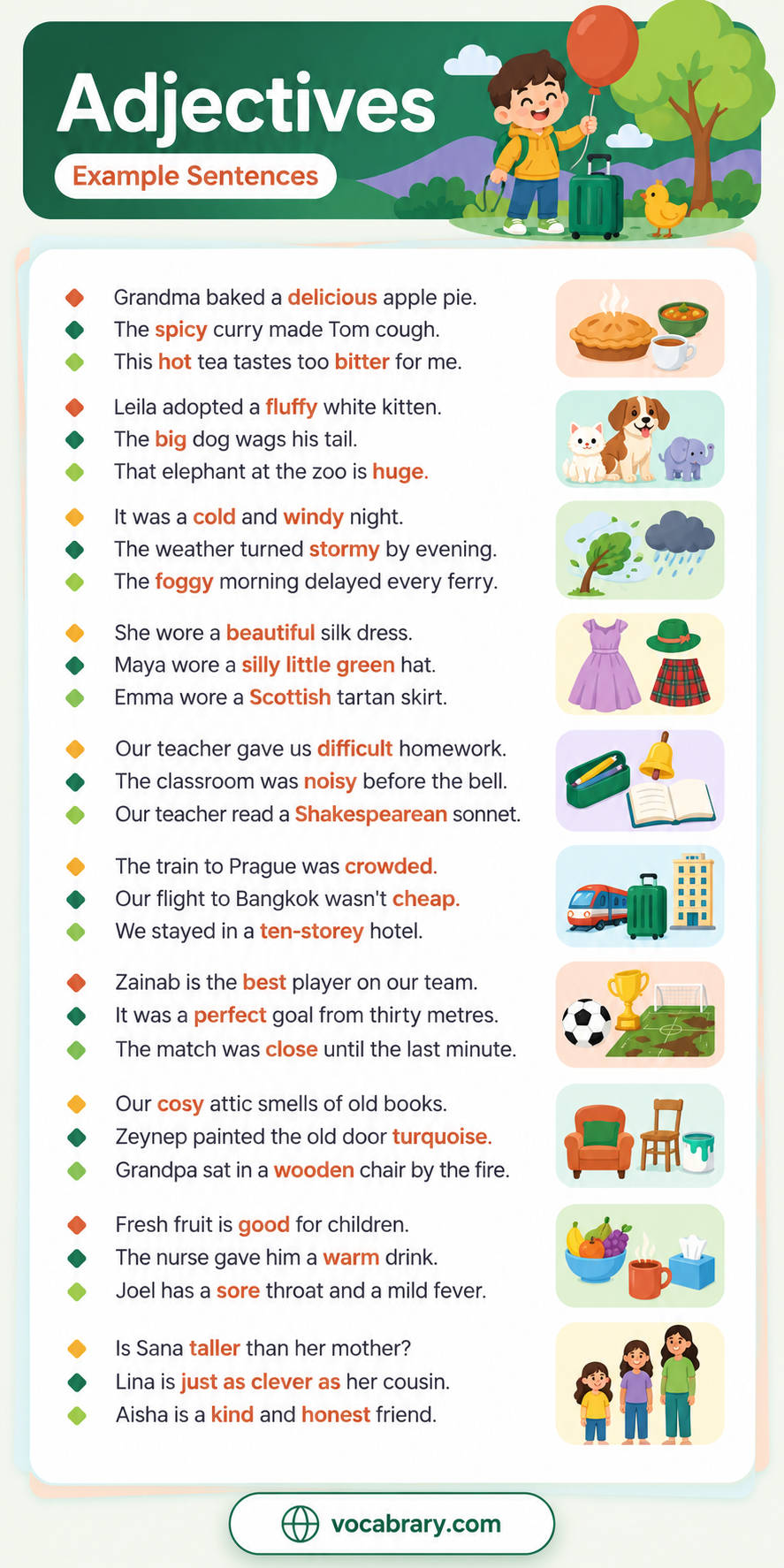
Adjectives Example Sentences by Type
Meaning, reference, degree, form, position, and sequence are six ways to classify adjectives, and one adjective belongs to several groups at once. The word broken is a participial adjective by form and a predicate adjective in the window is broken.
| Basis of classification | Adjective types | Example sentence |
|---|---|---|
| Meaning | Descriptive and proper adjectives | Peruvian potatoes are purple and knobbly. |
| Reference | Demonstrative and interrogative adjectives | Which road leads to that village? |
| Degree | Comparative, superlative, and as…as forms | The lake is deeper than the pond and as cold as a glacier. |
| Form | Compound and participial adjectives | A well-known painter exhibited a damaged canvas. |
| Position | Attributive and predicate adjectives | A tidy desk helps when the office is busy. |
| Sequence | Order of adjectives | Farah wore a long woollen scarf. |
Everyday Adjective Sentences About People and Places
Tall lighthouses, delicious pies, heavy bags and quiet streets are everyday adjectives. Each one gives the type or quality of the person, place, or object that the noun names.
- A tall lighthouse stands at the end of the pier.
- Grandma baked a delicious apple pie.
- The young girl carried a heavy bag.
- We rented a cramped flat above a bakery.
- Mr Alvarez wore a red scarf to the wedding.
- It was a cold and windy night.
- Aisha is a kind and honest friend.
- The modern clinic has spacious waiting rooms.
- Lagos is a busy city on the Atlantic coast.
- The soup in Mum’s kitchen smells wonderful.
- Tomás found an old coin in the garden.
- Our teacher gave us difficult homework.
- The narrow street was quiet after midnight.
- She wore a beautiful silk dress.
- A loud noise woke the baby.
- Hannah has curly brown hair and green eyes.
- The fresh bread was still warm.
- My brother is afraid of spiders.
- The strong wind blew the washing off the line.
- Zara wore a silver necklace to the party.
- This hot tea tastes too bitter for me.
- The thirsty travellers drank all the water.
- Omar planted fragrant herbs beside the sunny window.
- A generous neighbour left a basket of plums at our door.
Examples of Comparative Adjectives in Sentences
Taller than a brother, hotter than yesterday and better than a first essay are comparative adjectives, forms that compare two people, objects, or days. Most short adjectives add -er, long adjectives take more, and a few such as good and bad are irregular.
- Ravi is taller than his older brother.
- This phone is more expensive than the one in the window.
- Her second essay was better than her first.
- Today is hotter than yesterday in Madrid.
- The blue bag is heavier than the green one.
- Lisbon is warmer than London in March.
- Our new flat is bigger and brighter than the old one.
- Mathematics is more difficult for Sana than history.
- The train was faster than the bus, but the fare was higher.
- My sister is happier now than she was last year.
- That road is narrower than it looks on the map.
- This puzzle is less interesting than the last one.
- Yesterday’s lecture was worse than today’s.
A comparative adjective compares two items and takes than, while a superlative adjective ranks one item against the whole group and takes the, as in taller than and the tallest.
Superlative Adjectives Example Sentences
The tallest building, the best player, the worst harvest and the cheapest ticket are superlative adjectives, forms that place one item at the top of a group. Most short adjectives add -est, long adjectives take most, and a few such as good and bad are irregular.
- That is the tallest tree in the botanical garden.
- Zainab is the best player on our team.
- That was the worst harvest the village had known.
- Lena chose the cheapest ticket to Istanbul.
- The most beautiful beach on the island is at the north end.
- Denali is the highest peak in North America.
- Of all the cousins, Joseph is the funniest.
- It was the most thrilling concert of the summer.
- August is the hottest month in Seville.
- This is the least crowded beach on the coast.
- The longest river in Africa is the Nile.
- Ayaan gave the kindest speech at the wedding.
A superlative adjective ranks one item at the top or bottom of a group of three or more, whereas a comparative adjective sets two items against each other, as in the tallest and taller.
Sentences With Descriptive Adjectives
A rusty bicycle, a friendly waiter, a cloudy sky and a wooden chair are descriptive adjectives, the type that names a quality of the noun. They state how something looks, feels, tastes, or sounds.
- Nadia rode a rusty bicycle to the market.
- A friendly waiter brought our drinks.
- The cloudy sky promised rain for the weekend.
- Grandpa sat in a wooden chair by the fire.
- The spicy curry made Tom cough.
- Leila adopted a fluffy white kitten.
- A sleepy village lies at the foot of the mountain.
- The crowded platform smelled of coffee.
- Mr Kim has a gentle voice.
- The rocky shore stretched beyond the lighthouse.
- We watched a silent film from 1925.
- Oksana wore a bright green coat.
A descriptive adjective names a quality of the noun, whereas a demonstrative adjective identifies which noun is meant by its distance from the speaker.
This and That, These and Those in Sentences
This pen, that mountain, these cookies and those clouds are demonstrative adjectives, words placed before a noun to show which one by distance and number. This and that are singular, while these and those are plural.
- This pen is out of ink.
- That mountain looks closer than it is.
- These cookies are still warm from the oven.
- Those clouds are moving quickly toward the coast.
- Please carry this box to the kitchen.
- I like that song from the film.
- Who left these shoes in the hall?
- Those students won the science prize last year.
- Please read this sentence aloud to the class.
- We stayed at that hotel in 2019.
- These days, Mira cycles to work.
- Those apples are cheaper than these pears.
A demonstrative adjective stands before a noun, as in this pen is blue, while a demonstrative pronoun stands alone, as in this is mine.
Compound Adjective Sentences With Hyphens
A well-known author, a five-year-old girl, a long-distance runner and a sugar-free drink are compound adjectives, two or more words joined to describe one noun. A hyphen links them when they come before the noun.
- Chinua Achebe is a well-known author.
- Selin is a five-year-old girl who loves painting.
- A long-distance runner needs strong lungs.
- Mum bought a sugar-free drink for the picnic.
- We stayed in a ten-storey hotel.
- The high-speed train reaches Lyon in two hours.
- Ali drives a fuel-efficient car to the office.
- The little restaurant serves home-made pasta every evening.
- A part-time job helped Joy pay for college.
- That sun-dried tomato sauce tastes sweet.
- The old-fashioned clock still keeps perfect time.
- It was a last-minute decision by the committee.
A compound adjective joins words with a hyphen before the noun, as in a well-known author, while a participial adjective is a single word formed from a verb, as in a broken window.
Which, What and Whose Question Sentences
Which bus, what time and whose umbrella are interrogative adjectives, question words placed before a noun. Which is used for a choice, what for a kind, and whose for an owner.
- Which exit leads to the car park?
- What time does the concert begin?
- Whose scarf is hanging on the gate?
- Which colour do you prefer for the walls?
- What music does Hana play at weddings?
- Whose car blocked the driveway this morning?
- Which film did you watch last night?
- What subject does Pedro teach at the college?
- Whose idea was the surprise party?
- Which train should I take to Prague?
- What size shoes do you wear?
- Tell me which road leads to the lake.
An interrogative adjective stands before a noun and opens a question, as in which bus, while an interrogative pronoun stands alone, as in which is yours.
Proper Adjective Sentences With Italian and Japanese
Italian pasta, a Japanese garden, a Shakespearean sonnet and African drums are proper adjectives, adjectives formed from proper nouns. They keep a capital letter wherever they appear.
- Gina cooked Italian pasta for the whole class.
- We toured a Japanese garden in Kyoto.
- Our teacher read a Shakespearean sonnet.
- The African drums echoed through the hall.
- Mr Diaz drinks Colombian coffee every morning.
- The Victorian house on the corner is for sale.
- Aarav studies Indian classical dance in Chennai.
- A Brazilian football team visited our school.
- The Mexican festival fills the square with colour.
- Emma wore a Scottish tartan skirt.
- The Egyptian pyramids attract millions of visitors.
- Many Canadian families celebrate Thanksgiving in October.
A proper adjective such as Japanese comes from a proper noun and keeps a capital letter, whereas the proper noun Japan names the place itself.
Predicate Adjective Sentences With Be and Seem
A hot soup, tired children, fresh flowers and a calm lake become predicate adjectives when the adjective follows a linking verb and describes the subject, as in the soup is hot. The verb joins the two, and no noun comes after the adjective.
- The soup is hot, and the bread is fresh.
- The children seem tired after the long trip.
- These flowers from the market smell fresh.
- Karim grew nervous before the speech.
- The room became silent when the principal entered.
- My grandmother feels proud of every grandchild.
- That idea sounds reasonable to me.
- The lake looked calm at sunrise.
- Our neighbours are friendly and helpful.
- The students remained quiet during the exam.
- Rosa felt dizzy after the ride.
- The old bridge looks unsafe to everyone in the village.
- The fabric felt rough against his skin.
A predicate adjective follows a linking verb and describes the subject, as in the lake looked calm, while an attributive adjective stands before the noun, as in a calm lake.
Boring and Bored, Broken and Running in Sentences
A boring film, a bored audience, a broken window and a running tap are participial adjectives, adjectives formed from the -ing form or the past participle of a verb. In feeling pairs, the -ing form describes the cause, and the -ed form describes the person affected.
- The tiring climb left the tired hikers speechless.
- A cracked mirror hung in the hallway.
- Ana turned off the running tap.
- The encouraging results reached the lab on Friday.
- Rosa was excited about the trip to Kenya.
- A worried farmer counted his missing sheep.
- The shocking headline silenced the newsroom.
- Mr Lee bought a used laptop.
- The exhausted runners collapsed on the grass.
- We watched the setting sun from the balcony.
- That was an amazing performance by the young pianist.
- The locked door would not open.
- She felt confused by the confusing instructions.
A participial adjective describes a noun, as in a running tap, whereas the same -ing word in a verb phrase forms a tense, as in the tap is running.
Sentences With Several Adjectives Before One Noun
A lovely old wooden table, a big round red balloon and a small old blue van place several adjectives before one noun. The order of adjectives follows the sequence opinion, size, age, shape, colour, origin, material, and purpose.
- Ines inherited a charming old oak cupboard.
- Tom blew up a big round red balloon.
- The museum owns a beautiful ancient Greek vase.
- Dad drives a small old blue van.
- Maya wore a silly little green hat.
- We adopted a fluffy white Persian cat.
- A huge grey metal gate guarded the factory.
- I love my new leather running shoes.
- The tourists admired a tall modern glass tower.
- Kofi found a tiny old brass key in the drawer.
- She carried a heavy square wooden box.
- Grandma knitted a warm woollen blanket.
Cumulative adjectives such as a lovely old table keep a fixed order, but coordinate adjectives such as a cold, wet night work in either order and take a comma or and.
As…as Comparison Sentences With Adjectives
As tall as a sister, as hot as tea, not as difficult as expected and twice as old as a cousin compare two equal or unequal items. The as…as comparison uses the base form of the adjective between the two words.
- Nikos is as tall as his uncle now.
- This soup is as hot as the tea.
- The test was not as difficult as I expected.
- Omar is as strong as a professional wrestler.
- Our house is as old as the church.
- Bread is as cheap as it was last year.
- Lina is just as clever as her cousin.
- The film was not as long as the book.
- Pedro is twice as old as his cousin.
- Her voice was as soft as a whisper.
- Today is as cold as yesterday.
- Sofia is as busy as a bee in December.
- Our team was as nervous as the players on the other side.
An as…as comparison states that two items are equal in a quality and uses the base form, while a comparative adjective with than states a difference, as in as tall as and taller than.
Sentences by Adjective Position
Adjectives before nouns, after linking verbs and after the noun they describe are three positions of an adjective. An adjective before a noun is attributive, one after a linking verb is predicate, and one after the noun is postpositive.
Attributive Adjective Sentences Before a Noun
A quiet neighbour, a heavy parcel and a blue door put the adjective directly in front of the noun. This position is called attributive.
- A quiet neighbour moved into the flat next door.
- Hamza carried a heavy parcel to the post office.
- The blue door needs a new coat of paint.
- Chef Marco prepared a spicy sauce for the guests.
- The youngest child blew out the candles.
- A cheerful song played on the radio.
- Nobody wanted the broken chair in the corner.
- Isabel wears comfortable shoes on long walks.
- We saw a huge whale off the coast of Iceland.
- The historic square was full of tourists.
Sentences With the Adjective After a Linking Verb
Calm, silent, and delicious follow a linking verb such as be, seem, or become, and each one describes the subject, not the verb.
- The lake was calm all afternoon.
- Everyone in the hall became silent.
- Priya looked nervous before her speech.
- The cake in the oven smells delicious.
- My grandfather has grown forgetful in recent years.
- The new schedule sounds sensible to the night staff.
- The weather turned stormy by evening.
- These oranges from Valencia taste sweet.
- The twins appear identical in every photograph.
- Leo stayed awake until midnight to finish his novel.
Something Sweet and Someone Reliable Sentences
Something sweet, anything interesting, someone reliable and the people present follow the noun or pronoun they describe. This order is used after words such as something, anything, nobody, and someone.
- Mia wants something sweet after dinner.
- Is there anything interesting on television tonight?
- The people present voted for the plan.
- We need someone reliable to look after the dog.
- She found nothing wrong with the engine.
- The only seats available are at the back.
- Someone new joined our team on Monday.
- Everything necessary is already packed in the car.
- Nobody special attended the meeting last Tuesday.
- The reasons given did not convince the judge.
Asleep and Alone Versus Main and Only
Asleep, alone, afraid, and awake follow a linking verb, while main, only, mere, and utter stand before a noun. Most adjectives work in both positions, but these are used in one position only.
- The baby was asleep before the lullaby ended.
- Joao felt alone in the crowded hall.
- The main entrance closes at six.
- She is the only candidate with a medical licence.
- It was mere luck that Ana found the receipt.
- The twins were afraid of the dark corridor.
- An utter silence followed his announcement.
- Nobody in the dormitory was awake at dawn.
- The chief engineer inspected the dam.
Examples of Adjectives Formed With Suffixes and Prefixes
Hopeful, careless, unhappy, and impossible are formed by adding a suffix or a prefix to another word.
Suffix Sentences With Hopeful, Careless and Readable
Hopeful, careless, dangerous, and readable add -ful, -less, -ous, and -able to a noun or a verb. The suffix changes the word class, and the base spelling changes when it ends in e or y, as in fame and famous.
- Dina is hopeful about the interview next week.
- The careless driver ignored the red light.
- A dangerous current runs beneath the bridge.
- This readable handbook suits first-year students.
- Kwesi wore a woollen jacket to the market.
- The famous chef opened a restaurant in Lima.
- We admired the beautiful sunset over the bay.
- Mara is a creative designer from a musical family.
- The foggy morning delayed every ferry.
- A childish joke upset the sensible headmaster.
- His heroic rescue made the front page.
- The harmless snake slid under the shed.
Prefix Sentences With Unhappy, Impossible and Irregular
Unhappy, impossible, dishonest, and irregular add un-, im-, dis-, and ir- to a base adjective and give it the opposite meaning. Im- is used before p, b, and m, ir- before r, and il- before l.
- Hana felt unhappy about the cancelled trip.
- It is impossible to park near the stadium.
- The waiter was dishonest about the bill.
- Trains on this line are irregular at weekends.
- The illegal dump polluted the stream.
- A nonstick pan is easier to wash.
- Her unusual accent puzzled the border guard.
- That inaccurate map sent us to the wrong village.
- The tenants were unaware of the new rent.
- The immature fruit on the branch tasted sour.
- It was an irresponsible decision to ignore the warning.
- Nobody in the cabinet trusted the disloyal minister.
Noun Agreement Sentences With This and These, Much and Many
A tall boy and tall girls share one adjective form, but this and these, that and those, much and many, and little and few change with the number of the noun. Words such as every, each, several, both, and all also depend on whether the noun is singular or plural.
- A tall boy and two tall girls waited at the gate.
- This sandal is too tight, and these boots are too loose.
- That window is stuck, but those doors open easily.
- We have little time but few worries.
- There is much noise in the market, and many stalls sell fish.
- Every child received a medal at the ceremony.
- Each runner wore a bright number on the vest.
- Several mugs were chipped after the move.
- I need fewer cables and less clutter on this desk.
- Another bus will arrive in ten minutes.
- Both parents attended the school concert.
- She booked a two-week course in Prague.
- The blue curtains and the blue carpet match perfectly.
- All passengers must show a ticket at the gate.
Sentences by Adjective Function
An adjective modifies a noun or a pronoun, completes a verb as a complement, or names a group of people with the. Adjective phrases such as very proud of her son have the same functions across several words.
Object Complement Sentences With Furious and Turquoise
Made him angry, painted the door turquoise, and kept the baby warm give an adjective that describes the object of the verb, not the subject. The adjective follows the object directly.
- The delay made the passengers furious.
- Zeynep painted the old door turquoise.
- Please keep the baby warm during the night.
- The panel declared the young pilot innocent of any fault.
- Loud traffic keeps the patients awake.
- We consider the new budget plan realistic.
- Rain turned the football pitch muddy.
- Leave the bedroom window open, please.
- Mother boiled the eggs hard for the picnic.
Sentences About the Elderly, the Homeless and the Brave
The elderly, the homeless, and the brave combine the with an adjective to name a group of people, and these phrases take plural verbs.
- The elderly receive free bus passes in our city.
- Charities help the homeless during the winter months.
- The brave are remembered on this monument.
- A school for the deaf opened beside the park.
- The rich pay higher taxes in this country.
- Volunteers visit the sick every Sunday afternoon.
- The young in our village leave for the city after school.
- Nurses care for the injured day and night.
- The unemployed attended the job fair in large numbers.
Adjective Phrase Sentences Such as Too Heavy to Lift
Very proud of her son, too heavy to lift, and eager to learn are adjective phrases, groups of words with an adjective as the main word. The whole phrase describes the noun or the subject.
- Mrs Bello was very proud of her son.
- The sofa is too heavy to lift alone.
- Leila is eager to learn Japanese.
- The extremely cold wind froze the washing.
- Our team was happy with the final score.
- That is a surprisingly generous offer.
- Pedro seems sure about the date.
- Fresh tea is hot enough to burn a child’s tongue.
- The exam was harder than I expected.
- Our flat is close to the station.
Examples of Adjectives in Negative Sentences
Not big, not ready, never late and no cheap hotels use not, no, or never to deny a quality. The adjective keeps its form, and the negative word goes in front of it or in front of the noun.
- The room is not big enough for twelve guests.
- Lena was not ready when the taxi arrived.
- That joke was not funny at all.
- The shop isn’t open on Sundays.
- Our flight to Bangkok wasn’t cheap.
- Tomás is never late for class.
- There is no easy answer to this question.
- The water was not safe to drink.
- She doesn’t seem angry with us.
- No cheap hotels were left near the stadium.
- The film wasn’t scary, and the children laughed.
- You aren’t wrong about the date.
- Nobody felt comfortable in the crowded lift.
- It’s not dangerous to swim here.
- The instructions were not complete, so we called the shop.
Question Sentences With How Deep and Which Hotel
How deep is a pond, is the soup hot and which hotel is cheaper show adjectives inside questions. How and which open many of these questions, and the adjective follows the linking verb or the question word.
- How deep is the pond behind the school?
- Is the soup in the pot still hot?
- Which hotel near the station is cheaper?
- Are your new neighbours friendly to children?
- How old is your grandfather now?
- Was the history exam difficult for you?
- Why is the harbour so quiet today?
- Who is the oldest person in your family?
- Is this seat by the window free?
- How expensive is a ticket to Dubai?
- Were the children quiet during the film?
- What is the best way to learn a language?
- Is Sana taller than her mother?
- Which of these three coats is the warmest?
- Is the water in the lake deep enough for diving?
Reported Speech and Passive Sentences With Slippery and Furious
Said the stew was delicious, warned us the trail was slippery, was made furious, and was left speechless show an adjective after reported speech or a passive verb. The adjective describes the subject or the object of the verb.
- Yusra said that the lentil stew was delicious.
- The ranger warned us that the trail was slippery.
- Farid explained that his flat was small but comfortable.
- The nurse said the patient was calm.
- The reporter announced that the roads were icy.
- Mum said the new neighbours were friendly.
- Jun told us the interview had been brief.
- The manager said the report was incomplete.
- The crowd was made furious by the decision.
- Lara was left speechless by the news.
- The windows were painted blue last spring.
- The house was kept warm by an old stove.
Adjective Sentences by Everyday Setting
Cosy kitchens, strict teachers, busy offices, crowded trains, severe storms, dark forests, fast runners, and healthy diets each use their own adjectives. A kitchen scene uses cosy and soft, while a stadium scene uses loud and close.
Sentences About Home With Cosy and Soft
A cosy kitchen, a soft blanket, a leaking roof and a messy bedroom describe the rooms and furniture of a house. Household adjectives name comfort, condition, and colour.
- Our cosy attic smells of old books.
- Grandma knitted a soft blanket for the baby.
- The leaking roof needs repairs before winter.
- Dani’s bedroom is messy again this week.
- A wooden table stands in the middle of the hall.
- The old sofa is still very comfortable.
- Mum cooked a hot meal for the tired travellers.
- The bathroom floor is wet after the shower.
- We painted the walls a pale green.
- A tiny beetle crawled along the dusty shelf.
Strict and Noisy in School Sentences
A strict teacher, a heavy backpack, a difficult exam and a noisy classroom describe people and objects in a school day. Teachers also use adjectives to grade work.
- Our strict teacher expects neat handwriting.
- Maya carried a heavy backpack up the stairs.
- The final exam in physics was difficult.
- The classroom was noisy before the bell.
- Sanjay gave an excellent presentation on volcanoes.
- Every new student receives a printed timetable.
- The library is quiet in the afternoon.
- Zoe has neat handwriting and tidy notebooks.
- The young pupils sang a cheerful song.
- Her science project was creative and original.
Work Sentences With Busy and Demanding
A busy office, a demanding client, a tight deadline and a reliable colleague describe people, places, and tasks at work. Professional adjectives judge quality or speed.
- The office was busy on Monday morning.
- A demanding client called the manager twice.
- We face a tight deadline on Friday.
- Joy is a reliable colleague in the finance team.
- The monthly report is ready for the director.
- Our new manager seems friendly and well prepared.
- The company needs skilled engineers for the new plant.
- A professional photographer took the staff photos.
- The meeting room was empty at noon.
- Salaries are higher in the capital.
Travel Sentences Using Crowded and Narrow
A crowded train, a narrow street, an expensive hotel and a spectacular view describe places and trips. Travel adjectives name size, price, and condition.
- The train to Prague was crowded.
- We wandered through a narrow street in old Seville.
- The expensive hotel had a spectacular view.
- A local guide showed us the market.
- The ferry ride was smooth and calm.
- Our flight was delayed by two hours.
- The famous cathedral is open daily.
- It was a long trip across the desert.
- The beach was empty in November.
- Tourists enjoy the warm weather in Sicily.
Severe and Historic in News Report Sentences
A severe storm, a historic victory, a controversial decision and heavy rain appear in a news report. Reporters choose adjectives that measure size, danger, and importance.
- A severe storm hit the coast on Sunday.
- The team celebrated a historic victory.
- The mayor defended a controversial decision.
- Officials expect heavy rain across the north tomorrow.
- A massive fire destroyed the warehouse.
- The new law is popular among young voters.
- Prices stayed high throughout the winter.
- Police found a suspicious package at the station.
- The economic news was encouraging for small businesses.
- A rare comet will be visible tonight.
Fiction Sentences With Dark and Mysterious
A dark forest, an ancient castle, a mysterious stranger and a pale moon appear in a story. Writers of fiction choose adjectives that suggest mood.
- A dark forest surrounded the ancient castle.
- The mysterious stranger wore a long black coat.
- Her voice was trembling and faint.
- The old sailor told a thrilling tale.
- The garden was silent, and the moon was pale.
- A lonely child wandered along the misty shore.
- The king’s hall was vast and cold.
- Elizabeth gave a sharp reply to the stranger.
- The village looked peaceful under the golden sky.
- A fierce wind shook the tiny cottage.
Sentences About Sports With Fast and Strong
A fast runner, a strong defender, a close match and a loud crowd describe players and games. Sports adjectives measure speed, strength, and the score.
- Naomi is a fast runner in the girls’ relay.
- Our strong defender stopped every attack.
- The match was close until the last minute.
- The loud crowd chanted for the home team.
- A wet pitch slowed the game.
- Dev is the youngest player in the squad.
- The coach gave a short speech.
- It was a perfect goal from thirty metres.
- Their goalkeeper looked nervous before the penalty.
- The final in Madrid was thrilling to the end.
Healthy and Sore in Health Sentences
A healthy diet, a sore throat, a serious illness and a warm drink describe the body and its care. Health adjectives name condition, strength, and temperature.
- A healthy diet includes plenty of vegetables.
- Joel has a sore throat and a mild fever.
- The doctor said the wound was clean.
- Daily stretching keeps the muscles flexible.
- The patient felt weak but cheerful.
- A serious illness kept Ruth at home for weeks.
- The nurse gave him a warm drink.
- Fresh fruit is good for children.
- Her cough became worse at night.
- Doctors urge sensible use of antibiotics.
Adjective Sentences for Kids
Red balloons, soft kittens, big dogs and sunny days are among the first adjectives young children learn. Their sentences use short words for colour, size, and feeling.
- The red balloon is big and round.
- My kitten is soft and fluffy.
- The big dog wags his tail.
- It is a sunny day today.
- Sam has a new blue bike.
- The cake is sweet and yummy.
- I feel happy at the zoo.
- The tiny ant carries a crumb.
- Mum made hot soup for lunch.
- Our teacher has a kind smile.
- The green frog sits on a log.
- Grandpa wears a warm coat in the garden.
- The yellow duck swims in the pond.
- Our new puppy is very small.
- That elephant at the zoo is huge.
- Her hair is long and curly.
Academic Adjective Sentences for Students
Researchers who report significant results, essays that make a convincing argument and a text with a complex structure belong to exam writing. Students meet these formal adjectives in essays, reports, and reading tests.
- The study produced significant results after two years.
- Critics called the argument convincing but incomplete.
- The author uses a complex structure to build suspense.
- A reliable source is essential for a research paper.
- The report offers a balanced view of the debate.
- Her essay was coherent, concise, and well-organised.
- The findings were consistent with earlier studies.
- Lawyers describe the clause as vague.
- The economic impact of the policy is substantial.
- Teachers expect accurate references in every essay.
- The poem is ironic, and its tone is bitter.
- A critical reader questions every claim.
- The committee found the evidence sufficient to approve the grant.
- The experiment was valid because the sample was large.
- This is a fundamental difference between the two theories.
Short Adjective Sentences for Young Learners
A hot cup of tea, a sad little clown and a round green ball keep each sentence to a handful of words. Beginners copy lines like these before they meet longer clauses.
- The tea in my cup is hot.
- Our little puppy is very sleepy.
- She has a round green ball.
- The clown at the party looks sad today.
- It is a cold winter morning.
- That is a strong brown rope.
- Her rucksack is light and waterproof.
- The moon is bright over the hill tonight.
- He wears a funny red hat.
- Her room is clean and tidy.
- The soup in my bowl tastes good.
- A small bird sat on the wall.
- The old man is kind and wise.
- Her coat is long and warm.
Adjectives in Short Paragraphs
A rainy market, a cosy cottage and a nervous speaker show how adjectives describe a scene across several sentences. Each short text uses description, comparison, and position together.
The market was crowded and noisy on that rainy morning. A cheerful woman sold fresh bread from a wooden stall. Her loaves were warm, and the hungry customers lined up quickly. By noon, every golden loaf was gone.
Grandma’s cottage is small but cosy. It has a tiny garden full of fragrant roses, and the kitchen smells wonderful all day. The old armchair by the window is the most comfortable seat in the house.
Darius felt nervous before the important speech. His hands were cold, and his voice sounded weak at first. Then he saw the friendly faces in the front row and became calm. The speech was shorter than he planned, but the audience was delighted.
The new hotel is bigger than the old one, but it is not as cheap as the guesthouse. The rooms are spotless, the staff are polite, and the view is spectacular. It is the best choice for a long holiday.
A thin fog covered the silent harbour. The old fisherman checked his wet nets and his rusty hooks. He was tired, but he felt proud of the small catch in the blue bucket.
Adjectives Versus Adverbs in Example Sentences
A quick reply and replied quickly, a careful driver and drove carefully, and a good player and played well share a meaning but not a function. An adjective describes a noun or a pronoun, while an adverb describes a verb, an adjective, or another adverb.
| Feature | Adjective | Adverb |
|---|---|---|
| Word described | A noun or a pronoun | A verb, an adjective, or another adverb |
| Question it answers | Which one, what kind, or how many? | How, when, where, or how often? |
| Example with quick | She sent a quick reply. | She replied quickly. |
| Example with careful | He is a careful driver. | He drives carefully. |
| After a linking verb | Describes the subject, as in she seems calm | Gives time or place, as in she is here |
| Common endings | -ful, -ous, -ive, -al, -able | -ly, as in slowly and happily |
| Irregular partner | Good | Well |
FAQs
Q1. What are the main types of adjectives in English?
The main types of adjectives in English are descriptive, comparative, superlative, demonstrative, interrogative, compound, proper, predicate, and participial adjectives. These types overlap, because one adjective belongs to several groups at once. The word broken is a participial adjective by form and a descriptive adjective by meaning in a broken window.
Q2. What is the difference between a comparative and a superlative adjective?
A comparative adjective compares two people or objects, while a superlative adjective ranks one item against all the others in a group. Ravi is taller than his brother compares two people, and Zainab is the best player on our team ranks one player against the whole team. The comparative is followed by than, and the superlative takes the in front of it in most sentences.
Q3. What is a descriptive adjective?
A descriptive adjective is an adjective that names a quality of a noun, such as its size, colour, shape, age, or feeling. The words rusty, friendly, wooden, and cloudy are descriptive adjectives. The other types add comparison, distance, a question, or origin to this description.
Q4. What are demonstrative adjectives?
Demonstrative adjectives are the words this, that, these, and those used before a noun to show which one is meant. This and these refer to items near the speaker, while that and those refer to items farther away. The words are adjectives only when a noun follows, as in these cookies.
Q5. How are compound adjectives written?
Compound adjectives are written with a hyphen when they come before the noun, as in a well-known author and a sugar-free drink. The hyphen shows that the words work as one unit. After a linking verb, some compounds drop the hyphen, as in the author is well known, while others keep it, as in the drink is sugar-free.
Q6. What are interrogative adjectives?
Interrogative adjectives are the question words which, what, and whose placed directly before a noun. Which is used for a choice from a known set, what for a kind or an amount, and whose for an owner. In Whose umbrella is this? the word whose modifies umbrella.
Q7. What is a proper adjective?
A proper adjective is an adjective formed from a proper noun, such as Italian from Italy or Victorian from Victoria. It begins with a capital letter wherever it stands in a sentence. Examples include Japanese garden, Shakespearean sonnet, and Colombian coffee.
Q8. Where do predicate adjectives go in a sentence?
Predicate adjectives go after a linking verb such as be, seem, become, look, or taste. They describe the subject of the sentence, as in the lake looked calm. No noun follows the adjective in this pattern.
Q9. What are participial adjectives?
Participial adjectives are adjectives formed from the present participle (-ing) or the past participle (-ed) of a verb. The -ing form describes the thing that causes a feeling, as in a boring film, and the -ed form describes the person who has the feeling, as in a bored audience. Broken and running are participial adjectives in the same way.
Q10. What is the correct order of adjectives before a noun?
The standard order of adjectives before a noun is opinion, size, age, shape, colour, origin, material, and purpose. In a lovely old wooden table, lovely is an opinion, old is an age, and wooden is a material. A phrase with more than three adjectives sounds unnatural, so most speakers keep to two or three.
Q11. How do you use as…as to compare two things?
You use as…as by placing the base form of an adjective between the two words, as in Maya is as tall as her sister. The pattern states that two items are equal in that quality. A negative version, such as not as difficult as, states that the first item has less of the quality.
Q12. How do you identify an adjective in a sentence?
You identify an adjective by asking which one, what kind, or how many about a noun, and the word that answers is the adjective. In a tall lighthouse stands at the end of the pier, the word tall answers what type of lighthouse it is. A word placed after a linking verb, as in the soup is hot, answers the same question about the subject.
Q13. How is an adjective different from an adverb?
An adjective is different from an adverb in the word it describes. An adjective describes a noun or a pronoun, as in a quick reply, while an adverb describes a verb, an adjective, or another adverb, as in she replied quickly. Many adverbs end in -ly, but friendly, lovely, and lonely are adjectives.
Related
- Comparative Adjectives Example Sentences
- Superlative Adjectives Example Sentences
- Descriptive Adjectives Example Sentences
- Demonstrative Adjectives Example Sentences
- Compound Adjectives Example Sentences
- Interrogative Adjectives Example Sentences
- Proper Adjectives Example Sentences
- Predicate Adjectives Example Sentences
- Participial Adjectives Example Sentences
- Order of Adjectives Examples
- As…as Comparison Example Sentences
- Parts of Speech Example Sentences
- Nouns Example Sentences
- Pronouns Example Sentences
- Verbs Example Sentences
- Adverbs Example Sentences
- Prepositions Example Sentences
- Conjunctions Example Sentences
- Interjections Example Sentences

Leave a Comment