
An interjection is a word or short phrase that expresses a sudden feeling and has no grammatical link to the clause, as in wow in Wow, that was fast. With no grammar attaching it to the clause, punctuation alone joins or separates them: a comma continues the sentence after wow, while an exclamation mark ends it. Both choices recur in interjections example sentences, where hooray, whoa, ouch, and ugh join their clauses with a comma or stand alone before an exclamation mark.
What Is an Interjection?
An interjection expresses a sudden reaction such as delight, shock, doubt or politeness, and it has no grammatical link to the clause beside it. An exclamatory sentence differs because it contains a subject and a verb, as in How fast she runs!, while wow is complete on its own.
Interjection + comma or exclamation mark + clause (the clause is optional)
Samira opened the letter and shouted, “Hooray, I passed!”
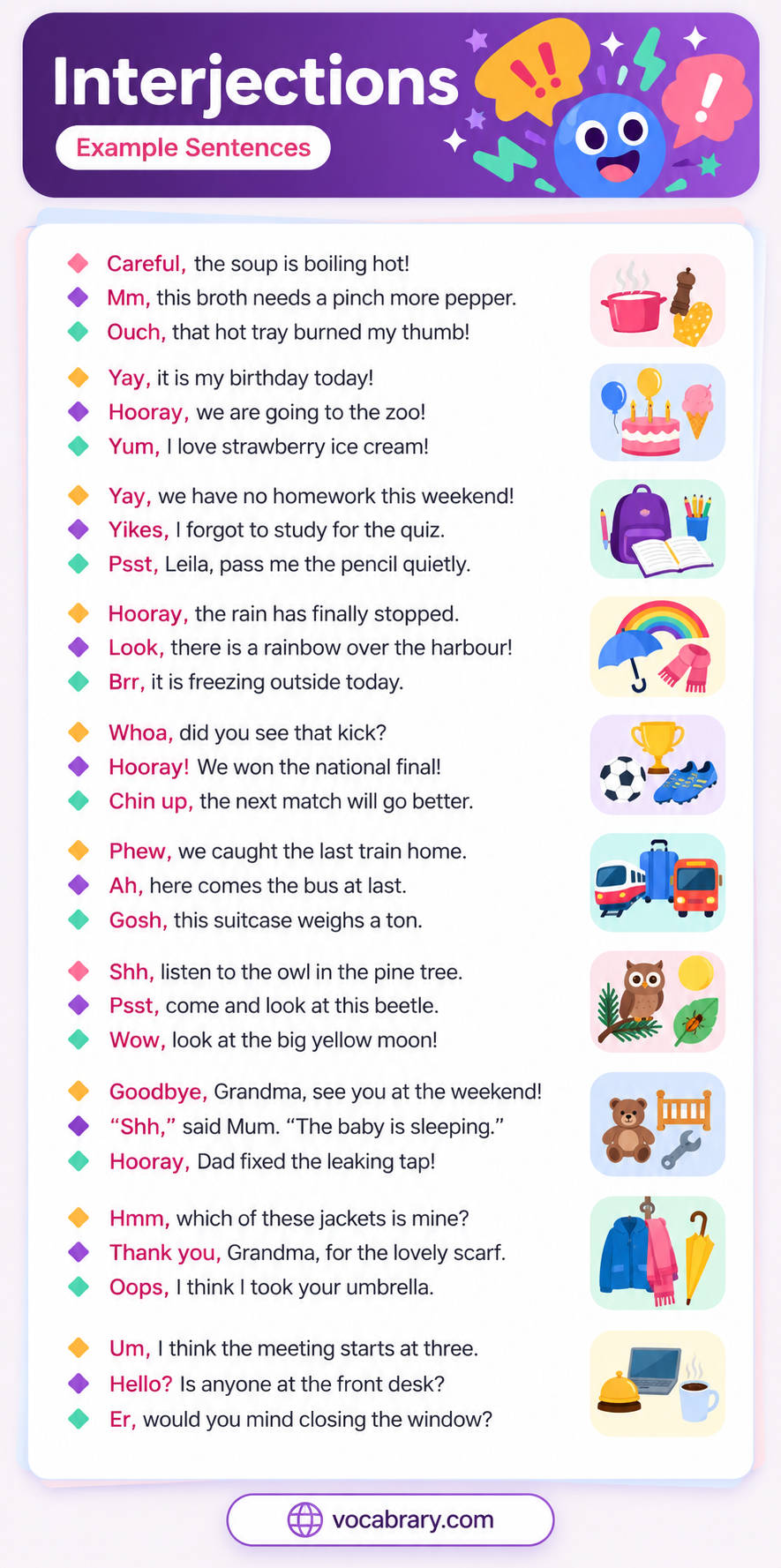
Interjections Example Sentences for Everyday Use
Wow, oops, hello and ouch are the interjections learners meet first, and each one expresses a feeling or a greeting in a single word with no grammatical link to the clause beside it.
- Wow, you finished the whole puzzle before breakfast!
- Oops, I dropped my pen under your chair.
- Hello, my name is Ayesha, and I am your new neighbour.
- Ouch, that hot tray burned my thumb!
- Hooray, our team won the regional spelling bee!
- Phew, we caught the last train home.
- Ugh, there is a hair in my soup.
- Hey, wait for me at the corner!
- Alas, the old library closed its doors last spring.
- Yes, I finished the report before lunch.
- Shh, the baby has just fallen asleep.
- Congratulations, Mei, on your new job at the hospital!
- Yikes, there is a wasp on your sandwich!
- Hmm, which route is faster, the bridge or the tunnel?
- Goodbye, Grandma, see you at the weekend!
- Gosh, it is already midnight, and we are still here.
- Yay, the library finally has the new dragon series!
- Sorry, I did not see you standing behind me.
Primary and Secondary Interjection Examples
Grammarians divide interjections by origin. Primary interjections such as ouch and aha belong to no other word class, while secondary interjections such as well and goodness are formed from nouns, adjectives, adverbs or verbs.
| Type | Origin | Examples | Sentence |
|---|---|---|---|
| Primary | Word that is only an interjection | Ouch, aha, psst, phew, ugh | Psst, the teacher is coming back. |
| Secondary | Noun, adjective, adverb or verb used as an exclamation | Well, sorry, goodness, great, look | Great, the train is on time! |
Sentences With Ouch, Aha and Psst
Ouch, aha, psst and phew have no other use in a sentence. Each works only as an exclamation.
- Aha, so the cat was hiding under the bed all morning!
- Ouch, that hurt more than I expected.
- Psst, Leila, pass me the pencil quietly.
- Phew, the lost passport was under the sofa all along.
- Ugh, the lift smells of old onions again.
- Eek, a mouse just ran across the kitchen floor!
- Tsk, you left the front door open again.
Sentences With Well, Sorry and Goodness
Nonsense, great, sorry and look belong to other word classes and turn into interjections only when they stand alone as an exclamation. The word well is an adverb in She sings well and an interjection in Well, that is settled.
- Nonsense, the shop is open until nine tonight.
- Goodness, how quickly the school term has passed!
- Great, we still have enough time for lunch.
- Sorry, I took the last biscuit from the tin.
- Well, that went better than anyone expected.
- Splendid, the guests have all arrived on time.
- Look, the swallows have returned to the barn.
- Rubbish, I was not late; the clock was wrong.
Joy and Excitement Sentences With Hooray and Yay
Hooray, yay, wow and whoopee express pleasure at good news such as a win, a holiday or a surprise gift. Many of them take an exclamation mark, as in these interjections example sentences about good news.
- Hooray, the long drought has ended in Kenya’s Rift Valley!
- Yay! The ice cream truck is turning into our street.
- Wow, you baked this whole cake by yourself?
- Whoopee! School is closed for the snow today.
- Yippee, Grandpa is arriving from Manila tonight!
- Woohoo! I passed my driving test on the first try.
- Amara threw her cap in the air and shouted, “Hurray, I graduated!”
- Wow! Lucas just scored a goal from the halfway line.
- “Hip hip hooray!” the class cheered as the principal announced a picnic.
- Awesome, we get an extra day for the project!
- Yes! Dilnoza finally won the chess final in Tashkent.
- Wahoo, we are going to the seaside this weekend!
Surprise Sentences With Whoa and Gosh
Oh, whoa, gosh and goodness express a reaction to something unexpected, whether pleasant or alarming. In interjections example sentences about shock, the clause after the interjection gives the cause.
- Oh, I did not expect to see you here!
- Whoa, that skateboard jump was higher than the fence!
- Gosh, it is much later than I thought.
- Goodness, what a lot of snow fell overnight!
- Gee, I never knew you spoke Japanese.
- My word, that painting is almost two hundred years old.
- Oh my, the whole garden is covered in butterflies!
- Ah, so that is why the shop was closed.
- Huh? I thought the concert started at eight.
- Heavens, the baby has learned to walk already!
- Gracious, what a huge pumpkin you grew!
- Golly, the bridge looks much longer from the bus.
Pain Sentences With Ouch and Ow
Ouch, ow and yow express a sudden sting, bump or burn. Writers close many of them with an exclamation mark.
- Ouch, the pan handle is hot!
- Ow! Someone stepped on my foot on the crowded bus.
- Ouch! The paper cut stings more than I expected.
- Kenji hit his elbow on the desk and cried, “Ow, that really hurts!”
- Yow, this sunburn hurts every time my shirt touches it!
- Ooh, my back aches after carrying those boxes upstairs.
- “Ouch,” whispered Elena as the nurse cleaned her scraped knee.
- Owie, my tooth wobbles when I bite an apple!
- Argh, my ankle twisted on the loose stone!
Examples of Interjections for Disgust
Ugh, yuck, ew and blech express a reaction to a bad smell, a bad taste or a messy sight.
- Yuck! The yoghurt I left on the shelf has gone sour.
- Eww, someone left chewed gum under the desk!
- Blech, this medicine tastes like burnt rubber.
- Ick, the pond water smells awful!
- Priya wrinkled her nose and said, “Ew, who forgot the fish in the car?”
- Phooey, these boiled sprouts are cold and soggy again.
- Bleah, I will never drink that green juice again.
- Gross, the sink is full of dirty plates!
Phew and Whew Example Sentences
Phew and whew express the end of worry, as when a train is caught or an exam is over. The phrase thank goodness expresses the same relief.
- Whew, the exam is finally over.
- Phew! The baby has stopped crying and fallen asleep.
- Thank goodness, the missing dog is safe at the vet’s.
- Phew, I thought I had left the oven on.
- Thank heavens, the storm passed before the wedding started.
- Phew, the test was easier than Marta expected.
- “Whew,” breathed Tariq as the bus pulled up at the gate.
- Phew, nobody was hurt in the crash on Station Road.
Sadness Sentences With Alas and Oh Dear
Alas, oh no, oh dear and aw express a reaction to a loss, a disappointment or bad news. The word alas belongs to formal or literary writing.
- Alas, no one remembered the poet after his death.
- Oh no, my phone fell into the river!
- Oh dear, the vase has slipped from her hands.
- Aw, the puppy was left behind at the shelter.
- Oh no, they have cancelled the festival because of the flood.
- “Alas,” sighed the king, “the harvest has failed again.”
- Aww, I miss my cousins in Lagos already.
- “Boohoo,” sobbed the little girl as her balloon floated away.
- Alas, the bridge that once linked the two villages is gone.
Sympathy and Comfort Sentences With There There
There there, aw, poor you and oh dear respond to another person’s trouble with kindness. Each one comes before a short comforting sentence.
- There there, the storm will be over by morning.
- Aw, I am sorry your bike was stolen outside the library.
- Oh dear, you look cold, so sit by the stove.
- Poor you, you had to wait two hours for the bus!
- “There there,” whispered Aunt Rosa, wiping the toddler’s tears.
- Oh no, Mei, I heard about your grandmother, and I am so sorry.
- Aww, the baby bird fell out of the nest, but we put it back.
- Ah, I understand why the news upset you so much.
- Poor thing, the cat has been shivering on the step since dawn.
- Oh, Kofi, I wish I had been there with you.
Annoyance and Anger Sentences With Tsk and Argh
Tsk, argh, grr and hmph express irritation without any rude word. They are mild sounds of annoyance in everyday speech and fiction.
- Tsk, the water was left running all night.
- Argh, the printer jammed with ten pages left!
- Grr, this zip is stuck again.
- “Hmph,” muttered Mr Anand, folding his newspaper and leaving the room.
- Tut, tut, the grass is far too long.
- Argh, I lost the file after two hours of typing!
- Bah, this television never works when I need it.
- Pfft, that excuse will not convince anyone.
- Humph, nobody asked me about the new plan.
Agreement and Refusal Sentences With Yes and No
Yes, yeah, okay and no are used to answer a question or confirm a plan. Many dictionaries label yes, yeah and okay interjections, while some grammars class yes and no as adverbs or response words.
- Yes, Nilufar sent the final report before noon.
- Yeah, I saw the match last night.
- Right, let us start with the first exercise.
- Okay, we will meet outside the cinema at six.
- Yep, the parcel arrived this morning.
- Sure, I can carry that bag for you.
- No, we have not decided on a holiday destination yet.
- Nope, the museum does not open until ten.
- Yes, Mr Santos, the homework is due on Friday.
- Uh-huh, I heard every word you said.
- Okay, okay, I will turn the music down now.
- No, thank you, I have already had two helpings.
Disagreement and Disbelief Sentences With No Way
No way, nonsense, rubbish and poppycock express rejection of a statement or doubt about a claim. The words no way and rubbish belong to informal speech, while nonsense is also used in formal writing.
- No way, you finished the marathon in under three hours!
- Nonsense, the shop does not close at noon on Saturdays.
- Rubbish, I never said the soup was too salty.
- “Poppycock,” snorted the colonel, “no horse of mine ever lost a race.”
- Balderdash, the map clearly shows the river on the other side.
- Come off it, Ravi, nobody believes you ran to school.
- No way, they sold the old cinema to a supermarket!
- “Nonsense,” said Grandma Eliza, “the factory is not closing this year.”
- Rubbish, that film was far better than the book.
- Hogwash, the report is full of errors.
Um, Er and Hmm Sentences for Hesitation
Um, er, hmm and well are used to fill a pause while a speaker decides what to say. They mark thought rather than feeling.
- Um, I think the meeting starts at three.
- Er, could you repeat the question, please?
- Hmm, which of these jackets is mine?
- Uh, I am not sure where I left my glasses.
- Well, it depends on the weather.
- Erm, the bill is missing a dessert.
- Yuki paused and said, “Um, maybe we should ask the teacher first.”
- “Hmm,” thought Ana, “the clock must be five minutes slow.”
- Well, I suppose we could take the later bus.
Attention Sentences With Hey and Psst
Hey, psst, listen and excuse me are used to get a person’s attention before the speaker says anything else. Each is followed by a comma, a colon or an exclamation mark.
- Hey, Samir, you dropped your scarf on the platform.
- Psst, Zoe, your bag is open.
- Listen, the neighbours are playing the violin again.
- Look, there is a rainbow over the harbour!
- Ahem, may I have your attention, ladies and gentlemen?
- Attention, passengers: the nine fifteen train to Leeds is delayed.
- “Ahoy!” called the sailor from the deck of the ferry.
- Oi, get off the grass, boys!
- Excuse me, you dropped your wallet near the fountain.
- “Yoo-hoo!” Aunt Rosa called from across the street.
Greeting and Farewell Sentences With Hello and Bye
Hello, hi, goodbye and bye are used to open and close a conversation. Dictionaries label them as interjections, and goodbye also works as a noun in She said a quick goodbye.
- Hi, Tomas, did you get my message?
- Hello, Mrs Okafor, thank you for coming to the meeting.
- Hello? Is anyone at the front desk?
- Bye, everyone, and thank you for the lovely dinner.
- Hey, good to see you again after so many years.
- Hi there, welcome to the Saturday coding club.
- “Goodbye,” said the guide, and she waved until the coach left.
- Welcome, everyone, to our school’s annual science fair.
- “Cheerio,” Mr Evans called as he drove off down the lane.
- “Bye-bye, little one,” Mum whispered at the nursery gate.
- “Farewell, my friends,” wrote the soldier at the end of his last letter.
Bravo and Congratulations Sentences for Praise
Bravo, well done and congratulations express praise for an achievement such as a speech, a concert or a graduation. The word bravo is an Italian import, well done is a phrase made from an adverb and a participle, and congratulations is a plural noun used as an exclamation.
- “Bravo!” shouted the audience when the pianist finished.
- Well done, Hamza, you answered every question correctly.
- Congratulations to both of you on your wedding!
- Good job, Leo, your poster looks fantastic.
- Nice one, Dad, you fixed the bicycle chain in two minutes.
- “Brilliant!” said Miss Hughes as she handed back the perfect test.
- Bravo, Camila, that was the best speech of the evening!
- Well done on crossing the finish line of the marathon, Chidi!
- Congratulations, you are now officially a doctor.
- “Hear, hear!” the committee members cried after the chairman’s speech.
Warning Sentences With Look Out and Careful
Look out, watch out, careful and heads up signal danger in few words. The phrases look out and watch out are imperative verb phrases, and careful is an adjective, but all of them work as exclamations here.
- Look out, a cyclist is coming round the corner!
- Watch out, the floor is wet near the kitchen.
- Careful, the soup is boiling hot!
- Mind out, the trolley is coming through.
- Heads up, the ball is flying toward the window!
- Stop! The traffic light has just turned red.
- Watch out, Zara, the step is higher than it looks.
- Look out! A branch is about to fall on the path.
- Careful, children, the ice on the pond is very thin.
Shh and Hush Sentences for Silence
Shh, hush and shush are used to ask for quiet in a library, a hospital ward or a nursery. They are formed from a hissing sound made with the breath.
- Shh, listen to the owl in the pine tree.
- “Hush,” said the nurse, “you are safe now.”
- Shush, the film is about to begin.
- “Shh,” whispered Noor, pointing to the sleeping cat.
- Quiet, please, the exam has started.
- “Sh,” the librarian whispered, pressing a finger to her lips.
Apology and Politeness Sentences With Oops and Sorry
Oops, sorry, pardon and excuse me are used to admit a small error or to ask for room and repetition. The word oops is the least formal of the four.
- Oops, I sent that message to the wrong group.
- Whoops, the milk spilled over the edge of the glass!
- Sorry, Mr Adeyemi, the bus was stuck in traffic.
- Pardon, could you say that again more slowly?
- Excuse me, is this the queue for the ticket office?
- Pardon me, I think you are sitting in my seat.
- Excuse me, may I squeeze past you to the exit?
- Sorry? I did not catch your last name.
- Whoops, wrong door; this is the cleaners’ cupboard!
- Oops, we have already eaten your piece of cake.
- Sorry, Grandpa, I will tidy my room right now.
Laughter Sentences With Haha and Hehe
Haha, hehe, tee-hee and ho ho represent the sound of laughter. They are sound words that work as interjections when they stand outside the clause.
- Haha, that joke about the penguin was brilliant!
- Hehe, I hid your slippers inside the piano.
- “Tee-hee,” giggled Lucia, covering her mouth with both hands.
- Ha ha, very funny, now give me back my hat.
- “Ho ho ho,” shouted Santa, waving from the shopping-centre balcony.
- Haha, you should have seen the look on Pedro’s face!
- “Ha,” laughed the old sailor, “that storm was nothing.”
- Hee hee, the twins whispered behind the curtain.
- Haha, I nearly spilled my tea when the dog stole the sausage.
- Heh, I knew you would choose the biggest slice.
Command and Encouragement Sentences With Come on
Come on, hurry up, hang on and cheer up are used to urge a listener to act or to feel better. The phrase hurry up is an imperative verb phrase that speakers use as an interjection.
- Come on, Dina, the bus leaves in five minutes!
- Hurry up, the film starts at eight!
- Go, Amara, go, the finish line is right there!
- Cheer up, the exam is over and the holiday starts tomorrow.
- Come on, you can lift that bag if you try again.
- Hang on, I need to find my keys first.
- Hold on, the soup is almost ready.
- Keep going, Lena, the hill ends at the next corner!
- Chin up, the next match will go better.
- Hurry up, Leo, or we will miss the ferry to Naxos.
- Steady on, there is no need to shout at the referee.
- Come on, everyone, one more push and the car is out of the mud!
Sound Word Interjection Example Sentences
Boom, bang and splash are formed from the noises they describe, and such words are called onomatopoeia. Onomatopoeia is a way of forming words, not a part of speech, so bang and splash are nouns and verbs that count as interjections only when they stand alone as an exclamation.
Sound Words Standing Alone in Sentences
Boom, crash, splash and achoo work as exclamations when no verb or noun phrase depends on them. A comma or an exclamation mark separates each one from the clause that follows.
- Boom! Thunder rolled across the valley at midnight.
- Bang! The balloon burst in front of the toddler.
- Splash! The frog jumped into the pond and vanished.
- “Achoo!” sneezed Oliver, and then he reached for a tissue.
- Crash! The tray of glasses hit the kitchen floor.
- Beep, beep, the delivery van reversed into the lane.
- “Knock, knock,” said a voice outside the tent.
- Whoosh! A train rushed past the platform.
- Splat! A water balloon landed on the pavement.
- Pow! The superhero’s punch sent the robot flying across the comic page.
- Boom, the fireworks lit up the sky over Sydney harbour.
- Tick-tock, tick-tock, the old clock counted every second of the night.
Sound Words as Nouns and Verbs in Sentences
Boom, bang, splash and crash are not interjections when they function as the subject, object or verb of a clause. The words keep their sound meaning, but their grammar is that of nouns or verbs.
- The boom of the cannon echoed across the harbour.
- The window banged against the frame all night.
- A loud splash woke the baby from her nap.
- The children splashed water over the edge of the pool.
- The firework boomed above the stadium.
- We heard a bang from the garage and ran outside.
- A crash of plates came from the kitchen.
- The sprinkler splashes the flowers every evening.
Interjections and Punctuation in Sentences
An exclamation mark, a comma and a question mark each set an interjection apart from the clause beside it. The mark chosen shows how strong the reaction is and whether the interjection asks something.
Exclamation Mark Sentences With Ouch and Yikes
Ouch, yikes, eek and hooray take an exclamation mark when the feeling is strong. The next sentence then begins with a capital letter, and a second exclamation mark at the end of the sentence is unnecessary.
- Wow! That mountain is much taller than it looks.
- Ouch! My finger is trapped in the drawer.
- Hooray! The summer holiday starts tomorrow.
- Yikes! A wasp is crawling across your sandwich.
- Eek! A spider just dropped onto the keyboard.
- Whoa! The cart is rolling down the hill.
- Bingo! I found the missing sock behind the washing machine.
Commas After Interjections
Oh, well, ah and hmm take a comma when the feeling is mild and the same sentence continues. The word after the comma starts in lower case unless it is a name or the pronoun I.
- Oh, I forgot to buy milk.
- Well, we should leave before the rain starts.
- Hmm, this puzzle has a missing piece.
- Yes, Dr Alvarez, I will send the results today.
- Oh, and bring a torch for the cave tour.
- Ah, here comes the bus at last.
- Gosh, this suitcase weighs a ton.
- Oops, I think I took your umbrella.
Interjections Followed by a Question Mark
Huh, eh, hello and right take a question mark when they ask for repetition, confirmation or attention. The question mark replaces the comma or the exclamation mark.
- Huh? I did not hear your question.
- Eh? Could you say that once more?
- Hello? Can anyone hear me on this line?
- Oh? Did Sara really say that to her manager?
- You will join us tomorrow, right?
- Hmm? I thought the meeting was on Thursday.
- Okay? We leave at seven, so please be on time.
Capital Letters After Interjections
An interjection takes a capital letter only at the start of a sentence, as with Hey in Hey! Where is my bag? A name such as Rashid or the pronoun I keeps its capital after a comma, but other words follow in lower case.
- Hey! Where did you put my bag?
- Ouch, that chair really hurt my knee.
- Oh, Rashid left his keys on the sofa.
- She smiled, and, wow, the room fell silent.
- The soup, ugh, tasted of soap.
- Hurrah! We are leaving for the lake at dawn.
- Ah, it is you, Professor Lindqvist.
- O brave sailors, the harbour is near!
Full Stops and Ellipses After Interjections
Hmm, um, well and right take a full stop or an ellipsis when the speaker slows down or changes direction. The ellipsis shows a pause, and a capital letter follows a full stop.
- Hmm. Let me think about that for a second.
- Um… I forgot the answer to that question.
- Well… maybe we could try the other road.
- Right. Now we begin the second experiment.
Sentences With Oh and O in Poems and Prayers
Oh expresses a feeling such as surprise or sorrow, while O addresses a person or thing and is found mostly in poetry, prayers and older speeches. The word O is written as a capital letter with no comma directly after it, whereas oh takes a comma or an exclamation mark.
- “O Captain! My Captain!” opens a famous poem by Walt Whitman.
- O Lord, hear our prayer on this quiet morning.
- O mighty river, carry our boats safely to the sea.
- O brave knight, return before the winter comes.
- O wise teacher, tell us how the stars were made.
- O friends, gather round and hear the story of the lighthouse.
- Oh, I forgot that today is a holiday.
- Oh, what lovely roses you have along the fence!
- Oh, it is you, Mr Clarke!
- “Oh,” she whispered, “so that is where the key went.”
- Oh, the soup has gone cold while we were talking.
- O sun, rise again over the hills of home.
Interjection Position in Written Sentences
An interjection stands at the start, in the middle, at the end or alone, and interjections example sentences show that the position changes the punctuation. The start suits an immediate reaction, while the middle and the end add a quick comment.
Interjections at the Start of a Sentence
Wow, hey, yuck and hooray open a sentence and give the reaction before the explanation. A comma or an exclamation mark follows the opening interjection.
- Wow, the lake is frozen solid this morning.
- Hey, that is my seat by the window!
- Oh, the museum is closed on Mondays.
- Hooray, the rain has finally stopped.
- Yuck, the bin outside smells terrible.
- Gosh, the fields turned white overnight, though nobody expected snow in April.
- Alas, the festival was cancelled on its final day.
- Ah, the postman has delivered my parcel at last.
- Whoa, hold the ladder steady, please.
- Psst, come and look at this beetle.
Interjections in the Middle of a Sentence
Ugh, oops, um and alas appear inside a sentence to add a quick reaction. Commas on both sides set the interjection apart, and the sentence reads correctly without it.
- The soup, ugh, was completely cold.
- We reached the top and, wow, the whole valley was glowing.
- My brother, oops, left the gate open.
- I think, hmm, that the train leaves at nine.
- The answer to question nine is, um, forty-two.
- She opened the box and, ah, there was the missing ring.
- You were, alas, a minute too late.
- It was, gosh, the hottest afternoon we had ever spent outdoors.
- I told him, er, that the meeting was cancelled.
Interjections at the End of a Sentence
Phew, oops, alas and brr close a sentence as a quick afterthought. A comma separates the interjection from the clause, and the final mark is a full stop, an exclamation mark or a question mark.
- The heavy rain has finally stopped, phew.
- I forgot my keys again, oops.
- This coffee is stone cold, ugh.
- You missed the last bus, alas.
- It is very cold outside, brr.
- That was a close call, whew.
- You are coming to the party, right?
- The queue went out of the door, yikes.
Stand-Alone Interjection Sentences
Wow, oops, yes and bravo make a complete reply or reaction without any clause. A stand-alone interjection is punctuated like a sentence and goes inside quotation marks in dialogue.
- Nobody spoke for a moment, and then Tia whispered, “Wow.”
- “Did you finish the puzzle?” “Yes.”
- “Ready for the race?” asked the coach. “Yep,” said Anil.
- The audience stood up and cried, “Bravo!”
- When the curtain rose, the crowd gasped, “Oh!”
- He tripped over the rug, said “Oops,” and kept walking.
- Kofi opened the door to a surprise party, and the room shouted, “Surprise!”
- “Another power cut,” sighed Dad. “Ugh.”
Mild and Strong Interjection Sentences
Mild interjections such as oh and hmm express a small reaction, while strong interjections such as wow and yikes express an intense one. A strong interjection is not rude; it has more force and takes an exclamation mark.
Mild Sentences With Oh, Well and Hmm
Oh, well, hmm and oops react to a minor surprise, doubt or slip. Each takes a comma and is followed by a calm statement, as in these interjections example sentences.
- Oh, I see what you mean now.
- Well, the film was a little too long.
- Hmm, perhaps we should take an umbrella.
- Oops, I mixed up the dates again.
- Mm, this broth needs a pinch more pepper.
- Gosh, I did not realise how late it was.
- Er, I have a small question about the schedule.
- Dear me, the milk has run out again.
Strong Sentences With Wow and Yikes
Yikes, eek, whoa and hooray react to danger, shock or great joy. Each takes an exclamation mark and is followed by a sentence that explains the cause.
- Yikes! The brakes on this bicycle have failed!
- Wow! This is the best day of my life!
- Hooray! We won the national final!
- Eek! There is a snake in the grass!
- Whoa! Hold on to the rail!
- Help! The boy has fallen into the pool!
- Argh! I deleted the whole essay!
- Oh no! The roof is leaking again!
Formal and Informal Interjection Sentences
Formal interjections such as alas and bravo suit speeches, letters and literature, while informal ones such as yay and yikes suit chat and friendly messages. Formal academic writing uses interjections sparingly.
Formal Sentences With Alas and Bravo
Alas, bravo, hear, hear and congratulations appear in official speeches, formal letters and older literature. Each gives a polite tone and leaves the sentence complete.
- Alas, the committee was unable to reach a decision.
- Congratulations on your appointment as head of department.
- Pardon, Madam Chair, I did not catch the last question.
- Bravo to the entire orchestra for a flawless performance.
- “Hear, hear,” the delegates replied to the minister’s proposal.
- Welcome, ladies and gentlemen, to the annual conference.
- Good heavens, the figures in this report are surprising.
- Well done to all the volunteers who cleaned the riverbank.
Informal Sentences With Yay and Yikes
Yay, yikes, yeah and nope belong to casual talk with friends, family and classmates. They suit text messages and stories with dialogue, but not a formal report.
- Yay, we have no homework this weekend!
- Yikes, I forgot to study for the quiz.
- Nope, I have not seen your charger anywhere.
- Yeah, I will text you when I get home.
- Whoa, did you see that kick?
- Huh, I thought Jamal lived in Dubai.
- Cool, see you at the skate park at four.
- Oof, that last level of the game was brutal.
Dialogue and Fiction Sentences With Interjections
Writers use wow, hmm, alas and shh to show how characters speak, and interjections example sentences in stories follow the punctuation rules for direct speech. The interjection goes inside the quotation marks, and a speech tag after an exclamation mark starts in lower case.
Spoken Dialogue Sentences
A detective who says hmm, a child who says yuck and a sailor who says alas all show their mood in the first word they speak. Each interjection stands inside the opening quotation marks of the line.
- “Wow!” said Tomas. “Look at the size of that whale.”
- “Hmm,” said the detective, “the window was locked from the inside.”
- “Oh, I am so sorry,” Amira said, picking up the scattered papers.
- “Ouch!” Leo shouted. “You trod on my toe.”
- “Hooray!” cried the children as the school bus turned toward the beach.
- “Well, it was worth a try,” Grandpa said with a shrug.
- “Psst,” whispered Lina, “the principal is behind you.”
- “Yuck!” said Ben, pushing the plate of beetroot away.
- “Alas,” said the old sailor, “the sea has taken my boat.”
- “Shh,” said Mum. “The baby is sleeping.”
Fiction Narration Sentences
Creaking doors, slamming shutters and clanging swords add sound to a story, and the narrator places the interjection in the sentence without quotation marks. Commas set it apart when it comes in the middle.
- The old house was silent, and then, bang, the shutters slammed.
- Crack! The ice split under his boots, and Arjun froze.
- She tiptoed forward, gulp, and pushed the heavy door open.
- Alas, the princess had vanished before sunrise, and the guards found only her slippers.
- The knight raised his sword and, clang, the blades met above the bridge.
- Oh, how the villagers wept when the old bell finally fell silent.
- The wind howled, brr, and the travellers pulled their coats tight.
- He turned the key and, click, the lock opened at last.
Interjection and Adverb Sentences With the Same Spelling
Well, right and now belong to two word classes, and the function of each word in its sentence shows which class it is. As an interjection it stands outside the clause, and as an adverb it modifies a verb, an adjective or another adverb.
Interjection Sentences With Well, Right and Now
Well, right, now and why open a remark, mark a change of subject or calm a listener. Each takes a comma, and the clause keeps its meaning when the word is removed.
- Well, I think we should start again tomorrow.
- Well, well, look who finally arrived!
- Right, everyone, please open your books at page ten.
- Right, I will call the plumber after lunch.
- Now, now, there is no need to cry over a spilled drink.
- Now, listen carefully, because I will say this only once.
- Why, that is the best answer I have heard all week!
- Now then, who would like to read the first line?
- Well, that was an unexpected ending.
- Right, who is ready for the quiz?
Adverb Sentences With Well, Right and Now
Well, right, now and why state manner, direction, time or reason when they modify a word in the clause. The clause changes meaning when the word is removed.
- Amina plays the violin well, even though she started last year.
- The road bends right just after the old mill.
- Mr Okafor is leaving now, so please bring his coat.
- Turn right at the bakery, and the museum is on your left.
- The engine runs well after the new spark plugs.
- Come right inside, because the soup has just finished cooking.
- The shop is now open until nine every evening.
- I wonder why the lights went out.
- Kenji slept well after the long hike.
- The picture hangs right above the sofa.
Well in Well, I disagree is an interjection, but well in She sings well is an adverb of manner. Removing the word shows the difference, because She sings loses the manner while I disagree keeps its meaning.
Interjections and Exclamatory Sentences Compared
Wow and What a steep mountain this is! both express strong feeling, but only the second has a subject and a verb. An exclamatory sentence of this type begins with what or how, and an interjection needs no clause at all.
- Ouch! My thumb is bleeding after that splinter.
- How loudly he shouted! The whole street heard him.
- Hooray, we won the quiz by three points!
- What a lovely garden your grandmother has!
- Wow, what a huge cake this is!
- How quickly the snow melted this morning!
- What a surprise you gave us!
- Yikes, how fast that car is going!
- Gosh, how tall your brother has grown!
- How kindly she smiled at the nervous child!
Interjections in Negative Sentences
An interjection itself is not made negative with not, because it has no verb. The negative belongs to the clause beside it, apart from no and nope, which are negative replies on their own.
- Oh, I did not know the shop had closed.
- No, we are not going to the beach today.
- Alas, nobody came to the concert in the rain.
- Oops, I have not saved my document yet.
- Phew, we did not miss the train.
- Yikes, nobody told me the exam was today!
- Nope, Aisha has not finished the report.
- Oh no, there isn’t any bread left for breakfast.
- Hey, don’t touch the wet paint!
Question Sentences With Interjections
An interjection opens a question to show surprise, doubt or politeness, and the question mark ends the whole sentence, as the interjections example sentences in this group show. The question is formed in the clause that follows, with the usual word order.
- Hey, where are you going with my umbrella?
- Hmm, which of these two bags is heavier?
- Oh, did you finish the whole book already?
- Huh? When did the shop change its name?
- Ah, is that the new library you told me about?
- Wow, how did you carry all those boxes?
- Excuse me, does this bus stop at the airport?
- Er, would you mind closing the window?
- Gosh, is it really half past eleven?
- Um, how much would a ticket to Lisbon cost?
- Pardon? Did you say Tuesday or Thursday?
Interjections in Reported Speech
Direct speech keeps the interjection inside quotation marks. Indirect speech reports the feeling with a verb such as exclaimed or with a phrase such as with delight instead of the interjection.
- Ravi cried, “Hooray, we have won!”
- Ravi exclaimed with delight that they had won.
- Mina said, “Ouch, that really hurts!”
- Mina said ouch and pulled her hand away from the stove.
- Mina cried out in pain that her hand was burned.
- The boy said, “Yuck, this soup is cold.”
- The boy complained with disgust that the soup was cold.
- She said “phew” as soon as the plane touched down.
- She said with relief that the plane had landed safely.
Sentences From Everyday Settings
Kitchens, classrooms, offices, airports, newsrooms, stadiums and clinics each have their own typical interjections, such as yum, well done and phew. The setting affects which feeling the speaker expresses, and these interjections example sentences cover seven places.
Home Sentences With Yum, Shh and Hooray
A plate of cinnamon rolls, sleeping twins and a repaired tap are reasons for yum, shh and hooray in a family home.
- Shh, the twins have finally fallen asleep upstairs.
- Yum, Grandma has baked cinnamon rolls again!
- Oops, I left the laundry in the machine overnight.
- Hooray, Dad fixed the leaking tap!
- Hey, who ate the last piece of cake?
- Brr, the heating is off, so put on a jumper.
- Aw, the kitten has curled up in the laundry basket.
School Sentences With Hooray, Oh No and Whoa
Spelling tests, a forgotten essay and science demonstrations are reasons for hooray, oh no and whoa in classrooms and corridors.
- Hey, Maria, did you bring your science book today?
- Hooray, the teacher cancelled the Friday spelling test!
- Oh no, I forgot to print my history essay.
- Well done, Class Four, you collected a hundred books for the library.
- Whoa, the chemistry demonstration made a huge cloud of foam!
- Excuse me, Miss Patel, may I go to the library?
- Yay, our art display won first prize!
Work Sentences With Ugh and Congratulations
A crashed server, a closed sale and a mismatched invoice are reasons for ugh, congratulations and hmm in meetings and phone calls.
- Hello, you have reached the customer service desk at Brightway Bank.
- Oops, the meeting invitation went to everyone in the department.
- Congratulations, Kwame, on closing the biggest sale of the year!
- Hmm, the budget total does not match the invoice.
- Ugh, the server crashed just before the presentation.
- Excuse me, Ms Rossi, do you have a minute to review this chart?
- Phew, the report reached the client one minute before the deadline.
Travel Sentences With Wow, Phew and Oops
A view from a tower, a gate reached in time and a wrong bus are reasons for wow, phew and oops at stations, airports and hotels.
- Wow, the view from the top of the Eiffel Tower is amazing!
- Excuse me, which platform will the Madrid train leave from?
- Phew, we reached the gate before boarding closed.
- Look out, the tram is coming around the bend!
- Ugh, the luggage belt has stopped again.
- Oops, we boarded the wrong bus at the terminal.
- Goodbye, Bali, and thank you for the lovely holiday.
News Report Sentences With Quoted Interjections
Reporters quote the exact words of witnesses, winners and officials, so hooray, oh no and phew appear inside quotation marks.
- “Hooray!” the crowd chanted as the first ferry crossed the repaired bridge.
- “Oh no,” said one resident, looking at the flooded street.
- “Wow, I never thought we would win,” the captain told reporters.
- “Phew,” said a shopkeeper, “the fire stopped before it reached my store.”
- “Congratulations,” said the prime minister, “to the national team on a historic victory.”
- “Boom, the thunder shook our windows,” a witness told the reporter.
Sports Sentences With Goal and Bravo
Penalty saves, a finish-line win and a spin from the high board are reasons for goal, bravo and come on from commentators, coaches and fans.
- “Goal!” shouted the commentator, and the stadium erupted.
- “Come on, Ayaan, run faster!” called his father from the stands.
- “Bravo!” cried the fans when the goalkeeper saved the penalty.
- Yes! Sofia crossed the finish line three seconds ahead of her rival.
- Oh, the ball hit the post and bounced away!
- Whoa, the diver spun three times before touching the water!
- “Heads up!” the coach called as the ball sailed over the net.
Health Sentences With Ouch and Achoo
A cleaned cut, a sneeze and a normal test result are reasons for ouch, achoo and phew in clinics, wards and chemists.
- “Ouch,” said the boy as the nurse cleaned the cut.
- “Ahh,” said the doctor, “open your mouth wide.”
- Phew, the test results came back normal.
- Ugh, this cough syrup tastes terrible.
- “Achoo!” sneezed Hana. “The pollen season has started.”
- Oh dear, your temperature is quite high, Mr Bianchi.
- Careful, the floor was just washed and is slippery.
Interjections Example Sentences for Kids
Short reactions such as yay, ouch, oops and yum are the first interjections children say and write. Every line stays under ten words and expresses one feeling, which makes these interjections example sentences suitable for primary classes.
- Yay, it is my birthday today!
- Ouch, I bumped my knee on the chair.
- Wow, look at the big yellow moon!
- Hello, my name is Pedro, and I am six.
- Oops, I spilled my juice on the floor.
- Hooray, we are going to the zoo!
- Yum, I love strawberry ice cream!
- Shh, my little sister is sleeping.
- Goodbye, Mummy, see you after school!
- Whee, I am going down the slide!
- Uh-oh, the balloon is floating away.
- Brr, it is freezing outside today.
- Oh no, my sandcastle fell over!
- Boo, I made you jump, Daddy!
- Eek, there is a spider on the wall!
- Thank you, Grandma, for the lovely scarf.
Interjections Example Sentences for Students
Exam answers, essays and grammar tasks require students to spot, punctuate and analyse interjections such as alas, well and wow. These interjections example sentences use longer clauses and name the grammar function directly.
- Alas, the experiment failed because the sample had been contaminated.
- Ah, now I understand why the author repeated the final line.
- Hmm, the second paragraph contradicts the evidence in the first.
- Well, the results of the survey were not what the researchers had predicted.
- “Bravo,” the examiner murmured when the candidate solved the final problem without notes.
- “Congratulations,” the letter began, “you have been awarded a place at the university.”
- In her essay, Amara noted that the poet opens with alas to signal grief.
- The narrator’s repeated oh in the second stanza shows growing sorrow.
- The teacher marked the word wow as an interjection because it has no grammatical link to the clause.
- In the sentence “Well, the bridge was closed,” the word well works as an interjection, not as an adverb.
- A comma follows hmm in that sentence because the interjection introduces a full clause.
- A sentence adverb such as however joins ideas, while an interjection such as alas only voices a feeling.
- Most formal essays avoid yay and yikes because both words belong to casual speech.
- The student replaced the informal yikes with the formal alas in her letter to the editor.
Short Paragraphs With Interjections
A rainy morning, a delayed flight, a football final, a doctor’s visit, a fairy tale and a science fair each contain several interjections. Each short text shows ugh, phew, alas and hooray in connected writing.
Hana woke early and looked out of the window. “Ugh, it is raining again,” she groaned. Then she remembered that the school trip was cancelled, and she shouted, “Hooray, we can stay home and bake!” Her brother ran in with flour on his nose. “Oops,” he said, “I dropped the whole bag.” Hana laughed and answered, “Well, now we have a snowy kitchen.”
Mr Okoye reached the airport at six and checked the board. “Oh no,” he said, “my flight to Accra is delayed by two hours.” He found a seat and opened his book. Soon a child waved from the next row and called, “Hello!” Mr Okoye smiled and said, “Hi, what is your name?” By the time the flight was called, the two were friends.
The final began in heavy rain, and both teams slipped on the grass. “Whoa,” said Lucia as the striker nearly fell. In the last minute, the ball curled into the top corner. “Goal!” shouted the commentator, and the fans roared, “Hooray!” The captain lifted the cup and cried, “Wow, we did it!” Nobody left the stadium for an hour.
At the clinic, Karim rolled up his sleeve and looked away. “Ouch,” he said when the needle touched his arm. The nurse smiled and said, “Well done, that was brave.” She pressed a plaster over the spot. “Phew,” breathed Karim, “that was quicker than I thought.” On the way out he said, “Goodbye,” to everyone in the waiting room.
Long ago a miller owned a golden hen. “Alas,” he said one morning, “the hen has gone.” He searched the barn, the garden and the river bank. Then he heard a small cluck behind the wall. “Aha,” he cried, “there you are!” The hen laid an egg at his feet, and the miller danced for joy.
Priya set her model volcano on the science fair table and waited. “Hmm,” she whispered, “the mixture needs more soda.” She stirred it and stepped back. “Whoa!” said the judge as red foam poured over the sides. “Bravo, that is the best volcano today.” Priya grinned and said, “Thank you, I practised all week.”
Interjections, Conjunctive Adverbs and Exclamatory Sentences Compared
Wow, however and What a cold night it was! each add feeling or connection, but they differ in grammar, so interjections example sentences need three separate labels. Interjections stand outside the clause, conjunctive adverbs link clauses, and exclamatory sentences are clauses themselves.
| Feature | Interjection | Conjunctive adverb | Exclamatory sentence |
|---|---|---|---|
| Class or type | Part of speech | Adverb that links clauses | Sentence type |
| Subject and verb | Neither | Neither | Both |
| Link to the clause | None | Joins two independent clauses | Is a complete clause |
| Main job | Expresses a sudden feeling | Shows contrast, result or addition | Expresses strong feeling in a full clause |
| Typical words | Wow, ouch, alas | However, therefore, moreover | What and how |
| Punctuation | Comma or exclamation mark after it | Semicolon before it and comma after it | Exclamation mark at the end |
| Example | Wow, the view is amazing. | The lake froze; however, the ferry kept running. | What a cold night it was! |
FAQs
Q1. What are some common examples of interjections?
Common interjections include wow, oops, ouch, hooray, hello, goodbye, alas, phew, ugh and hey. Each one expresses a feeling or a greeting without joining the grammar of the clause beside it. The interjections example sentences on this page group them by emotion, such as joy for hooray, pain for ouch and relief for phew.
Q2. How do you punctuate an interjection?
In interjections example sentences, an interjection takes an exclamation mark when the feeling is strong and a comma when the feeling is mild and the sentence continues. A question mark follows it when the interjection asks something, as in Huh?. A full stop or an ellipsis follows it when the speaker slows down, as in Hmm….
Q3. Does an interjection need an exclamation mark?
An interjection does not need an exclamation mark, because a comma, a question mark or a full stop is correct when the feeling is mild or the interjection asks something. The sentence Well, that is settled. has a comma and no exclamation mark. An exclamation mark suits strong feeling, as in Ouch!, and one mark is enough.
Q4. Do you capitalise the word after an interjection?
The word after an interjection starts with a capital letter when an exclamation mark, a question mark or a full stop ends the interjection, as in Wow! That was fast. After a comma the next word stays in lower case, as in Wow, that was fast, unless it is a name or the pronoun I. The interjection itself is capitalised only when it opens a sentence or a quotation.
Q5. Where does an interjection go in a sentence?
An interjection goes at the start of a sentence, in the middle, at the end, or alone as a complete reply, and interjections example sentences show all four. At the start it takes a comma or an exclamation mark, as in Oh, I forgot the tickets. In the middle two commas set it apart, as in The soup, ugh, was cold, and at the end one comma comes before it, as in It stopped raining, phew.
Q6. What is the difference between an interjection and an exclamatory sentence?
An interjection and an exclamatory sentence both express strong feeling, but only the exclamatory sentence contains a subject and a verb. Wow! is an interjection with no clause, while What a huge cake this is! is an exclamatory sentence that begins with what and ends with an exclamation mark. The two appear together in Wow, what a huge cake this is!
Q7. Is yes an interjection?
The word yes is labelled an interjection in many dictionaries, but some grammars class it as an adverb or a response word. In Yes, I finished the report, the word stands outside the clause and works like an interjection. Classification differs between sources, so a student follows the dictionary or textbook set for the course.
Q8. Are sound words such as bang and splash interjections?
Sound words such as bang and splash are interjections only when they stand alone as an exclamation, as in Bang! The balloon burst. In The bang woke the baby the word is a noun, and in The window banged it is a verb. Onomatopoeia is the name for words formed from sounds, and it is not a part of speech.
Q9. What is the difference between interjections and conjunctive adverbs?
Interjections and conjunctive adverbs differ in what they connect: a conjunctive adverb such as however joins two independent clauses, while an interjection such as alas joins nothing. A conjunctive adverb takes a semicolon before it and a comma after it. An interjection expresses a feeling and takes a comma or an exclamation mark.
Q10. Is it correct to use interjections in formal writing?
Interjections are correct in formal writing when they appear in quoted dialogue or serve a deliberate literary effect, but they are uncommon in reports and essays. Formal choices include alas, bravo and congratulations, while yay, yikes and nope belong to informal speech. A formal essay states the feeling in a full sentence instead.
Q11. How do you write interjections in dialogue?
Interjections in dialogue go inside the quotation marks with the rest of the spoken words, and the punctuation follows the strength of the feeling. After an exclamation mark the speech tag starts in lower case, as in “Wow!” said Tomas. The tag also starts in lower case after a comma, as in “Hmm,” said the detective. A new sentence inside the quotation starts with a capital letter.
Q12. What are primary and secondary interjections?
Primary interjections are words that work only as exclamations, such as ouch, aha, psst and phew. Secondary interjections are words from other classes that work as exclamations when they stand alone, such as well, goodness, sorry and look. The word well is an adverb in She sings well and an interjection in Well, that is settled.
Q13. What are some interjections for kids to learn first?
Interjections example sentences for kids begin with short reactions such as yay, ouch, oops, yum, shh and hello. These words match feelings children already know, so a child links each sound to a specific moment. Teachers add a comma or an exclamation mark after each word and then a short clause, as in Oops, I spilled my juice.

Leave a Comment