
A relative pronoun is a pronoun that introduces a clause describing a noun and stands for that noun inside the clause, as in the girl who won the race. It replaces the noun, so it has a role in its own clause: who is the subject in the girl who won, whom the object in the girl whom we met. Relative pronoun example sentences attach who, whom, whose, which, and that to nouns such as girl, book, and bus, each in the role its clause requires.
What Is a Relative Pronoun?
A relative pronoun stands in for a noun inside a clause and connects that clause to the noun it describes, which is called the antecedent. An interrogative pronoun opens a question, while a relative pronoun opens a clause that describes a noun.
Noun (antecedent) + relative pronoun + rest of the clause
The runner who crossed the line first is my cousin.
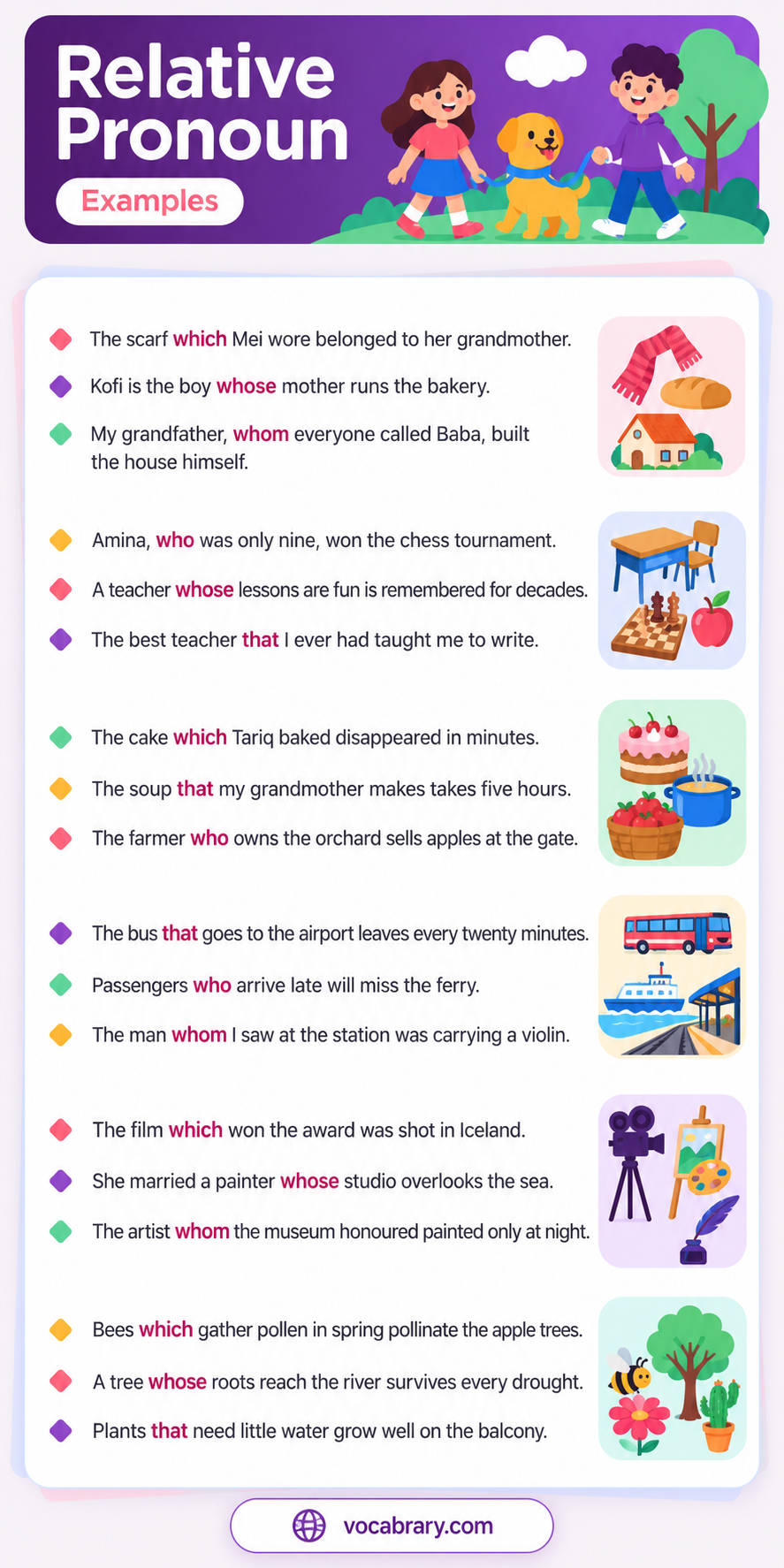
Common Relative Pronoun Example Sentences
The girl who won the race and the bus that goes to the airport are typical models. In each one a relative pronoun joins a short description to the noun before it.
- The girl who won the race is my cousin.
- I returned the book that you lent me.
- The man whom we met in Lisbon is a retired judge.
- Anita is the teacher whose class won the science prize.
- The bus that goes to the airport leaves every twenty minutes.
- Yusuf thanked the nurse who looked after his father.
- The phone which I bought last week has already broken.
- Everything that Sofia cooked disappeared within ten minutes.
- The children whose parents work nights stay with their grandmother.
- At the concert, the singer who opened the show forgot the second verse.
- We stayed in a hotel that overlooked the harbour.
- Mr Okafor, who teaches chemistry, has won a national award.
- The scarf which Mei wore belonged to her grandmother.
- People who exercise regularly sleep better.
- The song that played at the wedding was written in 1975.
- The woman whom the committee chose is a former pilot.
- Leila found the keys that had fallen behind the sofa.
- Anyone who finishes early may leave quietly.
- The river which flows through Cairo is the Nile.
- A neighbour whose car was stolen called the police at dawn.
Sentences With Who for People
In these sentences who stands for a person and is the subject of its own clause, as in the doctor who treated my brother and the farmer who owns the orchard. The verb comes right after who, with no other subject between them.
- The doctor who treated my brother works at the city hospital.
- Mateo is the player who scored twice in the final.
- Neighbours who play loud music after midnight upset the whole street.
- The student who sits beside me has a twin sister.
- She admires leaders who listen before they decide.
- A tourist who lost his passport spent the night at the embassy.
- My uncle, who drives a taxi in Nairobi, knows every street in the city.
- The women who founded the cooperative opened the first school in the valley.
- Every cook who respects fresh ingredients needs very few recipes.
- The librarian who helped us was endlessly patient.
- Passengers who arrive late will miss the ferry.
- Is there anyone here who speaks Portuguese?
- Children who have never seen snow stare at it in wonder.
- The farmer who owns the orchard sells apples at the gate.
Whom in Formal Sentences
Whom is the object form used in formal writing, as in the professor whom the students admired and the lawyer whom we consulted. A new subject follows whom, and him or her fits in the same spot when the clause is rewritten.
- The professor whom the students admired most retired last spring.
- She introduced me to the engineer whom she had hired in March.
- The candidate whom the voters trusted won by a wide margin.
- Ravi is a colleague whom I respect deeply.
- The woman whom the police questioned has not been named.
- The poet whom critics praised refused every prize.
- The lawyer whom we consulted advised us to wait.
- He thanked the stranger whom he had never met before.
- The guests whom Mariam invited arrived together by taxi.
- My grandfather, whom everyone called Baba, built the house himself.
- The artist whom the museum honoured painted only at night.
- The teacher whom the whole school loved moved to Seoul.
Sentences With Whose for People and Objects
Whose shows possession for people, animals, and objects, as in the girl whose bicycle was stolen and the company whose profits fell. A noun follows whose directly.
- The girl whose bicycle was stolen reported it to the police.
- I know a man whose brother plays for Barcelona.
- The company whose profits fell last year closed two factories.
- A tree whose roots reach the river survives every drought.
- Students whose projects are late lose five marks.
- She married a painter whose studio overlooks the sea.
- The neighbour whose dog barks all night is moving next month.
- This is the author whose novel won the prize in 2022.
- The house whose windows were broken stood empty for years.
- Families whose homes flooded received emergency food.
- Kofi is the boy whose mother runs the bakery.
- A country whose economy depends on tourism feels every global crisis.
Animal and Object Sentences With Which
Which refers to objects and animals, as in the laptop which I bought in May and the puppy which had been abandoned. Which never refers to a person in standard English, and it begins both defining and non-defining clauses.
- The laptop which I bought in May is already slow.
- She adopted a puppy which had been abandoned near the station.
- The film which won the award was shot in Iceland.
- Rice, which grows in warm, wet regions, feeds billions of people.
- The museum which we visited on Saturday closes on Sundays.
- Lena repaired the clock which her grandfather had made.
- This is the road which leads to the old castle.
- The cake which Tariq baked disappeared in minutes.
- Bees which gather pollen in spring pollinate the apple trees.
- The report which the committee published criticised the budget.
- We watched a documentary which explained how glaciers form.
- The mountain, which is visible from our window, is covered in snow.
- A bridge which collapsed in 2019 has finally been rebuilt.
- The horse which won the race belongs to a farmer from Kentucky.
Defining Clause Sentences With That
That refers to people, objects, and animals in defining clauses, as in the car that hit the fence and everything that Dana said. It is unable to follow a comma or a preposition.
- The car that hit the fence belonged to our neighbour.
- Everything that Dana said turned out to be true.
- It is the best film that I have ever seen.
- The only problem that worried me was the weather.
- Take the bag that is lying on the chair.
- The students that passed the test received certificates.
- All that glitters is not gold.
- Nothing that he explained made sense to us.
- She wore the dress that her sister had sewn.
- The first prize that Hiro ever won was a small silver cup.
- The email that arrived this morning contains the new schedule.
- This is the house that Jack built.
- Few of the answers that he gave were correct.
- Anything that Maria bakes sells out by noon.
Sentences With Which After a Comma
Which refers to a whole clause when it follows a comma, as in it rained all day, which ruined the picnic and Ben passed the driving test, which surprised everyone. The pronoun stands for the entire event, not for one noun.
- Ben passed the driving test, which surprised everyone.
- The train was cancelled, which meant a two-hour wait.
- She speaks four languages, which helps her at the embassy.
- It rained all day, which ruined the picnic.
- Our team lost the final, which disappointed the fans.
- He never apologised, which made her furious.
- The shop gives free delivery, which saves customers a great deal of money.
- Omar arrived two hours late, which annoyed the host.
- Prices fell sharply in March, which pleased the shoppers.
- The lift was broken, which is why we climbed twelve floors.
- She won the lottery, which nobody had expected.
Noun Clause Sentences With What
What introduces a noun clause and has no antecedent, as in I did not understand what the teacher said and she bought what she needed. The whole clause works as a noun, as the object or the subject of a verb.
- I did not understand what the teacher said.
- What you told me yesterday changed my mind.
- Show me what you found in the garden.
- She bought what she needed and left.
- What Daniel cooked tasted better than any restaurant meal.
- That is not what I ordered.
- We listened carefully to what the guide explained.
- He gave the children what they asked for.
- The boy drew what he saw from the window.
Defining and Non-Defining Relative Pronoun Sentences
A defining clause identifies the noun, and a non-defining clause adds extra description between commas, as in the student who sits by the window and my sister, who lives in Toronto.
Defining Clause Sentences Without Commas
Books that teach grammar and the woman who lives upstairs need their clauses to say which books and which woman are meant, so no commas separate the clause from the noun.
- Books that teach grammar are always on sale here.
- The woman who lives upstairs plays the cello.
- I need a pen that writes in blue ink.
- Farmers who grow rice need plenty of water.
- The restaurant which opened in June has a long waiting list.
- A teacher whose lessons are fun is remembered for decades.
- The ticket that I printed is for Friday.
- Children who skip breakfast struggle to concentrate.
- The cheese which we tasted in Normandy was unforgettable.
- Roads that flood every spring need better drains.
- The athlete who broke the record trains at dawn.
- The colleague whom I admire most is retiring soon.
Non-Defining Clause Sentences With Commas
Mount Fuji and Amina already name one exact person or place, so their clauses add extra description inside commas and use who, whom, whose, or which, never that.
- My sister, who lives in Toronto, visits us every summer.
- Mount Fuji, which is 3,776 metres high, attracts thousands of climbers.
- Our headteacher, whom everyone respects, announced her retirement.
- The festival, which begins in October, lasts three weeks.
- Mr Chen, whose daughter studies in Paris, is visiting the school.
- Lake Victoria, which borders three countries, is Africa’s largest lake.
- Amina, who was only nine, won the chess tournament.
- The bakery, which opened last month, sells fresh bread at dawn.
- Neil Armstrong, who walked on the moon in 1969, was born in Ohio.
- The Amazon, which flows through Brazil, carries more water than any other river.
- Her first novel, which nobody expected to sell, became a bestseller.
- Dr Silva, whom the hospital hired in January, specialises in children’s heart disease.
- The Nile, which runs north to the Mediterranean, is over six thousand kilometres long.
- My laptop, which I bought last year, has stopped working.
Person Sentences With Who and That
People who snore and anyone that wants a refund show the two choices for people in defining clauses. Who is the more formal choice in defining clauses, and that is also accepted for people in everyday speech and writing.
- People who snore should sleep on their side.
- Anyone that wants a refund must show a receipt.
- The pilot who landed the plane on the river was praised worldwide.
- The nurse that helped my father was kind and patient.
- My aunt, who is a pilot, has flown to forty countries.
- Everyone who attended the lecture received a certificate.
- The best teacher that I ever had taught me to write.
- Students who study engineering spend long hours in the lab.
- Students that choose engineering must enjoy mathematics.
- Dina, who studies engineering, has a job at a bridge firm.
Defining and Non-Defining Sentences With Which and That
The bike that I bought and the contract, which both sides signed in May show the split between defining and non-defining clauses. After a comma only which is correct for objects, and in a defining clause both words are accepted.
- The bike that I bought last week has a broken chain.
- The bag which I bought last week has a broken zip.
- My bike, which I bought in spring, has a broken chain.
- It is the only dictionary that includes this word.
- The tools that are on the shelf belong to my father.
- The contract, which both sides signed in May, ends next year.
- All the files that were on the old drive are now lost.
- The box which is on the top shelf contains old photographs.
- The novel, which is set in Chile, took her ten years to write.
- The village that I grew up in has no school now.
Relative Pronoun Sentences by Position in the Clause
A relative pronoun is the subject or the object of its own clause, or the object of a preposition inside it, as in the dog that barked all night and the song that Elena sang.
Subject Relative Pronoun Sentences
In the woman who opened the door and trains that leave before six, the pronoun is the subject of the clause, so the verb follows it directly and the pronoun stays.
- The woman who opened the door was holding a baby.
- The dog that barked all night belongs to Mr Ahmed.
- The committee which reviews applications meets on Fridays.
- The soldiers who guarded the gate stood motionless.
- Trains that leave before six are always crowded.
- The bridge that connects the two islands opened in 2016.
- A man who claimed to be a doctor entered the ward.
- The company which employs her has offices in twelve countries.
- Plants that need little water grow well on the balcony.
- Anyone who misses the deadline loses the scholarship.
- The storm that hit the coast last night knocked out the power.
- The athletes who train together win more medals.
Object Relative Pronoun Sentences
In the song that Elena sang and the woman whom Paulo married, the pronoun is the object, so a new subject follows it, and in a defining clause the pronoun is optional.
- The song that Elena sang made the audience cry.
- The people whom we invited have all replied.
- The film which Kenji recommended was long but wonderful.
- That is the mistake that she made last year.
- The man whom I saw at the station was carrying a violin.
- The soup that my grandmother makes takes five hours.
- The documents which the clerk lost were never found.
- The woman whom Paulo married is a marine biologist.
- The jacket that I borrowed has a torn pocket.
- The answer which the pupil gave surprised the examiner.
- The driver whom the passengers praised received a bonus.
- The cake that Fatima baked won first prize at the fair.
Contact Clause Sentences Without a Relative Pronoun
A contact clause has no relative pronoun, as in the book I borrowed and the woman we met yesterday. Only an object pronoun in a defining clause is left out this way, while a subject pronoun such as the one in the man who called stays.
- The book I borrowed was about Antarctica.
- The woman we met yesterday is a famous chef.
- This is the song Anna wrote for her mother.
- The girl you spoke to is my cousin.
- Everything he said was true, as the records showed.
- The mistake she made cost the company a fortune.
- The man I work for is very strict.
- That is the café we go to after football practice.
- The people Mira invited have all arrived.
- The bag I left on the train was returned the next day.
- Nothing we tried solved the problem.
- Did you like the soup I made?
Whom and Which After Prepositions in Sentences
In formal English the preposition comes before whom or which, as in the woman with whom I travelled and the house in which my mother was born. For the place and time versions of the same pattern, the relative adverb example sentences use where and when.
- The woman with whom I travelled speaks five languages.
- This is the house in which my mother was born.
- The club for which she plays has won six titles.
- The people to whom the letter was addressed never received it.
- The knife with which he cut the rope was very sharp.
- The chair on which she was sitting suddenly collapsed.
- The reason for which he resigned remains private.
- Mr Lopez is the teacher from whom I learned algebra.
- The tools with which the carpenter works are over fifty years old.
- The city in which we met is now my home.
- The friend about whom she spoke is moving to Dubai.
- The book from which the passage was taken is out of print.
- The committee to which he reported meets monthly.
- The room in which the exams are held is on the third floor.
Negative Sentences With Relative Pronouns
A relative clause stays complete in a negative sentence, as in the man who called did not leave a name and nothing that you say will change my mind. The negative word belongs to the main clause or to the relative clause.
- The man who called did not leave a name.
- None of the books that I ordered have arrived.
- She is not someone who gives up easily.
- The shop does not sell anything that costs less than ten pounds.
- There is nobody here who speaks Greek.
- The report which I have not read yet is on my desk.
- Nothing that you say will change my mind.
- No student who studied seriously failed the exam.
- The film that we did not watch was the one everyone discussed.
- I never trust people who refuse to listen.
- The house, which was not insured, burned down overnight.
- He has no friend whose advice he trusts more.
Question Sentences With That and Whose
Relative clauses fit inside questions, as in the book that I left and the man whose car was stolen. The main clause takes question order, while the relative clause keeps statement order.
- Is the woman who called you a relative?
- Where is the book that I left on the table?
- Did you meet the man whose car was stolen?
- Who is the girl whom the teacher praised?
- Have you seen the film which won the Oscar?
- Do you know anyone who repairs bicycles?
- Which of the shirts that you bought fits best?
- Was the restaurant that you recommended open on Monday?
- Are those the students who won the debate?
- Is this the bus that goes to the stadium?
Reported Speech and Passive Sentences With Relative Pronouns
Relative clauses keep the same pronoun inside reported speech and passive sentences, as in the man who called and the bridge that was built in 1890.
Reported Speech Sentences With Relative Clauses
In the man who called yesterday and the book which I wanted, the reporting verb shifts to the past while the relative pronoun stays the same.
- She said that the man who called yesterday would phone again.
- He told me that the book which I wanted was out of stock.
- Maria explained that the teacher whose class she joined had retired.
- The manager announced that anyone who arrived late would lose a day’s bonus.
- Ahmed asked if I had met the woman who lives next door.
- The guide said that the castle, which dates from 1250, was once a prison.
- They reported that the road that crosses the mountain was closed.
- The mechanic said that the part which had broken was no longer made.
Passive Sentences With Relative Clauses
In the bridge that was built in 1890 and the painting, which was stolen in 1998, the relative pronoun is the subject and the passive verb follows it directly.
- The bridge that was built in 1890 is still in use.
- The letters which were sent last week have not been answered.
- The students who were selected for the trip must bring passports.
- The painting, which was stolen in 1998, was recovered in Prague.
- The man who was arrested yesterday has been released.
- A cake that had been left on the counter was eaten by the dog.
- The house whose roof was damaged by the storm is being repaired.
- The patients who were treated at the clinic recovered quickly.
Home and Family Sentences With Relative Clauses
A kettle that Dad bought, a mother who works nights, and curtains Hana sewed are typical relative pronoun example sentences about family life. Each clause describes a person or an object in a house.
- The kettle that Dad bought is too noisy.
- My mother, who works nights, sleeps until noon.
- The sofa which we inherited from Aunt Rosa is very heavy.
- Our neighbour, whose garden is full of roses, waves every morning.
- The key that opens the back door is under the flowerpot.
- The plants which I water every Sunday are growing quickly.
- The curtains Hana sewed brighten the whole living room.
- The soup that simmers on the stove needs more salt.
- We painted the room which used to be a nursery.
- The grandmother who raised us still lives in the old house.
School Sentences About Teachers and Pupils
A teacher who marked an essay, pupils whose homework was late, and a library that closes at five are typical school settings in relative pronoun example sentences. Each clause names a person or a place in the school day.
- The teacher who marked my essay praised the introduction.
- The pupils whose homework was late stayed behind.
- The library, which closes at five, is on the second floor.
- The test that we took on Friday was harder than expected.
- Mrs Park is the teacher whom the whole class adores.
- Students who study together score higher.
- The classroom which faces the playground is always noisy.
- The girl who sits at the front asks the best questions.
- The textbook that we use was published in 2021.
- The head teacher, whose office is next to the hall, speaks to every class.
Work and Office Sentences With Who and Which
A manager who hired me and a printer which jams every morning show the relative clauses used in offices. Each clause adds a fact about a colleague, a tool, or a decision.
- The manager who hired me joined the company in 2009.
- The report that Sara wrote saved the department money.
- Our client, whose contract ends in June, wants a discount.
- The software which we installed last month crashes daily.
- Employees who work overtime receive extra pay.
- The meeting that was scheduled for nine has been postponed.
- The engineer whom the firm promoted designed the new bridge.
- The printer which jams every morning needs replacing.
- Colleagues who share an office chat more than the rest.
- The proposal that the board approved includes a new training programme.
Travel Sentences About Trains and Villages
A train that leaves at 7:15 and a village, which is only reachable by boat, show relative clauses on journeys. Each clause describes a vehicle, a place, or a traveller.
- The train that leaves at 7:15 is already full.
- We stayed at a hotel which overlooked the old harbour.
- The guide, who spoke fluent Spanish, led us through the ruins.
- The passport that I renewed expires in 2034.
- Tourists who visit in July should book early.
- The island we visited has no cars.
- The flight which was delayed landed after midnight.
- The woman whose suitcase was lost filed a complaint.
- The village, which is only reachable by boat, has forty residents.
- The ticket that costs the least is a standing place.
News Report Sentences About Ministers and Earthquakes
A minister who resigned and an earthquake, which struck at dawn, show how reports use relative clauses. Each clause adds a fact about a person, an event, or a law.
- The minister who resigned yesterday faces an inquiry.
- The earthquake, which struck at dawn, damaged hundreds of homes.
- Residents whose homes flooded will receive compensation.
- The law that parliament passed on Tuesday raises the minimum wage.
- The reporter whom the mayor insulted published the story anyway.
- The bridge which collapsed was built in the 1960s.
- The company, whose shares dropped sharply, denied the rumours.
- Witnesses who saw the accident gave statements to the police.
- The report that the agency released shows rising unemployment.
- The election, which took place in March, produced no clear winner.
Fiction Sentences About Wizards and Pirates
A wizard who guarded a tower and a map which a pirate buried show how stories use relative clauses. Each clause adds a fact about a character or an object in the plot.
- The wizard who guarded the tower had not slept in a hundred years.
- Elena opened the door that nobody had touched for decades.
- The knight, whose armour glowed in the moonlight, rode into the forest.
- The map which the pirate buried showed an island with three palm trees.
- The girl whom the villagers feared was only looking for her cat.
- The dragon that lived in the mountain had never seen a human.
- The detective found the letter which the butler had burned.
- Every child who entered the forest returned with a different story.
- The queen, whose crown was missing, called for the guards.
- The ghost that haunted the library appeared only during storms.
Sports Sentences About Strikers and Teams
A striker who scored the winning goal and a team that wins this match show relative clauses in match reports. Each clause adds a fact about a player, a club, or a result.
- The striker who scored the winning goal was only seventeen.
- The team that wins this match will play in the final.
- The coach, whose tactics changed the season, was fired in May.
- The marathon runner whom the crowd cheered most finished last.
- The stadium which holds sixty thousand fans was sold out.
- The goalkeeper whose injury worried us returned for the semi-final.
- Swimmers who train before sunrise improve faster.
- The race that Amina won was run in heavy rain.
- The referee who disallowed the goal was booed.
- The trophy which the captain lifted weighs nearly ten kilograms.
Health Sentences About Doctors and Medicine
A doctor who examined me and a medicine that he takes every morning show relative clauses in health writing. Each clause adds a fact about a person, a treatment, or a condition.
- The doctor who examined me prescribed rest.
- Patients whose symptoms persist should see a specialist.
- The medicine that he takes every morning lowers his blood pressure.
- Vitamin D, which the body makes in sunlight, strengthens bones.
- The nurse whom the patients trust most works the night shift.
- Food that contains too much sugar harms the teeth.
- The clinic which opened last year treats children free of charge.
- People who sleep eight hours wake up more alert.
- The virus that caused the outbreak was identified within a week.
- A runner whose knee hurts should rest for several days.
Relative Pronoun Examples for Kids
Relative pronoun example sentences for beginners are short, such as the boy who sits next to me and the cake which Mum made. In each one, who names a person, and which or that names an object or an animal.
- The boy who sits next to me is called Sam.
- I like the dog that wags its tail.
- This is the cake which Mum made.
- The girl who won the prize smiled.
- Here is the ball that I lost.
- The cat which sleeps on my bed is called Milo.
- A friend who shares his toys is a good friend.
- The bird that sings in our tree is very small.
- My teacher, who is kind, reads us a story every day.
- The boy whose kite flew away was sad.
- The apple that fell from the tree was red.
- I have a friend whose dog knows many tricks.
Relative Pronoun Examples for Students
Relative pronoun example sentences for exams are longer, such as the theory that Darwin proposed and the sources on which the historian relied, where a relative clause adds a full description to one sentence.
- Scholars who dispute the findings rarely offer their own evidence.
- The theory that Darwin proposed transformed biology.
- The author, whose arguments depend on weak statistics, ignores a major study.
- The treaty, which ended the war, imposed heavy penalties on the defeated nation.
- The sources on which the historian relied were later proved unreliable.
- Candidates who answer all three questions must manage their time carefully.
- The experiment which the team repeated produced identical results.
- Philosophers whose conclusions I dispute still deserve a careful reading.
- The economist whom the government consulted warned against the tax rise.
- The policy that the council adopted reduced traffic by a fifth.
- A hypothesis that cannot be tested is not scientific.
- The novelist, whose early work was ignored, won the prize at seventy.
Relative Pronouns in Short Paragraphs
Four connected passages about a market, a school trip, a hospital shift, and a lost dog use who, whose, which, and that in running text.
Saturday is the day that Tomas loves best. He visits the market, which opens at seven, and buys bread from a baker who has worked there for thirty years. The stall he likes most sells olives from a farm whose owner always gives him a free taste.
Our class went to a museum that displays old maps. The guide, who was very funny, showed us a map which was drawn in 1560. The students whose drawings were chosen will see them on the museum wall next month.
Nurse Adeyemi works the night shift at a hospital which stands near the river. The patients whom she cares for trust her calm voice. The doctor who leads the ward says the team that Nurse Adeyemi trains is the best in the city.
Our dog, which is only two years old, ran away on Sunday. A girl who lives nearby found him in the park. The collar that he wears has our phone number on it, so she called us within the hour.
Relative and Interrogative Pronoun Sentences Compared
Who, whom, whose, and which appear in relative clauses and in questions, but a relative pronoun joins a clause to a noun while an interrogative pronoun opens a question. The interrogative pronoun example sentences cover the question side.
| Feature | Relative pronoun | Interrogative pronoun |
|---|---|---|
| Job in the sentence | Joins a clause to a noun | Opens a question |
| Antecedent | A noun comes before it | No noun comes before it |
| Word forms | Who, whom, whose, which, that | Who, whom, whose, which, what |
| Sample sentence | The girl who won is here. | Who won the race? |
| Punctuation | Commas set off a non-defining clause | A question mark ends the sentence |
| The word that | Introduces a defining clause | Is not used to open a question |
FAQs
Q1. What are the relative pronouns in English?
The relative pronouns in English are who, whom, whose, which, and that, and relative pronoun example sentences use them to join clauses to nouns. Who, whom, and whose refer to people, which refers to objects and animals, and that refers to people or objects in a defining clause. What works as a relative pronoun only in noun clauses such as I know what you mean.
Q2. When do you use who instead of that for people?
Who is the standard choice for people in both defining and non-defining clauses, while that for people is accepted only in defining clauses. In My uncle, who drives a taxi, lives in Lagos, the commas require who, because that is unable to follow a comma. Formal writing uses who in defining clauses as well.
Q3. What is the difference between who and whom?
Who is the subject form and whom is the object form of the same relative pronoun. In The woman who called is my aunt, who is the subject of called, while in The woman whom I called is my aunt, whom is the object. Everyday speech replaces whom with who or leaves it out, but formal writing keeps whom, especially right after a preposition.
Q4. Can you use that after a comma?
That is unable to follow a comma when it introduces a relative clause, so a non-defining clause needs who or which. Write My car, which is red, needs repairs and never my car, that is red, needs repairs. The same limit applies after a preposition, where which or whom replaces it.
Q5. What is the difference between which and that in relative clauses?
Which and that both introduce relative clauses about objects, but only which opens a non-defining clause. In a defining clause, American style guides recommend that, while British usage accepts either word. The bike that I bought is red and The bike which I bought is red are both acceptable, and My bike, which I bought last week, is red needs which because of the commas.
Q6. How do you use whose in a relative clause?
Whose shows that the antecedent possesses the noun right after it, and it works for people, animals, and objects. In The girl whose bicycle was stolen called the police, whose replaces her and joins the two statements. Whose is a different word from who’s, which is only a contraction of who is or who has.
Q7. When can you leave out a relative pronoun?
A speaker leaves out a relative pronoun when it is the object of its clause in a defining relative clause. The book I borrowed was long drops that, but the woman who called keeps who because who is the subject. Non-defining clauses never drop the pronoun.
Q8. What is the difference between a defining and a non-defining relative clause?
A defining relative clause identifies which person or thing the speaker means, while a non-defining clause adds extra description about one that is already identified. Defining clauses take no commas, and non-defining clauses are set off by commas. Removing a non-defining clause leaves the meaning of the main sentence complete.
Q9. Can which refer to a whole sentence?
Which refers to a whole clause when the clause before it states an event or a fact, as in He passed the exam, which surprised everyone. A comma comes before which in this use, and that is unable to take its place. The verb after which is singular when which stands for one event.
Q10. How do you use a preposition with whom or which?
A preposition comes directly before whom or which in formal writing, as in the woman with whom I travelled and the house in which she was born. Everyday speech moves the preposition to the end of the clause and drops the pronoun or replaces it with that, giving the woman I travelled with. Whom follows the preposition for people, and which follows it for objects.
Q11. Does the verb after a relative pronoun agree with the antecedent?
The verb after a relative pronoun agrees with the antecedent, the noun that the pronoun stands for. In the students who were late, were is plural because students is plural, and in the student who was late, was is singular. Who, which, and that keep the same form for singular and plural nouns.
Q12. How is a relative pronoun different from an interrogative pronoun?
A relative pronoun differs from an interrogative pronoun in its job, because the relative pronoun joins a clause to a noun while the interrogative pronoun opens a question. The girl who won is here uses a relative pronoun, and Who won the race? uses an interrogative pronoun. More models appear in the interrogative pronoun example sentences.
Q13. How is a relative pronoun different from a relative adverb?
A relative pronoun replaces a noun inside its clause, while a relative adverb such as where, when, or why replaces a phrase of place, time, or reason. In the house where I grew up, where replaces in which. The relative adverb example sentences cover those three words.

Leave a Comment