
A demonstrative pronoun is a pronoun that replaces a noun and points to something near or far, unlike a demonstrative adjective, as in this is my brother. Because each form already carries distance, the speaker picks near this or far that first, and the verb then agrees in number, as in this is mine and those are yours. That agreement in number recurs in demonstrative pronoun example sentences, where this, that, these, and those each replace a noun in everyday speech.
What Is a Demonstrative Pronoun?
A demonstrative pronoun replaces a noun phrase and shows whether the person or object is near or far in space or time. A demonstrative adjective stands before a noun, while a demonstrative pronoun stands alone in its place.
This or that + singular verb, these or those + plural verb
I prefer these, but Mia likes those.
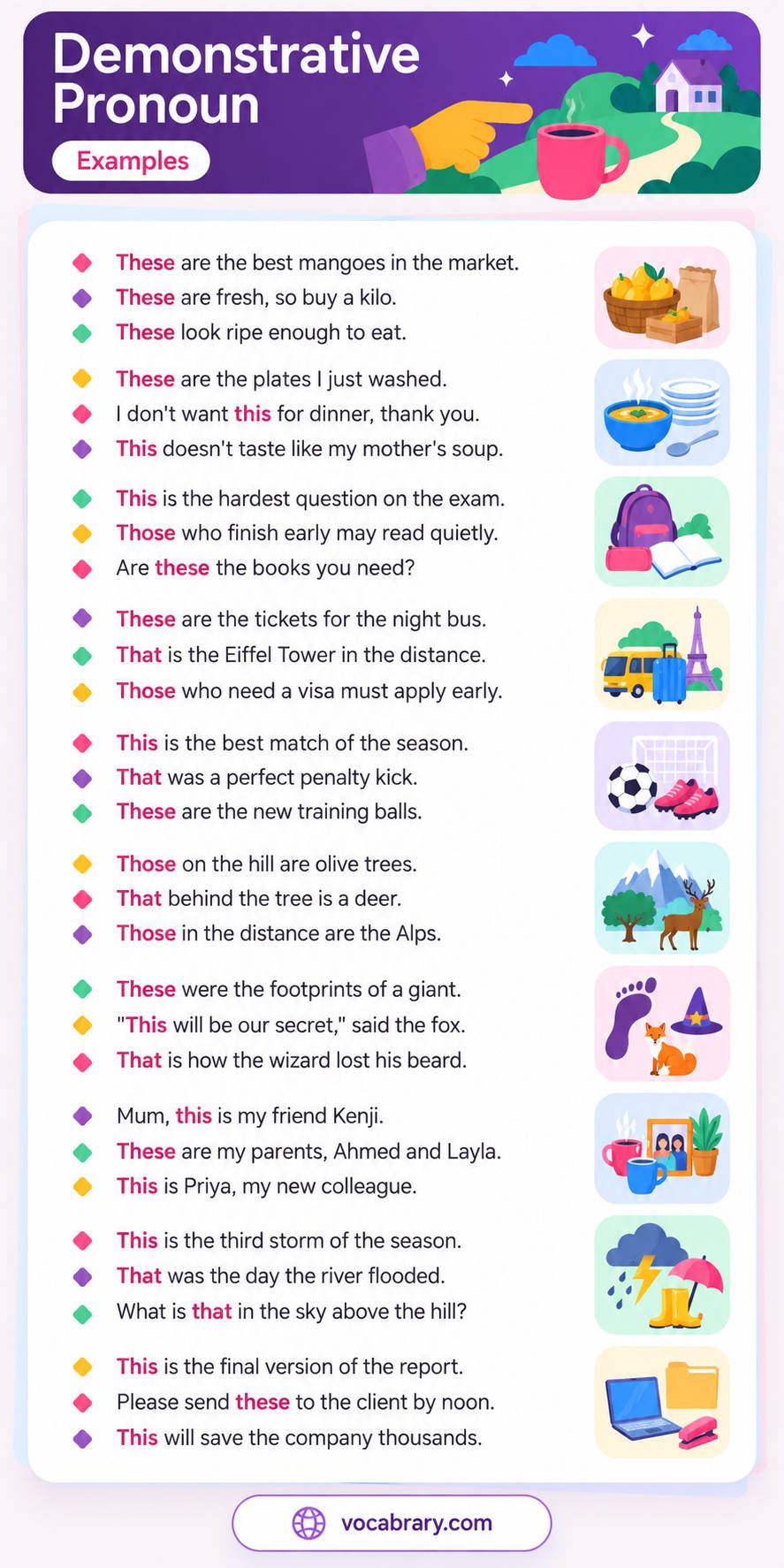
Demonstrative Pronoun Example Sentences for Everyday Use
This is my brother and those were the happiest years of her life are typical models. In each one the demonstrative pronoun replaces a noun and refers to something near or far.
- This is my brother, Daniel, who just arrived from Accra.
- That looks heavy, so let me carry it.
- These are the best mangoes in the market.
- Those were the happiest years of her life.
- I prefer this to anything else in the shop.
- That is exactly what I meant.
- These are mine, and those are yours.
- Is this your umbrella, or did someone else leave it?
- That was the loudest concert I have ever attended.
- Kenji picked up two coats and said, “These are too small.”
- This is going to be a long afternoon.
- Look at that, Dad, before it disappears behind the clouds!
- Those are the mountains we climbed last summer.
- Please hold this while I find my keys.
- That was a wonderful meal, and the dessert was even better.
- These taste better with a little salt.
- This smells delicious, so I want a second helping.
- Can you see that on the horizon?
- Those belong to the family who lives across the road.
- That is the end of the story.
Singular and Plural Forms With Near and Far Examples
This and these refer to what is near the speaker, and that and those refer to what is far. This and that are singular, while these and those are plural.
| Form | Meaning | Example sentence |
|---|---|---|
| This | One person or object that is near | This is my seat. |
| That | One person or object that is far | That is the library across the street. |
| These | Several people or objects that are near | These are my keys. |
| Those | Several people or objects that are far | Those are the lights on the far hill. |
This in a Sentence
This is the house where my grandmother grew up and try this before you decide show this referring to one person or object that is near the speaker in space or in the moment.
- This is the house where my grandmother grew up.
- This costs more than I expected.
- Who made this for the baby, and when did they finish?
- This is the best coffee in town.
- Try this once before you decide which one to buy.
- This is my friend Omar from Cairo.
- This has been the coldest winter in years.
- She handed me an envelope and said, “Open this later.”
- This is not what we agreed on.
- I will never forget this, however long I live.
- This looks like the right road.
- Everything about this feels familiar, as if I had been here before.
Sentences With That
That is my cousin by the fountain and did you hear that in the garden? show that referring to one person, object, or event that is far away or already mentioned.
- That is my cousin standing by the fountain.
- That sounds like a great plan.
- Did you hear that in the garden last night?
- I did not expect that from you.
- That is the school where I studied for six years.
- Don’t touch that; it is hot.
- That was the day the river flooded.
- Who told you that about the new teacher?
- That is the reason I moved to Lisbon.
- That made everyone laugh, even the stern headmaster.
- After that, we walked home in the rain.
- That will be twelve pounds, please.
These Example Sentences
These are the shoes I wore at the wedding and which of these do you want? show these referring to several people or objects that are near the speaker.
- These are the shoes I wore at the wedding.
- These are fresh, so buy a kilo.
- These are my parents, Ahmed and Layla.
- These have been on sale since Monday.
- Which of these do you want?
- These are the keys you were looking for.
- These look ripe enough to eat.
- I borrowed these from the library on Friday.
- These are not cheap, but they last for years.
- Take these with a glass of water.
- These are the reasons I accepted the job.
- These belong in the top drawer.
Those in a Sentence
Those are the neighbours who moved in last week and I would like some of those, please show those referring to several people or objects that are far from the speaker.
- Those are the neighbours who moved in last week.
- Those were the days, and I miss them all.
- Those look more comfortable than mine.
- I would like some of those, please.
- Those are my sister’s boots by the door.
- Are those the mountains you told me about?
- Those at the back are unable to hear the speaker.
- Those were the old tram lines.
- She keeps those in a tin box under her bed.
- Those taste even better with honey.
- Nobody believed those were real diamonds.
- Those are the stars we saw in Chile.
Demonstrative Pronoun Sentences for Near and Far Objects
This and these refer to what is within reach, and that and those refer to what is farther away, as in this by my elbow and that across the river.
Near the Speaker With This and These
This is my seat and these are the plates I just washed refer to what is within reach of the speaker.
- This is my seat, so please sit over there.
- These are the plates I just washed.
- Hold this for a moment while I tie my shoe.
- This in my hand is a rare coin.
- These in the basket are still warm.
- Taste this and tell me what you think.
- This on the desk belongs to Mrs Alvarez.
- These on my plate look delicious.
- This by my elbow is the button you press.
- These inside the box are the old photographs.
Far From the Speaker With That and Those
That over there is the library and those on the hill are olive trees refer to what is at a distance from the speaker.
- That over there is the library.
- Those on the hill are olive trees.
- That across the river is my grandfather’s farm.
- Those by the gate are the new students.
- Is that a satellite on the roof?
- That at the end of the street is the bakery.
- Those far away look like sheep.
- That on the top shelf belongs to my father.
- Those in the distance are the Alps.
- That behind the tree is a deer.
Present and Past Time Sentences With This and That
This is the happiest week of my life and those were the years when we had no television use this and these for the present and that and those for the past.
- This is the happiest week of my life.
- That was the winter we lost the house.
- This will not last long, so enjoy it now.
- Those were the years when we had no television.
- These are difficult times for small farms.
- That was long ago, and nobody remembers it now.
- This is the moment we have waited for.
- Those were hard days, but we survived.
- These are exciting days for the school.
- After the storm, that was all anyone talked about.
- This is only the beginning of a much longer journey.
- That was the last time I saw him.
Sentences for Phone Calls and Introducing People
Hello, this is Maria and Mum, this is my friend Kenji show this naming the speaker or a person nearby. The word that is used for the other person, as in is that you, Tom?
- Hello, this is Maria from the dentist’s office.
- Good morning, this is Mr Okonkwo speaking.
- Is that you, Tom, calling from the station?
- This is Priya, my new colleague.
- Mum, this is my friend Kenji.
- Who is that at the door?
- Hi, this is Sofia, and I am calling about the party.
- Dad, this is Mr Silva, my science teacher.
- Hello, who is this, and why are you calling so early?
- This is Dr Wong’s receptionist calling about your appointment.
- Is that the manager I am speaking to?
- Let me introduce you: this is my sister Hana.
- This is Bilal, and that is his brother Samir.
- Hello, is that Omar’s phone, or have I dialled wrongly?
Those Who Example Sentences
Those who arrive early get the best seats and we honour those who served in the war use those to mean people in general, followed by a relative clause that says which people.
- Those who arrive early get the best seats.
- Those who help others are remembered kindly.
- We honour those who served in the war.
- Those who forget the past repeat it.
- The prize goes to those who finish the course.
- Pity those who must travel in this storm.
- Those who live near the river were warned about the flood.
- Thanks to those who donated blood last week.
- Those who were present at the meeting voted in favour.
- Speak slowly for those who are learning English.
Comparison Sentences With That of and Those of
The climate of Spain is warmer than that of Norway and the prices in Tokyo are higher than those in Lisbon use that and those to avoid repeating a noun. That replaces a singular noun, and those replaces a plural noun.
- The climate of Spain is warmer than that of Norway.
- Her handwriting is neater than that of her brother.
- The prices in Tokyo are higher than those in Lisbon.
- The population of India is larger than that of Canada.
- His grades are better than those of most students in the class.
- The roof of the school is older than that of the library.
- The tallest buildings in Dubai are taller than those in London.
- The cost of living here is lower than that of the capital.
- Her voice is stronger than that of any other singer in the choir.
- The wages of nurses rose faster than those of teachers.
Where Demonstrative Pronouns Stand in Sentences
A demonstrative pronoun works as a subject, an object, a complement, or the object of a preposition, as in this costs ten pounds, I like that, the best part is this, and look at those.
Subject Position Sentences
This belongs to the new student and those need to be washed before dinner put the pronoun before the verb, where it is the subject.
- This belongs to the new student.
- That fell off the shelf during the night.
- These arrived by post this morning.
- Those need to be washed before dinner.
- This will take about an hour.
- That happened on the day of the final.
- These are growing faster than the others.
- Those along the north wall need repairs before winter.
- This costs ten pounds, but the larger one costs twenty.
- That makes me very proud of everything you have achieved.
Object Position Sentences
I like this very much and Elena bought these at the airport put the pronoun after the verb, where it receives the action.
- I like this very much, so I will buy it.
- Elena bought these at the airport.
- Nobody noticed that until the inspector arrived on Friday.
- Please take those to the kitchen.
- She hates this about winter, the dark mornings above all.
- Dad repaired that with a single screw.
- We ordered these last week, and they arrived today.
- Have you read this yet, or should I send it again?
- I remember that clearly, because it happened on my birthday.
- Nadia painted those herself, using colours from the market.
Sentences With the Pronoun After a Preposition
Don’t worry about that and look at those put the pronoun after a preposition, where it is the object of that preposition.
- Don’t worry about that, because I will fix it tonight.
- She is proud of this, her first finished painting.
- Look at those on the shelf!
- I agree with that entirely, and so does my sister.
- We argued about this all evening.
- He paid for these in cash.
- Nobody argues with that after seeing the final results.
- Our region is known for these.
- The coach spoke about this before the match.
- Thank you for that, because it saved me an hour.
- You must be careful with these.
- Listen to this before we make our final decision.
Complement Position Sentences
The best part is this and my favourite shoes are these put the pronoun after a linking verb, where it renames the subject.
- The best part of the trip is this: nobody has to cook.
- My favourite shoes for running in the rain are these.
- All I wanted for my birthday was that.
- Her answer was this: she would never return.
- The winners of the spelling contest are these, on the stage.
- My real reason for leaving early is this: I am exhausted.
- The cheapest tickets for the evening show are those.
- What I mean is this: we need more time.
Sentences Where This and That Stand Alone
I like this and I like this coat use the same word with different jobs. The pronoun stands alone, and the adjective describes a noun, as the demonstrative adjective example sentences illustrate.
- I like this, and Mia likes that.
- Ravi chose these, and Lena chose those.
- These are ripe, so pick them up today.
- Which is cheaper, this or that?
- Those in the red box belong to my aunt.
- Those are the boots I wanted, not these.
- Who owns that in the corner of the garden?
- Nobody wanted this, so Omar took that.
- Please read this to the class before the bell rings.
- Please read that aloud to the whole class, Sam.
Negative Sentences With This and That
This is not my coat and I don’t want this show a negative word with the verb, while the demonstrative pronoun stays in its usual place as subject or object.
- This is not my coat, so please check the label.
- That will not solve the problem.
- These are not ripe yet, so we must wait.
- Those were not the shoes I ordered.
- I don’t want this for dinner, thank you.
- That isn’t fair, and everyone in the room knows it.
- Nobody believed those who said the bridge was safe.
- This doesn’t taste like my mother’s soup.
- Those aren’t mine, so please ask in the office.
- I never said that to anyone in the office.
Question Sentences With Demonstrative Pronouns
Is this your phone? and whose are those? put the verb before the pronoun in a yes or no question, and a question word opens the others.
- Is this your phone, or does it belong to Ali?
- What is that in the sky above the hill?
- Are these the books you need?
- Who left those on the stairs?
- Did you write that yourself, or did someone help you?
- How much are these at the stall by the entrance?
- Whose are those on the stairs, and why are they wet?
- Is that why you left early?
- Does this belong to you, or should I take it to the office?
- Which of these is yours, the red one or the blue one?
Reported Speech and Passive Voice Example Sentences
In reported speech, this becomes that and these becomes those when the object is no longer near, as in she replied that that was the best cake. In passive sentences, the pronoun is the subject, as in these were built in the 1920s.
Reported Speech Sentences With This and Those
Tom told me those were his grandfather’s medals and Mum remarked that that was the last biscuit show demonstrative pronouns inside a clause after a past reporting verb, where the verb moves back in tense.
- She replied that that was the best cake she had ever tasted.
- Tom told me those were his grandfather’s medals.
- The guide explained that these were the oldest stones in the village.
- Mum remarked that that was the last biscuit.
- The clerk replied that this was the right form.
- He admitted that that had been his mistake.
- The teacher announced that these would be graded by Friday.
- She told us those were her favourites.
Passive Voice Sentences With Demonstrative Pronouns
This was painted by my grandmother and these were built in the 1920s use the demonstrative pronoun as the subject of a passive verb.
- This was painted by my grandmother.
- That was decided last week by the school board.
- These were built in the 1920s.
- Those are sold only in the north.
- This is made from recycled paper.
- That was taught to me by a neighbour.
- These are cleaned every morning before the shop opens.
- Those were delivered yesterday by a courier from Leeds.
Sentences About Home and Family Life
Old photographs, Grandma’s soup on the stove, and a mother’s reading glasses are typical household cases for demonstrative pronouns. The pronouns refer to objects and people inside a house.
- This is the room where we keep the old photographs.
- That on the stove is Grandma’s famous soup.
- These are my mother’s reading glasses.
- Dad said those needed fresh paint.
- This smells like cinnamon, which my grandmother always used.
- Please put these in the fridge.
- That is the sound of the washing machine.
- Whose are those by the sofa?
- This is cosy, so let us stay here all afternoon.
- Mum keeps these in the top drawer.
Sentences About Exams, Notes and Classmates
The hardest exam question, a missed set of notes, and a new classmate named Amir are typical school cases. The pronouns refer to a task, a person, or a place in the school day.
- This is the hardest question on the exam.
- These are the notes you missed on Monday.
- That is Mrs Evans’s classroom, at the end of the corridor.
- Please hand in these by Friday.
- Those who finish early may read quietly.
- This will be on the test.
- Those on the board are the homework tasks.
- That was the best presentation of the term.
- I forgot these at home, so I must go back.
- This is Amir, our new classmate.
Office Sentences About Reports and Invoices
The final version of a report, a stack of March invoices, and a colleague from the sales team are typical office cases for demonstrative pronouns. The pronouns refer to a document, a person, or a decision.
- This is the final version of the report.
- That needs the manager’s signature before it goes to the client.
- These are the invoices from March.
- Those in accounting will check the figures.
- This is Kavita from the sales team.
- Please send these to the client by noon.
- That was an excellent pitch, and the client loved it.
- Those are the new security badges.
- This will save the company thousands.
- That is not my department’s job.
Travel Sentences About Platforms and Landmarks
A platform, a train, and the Eiffel Tower in the distance are typical travel cases for demonstrative pronouns. The pronouns refer to a ticket, a landmark, or a vehicle.
- This is our platform, and that is our train.
- These are the tickets for the night bus.
- That is the Eiffel Tower in the distance.
- Those are the mountains we will cross tomorrow.
- This is the best view in the whole valley.
- Please show these at the gate.
- That looks like our hotel, the one with the green roof.
- Those who need a visa must apply early.
- This is Gate 12, where our flight leaves.
- That was the smoothest flight of my life.
News Report Sentences With This and That
The third storm of the season, the final election results, and the people affected by a flood are typical news cases for demonstrative pronouns. The pronouns refer to an event, a fact, or a group.
- This is the third storm of the season.
- That was the biggest protest in the city for years.
- These are the final results of the election.
- Those affected by the flood will receive help.
- This has been confirmed by two independent sources.
- Officials said that was a serious mistake.
- These are the facts as the police describe them.
- That will be debated in parliament next week.
- Those who lost their jobs will be retrained.
- This marks the longest drought on record.
Story Dialogue Sentences About Castles and Doors
A forgotten castle, a fox with a secret, and a lighthouse that went dark are typical story cases for demonstrative pronouns. The pronouns refer to an object, a night, or a character in the plot.
- “This is where the story begins,” said the old sailor.
- “That is no ordinary door,” whispered the child.
- These were the footprints of a giant.
- Those were the last words the king ever spoke.
- “This will be our secret,” said the fox.
- That was the night the lighthouse went dark.
- Those in the cellar had not seen daylight for years.
- These are the keys to the forgotten castle.
- That is how the wizard lost his beard.
- “This is not the end,” thought Anna.
Sports Sentences About Matches and Penalty Kicks
The best match of the season, a perfect penalty kick, and the coach by the net are typical sports cases for demonstrative pronouns. The pronouns refer to a play, a person, or a piece of equipment.
- This is the best match of the season.
- That was a perfect penalty kick.
- These are the boots I wore in the final.
- Those in the front row have the best view.
- This will decide the championship between the two oldest clubs.
- That was the fastest lap of the race.
- These are the new training balls.
- Those who run daily build stamina quickly.
- That is the coach standing by the net.
- This is where the marathon begins.
Health Sentences About Pills and Coughs
The pills taken with food, a nasty cough, and the clinic where a mother works are typical health cases for demonstrative pronouns. The pronouns refer to a treatment, a symptom, or a place.
- This will help you sleep better during the night.
- That sounds like a nasty cough.
- These are the pills you take with food.
- Those who smoke face a higher risk of heart disease.
- This hurts when I bend my knee.
- That is normal after a long run.
- These should be kept in a cool, dry place.
- Those with allergies should carry medicine.
- This is the clinic where my mother works.
- That was the best advice my doctor ever gave me.
Demonstrative Pronoun Example Sentences for Kids
Demonstrative pronoun example sentences for beginners are short, such as this is my dog and those are clouds. They teach that this and these are near and that and those are far.
- This is my dog.
- That is a big tree.
- These are my toys.
- Those are clouds.
- What is this?
- That is Mum’s car.
- I like these!
- Those are my friends.
- This is yummy.
- Wow, look at that, Dad!
- Are these yours?
- This is my school bag.
Sentences With Demonstrative Pronouns for Students and Exams
Demonstrative pronoun example sentences for exams are longer, such as this demonstrates that the policy failed and the effects of inflation are greater than those of unemployment. They are written for essays, where that and those replace a noun in a comparison.
- This demonstrates that the policy failed within two years.
- That supports the theory proposed by the earlier study.
- These are the main causes of the war, according to the author.
- Those who criticise the treaty ignore its economic benefits.
- This contradicts the claim made in the opening chapter.
- The effects of inflation are greater than those of unemployment.
- That is why historians still debate the cause of the collapse.
- These are only preliminary results, and further tests are required.
- The unemployment rate of the north exceeds that of the south.
- This raises a serious question about the accuracy of the data.
- Those who study ancient trade routes find surprising connections.
- That explains the sudden fall in sales.
Short Paragraphs With Demonstrative Pronouns
Running text about a market stall, a phone call, old photographs, and two harbours uses this, that, these, and those, so these demonstrative pronoun example sentences form connected writing.
At the market, Rosa lifted two melons. “These are heavy,” she said, “but those on the next stall look sweeter.” The seller smiled. “That is my best fruit, and this is my brother’s.”
The phone rang at noon. “Hello, this is Ahmed. Is that Dr Rao?” “Yes, this is Dr Rao.” “That is a relief, because I need your advice.”
Grandpa showed us old photographs. “These were taken in 1960,” he said. “Those were the years when the town had a cinema. This is the cinema, and that is the street where it stood.”
The harbour of the north is busier than that of the south. The ships in the north are larger than those in the south. This explains the difference in price, and those who ship goods choose the north.
Demonstratives as Pronouns and Adjectives Compared
This, that, these, and those work as pronouns and as adjectives, and the difference is the noun that follows. The pronoun stands alone, while the adjective describes a noun and is covered in the demonstrative adjective example sentences.
| Feature | Demonstrative pronoun | Demonstrative adjective |
|---|---|---|
| Job in the sentence | Replaces a noun | Describes a noun that follows |
| Noun after it | None | A noun follows |
| Position | Alone as subject, object, or complement | Before a noun |
| Singular sample | This is mine. | This book is mine. |
| Plural sample | These are mine. | These books are mine. |
FAQs
Q1. What are the demonstrative pronouns in English?
The demonstrative pronouns in English are this, that, these, and those, the four words in demonstrative pronoun example sentences. This and that are singular, while these and those are plural. Each one stands alone in place of a noun and refers to something near or far.
Q2. When do you use this and that?
This refers to one person or object that is near the speaker, and that refers to one that is far away. In This is my seat, the seat is within reach, and in That is the library, the library is across the street. Distance in time works the same way, so this is the week of the final is the current one and that was the year we moved is past.
Q3. What is the difference between these and those?
These and those are the plural forms of this and that, and they follow the same contrast between near and far. These refers to several objects near the speaker, as in These are my keys, and those refers to several objects far away, as in Those are the mountains. Both take a plural verb such as are or were.
Q4. What is the difference between a demonstrative pronoun and a demonstrative adjective?
A demonstrative pronoun stands alone in place of a noun, while a demonstrative adjective stands before a noun and describes it. I like this uses a pronoun, and I like this coat uses an adjective. The demonstrative adjective example sentences show the second use.
Q5. Can a demonstrative pronoun refer to a person?
A demonstrative pronoun refers to a person in introductions, on the phone, and in questions of identity. Examples are This is my sister and Who is that? Outside those uses, a personal pronoun such as she or they names a person, except that those who names people in general.
Q6. How do you use this and that on the phone?
On the phone, a speaker names himself or herself with this and asks about the other person with that. A caller says Hello, this is Maria, and British callers ask Is that Mr Davies? and American callers ask Is this Mr Davies? for the same purpose.
Q7. What does those who mean?
Those who means the people who, and it begins a general statement about a group. In Those who arrive early get the best seats, those refers to people, and who is a relative pronoun that starts the clause. The clause itself is covered in the relative pronoun example sentences.
Q8. What does that of mean in a comparison?
That of and those of replace a repeated noun in a comparison, so the noun is not repeated. In The climate of Spain is warmer than that of Norway, that stands for the climate. Use that of for a singular noun and those of for a plural noun.
Q9. Do demonstrative pronouns change in reported speech?
Demonstrative pronouns change in reported speech when the distance from the speaker changes. After a past reporting verb, this becomes that and these becomes those when the object is no longer near. Tom said, “These are mine” becomes Tom said those were his.
Q10. Can a demonstrative pronoun be the subject of a sentence?
A demonstrative pronoun works as a subject, an object, or a complement, and it also follows prepositions. This belongs to Ravi uses it as a subject, I like that uses it as an object, and The best part is this uses it as a complement. After a preposition, as in Look at those, it is the object of that preposition.
Q11. Do demonstrative pronouns take singular or plural verbs?
A verb agrees with a demonstrative pronoun in number, so this and that take singular verbs, and these and those take plural verbs. This is ready and These are ready show the pairs. The past forms follow the same agreement, as in That was late and Those were late.
Q12. How do demonstrative pronouns show time?
Demonstrative pronouns show time through the same near and far contrast that they show in space. This and these refer to the present, as in This is the week of the final. That and those refer to a past or distant time, as in Those were the years we lived abroad. The choice depends on whether the speaker treats the time as present or past.

Leave a Comment