
An uncountable noun is a noun that denotes a substance or a quality as an undivided mass, so it has no plural form in that meaning, as in water and advice. Such a noun cannot be counted directly, so a unit phrase supplies the number: two glasses of water and a piece of advice. The verb stays singular throughout, as in the news is good. Uncountable noun example sentences join such nouns to quantity words like some and much and to unit phrases, starting with liquids and materials.
What Is an Uncountable Noun?
An uncountable noun, also called a mass noun, names something that is measured or taken as a whole instead of counted one by one. A countable noun names separate items, so chair has the plural chairs, while furniture has no plural at all.
Quantity word + uncountable noun + singular verb
There is some water in the jug, and the news is good.
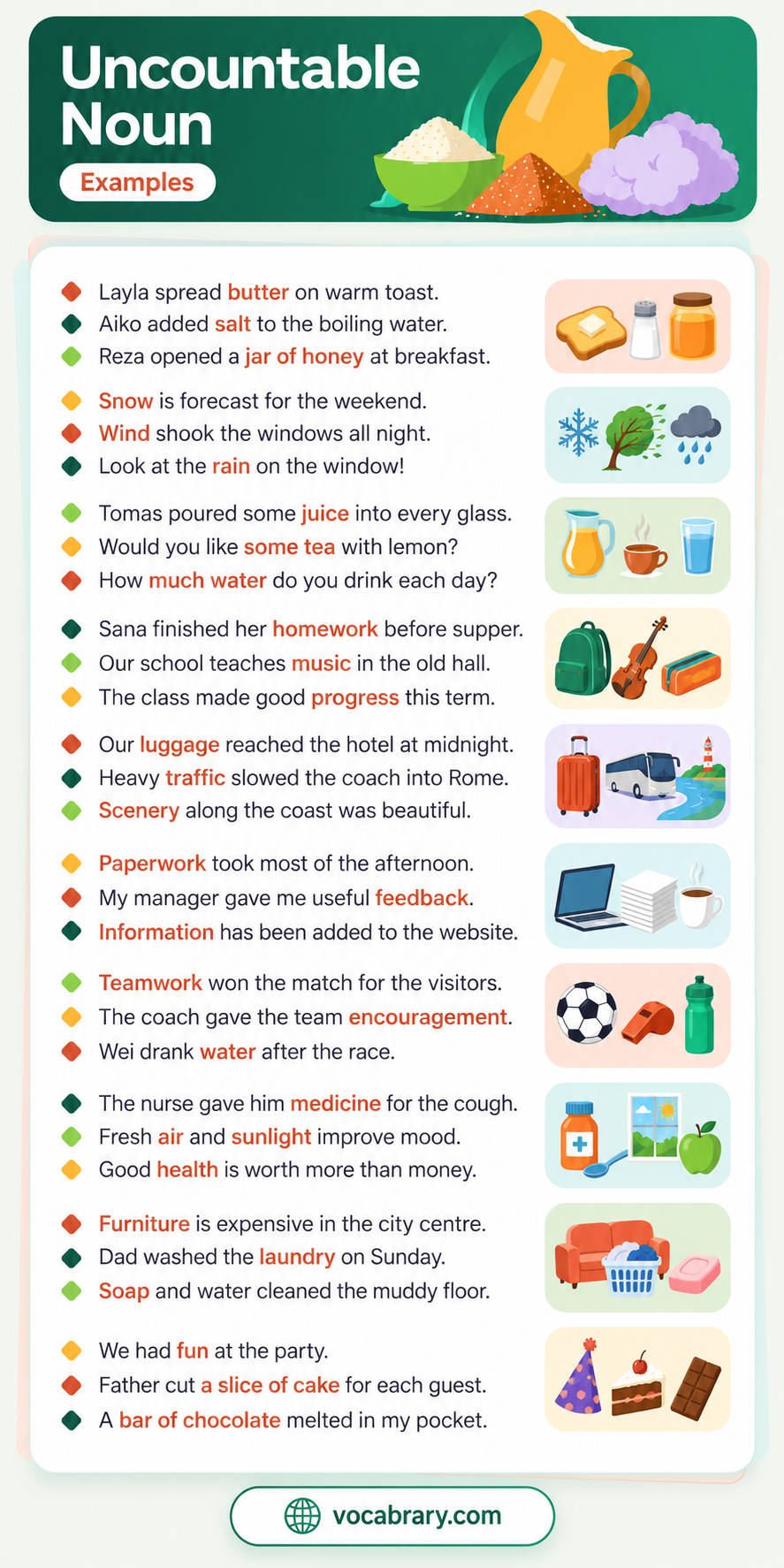
Common Uncountable Noun Example Sentences
Water, milk, advice, and money are the nouns met first in lessons on mass nouns, and each one names a mass that a speaker does not count one by one. Uncountable noun example sentences begin with these everyday words.
- Water covers most of the Earth’s surface.
- The children drank milk with their breakfast.
- Ravi gave me some good advice about renting a flat.
- Information about the bus times is posted at the station.
- Our furniture arrived on a lorry from Gdansk.
- She packed too much luggage for a weekend in Lisbon.
- Knowledge grows when people share what they learn.
- I have a lot of homework tonight.
- The news from the village was good.
- Traffic was heavy on the bridge this morning.
- The weather turned cold in the afternoon.
- We bought new equipment for the science laboratory.
- Tomas poured some juice into every glass.
- Rice is the main food in many parts of Asia.
- There was not enough sugar in the cake.
- Music filled the hall before the speeches began.
- Mei needs some help with her application.
- Fresh air made the patients feel better.
- Money cannot buy back lost time.
- The police found evidence near the river.
- Honey keeps for years in a closed jar.
- Her work impressed the whole committee.
- We saw snow on the mountains in April.
- Bread smells wonderful when it is fresh from the oven.
Sentences About Liquids Like Water and Oil
Water, oil, coffee, and petrol are liquids that take the shape of their container, so a speaker measures them in litres, cups, or bottles and does not count them as single items.
- The farmer carried water to the animals twice a day.
- Oil floats on top of vinegar in the salad dressing.
- Hana drinks coffee before every early lesson.
- Petrol became more expensive after the new tax.
- Spilled juice stained the white tablecloth.
- The soup needs more stock and a little salt.
- Heavy rain filled the ditches along the road.
- Is there any milk in the fridge?
- Blood carries oxygen around the human body.
- Carlos wiped the ink off his fingers with a wet cloth.
- Hot tea is the first thing my grandmother offers every guest.
- Nobody finished the lemonade because the evening turned cold.
Material and Substance Sentences With Gold and Wood
Gold, wood, glass, and cotton are materials that name what an object is made of, and each one stays uncountable until a speaker names a finished object such as a ring. They belong to the wider class of material nouns.
- The jeweller melted gold into a thin bar.
- Wood from the old barn was used for the new fence.
- Windows are made of glass, and it breaks easily.
- This shirt is made of soft cotton from Egypt.
- Steel holds the roof of the stadium in place.
- Workers poured concrete for the new bridge.
- Fine sand blew across the road during the storm.
- Her bracelet is made of silver, not of plastic.
- Wool keeps shepherds warm on cold hills.
- The potter pressed wet clay into the mould.
- Cement dries slowly in damp weather.
- The sculptor chose marble from a quarry in Carrara.
- Leather from the local market was cheap but strong.
- Paint and dust covered the floor of the old studio.
Food Sentences With Rice and Bread
Rice, bread, cheese, and butter are food mass nouns, because a cook spoons, slices, or weighs them instead of counting individual pieces. Names for single dishes, such as a sandwich, are countable.
- Rice is cooked in salted water for twelve minutes.
- Layla spread butter on warm toast.
- We bought cheese from a market stall in Lyon.
- Fresh bread disappears quickly in our house.
- The recipe calls for flour, eggs, and a little milk.
- Pasta is on the menu every Friday.
- Aiko added salt to the boiling water.
- Is there any chocolate left in the cupboard?
- Meat costs more than vegetables in this town.
- The baby refused to eat porridge for breakfast.
- Too much sugar spoils the taste of the sauce.
- Grandpa put honey in his tea every morning.
Sentences With Advice and Information
Advice, information, knowledge, and evidence name what a person gives, finds, or knows, and none of these nouns takes a plural in standard English.
- My teacher gave me advice that I still remember.
- The website offers free information on healthy eating.
- Her knowledge of birds surprised the whole class.
- The detective needs more evidence before an arrest.
- Research into the disease continued for ten years.
- The doctor offered useful guidance to the new parents.
- Nobody had any proof that the letter was a forgery.
- Years of experience made him a patient teacher.
- Feedback from the customers improved the new menu.
- She shared her wisdom with the younger players.
- Where can I find information about night trains to Vienna?
- Good advice is worth more than a gift.
Furniture and Luggage in Collective Noun Sentences
Furniture, luggage, equipment, and clothing are collective mass nouns that name a whole set of objects at once. The separate objects inside the set, such as a chair or a bag, are countable, but the set itself is not.
- The shop sells modern furniture at low prices.
- All our luggage was lost on the way to Nairobi.
- The gym buys new equipment every spring.
- Warm clothing is necessary on the northern ferry.
- Jewellery was displayed behind the glass counter.
- The postman brought a lot of mail this morning.
- Heavy machinery blocked the narrow village road.
- Rania packed all the baggage into the boot.
- The museum stores old cutlery in locked drawers.
- Garbage is collected from our street on Mondays.
- The charity collects used clothing for refugees.
- Cheap equipment often breaks within a year.
Sentences About Weather and Traffic
Weather, traffic, thunder, and sunshine name conditions that cover a place and a period of time instead of existing as separate items. Each one takes a singular verb.
- The weather is mild in Seville in March.
- Heavy traffic delayed the wedding guests by an hour.
- Thunder frightened the dog during the night.
- Sunshine warmed the empty beach all morning.
- Lightning struck the tower twice last summer.
- Thick fog closed the airport in Hamburg.
- Wind shook the windows all night.
- Snow is forecast for the weekend.
- Clean air is scarce in a crowded city.
- Electricity returned to the village after four hours.
Language and School Subject Sentences With English and Music
English, French, mathematics, and music are language and subject names that stay singular and uncountable. As school subjects, mathematics, physics, and economics end in -s but take singular verbs.
- English is spoken in more than one country.
- Amira studies French every evening after dinner.
- Mathematics is the hardest subject for my brother.
- Physics explains why the bridge stays standing.
- Our school teaches music in the old hall.
- Economics was Luis’s favourite course at university.
- Chemistry begins with a long list of symbols.
- Her Japanese improved after a year in Kyoto.
- History was taught by a retired soldier.
- Geography helps pupils read maps of unfamiliar countries.
News and Homework Sentences With Singular Verbs
In the meanings used here, news, homework, work, and progress have no plural, and each takes a singular verb. The word news ends in -s, yet it is singular.
- The news is on at six every evening.
- Bad news travels faster than good news.
- Sana finished her homework before supper.
- Work begins at eight in the new office.
- The class made good progress this term.
- There was no news from the camp for two days.
- Do we have any homework for Friday?
- Housework takes up most of Saturday morning.
- Overtime work is paid at a higher rate.
- Dev found work in a bakery near the station.
Quantity Word Sentences for Uncountable Nouns
Quantity words show how much of a mass is present. Much, little, and less combine with uncountable nouns, while many, few, and fewer combine with plural countable nouns. Some and any combine with both kinds.
Sentences With Much and Little
Much and little measure a mass, as in how much water or too much salt. Much occurs mainly in questions, in negatives, and after too, so, and as, and little means almost none.
- How much water do you drink each day?
- There is not much traffic on Sundays.
- Too much salt ruined the soup.
- We have so much homework this week.
- Zara did not spend much money on the trip.
- Little progress was made at the meeting.
- The village has little water in August.
- There is not much sunshine in January here.
- As much food as possible was packed into the van.
- He showed little interest in the new equipment.
- How much luggage is each passenger allowed?
- There was little hope of finding the keys.
- Not much news came from the island.
- The sandwich had too much butter in it.
A Little and Enough in Sentences
A little sugar, less water, and enough bread name three amounts: a small amount that exists, a smaller amount than before, and the amount needed.
- Add a little sugar if the tea tastes bitter.
- Could I have a little milk, please?
- We spend less time together since he changed jobs.
- Use less water when you wash the car.
- There is enough bread for everyone.
- Less traffic passes through the town since the bypass opened.
- She drinks less coffee than she did last year.
- Have we got enough rice for twelve people?
- Eat less sugar and more fruit.
- I have a little time before the next train.
- There is less snow on the hills this winter.
Some and Any in Sentences
Some tea in an offer and some bread in a statement show the first use, while any rice in a negative and any news in a question show the second. Any also means no matter which, as in any help at all.
- Would you like some tea with lemon?
- Tomas bought some bread on the way home.
- We do not have any rice left.
- Is there any news from the hospital?
- I need some advice about my visa.
- She did not give any information to the reporter.
- Could you lend me some money until Friday?
- Any help will be welcome on Saturday.
- Have you got any homework today?
- There was some cloud over the mountain, but no rain.
- Nobody brought any water to the picnic.
- Please add some salt to the soup.
- I cannot find any evidence of a break-in.
- Do you want some music while you cook?
A Lot of and Plenty of in Positive Sentences
A lot of water and plenty of room show the quantity phrases that work in positive sentences, where much sounds formal.
- We drank a lot of water during the hike.
- There is plenty of room in the back of the car.
- Dilnoza has lots of work to finish before Friday.
- The shop sells a lot of furniture from Sweden.
- Plenty of time remains before the train leaves.
- Nadia collected a lot of information for her essay.
Sentences With Unit Phrases Such as a Piece of
Unit phrases let a speaker count a mass: a piece of advice, a bottle of water, a slice of bread, and a bit of luck each name one measured portion. The noun after of stays uncountable, and only the unit word takes a plural.
| Unit phrase | Used with | Example |
|---|---|---|
| A piece of | Advice, news, furniture, equipment | One piece of advice saved the project. |
| A bit of | Luck, fun, time, help | A bit of luck changed the match. |
| A bottle of | Water, milk, oil, juice | A bottle of water cost one euro. |
| A slice of | Bread, cake, pizza, lemon | A slice of cake cost two pounds. |
| A loaf of | Bread | A loaf of bread lasted two days. |
| A grain of | Rice, sand, salt | A grain of sand stopped the lock. |
A Piece of and a Bit of With Advice
A piece of goes with advice, news, furniture, and equipment, while a bit of is the informal choice for luck, fun, time, and help. Both phrases turn a mass into one countable portion.
- Let me give you a piece of advice.
- That was a piece of good news.
- The new flat has only one piece of furniture.
- Each athlete carries a piece of equipment onto the pitch.
- A bit of luck saved us at the border.
- Can you spare a bit of time tomorrow?
- The trip was a bit of fun after a hard term.
- Dara asked for a bit of help with the boxes.
- She wrote the answer on a piece of paper.
- Two pieces of luggage were missing from the flight.
- I heard a piece of news that surprised me.
- Add a bit of salt, but not too much.
- Mr Okafor gave the class three pieces of advice before the exam.
- The inspector found a piece of evidence in the garage.
A Bottle of and a Slice of With Drinks
Containers such as a bottle, a cup, and a carton, and portions such as a slice, a loaf, and a bar, measure liquids and foods. A drop, a gust, a clap, and a bolt measure weather and nature.
- Hugo carried a bottle of water up the hill.
- She drank a cup of tea and read the newspaper.
- I bought a carton of milk and a loaf of bread.
- Father cut a slice of cake for each guest.
- A loaf of bread costs more than it did last year.
- The recipe needs a spoonful of sugar.
- A single drop of rain hit the window.
- A gust of wind blew the papers off the desk.
- We heard a clap of thunder over the valley.
- A bolt of lightning lit the sky for a second.
- Please bring a glass of water to the speaker.
- The baker sold a bag of flour to every customer.
- A bar of chocolate melted in my pocket.
- Add a pinch of salt to the dough.
- A sheet of paper fell from the folder.
- Reza opened a jar of honey at breakfast.
- A grain of rice stuck to the spoon.
- Beatriz needed a tube of toothpaste from the chemist.
Uncountable Noun Sentences With No Plural or Article
An uncountable noun has no plural form in its mass meaning and takes neither a nor an, because both words mark exactly one countable item. A speaker writes advice, never advices, and luggage, never luggages.
- Advice costs nothing, and good advice is rare.
- Her luggage is heavier than mine.
- We need equipment for the whole team.
- Furniture is expensive in the city centre.
- Nobody wrote down the information on the board.
- Everyone enjoyed the music at the wedding.
- Progress is slow in a large project.
- Mina left her homework on the bus.
- The traffic was calm after midnight.
- He wanted peace and quiet after the long flight.
- The weather in Norway changes quickly.
- Laughter is good for the heart.
Singular Verb Sentences With Uncountable Nouns
The furniture is old, the advice was kind, and the traffic moves slowly, because an uncountable subject takes a singular verb such as is, was, has, or a present tense form ending in -s.
- The furniture is old, but it is comfortable.
- Her advice was kind and practical.
- Traffic moves slowly at five o’clock.
- The news was a shock to the whole street.
- Information has been added to the website.
- The equipment needs repair after the storm.
- The weather has improved since Monday.
- Water boils at one hundred degrees Celsius.
- Luggage is checked before passengers start boarding.
- Mathematics was my favourite lesson as a child.
- The homework takes about an hour.
- Her jewellery is kept in a safe.
- Money was tight in our house that winter.
Paper and Glass Sentences With Two Meanings
Paper, glass, hair, and chicken are uncountable when they name a material or a mass. They are countable when they name a separate object, such as a newspaper, a drinking glass, one strand, or a whole bird.
- I need paper for the printer. (material)
- Zoltan reads a paper on the train every morning. (newspaper)
- Glass cuts the skin easily. (material)
- Pour the juice into a glass. (container)
- Her hair was long and dark. (all the hair)
- Ines found a hair in her soup. (one strand)
- We ate chicken and rice for dinner. (meat)
- Grandpa keeps a chicken in the garden. (bird)
- Time passes quickly in good company. (general)
- We met three times last month. (occasions)
- Experience is the best teacher. (general)
- It was an experience I will never forget. (event)
- Cats need light to hunt at dusk. (illumination)
- A light was left on in the hall. (lamp)
- Coffee grows in Ethiopia and Brazil. (substance)
- Two coffees, please, one with milk. (cups)
Sentences for Uncountable Nouns in Different Positions
An uncountable noun fills the same positions as any other noun, namely subject, object of a verb, and object of a preposition.
Subject Sentences With Honesty and Sunshine
Honesty and sunshine are uncountable subjects, and the verb that follows each one is singular.
- Honesty is the best policy in business.
- Sunshine brightened the whole kitchen by seven.
- Luggage must be weighed at the desk.
- Rice grows well in warm, wet fields.
- Pollution has damaged the river and its fish.
- Silence followed the announcement of the closure.
Object Sentences With Water and Evidence
Water after drank and evidence after needs show the object position, where a verb such as drink, need, buy, or give takes the mass as its object.
- Wei drank water after the race.
- The committee needs evidence before a decision.
- Mother bought flour at the market.
- The coach gave the team encouragement.
- Please bring paper to class tomorrow.
- Sven offered us tea and biscuits.
Patience and Sugar After Prepositions in Sentences
Prepositions such as with, for, of, and without take an uncountable noun as their object in phrases like with patience and without sugar.
- Aziza worked with great patience on the puzzle.
- Coffee without sugar tastes bitter to me.
- They searched for water in the desert.
- The room was filled with laughter.
- The village depends on tourism and fishing.
- He answered every question with complete honesty.
- This bread is made of flour and water.
- A map is useful for navigation.
Negative Sentences With No and Not Any
Not, no, and never turn an uncountable statement into a negative. No stands directly before the noun, as in no water, while not combines with any or much, as in not much traffic.
- There is no water in the well.
- We did not hear any news about the flight.
- She has no experience with horses.
- He never gives advice to strangers.
- There was not much traffic at dawn.
- Nobody offered help to the stranger.
- The old house has no furniture.
- I do not drink coffee after noon.
Question Sentences With How Much and Any
Questions about a mass use how much, any, or another question word such as where and what. How much asks for an amount, and how many does not fit an uncountable noun.
- How much rice should I cook?
- Is there any cream in the jug?
- Do you need any help with the suitcase?
- Where did you buy this furniture?
- How much time do we have?
- What will the weather be like tomorrow?
- Did you get any sleep on the flight?
- Has any news arrived from the camp?
Uncountable Nouns in Reported Speech and Passive Sentences
In reported speech the uncountable noun keeps its form and its singular verb, and in a passive sentence it becomes the subject, as in the luggage was delivered.
- Mrs Aziz said that the traffic was terrible.
- He told us that the news had spread fast.
- The teacher asked whether we had finished our homework.
- The luggage was delivered to the wrong hotel.
- Evidence was collected from the scene.
- All the equipment has been checked by the engineers.
- She explained that the weather would improve by noon.
- Fresh bread is baked every morning.
Uncountable Nouns in Everyday Contexts
Home, school, work, travel, news, fiction, sports, and health each use a typical group of uncountable nouns, such as furniture at home, homework at school, and equipment at work. Uncountable noun example sentences for each setting follow the same singular verb pattern.
Sentences About Laundry and Furniture
Furniture, laundry, soap, and electricity are the mass nouns of a household.
- Dad washed the laundry on Sunday.
- The kitchen is full of fresh bread and butter.
- We saved electricity by turning off the lights.
- She bought new furniture for the living room.
- Soap and water cleaned the muddy floor.
- Mum says cleanliness matters in a kitchen.
Homework and Knowledge in School Sentences
Homework, knowledge, chalk, and help belong to the classroom.
- Our teacher collects homework every Monday.
- Knowledge of grammar steadily improves a pupil’s writing.
- The pupils sang with great enthusiasm.
- Chalk dust covered the old desk.
- Marek lacked confidence in maths until the third term.
- The school offers help with reading.
Work Sentences With Paperwork and Equipment
Feedback, paperwork, equipment, and overtime pay belong to the office.
- The company ordered new equipment for the warehouse.
- Paperwork took most of the afternoon.
- My manager gave me useful feedback.
- Applicants need some experience in sales or marketing.
- The team earned respect for the quick repair.
- Overtime pay is included in the contract.
Luggage and Scenery in Travel Sentences
Luggage, scenery, traffic, and information appear in travel.
- Our luggage reached the hotel at midnight.
- Scenery along the coast was beautiful.
- Heavy traffic slowed the coach into Rome.
- Passengers waited for information at the gate.
- We bought fruit at a roadside stall.
- Sightseeing takes energy and good shoes.
Examples of Unemployment and Pollution in the News
Pollution, unemployment, evidence, and violence appear in reports and bulletins.
- Unemployment rose for the third month.
- The report blamed pollution for the fish deaths.
- Violence erupted outside the stadium after the match.
- Officials promised assistance to flood victims.
- The mayor demanded more information from the company.
- Evidence from the camera was shown in court.
Fiction Sentences With Mist and Darkness
Darkness, silence, mist, and love appear in many stories and poems.
- Mist covered the moor in the opening chapter.
- Darkness fell on the castle at midnight.
- The poet wrote about love and loss.
- Silence followed her cruel words at the dinner.
- Gold and treasure were hidden under the old oak.
- Courage carried the hero across the frozen river.
Sports Sentences With Training and Teamwork
Training, teamwork, skill, and equipment appear in matches and practice.
- The team needs more training before the final.
- Teamwork won the match for the visitors.
- The player showed great skill with the ball.
- New equipment arrived for the gymnastics club.
- Rain delayed the start of the cricket match.
- Enough sleep helps athletes recover after hard training.
Exercise and Medicine in Health Sentences
Medicine, exercise, fresh air, and sleep belong to a healthy routine.
- Doctors recommend exercise every day for older patients.
- The nurse gave him medicine for the cough.
- Sleep is essential for growing children and teenagers.
- Fresh air and sunlight improve mood.
- Plenty of rest helped her recover from the flu.
- Good health is worth more than money.
Uncountable Noun Example Sentences for Kids
Milk, juice, sand, and snow are mass nouns that children meet at breakfast, on the beach, and in the playground. Uncountable noun example sentences for kids stay short and use common verbs.
- I drink milk every morning before school.
- We play in the sand at the beach.
- Mum put butter on my toast.
- There is snow on the swing.
- Can I have some juice, please?
- The baby likes rice and soup.
- Dad gave me money for the ice cream.
- Look at the rain on the window!
- We had fun at the party.
- Grandma gave us some cake after lunch.
Uncountable Noun Example Sentences for Students
Research, evidence, knowledge, and progress appear in essays and exams, where the writer must choose a singular verb and a correct quantity word. Exam-level uncountable noun example sentences test exactly that choice.
- Research on climate change has increased rapidly.
- The essay lacks sufficient evidence to support its claim.
- Knowledge of two languages is an advantage.
- Considerable progress has been made in the field.
- The lecture offered valuable information about the topic.
- The student sought advice from her supervisor.
- Less pollution would reduce the cost of healthcare.
- The study found little evidence of improvement.
Short Paragraphs With Uncountable Nouns
Four short passages use uncountable nouns in running text, so a learner sees how a writer keeps the verbs singular from one sentence to the next.
On Saturday, Lena packed her luggage for the trip. She took warm clothing, some food, and a little money. The weather was cold, so she also brought equipment for the hike.
At the market, Omar bought bread, cheese, and fresh fruit. The traffic outside was loud, but the music from the stall was cheerful. He carried the shopping home in two bags.
My teacher gave me advice about the exam. She said that practice brings confidence and that sleep improves memory. Her encouragement made the week easier.
The news from the harbour was good this morning. Rain had finally come, and the water in the well was rising. Farmers felt hope for the first time in months.
Uncountable and Countable Noun Sentences Compared
Furniture and chairs, and advice and a suggestion, form pairs in which the first noun is uncountable and the second is countable. The contrast covers the plural, the words a and an, quantity words, and the verb.
| Feature | Uncountable noun | Countable noun |
|---|---|---|
| Plural form | None, as in furniture | Yes, as in chairs |
| A or an | Not used | Used with one item |
| Question word | How much | How many |
| Small quantity | Little, a little | Few, a few |
| Smaller amount | Less | Fewer |
| Verb | Singular | Singular or plural |
| Example | Advice is free. | A suggestion is free. |
FAQs
Q1. What are some common examples of uncountable nouns?
Common uncountable nouns are water, milk, rice, sugar, advice, information, furniture, luggage, news, and homework. Each one names a mass, a substance, or a set of items that a speaker measures instead of counting. Weather, traffic, music, and knowledge are also uncountable.
Q2. How do you know whether a noun is uncountable?
A noun is uncountable when it has no plural form in the meaning used and does not combine directly with the numbers one, two, or three. Test the noun by trying a or an in front of it and -s at the end, and an uncountable noun fails both tests. A dictionary marks the word with the label U or uncountable, and uncountable noun example sentences use much and little instead of many and few.
Q3. Is information a countable or uncountable noun?
The noun information is uncountable, so it has no plural and takes no a or an. A writer says some information or a piece of information, and never informations. The verb that follows is singular, as in the information is correct.
Q4. Why is the word news singular?
The word news is singular because it names one body of reports, even though it ends in -s. A speaker therefore says the news is good and not the news are good. The noun is uncountable, and the phrase a piece of news names one report.
Q5. Do uncountable nouns take a or an?
An uncountable noun takes neither a nor an, because both words mark exactly one countable item. A speaker adds a unit phrase such as a piece of, a bottle of, or a slice of to measure one portion. The unit word is countable, so two pieces of advice is correct.
Q6. What is the difference between much and many?
Much combines with uncountable nouns, as in much water, and many combines with plural countable nouns, as in many bottles. Much occurs mostly in questions, in negatives, and after too, so, and as. A lot of replaces both words in positive statements.
Q7. What is the difference between less and fewer?
Less combines with uncountable nouns, as in less sugar, and fewer combines with plural countable nouns, as in fewer cars. Traditional grammar books keep the two words apart for exactly this reason. In informal speech, many people use less with countable nouns, but formal writing uses fewer with them.
Q8. How do you count an uncountable noun?
An uncountable noun is counted with a unit phrase made of a countable noun and the word of. Examples are a piece of advice, two bottles of water, and three slices of bread. The noun after of stays singular and uncountable, and only the unit word takes the plural.
Q9. Is furniture countable or uncountable?
The noun furniture is uncountable, so a writer never uses a furniture or furnitures. A writer says some furniture or a piece of furniture instead. The separate objects inside the set, such as a chair, a desk, or a sofa, are countable nouns.
Q10. Is water a countable or an uncountable noun?
The noun water is uncountable when it names the liquid, as in water is essential. It becomes countable when a speaker means a glass or a serving, as in two waters, please. The plural waters also names the sea around a coast, as in coastal waters.
Q11. Do uncountable nouns take a singular or a plural verb?
Uncountable nouns take singular verbs, as in the furniture is old and the advice was helpful. The verb agrees with the subject noun, and an uncountable noun counts as singular. A present tense verb therefore ends in -s, as in the traffic moves slowly.
Q12. What is the difference between countable and uncountable nouns?
Countable nouns name separate items and take a plural, while uncountable nouns name a mass and take no plural. A countable noun combines with a, an, many, and few, and an uncountable noun combines with much, little, and less.
Q13. Are material nouns uncountable?
Material nouns are uncountable when they name the substance, as in gold, wood, glass, and cotton. Many of them become countable when they name an object, as in a glass or an iron.

Leave a Comment