
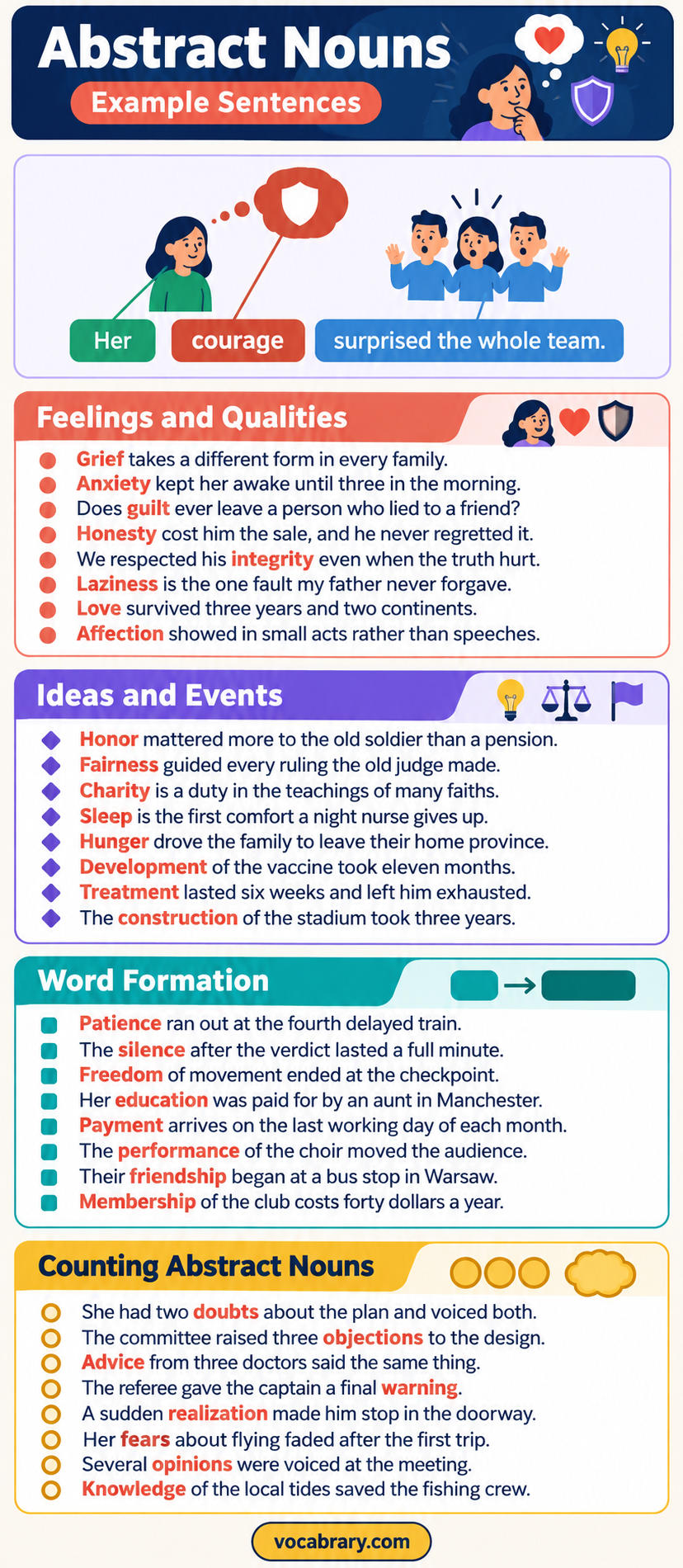
An abstract noun is a noun that denotes an idea, quality, or state rather than a concrete object, as in "Her courage surprised the whole team." Because an abstract noun cannot be seen or touched, its meaning is understood only through example sentences that place the word in a real situation.
Since practice needs plenty of material, we go through 307 abstract noun example sentences taken from school, work, news reports, novels, and family life. Feelings and qualities come first, and word endings such as "-ness" and "-ment" appear along the way. Once this practice is finished, English speeches and essays improve while compound nouns and possessive nouns extend the same study.
Quick Answer: Abstract Noun Example Sentences
- Feeling: Leo felt relief when the test results came back.
- Quality: The nurse’s patience calmed the anxious children.
- State: Safety in the village improved after the new bridge opened.
- Belief: Henry’s faith in the plan never wavered.
- Event: The celebration lasted until midnight.
- From an adjective: Her kindness surprised every guest at the wedding.
- From a verb: The decision to move to Dublin was made in one evening.
- From a noun: Their friendship began in the third grade.
Abstract Noun Example Sentences for Everyday Use
Abstract nouns are common nouns that express feelings and values with no physical form, so they fill ordinary conversation.
- Her courage surprised everyone in the rescue team.
- Honesty meant more to my grandmother than winning.
- The children shouted with joy when the snow began to fall.
- Nobody doubted his loyalty to the club after fifteen years of service.
- Freedom of speech is protected by the First Amendment to the U.S. Constitution.
- We waited in complete silence until the ceremony ended.
- Her kindness toward the new student changed his first week at school.
- Patience is exactly what my driving instructor asked for during the first lesson on a busy road.
- Marco lost his temper when the referee ignored the foul.
- The old letters left her with nostalgia for a small village in Poland.
- Truth was the only defense the young lawyer had left.
- His ambition took him from a village school to a laboratory in Tokyo.
- They celebrated their friendship with a trip across Scotland.
- Fear kept the puppy under the sofa for two hours.
- A sudden doubt crossed her mind as she signed the contract.
- The prisoner begged for mercy in front of the judge.
- Wisdom comes to some people late, and to others never.
- Daniel spoke about the poverty he had seen in the northern districts.
- Her beauty was never the reason people trusted her.
- Hope returned to the village after the first rain in June.
Abstract Noun Sentences for Feelings and Emotions
Emotions have no physical form, so speakers use abstract nouns to report what a person feels.
- Love kept the couple together through two long separations.
- His anger faded once he heard the whole story from her side.
- A wave of fear ran through the crowd when the lights went out.
- Joy spread across the hospital hallway when the twins were born.
- Deep sadness settled over the team after their captain retired.
- Jealousy ruined a friendship that had lasted since elementary school.
- Natalie felt a strange excitement the night before her first flight to Athens, and she barely slept.
- Grief takes a different form in every family.
- Tom hid his disappointment when the letter from the university arrived.
- Anxiety kept her awake until three in the morning.
- Pure relief showed on the driver’s face after the brakes finally worked.
- The crowd roared with delight as the final goal went in.
- Shame stopped him from telling his parents about the broken window.
- Does guilt ever leave a person who lied to a friend?
- Henry felt great pride as his daughter crossed the stage.
- Alice felt deep loneliness during her first winter in Chicago.
- A moment of panic passed when Oliver found his passport in the lining of the bag.
Abstract Noun Sentences for Qualities and Character
Praise and criticism of character depend on abstract nouns, because a trait belongs to a person and not to an object.
- Honesty cost him the sale, and he never regretted it.
- Her patience with the youngest students made her the favorite teacher in the school.
- Courage is what the firefighter showed when she entered the burning apartment.
- Everyone admired the generosity of the shopkeeper who fed the striking workers for a whole month without payment.
- Humility kept the champion from boasting after her third gold medal.
- Adam’s determination took him through six years of night classes.
- Cruelty to animals is punished by law in most European countries.
- We respected his integrity even when the truth hurt.
- Laziness is the one fault my father never forgave.
- The young doctor’s calmness reassured every patient in the waiting room.
- Curiosity led the boy to open every drawer in the attic.
- Does modesty ever hurt a person’s career in a competitive office?
- Natalie’s bravery during the storm earned her a medal from the town.
- The coach praised the discipline of the young swimmers.
- The neighbors admired the thoughtfulness of the boy who shoveled their driveway.
Abstract Noun Example Sentences for States and Conditions
A state or condition lasts over time, and an abstract noun gives it one word in a sentence.
- Freedom felt strange to the prisoner after eleven years inside.
- Her childhood on a farm in Iowa gave her a love of early mornings and a fear of thunderstorms.
- Sleep is the first comfort a night nurse gives up.
- Long years of poverty ended when the cooperative bought their coffee harvest.
- Health improved across the district once the new water pipes were finished.
- Nobody expected such silence from a class of thirty seven-year-olds.
- Peace returned to the two villages after the elders met.
- Hunger drove the family to leave their home province.
- Her retirement began with a month of walking in the Alps.
- Adulthood arrived early for children who raised their own brothers and sisters.
- The darkness in the tunnel lasted four minutes.
- Illness kept Diego away from the field for the whole season.
- The hikers collapsed in exhaustion at the end of the tenth mile.
- Maria read three magazines to fight off boredom at the airport.
- Months of unemployment left Daniel short of money and sleep.
Abstract Noun Sentences for Beliefs and Principles
Beliefs and principles belong to groups as well as individuals, which is why abstract nouns appear in debates about law and government.
- Justice came too late for the families who waited nineteen years for the inquiry to report.
- Democracy depends on citizens who vote in local elections as well as national ones.
- Her faith gave her something to say at every funeral she attended.
- Equality before the law is written into the constitution of South Africa.
- Sam defends capitalism in every debate, and his sister attacks it.
- Tradition decides who speaks first at a family wedding in Sicily.
- Morality was the theme of the philosophy course in the second semester.
- Political liberty meant little to people with no bread.
- Superstition stopped the sailors from leaving the harbor on a Friday.
- The nation’s patriotism rose sharply during the Olympic final.
- Honor mattered more to the old soldier than a pension.
- Fairness guided every ruling the old judge made.
- Optimism carried the settlers through their first winter.
- Socialism was the subject of the economics seminar on Thursday.
- Charity is a duty in the teachings of many faiths.
Abstract Noun Sentences for Events and Processes
Events and processes unfold over time, so an abstract noun refers to the whole of one in a single word.
- Education changed everything for the first girl in her family to finish school.
- The growth of the bakery forced the owners to rent a second kitchen.
- A civil rights movement grew out of meetings in church basements.
- Development of the vaccine took eleven months.
- Her marriage in 2019 brought two large families together for the first time in twenty years.
- Progress on the bridge stopped when the funding ran out.
- Farmers welcomed the arrival of the monsoon after four months of dust.
- Treatment lasted six weeks and left him exhausted.
- His sudden departure from the company puzzled the whole department.
- The death of the old chief was announced by drums at dawn.
- The construction of the stadium took three years.
- Recovery from the surgery took Henry two months.
- The election brought a record number of voters to the polls.
Abstract Noun Example Sentences by Word Formation
Many abstract nouns are built from a base word plus an ending, and the groups follow the word class of the base.
Abstract Nouns Formed From Adjectives
The endings "-ness" and "-ity" turn an adjective into the word for its quality.
- Her kindness during the funeral week was remembered for years.
- The sincerity in his apology convinced even his older brother.
- Patience ran out at the fourth delayed train.
- Darkness covered the valley by half past four in December.
- His generosity paid the school fees of nine children.
- Loneliness is the hardest part of working on a lighthouse.
- Great happiness followed the birth of their first grandchild.
- Curiosity about beetles turned a quiet schoolboy into a biologist with a museum named after him.
- Stupidity, not bad luck, lost them the match.
- The silence after the verdict lasted a full minute.
- Her kindness to the new employee won the whole office over.
- Honesty from the mechanic saved us a repair bill.
- His ability with numbers was noticed in fourth grade.
- Freedom of movement ended at the checkpoint.
- Patience is what the swimming coach asked of every beginner.
- Bitterness lingered after the argument over the will.
- Her boldness in the interview won her the job.
Abstract Nouns Formed From Verbs
From a verb, "-ment" and "-tion" form the word for the action or its result.
- Agreement between the two unions ended the strike on Friday.
- Her education was paid for by an aunt in Manchester.
- Movement along the border was restricted for a week.
- The decision of the referee angered both sets of supporters.
- Performance improved once the team trained in the mornings.
- His retirement party lasted until two in the morning.
- Acceptance into the academy took Lily three attempts and two years of Saturday classes at a college in Boston.
- Payment arrives on the last working day of each month.
- Public reaction to the new tax was furious.
- Guidance from her old professor shaped the second half of her career.
- The two sides signed an agreement on Tuesday.
- Her decision to study medicine shocked her father.
- The performance of the choir moved the audience.
- Assistance arrived from three neighboring villages.
- The invitation to the opening reached Emma by mail.
- Her suggestion saved the committee an hour of debate.
Abstract Nouns Formed From Nouns
A noun becomes the word for a state or a relationship with "-hood" and "-ship".
- Childhood in a small fishing town taught her to read the weather from the color of the sky.
- Their friendship began at a bus stop in Warsaw.
- Motherhood changed her working hours and nothing else.
- Leadership of the party passed to a former teacher.
- Stardom arrived too early for the young singer.
- Brotherhood among the miners survived the closure of the pit.
- Ownership of the land was disputed by three families.
- Membership of the club costs forty dollars a year.
- Adulthood brings bills that nobody warns you about.
- Martyrdom was never the aim of the protest leaders.
- His childhood in Naples gave him a taste for street food.
- Their friendship survived a move to opposite coasts.
- Leadership passed to a woman of twenty-nine.
- Parenthood changed how Marco spent his weekends.
- Partnership between the two bakeries lasted nine years.
Abstract Noun Sentences With the Noun as Subject
In subject position, an abstract noun states the idea that the rest of the sentence develops.
- Hope kept the search party going for a fifth night.
- Silence followed the announcement of the closure.
- Jealousy destroyed a partnership that had earned millions.
- Curiosity about her grandfather’s letters led Ana to a village in Sicily.
- Anger rarely improves a negotiation.
- Loyalty among the older staff kept the restaurant open through the worst winter of the crisis.
- Trust takes years to build and one afternoon to lose.
- Laughter filled the hallway long after the bell had rung.
- Fatigue ended his race at the thirty-second kilometer.
- Success in the first year surprised the founders more than anyone.
- Hunger woke the campers before sunrise.
- Rumor spread through the school by lunch.
Abstract Noun Sentences With the Noun as Object
When it follows a verb, an abstract noun states what is gained or lost.
- The nurse lost her patience with the visitor at midnight.
- Six months abroad gave Oliver real confidence in his English.
- Students owe their teachers a certain respect, even when they disagree with everything said in the lesson.
- Everyone needs rest after a week of examinations.
- She demanded an explanation from the airline.
- The company denied any responsibility for the leak.
- Rafael showed unusual bravery during the operation.
- We value reliability more than talent in this workshop.
- Marta gained enormous experience during two summers in a Berlin hospital.
- Nobody expected such generosity from a rival team.
- The coach demanded loyalty from every player.
- The judge showed mercy to the first-time offender.
Abstract Nouns After Prepositions
A preposition links the abstract noun to the action and expresses its manner or reason.
- He slammed the door in anger and regretted it within a minute.
- The surgeon worked with great patience for nine hours.
- Sara walked onto the stage without fear.
- Out of curiosity, Ben opened the old trunk in the cellar.
- They stayed together for the sake of friendship rather than profit, and the business survived.
- Miners returned to work under protest after the vote.
- She spoke about the accident with complete honesty.
- Every family in the village lived in poverty until the road was built.
- Aid arrived after months of delay.
- Dr. Walker worked in total obscurity until she was seventy.
- She answered the question with confidence.
- The crowd waited in silence for the verdict.
Countable and Uncountable Abstract Noun Example Sentences
Separate instances of an idea take a plural form, as with any countable noun.
- She had two doubts about the plan and voiced both.
- The committee raised three objections to the design.
- Advice from three doctors said the same thing.
- The referee gave the captain a final warning.
- Their hopes rose and fell with every announcement.
- A sudden realization made him stop in the doorway.
- Several beliefs about the illness turned out to be false.
- Three explanations were offered, and none satisfied the committee.
- Her fears about flying faded after the first trip.
- Several opinions were voiced at the meeting.
- Knowledge of the local tides saved the fishing crew.
- Happiness filled the kitchen when the results came.
Abstract Nouns in Proverbs and Sayings
Proverbs are fixed sayings that pass advice between generations, and many rest on one abstract noun.
- Patience is a virtue, as my grandmother reminded me every winter.
- Honesty is the best policy, even when the truth costs a customer.
- Knowledge is power, and the village library proved it.
- Beauty is in the eye of the beholder, according to the old saying.
- Practice makes perfect, which is why the pianist repeated one bar for an hour.
- Silence is golden in a house with a sleeping baby.
- Curiosity killed the cat, though nobody has ever warned the cat about that particular proverb.
- Ignorance is bliss until the bill arrives.
- Charity begins at home, said the priest at the collection.
- Laughter is the best medicine, and the whole ward believed it.
- Experience is the best teacher, as the old carpenter liked to say.
- Love is blind, as the saying goes, and Marco proved it.
Abstract Noun Example Sentences for School
Students and teachers describe effort and discipline with abstract nouns every day.
- Discipline in the hallways improved after the new principal arrived.
- Her concentration broke when a bee entered the classroom.
- Pride filled the hall as the youngest student collected the science prize.
- Teachers noticed a change in his behavior after the break.
- Attendance fell sharply during the flu outbreak.
- The school rewards effort rather than raw talent.
- Confidence grew in the girls’ debating team after their first win against a much older school.
- Knowledge of two languages gave Paul an advantage in geography.
- Motivation disappeared in the last week of the semester.
- Does fear of mathematics begin with a teacher or a parent?
- Creativity filled the art room on Friday afternoons.
- Honesty about the missing assignment earned Emma a second chance.
Abstract Nouns at Work and in Offices
Workplace conversations use abstract nouns to describe performance and pressure.
- Promotion came after eleven years and two failed interviews.
- Stress before the quarterly deadline emptied the office fridge and kept three people awake all night.
- Her efficiency saved the department two working days a month.
- The manager praised the team’s cooperation during the merger.
- Ambition took Daniel from the warehouse to the boardroom.
- Trust between the partners disappeared over one unpaid invoice.
- Nobody questioned her authority after the first meeting.
- Responsibility for the error was accepted by the supplier.
- Teamwork rescued the launch when two engineers fell ill.
- Burnout ended a thirty-year career.
- Loyalty to the company earned Brian a bonus.
- Flexibility in the schedule allowed Emma to work from home on Fridays.
Abstract Nouns in Relationships and Family Life
Close relationships are described in abstract nouns because their strength and strain have no visible form.
- Love survived three years and two continents.
- Jealousy over a single message ruined their vacation.
- Forgiveness came slowly, and the brothers spoke again after nine years.
- Their marriage grew stronger after the illness.
- Respect between the two families made the wedding a pleasure to arrange in a single afternoon.
- Loneliness pushed him to join the walking club.
- Affection showed in small acts rather than speeches.
- Honesty about money prevented most of their arguments.
- Commitment meant more to her than any ring.
- Does friendship survive when one friend moves abroad?
- Trust returned slowly after the apology.
- Devotion to her grandmother brought Alice home every weekend.
Abstract Noun Example Sentences in News and Politics
Reporters use abstract nouns for political and economic conditions that affect entire countries.
- Corruption in the ministry was exposed by two young reporters working from a rented apartment.
- Inflation reached nine percent before the central bank acted.
- Negotiation between the two governments lasted eleven days.
- Democracy was tested by the closest election in the country’s history.
- Unemployment fell for the sixth month in a row.
- Public opinion turned against the pipeline after the spill.
- Censorship of the student newspaper caused protests in three cities.
- Security around the summit cost millions.
- Poverty in the coastal districts doubled after the storm.
- Reform of the pension system divided the governing party.
- Pollution in the river drew protests across the county.
- Recession forced the city to cut its budget.
Abstract Nouns in Literature and Famous Novels
Many famous novels and plays have a main theme that is an abstract noun.
- Jane Austen’s Pride and Prejudice puts two abstract nouns in its title, pride and prejudice.
- Ambition destroys Macbeth in Shakespeare’s tragedy.
- Revenge drives Hamlet through Shakespeare’s play.
- Pip leaves for London full of ambition in Charles Dickens’s Great Expectations.
- Loneliness isolates Crooks, the stable hand, in Steinbeck’s Of Mice and Men.
- Harper Lee builds To Kill a Mockingbird around justice in a small Alabama town.
- Freedom is what Winston loses in Orwell’s Nineteen Eighty-Four.
- Mary Shelley’s Frankenstein turns on the isolation of a creature nobody accepts.
- Fear rules the boys on the island in Golding’s Lord of the Flies.
- Guilt follows Raskolnikov through Dostoevsky’s Crime and Punishment.
- Jealousy destroys Othello in Shakespeare’s tragedy.
- Obsession drives Captain Ahab in Melville’s Moby-Dick.
Abstract Noun Example Sentences for Kids
Young children learn abstract nouns from everyday experience at home and on the playground.
- Kindness means sharing your snack with a new classmate.
- Bravery is sitting still in the dentist’s chair.
- Birthday parties are full of fun and noise.
- Friendship grows when you play together every day.
- My little sister has no patience at all.
- Honesty means telling Mom about the broken cup.
- Love for a puppy makes a child feed it before breakfast.
- Laughter spread across the playground after the joke.
- Anger goes away faster after a glass of water.
- Do you feel happiness when it snows on a school day and the buses stop running?
- Sadness came over Mia when her balloon floated away.
- Courage helps you climb the tall slide.
Short Abstract Noun Sentences for Young Learners
Short sentences let beginners read an abstract noun and a verb together.
- Hope never dies.
- Fear makes us careful.
- Sleep repairs a tired body.
- Joy is loud.
- Anger never wins.
- Truth is enough.
- Patience wins races.
- Courage grows slowly.
- Kindness costs nothing.
- Trust takes time.
- Wisdom comes slowly.
- Friendship lasts.
Abstract Noun Example Sentences for Essays and Speeches
Essay and speech writing uses longer sentences in which an abstract noun states the central idea of an argument.
- Determination, rather than talent, explains why Maria passed the entrance exam at the third attempt.
- The independence of the judiciary protects citizens from the government of the day.
- Sacrifice by an older generation paid for the schools the country now takes for granted.
- Her dedication to research earned a place at a laboratory in Zurich.
- Tolerance of other opinions is what the debating society teaches first.
- Ignorance of the rules is no defense in an exam room.
- Economic growth without fairness creates resentment in the long run.
- Imagination produced the best answer in the history exam.
- Persistence turned a weak student into a county champion in two seasons.
- Integrity in research protects a scientist’s reputation for a lifetime.
- Innovation gave the small company its edge over larger rivals.
- Reliability matters in any group project.
Abstract Nouns in a Short Narrative
In connected writing, abstract nouns express the feelings of a character from one moment to the next.
- Fear was Amy’s first feeling on the morning of her nursing examination.
- Her confidence returned once the first patient thanked her.
- Exhaustion followed three night shifts in a row.
- The kindness of an older nurse kept her at the hospital.
- Patience with frightened children became her reputation on the ward.
- By December her anxiety had turned into something closer to pride.
- Gratitude from one family arrived as a letter she still keeps.
- Ambition now takes her toward a degree in Chicago.
FAQs
An everyday example is "Her courage surprised everyone in the rescue team." Another is "Hope returned to the village after the first rain in June."
With feelings, one example is "Tom hid his disappointment when the letter from the university arrived." Another is "Love kept the couple together through two long separations."
A character example is "Honesty cost him the sale, and he never regretted it." Another is "Humility kept the champion from boasting after her third gold medal."
At school, one example is "Attendance fell sharply during the flu outbreak." Another is "The school rewards effort rather than raw talent."
With adjective endings, one example is "The sincerity in his apology convinced even his older brother." Another is "Loneliness is the hardest part of working on a lighthouse."
A workplace example is "Promotion came after eleven years and two failed interviews." Another is "Teamwork rescued the launch when two engineers fell ill."
With plural forms, one example is "The committee raised three objections to the design." Another is "Several beliefs about the illness turned out to be false."
A literary example is "Ambition destroys Macbeth in Shakespeare’s tragedy." Another is "Guilt follows Raskolnikov through Dostoevsky’s Crime and Punishment."
For young children, one example is "Kindness means sharing your snack with a new classmate." Another is "Bravery is sitting still in the dentist’s chair."
A proverb example is "Patience is a virtue, as my grandmother reminded me every winter." Another is "Knowledge is power, and the village library proved it." Related: – Parts of Speech Example Sentences – Gender Noun Example Sentences – Material Noun Example Sentences – Verbal Noun Example Sentences – Irregular Plural Noun Example Sentences – Noun Phrase Examples – Noun Clause Examples

Leave a Comment