
An action verb is the verb type that names what its doer performs, in body or in mind, as in Leo kicked the ball. Most action verb example sentences put that verb straight after the doer, as in Amina paints every Sunday, before the mental verbs such as think, decide, and believe.
What Is an Action Verb?
An action verb tells what somebody or something does, from running and writing to deciding and forgetting, and it works with an object or with none at all. A linking verb names no deed, and instead joins the doer to a word that describes it, so Omar built a shed uses an action verb while Omar is tired uses a linking verb.
Doer + action verb (+ object)
Nadia repaired the bicycle before lunch.
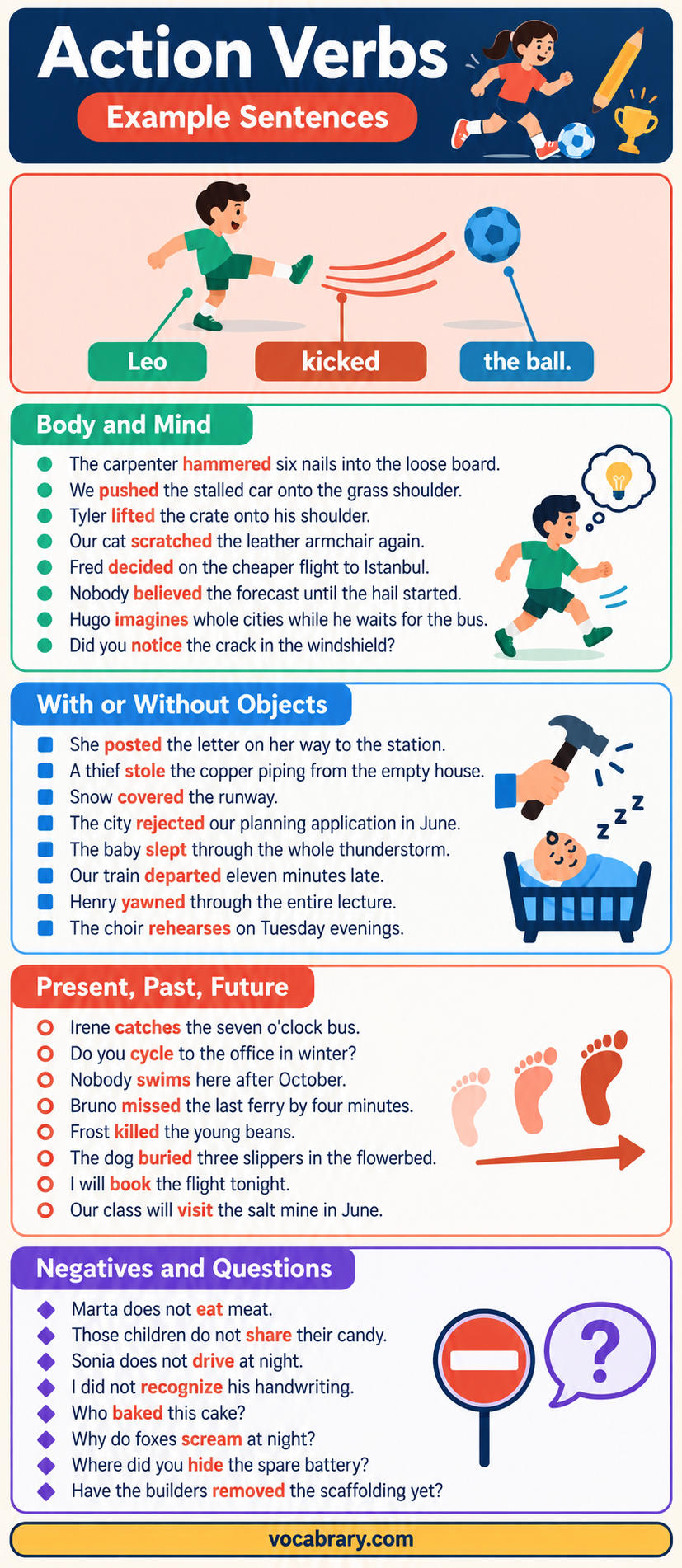
Common Action Verb Example Sentences
Painting a fence, diving for a penalty, and baking bread with a grandmother are the deeds learners meet first, and each bolded verb names exactly what the doer performs.
- Maria paints the fence every spring.
- The goalkeeper dived to his left and stopped the penalty.
- Our neighbours planted a fig tree beside the garden wall.
- Kwame writes poetry on the train to work.
- A courier delivered the parcel before seven o’clock.
- Every Thursday the children bake bread with their grandmother.
- Sofia swims forty lengths before breakfast.
- Nobody answered the door when the postman knocked twice.
- That mechanic repaired the gearbox in under two hours.
- Yusuf kicked the ball over the school wall.
- Did you lock the back gate last night?
- Rain soaked the washing.
- We rebuilt the garden steps with stone from the old chapel.
- Lena studies medicine in Krakow and teaches English at weekends.
- Diego chopped the onions while his brother stirred a pot of tomato sauce on the back burner.
- The audience clapped for a full minute.
- My grandfather repairs clocks in a workshop behind the bakery.
- Two dogs chased a seagull along the beach.
- She threw the letter into the fire without reading a word of it.
- Farmers harvest the barley in late August.
Action Verbs and What the Doer Does
Run, build, throw, decide, and forget cover both halves of the class, since the first three move a body through the world and the last two work behind the eyes.
| Action verb | What the doer does | Example sentence |
|---|---|---|
| Run | Moves fast on foot | Priya runs to the bus stop every morning. |
| Write | Puts words on paper | Tomas writes a diary in Czech. |
| Build | Joins parts into a whole | The council built a footbridge over the canal. |
| Throw | Sends something through the air | Hana threw the frisbee across the lawn. |
| Climb | Goes up with hands and feet | Two students climbed the water tower. |
| Whisper | Speaks very quietly | Emre whispered the answer to his partner. |
| Cook | Prepares food with heat | Marco cooks dinner for six on Fridays. |
| Repair | Mends what is broken | A jeweller repaired my mother’s clasp. |
| Decide | Settles a choice in the mind | Farid decided on the cheaper flight. |
| Believe | Accepts something as true | Nobody believed the weather forecast. |
| Remember | Brings a memory back | Grandma remembers every neighbour’s birthday. |
| Forget | Loses something from memory | Dad forgot his umbrella again. |
Physical Action Verbs
Jumping a fence, hammering a nail, and dragging a suitcase upstairs are deeds a camera would catch, because a physical action verb moves a body or an object.
- Ahmed jumped over the low fence without breaking his stride.
- The carpenter hammered six nails into the loose board.
- Rosa dragged her suitcase up four flights of stairs.
- Children splashed through every puddle on the way home.
- My uncle dug a trench along the edge of the vegetable patch.
- A gull snatched the sandwich straight out of his hand.
- We pushed the stalled car onto the grass verge.
- Elena sliced the melon into eight pieces.
- Somebody knocked three times and then walked away.
- Tariq lifted the crate onto his shoulder.
- Did the plumber tighten the valve under the sink?
- Waves battered the harbour wall all night, and by morning the fishermen had lost two boats.
- Julia sewed a patch over the torn elbow of her jacket.
- Our cat scratched the leather armchair again.
- The runners sprinted the final two hundred metres.
- Frost cracked the outer pipe during the cold week.
Mental Action Verbs
Deciding on a flight, forgetting an umbrella, and inventing a password are deeds nobody watches from outside, yet think, decide, and believe name real work all the same.
- Farid decided on the cheaper flight to Istanbul.
- I think about that summer whenever the wind smells of salt.
- Nobody believed the forecast until the hail started.
- Grandma remembers every neighbour’s birthday without a calendar.
- Dad forgot his umbrella again.
- Amara invented a password nobody in the family has guessed since.
- We considered three flats before signing for the one over the bakery.
- The jury doubted the second witness from the very first question, and the defence barrister noticed it at once.
- Hugo imagines whole cities while he waits for the bus.
- Did you notice the crack in the windscreen?
- Petra calculated the fare in her head and refused to pay it.
- Students memorise forty irregular verbs in the first term.
- My sister never worries about deadlines.
- He guessed the ending after twenty minutes of the film.
- Ana recognised her old teacher in the queue at the pharmacy.
Action Verbs With an Object and Without One
Borrowing a ladder takes an object, while sleeping takes none, and the same class of verb sorts itself by whether a noun has to follow it.
Transitive Action Verbs With an Object
Borrowing a ladder, posting a letter, and washing the curtains each need a noun straight after the verb, since a transitive action verb leaves the sentence unfinished without one.
- Omar borrowed a ladder from the flat downstairs.
- She posted the letter on her way to the station.
- My flatmate washed the curtains for the first time in years.
- Have you watered the tomatoes yet?
- Grandad mended the fence with two planks and a handful of screws.
- Children collect conkers under the big tree behind the church hall every autumn.
- A thief stole the copper piping from the empty house.
- We packed four boxes before midnight.
- Ravi answered every question in the interview without hesitating once.
- Snow covered the runway.
- Did anyone feed the rabbits?
- The council rejected our planning application in June.
- Teresa paints portraits of fishermen from her village.
- Nobody signed the birthday card.
Intransitive Action Verbs With No Object
Sleeping, arriving, laughing, and swimming finish a sentence on their own, because an intransitive action verb needs no noun after it at all.
- The baby slept through the whole thunderstorm.
- Guests arrived long before the caterers.
- Everyone laughed when the microphone squealed.
- Mariam swims every morning before her shift at the hospital.
- Our train departed eleven minutes late.
- Snow fell steadily from four in the afternoon until well past midnight, and the buses stopped running.
- Did the engine stall again on the hill?
- Leaves rot quickly in a wet autumn.
- Hassan yawned through the entire lecture.
- She hesitated, then knocked.
- Two swallows nest under our balcony each April.
- The choir rehearses on Tuesday evenings.
- Nothing moved in the courtyard.
- Pedro runs faster than anyone else in his year.
Action Verbs in the Present, Past, and Future
Walk turns into walked and will walk, and the deed stays the same while the ending moves the time of it.
Action Verbs in the Present
Catching a bus at seven, teaching Tuesday classes, and grinding coffee before dawn are habits rather than one-off deeds, so the present tense keeps them on repeat.
- Ines catches the seven o’clock bus.
- We teach two classes on Tuesday afternoons.
- My father grinds his coffee beans before anyone else wakes.
- Bees pollinate the orchard from late March onwards.
- Yara repairs phone screens in a kiosk beside the tram stop and charges half what the shops ask.
- Do you cycle to the office in winter?
- Rain falls on the coast for most of November.
- Our postman whistles the same tune every morning.
- Kofi cooks jollof rice for the whole street on New Year’s Day.
- Nobody swims here after October.
- Students hand their essays in on Fridays.
- The baker opens at five.
Action Verbs in the Past
Missing a ferry, dropping a tray of glasses, and finishing a marathon are deeds already over, and the past tense pins each one to a morning or an evening that has gone.
- Bruno missed the last ferry by four minutes.
- A waiter dropped an entire tray of glasses.
- Aisha finished the marathon in under four hours.
- We planted eighty bulbs along the front path last October.
- Frost killed the young beans.
- My brother sold his motorbike to a neighbour who had wanted it for years.
- Did Selena phone you back?
- Nobody locked the cellar door.
- The dog buried three slippers in the flowerbed.
- Lightning struck the church spire during the August storm and destroyed the weather vane.
- Thousands marched through the square on Saturday.
- Emre wrote his first song at fourteen.
Action Verbs in the Future
Booking a flight, planting a hedge, and repainting a kitchen next spring are deeds still ahead, so will plus the verb keeps them in front of the speaker.
- I will book the flight tonight.
- Gardeners will plant a beech hedge along the boundary next spring.
- We will repaint the kitchen once the rain stops.
- Sanjay will drive his daughter to the airport at dawn.
- Will you join us for lunch on Sunday?
- Nobody will forget that final penalty.
- The builders will finish the roof before the cold weather arrives, and the family plans to move in by December.
- Our class will visit the salt mine in June.
- Hanna will sing two songs at the wedding.
- Rain will ruin the hay unless we cut it this week.
- Doctors will examine the scans on Monday morning.
- Luca will teach his cousin to skate.
Action Verbs in Negative Sentences
Not eating meat, never watching horror films, and refusing to sign are denials of a deed, and do, does, and did take the tense while the action verb stays plain.
- Marta does not eat meat.
- We did not finish the puzzle before the guests arrived.
- Jonas never watches horror films alone in the house.
- My landlord has not repaired the boiler since February.
- Nobody swam in the lake that summer, because the water had turned green and smelled of weed.
- Those children do not share their sweets.
- Ravi will not apologise for the email he sent on Friday.
- The printer did not scan a single receipt.
- Sonia does not drive at night.
- Our neighbours never sweep the shared stairs.
- I did not recognise his handwriting.
- Yuki has not cooked since the oven broke.
Action Verbs in Questions
Who baked the cake, when did the plane land, and why do foxes scream at night are questions built on a deed, and the auxiliary in front takes the tense.
- Who baked this cake?
- When did the plane land in Doha?
- Why do foxes scream at night?
- Did Karim finish the report before the deadline on Thursday evening?
- Does your sister still teach at the language school beside the river?
- How many lengths did Ana swim this morning?
- Where did you hide the spare battery?
- What broke the window?
- Have the builders removed the scaffolding yet?
- Will Ibrahim drive us to the ferry, or should we book a taxi for six o’clock?
- Which team scored first?
- Do sunflowers really follow the sun across the sky all day long?
Strong Action Verbs That Replace Weak Ones
Sprinted instead of went fast, devoured instead of ate quickly, and hurled instead of threw hard give a reader the deed and its manner in one word.
- Priya sprinted for the closing doors of the train.
- Wolves devoured the carcass within an hour.
- Marcus hurled the cricket ball from the boundary rope to the wicketkeeper’s gloves.
- The old gate shrieked on its hinges.
- Floodwater swallowed the lower fields in under twenty minutes.
- Ella scribbled an address on the back of a receipt.
- Two climbers scrambled over the last ridge before dark.
- Smoke curled from the chimney of the corner house.
- Our dog bolted at the first firework.
- Yasmin hammered the final nail into the shed door and stepped back to admire it.
- Diners devour the lamb here every Sunday.
- Tourists swarmed across the bridge by nine o’clock.
Action Verbs in Everyday Settings
Sweeping a hallway, marking essays, saving a penalty, and kneading dough put the same verb class to work in the rooms and fields where learners actually need it.
Action Verbs at Home
Sweeping the hallway, hanging washing on a balcony, and defrosting a freezer are Saturday deeds, and every one of them starts with a verb somebody has to do.
- Mum sweeps the hallway before breakfast.
- We hang the washing on the balcony whenever the sun reaches it.
- Nour defrosted the freezer and found a bag of soup from two winters ago.
- My brother vacuums the stairs on Saturdays.
- Somebody left the tap running all night.
- Dad irons his shirts while the news is on.
- The kettle boiled twice before anyone poured a cup.
- Did you feed the cat this morning?
- Our children tidy their rooms once a month, and only after a serious argument about pocket money.
- Grandma knits scarves for every grandchild.
- Rain flooded the basement again.
- Tomas fixed the wobbly chair with a wedge of cardboard.
Action Verbs at School
Marking essays, raising a hand, sharpening a pencil, and reciting a poem are classroom deeds, and each sentence names who does the doing.
- Mrs Okafor marks thirty essays every weekend.
- Amir raised his hand before anyone else in the class.
- We sharpen our pencils at the bin by the window.
- The choir recited a poem by Christina Rossetti at the summer concert.
- Students copied the diagram into their notebooks.
- Did Leyla pass her chemistry exam?
- Our teacher explains every mistake twice.
- Nobody remembered the trip money.
- A caretaker switches the gym lights on at half past seven.
- Freya solved the last problem on the board while the rest of us argued about the second one.
- Boys from year nine painted the scenery for the play.
- I borrowed a dictionary from the library.
Action Verbs in Sport
Saving a penalty, dribbling past two defenders, and vaulting over a horse are match-day deeds, and the verb tells a reader what the body did.
- The goalkeeper saved the penalty with her fingertips.
- Nico dribbled past two defenders and crossed the ball.
- Our captain vaulted the barrier to reach the away supporters.
- Swimmers dive from the blocks at the sound of the buzzer.
- Sasha threw the javelin past the seventy metre line and broke her own club record.
- Did the referee award a free kick?
- Fans cheered for a full ten minutes.
- Idris headed the corner into the net.
- Nobody tackled the winger.
- Two cyclists attacked on the final climb.
- Anya scored eleven baskets in the last quarter.
- We train on Tuesdays and Thursdays.
Action Verbs at Work
Filing invoices, welding a joint, driving a delivery van, and chairing a meeting are shift deeds, and each verb names the task somebody was paid for.
- Ivan files the invoices every Friday afternoon.
- A welder joined the two steel beams in under an hour.
- Our driver delivers bread to eleven villages before noon.
- Mr Adeyemi chaired the meeting from a laptop in an airport lounge.
- Nurses changed the dressing twice a day.
- Did the agency send a replacement?
- Nobody booked the meeting room.
- Julia drafted the contract, printed it, and posted it before the office closed for the weekend.
- Two apprentices wired the whole ground floor.
- The auditor questioned three payments from last March.
- Farmers milk the herd at five and again at four.
- We hire extra staff in December.
Action Verbs in Cooking
Kneading dough, grating cheese, roasting peppers, and whisking eggs are kitchen deeds a reader tastes at once, and each verb names a different move of the hands.
- Paolo kneads the dough for ten minutes.
- Aunt Rima grated a whole wedge of cheese over the pasta.
- We roast the peppers until their skins blacken.
- Hana whisked four eggs with a splash of cold milk.
- Nobody stirred the risotto, and the bottom of the pan turned to charcoal within minutes.
- Did you salt the water?
- Chefs chop the herbs at the last moment.
- My uncle smokes mackerel in an old oil drum behind the shed.
- Sugar melted in the copper pan.
- Layla peels the potatoes while her father slices the leeks.
Action Verbs in Travel
Boarding a flight, dragging luggage across cobbles, and missing a connection are journey deeds, and each verb moves somebody nearer the destination or further from it.
- Passengers boarded the flight to Lisbon an hour late.
- We dragged our luggage across the cobbles to the guesthouse.
- Nina missed her connection in Zurich and slept on a bench by gate forty.
- Did our courier explain the route?
- Tourists queue outside the cathedral from eight in the morning.
- Ahmad drove the whole coast road in one day.
- Nobody stamped my passport.
- Our ferry docked at midnight.
- I booked two seats on the night train.
- The porter wheeled the trolley to the lift.
Action Verbs in Nature
Foxes screaming, salmon leaping, ivy climbing a wall, and swallows returning in April are wild deeds, and the verb names what the creature or plant did.
- Salmon leap the weir every autumn.
- Ivy climbs the north wall of the ruined mill.
- A fox screamed somewhere behind the hedge.
- Swallows return to the same barn in April.
- Frost split the rock along an old seam.
- We watched the otters for an hour from a hide beside the river, and none of them noticed us.
- Bats hunt over the pond at dusk.
- Ants stripped the peony buds.
- Did the badgers dig under the fence again?
- Moss spreads across the shaded stones.
Action Verbs on a Resume or CV
Launched, negotiated, trained, and cut open the strongest lines on a job application, because a recruiter reads the deed before the noun that follows it.
- Launched a weekly newsletter that reached four thousand subscribers in its first year.
- Negotiated a supplier contract worth eighteen thousand euros.
- Trained nine new cashiers during the summer season.
- Cut delivery times by a quarter across three depots.
- Designed the seating plan for a conference of six hundred delegates, and rebuilt it overnight when the venue changed.
- Rebuilt the customer database after a server failure.
- Supervised a kitchen brigade of twelve.
- Wrote copy for forty product pages.
- Raised eleven thousand pounds for a children’s hospice.
- Repaired and tested medical equipment in four wards.
- Taught evening Spanish classes to adult beginners.
- Recruited volunteers for a city food bank.
Action Verbs in Stories and Movement
Creeping along a corridor, darting between market stalls, and stumbling on wet steps are the deeds that push a story forward, and each verb shows the speed as well as the move.
- Anton crept along the corridor with his shoes in one hand.
- A pickpocket darted between the market stalls and vanished.
- Marta stumbled on the wet steps and grabbed the rail.
- Horses thundered past the winning line.
- The stranger limped towards the lamplight.
- Nobody noticed the small door behind the bookcase until the fire alarm emptied the whole building.
- Sparks scattered across the workshop floor.
- Yasmin flung open the shutters and shouted down to the street.
- We waded through knee-deep water to reach the boathouse.
- Snow drifted against the porch.
- Did the intruder climb the drainpipe?
- Leaves swirled around the churchyard gate.
Action Verbs and Linking Verbs in the Same Sentence
Tasting soup beside being salty, and looking under a bed beside looking pale, show the split a reader has to hear, and more linking verb example sentences work through the second half of it.
- Rafa tasted the soup, and it was far too salty.
- Because the twins grew tomatoes all summer, their salads were never dull.
- Petra looked under the bed, then looked pale for the rest of the evening.
- We smelled the smoke before the kitchen smelled of burnt sugar.
- Zeynep felt the radiator, which felt stone cold.
- The dog turned the corner and turned nasty at the sight of the postman.
- Marcus appeared on stage and appeared nervous for the first two minutes, though nobody in the audience minded.
- After he sounded the horn, the engine sounded rough.
- Nobody swept the hall, and the caretaker remained furious about it.
- Our neighbour ate dinner with us and stayed quiet throughout.
- Anika proved the theorem, which proved harder than her tutor expected.
- Jonah read the letter and got angry.
Weak Sentences Rewritten With a Stronger Action Verb
Went fast, ate quickly, and made a cake are the limp versions that mark a first draft, and one exact verb replaces all three.
- Priya sprinted to the platform ✅, weaker as Priya went fast to the platform ❌.
- Our guests devoured the roast ✅, weaker as our guests ate the roast quickly ❌.
- Grandma baked a lemon cake ✅, weaker as grandma made a cake ❌.
- Marcus hurled the ball at the stumps ✅, weaker as Marcus threw the ball hard ❌.
- A surgeon stitched the wound ✅, weaker as a surgeon did something to the wound ❌.
- Rain hammered the tent ✅, weaker as rain came down onto the tent ❌.
- We scrubbed the floorboards ✅, weaker as we made the floorboards nice ❌.
- Nadia whispered an apology ✅, weaker as Nadia said an apology quietly ❌.
- Two foxes raided the bins ✅, weaker as two foxes went through the bins ❌.
- The auditor queried four invoices ✅, weaker as the auditor had a look at four invoices ❌.
- Hugo memorised the whole speech ✅, weaker as Hugo got the whole speech into his head ❌, since one verb replaces five words.
- Builders demolished the wall ✅, weaker as builders took the wall down ❌.
Action Verb Example Sentences for Kids
Riding a bike, feeding a hamster, and drawing a dinosaur are the deeds a seven-year-old already knows, so the verb is the only new word in each sentence.
- Sami rides his bike to the park.
- We feed the hamster every evening.
- Lucy draws dinosaurs on the back of her homework.
- Dad cuts the birthday cake into nine pieces.
- Our class sings a song about the sea.
- Did the puppy chew your slipper again?
- Kofi throws the ball against the garage door.
- Mum reads two stories before bedtime.
- Rain stopped the football match.
- The twins built a castle out of cushions, blankets, and every chair in the living room.
- Nobody won the race.
- Ella plants sunflower seeds in a yoghurt pot.
Action Verb Example Sentences for Students
Revising for an exam, quoting a source, submitting an essay at midnight, and dissecting a leaf are student deeds, and each verb names a task with a deadline behind it.
- Tanvir revised for six hours and still missed the last question.
- We quoted three sources in the opening paragraph.
- Nadia submitted her essay eleven minutes before midnight.
- Biology students dissected a leaf under the microscope.
- Did your tutor approve the research proposal?
- Erik translated the whole poem from Norwegian into English for the language fair.
- Nobody attended the nine o’clock seminar.
- Our professor cancelled the lecture and emailed the slides instead.
- Amira highlighted every date in the chapter.
- Two classmates recorded the debate on a phone.
- Exam invigilators collected the papers at four.
- I rewrote the introduction three times, cut two hundred words, and finally handed the thing in on Monday.
Short Action Verb Sentences for Young Learners
Kicking a ball, climbing a tree, and eating an apple make four-word and five-word sentences that a beginner copies straight into a notebook.
- Tom kicks the ball.
- The cat sleeps.
- Ana eats an apple.
- Boys climb the tree.
- My dog barks at night.
- We wash our hands.
- Birds fly south.
- She opens the door.
- Rain falls outside.
Action Verbs in a Short Paragraph
Sara’s alarm, a burnt slice of toast, and a bus pulling away from the stop run through one Monday morning, with a fresh action verb behind each turn of the story.
- Sara switched off her alarm and slept another twenty minutes.
- Her brother burnt two slices of toast.
- Their mother shouted up the stairs twice.
- Nobody found the school bag under the coats.
- A bus pulled away from the stop as Sara reached the corner.
- Rain soaked her jacket before the next one arrived.
- She ran the last hundred metres and reached the gate at nine exactly.
- Mr Bello marked her late anyway.
Related
FAQs
An action verb and a linking verb differ in what they do with the doer: an action verb names a deed, while a linking verb joins the doer to a word that describes it. In Sara painted the door, painted names a deed; in Sara looked tired, looked joins Sara to tired and no painting has taken place. The englishan lesson on action verbs in English grammar works through the same split with its own practice sentences.
You identify an action verb by asking what the doer did, since the word that answers that question is the action verb. In Hassan dropped his keys, the answer to what did Hassan do is dropped. When no answer arrives, the verb names a state instead, as in Hassan was late, where was describes him rather than reporting a deed.
Have is never a linking verb, and it works in two other ways instead. As a main verb it means to own or to eat, as in We have breakfast at seven, and grammarians file the ownership sense under stative verbs because nobody performs owning. As a helping verb it comes in front of a past participle, as in She has finished the report, where finished is the action verb.
Action verbs work in every tense, and the deed stays the same while the ending changes the time. Walk turns into walked for a finished deed and into will walk for one still ahead, so Ines walks home, Ines walked home, and Ines will walk home all use the same action verb. A hundred more verb sentences in English run the forms side by side.
Not all verbs show action, because linking verbs such as be, seem, and become name a state rather than a deed, and helping verbs such as do, will, and have only support the main verb. Out of Marco is hungry and eats early, only eats reports something Marco does. The test stays the same: ask what the doer did.
Ten action verb example sentences run through home, school, and sport in one go. Maria paints the fence. Kwame writes poetry. The goalkeeper saved the penalty. Nour defrosted the freezer. Students copied the diagram. Bees pollinate the orchard. Marcus hurled the ball. Grandma knits scarves. Ines catches the seven o’clock bus. Farmers harvest the barley in August.
A sentence takes two or more action verbs whenever a writer joins deeds with and, but, or a subordinating word. In Diego chopped the onions while his brother stirred the sauce, chopped and stirred are both action verbs with their own doer. Long narrative sentences run four or five deeds together without any grammatical trouble at all.
You use action verbs on a resume by opening each line with the deed itself rather than with a phrase about duties. Launched a weekly newsletter beats was responsible for a newsletter, and negotiated a supplier contract beats had involvement in contracts. Past-tense verbs suit finished jobs, and present-tense verbs suit a job you are doing now.
Action verbs for kids are the everyday doing words a child already performs: run, jump, eat, draw, sing, swim, climb, kick, and paint. Sentences such as Sami rides his bike and Lucy draws dinosaurs let a young learner match one verb to one deed. Teachers act the verb out first, then ask the class to write it.
Action verbs strengthen writing by naming the deed so exactly that no adverb has to finish the job. Sprinted replaces went fast, devoured replaces ate quickly, and hammered replaces came down hard, which cuts the word count and sharpens the picture at the same time. Editors hunt for weak verbs first when a draft runs long.
An action verb and a main verb overlap without matching exactly, because main verb describes a position in the sentence while action verb describes a meaning. In She has repaired the roof, repaired is the main verb and an action verb, and has is the helper. In She has been ill, been is the main verb yet names a state, so it is no action verb. Sentences with transitive verbs show the same main verb taking an object.

Leave a Comment