
Do, does, and did are the present and past forms of the verb do, which names an action in she does her homework and props up a second verb in did you call me. Most do does did example sentences ask, deny, or add stress, so the pronoun and the time decide the form.
What Are Do, Does, and Did?
Do, does, and did give one verb two roles, naming an action in they do the dishes and propping up a second verb in he did not answer. Has, have, and had build perfect tenses with a past participle, while do, does, and did take a bare base verb after them.
I, you, we, they + do / He, she, it + does / Every pronoun in the past + did
Aisha does the shopping on Friday, and last week she did it twice.
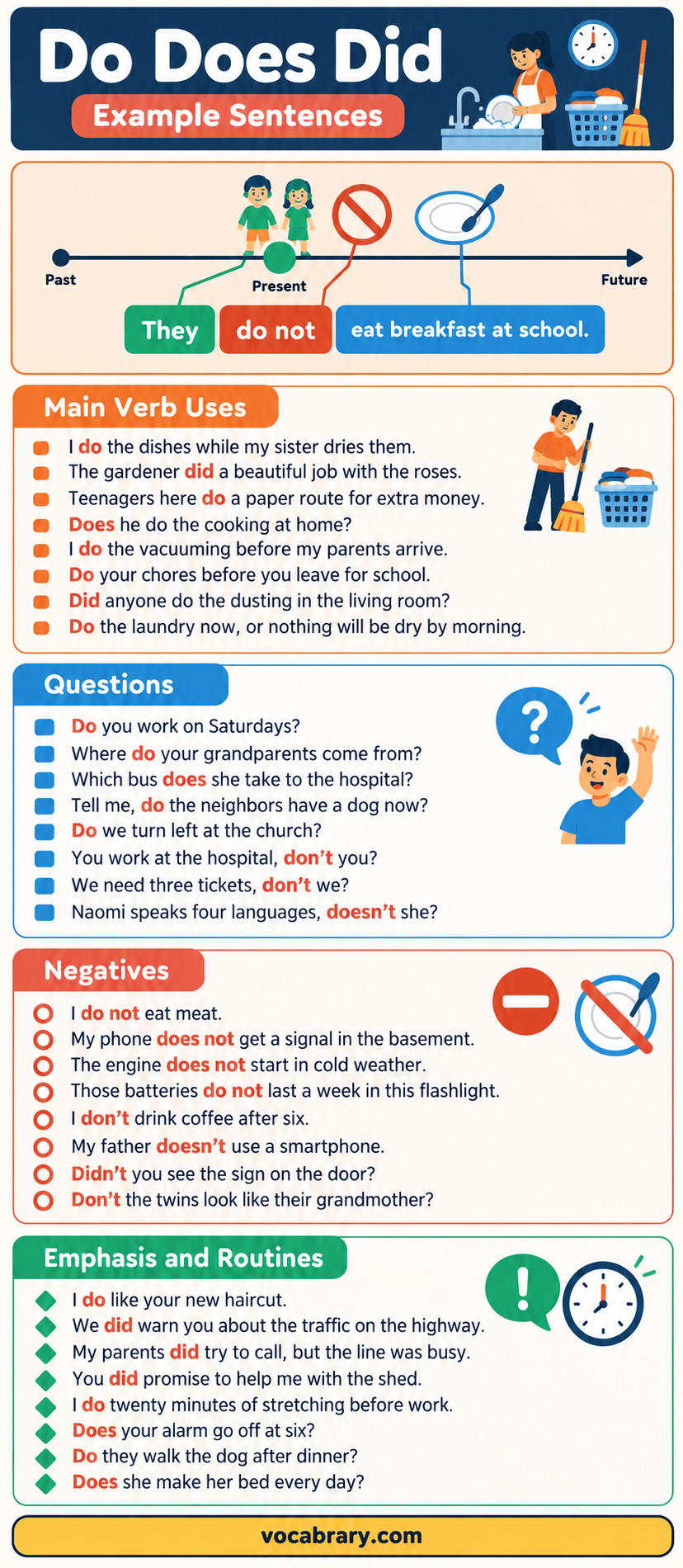
Common Do Does Did Example Sentences
Homework before dinner, dishes after it, and a question about the bakery’s opening time fill most do does did example sentences, where one form names the action and another props up a second verb.
- I do my homework before dinner every evening.
- Rosa does the shopping on Saturday morning.
- Last night my brothers did the dishes without complaining.
- Do you take sugar in your tea?
- Does the bakery open at six?
- Did Hassan call you back?
- We do not eat meat on Fridays.
- My laptop does not charge any more.
- The train did not stop at our station.
- Every summer the twins do a swimming course in Lisbon.
- Kenji does karate twice a week.
- Did your parents enjoy the concert in Vienna?
- Please do the ironing before the guests arrive.
- She does her hair in front of the hallway mirror.
- Nobody did the washing-up.
- What do your neighbours grow in that greenhouse?
- Grandma does the crossword with her morning coffee.
- They did their best in a difficult match.
- Do the boys walk to school on their own?
- Our dog does nothing all day except sleep.
- After the storm, the builders did the repairs in two days.
- How much does a monthly ticket cost in Prague?
- Amira and Yusuf do the gardening together on Sundays.
- The children do their homework in the front room while their mother cooks dinner.
- I did three interviews yesterday, and two went well.
Every Pronoun With Do, Does, and Did
I, you, we, and they take do, while he, she, and it take does, and every pronoun takes did once the action is over. A monthly account, a yoga class, and a karate lesson show each form at work.
| Pronoun | Form | Example sentence |
|---|---|---|
| I | Do | I do the laundry on Sunday. |
| You | Do | You do not need a ticket. |
| He | Does | He does the accounts every month. |
| She | Does | She does yoga before breakfast. |
| It | Does | It does not matter now. |
| We | Do | We do our homework together. |
| They | Do | They do the gardening on Saturday. |
| Maria | Does | Maria does her best at every match. |
| The boys | Do | The boys do karate on Tuesdays. |
| Every pronoun in the past | Did | You did, she did, and they did the same test. |
Sentences With Do
A speaker who irons on Sunday, two flatmates who split the cooking, and students who take a Friday quiz all take do, the form for I, you, we, they, and any plural noun.
- I do the ironing on Sunday evening.
- We do the cooking on alternate days.
- My flatmates do their share without being asked.
- Do you know the way to the harbour?
- They do morning exercise in the park near the river.
- Two of my cousins do volunteer work at the animal shelter.
- You do wonderful drawings for a ten-year-old.
- Every Friday the students do a short quiz at the end of class.
- I do believe her story.
- Farmers around Cork do most of the planting in April.
- Do we need more milk?
- The cleaners do the whole building before seven in the morning.
- Ana and I do our shopping at the Saturday market.
- Do your sisters play the piano as well?
- Those machines do the heavy work in the factory.
- Honestly, I do my best with the little time I have.
- You do the talking, and I will take notes.
- Do they charge extra for luggage on that airline?
- Children in this school do an hour of sport every afternoon.
- We do nothing at all on Sunday, and every member of the family guards that rule.
Sentences With Does
He, she, it, and any singular noun take does, so a night shift at the city hospital, a printer before a paper jam, and a bus at ten past eight each need the s form.
- She does the night shift twice a week at the city hospital.
- Does your brother speak Portuguese?
- The printer does not warn anyone before a paper jam.
- My father does the accounts for a small bakery in Naples.
- It does not rain much here in August.
- Does the bus leave at ten past eight?
- Kwame does thirty push-ups before breakfast.
- That machine does the washing and the drying in one cycle.
- Nobody does a better roast dinner than my aunt.
- Her youngest daughter does ballet on Thursday evenings.
- Tell me, does anyone here know first aid?
- The new law does little for tenants.
- Priya does her revision in the library, because her flat is noisy.
- Does this train go to Bristol?
- Every plumber in town does emergency repairs at double the price.
- He does care about the result, whatever he says in public.
- What does your sister study in Manchester?
- The volunteer group does a beach tidy on the first Sunday of each month.
- Does she remember me from the wedding in Split?
- Our teacher does a spelling test every Friday morning.
Sentences With Did
Did suits every pronoun once the moment has passed, so homework finished before a film, a marathon run in under four hours, and calls that nobody answered all take the past form.
- I did my homework before the film started.
- Did you sleep well last night?
- Lucia did the marathon in under four hours.
- We did the whole coast road in a single day.
- Did your team win the final in Rotterdam?
- My grandparents did the journey by ferry in 1974.
- She did not answer any of my calls.
- So, did the postman ring twice?
- Both boys did the same course last autumn.
- Nobody did the dishes after the party.
- Last winter the council did nothing about the flooding on Mill Road.
- Did Omar bring the tickets?
- You did a brilliant job with the garden.
- The workers did the roof in three days.
- Where did they find your wallet?
- He did apologise, although his hands shook.
- Did it snow in Sofia last week?
- Our neighbours did the whole renovation by themselves.
- Why did the alarm go off at midnight?
- After the exam marks came out, Tanya did a little dance in the corridor.
Main Verb Sentences With Do, Does, and Did
Do the dishes, do homework, do the laundry, and do business are the fixed pairings where do names the action itself, with no second verb behind it.
- I do the dishes while my sister dries them.
- Nour does her homework at the library after school.
- We did the laundry on Monday morning, because the machine broke on Sunday evening and flooded the floor.
- Do the maths before you sign the contract.
- My uncle does business with three factories in Poland.
- The gardener did a beautiful job with the roses.
- Everyone in this family does a chore before dinner.
- Did you do the washing-up already?
- She does her makeup on the bus every morning.
- Teenagers here do a paper round for pocket money.
- Do me a favour and close the window.
- Rafael did a lot of damage to his knee during the final.
- The storm did real damage to the pier at Brighton.
- Our cat does nothing but sleep and eat.
- Does he do the cooking at home?
- They did the packing the night before the flight.
- I did a first aid course in June.
- What do you do for a living?
- Grandad does a crossword puzzle every single morning with his tea.
Chores at Home With Do, Does, and Did
Ironing in front of the news, hoovering before parents arrive, and a mountain of washing after a camping trip are the chores that pair naturally with do, does, and did.
- I do the hoovering before my parents arrive.
- Mum does the ironing while she watches the news.
- We did the whole kitchen in two hours.
- Do the beds before you leave for school.
- My brother does the recycling on Tuesday night.
- Yesterday the boys did the washing after their camping trip.
- Nobody does the shopping better than Grandma.
- Did anyone do the dusting in the front room?
- Each of us does one chore every day of the week.
- Sofia did the washing-up and then fell asleep on the sofa.
- Do the laundry now, or nothing will be dry by morning.
- The twins do the feeding of the rabbits every afternoon.
- Rashid does the gardening on Saturday, and his wife does the painting.
- Did you do the bins last night?
- We do the big tidy-up once a year, in the first week of September, before the new term starts.
- Does your flatmate do her share of the chores?
Question Sentences With Do, Does, and Did
A question about Saturday work, a museum’s closing time, or a cat on the roof starts with do, does, or did, and the main verb that follows keeps its base form.
- Do you work on Saturdays?
- Does Marco drive to the office?
- Did they finish the report before the deadline?
- Where do your grandparents come from?
- What time does the museum close on Sunday?
- Why did you leave so early?
- Do these shoes come in a smaller size?
- Which bus does she take to the hospital?
- How did the cat get onto the roof?
- Does anybody want the last slice?
- Tell me, do the neighbours have a dog now?
- Who did you meet at the conference in Helsinki?
- Did the parcel arrive while I was out?
- How much do the tickets cost for children under twelve?
- When does the new term start in Poland?
- Do we turn left at the church?
- What did the doctor say about your shoulder?
- Does it hurt when I press here?
- Did your sister pass her driving test the first time?
- Seriously, do they expect us to wait another hour in this queue without a single announcement?
Negative Sentences With Do Not, Does Not, and Did Not
A speaker who eats no meat, a phone with no signal, and a shop shut on Monday all deny something with do not, does not, or did not, and the verb after them stays bare.
- I do not eat meat.
- She does not want a second coffee.
- They did not invite their cousins to the wedding.
- My phone does not get a signal in the basement.
- We do not own a car.
- The shop did not open on Monday morning.
- You do not need a visa for a three-day trip.
- Hamza does not play football any more, because of his ankle.
- A single proofreader did not notice the mistake in the headline.
- The engine does not start in cold weather.
- Our landlord did not repair the boiler last winter.
- Please do not touch the paintings.
- Emilia does not speak German at home, although she studied it for years.
- Do not worry about the noise from upstairs.
- Those batteries do not last a week in this torch.
- Last night the lift did not work, so we walked up six floors.
- Nina and Paul do not agree about the colour of the kitchen.
- It does not matter who starts first.
- Sorry, you did not promise anything of the kind.
- Children under six do not pay on this ferry.
Contractions With Don’t, Doesn’t, and Didn’t
Speech shortens do not to don’t, does not to doesn’t, and did not to didn’t, as in a speaker who doesn’t drink coffee after six or a bus that didn’t come for forty minutes.
- I don’t drink coffee after six.
- She doesn’t work on Fridays.
- We didn’t hear the alarm this morning.
- Don’t forget your umbrella.
- My father doesn’t use a smartphone.
- The bus didn’t come for forty minutes.
- You don’t have to answer that question.
- Honestly, Karim doesn’t care who wins.
- Didn’t you see the sign on the door?
- Our cat doesn’t like strangers in the house.
- They didn’t book ahead, so they waited outside for an hour.
- Don’t put that pan in the dishwasher.
- Sara doesn’t eat before a race.
- The heating didn’t switch on at six, although we set the timer.
- Don’t the twins look like their grandmother?
- It doesn’t rain here between June and September.
- We didn’t finish the film, because the baby woke up.
- Doesn’t anyone in this office know the wifi password?
Short Answers With Do, Does, and Did
Short answers repeat do, does, or did instead of the whole sentence, so a question about sugar, a question about a job, and a question about last night each get a two-word reply.
- Do you take sugar? Yes, I do.
- Does she work here? Yes, she does.
- Did they call you back? No, they did not.
- Mum, do I have to go? Yes, you do.
- Does your brother drive? No, he doesn’t.
- Quick, did anyone lock the gate? Yes, someone did.
- Do the shops open on Sunday in Athens? Yes, they do.
- Tell me honestly, did you read the whole book before the exam? No, I didn’t.
- Does it hurt? Yes, it does.
- Did Elena pass her test? Yes, she did.
- So, do we need an umbrella? No, we don’t.
- Sorry, does anyone here speak Arabic? Yes, two of us do.
- Excuse me, do these trains stop at Leeds? No, they don’t.
- Did the baby sleep through the night? No, she didn’t.
- Do you play chess? Yes, I do, though badly.
- Wait, did he apologise in the end? Yes, he did.
Emphatic Sentences With Do, Does, and Did
A speaker who does like a new haircut, a student who does study, and a team that did score twice add do, does, or did before the main verb to press the point.
- I do like your new haircut.
- She does study, whatever her brother says.
- We did warn you about the traffic on the ring road.
- He does know the answer, so give him a moment.
- You do look tired this morning.
- My parents did try to call, but the line was busy.
- Rosa does care about the environment, and her shopping proves it.
- They do deserve the prize after two years of work.
- Believe me, the soup does taste better with a little lemon.
- I did send the invitation, and here is the proof on my screen, dated last Tuesday.
- Yasmin does speak Italian, although she is shy about it.
- Our team did score twice in the second half.
- You did promise to help me with the shed.
- Boys of that age do eat an enormous amount.
- Whatever the neighbours think, we did ask permission for the extension.
- It does get cold in Melbourne in July.
Question Tags With Do, Does, and Did
A hospital job, a roof finished yesterday, and four languages take a tag at the end, so don’t you, didn’t they, and doesn’t she turn a statement into a check.
- You work at the hospital, don’t you?
- She doesn’t eat fish, does she?
- They finished the roof yesterday, didn’t they?
- We need three tickets, don’t we?
- Your brother doesn’t drive, does he?
- I said something stupid, didn’t I?
- The twins play the violin, don’t they?
- Marek didn’t apologise, did he?
- It doesn’t rain much in Seville between the middle of June and September, does it?
- You didn’t forget the keys, did you?
- Naomi speaks four languages, doesn’t she?
- Those trains stop at Ghent, don’t they?
- Somebody left the tap running, didn’t they?
- Your parents don’t know yet, do they?
- He does the accounts himself, doesn’t he?
School and Classroom Sentences With Do, Does, and Did
An essay handed in on time, a spelling test on Friday, and a science project about volcanoes are the classroom scenes where do, does, and did turn up in every second sentence.
- I do my homework straight after school.
- Does Mr Alvarez set homework every night?
- The pupils did a science project about volcanoes last term.
- Did you hand in the essay on time?
- Our class does a spelling test on Friday.
- Where do the new students eat lunch?
- Yara does extra reading with a tutor on Wednesday.
- Do the exams start in June or in July?
- Nobody did the optional exercise at the end of the chapter.
- My little sister does not enjoy maths, though she is good at it and never misses a lesson.
- Did the teacher explain the homework twice?
- Students in year nine do two hours of art each week.
- What did you get for question four?
- Does the library open during the holidays?
- Boys and girls in this school do the same sports lessons.
- After the bell, Tomas did the whole worksheet in fifteen minutes.
Work and Office Sentences With Do, Does, and Did
A colleague who does the payroll, a printer that did not work all week, and a manager who does the rota a month ahead show do, does, and did across an ordinary working day.
- I do the payroll on the last Friday of the month.
- Does Helena manage the new account?
- The team did three presentations before lunch.
- Did the client sign the contract?
- Our office does not open before nine.
- How many hours do you work in a normal week?
- Bilal does the night shift at the warehouse.
- Do we have a meeting room free at two?
- The printer did not work for the whole of last week.
- My manager does the rota a month in advance.
- Did anyone book the taxi for the airport?
- Accountants at this firm do the year-end figures in March.
- What does your company actually make?
- We did the stocktake on Sunday morning, with four people, two trolleys, and a borrowed scanner.
- Does the courier come twice a day?
- Samira did the hiring interviews and picked two candidates.
Sports and Hobbies Sentences With Do, Does, and Did
Yoga before breakfast, karate on Tuesday evenings, and a five-kilometre run along the canal are the hobbies that pair with do, does, and did in everyday talk.
- I do yoga before breakfast.
- Kenji does karate on Tuesday evenings.
- We did a five-kilometre run along the canal on Sunday.
- Do you swim at the pool on Marsh Lane?
- My cousin does athletics for the county.
- Did your team train in the rain yesterday?
- Older members of the club do gentle exercise on Monday mornings.
- Nadia does ballet and gymnastics in the same week.
- Does he still play in the Sunday league?
- The climbers did the north face in seven hours.
- Do the children do judo or taekwondo?
- Every August my uncle does a long cycle tour in Slovenia with two friends from his old club.
- She did not finish the race, because of a blister.
- What sport did you play at school?
- Our neighbours do ballroom dancing every Friday night.
- After his operation, Paulo did light training for six weeks.
Shopping and Food Sentences With Do, Does, and Did
A market on Saturday, a supermarket that does home delivery, and a cake that did not rise are the shopping and kitchen moments behind these do, does, and did sentences.
- We do the shopping at the market on Saturday.
- Does this supermarket deliver to the village?
- Grandma did the baking for the whole street.
- Do you want anything from the bakery?
- The cake did not rise, so we ate biscuits instead.
- How much does a kilo of tomatoes cost here?
- My flatmate does the cooking, and I wash up.
- Did they run out of bread again?
- Nobody does a better paella than Uncle Javi.
- Do the eggs come from that farm on the hill?
- Hana does all her shopping online now.
- The restaurant does a set menu for eight euros at lunchtime.
- Did you pay by card or in cash?
- Small shops in the old town do not accept cards under five euros.
- Our butcher does a lamb order for every family in the street before Eid each year.
- Does the coffee shop open early on weekdays?
Daily Routine Sentences With Do, Does, and Did
An alarm at six, a bed made every day, and a walk with the dog after dinner show how do, does, and did track a single ordinary day from morning to night.
- I do twenty minutes of stretching before work.
- My wife does the school run in the morning.
- We did the food shopping before breakfast.
- Does your alarm go off at six?
- The children do their reading before bed.
- At eight o’clock Ahmed does the washing-up from the night before.
- Did you feed the cat this morning?
- Nobody does anything quietly in this house before nine.
- Do they walk the dog after dinner?
- My father does the crossword on the train to work.
- On Wednesday evenings we do the big wash.
- Does she make her bed every day?
- Last night I did the packing for the trip to Bergen.
- The cleaner does the stairs on Monday and the windows on Friday.
- Do you check your email before you get up?
- Between six and seven, my brother did nothing at all except stare at his phone in the dark.
Short Do Does Did Sentences for Kids
Feeding a rabbit, drawing a picture, and washing a cup are the small actions in the shortest do does did example sentences, each one a handful of words long.
Sentences for Beginners
A dog that does tricks, a boy who did the drawing, and children who do not like onions keep these beginner sentences to one short clause.
- I do my homework.
- She does her homework too.
- We did it yesterday.
- Do you like milk?
- My dog does tricks.
- Did Sam wash the cup?
- They do not like onions.
- Ali did the drawing.
- Does it rain here?
Short Sentences for Young Learners
Feeding time, a drawing to show, and Dad at the cooker keep these young-learner sentences to five words or fewer with do, does, and did inside.
- I do the feeding.
- Did you draw this?
- Dad does the cooking.
- We do our best.
- Does Mia sing?
- She did her best.
- Do not run inside.
- The baby did it.
- Tom does not cry.
A Short Paragraph With Do, Does, and Did
A Saturday of chores, a rainy afternoon, and a surprise visit from cousins run through one short story told with do, does, and did.
- Every Saturday my family does the housework together before lunch.
- This week I did the hoovering, and my brother did the bins.
- Mum does the ironing in the front room, because the light is better there.
- Did anyone remember the rabbit? Yes, Leo did.
- By one o’clock we did not have a single job left on the fridge door.
- Then the rain started, so we did nothing all afternoon except read.
- At four our cousins arrived, and they do love a surprise visit.
- Does every family spend Saturday this way? Ours does, and nobody complains.
Related
FAQs
Do, does, and did differ by pronoun and by the time of the action. Do follows I, you, we, and they, does follows he, she, it, and any singular noun, and did follows every pronoun once the action is over. I do the dishes, she does the dishes, and last night they did the dishes show all three forms in one setting.
Do works in three roles in a sentence with I, you, we, and they. It names an action as a main verb, props up the main verb in questions and negatives, and adds stress in front of a positive verb. We do the shopping, do you drive?, and I do like it cover the three roles in turn.
Did replaces both do and does as soon as the action is finished, and it keeps one form for every pronoun. Did you call? and she did not answer both point back to yesterday rather than today, so did turns up in nearly every past tense example sentence.
Do, does, and did add emphasis when a speaker puts them in front of a positive main verb, as in I do like your haircut or she does study. The stressed form contradicts a doubt that somebody has raised, and the main verb after it stays in its base form.
The base verb follows did because did already marks the past, and English marks tense once in a verb phrase. She did not want that job is correct, while she did not wanted that job marks the past twice. The same rule governs do and does, so he does not walk keeps walk bare.
Do, does, and did work as helping verbs whenever they support a second verb in a question, a negative, or an emphatic statement, as in did she leave? The same three forms work as main verbs when they name an action instead, as in he does the dishes every evening.
Do, does, and did are all verbs, and each is a form of the irregular verb do, which has five forms in total: do, does, did, doing, and done. Grammar books call them auxiliary or helping verbs in questions and negatives, and main verbs when no other verb follows them.
Do, does, and did act as main verbs in fixed pairings such as do the dishes, do homework, do business, and do a favour, where no second verb follows. A sentence such as does he do the cooking? shows both roles at once, the first form helping and the second naming the action.
A question tag repeats do, does, or did with the opposite polarity to the statement, so a positive statement takes don’t you and a negative statement takes do you. You work here, don’t you? and she doesn’t eat fish, does she? follow that pattern. Englishan’s question tags lesson sets out the matching rules for the same three forms.
Did is the past tense of do for every pronoun, singular and plural alike, so I did, he did, and they did share a single form. The past participle is done, as in she has done her homework, and that form never replaces did in a plain past statement. One form per tense is the pattern for every English verb, as the wider set of tense sentences shows.
Do, does, and did take a bare base verb after them, while has, have, and had take a past participle, so did you see it? contrasts with have you seen it? The first three build questions and negatives in the present and past, and the second three build the perfect tenses. Sentences with the other trio are at has have had example sentences.
The most frequent mistakes with do, does, and did are adding an s or an ed to the main verb behind them, as in she does not wants or he did not called. Two more are pairing do with he, she, or it, and answering a did question with do. The corrected versions read she does not want, he did not call, he does not want, and yes, I did.
Negative sentences put not straight after do, does, or did, giving do not, does not, and did not, which shorten to don’t, doesn’t, and didn’t in speech. The main verb then stays bare, as in we do not agree, the shop does not open on Monday, and the bus did not come.

Leave a Comment