
Have got and has got are the British English forms of have used for possession, relationships, and states, as in I have got a bike. Most have got has got example sentences name a belonging, a relative, or a symptom, and the pronoun decides which of the two forms fits.
What Are Have Got and Has Got?
Have got and has got give the verb have its spoken British form for possession, relationships, and states, with got adding no extra meaning of its own. Plain has, have and had do the same work across every tense, while the got form stays in the present. American English prefers plain have, most of all in writing.
I, you, we, they + have got / He, she, it + has got
Yusuf has got two sisters, and they have got a dog called Pepper.
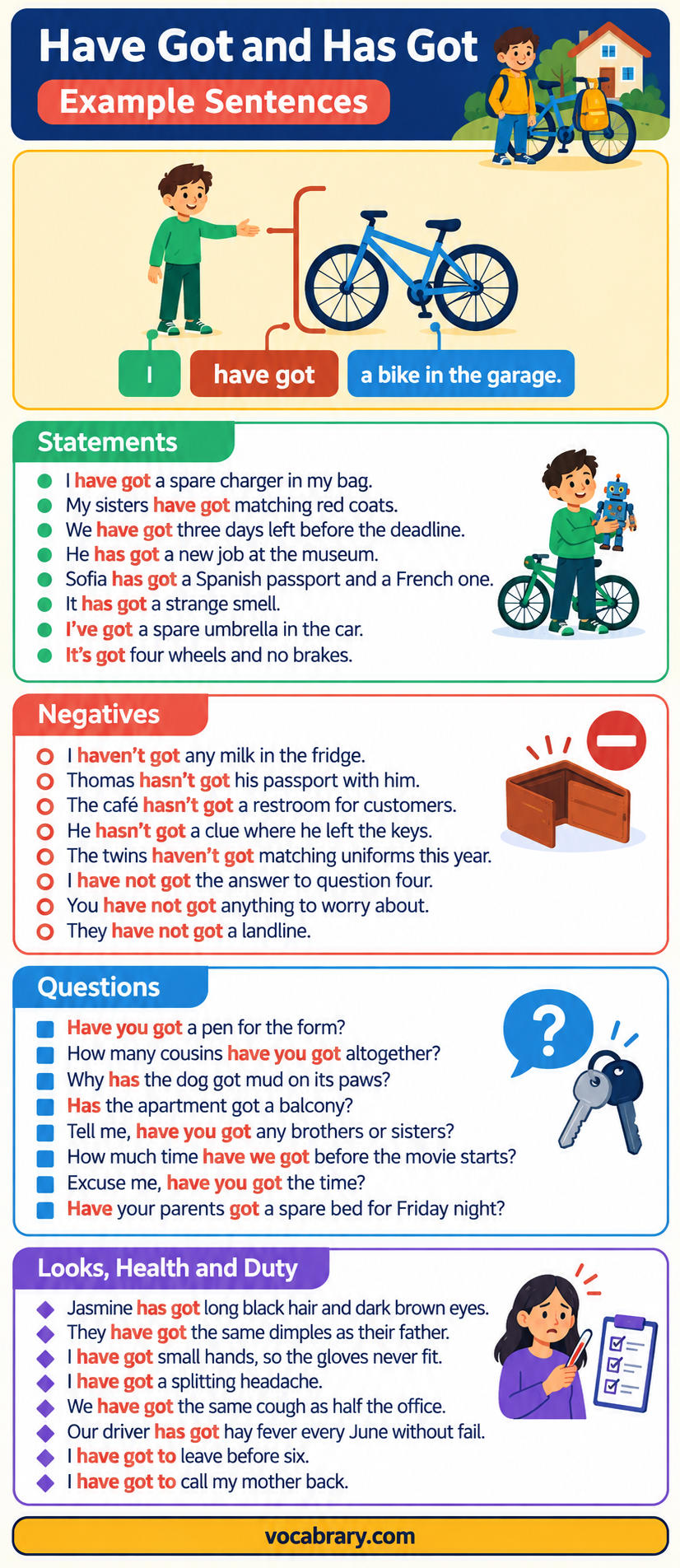
Common Have Got Has Got Example Sentences
A bike in the garage, two brothers in Tunis, and a headache before an exam fill most have got has got example sentences, where the verb ties a person to what they own or feel.
- I have got a bike in the garage.
- Fatima has got two brothers and one sister.
- We have got enough chairs for everyone at the table.
- My neighbour has got a small blue van that smells of paint.
- They have got a flat over the bakery on Green Street.
- She has got a headache and wants the light switched off.
- You have got something on your sleeve.
- Our school has got a new library with glass doors.
- Omar has got three cousins in Amman and two in Cairo.
- The puppy has got white paws.
- Both of my aunts have got the same ringtone on their phones.
- His parents have got a cottage near the lake in Killarney.
- Marta has got a scar under her left eyebrow from a fall.
- Those trousers have got a hole near the pocket.
- Everyone in our class has got a partner for the science project.
- It has got four legs and a broken handle.
- Priya and Jack have got tickets for the Saturday match in Leeds.
- Grandpa has got an old radio that still works perfectly.
- Mr Okafor, who teaches history on Tuesdays, has got the loudest laugh in the whole building.
Have Got and Has Got With Every Pronoun
I, you, we, and they take have got, while he, she, and it take has got. A spare ticket, a nurse in Lisbon, and a kitchen with two windows each show one pairing at work.
| Pronoun | Form | Example sentence |
|---|---|---|
| I | Have got | I have got a spare ticket. |
| You | Have got | You have got paint on your hands. |
| He | Has got | He has got a new job in Lisbon. |
| She | Has got | She has got curly hair. |
| It | Has got | It has got two windows. |
| We | Have got | We have got a table by the window. |
| They | Have got | They have got twin daughters. |
Sentences With Have Got for I, You, We, and They
A spare charger, a table booked for eight o’clock, and twin daughters at school belong to the speakers who take have got, whether one person or a whole group.
- I have got a spare charger in my bag.
- You have got my number already.
- We have got a table by the window for eight o’clock.
- They have got twin daughters who started school last week.
- My sisters have got matching red coats.
- The twins have got the same birthday as their father.
- I have got a dentist appointment on Thursday morning.
- You and Daniel have got the same surname.
- We have got three days left before the deadline.
- My colleagues have got a meeting room booked until noon.
- They have got a caravan parked behind the farmhouse in Wexford.
- I have got an answer.
- The students at the back have got questions about the reading for tomorrow.
- You have got a visitor waiting at reception with a brown envelope.
- Our cousins in Manchester have got a garden full of apple trees.
- We have got nothing planned for Sunday, so the beach sounds good.
Sentences With Has Got for He, She, and It
A nurse with curly hair, a kitten with white paws, and a phone with a cracked screen show has got beside he, she, it, and every single noun.
- He has got a new job at the museum.
- She has got curly hair and green eyes.
- It has got a cracked screen.
- My brother has got a motorbike that never starts in winter.
- The kitten has got white paws and a black nose.
- Sofia has got a Spanish passport and a French one.
- He has got a sore throat, so the doctor told him to stay at home.
- Our flat has got a balcony facing the river.
- She has got two older brothers who both play cricket for the county.
- The old bus has got no heating at all.
- Hiroshi has got a cousin who works as a pilot in Osaka.
- It has got a strange smell.
- My laptop has got enough battery for the film.
- The house at the end of the lane has got green shutters and a red door.
- She has got an interview at four with the head of the department.
- Lucas has got freckles across his nose.
Negative Sentences With Haven’t Got and Hasn’t Got
An empty milk bottle, a hill with no phone signal, and a café without a toilet turn a positive line into a negative one, with not slipping between have or has and got.
- I haven’t got any milk in the fridge.
- She hasn’t got a brother.
- We haven’t got enough chairs for nine people.
- Tomas hasn’t got his passport with him.
- They haven’t got a garden, so the herbs grow on the windowsill.
- My phone hasn’t got a signal on this hill.
- You haven’t got long before the bus leaves.
- The café hasn’t got a toilet for customers.
- Amira hasn’t got a bicycle yet, though she has asked for one since her birthday in March.
- Our new flat hasn’t got a bath, only a shower.
- Those shoes haven’t got laces.
- He hasn’t got a clue where he left the keys.
- It hasn’t got a lid.
- Grandad hasn’t got a mobile phone, so we write to him instead.
- I haven’t got time for a coffee this morning.
- The twins haven’t got matching uniforms this year.
Full Forms With Have Not Got and Has Not Got
Written English and slow, careful speech keep the two words apart, as in a hotel with no lift, a village with no chemist, and an unanswered question four.
- I have not got the answer to question four.
- She has not got a second remote for the garage door.
- We have not got room for another bookcase in this hallway.
- The hotel has not got a lift, so the suitcases go up by hand.
- You have not got anything to worry about.
- Daniel has not got a licence yet.
- They have not got a landline.
- My grandmother has not got a bank card and pays for everything in cash.
- It has not got a price on it.
- Our village has not got a chemist, so prescriptions come from Keswick.
Question Sentences With Have You Got and Has She Got
A borrowed pen, a sister in Bristol, and mud on a dog’s paws become questions once have or has jumps in front of the pronoun and got stays behind it.
- Have you got a pen for the form?
- Has she got a sister in Bristol?
- How many cousins have you got altogether?
- Sorry, have they got tickets for the late train?
- Why has the dog got mud on its paws?
- What have we got for supper tonight?
- Has the flat got a balcony?
- Which of your neighbours has got the ladder this week?
- Tell me, have you got any brothers or sisters?
- Who has got the spare charger?
- Has Marek got his own room at his grandmother’s house in Gdansk?
- How much time have we got before the film starts at the Odeon in town?
- Have the children got their swimming kits?
- Excuse me, have you got the time?
- Mum, has it got a guarantee?
- Have your parents got a spare bed for Friday night?
Short Answers With Yes I Have and No She Hasn’t
A short answer repeats have or has and drops everything else, so a question about a phone number, a plaster, or a kitten without a name comes back in three words.
- Has she got your number? Yes, she has.
- Mum, have I got time for a shower? No, you haven’t.
- Have they got a spare room in the house at Whitby? Yes, they have.
- Quickly, has anyone got a plaster? No, nobody has.
- Have you got change for a ten-pound note? No, I haven’t.
- Tell me straight, has the printer got any paper left in the tray? Yes, it has.
- Has Yusuf got his own bike? No, he hasn’t.
- So, have we got everything for the picnic? Yes, we have.
- Dad, have the neighbours got a new car? Yes, they have.
- Wait, has your brother got the same coat as mine? No, he hasn’t.
- Honestly, have you got a headache again? Yes, I have.
- Listen, has the kitten got a name yet? No, it hasn’t.
Contractions With I’ve Got and She’s Got
Fast speech glues the pronoun to have or has, so a spare umbrella, a flat in Dundee, and a cockerel that wakes the street all arrive as I’ve got, she’s got, or they’ve got.
- I’ve got a spare umbrella in the car.
- She’s got a new flat near the station in Dundee.
- We’ve got twenty minutes before the doors open.
- He’s got a cold and a temperature.
- They’ve got three chickens and a very loud cockerel.
- You’ve got something in your hair.
- It’s got four wheels and no brakes.
- My sister says she’s got the tickets already.
- Ben thinks he’s got the flu, though the doctor called it a heavy cold.
- We’ve got enough bread for breakfast.
- They’ve got a cousin who plays the trumpet in a brass band in Huddersfield.
- I’ve got nothing to wear for the wedding on Saturday.
- You’ve got my word.
- Everyone in the office says she’s got the best handwriting.
Have Got and Has Got for Belongings and Family
Three pairs of walking boots, a season ticket for the swimming pool, four grandchildren under six, and a godmother in Galway divide the two forms between what people own and who they are related to.
Possessions and Belongings
A red motorbike, a record player from the seventies, and a rowing boat moored at the lake name what people own, which is the work have got and has got do most.
- Karim has got a red motorbike and a helmet to match.
- We have got two umbrellas by the door.
- My sister has got a record player from the seventies.
- They have got a rowing boat moored at the far end of the lake.
- I have got three pairs of walking boots.
- The Nowaks have got a caravan they take to the coast every August.
- She has got a leather bag with a broken strap.
- Our teacher has got a whistle on a red cord.
- You have got more books than shelves.
- His flat has got wooden floors throughout.
- Everyone in the band has got their own microphone.
- It has got a wooden handle.
- Nobody in our family has got a car big enough for eight passengers and a dog.
- Elena has got a season ticket for the swimming pool.
Family and Relationships
Two older brothers, four grandchildren under six, and a godmother in Galway show how English counts relatives, with has got for one person and have got for a couple or a crowd.
- Leila has got two older brothers and a baby sister.
- We have got cousins in Toronto and in Lahore.
- My uncle has got four grandchildren under the age of six.
- They have got a stepdaughter who studies medicine in Leeds.
- He has got a twin brother nobody ever mixes him up with.
- Our neighbours have got a new baby, so the lights are on all night.
- I have got a godmother in Galway who sends a card every Easter.
- She has got a boyfriend from her drama class.
- The Ahmeds have got relatives staying until the end of the month.
- You have got your mother’s eyes.
- Both of my aunts have got daughters at the same college.
- Marco has got a half-sister he met for the first time last year.
- Grandma has got nine great-grandchildren.
- Nobody in the choir has got a surname as long as hers.
Have Got and Has Got for Looks and Health
Long black hair, a beard down to a collar, a sore throat and a temperature of thirty-nine: description and symptoms are the two everyday jobs that pull have got and has got into conversation.
Hair, Eyes, and Height
Freckles across a nose, broad swimmer’s shoulders, and matching dimples on father and child give have got and has got the work of describing a face or a build.
- Yasmin has got long black hair and dark brown eyes.
- My brother has got freckles all over his nose.
- He has got broad shoulders from years of swimming.
- They have got the same dimples as their father.
- She has got short grey hair now.
- Our coach has got a beard that reaches his collar.
- I have got small hands, so the gloves never fit.
- The baby has got blue eyes for the moment.
- Ivan has got a tattoo of a swallow on his wrist.
- You have got a lovely smile.
- His grandmother has got the straightest back of anyone in the Tuesday exercise class.
- Pedro and his father both have got thick eyebrows and the same walk.
Colds, Headaches, and Sore Throats
A splitting headache, chickenpox that keeps a child at home, and hay fever every June turn have got and has got into the words a patient uses at the surgery.
- I have got a splitting headache.
- She has got a sore throat and a blocked nose.
- My son has got chickenpox, so he is at home this week.
- We have got the same cough as half the office.
- He has got a temperature of thirty-nine.
- The children have got upset stomachs after the party food.
- Alina has got toothache and an appointment at eleven.
- You have got a bruise on your elbow.
- Our driver has got hay fever every June without fail.
- It has got a rash on its back leg, so the vet wants to see it tomorrow.
- Grandad has got a bad back and walks with a stick.
- Nobody in the class has got flu this term.
Have Got and Has Got for Time and Appointments
A meeting at half past nine, driving lessons on Tuesdays, and an exam first thing tomorrow pin have got and has got to a clock or a date in the diary.
- We have got a meeting at half past nine.
- She has got a dentist appointment on Thursday afternoon.
- I have got ten minutes before the next train.
- Tomek has got driving lessons every Tuesday and Friday.
- They have got a wedding to attend in Cork this weekend.
- The clinic has got no free appointments until March.
- You have got until Friday.
- My parents have got tickets for the seven o’clock showing at the Odeon.
- He has got a job interview at two, so he pressed his shirt last night.
- Our team has got a match on Sunday morning.
- Nadia has got an exam first thing tomorrow.
- Everybody has got a turn at reading aloud this week.
Have Got and Has Got at School, at Work, and at Home
Double maths before lunch, two clients waiting in reception, and washing on the line put the same two forms into a classroom, an office, and a kitchen.
At School
A swimming pool behind the sports hall, thirty-one pupils in one class, and a locker near the science lab fill the school day with have got and has got.
- Our school has got a swimming pool behind the sports hall.
- I have got double maths before lunch.
- Mrs Doyle has got thirty-one pupils in her class this year, and four of them are left-handed.
- The library has got new computers.
- We have got homework in maths, French, and history tonight.
- He has got a locker near the science lab.
- They have got football practice after the last bell on Wednesdays.
- You have got the wrong textbook.
- Every classroom has got a map of the world on the back wall.
- Sana has got the highest mark in the spelling test.
At Work
Three interviews before lunch, a coffee machine nobody understands, and a Friday deadline at noon are the working-day sentences that take have got and has got.
- My manager has got three interviews this morning.
- We have got a deadline on Friday at noon.
- The office has got a new coffee machine that nobody understands.
- She has got a desk by the window on the fourth floor.
- I have got two clients waiting in reception.
- Karl has got the day off for his daughter’s concert.
- They have got enough staff for the night shift.
- Our department has got a budget for training, though it shrinks every year.
- He has got a spare pass.
- Everyone on the ward has got a break before eight, even on the busiest nights.
At Home
Two kitchen windows facing the garden, thin walls that let the neighbours hear everything, and a chair reserved for one grandfather belong to the house, and each of them takes has got or have got.
- Our kitchen has got two windows facing the garden.
- I have got washing on the line.
- The cottage has got a wood-burning stove in the front room.
- We have got milk, eggs, and half a loaf.
- My flat has got thin walls, so the neighbours hear everything.
- It has got a stiff handle.
- They have got a shed full of paint tins at the bottom of the garden.
- She has got the spare bed made up for Saturday.
- You have got visitors at the door.
- Grandad has got a chair nobody else is allowed to use.
Have Got and Has Got in Shops and With Pets
A jumper in a larger size, two sourdough loaves left at the baker’s, a cat with one white paw: shopping and pets give beginners the friendliest sentences for have got and has got.
In Shops and Markets
Customers and shopkeepers trade the same two forms across the counter, from a loyalty card for the garden centre to strawberries on a market stall by the church.
- Have you got this jumper in a larger size?
- The baker has got two sourdough loaves left.
- We have got a voucher for ten pounds off.
- Has the chemist got anything for insect bites?
- My mother has got a loyalty card for the garden centre.
- They have got strawberries at the market stall by the church.
- I have got no cash on me.
- Has it got a guarantee?
- The shop on the corner has got milk until nine at night, even on a Sunday.
- You have got the receipt in your coat pocket.
With Pets and Animals
One white paw on a black cat, a parrot that whistles the doorbell tune, and a tortoise older than somebody’s father keep has got in the singular and have got in the plural.
- Our cat has got one white paw and three black ones.
- They have got two rabbits in a hutch by the shed.
- My dog has got a torn ear from a fight last spring.
- She has got a parrot that whistles the doorbell tune.
- The goldfish has got a castle in its tank.
- We have got a tortoise older than my father.
- He has got a border collie with one blue eye and one brown.
- It has got fleas.
- Emel has got three hens and a duck in her back yard.
- You have got a very muddy spaniel at the door.
Have Got To for Obligation
Leaving before six, a boiler the landlord must fix, and a form everybody signs before the trip show have got to and has got to standing in for must in spoken British English.
- I have got to leave before six.
- She has got to finish the report tonight.
- We have got to book the tickets before the price rises.
- Marcus has got to collect his brother from the airport at midnight.
- You have got to try the almond cake at that bakery.
- They have got to be at the clinic by eight in the morning.
- He has got to wear a tie for the interview.
- Our landlord has got to fix the boiler this week.
- I have got to ring my mother back.
- Everyone has got to sign the form before the trip to the museum in Bath.
- The driver has got to stop for a break after four hours on the road.
- My sister has got to revise all weekend for her chemistry exam.
- You have got to see the view from the top of the hill.
- Nobody has got to stay late tonight.
Have Got in British English and Have in American English
A cold in Manchester and a cold in Miami, a lift in Bath and an elevator in Phoenix: the two varieties describe one situation, and only the British version keeps got beside the verb.
- In Brighton the shopkeeper has got change for a twenty, and in Denver he has change for a twenty.
- "Have you got the time?" is the British question, and "Do you have the time?" is the American one.
- My aunt in Glasgow has got three cats, while her sister in Seattle has three cats.
- Pupils in Dublin say they have got homework, and pupils in Ohio say they have homework.
- A nurse in Leeds writes that the patient has got a temperature, and a nurse in Dallas writes that the patient has a fever.
- British children ask "Has she got a brother?", and American children ask "Does she have a brother?"
- On the phone from London, Rosa said she has got a new address, though her friend in Boston would say she has a new address.
- Americans keep have got for emphasis, as in "You have got to hear this song."
- In formal writing even British writers drop have got and write have instead.
- A hotel in Bath has got a lift, and a hotel in Phoenix has an elevator.
- Teenagers in both countries say I’ve got.
- An English teacher in Prague teaches have got first, because her textbook came from London.
Short Have Got Has Got Sentences for Kids and Beginners
A red ball, a blue bike, four legs on a chair: five-word sentences let a child copy the pattern without losing track of which form goes with which pronoun.
For Kids
A doll, two cats, and a big hat on dad keep these lines short enough for a first English lesson, with one bold form in each.
- I have got a red ball.
- She has got a doll.
- We have got two cats.
- He has got a blue bike.
- They have got new shoes.
- It has got four legs.
- My dad has got a big hat.
- You have got my pencil.
- Our dog has got a bone.
Short Sentences for Young Learners
Small hands on a baby, a green bag, and white paws on a cat give beginners lines they say aloud in one breath.
- The baby has got small hands.
- I have got a green bag.
- Grandma has got a garden.
- They have got a kite.
- He has got a toy train.
- We have got milk and bread.
- She has got curly hair.
- Our cat has got white paws.
- You have got a nice smile.
A Saturday Told With Have Got and Has Got
A market stall in Ludlow, a van with a flat tyre, and two children with one umbrella between them run through a single Saturday morning, where every stage takes have got or has got.
Mia has got a cheese stall in Ludlow market, and by six in the morning she has got the van loaded. Today her husband has not got the keys, because their son has got them in his coat pocket. The children have got one umbrella between them, so the walk to the square is a wet one. By nine the stall has got a queue of eight people, and Mia has got no change for a fifty-pound note. Her neighbour on the fruit stall has got plenty, and she has got a spare crate for the cheese as well. At one o’clock the family have got nothing left except the rind, and Mia has got to admit that the rain brought the crowd.
Related
FAQs
An everyday example is "I have got a bike in the garage." Another is "Our school has got a new library with glass doors."
For I and you, one example is "I have got a dentist appointment on Thursday morning." Another is "You have got my number already."
With he and she, one example is "She has got curly hair and green eyes." Another is "The kitten has got white paws and a black nose."
A negative example is "I haven’t got any milk in the fridge." Another is "Thomas hasn’t got his passport with him."
One question is "Have you got a pen for the form?" Another is "Who has got the spare charger?"
A pet example is "Our cat has got one white paw and three black ones." Another is "My dog has got a torn ear from a fight last spring."
In a family, one example is "Frances has got two brothers and one sister." Another is "I have got a godmother in Galway who sends a card every Easter."
For health, one example is "She has got a sore throat and a stuffy nose." Another is "My son has got chickenpox, so he is at home this week."
At school, one example is "I have got double math before lunch." Another is "Every classroom has got a map of the world on the back wall."
An obligation example is "I have got to leave before six." Another is "Our landlord has got to fix the boiler this week."
Related: