
Tense is a verb form that marks the time of an action, as in she walks today, she walked yesterday, and she will walk tomorrow. These tense sentences examples mark the verb in bold across all twelve tenses, starting with the present family and ending with one story retold in every form.
What Is Tense?
Tense is the grammatical marking on a verb that places an action in present, past, or future time. Aspect is the second layer, dividing each of those three times into simple, continuous, perfect, and perfect continuous forms, which is how three tenses become twelve.
Present, past, or future time + one of four verb forms
Yusuf writes every morning, wrote three pages yesterday, and will write again tonight.
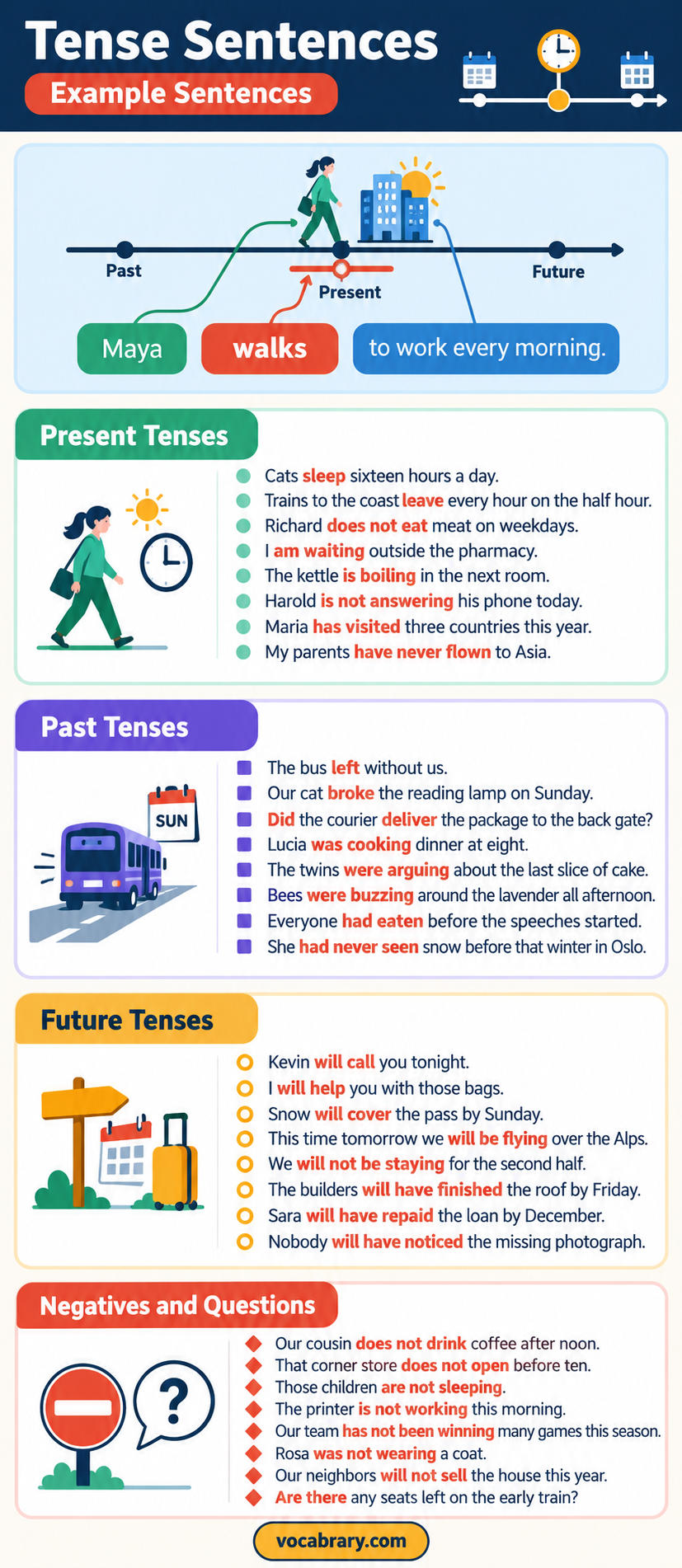
Common Tense Examples in Sentences
Water boiling at one hundred degrees, builders finishing a roof by Friday, and a teacher reaching twenty years in June are the everyday tense sentences examples that put all twelve forms side by side.
| Tense | Formula | Example sentence |
|---|---|---|
| Present simple | Subject + base verb (+ s/es for he, she, it) | Amira works at a clinic near the river. |
| Present continuous | Subject + am/is/are + verb-ing | The twins are painting the garden fence. |
| Present perfect | Subject + has/have + past participle | Our team has finished the report already. |
| Present perfect continuous | Subject + has/have been + verb-ing | Daniel has been learning Portuguese since April. |
| Past simple | Subject + past form of the verb | The bus left without us yesterday morning. |
| Past continuous | Subject + was/were + verb-ing | Lucia was cooking dinner at eight last night. |
| Past perfect | Subject + had + past participle | Everyone had eaten before the speeches started. |
| Past perfect continuous | Subject + had been + verb-ing | They had been waiting two hours when the doctor arrived. |
| Future simple | Subject + will + base verb | Kwame will call you after the meeting. |
| Future continuous | Subject + will be + verb-ing | This time tomorrow we will be flying over the Alps. |
| Future perfect | Subject + will have + past participle | The builders will have finished the roof by Friday. |
| Future perfect continuous | Subject + will have been + verb-ing | Noor will have been teaching for twenty years in June. |
- Water boils at one hundred degrees Celsius.
- Right now the twins are painting the garden fence a deep green.
- Our team has finished the safety report already.
- Since April, Daniel has been learning Portuguese with a tutor from Lisbon.
- The bus left without us yesterday morning.
- At eight last night, Lucia was cooking dinner for six guests in a borrowed kitchen.
- Everyone had eaten before the speeches started.
- They had been waiting two hours when the doctor finally arrived at the ward.
- Kwame will call you tonight.
- This time tomorrow, we will be flying over the Alps.
- By the end of Friday afternoon, the builders will have finished the new roof over the workshop.
- In June, Noor will have been teaching at the same village school for twenty years.
Present Tense Examples in Sentences
Boiling water, a fence being painted this minute, a finished report, and three months of Portuguese lessons separate the four present tenses, each one anchored to the moment of speaking.
Present Simple Tense Examples
Water boiling at one hundred degrees, trains leaving on the half hour, and penguins living in the southern hemisphere are the facts, timetables, and habits that fill simple present tense sentences.
Subject + base verb (+ s/es for he, she, it)
- Cats sleep sixteen hours a day.
- My sister teaches chemistry at a secondary school in Accra.
- Trains to the coast leave every hour on the half hour.
- Rashid does not eat meat on weekdays.
- Penguins live in the southern hemisphere and never meet a polar bear.
- Do you walk to the office, or do you take the tram from the square?
- The museum opens at ten and closes at six.
- Nobody in our building recycles the cardboard.
- Every August my grandparents drive to the lake and stay three weeks.
- She plays the cello in a youth orchestra on Saturday afternoons.
- Coffee costs less at the market than at the station café.
- Farmers in the valley plant rice in June and harvest it in October.
Present Continuous Tense Examples
A fence being painted this minute, a kettle boiling in the next room, and a city building two new hospitals this year drive present continuous tense examples, which report an action still in progress.
Subject + am/is/are + verb-ing
- I am waiting outside the pharmacy.
- Lucia is painting the fence while her brother mixes the second tin of green.
- Both children are sleeping, so please close the door quietly.
- The kettle is boiling in the next room.
- Why are you standing in the rain without an umbrella?
- Our city is building two hospitals this year.
- Hamid is not answering his phone today.
- Snow is falling across the northern counties, and the airport has closed both runways.
- Those students are revising for an exam that starts in ninety minutes.
- Nadia is living with her aunt until the new flat is ready.
- Prices are rising faster than wages in most coastal towns.
- Listen, somebody is knocking at the back door.
Present Perfect Tense Examples
A finished safety report, three countries visited this year, and keys lost twice in one week are the completed-but-connected actions behind present perfect tense sentences.
Subject + has/have + past participle
- Maria has visited three countries this year.
- We have finished the safety report.
- Priya has lost her keys twice this week, and the landlord refuses to cut another set.
- The train has already left platform four.
- Have you eaten anything since breakfast?
- My parents have never flown to Asia.
- Rain has fallen every day since Tuesday.
- Ahmed has broken his glasses again.
- Those two neighbours have known each other for forty years.
- The council has spent eleven million pounds on the bridge and still needs more.
- Nobody has signed the visitors book today.
- Scientists have discovered a new species of frog in the highland forest.
Present Perfect Continuous Tense Examples
Portuguese lessons running since April, a dog barking for an hour, and builders working on one roof all week make up present perfect continuous tense examples, where the action began earlier and continues.
Subject + has/have been + verb-ing
- Daniel has been learning Portuguese since April.
- That dog has been barking for an hour.
- We have been waiting for the blood test report since nine this morning.
- Amina has been working at the hospital for six years.
- How long have you been studying Japanese?
- My eyes hurt because I have been staring at a screen all afternoon.
- The builders have been repairing the same roof all week, and the rain keeps stopping them.
- Petrol prices have been rising since January.
- Sofia has not been sleeping well since the baby arrived.
- Our neighbours have been arguing about that fence for three summers.
- Ravi has been driving taxis in Delhi since he left school at seventeen.
- Nothing has been going to plan.
Past Tense Examples in Sentences
A bus that left without its passengers, a dinner being cooked at eight, a meal eaten before the speeches, and a two-hour wait in a hospital corridor divide the four past tenses.
Past Simple Tense Examples
A bus leaving without its passengers, an exam sat last June, and a lamp broken by the cat are the finished past actions behind simple past examples in sentences.
Subject + past form of the verb (verb + ed for regular verbs)
- The bus left without us.
- Marek sat his final exam last June and passed every paper.
- Our cat broke the reading lamp on Sunday.
- I posted the letter on Monday afternoon.
- Did the courier deliver the parcel to the back gate?
- Grandpa worked at the steelworks for thirty-one years before it closed.
- Nobody told the goalkeeper about the change of kit.
- Fatima wrote her first novel in a rented room over a bakery in Tangier.
- We did not hear the alarm.
- The storm destroyed two greenhouses and flooded the lower field.
- Alexander Fleming discovered penicillin in 1928 at St Mary’s Hospital in London.
- Yesterday the children swam in the river and built a small dam of stones.
Past Continuous Tense Examples
A dinner cooked at eight, rain falling through a match, and a fire alarm that interrupts two colleagues fill past continuous tense examples, where a longer past action sets the scene.
Subject + was/were + verb-ing
- Lucia was cooking dinner at eight.
- Rain was falling steadily while the second half of the match went on.
- We were talking in the corridor when the fire alarm sounded.
- What were you doing at midnight?
- The twins were arguing about the last slice of cake.
- Hassan was driving home from the airport when his tyre burst on the ring road.
- Nobody was listening to the announcement.
- Bees were buzzing around the lavender all afternoon.
- My laptop was updating itself, so I read a chapter of a novel instead.
- Rosa was not wearing a coat, and the temperature had dropped to minus three.
- Passengers were sleeping when the ferry docked at Calais just after five.
- Somebody was singing upstairs.
Past Perfect Tense Examples
A meal eaten before the speeches, a train gone before the taxi arrived, and keys left on a kitchen table are the earlier-of-two-past-actions in past perfect tense examples.
Subject + had + past participle
- Everyone had eaten before the speeches started.
- By the time our taxi reached the station, the last train had gone.
- Omar realised that he had left his keys on the kitchen table.
- She had never seen snow before that winter in Oslo.
- Had the shop closed by the time you got there?
- The pitch was unplayable because rain had fallen for three days.
- Nobody had warned the crew.
- After the guests had left, we washed forty plates and two enormous pans.
- Yuki had studied German for a year before she moved to Vienna.
- Our flight was cancelled, and the airline had not offered a single hotel room.
- The thieves had disappeared long before the alarm reached the police station.
- Ines was furious because her brother had borrowed her bicycle again.
Past Perfect Continuous Tense Examples
Two hours of waiting in a hospital corridor, a cough that had troubled a patient for weeks, and a search for a flat that had run since spring fill past perfect continuous tense examples.
Subject + had been + verb-ing
- They had been waiting two hours when the doctor arrived.
- My grandfather had been coughing for weeks before he agreed to see anyone.
- We had been searching for a flat since spring, and the deposit kept rising.
- Rain had been falling all night, so the path turned to mud.
- Had she been living in Cairo long before the job at the German school ended?
- Tomasz had been driving for nine hours when he pulled into the service station.
- The children had been playing outside, and their boots left prints across the hall.
- Nobody had been using the spare room.
- Prices had been climbing steadily until the government stepped in.
- Aisha had not been sleeping properly, and the exam was two days away.
- Our team had been training since August for a final that lasted ninety minutes.
- Something had been burning in the oven.
Future Tense Examples in Sentences
A phone call promised for tonight, a flight over the Alps this time tomorrow, a roof finished by Friday, and twenty years of teaching completed in June divide the four future tenses.
Future Simple Tense Examples
A promised phone call, a delivery due on Thursday, and an offer to help with heavy bags are the predictions and promises in simple future tense sentences.
Subject + will + base verb
- Kwame will call you tonight.
- Our parcel will arrive on Thursday morning.
- I will help you with those bags.
- Scientists say the glacier will disappear within forty years.
- Will you wait here while I fetch the car?
- Nobody will believe this story.
- The referee will blow the whistle at four, and the stadium will empty within minutes.
- Marta will not sign the contract until her lawyer reads every clause.
- Snow will cover the pass by Sunday.
- Your train will depart from platform seven in eleven minutes.
- If the rain stops, the gardeners will plant two hundred tulip bulbs along the wall.
- Sami will bring dessert.
Future Continuous Tense Examples
A flight over the Alps this time tomorrow, essays marked all Saturday morning, and a friend driving past a station at six fill future continuous tense examples.
Subject + will be + verb-ing
- This time tomorrow we will be flying over the Alps.
- Mr Okafor will be marking essays all Saturday morning.
- I will be driving past the station at six, so wait by the ticket office.
- How long will you be using the car on Sunday?
- The band will be playing in Lisbon next weekend.
- At noon the delegates will be voting on the second amendment.
- Nobody will be working in the office during the public holiday.
- Rita will be studying in Seoul this time next year, and her sister plans to visit.
- Rain will be falling across the hills by the time you reach the summit.
- We will not be staying for the second half.
- Passengers will be boarding from gate twelve.
- Think of us next Tuesday, because the whole department will be moving into a new building.
Future Perfect Tense Examples
A roof finished by Friday, a loan repaid by December, and a pilot who reaches a thousand flying hours by spring are the deadline actions in future perfect tense examples.
Subject + will have + past participle
- The builders will have finished the roof by Friday.
- Sara will have repaid the loan by December.
- By spring, Captain Lund will have flown a thousand hours over the North Sea.
- Will the guests have arrived before the storm reaches the coast?
- We will have eaten by then.
- Ibrahim will have written forty letters before the campaign closes on the last day of April.
- Water will have boiled in the kettle by the time you find the cups.
- Nobody will have noticed the missing photograph.
- Their daughter will have turned eighteen before the wedding.
- By 2030 the council will have planted ten thousand trees along the riverbank.
- The film will have started already, so we should choose the later screening.
- Our lease will have expired by August.
Future Perfect Continuous Tense Examples
Twenty years of teaching completed in June, six hours of driving by nightfall, and a decade of waiting for a hospital place are the run-up-to-a-deadline actions in future perfect continuous tense example sentences.
Subject + will have been + verb-ing
- Noor will have been teaching for twenty years in June.
- Erik will have been driving for six hours without a proper break by nightfall.
- Our village will have been waiting a decade for a hospital place.
- In August they will have been living in Toronto for five years.
- By June, will you have been working here long enough to take the sabbatical?
- The pump will have been running all night.
- By the final whistle, Ana will have been playing her first full match since the injury.
- Next month Grandma will have been knitting that blanket for a year, and it grows slowly.
- Researchers will have been tracking the whales for three seasons.
- I will not have been sleeping long when the alarm goes off at four.
- In December the committee will have been debating the bypass for eleven years.
- Rain will have been falling for twelve hours by dawn.
Everyday Verb Form Examples in Sentences
Am, is, are, was, were, has, have, had, do, does, did, there is, and there are are the small verbs that build every tense in English, and learners meet them first.
Am, Is, and Are Examples
A nurse on a night shift, two brothers who are twins, and a soup that is too salty run through am is are example sentences, the present forms of the verb be.
Subject + am/is/are + noun, adjective, or place
- I am a nurse on the night shift.
- My brothers are twins, though nobody outside the family believes it.
- This soup is too salty.
- Are your cousins still in Karachi?
- Nadia is thirty-one today.
- The keys are on the shelf beside the blue jug.
- You are right about the timetable.
- Football is the cheapest sport in the world, and that explains its reach.
- Both lifts are out of order again.
- Am I early?
- The soldiers are tired, hungry, and a long way from any road.
- Amina is not at home.
Was and Were Examples
An exam that was harder than expected, streets that were empty at dawn, and a father who was a carpenter fill was and were example sentences, the past forms of be.
Subject + was/were + noun, adjective, or place
- The exam was harder than anyone expected.
- Streets were empty at dawn.
- My father was a carpenter in a village near Bologna for most of his life.
- Were you at the concert on Friday?
- Both tyres were flat.
- Ruth was not ready when the taxi arrived at half past six.
- We were nervous before the interview, and the waiting room made it worse.
- Was the water cold?
- Those letters were written by her grandmother in 1947.
- Everyone was delighted with the result.
- The old bridge was wooden until a flood carried half of it downstream in March.
- Sanjay was twelve then.
Has, Have, and Had Examples
Three cars and a caravan, a village with no electricity until 1974, and a temperature of thirty-nine degrees fill has have had example sentences.
Subject + has/have/had + object, or + past participle as a helping verb
- Our neighbours have three cars and a caravan.
- Sofia has a temperature of thirty-nine degrees.
- The village had no electricity until 1974.
- Has your brother finished his apprenticeship?
- I have two sisters in Melbourne and one in Perth.
- Nobody had a spare umbrella.
- That café has the best almond pastries on the whole street.
- We had a puncture near the border and lost ninety minutes.
- Have you got a moment?
- Kofi has not written since March.
- Their old house had eleven rooms, a cellar, and a walled garden full of plum trees.
- The cat has fleas.
Examples With Do, Does, and Did
Homework done every evening, a bus to the port, and a thermostat nobody admits touching drive do does did example sentences. These three verbs work as main verbs and as helpers.
Do/does/did + subject + base verb for questions, or subject + do/does/did not + base verb
- Do you take sugar in your tea?
- Marcus does his homework every evening before dinner.
- Did anyone touch the thermostat?
- We did not book the tickets in advance, and the show sold out by Tuesday.
- Does this bus go to the port?
- She did the washing up without being asked.
- Nobody does the accounts as carefully as Laila.
- Did the referee award a penalty in the final minute of injury time?
- They do not speak Italian at home.
- Do hedgehogs really sleep through the whole winter in this climate?
- Rani did her best.
- Our landlord did not repair the boiler until three tenants complained in writing.
There Is and There Are Examples
A crack in the ceiling, four cyclists outside the shop, and an empty milk bottle fill there is there are example sentences. There comes in front of the verb be.
There + is/are/was/were + noun
- There is a crack in the bathroom ceiling.
- Outside the shop, there are four cyclists waiting for the lights to change.
- In the fridge there is no milk left.
- Is there a chemist near the bus station?
- Last spring there were eleven candidates for one teaching job at the village school.
- On Tuesday evening there was a power cut across the whole district.
- Are there any seats in the second carriage?
- Along that coast there are two harbours, and the narrow one floods every spring.
- Apart from the olives, there is nothing in the fridge.
- Before five o’clock there was not enough time to visit the castle.
- In the solar system there are eight planets, though older school books counted nine.
- There is somebody at the door.
Future and Habit Form Examples in Sentences
Be going to, used to, the present continuous with a future time, and the future in the past cover plans already made, habits dropped years ago, and futures seen from a point in the past.
Be Going To Examples
A plan to study medicine, a sky about to break into a storm, and a couple who are going to move in April fill be going to example sentences, which report intentions and visible evidence.
Subject + am/is/are going to + base verb
- Zara is going to study medicine in Dublin.
- Look at those clouds, because it is going to rain before we reach the car.
- We are going to move to a smaller flat in April.
- Are you going to apply for the manager’s job?
- I am going to phone the bank tomorrow.
- The company is not going to renew any temporary contracts this year.
- Those shelves are going to collapse under all that tinned fruit.
- Felipe is going to sell his van.
- Is the council going to close the swimming pool for good?
- My cousins are going to spend August on their grandmother’s farm near Cluj.
- Nobody is going to remember this argument next week.
- The referee is going to stop the match.
Used To Examples
A pipe smoked on the back step, a factory that employed half a town, and a childhood hatred of olives fill used to example sentences, for habits that ended.
Subject + used to + base verb
- Grandpa used to smoke a pipe on the back step.
- That factory used to employ half the town.
- I used to hate olives.
- Did you use to play the violin at school?
- My mother used to walk four kilometres to the nearest secondary school in all weathers.
- Buses used to run every ten minutes along this road.
- Priya did not use to enjoy cold weather, and now she skis every winter.
- There used to be a bakery on the corner before the phone shop took over.
- We used to spend every August at the same rented caravan beside a stony beach.
- Nobody used to lock their doors in the village.
- Hamza used to be a goalkeeper.
- Newspapers used to cost ten pence.
Present Continuous for Future Examples
A dentist at four, a flight to Oslo on Saturday, and a dinner with neighbours on Friday night make up present continuous for future example sentences, where the arrangement is already booked.
Subject + am/is/are + verb-ing + future time reference
- I am seeing the dentist at four.
- Hannah is flying to Oslo on Saturday morning.
- We are having dinner with the neighbours on Friday night.
- Are you coming to the match tomorrow?
- The Ahmeds are arriving on the eleven o’clock ferry.
- Diego is starting his new job on Monday.
- Our class is visiting the paper mill next Thursday, and the bus leaves at eight sharp.
- Nobody is working on the public holiday.
- Doctor Herrera is operating at seven tomorrow morning.
- Rosa and Tom are getting married in a small chapel outside Seville in September.
- I am not staying for the whole conference.
- The choir is singing at the cathedral on Christmas Eve.
Future in the Past Examples
A guest who meant to leave early, a coach who knew his side would lose, and a letter nobody expected fill future in the past example sentences.
Subject + was/were going to + base verb, or subject + would + base verb
- Elena was going to leave early, then the rain started.
- The coach knew his side would lose without two injured defenders.
- We were going to camp by the lake until the forecast changed on Thursday evening.
- Nobody guessed that the letter would change everything.
- Yusuf was about to call a taxi when his neighbour offered a lift.
- They were going to sell the piano.
- She promised that she would write every week from the training camp in Cyprus.
- The captain announced that the ferry would dock two hours late.
- I was going to apologise, and then he laughed at the whole thing.
- Our teacher warned us that the second paper would be far longer than the first.
- Were you going to tell me about the interview?
- Marco believed that his brother would arrive before midnight, and the road was empty.
Tense Examples in Negative Sentences
A shop that never opens before ten, a phone nobody answers, and a mural missed by opening night turn the twelve tenses negative. Not attaches to the helping verb, and the main verb stays plain.
- Rashid does not eat meat on weekdays.
- That corner shop does not open before ten.
- Those children are not sleeping.
- Hamid is not answering his phone today.
- We have not signed the lease, and the agent keeps sending reminders.
- My parents have never flown to Asia.
- Sofia has not been sleeping well since the baby arrived.
- The engineers had not been working on that line for long when the fault appeared.
- Nobody told the goalkeeper, and the team did not hear about the change of kit.
- Rosa was not wearing a coat.
- Our flight was cancelled, and the airline had not offered a single hotel room.
- Marta will not sign the contract until her lawyer reads every clause.
- The department will not be moving before September.
- Ferrara will not have finished the mural by the opening night.
Tense Examples in Question Sentences
A tram to the office, an umbrella missing in the rain, and a shop already closed turn the twelve tenses into questions. The helping verb moves in front of the person, or do, does, and did step in.
- Do you walk to the office, or do you take the tram?
- Does this bus go to the port?
- Why are you standing in the rain without an umbrella?
- Have you eaten anything since breakfast?
- How long have you been studying Japanese?
- Did the courier deliver the parcel to the back gate?
- What were you doing at midnight?
- Had the shop closed by the time you got there?
- Had she been living in Cairo long before the job at the German school ended?
- Will you wait here while I fetch the car?
- How long will you be using the car on Sunday?
- Will the guests have arrived before the storm reaches the coast?
- By June, will you have been working here long enough to take the sabbatical?
- Is there a chemist near the bus station?
Tense Examples With Time Markers and Signal Words
Every morning, right now, already, since April, yesterday, by Friday, and this time next week are the time markers that pin a sentence to one tense and no other.
- Every morning Yusuf writes two pages before breakfast.
- Right now the twins are painting the fence.
- Our team has already finished the report.
- Since April, Daniel has been learning Portuguese.
- Yesterday the bus left without us.
- At eight last night Lucia was cooking dinner for six guests in a borrowed kitchen.
- By the time the taxi arrived, the last train had gone.
- For two hours they had been waiting in a cold corridor when the doctor finally appeared.
- Tomorrow Kwame will call you.
- This time next week, we will be flying over the Alps.
- By Friday the builders will have finished the roof.
- In June, Noor will have been teaching for twenty years.
- Twice a week Amina swims before work.
- Ten minutes ago somebody knocked at the back door.
Mixed Tense Examples in One Sentence
A meal eaten before the speeches, a phone that rings during the cooking, and a trip to Kerala once the exams end pair two tenses in one sentence. A time word joins the halves.
- Everyone had eaten before the speeches started.
- Lucia was cooking dinner when the phone rang.
- Once the exams end, Ravi will travel to Kerala for a month.
- Omar realised that he had left his keys on the kitchen table.
- We have lived here since the council rebuilt the station.
- While the twins were painting the fence, their mother repaired the gate.
- By the time you read this, the ferry will have reached Dover.
- She says that she will apply for the scholarship in October.
- The coach knew that his side would lose without two injured defenders.
- If the rain stops, the gardeners will plant two hundred bulbs along the wall.
- Nobody had been using the spare room until the cousins arrived from Lagos.
- Hassan was driving home when his tyre burst on the ring road.
- Amina has been working at the hospital since she qualified in 2019.
- Marek sat the exam in June and will start his degree in Kraków this autumn.
One Story Told Through Every Tense
Leila, an early shift at a bakery on Rue Carnot, a broken oven, and a move to Lyon tell one story across all twelve tenses, with the verb marked in every line.
- Leila works the early shift at a bakery on Rue Carnot.
- She is kneading dough at five this morning while the ovens heat.
- Her hands have carried flour to that counter for three years.
- Every spare euro has been saved since the day she started.
- Last winter the oven broke in the middle of a Saturday rush.
- Customers were queueing past the door when the smoke alarm went off.
- The owner had promised a repair.
- Leila had been asking for a new oven since the previous autumn.
- She will finish her pastry course in the spring.
- This time next year she will be running her own small kitchen in Lyon.
- By the end of that first summer she will have baked ten thousand loaves.
- In December she will have been working with dough for five years.
- Her mother used to bake the same round loaves in a village outside Oran.
- Tomorrow Leila is meeting the landlord of a narrow shop near the river.
Related
- Am Is Are Example Sentences
- Future Perfect Continuous Tense Example Sentences
- Future in the Past Example Sentences
FAQs
The twelve English tenses are the four present forms, the four past forms, and the four future forms. Each of the three times takes a simple, continuous, perfect, and perfect continuous form. That gives present simple, present continuous, present perfect, and present perfect continuous, with matching sets in the past and the future.
English has three times and twelve tense forms, so both answers appear in textbooks for a reason. Strict grammarians count two marked tenses, present and past, because English builds the future with will and other helpers rather than with an ending on the verb. School courses count twelve because each of the three times combines with four verb forms.
The twelve formulas run in four rows of three across present, past, and future. Subject plus base verb, subject plus past form, and subject plus will plus base verb give the simple set. Am, is, are, was, were, or will be plus verb-ing gives the continuous set. Has, have, had, or will have plus a past participle gives the perfect set, and been before verb-ing gives the perfect continuous set.
Tenses and verbs are not the same, since a verb is a word and a tense is one of the forms that verb takes. The verb write turns into writes, wrote, is writing, has written, and will have been writing, and each form marks a different time.
Two tenses work inside one sentence whenever the two actions belong to different times, as in Omar realised that he had left his keys on the table. The past perfect marks the earlier action and the past simple marks the later one. Reported speech, time clauses, and conditional sentences all pair tenses in this way.
The past simple and the present perfect differ in whether the time is finished. The bus left at nine names a finished moment in the past, while the bus has left reports a past action whose result still counts now, with no time named. Words such as yesterday and last year take the past simple, while already, yet, and since take the present perfect.
Tense shifts back one step in reported speech when the reporting verb is in the past. I am tired becomes she said she was tired, I have finished becomes he said he had finished, and I will call becomes they said they would call. A fact that remains true allows the original tense to stay.
No thirteenth tense exists in standard English grammar, and the phrase turns up as a puzzle rather than a rule. Forms such as be going to, used to, the present continuous with a future time, and the future in the past stay outside the twelve, which is why some teachers half-jokingly call them extra tenses.
The present tense adds s or es to the verb for he, she, and it, and leaves the base form everywhere else, as in she teaches beside they teach. For the continuous it takes am, is, or are plus verb-ing; for the perfect it takes has or have plus a past participle.
Children grasp tense fastest through one verb and three pictures: I play today, I played yesterday, I will play tomorrow. Once those three land, add the continuous with I am playing for something happening this minute, then the perfect with I have played for something finished that still counts.
Will and be going to both point forward, yet they report different states of mind. Will marks a decision taken while speaking, a prediction, or a promise, as in I will help with those bags. Be going to marks an intention formed earlier or evidence anyone sees, as in those clouds mean it is going to rain.
Signal words are the time markers that pin a sentence to one tense. Every day, always, and twice a week go with the present simple, while now and at the moment go with the present continuous. Already, yet, and since take the present perfect; yesterday, ago, and last week take the past simple; and by Friday takes the future perfect.
Facts and timetables take the present simple, even when the event lies in the future. Water boils at one hundred degrees states a permanent fact, while the train leaves at six tomorrow reports a fixed schedule. Personal arrangements take the present continuous instead, as in I am seeing the dentist at four.

Leave a Comment