
The future perfect continuous tense is a verb form that measures how long an action will have been running by a future moment, as in she will have been teaching for twenty years by June. Nearly all future perfect continuous tense example sentences join a length of time to a future marker.
What Is the Future Perfect Continuous Tense?
The future perfect continuous tense counts the hours, weeks, or years an activity will have run before a named moment ahead, and the activity is still going at that moment. The future perfect, taught in the englishan lesson on the future perfect tense, looks instead at a finished action rather than at its length.
Subject + will have been + verb-ing
By midnight, Rosa will have been driving for nine hours.
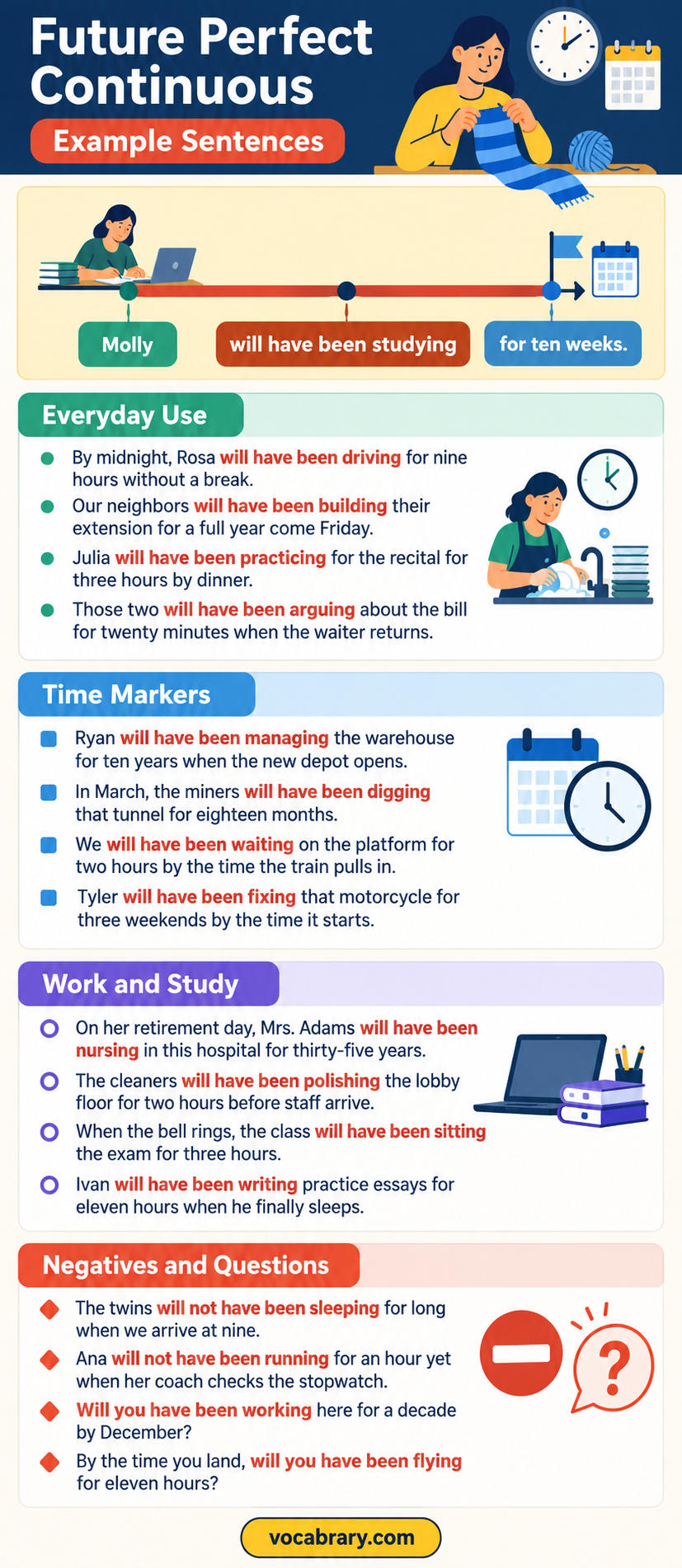
Common Future Perfect Continuous Examples in Sentences
Nine-hour drives, twenty years at one school, and rain that refuses to stop before the river rises are the everyday cases, where a stretch of time reaches a named moment ahead and keeps going.
- By midnight, Rosa will have been driving for nine hours without a break.
- Next June, Mr. Okafor will have been teaching at the same school for twenty years.
- The rain will have been falling for three days by the time the river rises.
- Aisha will have been studying Japanese for five years when she lands in Osaka.
- When the guests arrive at seven, we will have been cooking since noon.
- They will have been walking for six hours by the time they reach the mountain hut.
- In August, Diego will have been playing the cello for a decade.
- Our neighbours will have been building their extension for a full year come Friday.
- She will have been working on the same report for three weeks by Thursday.
- By the end of this match, Ana will have been running for ninety minutes.
- Lucas will have been waiting at the airport for four hours before his sister lands.
- Come September, the twins will have been sharing a bedroom for eleven years.
- Farmers here will have been harvesting olives for six weeks when the frost arrives.
- I will have been saving for this trip for two years next Tuesday.
- The engineers will have been testing the bridge for eight months when it opens to traffic.
- Yuki will have been practising for the recital for three hours by dinner.
- On Sunday, the choir will have been rehearsing the same chorus for a month.
- His dog will have been barking at the gate for an hour before anyone wakes.
- We will have been living in this flat for five years this winter.
- Priya will have been typing her thesis for eleven hours by the time she stops tonight.
- Before the doctor calls his name, Sam will have been sitting in the corridor for two hours with his coat still on.
- Grandma will have been knitting that blanket for a year by Christmas.
- Around noon, the band will have been playing for three hours nonstop.
- Those two will have been arguing about the bill for twenty minutes when the waiter returns.
- Marco will have been swimming for forty minutes by then.
- Tomorrow at six, the bakers will have been shaping loaves since two in the morning.
Future Perfect Continuous Sentences With Time Markers
By then, by next year, for ten years, and by the time the train pulls in are the markers that make this verb form work. Each one fixes the deadline that the duration has to reach.
By Then and By Next Year
Eight hours of revision, a decade of the same soup on a café menu, and eighteen months of beard growth show how by then and by next year set the deadline.
- Hassan will have been revising for eight hours by then.
- By next year, the café will have been serving the same soup for a decade.
- The night nurse will have been checking on that patient every hour by then.
- Emily will have been coaching the junior team for three seasons by next year.
- Our landlord will have been promising to fix the boiler for two winters by then.
- Tomas will have been growing his beard for eighteen months by next Christmas.
- Fatima will have been flying long-haul routes for eleven years by next spring.
- My brother will have been learning guitar for six months by then, and his fingers will ache.
- By next term, the pupils will have been using tablets in class for two full years.
- Workers at the plant will have been striking for a fortnight by then.
- Nina will have been dancing on that stage for four hours by then.
- The puppies will have been chewing on my shoes for a month by next weekend.
- Carlos will have been fasting for sixteen hours by then.
- Researchers off the coast of Iceland will have been tracking the same whale pod for five years by next autumn.
- Grandad will have been telling the same story for forty years by then.
- By next summer, Leila will have been rowing with the club for three seasons.
For Ten Years and Other Length Phrases
Ten years in a warehouse, three decades behind a guesthouse desk, and a whole morning of rehearsal give the tense its length phrase, the part that answers how long rather than when.
- Ravi will have been managing the warehouse for ten years when the new depot opens.
- Come October, my parents will have been running the guesthouse for three decades.
- Sofia will have been rehearsing all morning by the time the director arrives.
- That printer will have been jamming for six months by the day we replace it.
- The volunteers will have been sorting donations for eight hours straight tonight.
- Ahmed will have been cycling to work for two winters by February.
- We will have been queuing for tickets since dawn when the doors open.
- Hannah will have been writing her novel for four years this autumn.
- In March, the miners will have been digging that tunnel for eighteen months.
- Mia will have been babysitting for the same family for seven years by graduation.
- The old clock in the hallway of my grandmother’s cottage will have been ticking for a century by 2030.
- Joel will have been painting the ceiling for two days when his cousin finally helps.
- Every nurse on that ward will have been working double shifts for a fortnight by Sunday.
- Kemi will have been selling mangoes since five in the morning.
By the Time Plus a Present Tense Clause
A train pulling in, a film ending, and a referee blowing the whistle are the present tense events that follow by the time, and the duration runs right up to each of them.
- We will have been waiting on the platform for two hours by the time the train pulls in.
- Dinner guests will knock at eight, and Anita will have been chopping vegetables for an hour by the time they do.
- The toddler will have been sleeping for ninety minutes by the time the film ends.
- Firefighters will have been battling the blaze for six hours by the time the rain arrives.
- By the time you finish reading, the kettle will have been boiling for ten minutes.
- Samuel will have been queueing since Friday by the time the doors open.
- Both teams will have been playing for two hours by the time the referee blows the whistle.
- My sister will have been revising for nine hours by the time she switches off the lamp.
- By the time the sun sets, the hikers will have been climbing for eleven hours.
- Tariq will have been fixing that motorbike for three weekends by the time it starts.
- Nonna will have been baking since five in the morning by the time the bread comes out.
- Kofi will have been jogging for an hour by the time we wake.
- The gardener will have been watering the flower beds for two hours by the time the heat peaks.
- Zara will have been refreshing the college website for forty minutes by the time her marks appear.
- Passengers will have been sitting on the runway for three hours by the time the plane takes off.
Duration at Work and in Careers
Thirty-five years on a hospital ward, a night bus shift that ends at four, and forty years of watch repair in one small shop are the working years this tense measures in hours and decades.
- On her retirement day, Mrs. Adeyemi will have been nursing in this hospital for thirty-five years.
- Ben will have been driving the night bus around the city for six hours when his shift ends at four in the morning.
- By the audit, the accountants will have been checking invoices for three straight weeks.
- Our team will have been negotiating the contract for four months by the signing date.
- Ines will have been freelancing for five years when she finally hires an assistant.
- The barista will have been pulling shots for eight hours by closing time.
- Next spring, Klaus will have been repairing watches in that shop for forty years.
- I will have been answering support calls for nine hours by the end of this shift.
- Pilots on the Atlantic route will have been flying for eleven hours before landing.
- Amara will have been leading the research group for a decade come January.
- The cleaners will have been polishing the lobby floor for two hours before staff arrive.
- Jonas will have been apprenticing with the village carpenter for three years by summer.
- When the plant closes, half the town will have been assembling engines for two generations.
- Rita will have been teaching night classes for seven terms by the time she takes leave.
- My uncle will have been farming the same hillside for fifty years this autumn.
- Delivery riders will have been pedalling through rain for six hours by nightfall.
Study, Exams, and Classroom Hours
Three-hour exam papers, two weeks of irregular verbs, and a study group that meets every Tuesday give learners the duration sentences examiners expect in writing tasks.
- When the bell rings, the class will have been sitting the exam for three hours.
- Nadia will have been memorising irregular verbs for two weeks by the test on Monday.
- By June, Tom will have been preparing for his driving theory exam for four months.
- The library lamps will have been burning since dawn by the time the first paper starts.
- Students in the top set will have been solving past papers for six weekends by March.
- Ella will have been attending evening French classes for a year by the oral exam.
- Our study group will have been meeting every Tuesday for a whole term by then.
- Ivan will have been writing practice essays for eleven hours when he finally sleeps.
- Before the marks arrive, the twins will have been waiting anxiously for six long weeks.
- Lara will have been tutoring her cousin in algebra for five months by the finals.
- That professor will have been marking scripts for two days without a proper meal.
- Mei will have been reading the same chapter about the water cycle for an hour by the time she finally understands it.
- Next week, the school will have been running revision clubs for a full month.
- Kwame will have been drilling vocabulary for forty minutes by the time the lesson ends.
Travel, Journeys, and Long Drives
Nine hours across a desert, twelve hours on a ferry, and three months of backpacking in Peru turn a journey into a length of time that meets an arrival.
- Their coach will have been crossing the desert for nine hours by sunrise.
- Emma will have been backpacking through Peru for three months by Christmas.
- When we reach Lisbon, the family will have been driving since six in the morning.
- The ferry will have been sailing for twelve hours by the time land comes into view.
- Hiroshi will have been cycling the coast road from Sendai to Aomori for two weeks by the end of the trip.
- Next Tuesday, the crew will have been sailing the Atlantic for forty days.
- Nadia and her father will have been queueing at passport control for an hour by then.
- Our train will have been climbing through the Alps for three hours when the tunnel ends.
- Pedro will have been hitchhiking across Chile for a fortnight by his birthday.
- By landing time, the toddler will have been crying for most of the flight.
- The tour group will have been walking around the old city for five hours by lunch.
- Amina will have been riding camels in the dunes for two days when the storm hits.
- I will have been packing and repacking this rucksack for an hour by midnight.
- Sven will have been skiing the same slope for six hours by the last lift.
Waiting, Queues, and Delays
Four hours outside a shop before a sale, fifty minutes on a helpline, and two nights of camping for concert tickets are the waits that this tense states without exaggeration.
- Shoppers will have been queuing outside the store for four hours before the sale starts.
- Ravi will have been holding on the helpline for fifty minutes by the time someone answers.
- The taxi will have been idling outside for twenty minutes before we come down.
- Patients in the clinic will have been sitting on plastic chairs for three hours by noon.
- Nour will have been standing at the bus stop for an hour in the cold by then.
- By boarding time, the passengers will have been sleeping on the airport floor for six hours.
- Fans will have been camping outside the arena for two nights by the time tickets go on sale on Saturday morning.
- My father will have been waiting for a callback from the bank for nine days by Friday.
- Lorries will have been crawling towards the port for five hours by dusk.
- The kids will have been asking about dinner for an hour by the time it is ready.
- Sana will have been refreshing the ticket site for half an hour by then.
- Delegates will have been circling the car park for twenty minutes before anyone leaves.
Weather, Seasons, and Long Rain
Snow drifting against a door for two days, a fortnight of monsoon rain on the fields, and a heatwave in its third week give weather sentences their natural duration.
- The snow will have been drifting against the door for two days by Thursday.
- Monsoon rain will have been soaking the fields for a fortnight by the end of July.
- By dawn, the wind will have been howling across the moor for nine hours.
- Drought will have been drying the riverbed for six months by harvest.
- Ice will have been forming on the lake for three weeks by the skating weekend.
- Next month, the sun will have been shining on this coast for ninety days without a break.
- The storm will have been battering the harbour for eleven hours by the time it passes.
- Leaves will have been falling in the orchard for six weeks by the first frost.
- Tomorrow evening, hail will have been hammering the greenhouse roof for an hour.
- Fog will have been hiding the valley since midnight by the time the ferry sails.
- By August, the heatwave will have been scorching southern Spain for three weeks.
- Thunder will have been rumbling over the hills for half an hour before the first drops fall on the dry fields.
Sport and Training
Ninety minutes of diving for shots, eight months of marathon training, and a swim squad that starts at six in the morning show how athletes count preparation in months and matches in minutes.
- At the final whistle, the goalkeeper will have been diving for shots for ninety minutes.
- Chen will have been training for the marathon for eight months by race day.
- The rowers will have been pulling hard for twenty minutes by the halfway marker.
- By the last set, Hana’s opponent will have been chasing every ball for three hours.
- Dele will have been lifting in the gym five mornings a week for a year by June.
- Our swim squad will have been training in the cold pool at six in the morning for two winters by then.
- Boxers will have been sparring for forty minutes by the time the coach calls time.
- Next season, Ibrahim will have been playing for the same club for a decade.
- The cyclists will have been racing through the mountains for six hours by the finish.
- Keiko will have been practising her serve for two hours by sunset.
- When the buzzer sounds, both sides will have been defending furiously for four quarters.
- Marta will have been running laps for forty minutes by the time her father collects her.
- By September, the gymnasts will have been rehearsing the floor routine for five months.
- Fans will have been singing in the upper tier for two hours before kick-off.
Building Sites, Long Projects, and Machines
Fourteen months of bricklaying, a tunnel that meets in the middle after three years, and a server grinding through a simulation overnight are the long jobs this tense keeps in motion.
Building Work and Long Projects
Bricklayers at handover, a museum mosaic in its fourth year of restoration, and volunteers on a school roof every weekend all reach a deadline with the work still unfinished.
- By handover, the crew will have been laying bricks for fourteen months.
- Engineers will have been drilling the tunnel for three years when the two ends meet.
- Our architect will have been redrawing the plans for six weeks by the council meeting.
- The council will have been repaving this street for two months by the time the shops reopen after the Easter holidays.
- Ahmed will have been renovating his kitchen for half a year by Easter.
- Volunteers will have been rebuilding the school roof for nine weekends by the new term.
- In October, the museum will have been restoring that mosaic for four years.
- Carpenters will have been fitting shelves in the new library for a week by opening day.
- My cousins will have been decorating the hall for six hours before the party begins.
- Before the inspection, the plumbers will have been replacing old pipes for a fortnight.
- Sara will have been designing the garden for three months by the first planting.
- Workers at the dam will have been pouring concrete for eleven days without stopping by Sunday.
Technology and Machines Running
A simulation at sixty hours, turbines a decade into service, and a laptop rendering video until dawn show machines measured by the time they keep going.
- A server upstairs will have been running the simulation for sixty hours by Monday morning.
- My phone will have been charging for twenty minutes by the time we leave.
- Those turbines will have been spinning for a decade by the next inspection.
- That washing machine will have been rinsing for half an hour by the time I return.
- Ola’s laptop will have been rendering the video for nine hours by dawn.
- By midnight, the printers will have been producing exam papers for two full shifts.
- Satellites overhead will have been circling the planet for twenty years by the time they burn up.
- An old tractor will have been ploughing that field for six hours by dusk.
- Sensors in the lab will have been reading temperatures for a month by the report deadline.
- Our fridge will have been humming in the corner for fifteen years this spring.
- Data centres here will have been cooling their machines for three summers by then.
- The robot arm will have been welding the same joint for eight hours by the end of the night shift on Friday.
Relationships and Anniversaries
Fifty years of marriage, ten years of letters to a pen pal in Kyoto, and seven summers of arguing over a hedge are the anniversaries families count out loud.
- On their golden wedding day, my grandparents will have been living together for fifty years.
- Nadia and Bilal will have been dating for three years by their trip to Cairo.
- By August, the Ferreiras will have been raising four children for two decades.
- Tom will have been writing to his pen pal in Kyoto for ten years next month.
- Those two friends will have been meeting for coffee every Saturday for six years by then.
- My parents will have been planning their anniversary party for three months by June.
- In spring, Grace will have been caring for her mother at home for four years.
- Diego and Sofia will have been sending each other birthday letters for a decade by their wedding in Seville next spring.
- The neighbours will have been feuding over that hedge for seven summers by July.
- Kenji will have been calling his sister every Sunday for fifteen years by Christmas.
- By their fifth anniversary, the couple will have been saving for a house for four years.
- Aunt Vera will have been baking the family birthday cake for thirty years this September.
Negatives, Questions, and Short Answers
Rain that will not have been falling for long, a neighbour who won’t have been waiting ten minutes, and a question about a decade at one desk keep will have been in one order. Only not and the person doing the action move around it.
| Form | Pattern | Example sentence |
|---|---|---|
| Affirmative | Noun or pronoun + will have been + verb-ing | By June, Elena will have been teaching for twenty years. |
| Negative | Noun or pronoun + will not have been + verb-ing | The twins will not have been sleeping for long when we arrive. |
| Negative contraction | Noun or pronoun + won’t have been + verb-ing | Jamal won’t have been waiting more than ten minutes. |
| Yes or no question | Will + noun or pronoun + have been + verb-ing | Will you have been working here for a decade by December? |
| Wh- question | How long + will + noun or pronoun + have been + verb-ing | How long will the pump have been running by midnight? |
| Short answer | Yes or No + pronoun + will or will not | Yes, I will. No, they will not. |
Negative Sentences With Will Not Have Been Waiting
Twins who have barely fallen asleep, a laptop short of a full charge, and builders one week into a roof are the cases where the duration falls short of the deadline.
- The twins will not have been sleeping for long when we arrive at nine.
- Jamal won’t have been waiting more than ten minutes by the time the bus pulls up outside the library on the corner.
- By Friday, Olivia will not have been working here for a full year.
- My laptop won’t have been charging long enough for the whole flight.
- Those students will not have been studying French for even a term by the trip.
- Hakim won’t have been living in Berlin for two years until next March.
- Rain will not have been falling for more than an hour when the match resumes.
- We won’t have been queueing all night, because the doors open at seven.
- Ana will not have been running for an hour yet when her coach checks the stopwatch.
- Next week, the builders won’t have been working on our roof for a month.
- That kettle will not have been boiling long, so the water stays lukewarm.
- Paolo won’t have been practising the piano for three hours, whatever he claims.
- By noon, the volunteers will not have been sorting parcels for a full shift.
- Grandpa won’t have been gardening for two hours; he stops after forty minutes.
Questions With Will You Have Been Working
A decade at one desk, eleven hours in the air, and a museum mosaic in its fourth year turn into questions by moving will in front of the person doing the action.
- Will you have been working here for a decade by December?
- How long will the pump have been running by midnight?
- By June, will Marta have been studying Arabic for three years?
- Won’t they have been waiting at the gate for two hours by then?
- When the last passenger boards the delayed flight to Nairobi, will the crew have been standing at the gate for six hours?
- How many hours will Omar have been driving before he stops for coffee?
- Will your sister have been living in Madrid for five years this autumn?
- After the interval, will the orchestra have been playing for ninety minutes?
- Won’t the snow have been falling for three days by Thursday?
- By the time you land, will you have been flying for eleven hours?
- Next April, will the museum have been restoring that mosaic for four years?
- In October, will your parents have been running the guesthouse for thirty years?
- Once the timer stops, will the bread have been baking for fifty minutes?
- Three hours from now, will we have been waiting for our marks all day?
Short Answers With Will and Will Not
A dog walker due at eight, a kettle left on the hob, and a coach finishing her first season give each question a two-word reply that repeats will alone.
- Will you have been waiting long by seven? Yes, I will, because I arrive at five.
- By March, will they have been renting that flat for two years? No, they will not.
- Tonight, will the kettle have been boiling for ten minutes? Yes, it will, so mind the steam.
- Won’t the dog have been barking all morning? No, he will not, since the walker comes at eight.
- Next week, will Omar have been coaching the team for a season? Yes, he will.
- After lunch, will the twins have been napping for two hours? Yes, they will.
- At the border, will your parents have been driving since dawn? No, they will not, because they left the hotel at nine.
- By Friday, will Lena have been training for six weeks? Yes, she will, and she feels ready.
- Won’t the printers have been working since six in the morning? Yes, they will, and the paper is nearly gone.
- Honestly, will we have been queueing for three hours by then? No, we will not.
Future Perfect Continuous and Future Perfect in the Same Sentence
Three hours of cooking beside six finished dishes, four years at a thesis beside a finished draft, and eleven hours in the air beside a landing put both future forms in one sentence. The continuous half counts the time, and the perfect half reports the finished work.
- By nine, Ravi will have been cooking for three hours, and he will have made six dishes.
- Nadia will have finished her thesis by spring, and by then she will have been writing it for four years.
- When the gates open, fans will have been queuing since dawn, and stewards will have checked every bag.
- The painters will have been working on the hall for a week, though they will not have finished the ceiling.
- Come retirement day, Mr. Okafor will have taught nine hundred pupils, and he will have been teaching for thirty years.
- Our plane will have landed by six, and the crew will have been flying for eleven hours.
- Lucia will have been revising all night, yet she will have covered only half the syllabus.
- The volunteers will have packed four hundred boxes by Sunday, and they will have been sorting donations for a fortnight.
- Snow will have been falling for two days by Friday, and it will have buried the lane.
- Kofi will have run twenty miles by noon, and he will have been running since five.
- Dinner will have been simmering for an hour, and Mum will have set out the plates.
- By the vote in March, the committee will have been debating the plan for six months, and members will have read nine reports.
- Amara will have been leading the group for a decade next year, and she will have trained forty researchers.
- Before the final whistle, both keepers will have made ten saves, and the strikers will have been chasing the ball for ninety minutes.
- My grandparents will have been living in that house for fifty years by June, and they will have paid the last of the mortgage.
- At the end of the shift, the barista will have served three hundred customers, and her feet will have been aching since noon.
Future Perfect Continuous and Future Continuous in the Same Sentence
Lena at her exam desk, a family flying over the Alps, and night nurses handing over at seven separate an action in progress at a future moment from the hours piled up behind it.
- At noon tomorrow, Lena will be sitting her exam, and by then she will have been revising for six weeks.
- This time on Friday, we will be flying over the Alps, and we will have been travelling since dawn.
- Musa will be washing the van at ten, and by lunch he will have been cleaning vehicles for four hours.
- Tonight at eight, the twins will be sleeping, and they will have been napping on and off all day.
- Rain will be falling when you arrive, and it will have been falling for three days.
- By this time next week, Ana will be working in Oslo, and she will have been learning Norwegian for a year.
- The choir will be singing at seven, and by the interval it will have been performing for ninety minutes.
- Dad will be driving through France on Saturday, and by evening he will have been driving for ten hours.
- At midday, the builders will be fitting windows, and they will have been working on the flats since March.
- Next term, Ivan will be studying in Prague, and by June he will have been living abroad for half a year.
- Nurses will be changing shifts at seven, and the night team will have been treating patients for twelve hours.
- When the film ends, we will be eating popcorn, and the dog at home will have been howling at the letterbox for two hours.
- Farmers will be picking grapes at sunrise, and by noon they will have been picking for six hours.
- Zoe will be speaking at three, and by then the conference will have been running for two days.
Sentences Rewritten With the Correct Future Perfect Continuous
Twenty years of teaching, nine hours of driving, and a thesis typed since morning turn correct once will have been joins a verb ending in -ing. Every wrong version drops been, drops the -ing ending, or swaps for and since.
- By June, Elena will have been teach here for twenty years ❌ / By June, Elena will have been teaching here for twenty years ✅
- Rain will have falling for three days by Thursday ❌ / Rain will have been falling for three days by Thursday ✅
- We will have been waiting since two hours ❌ / We will have been waiting for two hours ✅
- Omar will have been drive for nine hours by midnight ❌ / Omar will have been driving for nine hours by midnight ✅
- By the time she will arrive, I will have been cooking for an hour ❌ / By the time she arrives, I will have been cooking for an hour ✅
- Will you have been work here for a decade by December? ❌ / Will you have been working here for a decade by December? ✅
- They will not have been sleep for long when we arrive ❌ / They will not have been sleeping for long when we arrive ✅
- Next month, Tom will have been knowing Sara for ten years ❌ / Next month, Tom will have known Sara for ten years ✅
- The team will has been training for six weeks by the final ❌ / The team will have been training for six weeks by the final ✅
- Priya will have been typed her thesis for eleven hours ❌ / Priya will have been typing her thesis for eleven hours ✅
- My uncle will have been farming that hillside since fifty years ❌ / My uncle will have been farming that hillside for fifty years ✅
- Where you will have been staying for a month by then? ❌ / Where will you have been staying for a month by then? ✅
- The builders won’t have been work on our roof for a month by Friday ❌ / The builders won’t have been working on our roof for a month by Friday ✅
Long Hours in Short Paragraphs
A hospital handover at seven and an olive press in its thirtieth year keep several duration verbs in one stretch of writing, each one counting hours that reach the same future moment.
By the time the morning team arrives at seven, the night staff will have been working for twelve hours. Dr. Mensah will have been treating the same patient since three, and the porters will have been pushing trolleys along that corridor all night. In the waiting room, two families will have been sitting on plastic chairs for six hours. The kettle in the staff room will have been boiling and cooling since midnight. Outside, an ambulance driver will have been circling the car park for twenty minutes. Nobody will have been sleeping, and everyone will have been counting the minutes to the handover.
Next August, my aunt and uncle will have been running the olive press for thirty years. By the first morning of the harvest, pickers will have been arriving from three villages since dawn. The old press will have been turning for six hours before anyone stops to eat. My cousins will have been filling crates all morning, and their arms will have been aching since ten. By nightfall, the village will have been working together for fourteen hours, and the first bottles will have been cooling in the store room since the afternoon.
Related
FAQs
The formula of the future perfect continuous tense is a noun or pronoun, then will have been, then a verb ending in -ing, then a length of time. By midnight, Rosa will have been driving for nine hours follows that order exactly. The length phrase starts with for or since, and a future marker such as by then fixes the deadline it reaches.
We use the future perfect continuous tense to state how long an action will have been going on at a named moment ahead. A teacher counting twenty years at one school, a driver counting nine hours at the wheel, and rain counting three days on the fields all take this form. Duration that reaches the present moment instead takes the form shown in present perfect continuous tense example sentences.
You use the future perfect when the action finishes before the future moment, and the future perfect continuous when the action is still going at that moment. By Friday, Sam will have written four chapters counts finished work, while By Friday, Sam will have been writing for six weeks counts time at the desk. Numbers of finished chapters answer to the first form, and numbers of hours, weeks, or years answer to the second.
The future continuous describes an action in progress at a future moment, while the future perfect continuous measures how long that action will have been in progress by then. At noon tomorrow, Lena will be sitting her exam pictures the moment itself, and By noon tomorrow, Lena will have been revising for six weeks counts the time behind it. The englishan lesson on the future continuous tense drills the first of the two.
By then, by next year, by the time, by Friday, for ten years, and since Monday are the markers that signal the future perfect continuous tense. One marker fixes the deadline and the other states the length, as in By June, Elena will have been teaching here for twenty years. A future sentence with no length phrase at all is future perfect instead.
Since works in the future perfect continuous tense whenever the starting moment counts for more than the total hours. Kemi will have been selling mangoes since five in the morning names the start, while Kemi will have been selling mangoes for six hours names the length. For marks a stretch of time and since marks a point on the clock or the calendar, so the two never swap.
The helping verbs of the future perfect continuous tense are will, have, and been, and all three stay the same for every person and number. I will have been waiting, she will have been waiting, and they will have been waiting keep the identical three words. Only the main verb changes, and it always ends in -ing.
The future perfect continuous tense has a theoretical passive, will have been being cleaned, which English speakers avoid in both writing and speech. An active sentence such as The cleaners will have been polishing the lobby for two hours replaces it. Where a passive is needed, writers reach for the future perfect passive instead, as in The lobby will have been polished by nine.
You identify the future perfect continuous tense by a four-part verb, will have been plus an -ing form, next to a phrase that answers how long. The engineers will have been testing the bridge for eight months shows all four parts in order. Drop been and the sentence turns into the future perfect; drop have and it turns into the future continuous.
Ten future perfect continuous tense example sentences all pair will have been with an -ing verb and a length of time. Three short ones: We will have been living here for five years this winter; My phone will have been charging for twenty minutes; Grandma will have been knitting that blanket for a year. Three longer ones: By midnight, Rosa will have been driving for nine hours; Next June, Mr. Okafor will have been teaching for twenty years; Chen will have been training for eight months by race day.
A negative sentence adds not straight after will, as in The twins will not have been sleeping for long when we arrive, and won’t have been is the contracted version. A question moves will in front of the person doing the action, as in Will you have been working here for a decade by December? Wh- questions put how long or how many hours at the front, and short answers repeat will on its own, as in Yes, I will and No, they will not.
The future perfect progressive means the same as the future perfect continuous, since progressive and continuous are two names for one verb form. American course books prefer progressive and British ones prefer continuous, and the verb order never changes between them. By 2030, the satellites will have been circling the planet for twenty years answers to either name.
Teachers introduce the future perfect continuous tense with a timeline on the board that marks today, a future date, and the hours between the two. Pupils then finish a sentence such as By 2035, I will have been living in this town for twenty years with their own numbers. Drilling the negative and the question in the same lesson stops learners from dropping been. More practice with every tense is at tense sentences examples.

Leave a Comment