
Be going to is the future form used for plans already made and for predictions based on evidence, as in we are going to repaint the kitchen. Most be going to example sentences put am, is or are before going to and a base verb, reporting a decision already taken or a sign already visible.
What Is Be Going To?
Be going to is a two-part future form: a present form of be (am, is, are), then going to, then the base verb. Speakers choose it when the decision came before the moment of speaking, or when present evidence makes the outcome obvious. Will in future sentences announces a choice made while speaking, and the present continuous for future arrangements names an appointment already fixed with somebody else.
I am / he is / they are + going to + base verb
Nadia is going to study medicine in Vienna.
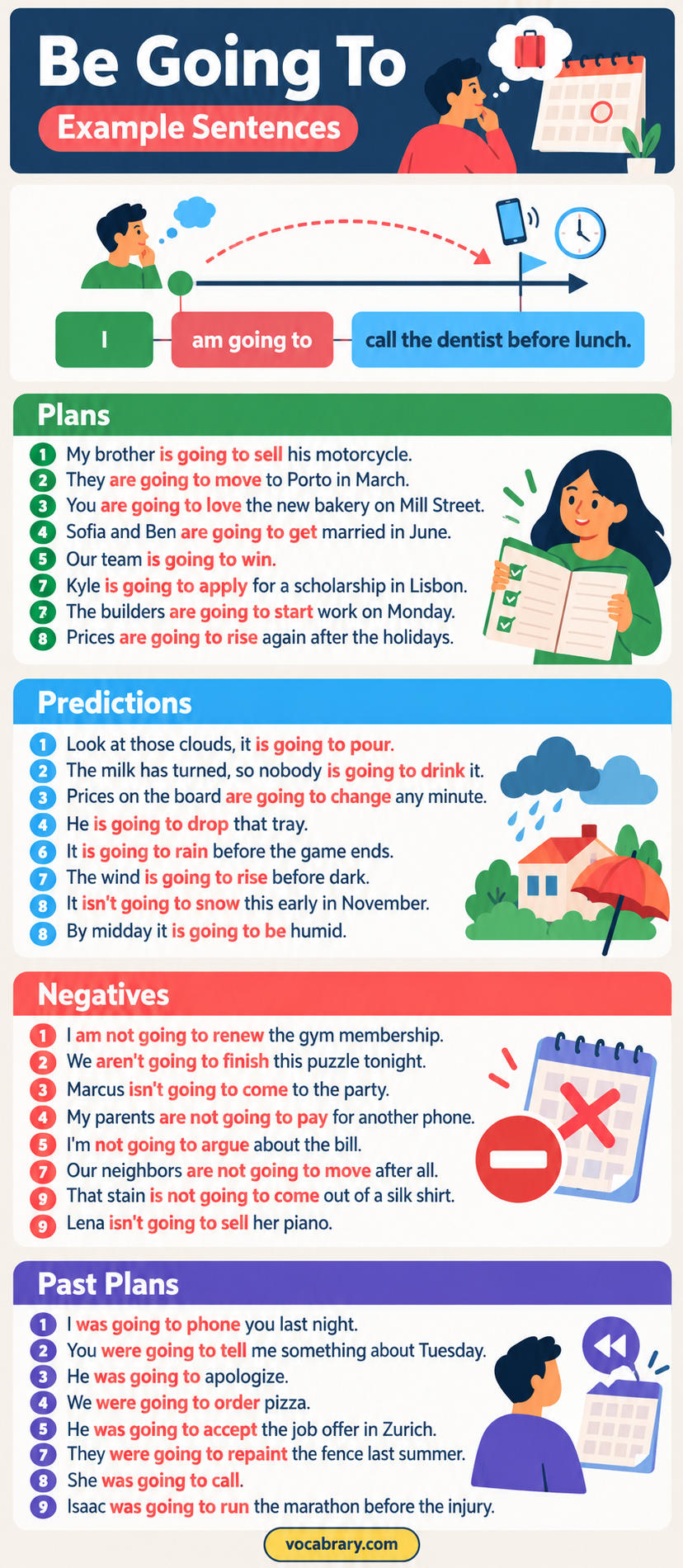
Common Be Going To Example Sentences
A kitchen repaint, a dentist appointment, and storm clouds over the harbour make up the common be going to example sentences, where a settled plan or a visible sign decides what comes next.
- We are going to repaint the kitchen on Saturday morning.
- Nadia is going to study medicine in Vienna next autumn.
- I am going to call the dentist before lunch.
- Those clouds are going to burst over the harbour within an hour.
- My brother is going to sell his motorbike.
- They are going to move to Porto in March.
- Rain is going to ruin the school sports day again.
- You are going to love the new bakery on Mill Street.
- Sofia and Ben are going to get married in June.
- He is going to miss the train.
- Our team is going to win.
- Grandma is going to teach me how to make dumplings this weekend.
- Everyone is going to ask about your haircut.
- Kofi is going to apply for a scholarship in Accra.
- The builders are going to start work on Monday.
- It is going to be a long night for the night shift at the hospital.
- Lin is going to bring her guitar to the picnic.
- Prices are going to rise again after the holidays.
- We are going to need a bigger table.
- Dad is going to drive us to the airport at five in the morning.
Be Going To Sentences for Plans and Intentions
Booked driving lessons, a savings account for a house deposit, and a promise to quit smoking come from decisions already taken, which is why each one uses going to instead of a choice made mid-sentence.
- Amara is going to take driving lessons in the spring.
- I am going to open a savings account for a house deposit.
- We are going to adopt a dog from the shelter next month.
- Hassan is going to quit smoking on his fortieth birthday.
- My parents are going to sell the farm.
- She is going to learn Portuguese before the move to Brazil.
- They are going to paint the hallway pale green.
- Tomorrow I am going to cook dinner for eight people.
- Our club is going to choose a new president in November.
- Diego is going to grow tomatoes on the balcony this year.
- You are going to regret that decision.
- After the exams, we are going to walk part of the coastal path.
- Ingrid is going to write a book about her grandmother’s village.
- The council is going to build a cycle lane along the river before the end of the year.
- He is going to ask for a transfer to the Manchester office.
- Yuki and I are going to share a flat near the university.
- I am going to delete every app that wastes my evenings.
- Next summer my sister is going to volunteer at an animal rescue centre.
Predictions Based on What You See
Black clouds over the hills, a toddler leaning off a chair, and a car drifting toward a kerb give the prediction use of going to, where evidence in front of the speaker settles the outcome.
- Look at those clouds, it is going to pour.
- That toddler is going to fall off the chair.
- The milk has turned, so nobody is going to drink it.
- Your team is going to lose this match.
- Kemal has three assignments due tomorrow, so he is going to be awake all night.
- Watch out, that car is going to hit the kerb.
- She has packed two suitcases, so she is going to be away for weeks.
- Prices on the board are going to change any minute.
- My phone is going to die.
- Judging by the queue, we are going to wait an hour for a table.
- The sky over the hills is going to brighten before sunset.
- He is going to drop that tray.
- With four goals in the first half, Brazil are going to finish top of the group.
- Those flowers are going to die without water.
- I am going to sneeze.
- The dog has seen the postman, so it is going to bark for ten minutes.
Negative Sentences With Not Going To
A gym membership left to lapse, a party nobody attends, and a stain that refuses to wash out produce am not going to, is not going to and are not going to. Speech shortens the last two to isn’t and aren’t.
- I am not going to renew the gym membership.
- She is not going to apologise for something she never did.
- We aren’t going to finish this puzzle tonight.
- Those batteries are not going to last until Friday.
- Marcus isn’t going to come to the party.
- You are not going to believe what happened at the station this morning.
- It isn’t going to rain before evening.
- My parents are not going to pay for another phone.
- Rania is not going to accept the first offer.
- I’m not going to argue about the bill.
- The shop isn’t going to open on the public holiday.
- Our neighbours are not going to move after all.
- He isn’t going to pass the test without revision.
- That stain is not going to come out of a silk shirt.
- They aren’t going to wait.
- Chen is not going to change his mind about the job in Singapore, even after three long conversations.
Question Sentences With Be Going To
Wedding dates, a spare ticket, and the fate of an old car turn into questions once am, is or are moves in front of the speaker’s name, as in Are they going to sell it.
- Are you going to wear the blue dress?
- Is he going to call her back tonight?
- What time are we going to leave for the airport?
- Am I going to need my passport for the ferry?
- Tell me, are they going to sell the old car?
- Why is Priya going to change schools in the middle of the year?
- Do you think it is going to snow tonight?
- Who is going to bring the picnic basket up the hill?
- How long are the roadworks going to last?
- Are we going to have enough chairs for everyone?
- Where is your sister going to live after graduation?
- On Thursday, is the shop going to stay open late?
- When are Omar and Leyla going to announce the wedding date to the rest of the family?
- Hey, are you going to eat that?
- How is he going to explain the broken window to his father?
- Is anyone going to answer the phone?
Short Answers With Be Going To
A question about a flight, a borrowed jumper, and Sunday lunch draw replies such as Yes, I am and No, they aren’t, where the reply repeats only the be form from the question.
- "Are you going to book the flight?" Mira asked. "Yes, I am."
- When Paulo asked whether the twins are going to join us, their mother said, "No, they aren’t."
- "Is she going to wear my jumper again?" "Yes, she is."
- Tariq wanted to know if we are going to cook Sunday lunch, and I answered, "Yes, we are."
- "Are they going to charge for delivery?" "No, they aren’t."
- Asked whether it is going to rain before the match, the groundsman replied, "Yes, it is."
- "Am I going to need a ticket?" Sasha asked. "No, you aren’t."
- Lucia checked whether the café is going to open early, and the owner nodded, "Yes, it is."
- "Is Daniel going to drive?" "No, he isn’t."
- Nneka asked if I am going to stay for the second half, and I said, "Yes, I am."
Contractions With I’m Going To and She’s Going To
I’m, she’s, we’re and they’re shorten the be form in front of going to, so a plan to return a library book or catch the early bus sounds the way people actually speak.
- I’m going to return these library books this afternoon.
- She’s going to catch the early bus to Cork.
- We’re going to be late for the ceremony if the traffic stays like this for another ten minutes.
- They’re going to announce the winners at noon.
- He’s going to fix the gate at the weekend.
- You’re going to enjoy the second half of the film.
- It’s going to be freezing on the terrace tonight.
- Dad’s going to collect the parcel from the sorting office.
- I’m not going to answer that question.
- Aisha’s going to run the Berlin marathon in September.
- We’re going to need more rice.
- There’s going to be a queue outside the bakery before seven in the morning.
- They’re not going to wait for us at the cinema.
- Tom’s going to teach his daughter to swim next summer.
Gonna in Relaxed Speech
Gonna is the informal spoken reduction of going to, heard in films and quick replies, and teachers accept it in conversation while marking it wrong in written English.
- I’m gonna call you back in five minutes.
- We’re gonna miss the start of the film.
- She’s gonna love that present.
- They’re gonna be furious about the change.
- What are you gonna do about the broken window?
- He’s gonna need a bigger ladder.
- Nobody’s gonna notice the stain on the carpet.
- It’s gonna rain.
- I’m gonna ask Maya whether she wants a lift to the station tomorrow.
- You’re gonna regret skipping breakfast.
Be Going To Forms and Their Uses
Am, is and are change with the person in front of going to, so a bakery in Lisbon, a sold car and a rained-off camping trip each take a different be form.
| Form | Use | Example sentence |
|---|---|---|
| Affirmative | A plan already decided | Marco is going to open a bakery in Lisbon. |
| Negative | A plan dropped or refused | I am not going to renew the gym membership. |
| Question | Asking about another person’s plan | Are they going to sell the old car? |
| Short answer | A reply that repeats the be form | Yes, she is. No, we are not. |
| Past | A plan dropped before it happened | We were going to camp, but the rain arrived. |
| Prediction | Evidence in front of the speaker | Those clouds are going to burst before noon. |
- I am going to join the choir in October.
- You are going to need warmer boots for Helsinki.
- He is going to fix his brother’s bicycle.
- She is going to present the report on Wednesday.
- It is going to freeze tonight.
- We are going to plant apple trees along the fence.
- They are going to stay with cousins in Chennai for a fortnight.
- Ravi and I are going to share the driving on the way back from Bristol.
Be Going To and Will in the Same Sentence
A shed repaint interrupted by rain, twelve dinner guests and a late bus put going to and will side by side. The first form names a plan already fixed, the second a decision made mid-sentence.
- We are going to repaint the shed on Sunday, and if it rains I will stay indoors with a book.
- Hana is going to cook for twelve guests, so her brother will wash every dish afterwards.
- I am going to walk to the station, though I will take a taxi if my knee hurts.
- They are going to sell the flat in spring, and the agent will phone them with the first offer.
- My father is going to retire in June, and the firm will hire two younger engineers.
- You are going to need a coat, and I will lend you mine.
- Petra is going to run the stall at the fair, and her neighbours will bake the bread for it.
- The bus is going to be late again, so I will wait in the cafe across the road.
- Grandad is going to build the cot, and we will paint the nursery yellow.
- He is going to study in Uppsala, and his sister will visit him at Christmas.
- Nobody is going to answer the door tonight, so the parcel will stay on the step.
- Are you going to tell her, or will I have to?
Was Going To and Were Going To for the Past
A camping trip cancelled by rain, a phone call that never came, and a cake left unbaked turn into was going to and were going to. That past form names a plan that changed before it happened.
- We were going to camp by the lake, but the rain arrived first.
- I was going to phone you last night.
- She was going to study law before she discovered archaeology.
- They were going to sell the house until the roof was repaired.
- Hamid was going to bake a cake, and then the oven broke.
- You were going to tell me something about Tuesday.
- The council was going to close the library in March.
- My parents were going to retire to the coast, though the winters changed their minds.
- He was going to apologise.
- Nina was going to wear her red coat to the wedding in Krakow.
- We were going to order pizza.
- Those trees were going to be cut down before the protest began.
- I was going to ask for a refund, but the manager offered a replacement instead.
- Everyone was going to meet at the bridge at seven.
Be Going To Plans in Everyday Life
Weekends, exam timetables, offices, shopping lists and gym schedules produce most of the future plans learners write, among them a trip to the coast and a resit in August.
Weekend and Holiday Plans
A Saturday market in Valencia, a walk along the coastal path and cousins arriving for Eid make up the weekend and holiday plans that take going to.
- We are going to visit the Saturday market in Valencia.
- On Sunday I am going to sleep until ten.
- My cousins are going to arrive for Eid on Thursday.
- Lars is going to spend the whole weekend in the garden.
- They are going to drive to the coast on Friday evening if the weather forecast improves.
- Grandad is going to teach us card games at Christmas.
- I am going to finish that novel.
- Our neighbours are going to host a barbecue in the back garden on Saturday afternoon.
- Zara is going to take her children to the aquarium.
- Nobody is going to work over the New Year holiday.
- You are going to love the mountain hut.
- Both families are going to walk the coastal path in two days.
Study and Exam Plans
A resit in August, flashcards for chemistry and a dissertation on Roman roads make up the study plans, where going to announces revision already timetabled.
- Bilal is going to resit the chemistry exam in August.
- I am going to revise vocabulary for an hour every evening.
- We are going to meet in the library after lunch.
- She is going to write her dissertation on Roman roads in Britain.
- My study group is going to test each other with flashcards.
- They are going to sign up for the university entrance exam next week.
- He is going to fail.
- Our teacher is going to hand back the essays on Monday morning.
- Mei is going to apply to three universities in Canada.
- You are going to find the second question much harder than the first one on the paper.
- I am going to switch off my phone while I study.
- Nobody is going to copy answers in this exam.
Work and Career Plans
A transfer to Manchester, a bakery opening in Lisbon and a resignation letter already written come from working life, each announced with going to.
- Marco is going to open a bakery in Lisbon next spring.
- I am going to hand in my resignation on Friday.
- Our manager is going to interview four candidates tomorrow.
- They are going to move the whole team to the second floor.
- Fatou is going to train as an electrician.
- We are going to launch the new website before the end of the quarter.
- He is going to ask for a raise.
- The factory is going to close two production lines in June.
- You are going to work with Diego on the Berlin account.
- My sister is going to apply for a job at the archaeology museum in Athens this autumn.
- Nobody is going to answer emails after six.
- I am going to take a week of unpaid leave.
Money and Shopping Plans
A savings account for a deposit, a winter coat in the January sale and a cancelled streaming subscription make the money plans, all built with going to.
- I am going to save two hundred euros every month.
- We are going to cancel the streaming subscription.
- She is going to buy a winter coat in the January sale.
- My brother is going to pay off his student loan by December.
- They are going to raise the bus fares again.
- Dina is going to sell her old textbooks online.
- You are going to spend far too much in that shop.
- Our landlord is going to increase the rent in April.
- He isn’t going to lend anyone money again.
- I am going to compare prices before ordering the fridge.
- Prices are going to fall after the festival.
- We are going to split the bill between the six of us at the end of the meal.
Health and Fitness Plans
A half marathon in Berlin, a knee specialist booked for Tuesday and a promise to swim twice a week give the health plans their going to form.
- Aisha is going to run a half marathon in Berlin.
- I am going to swim twice a week from now on.
- We are going to cycle to work instead of driving.
- My father is going to see a specialist about his knee on Tuesday.
- She is going to give up sugar for a month.
- They are going to join a yoga class near the station.
- He is going to lift weights three mornings a week.
- Ravi is going to book a dental appointment for the whole family before the end of the month.
- You are going to feel better after a proper night of sleep.
- I am not going to skip breakfast again.
- Our doctor is going to check my blood pressure every six months.
- Nobody is going to smoke inside the house.
Weather Predictions With Be Going To
Clouds over the harbour, frost on the windscreen and a wind rising before dark supply the weather predictions, where what a speaker sees overhead decides the going to sentence.
- It is going to rain before the match ends.
- Those clouds over the harbour are going to bring thunder.
- Frost is going to cover the windscreen tonight.
- The wind is going to rise before dark.
- Temperatures are going to drop under zero in Tromso.
- It isn’t going to snow this early in November.
- Fog is going to delay flights out of Heathrow all morning.
- Farmers say the drought is going to last another month.
- The sun is going to break through by lunchtime.
- By midday it is going to be humid.
- Storm Bella is going to reach the west coast on Wednesday evening.
- Puddles on the road are going to freeze overnight, so drive slowly on the hill road tomorrow.
Travel Plans With Be Going To
A ferry to Santorini, a hostel booked near Kyoto station and a rucksack packed for the Andes come from travel, where going to reports tickets already bought.
- We are going to take the night ferry to Santorini.
- Priya is going to backpack through the Andes in July.
- I am going to book a hostel near Kyoto station.
- They are going to hire a car at Faro airport.
- My sister is going to fly to Toronto on the twelfth.
- You are going to need a visa for that trip.
- Our train is going to leave from platform nine.
- Ahmed is going to spend three weeks with relatives in Casablanca and Rabat this summer.
- We are going to pack light.
- The tour is going to start outside the cathedral at nine.
- She is going to learn a few phrases before landing in Seoul.
- Nobody is going to check that suitcase at the gate.
Plans That Changed Before They Happened
A wedding moved to October, a fence left unpainted and a coach that never arrived show plans that shifted, with was going to and were going to marking what never took place.
- Marta was going to marry in June, but the wedding moved to October.
- We were going to fly to Oslo until the airline cancelled the route.
- I was going to buy that jacket, and then I saw the price.
- He was going to accept the job offer in Dubai.
- They were going to repaint the fence last summer.
- Our class was going to visit the observatory, though the coach never arrived.
- She was going to call.
- Ibrahim was going to run the marathon before the injury.
- My parents were going to adopt a second dog.
- You were going to send me the photographs from the concert in Lyon.
- The band were going to play three encores, but the power failed after the second one.
- Tomorrow’s meeting was going to start at eight, and now it begins at ten.
Be Going To Examples for Kids
A birthday cake, a puppy digging in the garden and a sandcastle at the beach give children their first going to sentences about what comes next.
- I am going to blow out the candles on my cake.
- We are going to build a sandcastle at the beach.
- My puppy is going to dig another hole in the garden.
- She is going to ride her new bicycle to the park.
- They are going to watch cartoons after dinner.
- Our teacher is going to read us a story about a dragon who lost his fire.
- It is going to be my turn next.
- Dad is going to make pancakes on Saturday morning.
- You are going to laugh when you see my drawing of a purple elephant.
- Grandma is going to knit me a red scarf.
- I am going to feed the rabbit.
- The kittens are going to sleep in the basket by the door.
Short Be Going To Sentences for Young Learners
A ball, a bus and a rain shower keep these to five or six words, so young learners hear going to with nothing extra around it.
- I am going to run.
- We are going to sing.
- She is going to help.
- It is going to rain.
- They are going to play.
- He is going to jump.
- You are going to win.
- Mum is going to drive.
- The bus is going to stop.
Be Going To Sentences for Beginners
One idea a sentence, with a bus at eight, soup on the stove and homework after dinner, keeps beginner going to sentences within reach.
- I am going to catch the bus at eight.
- She is going to make soup for dinner.
- We are going to do our homework after dinner.
- They are going to play football in the park.
- He is going to wash the car.
- It is going to be cold tomorrow.
- You are going to meet my brother at the station on Sunday afternoon.
- My mother is going to visit her sister in Warsaw at the end of next week.
- The film is going to start soon.
- I am going to open the window.
- Ana is going to buy bread.
- Our dog is going to bark at the postman again.
Be Going To in a Short Paragraph
A Saturday move into a flat over a bakery, a borrowed van and pizza eaten on the floor join eight sentences into one plan told entirely with going to.
- On Saturday we are going to move into the flat over the bakery.
- Tomas is going to borrow a van from his uncle in the morning.
- I am going to wrap the crockery tonight so that nothing breaks.
- My sister is going to drive the cat across town in her car.
- The neighbours are going to help with the heavy furniture after lunch.
- Rain is going to arrive around four, according to every forecast.
- Nobody is going to have the energy to cook.
- We are going to eat pizza on the floor and sleep very well.
Sentences Rewritten With the Correct Be Going To
A missing to, a doubled verb ending, and a plural be form after nobody are the slips learners repeat. Each one is repaired by am, is or are plus going to plus the base verb.
- ❌ She is going to studies medicine in Vienna. ✅ She is going to study medicine in Vienna.
- ❌ They going to move to Porto in March. ✅ They are going to move to Porto in March.
- ❌ I am going buy a bicycle on Friday. ✅ I am going to buy a bicycle on Friday.
- ❌ He is going to not apologise. ✅ He is not going to apologise.
- ❌ Are you going to wearing the blue dress? ✅ Are you going to wear the blue dress?
- ❌ It is going to rains before the match. ✅ It is going to rain before the match.
- ❌ We was going to camp by the lake. ✅ We were going to camp by the lake.
- ❌ Do you going to sell the old car? ✅ Are you going to sell the old car?
- ❌ My parents is going to pay for the flights. ✅ My parents are going to pay for the flights.
- ❌ Tomorrow I am going to cooking dinner. ✅ Tomorrow I am going to cook dinner.
- ❌ Nobody are going to notice the stain. ✅ Nobody is going to notice the stain.
- ❌ I’m gonna to call you back in five minutes. ✅ I’m gonna call you back in five minutes.
Related
FAQs
Be going to reports a plan settled before the moment of speaking, and a prediction backed by evidence in front of the speaker. We are going to repaint the kitchen shows the first use, and those clouds are going to burst shows the second. Learners reach for it whenever the decision was made earlier rather than invented mid-conversation. Every other future form for the same week of plans turns up in tense sentences.
Will and be going to split by timing: be going to announces a decision taken earlier, while will announces a decision taken as the words leave the speaker’s mouth. Evidence separates them too, since be going to answers what a speaker watches happening right now. I am going to pay by card means the wallet is already open, and I will pay answers a question asked one second ago.
Will and be going to trade places in plenty of sentences without damage, so it will rain tonight and it is going to rain tonight both work in a weather forecast. They part company after visible evidence, where be going to wins, and after an offer or a promise, where will wins. A teacher marks I am going to help you with that bag as odd the second a speaker has just noticed the bag.
Be going to states an intention, while the present continuous for the future states an arrangement fixed with somebody else, complete with a time and a place. I am going to see the dentist names the intention alone, and I am seeing the dentist at four on Tuesday names the appointment already in the diary. Both forms start from a present form of be and point ahead.
Be going to copies the look of the present continuous, am, is or are plus going, yet it works as a future form instead of a description of action in progress. In she is going to the market, going is a verb of movement with a destination after it. In she is going to sell the market stall, going to does grammatical work and sell names the action.
A negative sentence with be going to puts not straight after am, is or are. Three models follow that shift: I am not going to renew the gym membership, he is not going to apologise, we are not going to wait. Speech shortens is not to isn’t and are not to aren’t, while am not shortens only inside I’m not. The base verb after going to never changes.
Questions with be going to move am, is or are in front of the person, as in Are you going to wear the blue dress? and Is he going to call her back? A short answer repeats that same be form and nothing more, so the replies run Yes, I am, No, he isn’t, and Yes, we are. Question words such as when, where and why go at the front, ahead of am, is or are.
Time expressions that suit be going to all point forward: tomorrow, tonight, next week, next summer, on Friday, in March, after the exams, this weekend. A prediction drawn from evidence needs no time expression at all, because watch out, that car is going to hit the kerb refers to the next two seconds. A past time word beside going to produces a contradiction that examiners mark wrong.
Ten sentences using be going to start with I am going to call the dentist and Nadia is going to study medicine in Vienna. Three more run we are going to repaint the kitchen, they are going to move to Porto, and he is going to miss the train. Two predictions follow: it is going to freeze tonight and you are going to love the bakery. Negatives and questions finish the set with my parents are not going to pay for another phone, are you going to book the flight?, and is anyone going to answer the phone?
Going to go is correct English, and we are going to go to the cinema breaks no rule at all. Speakers drop the second go and say we are going to the cinema when the meaning is travel, and teachers accept either version. In he is going to go bald, no shortening works, because go bald has nothing to do with movement.
A prediction with be going to starts from something the speaker sees, hears or smells at that very moment: black clouds, a toddler leaning off a chair, a phone battery at one percent. Look at those clouds, it is going to pour works because the clouds are overhead, and my phone is going to die works because the warning flashed a second ago. Will in the same sentence would sound like a guess about a distant year.
To complete a sentence with the correct form, match am, is or are to the person, keep going to unchanged, then finish with the base verb. Write my parents are going to pay, never my parents is going to pays. Negatives add not after the be form, and questions move the be form to the front. Plans dropped before they happened take was and were, as in we were going to camp by the lake, the pattern set out in future in the past example sentences.

Leave a Comment