
Prepositions of time are the prepositions that place an action at a point or period in time, as in the train leaves at six o’clock. Most prepositions of time example sentences start with at, on and in, because a clock time, a date and a month each take a different word.
What Are Prepositions of Time?
A preposition of time ties a verb to the moment or stretch of time around it, naming a clock reading, a day, a longer period, a starting moment, a length, or a deadline. Prepositions of place, such as in the drawer and on the shelf, answer where, while prepositions of time answer when.
Preposition + time expression (at six, on Friday, in July)
Nadia finishes her shift at five o’clock every weekday.
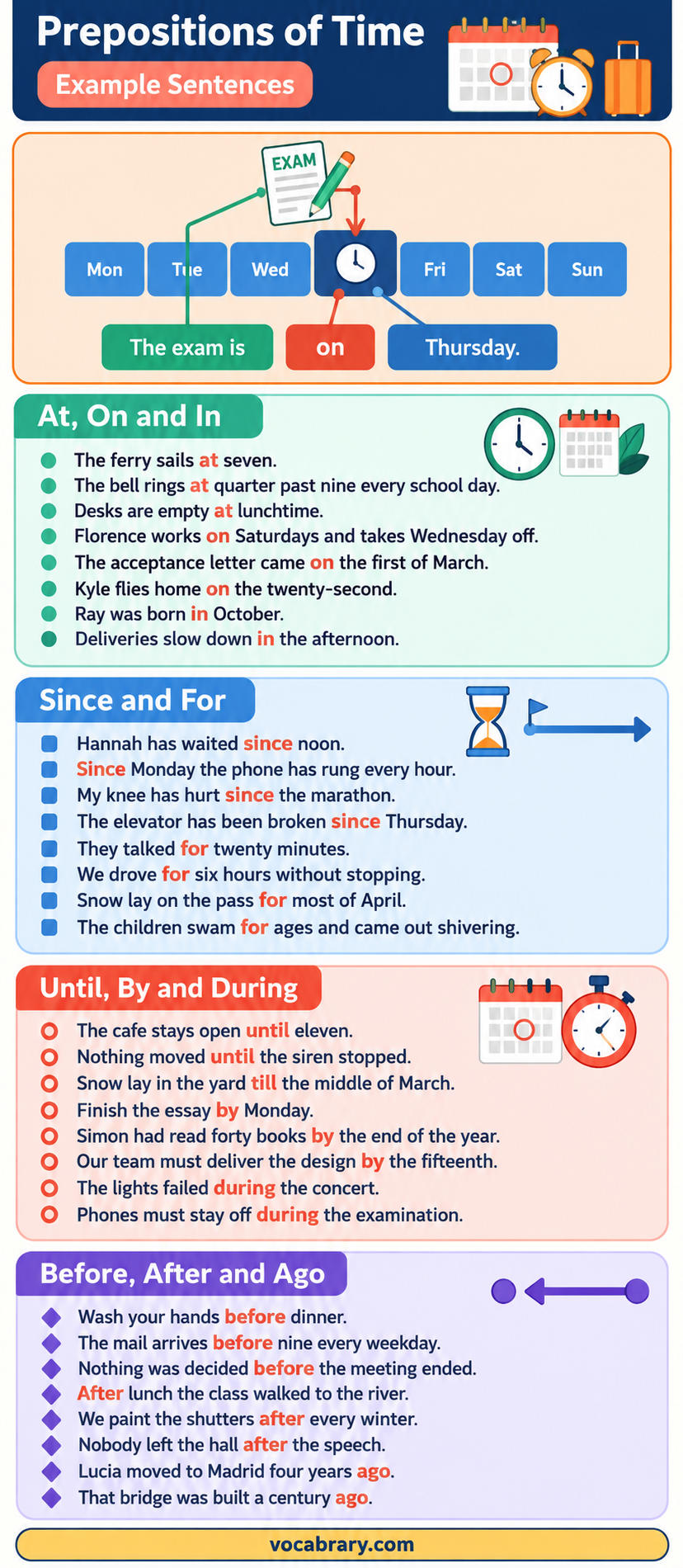
Common Prepositions of Time Examples in Sentences
A six o’clock train, a job that starts on Monday, and a wedding in 1994 open the common prepositions of time example sentences, where one small word answers when the action happens.
- The train leaves at six o’clock.
- Farah starts her new job on Monday.
- My parents were married in 1994.
- Grandad has coughed since Tuesday.
- Idris studied Japanese for three years before he moved to Osaka.
- Please send the finished report by Friday afternoon.
- The library stays open until nine every weekday.
- Nobody spoke during the film.
- Wash your hands before dinner.
- After the storm, the whole village lost power.
- Lucia moved to Madrid four years ago.
- The shop opens at half past eight.
- Our exams finish on the tenth of June.
- Bears sleep in winter.
- Rafael has taught the same class since 2011.
- Mateo rented a small flat for six months while the builders repaired his roof.
- The plumber promised a working shower by the end of October.
- Amina waited until midnight, and her brother never phoned.
- Snow fell during the night and covered the whole yard.
- Read the safety notice before the machine starts.
- After lunch the whole class walked down to the river.
- The museum closed its doors two hours ago.
- Children go to bed at eight.
- Diwali falls on a different date each year.
- Our daughter was born in the spring of 2019.
- Nothing has changed since the new manager arrived.
- Petra swam for an hour and then ate breakfast.
- Tickets must be bought by noon tomorrow.
At, On, and In as Prepositions of Time
A bell at nine, a wedding on 12 August, and tulips in spring separate the three commonest prepositions of time. One marks a clock reading, one a named day, and one a longer period.
| Preposition | Use | Example sentence |
|---|---|---|
| At | A clock time or a festival | The bell rings at nine o’clock. |
| On | A day or a date | The parcel arrives on Thursday. |
| In | A month, year, season, or part of the day | Karim was born in March. |
| Since | A starting moment in the past | Hala has waited since noon. |
| For | A length of time | They talked for twenty minutes. |
| By | A deadline, and no later | Finish the essay by Monday. |
| Until | A state that continues to an end time | The cafe stays open until eleven. |
| During | A period that surrounds the action | The lights failed during the concert. |
| Before | An earlier time than another | Phone me before eight. |
At for Clock Times and Festivals
Seven o’clock ferries, midnight fireworks, and cousins who visit at Christmas keep at with exact clock readings and with festivals named by a single word.
- The ferry sails at seven.
- Ivan wakes up at dawn without an alarm.
- We eat dinner at eight, and the children eat an hour earlier.
- Stars are brightest at night.
- Marta phoned at midnight to say the baby had arrived.
- The bell rings at quarter past nine every school day.
- My cousins visit at Christmas and stay a whole week.
- Nobody works at Easter in that village.
- Rania bakes trays of pastry at Eid.
- Buses are rare at the weekend.
- Desks are empty at lunchtime.
- Sara studies best at dusk, when the house finally goes quiet.
- Fireworks start at midnight.
- Please arrive at half past two for your appointment.
- Jamal was born at noon.
- The market traders pack their vans at sunset.
On for Days and Dates
Saturday shifts, a wedding on 12 August, and bins emptied on Wednesday put on in front of named days and full dates, and in front of the day a festival falls on.
- Farida works on Saturdays and takes Wednesday off.
- The wedding is on 12 August.
- Deliveries arrive on Tuesday and Friday mornings.
- On my birthday my grandmother always bakes a lemon cake.
- We met on a rainy Thursday in Bruges.
- The acceptance letter came on the first of March.
- Shops shut on Christmas Day.
- Ana never studies on Sunday evenings.
- On New Year’s Eve the whole street sings until two.
- Our team trains on Monday, Wednesday, and Friday.
- The baby was born on 3 April 2021, a cold and windy morning.
- Kofi flies home on the twenty-second.
- Nurses work longer shifts on public holidays.
- On Independence Day the square is full by seven.
- My uncle retires on the last day of the month.
- Bins are emptied on Wednesday.
In for Months, Years, Seasons, and Parts of the Day
October birthdays, a war that ended in 1945, and tulips that bloom in spring give in the longer periods: months, years, seasons, decades, and the morning, afternoon, or evening.
- Ramesh was born in October.
- The war ended in 1945.
- Tulips bloom in spring.
- In the morning the whole valley smells of pine.
- We swim every day in summer.
- Karim finished his thesis in three weeks.
- In the evening the fishermen mend their nets by lantern light.
- The factory closed in the 1980s and never reopened.
- Deliveries slow down in the afternoon.
- Sofia will graduate in 2027.
- In autumn the road to the farm floods twice a week.
- Our boiler broke in January, the coldest month of the year.
- Lessons begin again in September.
- Elena writes her diary in the evening.
- The garden looks its best in June.
- Most families walked to work in the twentieth century.
- Yusuf learned to drive in two months.
- Grapes ripen in late August, and the harvest starts a week later.
Since and For in Time Sentences
A knee that has hurt since the marathon, a bakery run since one father retired, and a drive of six hours split the pair. Since names the moment a state began, and for names its length.
Since for a Starting Point
Noon, the argument in June, and the year a cello student turned six are the starting moments that follow since, each one fixed on the calendar or the clock.
- Hala has waited since noon.
- We have not spoken since the argument in June.
- Prices have risen since the new tax came in.
- Since Monday the phone has rung every hour.
- Tomas has played the cello since he was six.
- Nothing has grown in that field since 2018.
- My knee has hurt since the marathon.
- Since breakfast the baby has slept twice.
- Ines has run this bakery since her father retired, and the recipes have not changed.
- Rain has fallen since dawn.
- The lift has been broken since Thursday.
- Kwame has studied medicine since 2022.
- Our village has had one doctor since the clinic shut.
- Nadia has not eaten sugar since January.
For a Length of Time
Twenty minutes of talk, eleven years in one house, and fifty-two years of marriage measure a stretch rather than fixing its start, which is the work for does.
- They talked for twenty minutes.
- Bruno has lived here for eleven years.
- We drove for six hours without stopping.
- The kettle boiled for a full minute before anybody noticed.
- For three weeks the water supply failed every afternoon.
- Amara practised the piano for half an hour.
- Our grandparents were married for fifty-two years.
- Snow lay on the pass for most of April.
- Pietro waited for a moment and then knocked again.
- The children swam for ages and came out shivering.
- For two centuries this bridge has taken every cart and lorry across the gorge.
- Leila slept for ten hours.
- Nobody has used this room for years.
- My phone charges for an hour and then dies by lunchtime.
From and To, Between, and Until for a Stretch of Time
Office hours from nine to six, a nap between two and four, and a cafe open until eleven mark a stretch of time. Two of them name both ends, and the third names only the finish.
From and To for a Fixed Stretch
A shop open from nine to six, a festival from 3 June to 9 June, and a night shift from eight to four name both ends of the stretch, so from and to travel together.
- The shop is open from nine to six.
- Hamid worked from Monday to Thursday last week.
- We drove from dawn to dusk.
- The festival runs from 3 June to 9 June.
- Lectures last from ten to noon.
- From March to October the ferry sails twice a day.
- Our shift goes from eight in the evening to four in the morning.
- Rina studied from childhood to her late twenties without a break.
- Admission is free from Tuesday to Sunday.
- Rain fell steadily from Friday to Monday.
- From 1962 to 1978 my grandfather drove the night mail train between two cities.
- Classes run from September to June.
Between for a Stretch of Time
A phone call between six and seven, a nap between two and four, and a harbour rebuilt between 1995 and 2004 set two limits and leave the exact moment open.
- Phone me between six and seven.
- The baby sleeps between two and four every afternoon.
- Between Christmas and New Year the office is almost empty.
- Deliveries happen between Monday and Wednesday.
- Nour studied between midnight and three and still passed her exam.
- Rain is expected between now and Thursday.
- Between 1995 and 2004 the harbour was rebuilt twice.
- We walk the dog between breakfast and the first meeting of the working day.
- Trains are rare between eleven at night and five in the morning.
- The doctor sees patients between nine and one.
- Anya was born between the wars.
- Nothing grows here between November and March.
Until and Till for a Continuing State
A cafe open until eleven, a road shut until the bridge is repaired, and a grandmother who sewed until ninety keep a state going right up to its end moment. Until and its shorter form till both mark that moment.
- The cafe stays open until eleven.
- Wait here till I come back.
- Ravi worked until his eyes ached.
- Until last spring nobody had complained about the noise.
- Nothing moved until the siren stopped.
- We stayed up till two watching old films.
- The road remains shut until the bridge is repaired.
- Sana refused to eat until her brother sat down with her.
- Until the rain came in October the reservoir had been dropping for eleven weeks.
- Snow lay in the yard till the middle of March.
- Our grandmother sewed until she turned ninety.
- A shop assistant counted coins until the drawer balanced.
- Keep stirring till the sauce thickens.
- Dogs bark until somebody feeds them, and cats simply stare.
By for Deadlines
An essay due by Monday, a watertight roof promised by October, and an invoice paid by the thirtieth all name a moment the action finishes at or before, which is the whole work of by.
- Finish the essay by Monday.
- The roof must be watertight by October.
- By the time we arrived the gates had closed.
- Hand your passport in by Friday afternoon at the latest.
- Sami had read forty books by the end of the year.
- Book your seat by noon tomorrow.
- By nine the whole street is awake.
- Our team must deliver the design by the fifteenth.
- Pay the invoice by the thirtieth or the supplier stops shipping.
- Leah had learned to swim by her fifth birthday.
- The builders promise to be finished by spring.
- Please reply by Thursday.
- This factory will have replaced every diesel van by 2030.
- Nobody had spoken by the time the chairman sat down, and the room grew uneasy.
Before, After, and Ago in Time Sentences
Hands washed before dinner, a class walking to the river after lunch, and a move to Madrid four years ago put one action earlier or later than another, or measure backwards from today.
Before for an Earlier Time
Stretching before a long run, notes read before an exam, and mail that arrives before nine put before in front of the later moment the action beats.
- Wash your hands before dinner.
- Nadia always stretches before a long run.
- Before the exam Youssef read his notes twice.
- The mail arrives before nine every weekday.
- We had never eaten octopus before that holiday in Lisbon.
- Finish your homework before bedtime.
- Before 1970 this whole valley was farmland, and only one road crossed it.
- Kemal left the party before midnight.
- Nothing was decided before the meeting ended.
- Please switch the oven on before the guests arrive.
- Birds sing loudest before sunrise.
- Our train pulled out before the storm reached the coast.
After for a Later Time
Tea served after a ceremony, roads that flood after heavy rain, and shutters painted after every winter put after in front of the earlier moment the action follows.
- After lunch the class walked to the river.
- Tea is served after the ceremony.
- Marco felt better after two days of rest.
- After midnight the roads are empty and the drive across town takes ten minutes.
- We paint the shutters after every winter.
- The dog barks after every doorbell.
- Layla wrote her best chapter after breakfast.
- Nobody left the hall after the speech.
- Roads flood after heavy rain.
- Ibrahim finally took the job in Rotterdam after three interviews.
- Our neighbours moved out after the lease ended.
- The shop reopens after the public holiday, and the queue starts early.
Ago for Distance Into the Past
A museum closed two hours ago, a grandfather who left an island sixty years ago, and dinosaurs gone millions of years ago count backwards from now, so ago follows the length instead of leading it.
- Lucia moved to Madrid four years ago.
- The museum closed two hours ago.
- My grandfather left the island sixty years ago, and he never returned.
- Dinosaurs disappeared millions of years ago.
- We spoke ten minutes ago.
- Karin sent the message a moment ago.
- That bridge was built a century ago.
- Nobody used this password until three weeks ago.
- Our cat wandered off an hour ago and came back covered in dust.
- Hassan started his apprenticeship six months ago.
- Rain stopped a while ago.
- The last train went twenty minutes ago.
During, While, Within, and Throughout
Lights that failed during a concert, a phone that rang while dinner cooked, and a parcel promised within two days each set an action inside a longer period rather than at one moment.
During and While in Time Sentences
Two minutes of silence, a kettle boiling, and a stay in hospital surround the action, and during takes a noun after it while while takes a whole clause.
- The lights failed during the concert.
- Ayesha phoned while dinner was cooking.
- Nobody moved during the silence.
- During the flood the school became a shelter for forty families.
- Ravi read three novels during his stay in hospital.
- While the kettle boiled, Mira wrote two emails.
- Phones must stay off during the examination.
- Our roof leaked during the storm.
- Snow fell while we slept, and the garden turned white.
- Tourists crowd the old town during August.
- Yannis learned Greek cooking while he worked at his uncle’s taverna in Thessaloniki.
- Do not talk during the film.
- The alarm sounded while the engineers were still on the roof.
- Bees are busiest during the middle of the day, and wasps arrive later.
Within and Throughout in Time Sentences
A parcel due within two days, a fever that broke within an hour, and lamps burning throughout the night mark an inside limit with within and a full stretch with throughout.
- Your parcel will arrive within two days.
- Throughout July the fountain stayed dry.
- Reply within twenty-four hours or the offer ends.
- The fever broke within an hour of the injection.
- Rain fell throughout the weekend.
- Within a month of opening, the little bakery had a queue every morning.
- Marek finished the repair within the week.
- Lamps burned throughout the night in the fishing village.
- Throughout her twenties Priya worked nights and studied law by day.
- We heard drums throughout the festival.
- Doctors expect an answer within ten working days.
- The engine cooled within minutes, and the mechanic started again.
Past, To, Around, and About for Telling the Time
Quarter past eight, ten to six, and a train that leaves around noon read the same clock two ways, one with exact minutes and one with a rough moment.
Past and To for Clock Readings
Quarter past eight, half past four, and five to seven split the hour in two, so the minutes run past the last hour or to the next one.
- The lesson starts at quarter past eight.
- Aziz phoned at ten to six.
- We leave at half past four.
- Buses run at twenty past and twenty to the hour.
- Her alarm rings at five to seven.
- Our bank shuts at quarter to five.
- Dinner is at twenty-five past seven tonight.
- Sanjay arrived at ten past midnight, soaked and laughing.
- My watch says five past, but the church clock disagrees by three minutes.
- Class ends at twenty to eleven.
- Nobody answered the door at half past ten.
- The kettle clicked off at quarter past six, and the whole house woke up.
- Trains leave at ten to the hour, every hour.
Around and About for Approximate Times
A train that leaves around noon, a nap about three, and mail that arrives about eleven leave the exact minute open, which is what around and about signal.
- The train leaves around noon.
- Grandma naps about three every afternoon.
- We reached the summit around four, tired and thirsty.
- Around midnight the wind dropped.
- Letters arrive about eleven on weekdays.
- Kofi expects the plumber around two.
- About a week before the wedding the caterer disappeared.
- Shops fill up around five, when the offices empty.
- Our flight lands about half past nine, so meet us at ten.
- Rehearsals finish around eight.
- Nobody phones this house about dinner time.
- The temperature drops around sunset, and the moths come out then.
Prepositions of Time in Questions and Negative Sentences
A question about the bus in the morning, one about a passport valid until 2029, and a shop that does not open on Sundays keep the preposition beside its time word in both forms.
Questions With Prepositions of Time
Bus timetables, pharmacy opening hours, and a fire drill during a lesson turn into questions where the preposition stays glued to its time expression.
- What time does the bus leave in the morning?
- Are you free on Saturday?
- Until what hour does the pharmacy stay open?
- Did the letter arrive on Tuesday?
- When during the day is the office quietest?
- Will the plumber come at two?
- How many days have you waited since the interview?
- Shall we meet before the film or after it?
- Is your passport valid until 2029?
- Which month in 1998 did your parents marry?
- Have the builders finished by now?
- Why does the alarm ring at half past five every single morning in this house?
- During which lesson did the fire drill start?
- Where were you between eight and ten last night?
Negative Sentences With Prepositions of Time
A shop shut on Sundays, a parcel that will not reach you by Friday, and trains that stop between one and five show the negative touching the verb while the preposition stays put.
- The shop does not open on Sundays.
- Nobody phones after ten in our family.
- Priya has not slept properly since the baby arrived.
- We do not work at the weekend.
- Before March the road was not gritted once.
- Marco did not eat anything during the flight.
- The parcel will not reach you by Friday.
- Trains do not run between one and five in the morning.
- Farhan has not driven for eleven years, and his licence expired long ago.
- Our pool is not heated in winter.
- Nothing was delivered until Wednesday.
- My grandmother never travelled abroad before her sixtieth birthday.
Prepositions of Time With the Present Perfect
A tap dripping since Monday, nine years of Arabic study, and a lift out of order for three months put since and for beside a present perfect verb, where the action reaches into now.
- Ines has worked here since 2015.
- We have not seen Marco for months.
- The tap has dripped since Monday.
- Halima has studied Arabic for nine years and still reads poetry slowly.
- Since the move our mail has arrived late every single week.
- Nobody has cleaned this window for years.
- My cousins have lived in Oslo since their father changed jobs.
- Prices have doubled since 2019.
- For three months the lift has been out of order.
- Rafik has not written to his sister since the funeral.
- The kettle has boiled twice within the last ten minutes.
- Our team has trained every Tuesday since September.
- Petra has been awake since four.
- Scientists have watched this volcano for two centuries, and it has never erupted.
Daily Routine and Timetable Sentences
Alarms at six, bins out on Thursday night, and a factory shift between six and midnight fill the ordinary week, and every fixed hour in it needs a preposition of time.
Daily Routine Sentences
A six o’clock alarm, a dog walked after work, and cards played in the evening give the home routine its hours, each one fixed by a single preposition.
- My alarm rings at six.
- We eat breakfast before the news starts.
- Dad walks the dog after work.
- In the evening the family plays cards.
- Leo brushes his teeth before bed.
- The bins go out on Thursday night.
- Mum naps for twenty minutes.
- At noon the whole street smells of cooking.
- Sara checks her email at half past eight.
- Nobody in this house showers before seven.
- We water the plants on Saturday mornings, and the tomatoes get a second soaking.
- Grandpa reads the paper from nine to ten.
- The children are collected at quarter past three.
- Rania phones her mother every night before the ten o’clock news.
School and Work Timetables
Roll call at half past eight, payslips on the twenty-fifth, and exams in June turn a printed timetable into sentences, with one preposition for every hour and date on it.
- Roll call is at half past eight.
- History runs from ten to eleven.
- The staff meeting is on the first Monday of every month.
- At break the corridor grows noisy.
- Exams start in June.
- Nurses change shift at seven.
- During term the library opens early.
- Fatima teaches evening classes on Tuesdays and Thursdays.
- The factory runs three shifts between six and midnight, every day of the year.
- Payslips arrive on the twenty-fifth.
- By Friday every report must be with the finance office.
- Our contracts end in December, and nobody has heard about renewals.
- Lessons finish at quarter to four.
- Apprentices train for two years.
Travel, Appointments, Festivals, and Holidays
A flight that boards at eleven, a dentist at half past four, and cousins who arrive at Christmas are the hours people write in a diary, and each one takes its own preposition.
Travel Plans and Appointments
A boarding time of eleven, a ferry on Tuesdays and Fridays, and a hotel booked for four nights turn a diary into sentences where the preposition marks the fixed hour.
- Our flight boards at eleven.
- The ferry to Bergen sails on Tuesdays and Fridays.
- I have a dentist appointment at half past four.
- On the twelfth we drive to the coast.
- Check in two hours before departure.
- Passports must be renewed within six weeks.
- Marta booked the hotel for four nights.
- By the time the coach reached Porto everybody was asleep.
- The doctor sees me on Wednesday morning.
- Trains to the airport leave every ten minutes until midnight.
- We toured three islands in a single week, and the ferry was never late.
- Ahmed arrives in two hours.
- Her visa interview is on 8 March.
- Nobody wants a nine o’clock appointment after a night shift.
Festivals and Holidays
Cousins at Christmas, bells on Easter Sunday, and lanterns hung throughout a festival week show festivals taking at, on, in, and during according to how the day is named.
- My cousins arrive at Christmas.
- Shops close on New Year’s Day.
- During Ramadan the market stays open late.
- Eid falls in a different month each year.
- We decorate the house before Diwali.
- The parade starts at noon.
- On Easter Sunday the church bells ring for an hour.
- Schools shut for two weeks.
- Nobody works during the harvest festival in that valley.
- Tickets for the summer carnival sell out by March.
- Our grandmother has cooked the same dish every New Year since 1978.
- Fireworks continue until two in the morning.
- Lanterns hang throughout the festival week.
- After Thanksgiving the shops fill with coloured lights, and the queues begin early.
Prepositions of Time Examples for Kids and Beginners
A birthday in June, school on Monday, and bedtime at eight keep these lines to six words or fewer, so a young learner repeats the preposition without stumbling.
Short Sentences for Young Learners
Bedtime at eight, snow in winter, and Dad at work on Saturday give the shortest sentences, each with one bold preposition and nothing after it to slow a child down.
- School starts on Monday.
- I sleep at night.
- My birthday is in June.
- We eat lunch at twelve.
- Dad works on Saturday.
- Snow falls in winter.
- Bedtime is at eight.
- Play outside before dinner.
- After school we run home.
Prepositions of Time for Beginners
A bus at nine, Grandma on Sunday, and cartoons after breakfast give beginners five word sentences they say aloud in one breath.
- The bus comes at nine.
- Grandma visits on Sunday.
- Flowers grow in spring.
- Wash your hands before food.
- We watch cartoons after breakfast.
- Rain falls during the night.
- Shops open at ten.
- My class ends on Friday.
- Ducks swim in summer.
Prepositions of Time in a Short Paragraph
A harbour clerk named Nazia, ferries that dock between eight and ten, and customs forms due by four make one paragraph where almost every sentence needs a preposition of time.
Nazia has worked at the harbour office since 2019, and her day begins at seven. On weekdays she cycles down the hill before the traffic builds. Ferries dock between eight and ten, so the desk is busiest in the morning. During lunch she walks to the pier for twenty minutes. Every form must reach the customs agent by four on Friday. After the last sailing she locks the gate and stays until the night guard arrives. In August the harbour never sleeps, and nobody takes a holiday until September.
Related
- Parts of Speech Example Sentences
- Prepositions of Place Example Sentences
- Prepositions of Movement Example Sentences
FAQs
In everyday writing, one example is "The train leaves at six o’clock." Another is "Our exams finish on the tenth of June."
For young learners, one short example is "School starts on Monday." Another is "My birthday is in June."
In a first lesson, one example is "The bus comes at nine." Another is "Flowers grow in spring."
With a clock time, one example is "The ferry sails at seven." Another is "Please arrive at half past two for your appointment."
For a date, one example is "The wedding is on 12 August." Another is "Deliveries arrive on Tuesday and Friday mornings."
With a month, one example is "Ray was born in October." Another is "Lessons begin again in September."
For a starting point, one example is "Hannah has waited since noon." Another is "Bruno has lived here for eleven years."
To state a deadline, one example is "Finish the essay by Monday." Another is "Please reply by Thursday."
In a sequence of events, one example is "Wash your hands before dinner." Another is "Tea is served after the ceremony."
Inside a longer period, one example is "The lights failed during the concert." Another is "Your package will arrive within two days."
Related:

Leave a Comment