
For is a preposition that marks a purpose, a recipient, or a length of time, as in she waited for twenty minutes. Most sentences with for name who something is meant for, why it happened, or how long it lasted, and the everyday ones come first.
What Is the Preposition For?
For links a verb, a noun or an adjective to the person who benefits, the reason behind an action, or the stretch of time an action lasted. Since marks the starting point of that stretch rather than its length, and to marks direction toward a place or a receiver.
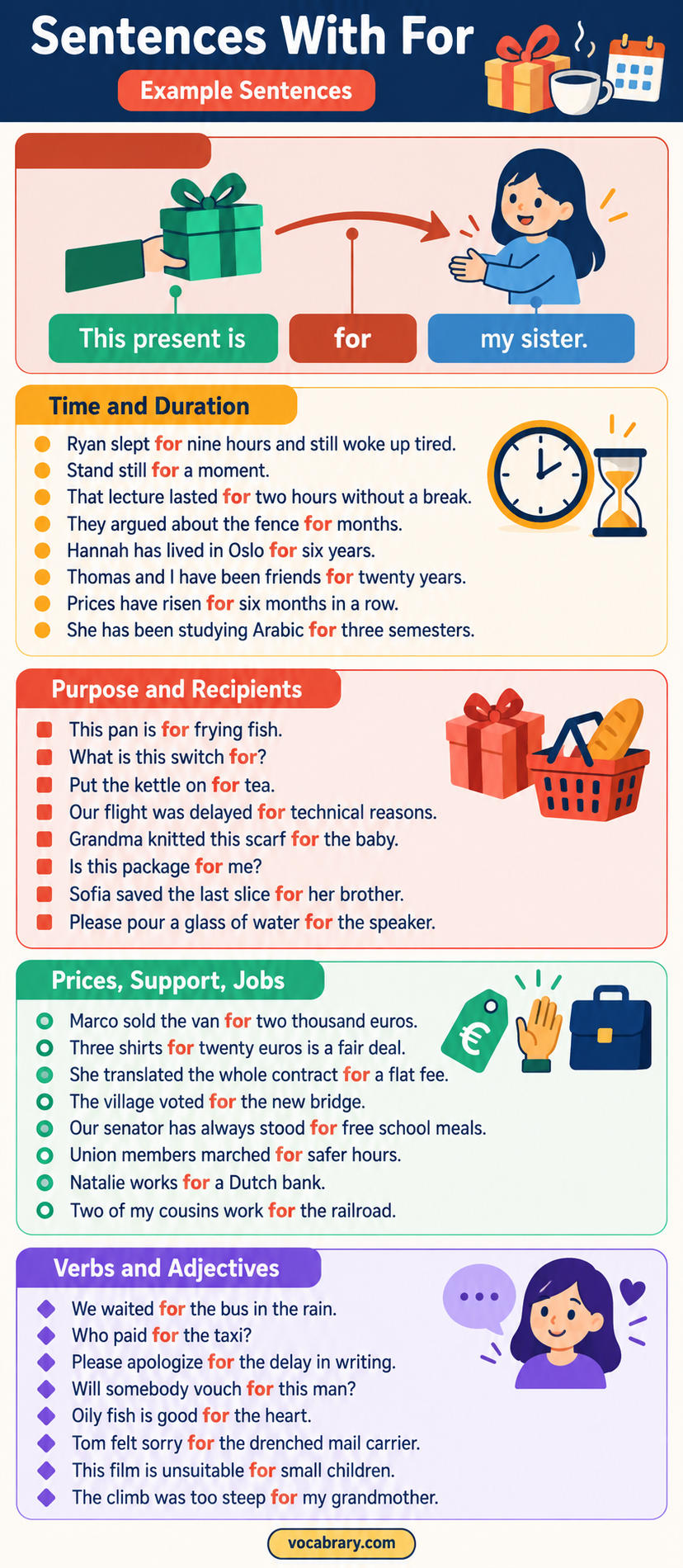
for + period of time / for + person / for + purpose
Hannah has played the cello for eleven years.
Common Sentences With For
A present for a sister, a twenty-minute wait at a bus stop, and ten pounds paid for a secondhand jacket are the everyday sentences with for. The preposition names a recipient, a length of time, or a price.
- This present is for my sister.
- We waited for twenty minutes at the bus stop.
- Daniel paid ten pounds for a secondhand jacket.
- Thank you for your patience.
- The parcel on the step is for the neighbours upstairs.
- I have worked here for six years.
- Aisha bought flowers for her mother’s birthday.
- Nobody has asked for the bill yet.
- Our train leaves for Bristol at half past eight.
- Everyone voted for the shorter route home.
- She studied for the exam every evening last month, and her marks rose from a bare pass to a distinction.
- There is a letter for you on the hall shelf.
- Rain is forecast for Saturday afternoon.
- Hugo cooked dinner for eight people without any help.
- Are these seats for the choir?
- My father worked for the same shipping firm all his life.
- Milk is good for growing children.
- Leila apologised for arriving late.
- That chair is too small for a grown adult.
- Keep the receipt for a full refund.
- They named their daughter for her great-grandmother.
- Sam has been saving for a bicycle since March.
- Please open the door for the woman with the pram.
- Pancakes for breakfast turned a wet Sunday into a treat.
- The whole town turned out for the parade.
Main Uses of the Preposition For
A ladder lent for the afternoon, a taxi ordered for six o’clock, and a fortnight in Lisbon show the main uses of for, each one with its own pattern after the preposition.
| Use | Pattern | Example sentence |
|---|---|---|
| Length of time | For + period | Ravi slept for nine hours. |
| Recipient | For + person | Grandad posted a parcel for his niece. |
| Purpose | For + noun or -ing form | This pan is for frying fish. |
| Reason | For + noun | Marta was praised for her honesty. |
| Price or exchange | For + amount | He sold the van for two thousand euros. |
| Support | For + noun | The village voted for the new bridge. |
| Employer | For + organisation | Nadia works for a Dutch bank. |
| Destination | For + place | The ferry left for Ibiza at dawn. |
| Distance | For + distance | We cycled for thirty kilometres. |
| Meal | For + meal name | They had soup for lunch. |
| Comparison | For + noun | She reads well for her age. |
| Meaning | For + word or phrase | What is the Italian word for rain? |
- Our neighbours lent us a ladder for the afternoon.
- Priya ordered a taxi for six o’clock.
- Gabriel swapped his old phone for a newer model.
- Nothing on the menu was suitable for a vegan guest.
- The committee argued for an hour and settled nothing.
- Ice cream for dessert made the children cheer.
- Will you translate this form for my grandfather?
- Marcus has been in Lisbon for a fortnight.
- Hospitals charge nothing for emergency treatment in Spain.
- A hammer is the wrong tool for this job.
- Yasmin left for the airport before anyone else woke up.
- Six of us signed the petition for a safer crossing outside the school gates, and the council replied within a week.
For With Lengths of Time
Nine hours of sleep, a hillside farmed for two hundred years, and four days without power are the length-of-time sentences with for, where the number after the preposition measures how long something lasted.
- Ravi slept for nine hours and still woke up tired.
- We stayed in Lisbon for a fortnight.
- The kettle boils for about three minutes.
- Her grandparents farmed that hillside for two hundred years.
- Stand still for a moment.
- Traffic on the motorway crawled for eleven kilometres.
- I have not eaten meat for five years.
- Boil the pasta for eight minutes, then drain it.
- That lecture lasted for two hours without a break.
- Kofi practised the trumpet for half an hour every morning before school.
- Snow fell for three days and buried every fence in the valley.
- Did you queue for long?
- Our cat hid under the bed for the whole of Bonfire Night.
- Nobody spoke for a full minute after the verdict.
- She has taught in the same classroom for twenty-two years.
- Rest your eyes for ten seconds between pages.
- They argued about the fence for months.
- Amara rowed for an hour before sunrise.
- The power stayed off for four days after the storm brought down the lines.
- Wait for a while.
For With the Present Perfect
Six years in Oslo, three days without rain, a cough into its second week, and a friendship of twenty years take for with the present perfect. The period began in the past and reaches the present moment.
- Hannah has lived in Oslo for six years.
- We have not seen rain for three days.
- My cough has lasted for a week now.
- Tomas and I have been friends for twenty years.
- Has your brother been unwell for long?
- The shop has stood empty for almost a year.
- Prices have risen for six months in a row.
- I have known Ines for half my life.
- Our landlord has promised repairs for ages.
- She has been studying Arabic for three semesters.
- Nobody has used that footpath for decades.
- They have waited for forty minutes and no bus has come.
- Grandad has smoked a pipe for sixty years and refuses to give it up.
- Have you worked here for long?
- The choir has met on Thursdays for as long as anyone in the village remembers, and the door has never been locked.
- Karim has been driving for eight hours straight.
- Rents in this district have climbed for five years without pause.
- Josef has not spoken to his cousin for two whole years.
For Purpose and Reason
A pan for frying fish, a fine for parking on a corner, a chemist visited for cough syrup, and an award for bravery are the purpose sentences with for. The preposition names what something is meant to do or why it happened.
- This pan is for frying fish.
- Yusuf got a fine for parking on the corner.
- I went to the chemist for cough syrup.
- The firefighter received an award for bravery.
- What is this switch for?
- Scissors for cutting fabric belong in the sewing basket.
- We stopped for petrol just outside Dijon.
- Nadia takes vitamin D for her bones.
- The school closed for repairs to the roof.
- Elena was fined for dangerous driving.
- Put the kettle on for tea.
- A ladder is needed for the upstairs windows.
- Thomas thanked the paramedics for saving his father.
- Salt is added for flavour rather than colour.
- Our flight was delayed for technical reasons.
- Children under five pay nothing for the ferry.
- Rania trained for the marathon in the hills behind her village every weekend of the winter.
- Books for the charity sale go in the blue crate.
For a Recipient and a Beneficiary
A scarf knitted for a baby, a lift door kept open for an older passenger, and a last slice saved for a brother are the recipient sentences with for. The preposition names who receives or benefits.
- Grandma knitted this scarf for the baby.
- Let me make a cup of tea for you.
- Mum ordered a cake for the twins.
- Is this parcel for me?
- Ibrahim kept the lift doors open for an older passenger.
- The children drew cards for their teacher.
- Nothing in the fridge was meant for the guests.
- Sofia saved the last slice for her brother.
- Will you sign this form for my mother?
- A neighbour fed the cat for us while we were away in Greece.
- Tickets for the family have been left at the desk.
- He wrote a song for his wife and sang it at their silver wedding.
- Our aunt knits jumpers for every new baby on the street.
- Please pour a glass of water for the speaker.
- The lawyer spoke for the tenants at the hearing.
- Zara took the shopping for her grandfather all the way up the hill without once complaining.
For Prices and Exchange
Marco’s van at two thousand euros, a cheque for four hundred pounds, and wool traded for cheese at an autumn market are the exchange sentences with for, where the preposition sets one amount against another.
- Marco sold the van for two thousand euros.
- Dad wrote a cheque for four hundred pounds.
- Gabriel swapped his bicycle for a set of drums.
- Three shirts for twenty pounds is a fair deal.
- I bought this coat for ten pounds at a jumble sale.
- Nobody pays full price for a ticket on a Tuesday.
- Will they change these dollars for euros at the airport?
- The baker gives day-old bread away for nothing.
- Our neighbours exchanged their flat for a cottage near the sea.
- She translated the whole contract for a flat fee.
- Farmers here trade wool for cheese at the autumn market.
- Two seats for the matinee cost less than one seat on Saturday night.
- He worked all summer for very little money and learned more than he had in three years at college.
- The boiler repair was done for free under the warranty.
- Would you sell that painting for a thousand?
For Support and Opinion
A village that voted for a new bridge, fans cheering for the underdog, and a petition for Sunday library hours are the opinion sentences with for, where the preposition marks which side a person takes.
- The village voted for the new bridge.
- Ninety fans cheered for the underdog until the final whistle.
- Are you for the proposal or against it?
- Marta argued for longer lunch breaks at the staff meeting.
- Nobody in our street campaigned for the parking scheme.
- Our MP has always stood for free school meals.
- I am for anything that shortens the working week.
- Every argument for and against the plan was heard before the vote.
- She spoke for the nurses at the inquiry.
- Union members marched for safer hours.
- Two governors voted against, and eleven voted for the merger.
- Hassan signed a petition for the library to stay open on Sundays, and four hundred neighbours added their names within a fortnight.
- Most letters to the paper were for the ban after the accident.
- Will you root for my team tonight?
For Jobs and Employers
A Dutch bank, a shipping firm in Piraeus, the BBC in Nairobi, and a cobbler in Naples are the employers in these sentences with for. The preposition links a worker to whoever pays the wages.
- Nadia works for a Dutch bank.
- My uncle sailed for a shipping firm in Piraeus.
- Have you ever written for a newspaper?
- Fatima has designed bridges for the same engineering practice since 2014.
- Nobody wants to work for a company that pays late.
- He drives for a delivery firm at weekends and studies law during the week.
- Our neighbour baked for the village shop until her knees gave out.
- Two of my cousins work for the railway.
- She reported for the BBC from Nairobi.
- Thousands of nurses work for the health service in this county alone.
- I would rather work for myself than answer to a manager.
- Karl volunteered for a mountain rescue team every winter.
- Are you still consulting for that software company?
- Grandpa mended shoes for a cobbler in Naples before the war.
For With Destinations and Departures
A train for Manchester, a ferry that left for Ibiza at dawn, and a plane bound for Tokyo are the departure sentences with for. The preposition names where a journey is aimed rather than every stop along the way.
- The train for Manchester leaves from platform four.
- Our ferry left for Ibiza at dawn.
- A plane bound for Tokyo circled twice before landing.
- Every August my family heads for the hills behind Grenoble.
- Is this the coach for Edinburgh?
- Yasmin set off for work in the dark.
- Passengers for Lyon should change at Dijon.
- Nobody on the quay knew which boat was bound for the island.
- We made for the nearest cafe when the rain started.
- He left for Canada in March and has not written since.
- Sailors for the night crossing gathered near the ramp.
- Twelve of us set out for the summit at four in the morning and reached it before the mist closed in.
For With Common Adjectives
Oily fish that is good for the heart, Bruges famous for its lace, and a climb too steep for a grandmother are the adjective sentences with for, where the adjective needs for before its object.
- Oily fish is good for the heart.
- Bruges is famous for its lace.
- Priya is responsible for three shops in the north.
- Tom felt sorry for the drenched postman.
- Are you ready for the interview?
- Late nights are bad for concentration.
- Nobody was late for the rehearsal.
- This film is unsuitable for small children.
- We are grateful for every donation.
- Marcus is eager for news from home.
- Sugar is not necessary for a good sauce.
- The climb was too steep for my grandmother.
- She looks young for her age.
- Salima is qualified for the role and knows the building well.
- Our dog is notorious for stealing socks from the washing line.
- Is anyone here responsible for the noise last night?
- Fresh air is better for a headache than another tablet, my aunt insists.
- Ahmed was thankful for the lift home after an evening that had gone badly wrong.
For With Common Verbs
Waiting for a bus, looking for lost keys, asking for the bill, and caring for an elderly father are the verb sentences with for, where the verb needs the preposition before its object.
- We waited for the bus in the rain.
- Hana is looking for her keys again.
- Ask for the bill when you are ready.
- Ravi cares for his elderly father at home.
- Who paid for the taxi?
- Nobody applied for the caretaker’s job.
- The rescue team searched for survivors until midnight.
- I hope for better weather tomorrow.
- Please apologise for the delay in writing.
- Farmers longed for rain after ten dry weeks.
- She blamed the referee for the defeat.
- Our teacher praised Leo for his patience with the younger children.
- Do not settle for the first offer you get.
- The charity provides for families who lose their homes in floods.
- Yusra opted for the night train instead of a cheap flight.
- Everyone stood up and clapped for the retiring caretaker.
- Insurance accounts for almost a third of our monthly outgoings.
- Will somebody vouch for this man?
- Children here long for snow every December.
- Amina prepared for her driving test by reading the highway code twice from cover to cover.
For in Fixed Expressions
For example, for now, for good, for free and for the time being are the fixed expressions built on for, where the whole phrase works as one adverb and never changes.
- Many fruits grow here, for example figs and pomegranates.
- Leave the crates in the hall for now.
- Rafael has given up smoking for good.
- Children under six travel for free on this line.
- Nobody knows for sure what happened to the manuscript.
- The train arrived early for once.
- We are staying with my aunt for the time being.
- The old mill has been empty for ages.
- Take nothing for granted after an illness like that.
- Our cottage is not for sale.
- The clerk read the statement back word for word.
- Say that again, for goodness’ sake.
- Bicycles are for hire beside the harbour.
- Mira wants to live in Iceland for ever.
- For the most part, the audience sat in silence.
- Let us walk home for a change.
- I did the whole job for nothing and would do it again tomorrow.
- For the record, nobody in the department was consulted about the closure, and the notice went up overnight.
For and Since in the Same Sentence
Six years in Oslo counted against a transfer in 2019, a cough of five days counted against Tuesday morning, and eighteen months without a doctor counted against Dr Halim’s retirement separate for from since. For measures the length of the period, and since fixes the moment it began.
- Hannah has lived in Oslo for six years, since her transfer in 2019.
- My cough has lasted for five days, since Tuesday morning.
- The shop has been empty for a year, since the owner died.
- We have known each other for decades, since our first term at university, and neither of us has missed a single birthday.
- Nadia has played in the orchestra for three seasons, since the conductor invited her.
- Rain has fallen for nine hours, since just after midnight.
- They have been married for forty years, since a wet August wedding in Cork.
- I have not touched chocolate for a month, since the dentist warned me.
- Prices have climbed for two quarters, since the new tariffs came in.
- Our village has had no doctor for eighteen months, since Dr Halim retired.
- Karim has been awake for twenty hours, since the alarm went off at the plant.
- Have you been coughing for long, or only since the weekend?
For and To in the Same Sentence
A parcel given to a courier but bought for a cousin, a market visited for onions, and a van lent to a friend for the weekend separate for from to. For marks benefit or purpose, and to marks direction or the receiver of a giving verb.
- Bilal gave the parcel to the courier after buying it for his cousin.
- She wrote a letter to the council and a card for her neighbour.
- I went to the market for onions.
- This knife is for slicing bread, so take it to the kitchen.
- Please explain the rule to the class and repeat it for anyone at the back.
- Hakan drove to Ankara for a job interview.
- Nobody sent flowers to the hospital, though three neighbours cooked for the family.
- We walked to the harbour for ice cream.
- The nurse handed the chart to the doctor and fetched water for the patient.
- Ola posted the forms to the tax office for her father.
- Are these sandwiches for the driver, or should I take them to the office?
- Ravi lent his van to a friend for the weekend and got it back with an empty tank and a dented bumper.
For as a Conjunction Meaning Because
A locked door explained by an early closing, a boat turned back by fog, and a silent house at noon show for as a conjunction. The clause after it gives the reason for the clause before.
- The door was locked, for the shop had closed early.
- We turned back, for the fog was thickening over the pass.
- Amina said nothing, for she had promised her sister to keep the secret.
- That old bridge was closed, for the floods had weakened its middle pier.
- He never learned to swim, for the river near his village was too fast.
- I took the earlier bus, for the roads flood after heavy rain.
- Nobody answered the bell, for the family had already left.
- Do not wake the baby, for she has slept badly all week.
- Our grandmother kept every letter, for paper was precious in her childhood.
- Sailors respected that stretch of coast, for three ships had gone down on the rocks in a single winter and none of the crews came home.
- She refused the promotion, for it would have meant moving abroad.
- Bring a coat, for the evenings turn cold in September.
- The house was silent at noon, for everyone had gone to the funeral.
- Yusuf walked the last mile, for his bicycle chain had snapped.
Short Sentences With For for Young Learners
A cake, a ball, a bone and a bowl of soup make the shortest sentences with for, and each one keeps the preposition beside a person or a small amount of time.
For Kids
A cake, a ball, a bone and a bowl of soup give young children their first sentences with for, each one under seven words.
- This cake is for you.
- We play for an hour.
- Mum made soup for lunch.
- Is that ball for me?
- I wait for the bus.
- Sam drew a card for Dad.
- The bone is for our dog.
- Anna sings for her class.
- Buy milk for the baby.
For Beginners
A bus, a birthday card, a shoe shop and a ten-minute read take beginners past the first pattern, adding a reason and a length of time to the recipient sentences.
- Nina reads for ten minutes every night.
- My brother works for a shoe shop.
- We are late for the film.
- Thank you for the card.
- Karim waited for his sister outside the gate.
- Is this seat for me?
- They paid five euros for two coffees.
- Our teacher is famous for her long stories.
- Do not go out for a walk without a coat.
For in Sentences for Students and Exams
Revision for a biology paper, a scholarship application, a thesis praised for its research, and a two-pound library fine are the study sentences with for, where the preposition marks purpose, reason and study time.
- Ines revised for the biology paper every evening.
- No student leaves the hall for the first thirty minutes.
- Daniel applied for a scholarship in marine biology.
- Her thesis was praised for its careful research.
- The library charged me two pounds for an overdue novel.
- Are these notes for the final exam?
- Students sat for three hours without a break.
- Our tutor set aside Fridays for one-to-one meetings.
- I have studied Japanese for four terms and still stumble over the counters.
- Practise past papers for twenty minutes a day rather than six hours the night before the exam.
- Marks are given for method as well as answers.
- Every candidate for the medical course sat an extra written test in the spring.
For in a Short Paragraph
A night nurse named Adaeze, a twelve-hour shift, and a card signed for a retiring porter make one paragraph where nearly every sentence takes for.
Adaeze has worked for the same hospital for nine years. Her shift runs for twelve hours, and she rarely stops for more than a sandwich. Last week the ward collected money for a card and a clock for a retiring porter. Adaeze paid eight pounds for her share and wrote a line thanking him for thirty years of kindness. She waited for the night bus afterwards, for the last tram had already gone. Nobody had asked her to stay late, yet she stayed for an hour and settled the new patients. For now, she has no plan to leave, since the work suits her.
Related
- Parts of Speech Example Sentences
- Sentences with By
- Sentences with With
- Prepositions of Time Example Sentences
FAQs
An everyday example is "This present is for my sister." Another is "Thank you for your patience."
For a length of time, one example is "We stayed in Lisbon for two weeks." Another is "Snow fell for three days and buried every fence in the valley."
With the present perfect, one example is "Hannah has lived in Oslo for six years." Another is "We have not seen rain for three days."
A purpose example is "This pan is for frying fish." Another is "The school closed for repairs to the roof."
For a recipient, one example is "Grandma knitted this scarf for the baby." Another is "The children drew cards for their teacher."
In a price sentence, one example is "Marco sold the van for two thousand euros." Another is "Will they change these dollars for euros at the airport?"
A job example is "Natalie works for a Dutch bank." Another is "Have you ever written for a newspaper?"
For a destination, one example is "Our ferry left for Ibiza at dawn." Another is "Passengers for Lyon should change at Dijon."
After an adjective, one example is "Bruges is famous for its lace." Another is "Are you ready for the interview?"
A fixed expression example is "Leave the crates in the hall for now." Another is "The train arrived early for once."
Related:

Leave a Comment