
On is a preposition that links a word to a surface, a day, or a device, as in the keys on the counter, on Friday, and on the radio. Sentences with on name a surface, a date, a street, or a screen, so the noun after the preposition decides the meaning.
What Is the Preposition On?
On marks contact with a surface and attaches to a named day or date, which is why on the shelf and on Tuesday use one word for two jobs. In names the inside of something and at names a precise time or a single address, so in the drawer, at six o’clock, and on the wall never swap places.
On + surface, day, date, street, or device
Her passport was on the desk, and her flight leaves on Sunday.
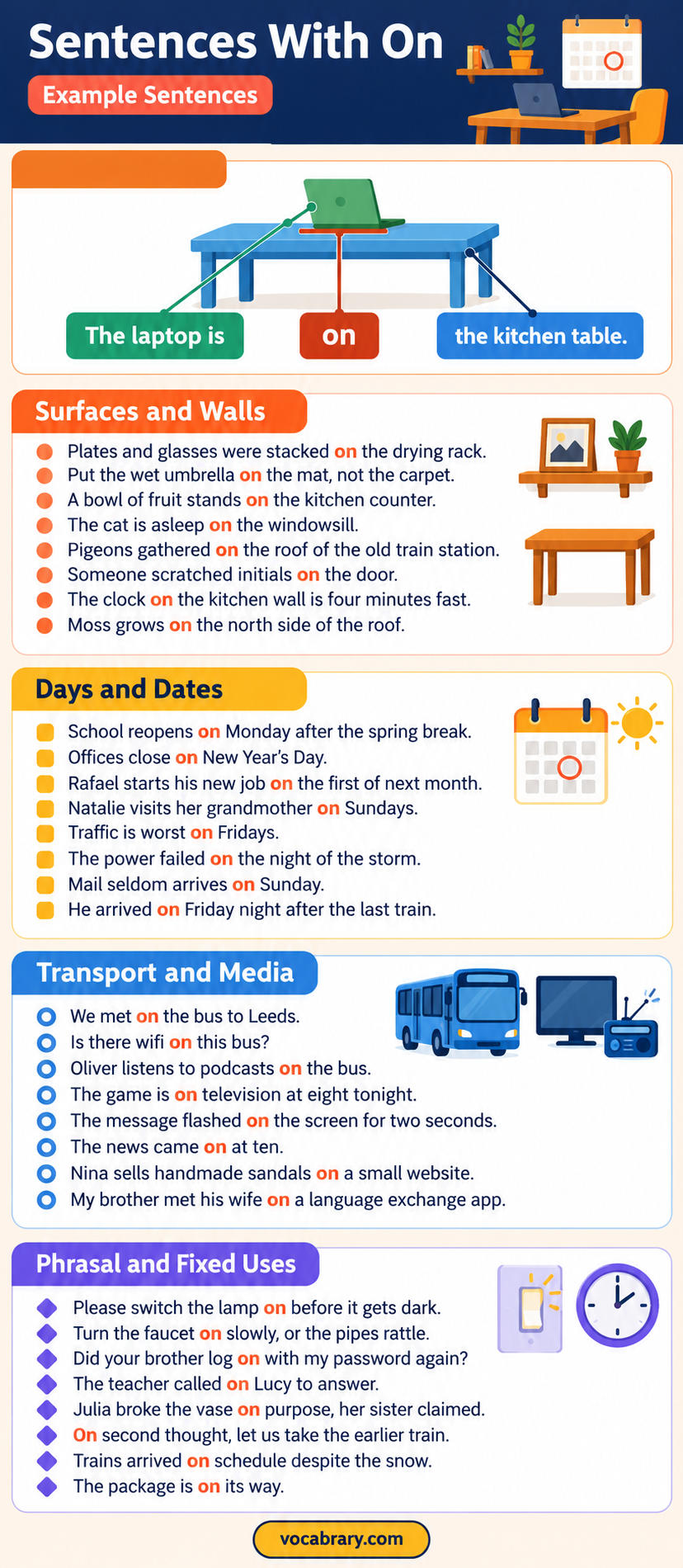
Common Sentences With On
Keys left on a counter, a birthday falling on a Tuesday, and a song heard on the radio make up most sentences with on. One small word ties a noun to a surface, a date, or a broadcast.
- The keys are on the counter.
- Aisha put her phone on silent during the lecture.
- My birthday falls on a Tuesday this year.
- We watched the final on television with the neighbours.
- Diego left a note on the fridge door because he had to leave for work before sunrise.
- Please hang your coat on the hook by the door.
- There is a coffee stain on the second shelf.
- Her grandmother was born on 3 March 1948 in Seville.
- Two cyclists waited on the bridge for the rain to stop.
- Is your sister still on the phone with the bank?
- I heard that song on the radio twice this morning.
- Rain drummed on the tin roof all night.
- Nobody was on the platform when the last train pulled in.
- Luca spilled soup on his white shirt five minutes before the interview.
Main Uses of the Preposition On With Patterns
A plate on a table, a wedding on the fourteenth, a bakery on Maple Avenue, and a film on television cover the uses learners meet first. Each takes its own pattern after the preposition.
| Use | Pattern | Example sentence |
|---|---|---|
| Surface | On + flat surface | The plate is on the table. |
| Day | On + day of the week | Lessons begin on Monday. |
| Date | On + full date | She was born on 3 March 1948. |
| Street | On + street name | The bakery is on Maple Avenue. |
| Transport | On + bus, train, plane, foot | We met on the bus to Leeds. |
| Media | On + television, radio, phone | The match is on television tonight. |
| Study field | On + field of study | Professor Adeyemi wrote a book on trade routes. |
| State | On + holiday, duty, sale, time | My colleagues are on holiday until the ninth. |
On for Flat Surfaces
Stacked plates, frost across a windscreen, and crumbs left on a tablecloth are the everyday surface cases, where on shows that one thing lies against the top of another and draws its support from it.
- Plates and glasses were stacked on the draining board.
- Someone taped a poster on the classroom wall last night.
- Frost had formed on the windscreen by six in the morning.
- My laptop is on the desk beside the printer.
- The cat sleeps on the warm radiator every evening after dinner.
- Yuki dropped her earring on the bathroom floor and searched for it for ten minutes.
- There were crumbs on the tablecloth.
- Put the wet umbrella on the mat, not the carpet.
- Grandma keeps her photographs on the top shelf of the cabinet.
- Paint dripped on the newspaper spread under the ladder.
- Both suitcases lay on the bed, still unpacked.
- Is that mud on my floor?
On the Wall, the Ceiling, and the Roof
Wedding photographs, damp patches after a storm, and pigeons gathering overhead give on its vertical reach, because a wall, a ceiling, and a roof all count as surfaces in English.
- Their wedding photograph hangs on the living room wall.
- Pigeons gathered on the roof of the old railway station.
- Damp patches appeared on the ceiling after the storm.
- Kwame painted a mural on the wall of the youth centre in one weekend.
- Solar panels were fitted on the roof last spring.
- Someone scratched initials on the door.
- A spider crawled on the ceiling all through the film.
- Ivy grew on the garden wall until the builders cleared it.
- Is there a leak on the roof again?
- The clock on the kitchen wall is four minutes fast.
On for Days and Dates
A school reopening on Monday, a birth recorded on 12 August, and a wedding set for June show the rule behind sentences with on for time. A named day or a full date takes on, never in.
- School reopens on Monday after the half-term break.
- Nina was born on 12 August 1999.
- We always eat fish on Fridays.
- The wedding is on the fourteenth of June.
- Offices close on New Year’s Day.
- My parents got married on a rainy Saturday in Lisbon.
- Deliveries stop on public holidays.
- Does the museum open on Sundays?
- Rafael starts his new job on the first of next month.
- Snow fell on Christmas Eve for the first time in nine years, and the children cheered.
- Her visa expires on 30 September.
- Tickets become available on Tuesday at nine.
On With Parts of the Day and Special Dates
Friday evenings, the morning of a flight, and the night of a storm pair a day with a part of it, and each one takes on because the day itself is named.
- Traffic is worst on Fridays.
- On the morning of the flight, Priya woke before the alarm.
- Everyone gets a cake on their birthday at this office.
- The power failed on the night of the storm.
- Guests arrive on Christmas morning and leave after lunch.
- Farid works late on Wednesday afternoons.
- Was the accident on the day of the parade?
- Our team trains on Saturday mornings in the small park behind the public library.
- Letters seldom arrive on Sunday.
- She called me on the anniversary of their first meeting.
On for Streets, Corners, and Addresses
A bakery two doors from a pharmacy, a café at Fifth and Grand, and a flat three floors up all need on. The preposition fixes a building to a street name, a corner, or a level.
- The bakery is on Maple Avenue, two doors from the pharmacy.
- Their flat is on the third floor.
- Turn left on Oak Street and drive for two kilometres.
- A new café opened on the corner of Fifth and Grand.
- Elena grew up on a quiet street in Porto and still visits her old neighbours.
- Roadworks slowed everything on the motorway into town.
- Is the pharmacy on this side?
- My cousin’s house is on the left, just past the church.
- Children were playing on the pavement outside the shop.
- Buses stop on both sides of the square.
On for Buses, Trains, Planes, and Foot
A shared bus to Leeds, two chapters read between Vienna stops, and an uncle who arrived without a taxi mark the transport rule. Public vehicles and foot take on, while a car and a taxi take in.
- We met on the bus to Leeds.
- Sofia read two chapters on the train to Vienna.
- Passengers were asked to stay on board until the crew had finished the safety check.
- Nobody sleeps well on a long flight in economy.
- My uncle came on foot because the taxis were full.
- Riders on horseback crossed the shallow river.
- Is there wifi on this coach?
- Children under five travel free on the ferry.
- Jonas broke his wrist on a bicycle last summer.
- Two seats on the plane stayed empty all the way to Cairo.
- Everyone on the tram stood up when the elderly man boarded.
- Did you lose your umbrella on the underground?
On for Television, Radio, and the Phone
A match at eight, news heard while driving, and an hour lost to an insurance helpline show why broadcasts and calls take on. Sound and picture reach the listener through a channel, not from a place.
- The match is on television at eight tonight.
- Amara heard the news on the radio while driving to work.
- Dad has been on the phone with the insurance company for an hour.
- Nothing good is on tonight.
- Her interview went out on national radio last Thursday.
- We watched the documentary on a laptop in the hotel room.
- Is that film still on at the cinema?
- My sister appeared on a quiz show two winters ago.
- The message flashed on the screen for two seconds.
- Everyone was on a video call when the power cut out.
- Did you see the weather forecast on channel four?
- Grandpa still listens to cricket on an old transistor radio.
On the Internet and Social Media
Answers found in seconds, festival photographs posted the same evening, and sandals sold from a small website show the newer use of on, where a site or an app works like a broadcast channel.
- Half the class found the answer on the internet within a few seconds.
- Photographs of the festival appeared on Instagram that evening.
- Noor sells handmade sandals on a small website.
- Nothing stays private on social media for long.
- We talked on a video call for two hours.
- The recipe is on YouTube.
- Did you read that comment on the school forum?
- Students submit homework on the college portal every Sunday night.
- My brother met his wife on a language exchange app.
- Tickets are cheaper on the airline’s own site than at any travel agency in town.
On With Body Parts and Clothing
A ring on a thumb, mud dried into football boots, and a bruise that lasted a fortnight put on to work with the body, because skin, hands, and feet all behave as surfaces in English.
- A silver ring shone on her thumb.
- Mud dried on his football boots overnight.
- Put your hat on your head before we go out.
- There was a bruise on my left knee for a fortnight.
- Tomas felt a cold raindrop on the back of his neck and turned up his collar.
- Her name is tattooed on his forearm.
- Does that scar on your chin still hurt?
- Ink stains showed on the cuffs of the white shirt.
- The baby wore a woollen sock on one foot only.
- Sunscreen goes on your shoulders before the beach, never after.
On for Books, Talks, and Reports
A book about medieval trade, a lecture about climate change, and a documentary about honeybees all take on before the field they treat, which is the meaning learners meet in study and exam writing.
- Professor Adeyemi wrote a book on medieval trade routes.
- The lecture on climate change filled the largest hall.
- Yuki gave a talk on food waste at the science fair and answered questions afterwards.
- My father reads everything on ancient Egypt.
- A documentary on honeybees won the festival prize.
- Did the committee publish its report on air quality?
- Students need advice on choosing the right course.
- Two chapters on grammar were added to the new edition.
- Nobody asked a single question on the budget.
- Her essay on Jane Austen earned the highest mark in the year.
On for Holiday, Duty, Sale, and Other States
Colleagues away until the ninth, nurses working a shift, and a shop cutting prices for a weekend all use on for a state. No surface and no date is involved.
- My colleagues are on holiday until the ninth.
- Two nurses were on duty when the ambulance arrived.
- Everything in the shop is on sale this weekend.
- The bus arrived on time.
- Dockworkers have been on strike since Monday.
- Grandma is on a strict diet after her check-up.
- Is your father still on medication for his back?
- Half the building was on fire before the engines arrived.
- Rafael travelled to Osaka on business twice last year and never saw the city centre.
- Nobody in the office is on call tonight.
- The project finished on schedule and under budget.
- Our teacher has been on leave since the accident.
On in Phrasal Verbs
Switching a lamp on, putting a coat on, and depending on a bus service show on working as a verb particle, where the preposition changes what the verb does instead of naming a place.
- Please switch the lamp on before it gets dark.
- Aisha put on her coat and left without a word.
- We depend on the bus service every school day.
- The show went on despite the power cut.
- Turn the tap on slowly, or the pipes rattle.
- Nobody counted on the referee changing his mind.
- My laptop takes ages to come on in the morning.
- Try the shoes on before you pay for them.
- Everyone moved on after the company closed the factory.
- Did your brother log on with my password again?
- Keep on walking.
- Hana took on three extra students this term.
- The idea caught on quickly among the younger staff within a month of the launch.
- Pass the message on to whoever answers the phone.
On in Fixed Expressions
Breaking a vase on purpose, spending an hour a day on average, and speaking on behalf of a family are set phrases, so the noun after on drops its determiner and never changes form.
- Julia broke the vase on purpose, her sister claimed.
- Households spend, on average, an hour a day cooking.
- On the whole, the trip went better than expected.
- We are on the way to the airport now.
- On second thought, let us take the earlier train.
- Farmers are working on a tight budget this season.
- The film was not boring; on the contrary, it kept us awake until three.
- Her lawyer spoke on behalf of the whole family.
- Is the wedding still on?
- Trains arrived on schedule despite the snow.
- My grandfather learned to swim on his own at forty.
- Everything depends on whether the visa arrives in time.
On and Onto in Movement Sentences
Water dripping to a floor, a dog leaping to a sofa, and children running to a pitch need onto for the movement, while on names where the thing ends up once the movement has stopped.
- Water dripped onto the floor and dried on the tiles.
- Diego climbed onto the roof, where the aerial lay on its side.
- Passengers stepped onto the platform while their luggage stayed on the train.
- She poured syrup onto the pancakes on her plate.
- The dog leapt onto the sofa and settled on the cushion.
- Rain blew onto the balcony and pooled on the concrete.
- Kwame lifted the heavy crate onto the shelf beside the tins on the far left.
- Snow drifted onto the road and froze on the windscreens overnight.
- Children ran onto the pitch while the coach waited on the touchline.
On and In Compared
Milk inside a fridge against a receipt stuck to its door, and a passport in a drawer against a form left out for signing, separate the two prepositions in sentences with in.
- Documents stay in the folder, while the folder lies on the desk.
- My passport is in the drawer, and the visa form is on the table.
- Travellers ride in a car but on a bus.
- The milk is in the fridge, and the shopping receipt is stuck on the fridge door.
- Nina works in Toronto, on a street near the lake.
- Children swim in the pool and dry off on the grass.
- Put the letter in an envelope and the stamp on the corner.
- We arrived in March, on the fifth to be exact.
- Her keys were in her coat pocket, not on the hook.
- Rice cooks in a pot on the stove.
On and At Compared
A meeting fixed for Monday at nine, fireworks timed for midnight, and a bus stop named by its street split the two words. On takes the day, and at takes the clock time or the single address, as sentences with at set out.
- The meeting is on Monday at nine in the morning.
- Sofia waited at the bus stop on Oak Street for twenty minutes.
- Fireworks start at midnight on New Year’s Eve.
- My parents were at home on the day of the earthquake.
- Books are cheaper on the airline website than at the desk inside the terminal building.
- Guests arrive at the hotel on Friday afternoon.
- Did the match end at ten on Saturday night?
- Farid works at a bank on the main avenue.
- Lessons begin at eight on weekdays.
- We ate at a small café on the corner.
Short Sentences With On for Kids and Beginners
A cat on a mat, a doll on a chair, and apples counted on a plate keep the preposition beside one short noun. Young learners meet on this way first.
For Young Learners
- The cat is on the mat.
- My book is on the bed.
- Put the cup on the tray.
- Birds land on the fence.
- We play on Saturday.
- A bee landed on the flower.
- Her doll is on the chair.
- Shoes go on your feet.
- Is the ball on the grass?
For Beginners
- Ali writes on paper.
- Two apples are on the plate.
- Snow falls on the hill.
- Please knock on the door.
- Dinner is on the stove.
- Nobody is on the swing.
- We go to school on foot.
- Does the light stay on all night?
- Her name is on the bag.
Sentences With On in a Short Paragraph
A Saturday market trip and a delayed flight use on from start to finish. The preposition moves from a date to a street, a stall, a bus, and finally a screen.
Marta walks to the market on Alameda Street on the first Saturday of every month. Crates of oranges wait on the pavement, and the cheese seller keeps a small radio on the counter beside the till. She pays, puts the bag on her shoulder, and rides home on the number nine bus. On the way she reads the football scores on her phone. Lunch is already on the stove when she arrives, and her father is on the balcony with the newspaper.
Jonas landed on 2 October after a flight that had been delayed twice. His name was on a card held up near the arrivals gate, and the driver waited on the far side of the barrier. They drove to a hotel on Queen Street, where the room keys lay on the reception desk. On the second night his meeting was cancelled on short notice, so he watched two films on a laptop and called his mother on the phone until midnight.
Related
- Parts of Speech Example Sentences
- Sentences with In
- Sentences with At
- Prepositions of Place Example Sentences
FAQs
An everyday example is "The keys are on the counter." Another is "My birthday falls on a Tuesday this year."
For a surface, one example is "My laptop is on the desk beside the printer." Another is "Both suitcases lay on the bed, still unpacked."
In a wall sentence, one example is "Their wedding photograph hangs on the living room wall." Another is "Damp patches appeared on the ceiling after the storm."
With a day, one example is "We always eat fish on Fridays." Another is "The wedding is on the fourteenth of June."
A street example is "Turn left on Oak Street and drive for two kilometers." Another is "The bakery is on Maple Avenue, two doors from the pharmacy."
On public transport, one example is "Sofia read two chapters on the train to Vienna." Another is "My uncle came on foot because the taxis were full."
For a broadcast, one example is "Anna heard the news on the radio while driving to work." Another is "The recipe is on YouTube."
On a subject, one example is "The lecture on climate change filled the largest hall." Another is "Two chapters on grammar were added to the new edition."
With a phrasal verb, one example is "We depend on the bus service every school day." Another is "Pass the message on to whoever answers the phone."
A fixed expression example is "On the whole, the trip went better than expected." Another is "Trains arrived on schedule despite the snow."
Related:

Leave a Comment