
By is a preposition that names the doer of an action, the method behind it, or the moment a job must be finished, as in the fence was painted by my brother. Most sentences with by fall into one of those three duties, and the doer sentences come first.
What Is the Preposition By?
By names whoever or whatever performs an action, the means used to perform it, and the limit of a stretch of time, so one short word answers who, how, and when. With marks the tool in the hand rather than the doer, which is why a form is signed by a clerk with a blue pen.
Doer: Passive verb + by + person / Method: By + noun or by + verb-ing / Deadline: By + time
The garden wall was rebuilt by two neighbours with second-hand bricks.
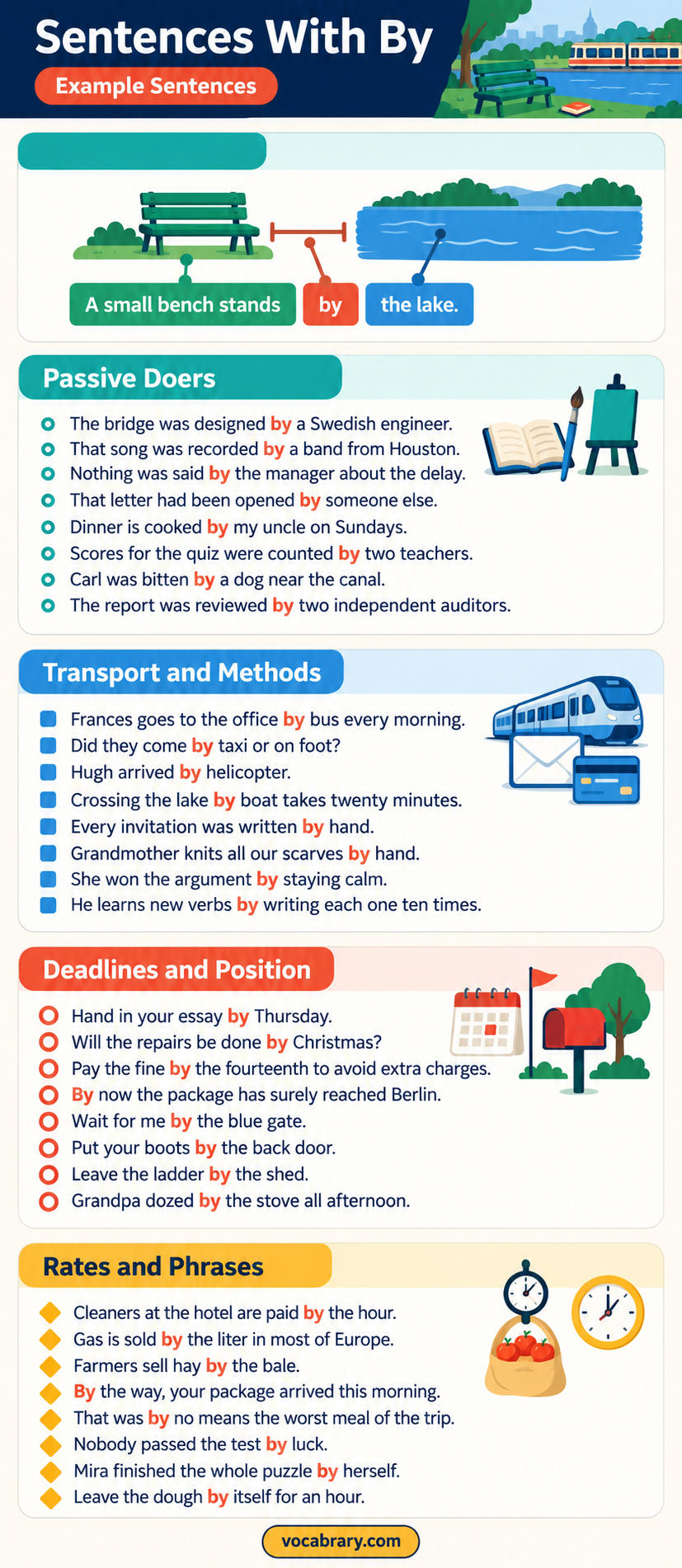
Common Sentences With By
A courier at the door, a form due on Friday, and a café beside the harbour show the three jobs by does most. Each sentence names a doer, a method, or a time limit.
- The parcel was delivered by a courier on Tuesday morning.
- Nadia goes to work by train every weekday.
- Sign the form by Friday.
- A small café by the harbour serves the best coffee in town.
- We paid for the tickets by card.
- This novel was written by Chinua Achebe.
- Put the umbrella by the door so nobody forgets it.
- Our team won by two goals.
- He fixed the shelf by himself.
- Eggs are sold by the dozen at the farm shop.
- By the way, your brother phoned while you were out.
- Rain came in by the open window and soaked the carpet.
- She learned the whole poem by heart in one evening.
- Send the report by email before the meeting starts at ten.
- The door opened by itself.
- Lukas knows the answer by now.
- My grandmother sews every curtain by hand.
- Three of the runners finished by noon, and the rest arrived much later.
- That fence by the orchard needs paint.
- Salaries at the warehouse are paid by the hour.
- Did you break the vase by accident?
- Thirty divided by six equals five.
Uses of By With Patterns and Example Sentences
A broken window, a train to Rome, strawberries priced by the kilo, and an essay due by Thursday each need a different pattern after the same preposition.
| Use | Pattern | Example sentence |
|---|---|---|
| Doer of an action | Passive verb + by + person | The window was broken by a stray ball. |
| Author or maker | Noun + by + creator | This portrait was painted by Frida Kahlo. |
| Transport | Go or travel + by + vehicle | Sofia went to Rome by train. |
| Method | Verb + by + noun | Pay by card at the machine near the exit. |
| Method with a verb | By + verb-ing | Yusuf saved money by cycling to work. |
| Deadline | Verb + by + time | Finish the essay by Thursday. |
| Position | Be or stay + by + place | Wait by the blue gate. |
| Rate of pay or sale | Paid or sold + by the + measure | Strawberries are sold by the kilo. |
| Difference in amount | Rise or fall + by + amount | The rent went up by forty euros. |
| Arithmetic | Multiply or divide + by + number | Multiply the total by three. |
| Alone | By + reflexive pronoun | Hana painted the fence by herself. |
| Fixed phrase | By + fixed noun | Rehan learned the song by heart. |
By for the Doer in Passive Sentences
A Swedish engineer, a taxi driver who returned a wallet, and firefighters who pulled two goats from a flood all appear after the verb. In passive sentences with by, the doer arrives last.
- The bridge was designed by a Swedish engineer.
- Our flat was cleaned by a company from the next street.
- Every window in the hall was broken by hailstones last April.
- Amira was chosen by her classmates to lead the debate.
- Both slices of cake were eaten by the twins before anyone noticed.
- Two goats were rescued by firefighters after the flood.
- That song was recorded by a band from Lagos.
- My passport was checked by an officer at the border.
- Nothing was said by the manager about the delay.
- That letter had been opened by someone else.
- Were these photographs taken by your father?
- Dinner is cooked by my uncle on Sundays.
- Half the roof was damaged by the storm on Sunday night.
- Students were warned by the head teacher about the flooded car park.
- A wallet was found by a taxi driver and returned the same evening.
- Our luggage was searched by security.
- Scores for the quiz were counted by two teachers.
- Most of the village was rebuilt by volunteers after the earthquake.
- Every decision about the budget was made by the whole committee.
- Karim was bitten by a dog near the canal.
- These chairs were repaired by a carpenter in Tunis.
- The fire in the workshop was put out by neighbours long before the engine arrived from town.
By With Authors, Artists, and Composers
Jane Austen, Vincent van Gogh, Antonio Vivaldi, and Chimamanda Ngozi Adichie each made the work that names them. A title followed by its maker is the oldest use of this preposition.
- Pride and Prejudice was written by Jane Austen in 1813.
- My father owns a print of Sunflowers, painted by Vincent van Gogh.
- Arrow of God was written by Chinua Achebe.
- A choir sings the Ninth Symphony, composed by Ludwig van Beethoven, every December.
- Students in year ten read Hamlet, a tragedy written by William Shakespeare.
- One Hundred Years of Solitude was written by Gabriel García Márquez.
- Our school hall has a poster of Guernica, painted by Pablo Picasso in 1937.
- Jane Eyre was written by Charlotte Brontë, and Wuthering Heights by her sister Emily.
- Every violin student knows The Four Seasons, composed by Antonio Vivaldi.
- Don Quixote was written by Miguel de Cervantes.
- Was The Kite Runner written by Khaled Hosseini?
- Half of a Yellow Sun was written by Chimamanda Ngozi Adichie in 2006.
- The bronze figure called The Thinker was sculpted by Auguste Rodin.
- Mrs Dalloway was written by Virginia Woolf in 1925.
- Twenty-one nocturnes were composed by Frédéric Chopin.
- The Waste Land, a long poem published in 1922, was written by T. S. Eliot.
- That mural near the station was painted by a group of local teenagers.
- The Old Man and the Sea was written by Ernest Hemingway in 1952.
- Her favourite ballet score was composed by Igor Stravinsky.
By for Transport and Travel
A ferry across the channel, a tram from the main square, and cargo that arrives by sea all take the same preposition. Only on foot refuses it.
- Fatima goes to the office by bus every morning.
- We crossed the channel by ferry in heavy rain.
- Most of the cargo arrives by sea.
- Did they come by taxi or on foot?
- Sending a parcel by air costs three times as much as sending it by road.
- My uncle never flies, so he crosses Europe by train.
- Travelling by bicycle through the hills took us four days.
- Students reach the campus by tram from the main square.
- She returned from Cairo by plane on Sunday evening.
- Going by motorbike through the old town is faster than driving.
- Nobody goes to the island by car, because the bridge is closed.
- They shipped the furniture by lorry to Marseille.
- Do you prefer to go by coach or by rail?
- Hiro arrived by helicopter.
- Letters used to be carried by horse across the plains.
- Our grandparents came to Canada by ship in 1958.
- Rania went to the wedding by overnight train from Ankara.
- Nothing reaches the research station by road during winter.
- Farmers bring their vegetables to the market by van.
- Will you get there by underground or by taxi?
- Crossing the lake by boat takes twenty minutes.
- He never goes anywhere by plane if a train exists.
By for Method, Means, and Mistakes
Payment by card, invitations written by hand, and a folder deleted by mistake answer the question how. The noun or the verb-ing form after by supplies the method.
By Hand, By Email, and By Card
Knitted scarves, bank transfers, confirmed reservations, and three hundred euros saved on bus fares all answer how, with by plus the means chosen.
- Every invitation was written by hand.
- Send your answers by email before midnight.
- We paid the deposit by bank transfer.
- Grandmother knits all our scarves by hand.
- Reservations are confirmed by telephone.
- Is it possible to pay by card in this shop?
- Marks are sent to parents by mail each term.
- Yusuf saved three hundred euros by cycling to work all year.
- Do not reply by text message, because the number on that old contract changes every single week.
- She won the argument by staying calm.
- Our landlord prefers rent by standing order.
- Tickets bought by phone cost one euro more.
- They opened the tin by pressing the small lever on the side.
- He learns new verbs by writing each one ten times.
- The chef thickens the sauce by adding cold butter at the end.
- Payment by cheque is no longer accepted at the counter.
- Amelia improved her accent by listening to the radio every night.
- Fees at the clinic are settled by direct debit.
By Mistake and By Accident
A deleted folder, the wrong coat, an alarm at four in the morning, and a leak found while hunting for a mop are the classic unplanned cases.
- I deleted the whole folder by mistake.
- Omar took the wrong coat by accident.
- The alarm went off by mistake at four in the morning.
- She discovered the leak by chance while looking for a mop.
- Did you send that message by accident?
- Two pages were printed twice by mistake.
- He met his old teacher by chance at the airport in Doha.
- Our cat let itself out by accident and stayed away for two nights.
- Nobody breaks a window by design.
- We booked the wrong date by mistake and lost the whole deposit two days before the wedding.
- Leila answered the question correctly by guessing.
- My brother dialled your number by accident last night.
By With Deadlines and Time Limits
An essay due on Thursday, rent due on the first, and a gate that shuts at 07:40 mark a moment that nothing is allowed to pass. By means at that moment or earlier, never throughout.
- Hand in your essay by Thursday.
- The shop closes by nine on weekdays.
- Amara promised to finish the painting by the end of March.
- We need the signed contract by noon tomorrow.
- All passengers must be at the gate by 07:40.
- Will the repairs be done by Christmas?
- Rent is due by the first of every month.
- By next summer the new library will be open.
- Marks must be entered by Friday afternoon, or the office locks the system until the next examination board.
- Nothing was ready by the deadline.
- Our guests will have arrived by eight.
- Pay the fine by the fourteenth to avoid extra charges.
- By the age of six, Mira already read chapter books.
- The builders promised to finish by autumn, yet the roof is still open.
- Applications close by midnight on 30 June.
- Send the invoice by Wednesday at the latest.
- By now the parcel has surely reached Berlin.
- Sara had learned to swim by her fifth birthday.
- Every room must be vacated by eleven on the morning of departure.
- Hurry, because the gates shut by dusk.
- They had sold every ticket by Tuesday morning.
- Reply by Wednesday if the address on the label is wrong.
By the Time in Longer Sentences
A last train already gone, cold dinner, a dead phone in a strange city, and an empty fridge follow the clause that by the time opens or closes.
- Dinner was cold by the time the guests arrived.
- By the time we reached the station, the last train had gone.
- The snow had melted by the time we came back from Oslo.
- Her fever had dropped by the time the doctor arrived.
- Every seat was taken by the time the concert began.
- I will be in Seville by the time you read this.
- He had forgotten the whole argument by the time Monday came.
- Nothing was left in the fridge by the time my brothers went to bed.
- Ana had lived in five countries by the time she turned thirty.
- Will the shop be shut by the time we get there?
- Most of the guests had left by the time the cake appeared.
- My phone had died by the time I found the hotel.
- Rescue teams reached the village by the time the river rose again.
- By the time the removal van finally arrived at the new flat in Leeds, we had eaten every sandwich.
By for Position and Nearness
A lamp beside the piano, a dog asleep against the radiator, and boots left at the back door place one thing right beside another. Here by means at the side of.
- Wait for me by the blue gate.
- A tall lamp stood by the piano.
- Our cottage is by a stream that freezes every January.
- She sat by the window and watched the snow.
- Put your boots by the back door.
- The dog sleeps by the radiator all winter.
- Is that your bicycle by the wall?
- Two benches by the pond were repainted last week.
- He grew up by the sea in a fishing village near Galway.
- Nobody was waiting by the ticket machine.
- Park by the pharmacy, because the main street is closed.
- Leave the ladder by the shed.
- Amir waited by the arrivals door for almost an hour.
- The kettle is by the sink.
- Flowers grow thickly by the railway line outside Bruges.
- They built a small chapel by the crossroads.
- Grandpa dozed by the stove all afternoon.
- Her office is by the lift on the third floor.
- Children were playing by the fountain until the rain started.
- Somebody left a suitcase by the escalator.
- We ate our sandwiches by the river and fed the ducks with the last of the bread.
By for Measurement, Rate, and Numbers
Hotel cleaners, market tomatoes, translators, and taxi meters are all priced against a measure. The noun after by the names whatever the money is counted against.
Paid by the Hour and Sold by the Kilo
Hourly wages, fabric cut by the metre, hay sold by the bale, and rooms let by the week fix a price to a single measure.
- Cleaners at the hotel are paid by the hour.
- Tomatoes are sold by the kilo in the covered market.
- Fabric is cut and priced by the metre.
- Petrol is sold by the litre in most of Europe.
- Oysters are sold by the dozen at the fish counter.
- Freelancers charge by the day rather than by the project.
- Rooms are let by the week in that old guesthouse.
- Coffee beans are weighed and sold by the gram in the new shop.
- Are these strawberries priced by the punnet or by the kilo?
- Farmers sell hay by the bale.
- Translators are paid by the word, so long sentences earn more.
- Rice is sold by the sack in the wholesale market near the harbour, never by the kilo.
- Taxis in the city charge by the kilometre.
- Nurses on night duty are paid by the shift.
Numbers, Amounts, and Differences
Ninety divided by nine, a rent rise of forty euros, a record missed by two seconds, and a carpet four metres by five give the exact size of a difference.
- Multiply the total by three.
- Ninety divided by nine equals ten.
- Prices rose by four percent in a single quarter.
- Our team lost by one goal.
- Rent for the flat went up by forty euros last March.
- Sales fell by half after the factory closed.
- She missed the record by two seconds.
- The carpet measures four metres by five.
- Ticket sales grew by a third once the festival added a second stage.
- He improved his own time by eleven seconds at the meeting in Nairobi.
- Reduce the temperature by ten degrees.
- Wages in the region increased by two percent, which pleased nobody.
- Divide the bill by six, and each of us pays nine pounds.
- The garden is twelve metres by eight.
By in Fixed Expressions
A script known by heart, a swimmer who is by far the fastest, and candles that go out one by one come from phrases English never alters.
By the Way, By Far, and By Heart
Borrowed ladders, a poem learned by heart, twins walking side by side, and a puppy growing bolder day by day keep the same words in every mouth.
- By the way, your parcel arrived this morning.
- Ines is by far the fastest swimmer in the club.
- Every actor knew the whole script by heart.
- Our neighbours are, by and large, quiet people.
- The car broke down again, and by then the shops had closed.
- He knows the number by heart.
- Take the ladder for the weekend by all means.
- That was by no means the worst meal of the trip.
- Little by little, Yara rebuilt her confidence in class.
- We sat, by chance, next to an old neighbour from our street on the flight home from Lisbon.
- Day by day, the puppy grew bolder.
- This exam was by far the hardest paper of the year.
- Learn the first verse by heart before Monday.
- The youngest team should by rights take the prize.
- Side by side, the twins walked to school in matching coats.
- Nobody passed the test by luck.
- A square has, by definition, four equal sides.
- One by one, the candles went out.
- By now everyone in the village knows the story.
By With Reflexive Pronouns
A puzzle finished alone, a bicycle repaired in one afternoon, and a kettle that switches off without a hand on it take by plus myself, herself, or itself.
- Mira finished the whole puzzle by herself.
- I prefer to eat by myself on busy days.
- The door closed by itself.
- Do the twins walk to school by themselves?
- Hassan repaired the bicycle by himself in one afternoon.
- We painted the hallway by ourselves and saved a fortune.
- Our youngest boy refuses to eat by himself.
- She went across Peru by herself for six weeks.
- Leave the dough by itself for an hour.
- You will never manage that wardrobe by yourself.
- My grandparents still garden by themselves at eighty.
- Are you here by yourself?
- The kettle switches off by itself once the water boils.
- Amina learned Korean by herself, using two apps and a notebook that she filled within a month.
- Please do not go to the lake by yourselves.
- He laughed by himself in the corner, remembering the joke.
By and Until in the Same Sentence
A report due by Friday, an office open until five, and a ferry that runs until noon separate the two words. By sets the last moment for one action, while until stretches a situation to its end.
- Finish the report by Friday, and then rest until Monday.
- Sign the form by noon; the office stays open until five.
- Reply by Monday, not until Monday.
- The shop must close by ten, although the café next door serves until midnight.
- Deliver the parcel by Tuesday and keep the receipt until the refund clears.
- Ana will be home by seven, so nobody has to wait until nine.
- Pay the fee by the first of April, because the discount lasts until then.
- Send your answers by midnight, since the site stays open only until that hour.
- We must leave by dawn, yet the ferry runs until noon.
- Book the room by March, and leave the deposit until you arrive.
- Repairs should end by Thursday; the road stays shut until the paint dries.
- Hand your keys back by eleven, even though guests use the lounge until twelve.
- The essay is due by Friday, and the library is open until ten every night.
- Tickets must be bought by Wednesday, while the exhibition runs until September.
- My visa is valid until June, so renew it by the end of April.
By and With in the Same Sentence
A letter written by Nour with a fountain pen, snow cleared by the caretaker with a plastic shovel, and a portrait drawn by a street artist with charcoal split the doer from the tool.
- The letter was written by Nour with a fountain pen.
- Both walls were painted by two students with a roller.
- The lock was opened by a neighbour with a bent wire.
- Bread is kneaded by hand, never with a machine, in that bakery.
- My hair was cut by an apprentice with blunt scissors.
- Soup stirred by hand tastes better than soup mixed with blades.
- Our fence was rebuilt by volunteers with timber from the old barn.
- That photograph was taken by Marcus with an old film camera.
- Vegetables are chopped by the trainee with the smallest knife.
- Were these shelves fixed by your uncle with his own tools?
- Snow was cleared by the caretaker with a plastic shovel.
- This song was recorded by a student with one microphone.
- A tooth was pulled by the dentist with steady hands.
- Her portrait was drawn by a street artist with charcoal.
- Dinner was cooked by my brother with three pans and no recipe.
- The final report was typed by a temporary assistant with a borrowed laptop that crashed twice before lunch.
By and Near Compared
A hotel on the sand beside a flat two streets inland: by puts two objects side by side, while near allows a short walk between them.
- Our hotel was by the beach, while my cousin’s flat was only near it.
- Take the chair by me, not the one near the door.
- The chapel by the lake is smaller than the church near the market.
- Park by the entrance whenever possible, or anywhere near the stadium.
- She waited by the window, though her friends waited near the stairs.
- Fishing is allowed by the bridge and near the weir.
- A café by the harbour smells of salt; a café near the harbour does not.
- Leave the crates by the desk rather than near the radiator.
- Our tent was pitched by the river at the bottom of the field, and theirs somewhere near the woods.
- He grew up by the docks, not merely near them.
- Are the toilets by the ticket hall or near the platform?
- My desk is by the window, while hers is near the printer.
Short Sentences With By for Young Learners
Cats asleep at the fire, ducks on the reeds, a cup set beside a plate, and milk finished by eight suit a first lesson on this preposition.
For Kids
A cat, a boat, a ball at the gate, and a lamp for reading give five-word and six-word sentences with by that young children copy without trouble.
- The cat sleeps by the fire.
- Stay by me.
- A boat goes by the bridge.
- Mum came by car.
- I write by hand.
- That ball rolled by the gate.
- We go to school by bus.
- Put the cup by the plate.
- Dad reads by the lamp.
- This picture was drawn by Mia.
- Come home by six.
- She did it by herself.
- Ducks swim by the reeds.
- Finish your milk by eight.
- Two by two, the children lined up.
- Our class went to the zoo by train and came home by bus.
For Students and Exam Practice
Coursework due on 15 June, marks awarded by two examiners, and a theory tested by experiment match the language of exam papers and lab reports.
- The experiment was repeated by three different teams.
- Candidates must submit the coursework by 15 June.
- Marks are awarded by two examiners working separately.
- Rewrite the active sentence so that the doer comes after by.
- Volumes are measured by the litre in the chemistry lab.
- By the end of term, every student had presented once.
- Population grew by nine percent between the two censuses.
- An answer written by hand earns no extra marks.
- Divide the sample by four before weighing it.
- Were the notes checked by your tutor?
- Essays handed in by Monday go to the second marker.
- Nobody passes this paper by memorising dates alone.
- That theory was tested by experiment, not by argument.
- Learn the formula by heart, since calculators are not allowed.
- Applications are ranked by the panel in order of merit.
- Students who revise by teaching a friend remember far more than those who read the chapter twice.
Sentences With By in a Short Paragraph
Halima’s morning gathers six uses at once: a time limit at six, a bicycle, bread wrapped by hand, a tram, an email, and a canal bank at lunch.
- Halima was already awake by six in the morning.
- She went to the bakery by bicycle, because the bus starts late.
- Bread there is sold by the loaf and wrapped by hand.
- By eight she had reached the office by tram.
- Her report had to be sent by email before ten.
- Nobody helped her; she finished it by herself.
- The rain had stopped by lunchtime, so she ate by the canal.
- Everything was quiet by the time she got home.
Related
- Parts of Speech Example Sentences
- Sentences with With
- Sentences with For
- Prepositions of Movement Example Sentences
FAQs
An everyday example is "Natalie goes to work by train every weekday." Another is "Sign the form by Friday."
For a passive doer, one example is "The bridge was designed by a Swedish engineer." Another is "Two goats were rescued by firefighters after the flood."
With an author, one example is "Pride and Prejudice was written by Jane Austen in 1813." Another is "Don Quixote was written by Miguel de Cervantes."
A transport example is "We crossed the channel by ferry in heavy rain." Another is "Most of the cargo arrives by sea."
For a deadline, one example is "Hand in your essay by Thursday." Another is "We need the signed contract by noon tomorrow."
As a method, one example is "Every invitation was written by hand." Another is "Send your answers by email before midnight."
For position, one example is "A tall lamp stood by the piano." Another is "She sat by the window and watched the snow."
In measurement, one example is "Cleaners at the hotel are paid by the hour." Another is "Prices rose by four percent in a single quarter."
With a reflexive pronoun, one example is "Mira finished the whole puzzle by herself." Another is "The door closed by itself."
A fixed expression example is "Every actor knew the whole script by heart." Another is "Irene is by far the fastest swimmer in the club."
Related:

Leave a Comment