
Prepositions of movement are the prepositions that show direction from one place to another, as in she ran into the kitchen and the train went through the tunnel. Most prepositions of movement example sentences pair one of these words with a verb of motion, so the noun after it names where the journey ends.
What Are Prepositions of Movement?
Prepositions of movement give the path or direction of somebody who is going somewhere: into an enclosed place, onto a surface, across open ground, or away from a starting point. Prepositions of place, such as in, on and behind, fix a position instead of a path.
Verb of motion + preposition + noun (the destination or the path)
The children ran into the garden and climbed onto the wall.
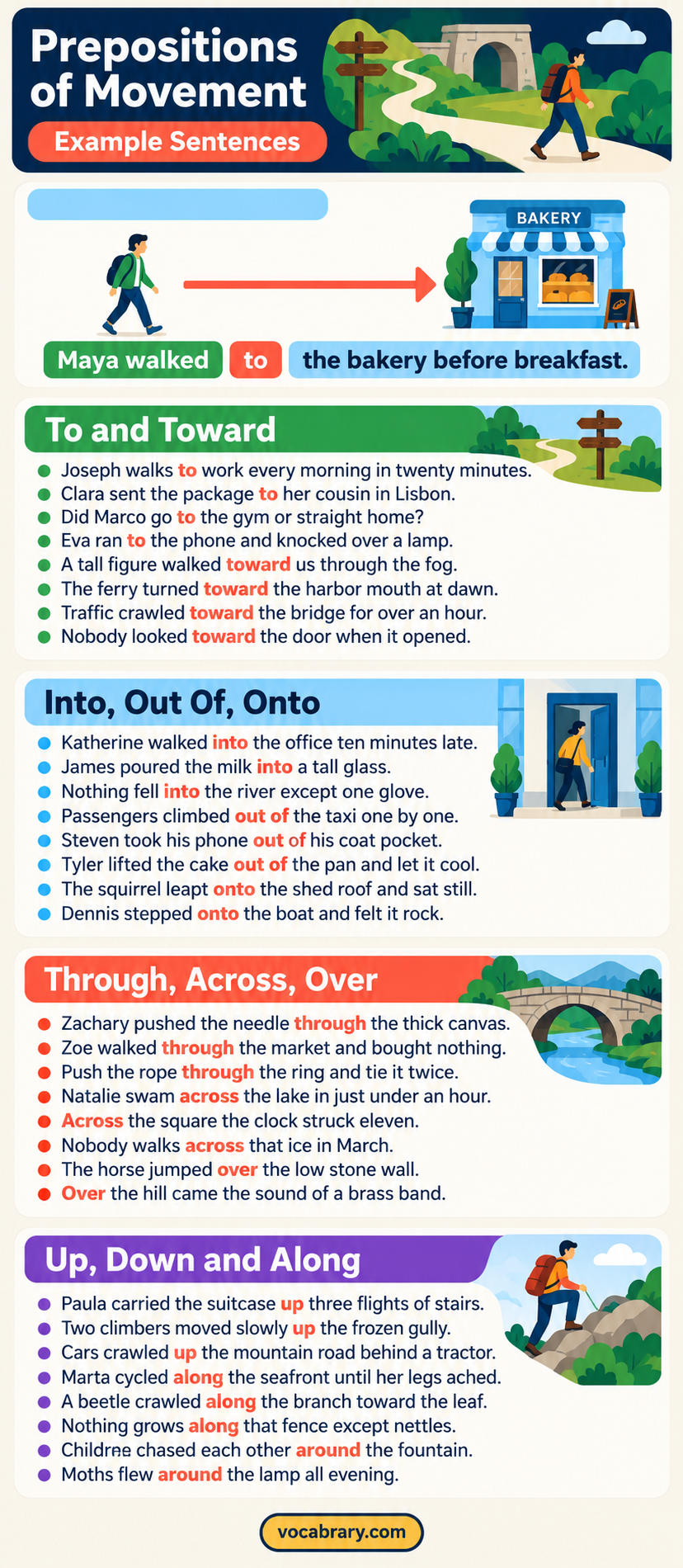
Common Prepositions of Movement Example Sentences
Children running into a classroom, a cyclist riding through an old tunnel and a cat jumping onto a windowsill are the everyday prepositions of movement example sentences. Each one names the path a person or an animal took.
- The children ran into the classroom when the rain started.
- Maya walked to the bakery before breakfast.
- A grey cat jumped onto the windowsill.
- Omar cycled through the old railway tunnel.
- Across the river a wooden bridge leads walkers to the village.
- Priya climbed up the ladder with a tin of paint.
- Water dripped off the edge of the roof all night.
- Lucas drove past the school without seeing the new sign.
- Nobody moved towards the door until the alarm stopped.
- Sofia stepped out of the taxi and paid the driver.
- Down the hill the sledge went faster than the children expected.
- Diego threw the ball over the fence by mistake.
- Two swans swam along the canal as far as the lock.
- Aisha ran around the track four times before school.
- The bus pulled away from the kerb at six exactly.
- A mouse darted under the fridge and stayed there until midnight.
- Wind pushed the small boat towards the rocks.
- Ravi carried the heavy suitcase up four flights of stairs.
- After the bell rang, the whole class walked out of the hall and across the playground to the front gate.
- Where did the dog run to after the gate blew open?
Ten Prepositions of Movement and the Direction They Show
A cat slipping into a kitchen, snow sliding off a windscreen and a horse jumping over a low wall show ten movement words at work. Each one gives a different path: inside, outside, over a surface, or straight at a destination.
| Preposition | Movement it shows | Example sentence |
|---|---|---|
| To | Movement that ends at a named destination | Hana walked to the library after lunch. |
| Into | Movement from outside to inside | The cat slipped into the warm kitchen. |
| Out of | Movement from inside to outside | Ravi stepped out of the lift on the top floor. |
| Onto | Movement that ends on top of a surface | The squirrel jumped onto the shed roof. |
| Off | Movement that leaves a surface | Snow slid off the car windscreen. |
| Through | Movement from one end of an enclosed path to the other | The train went through a long tunnel. |
| Across | Movement from one side of something to the other | Nadia swam across the lake in an hour. |
| Over | Movement from one side to the other at a higher level | The horse jumped over the low wall. |
| Along | Movement that follows the length of something | We walked along the river path for two miles. |
| Towards | Movement in the direction of something | The dog ran towards the garden gate. |
- Hana walked to the library with three overdue books in her bag.
- A fox slipped into the garden through a hole in the hedge.
- Passengers hurried out of the station before the storm arrived.
- Onto the stage walked a nervous boy with a violin.
- Rain ran off the tent and soaked our shoes.
- Felix drove through the village at walking pace.
- Nobody wanted to swim across such a cold lake.
- Over the fence came a football and then an apology.
- Marta cycled along the seafront until her legs hurt.
- Did the wasp fly towards the open window or the door?
- Two divers went down the rope ladder into the dark water.
- Snow fell onto the roof of the old barn and stayed there for a week without melting.
To and Toward in Example Sentences
To names the end of a journey, while toward and towards give only the direction of it. A walk to the dentist arrives; a walk towards the dentist has started.
To for a Named Destination
A morning walk to the dentist, a flight to Nairobi and a letter sent to a cousin in Lisbon share one pattern: the noun after to is the place the journey ends.
- Yusuf walks to work every morning in twenty minutes.
- We flew to Nairobi on the first flight of the day.
- Clara sent the parcel to her cousin in Lisbon.
- To the dentist she went, with her sister holding her hand.
- The whole family drove to the coast for the long weekend.
- Bilal returned to his old school as a teacher last September.
- Every Friday my grandfather cycles to the market with two empty baskets tied to the handlebars.
- Nadia moved to Warsaw after finishing her degree.
- Did Marco go to the gym or straight home?
- Our train gets to Milan at half past eight.
- Eva ran to the phone and knocked over a lamp.
- The letters went to the wrong address for three months.
- Chen swims to the far end of the pool without stopping.
- Nobody came to the meeting except the two organisers.
Toward and Towards for a Direction
Waves pushing a boat, a crowd turning to face a stage and a dog trotting up a lane all move towards something without arriving, so the noun names a direction instead of a destination.
- A tall figure walked towards us through the fog.
- The ferry turned towards the harbour mouth at dawn.
- Rosa leaned toward the microphone and repeated the question.
- Towards evening the birds flew back to the marsh.
- Traffic crawled towards the bridge for over an hour.
- Our dog trots towards the gate whenever a car slows down.
- Hugo pushed the trolley toward the checkout with one hand.
- Smoke from the bonfire drifted towards the houses on the far side of the shallow valley.
- Nobody looked towards the door when it opened.
- The crowd surged towards the stage as the band appeared.
- Isla stepped toward the edge and then changed her mind.
- Why is that ship sailing towards the rocks?
Into and Out Of in Example Sentences
Into puts somebody inside an enclosed place, and out of brings them back to the open air. A coin dropping into a charity tin and a rabbit bolting out of a hedge mark the two directions.
Into in Example Sentences
A fox slipping into a hen house, a swimmer diving into a cold pool and rain blowing into a hallway all cross one boundary from outside to inside.
- Katya walked into the office ten minutes late.
- The coin rolled into a crack between two floorboards.
- Into the cave went three torches and one nervous teacher.
- Jamal poured the milk into a tall glass.
- Our cat squeezed into a basket half her size.
- Leo dived into the pool without testing the water first.
- Rain blew into the hallway while the front door stood open.
- Noor put the unopened letters into her bag and forgot about them until Friday evening.
- The children climbed into the back of the van with their bikes and two wet dogs.
- Amara stepped into the lift and pressed the button for the roof garden.
- Nothing fell into the river except one glove.
- Did the wasp get into the kitchen through the window?
- Oscar ran into the sea and shouted at the cold.
- Water leaked into the cellar after three days of storms.
Out Of in Example Sentences
Passengers stepping out of a taxi, a rabbit bolting out of a hedge and papers spilling out of an old envelope all leave an enclosed place, so out of reverses the journey that into begins.
- Passengers climbed out of the taxi one by one.
- A rabbit bolted out of the hedge and crossed the lane.
- Samir took his phone out of his coat pocket.
- Out of the dark came a small boy with a torch.
- Steam rose out of the kettle and fogged the window.
- Vera walked out of the cinema before the film ended.
- Old photographs spilled out of the envelope onto the carpet.
- Nobody came out of the building until the firefighters arrived.
- Tariq lifted the cake out of the tin and let it cool.
- Smoke poured out of the engine, so the driver stopped on the hard shoulder and called for help.
- Get out of the water now, please.
- Why did you jump out of bed so early?
Onto and Off in Example Sentences
Onto lands something on a surface, and off takes it away again. A cat on a shed roof and snow leaving a windscreen show the same surface from two directions.
Onto in Example Sentences
A squirrel landing on a shed roof, a suitcase lifted onto a rack and paint dripping onto a dust sheet all finish on top of something, which is the work of onto.
- The squirrel leapt onto the shed roof and sat still.
- Greta lifted her suitcase onto the luggage rack.
- Paint dripped onto the dust sheet all afternoon.
- Onto the pitch ran eleven players in bright yellow shirts.
- Our neighbour climbed onto the wall to rescue a kite.
- Wet leaves blew onto the path and made it slippery.
- Dmitri stepped onto the boat and felt it rock.
- Pour the sauce onto the pasta while it is hot.
- A wasp flew onto my plate and refused to leave.
- Nobody moved onto the dance floor until after midnight.
- Farid loaded the last heavy crate onto the truck and locked the back door behind him.
- Did the cat jump onto the table again?
- Snow settled onto the windscreen within minutes.
Off in Example Sentences
Snow sliding from a windscreen, a boy falling from a swing and a cup knocked from a shelf all leave a surface, and off gives that downward or outward direction.
- Snow slid off the roof of the car.
- Ines fell off her bike on the gravel path.
- Take your feet off the sofa.
- Off the table went the cup, and the tea went with it.
- Pablo jumped off the last step and landed badly.
- Dust blew off the shelf when Rania opened the window.
- Two apples rolled off the counter during the earthquake drill.
- Wen stepped off the bus at the wrong stop and walked back.
- Nothing came off the wall except one old poster.
- Our plane took off twenty minutes late from a wet runway at Dublin airport.
- The cat knocked the pen off my desk on purpose.
- Did you get off at the station by the museum?
Through and Across in Example Sentences
Through takes a journey inside something with walls or edges, and across takes it from one side of an open surface to the other. A tunnel needs through; a bridge needs across.
Through in Example Sentences
A train inside a tunnel, a needle pulled through thick cloth and a walk under the trees of a wood all stay inside something while the journey lasts, which is what through marks.
- The express train raced through the tunnel in forty seconds.
- Zaid pushed the needle through the thick canvas.
- Through the forest a narrow path leads to the old mill.
- Cold air came through the crack under the door.
- We drove through four villages before finding a petrol station.
- Sunlight poured through the tall windows of the reading room.
- Yara walked through the market and bought nothing.
- A fox slipped through the fence and disappeared behind the compost heap.
- Nobody goes through that gate after dark.
- Push the rope through the ring and tie it twice.
- Water seeped through the cracked wall of the cellar.
- Did the parade pass through your street this year?
- Hugo cycled through heavy rain for eleven kilometres and arrived at the office soaked to the skin.
Across in Example Sentences
A swimmer crossing a cold lake, a cat walking over a garden wall and a ferry making the trip from one bank to the other all go from edge to edge, which across marks.
- Nadia swam across the lake in just under an hour.
- A black cat walked across the wet path in front of us.
- Across the square the clock struck eleven.
- Elena drove across the bridge at sunrise.
- Two children ran across the field towards the ice cream van.
- Ferries go across the river every twenty minutes.
- Wind carried the smell of bread across the whole street.
- Nobody walks across that ice in March.
- Marta spread the map across the kitchen worktop and traced the route with a pencil.
- Our ball rolled across the tennis court and stopped at the net.
- Kofi looked across the valley and saw the storm arriving.
- Did you cycle across Denmark last summer?
- Light moved across the ceiling as cars passed outside.
Over, Under and Against as Movement Words
Over takes a journey higher than an obstacle, under takes it beneath one, and against ends it in contact with something solid. A horse, a tunnel digger and a wave give the three pictures.
Over and Under in Movement Sentences
A horse clearing a low wall, a boat passing beneath an iron bridge and a ball sent into a neighbour’s garden show over and under giving height to a journey rather than a fixed position.
- The horse jumped over the low stone wall.
- Our boat passed under the iron bridge at low tide.
- Leo threw his jumper over the back of the chair.
- Over the hill came the sound of a brass band.
- A hedgehog crawled under the gate and vanished into the grass.
- Planes fly over our roof every four minutes.
- Rania climbed over the barrier and apologised to the guard.
- Pull the blanket under the mattress so it stays flat.
- Nothing went over the net during the first three serves.
- Swallows swooped over the pond and touched the water with their wings.
- Water flooded under the door of the garden shed during the heavy March storms last year.
- Did the cat crawl under the car again?
- Felix rolled the wheelbarrow over the muddy patch and left two deep tracks.
Against for Movement Into Contact
Waves hitting rocks, hail striking a greenhouse and a rower pulling upriver show against at work: the journey ends in contact with something, or pushes at a force coming the other way.
- Waves crashed against the harbour wall all night.
- Hail rattled against the greenhouse and cracked one pane.
- Isla pushed the wardrobe against the bedroom wall.
- Against the current two rowers made very slow progress.
- Cyclists struggled against a headwind on the coast road.
- Branches knocked against my window during the storm.
- Nobody leaned against the wet paint after the second warning.
- Tariq swam against the tide for twenty minutes, gave up and let the current bring him back.
- Snow piled against the north side of the barn.
- Did the ladder slip against the gutter?
Up and Down in Example Sentences
Up and down give the slope of a journey. Stairs climbed with a suitcase, a sledge on a snowy hill and a diver on a rope ladder show the two directions.
- Priya carried the suitcase up three flights of stairs.
- The sledge shot down the hill and hit a bale of straw.
- Up the ladder went the painter with a pot of white paint.
- Water ran down the window in thin lines.
- Two climbers moved slowly up the frozen gully.
- Amara walked down the lane to fetch the newspaper.
- Smoke curled up the chimney and out into the night air.
- Nobody runs up that hill twice.
- Chen slid down the banister and got a splinter for his trouble.
- Cars crawled up the mountain road behind a tractor.
- Toss the rope up to the window.
- Rain washed the mud down the path and into the drain by the gate.
- Did you walk up the tower or take the lift?
- Our lift went down to the basement instead of the lobby.
Along and Around in Example Sentences
Along follows the length of a road, a river or a shelf, while around circles an obstacle or a centre. A canal walk and a roundabout give the two shapes.
Along in Example Sentences
A walk beside a canal, a hand sliding down a banister and a beetle crawling the length of a branch all follow one line from end to end, which is the work of along.
- Marta cycled along the seafront until her legs ached.
- We walked along the canal as far as the second lock.
- Along the corridor came the smell of burnt toast.
- A beetle crawled along the branch towards the leaf.
- Dmitri ran his hand along the banister and found a loose rail.
- Two joggers moved along the towpath in the half dark.
- Buses go along Mill Street every six minutes.
- Nothing grows along that fence except nettles.
- Noor drove along the coast road for three hours and stopped at almost every viewpoint on the way.
- Rain water trickled along the gutter and into the barrel.
- Walk along the platform to coach B.
- Did the parade go along the river or through the park?
Around in Example Sentences
Runners circling a track, a taxi going round a roundabout and children chasing each other round a fountain all keep turning, so around gives a curved path instead of a straight one.
- Aisha ran around the track four times before breakfast.
- Our taxi went twice around the roundabout before taking the right exit.
- Children chased each other around the fountain.
- Around the corner a small queue waited for the bakery to open.
- A wasp circled around my head and then flew off.
- Yusuf walked around the puddle instead of through it.
- Moths flew around the lamp all evening.
- Nobody drives around the old town at midday.
- Vera turned the handle around twice and heard the bolt move.
- Guides take visitors around the cathedral and its crypt every hour until four in the afternoon.
- Wrap the scarf around your neck.
- Did the cyclists go around the lake or straight back?
Past and By as Movement Words
Past and by both take a journey alongside something without stopping. A bus going past a school and a swan drifting by a boat show movement that leaves the place behind.
- Lucas drove past the school without seeing the sign.
- A fire engine raced past us with its siren on.
- Past the cathedral the road narrows to one lane.
- Eva walked by the bakery and pretended not to smell the bread.
- Two swans drifted by our boat at the mooring.
- Buses go past the hospital every ten minutes.
- Nobody walks past that dog without crossing the road first.
- Zaid ran past the finish line and kept going for another lap.
- Our train rushed past three small stations without slowing down at all.
- Hurry past the roadworks.
- Did anyone go past the gate at eleven?
- Years went by before Rosa returned to the village.
From and Away From in Example Sentences
From names where a journey starts, and away from gives the direction a person or a thing takes when leaving. A flight from Cairo and a boat pulling away from a jetty mark both halves.
- Our flight came from Cairo and landed in heavy rain.
- The bus pulled away from the kerb at six exactly.
- Samir walked from the station to the hotel in fifteen minutes.
- From the top of the tower the whole harbour looks small.
- Sheep ran away from the dog and crowded into the corner of the field.
- Water drained from the pool through a rusty pipe.
- Nobody moved away from the fire until the wood burnt out.
- Katya drove from Lisbon to Porto in a borrowed car.
- Step away from the edge.
- A cold wind blew from the north all week.
- Ines took her coat from the hook and locked the shop for the last time.
- Did the letter come from your grandmother in Kerala?
In and Out in Spoken Movement Sentences
Spoken English shortens into and out of to in and out: get in the car, jump out the window, come in from the rain. These forms appear in speech, notices and quick instructions.
- Come in out of the rain.
- Get in the car, please.
- Pablo jumped out the window and landed in a flower bed.
- In came the cat with muddy paws.
- Our guests walked in without knocking.
- Wen ran out as soon as the bell rang.
- Move in a little and let me close the door.
- Nobody went out after the second snowfall.
- Farid climbed in through the back door because his front door lock had jammed.
- Rania waved and drove out through the side gate.
- Are you going out tonight?
- The dog raced out and chased a pigeon.
Prepositions of Movement With Verbs of Travel
Walking, running, driving, flying, swimming, cycling and climbing each take a movement word after them, so the verb gives the manner and the preposition gives the path.
- Hana walks to the market every Saturday morning.
- Two boys ran across the bridge and shouted at the water.
- Oscar drove through the mountain pass before the snow arrived.
- Over the Alps we flew in bright sunshine.
- Nadia swam out of the cave and back into the daylight.
- Greta cycled up a hill so steep that she pushed the bike for the final kilometre.
- Climbers went down the north face on ropes.
- Passengers walked along the platform looking for coach D.
- Our ferry sailed past three small islands before lunch.
- Nobody drives into the old quarter on market days.
- Leo sailed towards the lighthouse until the engine failed.
- Marta ran round the park twice and then walked home slowly.
- Did you fly from Doha or from Dubai?
- Amara jogged onto the beach and left her shoes by the steps.
- Tourists climb up the tower for the view over the harbour.
- Our coach pulled away from the hotel at five in the morning.
Giving Directions in a City
Directions to a station, a museum and a pharmacy depend on movement words: go along the high street, turn into Baker Lane, cross over the footbridge, walk past the bank.
- Walk along the high street until you reach a red postbox.
- Turn into Baker Lane after the pharmacy.
- Past the bank you will find a narrow alley with a green door.
- Cross over the footbridge and follow the signs to the station.
- Go through the archway and the museum entrance is on your left.
- Take the second exit off the roundabout.
- Yara told us to drive towards the cathedral and park behind it.
- Nobody cycles up that street because the hill is brutal.
- Follow the river to the third bridge, then turn right into a square with a fountain.
- Buses run from the airport to the city centre every half hour.
- Step out of the station and look for the blue tram stop.
- Did they walk around the park or straight across it?
- Visitors climb up two hundred steps to reach the old citadel.
- Our hotel is five minutes from the metro, just past a small cinema.
Prepositions of Movement at School and in the Corridor
A class filing into a hall, a pupil running down a corridor and a bag thrown onto a desk are the school scenes where these prepositions do the work.
- The class walked into the hall in two quiet lines.
- Jamal ran down the corridor and was told to slow down.
- Someone threw a bag onto the back desk.
- Out of the science lab came a strong smell of vinegar.
- Pupils file past the office on the way to the canteen.
- Our teacher walked around the room while we wrote the test.
- Chalk dust drifted onto the front row every morning.
- Nobody goes through that door without a pass.
- Leo climbed over the low fence behind the bike shed and tore the sleeve of his blazer.
- Move to the back of the queue, please.
- Papers blew off the desk when Ines opened the window.
- Did the whole year group go into the sports hall for the talk?
- Two hundred parents walked across the playground for the evening concert.
- Rania carried the projector up to the third floor.
Prepositions of Movement in Sports and Games
A ball over a crossbar, a swimmer to the far wall, a runner around a track and a cyclist up a long climb: sport depends on movement words.
- The striker chipped the ball over the goalkeeper.
- Chen swam to the far wall and touched it first.
- Runners sprinted around the final bend together.
- Into the net went the third goal of the afternoon.
- Our captain dived across the goalmouth and stopped the shot.
- Tariq hit the ball out of the court and lost the point.
- Cyclists climbed up the last kilometre in driving rain.
- Nobody skated onto the ice until the coach arrived.
- The rider guided her horse towards the water jump and cleared it cleanly.
- Kick the ball through the defence.
- Play moved down the wing and back again.
- Did the penalty go past the goalkeeper or off the crossbar?
- Wen threw the javelin across the whole field and broke a school record from 1998.
- Two swimmers pushed off the wall at the same second.
Prepositions of Movement in Driving and Traffic
Cars pulling out of a driveway, lorries going over a bridge, a taxi turning into a side road and traffic crawling towards a tunnel are the traffic scenes these prepositions describe.
- Felix reversed out of the driveway without checking the mirror.
- Lorries rumble over the old bridge all night.
- Into the tunnel the traffic crawled at walking pace.
- A taxi turned into the side road and stopped outside number nine.
- Cars queued towards the border crossing for four hours.
- Our van broke down halfway up the hill.
- Motorbikes weave through the traffic on Mill Street.
- Nobody drives past that junction quickly after the accident last winter.
- Ines pulled off the motorway at the first service station and slept for an hour.
- Move to the left lane.
- The lorry rolled slowly down the ramp and onto the ferry deck.
- Did the bus go around the flooded road or through it?
- Cyclists rode along the cycle lane beside the tram tracks.
- A tractor pulled out of a field and held up nine cars.
Prepositions of Movement With Animals and in Nature
A fox slipping under a fence, swallows flying over a pond, salmon swimming up a river and a snail crossing a path give these prepositions their plainest pictures.
- A fox slipped under the fence and crossed the lawn.
- Swallows swooped over the pond at dusk.
- Salmon swim up the river every autumn to spawn.
- Across the path a snail moved at its own pace.
- Bats flew out of the barn as the light faded.
- A squirrel ran along the top of the wall with a nut in its mouth.
- Ants marched into the kitchen through a crack by the back door.
- Nothing swims through that weed except eels.
- Geese fly towards the marshes in October and return in March.
- Wind blew the seeds off the dandelion in one breath.
- One heron stepped into the shallow water and waited.
- Did the badger dig under the shed again?
- Leaves drifted down the stream and collected at the weir.
- Our neighbour’s goat jumped onto the roof of the garage.
Action in Stories and Adventure Scenes
A thief climbing through a skylight, a horse galloping across a moor and a lantern carried down a staircase turn movement words into the engine of a scene.
- The thief climbed through the skylight and dropped onto a pile of sacks.
- Hooves thundered across the moor in the dark.
- Down the spiral staircase the lantern light went, step by step.
- Rosa crawled under the barbed wire and lay still in the wet ditch until the lights passed.
- Somebody ran towards the church, then stopped and turned back.
- An old sailor rowed away from the burning ship as the masts fell.
- Two soldiers waded through the flooded field and reached the empty farmhouse just before dawn.
- Nobody escaped out of that prison in ninety years.
- A letter slid under the door at midnight.
- Bells rang across the valley and woke the whole village.
- Dust rose off the road as the horsemen approached.
- The prisoner walked into the courtroom with his head high.
In and Into, On and Onto Compared
In and on fix a position, while into and onto give the movement that put something there. The same scene changes meaning with one letter.
In and Into Compared
A cat already in a basket and a cat jumping into it describe one animal at two moments, so in names the position and into names the arrival.
- Our cat sleeps in the basket, and our kitten jumped into it this morning.
- Priya swims in the lake, then runs into the changing hut to warm up.
- Spare change stays in the drawer until somebody drops it into a coat pocket.
- In the hall there is a mirror, and the dog ran into it once.
- Milk is in the jug because Yusuf poured it into the jug at breakfast.
- Nobody is in the office, so put the form into the letterbox.
- Coins lay in the fountain for weeks after the last tourists of the season had thrown them into the cold water.
- Marco sat in the car for a minute before driving into the garage.
- Water stays in the barrel, and rain runs into it from the gutter.
- Photographs stay in an old tin that Vera slipped into her suitcase.
On and Onto Compared
A book already on a shelf and a book pushed onto it separate the two words: on gives the surface, onto gives the journey to that surface.
- The atlas is on the shelf because Leo pushed it onto the shelf last night.
- Snow lay on the roof after falling onto it for two days.
- Hana sat on the wall, then jumped onto the grass.
- On the stage the singer waited, and the drummer walked onto it late.
- Paint is on the floor, because a brush rolled onto the boards.
- Nobody stood on the ice that winter, though a stray dog ran onto it for one terrifying minute.
- Our plates are on the table, so put the bread onto the wooden board.
- Rain fell onto the windscreen and stayed on the glass in fat drops.
- Tariq climbed onto the roof and sat on the ridge for an hour.
- Dust settled onto the piano and now lies on the closed lid.
Prepositions of Movement in Questions
Questions about a route, a missing cat and an open garden gate put the movement word at the start of the sentence or at the very end.
- Where did the cat run to?
- Has the parcel fallen into the recycling bin?
- Across which bridge did you cycle this morning?
- How did the fox get into the garden?
- Are you walking up the hill or taking the bus?
- Who climbed onto the roof and rescued the kite by herself last Tuesday afternoon?
- Which street do we turn into after the traffic lights?
- Why did the ball roll off the table?
- Did anybody go past the gate at eleven last night?
- Where does this path lead through the woods?
- Shall we drive around the lake before dinner?
- Have the swallows flown away from the barn already?
Prepositions of Movement in Negative Sentences
A dog that never goes into the sea, a ball that did not go over the bar and a bus that has not pulled away yet all use a movement word inside a negative.
- Our dog never goes into the sea.
- The ball did not go over the crossbar.
- Nobody walked across the wet cement.
- Into that cupboard nothing has been put since March.
- Elena did not drive through the village after the flood warning.
- Passengers must not lean out of the window.
- Zaid has not climbed up that tower since he broke his ankle two summers ago.
- Do not step onto the frozen pond.
- Our coach has not pulled away from the hotel yet.
- Wind never blows from the south in this valley.
- The cat refuses to jump off the wardrobe.
- Did nobody swim to the raft this year?
Prepositions of Movement Example Sentences for Kids
Frogs jumping into a pond, a ball rolling under a car and a child sliding down a slide give young readers prepositions of movement example sentences they act out in one second.
- The frog jumped into the pond.
- A red ball rolled under the parked car.
- Sara slid down the yellow slide.
- Up the tree went the little cat.
- Ducks swam across the pond for bread.
- Two puppies ran around the garden and knocked over a plant pot.
- Ali walked to school with his big brother.
- Throw the ball over the net.
- Nobody climbed onto the swing after the rain.
- A bee flew out of the flower and back to the hive.
- The train goes through a tunnel and comes out the other side.
- Did the kite fly over the roof?
- Mia ran past the bakery and waved at the baker.
- Snow fell onto the garden all night, so the children ran out of the house at seven.
Short Prepositions of Movement Sentences for Young Learners
A cat, a ball, a bus and a boy fill these five-word and six-word sentences, short enough for a first lesson about direction.
- The cat ran into the house.
- Tom walks to school.
- Down the hill goes the bus.
- A ball rolled off the bed.
- Birds fly over the trees.
- Put the book onto the shelf.
- Out of the bag came a toy.
- Our dog ran around the tree.
- Did Anna go into the shop?
Prepositions of Movement Example Sentences for Beginners
A bus to the airport, a walk along a beach and a lift up to the fourth floor use the ten words a beginner needs first, one preposition to each sentence.
- This bus goes to the airport.
- Farid walked along the beach for an hour and collected six flat stones.
- The lift took us up to the fourth floor.
- Into the classroom came a new student from Peru.
- Katya ran out of the shop with her umbrella.
- Cars drive over the bridge all day.
- A cat sleeps under the table, then jumps onto it.
- Nobody went through the blue door.
- Our plane flew across the sea at night.
- Step off the bus carefully.
- Did you cycle past the lake?
- Two friends walked towards the station together.
Prepositions of Movement in Short Paragraphs
A school morning, a market delivery, a mountain walk, a night train and a morning ferry each run for six sentences, so the movement words build one journey instead of one step.
Every morning Kofi walks out of his flat at half past seven. He goes down three flights of stairs and through the heavy front door. The path takes him along the canal and past a bakery with warm windows. At the second bridge he crosses over the water and turns into Mill Street. Pupils stream towards the gate from every direction. By five to eight he is in the classroom with wet shoes.
Our delivery van leaves the depot at five and drives through empty streets. It turns into the market square and reverses towards the loading bay. Two porters lift crates off the van and onto flat trolleys. The trolleys roll across the cobbles and into the covered hall. By seven the fruit stalls are full and the van has gone back to the depot. Nobody watching the market at nine imagines that early hour.
Last April we climbed up the ridge behind the village before sunrise. The path went through a wood of birches and then out of the trees into open grass. Sheep scattered away from us and ran down the slope. Over the last rocks we scrambled on hands and knees. Cloud moved across the valley while we ate breakfast. Going down took half the time and twice the courage.
The night train pulls out of Vienna at ten and rattles towards the border. Passengers climb into narrow bunks and push suitcases under them. Somebody walks along the corridor every hour with a torch. At two the train goes through a long tunnel and everybody wakes. Frost spreads across the window while the wheels hum underneath. By seven the city comes into view and we step off onto a cold platform.
Tourists come down the harbour steps at nine and file onto the small ferry. The boat pulls away from the quay and turns towards the island. Gulls sweep across the wake for scraps of bread. Halfway across the bay the engine slows so that everybody sees a seal. Passengers move to the rail with their cameras. By ten the ferry slides into the harbour on the far shore.
Related
- Parts of Speech Example Sentences
- Prepositions of Place Example Sentences
- Prepositions of Time Example Sentences
FAQs
In everyday writing, one example is "The children ran into the classroom when the rain started." Another is "Maya walked to the bakery before breakfast."
Young learners act out a sentence such as "The frog jumped into the pond." Another is "A red ball rolled under the parked car."
For a first lesson, one example is "This bus goes to the airport." Another is "Step off the bus carefully."
With a destination, one example is "Chris swims to the far end of the pool without stopping." Another is "A tall figure walked toward us through the fog."
To enter a place, one example is "Leo dived into the pool without testing the water first." Another is "Passengers climbed out of the taxi one by one."
For a path inside something, one example is "The express train raced through the tunnel in forty seconds." Another is "Elena drove across the bridge at sunrise."
On a slope, one example is "The sled shot down the hill and hit a bale of straw." Another is "Paula carried the suitcase up three flights of stairs."
When giving directions, one example is "Turn into Baker Lane after the pharmacy." Another is "Go through the archway and the museum entrance is on your left."
Sports reports use sentences such as "The striker chipped the ball over the goalkeeper." Another is "Chris swam to the far wall and touched it first."
In nature, one example is "Salmon swim up the river every fall to spawn." Another is "A squirrel ran along the top of the wall with a nut in its mouth."
Related:

Leave a Comment