
The object of the preposition is the noun, pronoun or noun phrase that follows a preposition and completes the prepositional phrase, as in under the bridge. Most object of preposition examples put a plain noun after in, on, at or with, so the preposition names a relation and the object names the thing.
What Is an Object of a Preposition?
An object of a preposition is the noun, pronoun, gerund or noun clause that a preposition governs, and the two together build one prepositional phrase. A direct object answers what or whom straight after a verb, while this object answers what or whom after a preposition such as for, about or with.
Preposition + determiner + object (noun, pronoun, gerund or clause)
Nadia left her umbrella on the bus.
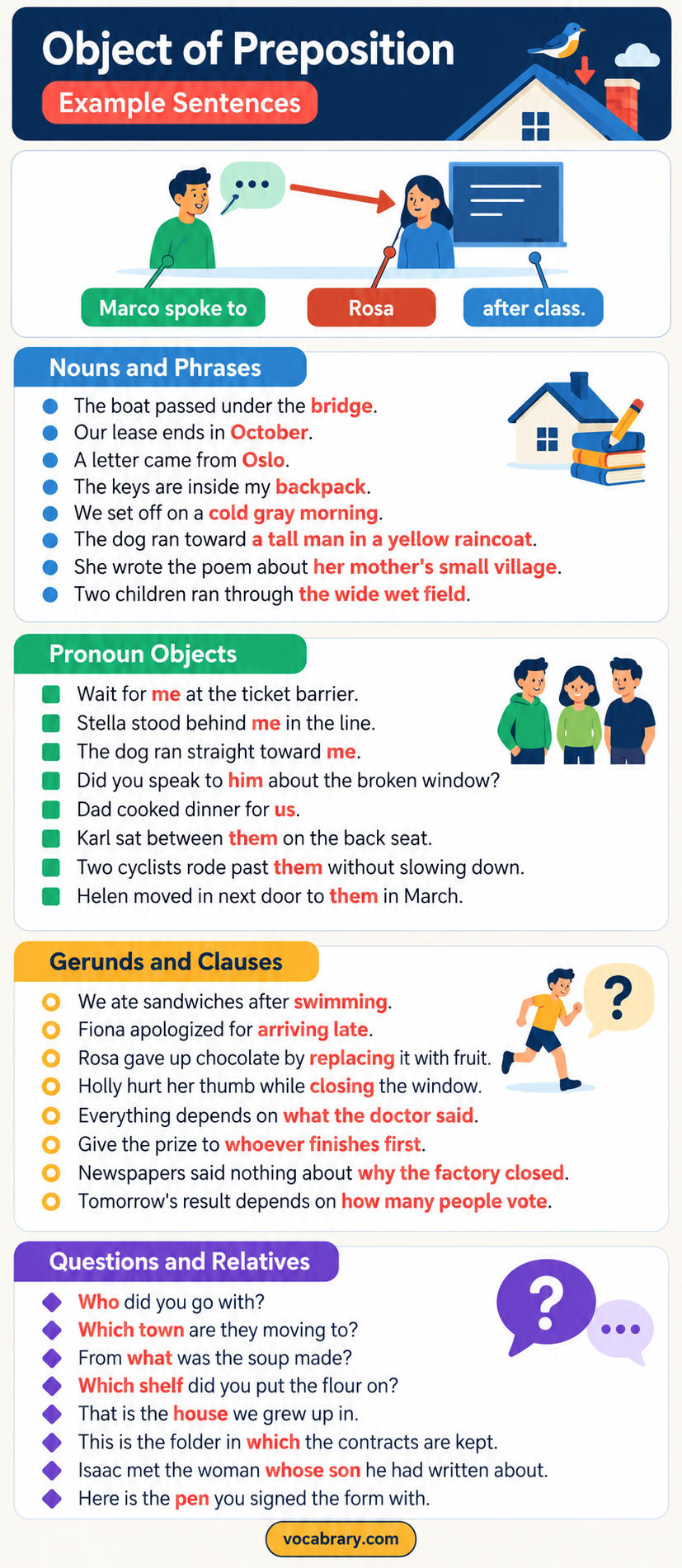
Common Object of Preposition Examples in Sentences
An umbrella left on the bus, a poem about a grandmother and a train that leaves without us are the everyday cases, where one plain noun or pronoun answers the question the preposition asks.
- Nadia left her umbrella on the bus.
- The children ran across the playground long before the bell rang for lunch.
- We waited for Daniel outside the cinema.
- Put the milk in the fridge, please.
- Lucas walked to school with his cousin.
- A letter from Berlin arrived this morning.
- She hid the spare keys under the doormat.
- Nobody spoke during the film.
- Our cat jumped onto the sofa.
- Farida wrote a poem about her grandmother.
- They argued about the bill for ten minutes.
- The train left without us.
- Kofi sat between his parents at dinner.
- I borrowed a pencil from Maria.
- The parcel came with a receipt.
- Rain lashed against the window all night, and none of the children slept well.
- He apologised to the waiter.
- Our flight to Lisbon boards at nine.
- Marta hung her wet coat behind the door.
- The dog barked at the postman.
- There is no milk in the jug.
- Without practice, a sonata this hard never improves.
- Amir paid for the tickets with his own money.
- Did you hear about the storm?
- The old bridge over the river closed for repairs in April.
- Nothing inside the envelope surprised her.
- Ravi hid the birthday present beneath a pile of towels at the back of the cupboard.
Ten Prepositions With Their Objects and Full Prepositional Phrases
In the fridge, about the storm, for my sister and with a pencil each split into two halves, so the preposition on the left and the bolded object on the right make one prepositional phrase.
| Preposition | Object | Full prepositional phrase |
|---|---|---|
| In | The fridge | In the fridge |
| On | A wooden shelf | On a wooden shelf |
| At | The dentist | At the dentist |
| For | My sister | For my sister |
| With | A pencil | With a pencil |
| About | The storm | About the storm |
| Under | Two blankets | Under two blankets |
| Between | Us | Between us |
| After | Lunch | After lunch |
| Through | The tunnel | Through the tunnel |
| Without | Her passport | Without her passport |
| Beside | The old piano | Beside the old piano |
- The yoghurt is in the fridge behind the eggs.
- Yusuf keeps his tools on a wooden shelf in the garage.
- Grandma has an appointment at the dentist tomorrow.
- I bought this scarf for my sister.
- Sign the form with a pencil first, then go over it in ink.
- Everyone talked about the storm.
- Two cats slept under two blankets.
- That argument stayed between us.
- We play football after lunch.
- The number 12 tram goes through the tunnel.
- Ana travelled to Rome without her passport and spent four hours at the embassy.
- A cracked vase waits beside the old piano.
Nouns and Noun Phrases as the Object of the Preposition
A Single Noun as the Object of the Preposition
Bridge, garden, October, Cairo and chemistry each stand alone after the preposition, so a one-word object is enough to finish the phrase.
- The boat passed under the bridge.
- Tomatoes grow well in that garden.
- Our lease ends in October.
- Hassan flew to Cairo on Tuesday morning with two heavy suitcases.
- Nobody argues about chemistry at Sunday dinner.
- Leila hid her diary beneath the mattress.
- A letter came from Oslo.
- A row of poplars grows along the canal.
- Put your name at the top, and write the date underneath it.
- The keys are inside my rucksack.
- We finished the painting before midnight.
- Marco spoke to Rosa after class.
- Cycling through snow is harder than cycling through rain.
- The shop opposite the station sells fresh bread until eight on every day except Sunday.
- Elena worked as a nurse during the war.
A Noun Phrase With Adjectives as the Object of the Preposition
A cold grey morning, three enormous cardboard cartons and her oldest pair of boots show a full noun phrase after the preposition, where the adjectives and the bolded noun work as one object.
- We set off on a cold grey morning.
- The removal men carried in three enormous cardboard cartons.
- Priya walked to the market in her oldest pair of boots.
- Nobody sleeps well after a heavy late dinner.
- The dog ran towards a tall man in a yellow raincoat.
- Karim paid for two return tickets to Bratislava.
- A robin nests under the rusty green gutter.
- She wrote the poem about her mother’s small village.
- Our class waited for a very slow lift.
- Omar hid the money inside an old biscuit tin.
- Rain fell on the freshly cut grass all afternoon, and the game was called off at four.
- Two children ran through the wide wet field.
- We ate supper beside a noisy motorway.
- Anna argued with the second referee.
Pronouns as the Object of the Preposition
Me, Him and Her After a Preposition
Wait for me, a seat next to him and a parcel addressed to her put the object pronouns me, him and her straight after the preposition, never the forms I, he and she.
- Wait for me at the ticket barrier.
- Grandpa sat next to him during the whole concert.
- The parcel is addressed to her.
- Nobody told me about the change of plan, so I turned up an hour early on Sunday.
- Salma stood behind me in the queue.
- This coffee is for him.
- We heard the news from her last night.
- The dog ran straight towards me.
- Layla borrowed a tent from him.
- Between the two of us, the secret stayed with me.
- Chen sat opposite her on the long train ride to Prague.
- Did you speak to him about the broken window?
- Everything that evening depended on me.
- Marco walked home with her.
Us, Them and You After a Preposition
Cook dinner for us, travel with them and a letter meant for you show the plural object pronouns us and them, along with you, in the same position after the preposition.
- Dad cooked dinner for us.
- Nina travelled through Peru with them for six weeks last summer.
- This letter is meant for you.
- Our waiter brought the bill to us.
- Karl sat between them on the back seat.
- Nobody complained about you.
- The coach shouted at us from the touchline.
- Two cyclists rode past them without slowing down.
- A neighbour left a note for you on the kitchen counter this morning.
- Everything depends on them now.
- The teacher handed the certificates to us one by one.
- Halima moved in next door to them in March.
- Is there any news from you yet?
- A storm passed right over us.
Gerunds and Noun Clauses as the Object of the Preposition
A Gerund as the Object of the Preposition
After swimming, before leaving and without knocking put an ing form straight after the preposition, so the gerund takes the place of a noun and finishes the phrase.
- We ate sandwiches after swimming.
- Turn off the heater before leaving.
- Hamza walked into the room without knocking.
- Farah apologised for arriving late.
- Thank you for waiting.
- The twins are good at drawing.
- Nobody thinks about failing on the first day of a new job.
- Rosa gave up chocolate by replacing it with fruit.
- The team won the match despite playing with ten players for an hour.
- Elias is tired of cleaning the same two rooms.
- Instead of complaining, Yara wrote a letter to the council.
- Sara left the cinema after watching twenty minutes of the film.
- We talked about moving to a quieter street.
- Hana hurt her thumb while closing the window.
- Joaquin earns his rent by teaching the guitar.
- She insisted on paying for the whole meal.
A Noun Clause as the Object of the Preposition
What the doctor said, where they hid the money and whoever finishes first are whole clauses in object position, so the bolded clause answers the preposition exactly as a noun would.
- Everything depends on what the doctor said.
- The police asked about where they hid the money.
- Give the prize to whoever finishes first.
- Nobody agreed with what the manager decided at the Monday meeting.
- We argued over who should drive home.
- Raj was surprised by how quickly the snow melted.
- Newspapers said nothing about why the factory closed.
- Pay attention to what the label says.
- Nour worried about whether her visa would arrive before the wedding in Beirut in June.
- Tomorrow’s result depends on how many people vote.
- Think carefully about what you promise.
- The letter was from whoever lost the grey umbrella.
- Our plan depends upon what the weather does on Saturday.
Compound Objects Joined by And or Or
Between Ana and me, for the twins and their cousin, and with milk or cream give the preposition two objects at once, and both halves keep the same case and the same bold.
- Our secret stayed between Ana and me.
- Mum bought new shoes for the twins and their cousin.
- Do you take your coffee with milk or cream?
- The bus goes past the hospital and the old library before it reaches our street.
- Nobody heard from Hana or her brother all winter.
- We sat between the window and the radiator.
- Yusuf apologised to the driver and the passengers.
- This parcel is for you and your flatmate.
- The path runs between a stone wall and a hedge.
- Sofia argued with the landlord and the estate agent for three weeks about the leaking roof.
- Send the photographs to Marta or Diego.
- First prize went to Leo and me.
- Rain fell on the tents and the picnic tables.
- Talk to your teacher or the head of year before you fill in the form.
Objects After Prepositions of Time, Place and Movement
Objects After Prepositions of Time
Monday, six o’clock, the holidays and 1998 answer the question when, since each one names a day, an hour or a stretch of time after at, on, before or until.
- The exam starts on Monday.
- Karim wakes at six o’clock every weekday, even when the shop stays shut.
- We travel to Seville in August.
- The library closes during the holidays.
- Nothing has changed since 1998.
- Wash the grapes before dinner.
- Nour studied until midnight.
- Our film begins after the adverts.
- Andrea moved to Turin in spring.
- Wait for me until half past four, and then go on to the restaurant without me.
- Every shop reopens on the fifteenth.
- Snow fell throughout the night.
- Is the meeting before or after lunch?
Objects After Prepositions of Place
The fridge, the wall, a stone bench and the two shops name where something is, so in, on, at, under, behind and between each take a place noun as the bolded object.
- The jam is in the fridge.
- A calendar hangs on the wall.
- Grandma rested on a stone bench near the church for a quarter of an hour.
- The bakery is between the two shops.
- Our neighbour parks behind the garage.
- Boots wait beside the door.
- Nothing grows under that old fir.
- Yasmin lay on the grass and read until the light faded.
- Your keys are at the reception.
- Frogs hide among the reeds.
- A photograph of Jakarta hangs over my desk.
- Wait inside the hall.
- Is your bicycle outside the gate?
Objects After Prepositions of Movement
The bridge, the field, the roof and the motorway follow across, through, onto and along, so the bolded object names the place a journey crosses or ends at.
- We drove across the bridge.
- The horses galloped through the field.
- A cat climbed onto the roof.
- Lorries thunder along the motorway long after midnight, and nobody in the flat sleeps.
- Sami ran towards the lake.
- Someone slipped a letter under the door.
- Pour the batter into the tin.
- Tourists walked around the cathedral.
- Anya jumped over the puddle.
- The road descends to the harbour.
- A magpie flew past my window twice this morning.
- Our dog leapt off the wall.
- Did the parcel come through the letterbox?
Objects After Phrasal and Prepositional Verbs
Look after the baby, wait for the bus, depend on your brother and apply for a visa pair a verb with its own preposition, and the noun straight afterwards is the object of that preposition.
- Yara looks after the baby on Thursdays.
- We waited for the bus in the rain.
- Everything depends on your brother now.
- Nadia applied for a visa three months before the wedding in Marrakesh.
- The twins take after their father.
- Listen to the announcement.
- Nobody believes in ghosts in this family.
- Pedro asked for a refund.
- The doctor insisted on a second scan.
- I ran into Omar at the airport last Friday.
- Please look at the map before you set off across the moor.
- Zeinab is looking forward to the holidays.
- The teacher objected to the noise.
- Sara paid for the damage herself.
- Do you agree with Marco?
Objects of Prepositions in Questions and Relative Clauses
Objects of Prepositions in Questions
Who did you go with, what are you waiting for and whom did she write to move the question word to the front, and that question word is still the object of the stranded preposition.
- Who did you go with?
- What are you waiting for?
- To whom did she write the complaint about the delayed refund?
- Which town are they moving to?
- Whose car did you arrive in?
- For whom is this bouquet?
- From what was the soup made?
- Who are you laughing at?
- What type of paper should the poster be printed on?
- About what did the two managers argue for a full hour on Friday afternoon?
- Which shelf did you put the flour on?
- With whom did Ravi share the prize money?
- Over what did the argument start?
Objects of Prepositions in Relative Clauses
The house we grew up in, the friend I travelled with and the film everyone talks about tuck the object into a relative clause, where which, whom or that names it.
- That is the house we grew up in.
- Marisol is the friend I travelled to Peru with two summers ago.
- The film everyone talks about won four awards.
- This is the folder in which the contracts are kept.
- The teacher to whom I owe my place at university retired in June.
- Bring the pan you cooked the rice in.
- Ibrahim met the woman whose son he had written about.
- Nobody finds the town they escaped from on a modern map.
- That is the ladder Dad fell off.
- A wooden bench on which the old fishermen gather every evening faces the grey harbour wall.
- Here is the pen you signed the form with.
- Physics and Latin are the subjects she is best at.
- Floods reach the street we live on twice a winter.
Objects of Prepositions at the End of a Sentence
Who did you buy it for, the chair I sat on and something worth waiting for park the preposition at the end, though the bolded object still answers its question.
- Who did you buy it for?
- This is the chair I sat on.
- Spring in the mountains is something worth waiting for.
- What are you thinking about?
- There is nothing left to worry about now that the grades are out.
- Tell me the name of the village you come from.
- Rice and beans are all we lived on that winter.
- Which hotel did you stay at?
- That is the tin the letters were in.
- Whom are you working for these days?
- The cousin she named the baby after died in 1974.
- A chipped mug is what the coffee was served in.
- Which shelf is the honey on?
Between You and Me and Other Pronoun Traps
Between you and me, with Jonas and me, and to my sister and me are the phrases learners get wrong most, because a second name tempts writers into I instead of me.
- Our plan stayed between you and me.
- Ella walked to the station with Jonas and me.
- Send the wedding invitation to my sister and me before the end of the month.
- Nobody spoke to her and me after the meeting.
- A photograph of him and his brother hangs in the hall.
- The decision lies with them and their lawyer.
- My uncle left the old clock to my cousins and me.
- There was one umbrella for Diego and me.
- The teacher sat between Amina and him.
- Keep this news between the four of us until the contracts are signed on Friday.
- Two seats were saved for Leila and us.
- That argument started with Marco and them.
- Everything now depends on you and her.
Sentences Rewritten With the Correct Object Pronoun
Between you and I, for he and I, and with we all turn up in speech and in exam papers, and each wrong version is put right by swapping the pronoun into the object case.
- ❌ Between you and I, the rent is far too high. ✅ Between you and me, the rent is far too high.
- ❌ Mum cooked dinner for he and I. ✅ Mum cooked dinner for him and me.
- ❌ The letter arrived for my brother and I on Tuesday. ✅ The letter arrived for my brother and me on Tuesday.
- ❌ Nobody came to the cinema with we. ✅ Nobody came to the cinema with us.
- ❌ The coach shouted at they. ✅ The coach shouted at them.
- ❌ This secret stays between she and I. ✅ This secret stays between her and me.
- ❌ Ravi sat next to I during the exam. ✅ Ravi sat next to me during the exam.
- ❌ Who did you give the keys to, him or she? ✅ Who did you give the keys to, him or her?
- ❌ The prize went to Leo and I. ✅ The prize went to Leo and me.
- ❌ There is no room in the car for they and their luggage. ✅ There is no room in the car for them and their luggage.
- ❌ She waited for Karim and I outside the library. ✅ She waited for Karim and me outside the library.
- ❌ Everything depends on we now. ✅ Everything depends on us now.
Objects of Prepositions at School, at Work and at Home
Objects of Prepositions at School and in the Classroom
The whiteboard, the bell, chapter nine and the head teacher name the objects pupils meet all day, since school English repeats short prepositional phrases such as on the whiteboard and after the bell.
- Write your answers on the whiteboard.
- The corridor empties after the bell.
- Open your books at chapter nine.
- Yusra spoke to the head teacher about the science trip to the coast.
- Our library is opposite the gym.
- Leave your bag under the desk.
- Nobody was late for registration.
- The exam runs from nine until noon.
- Two girls argued about the answer during the whole chemistry lesson.
- Put the chalk in the tray.
- Our class went to the museum on Friday.
- Names of the football team are pinned beside the door.
- Did you revise with Amira?
Objects of Prepositions at Work and in the Office
The printer, a client in Oslo, the budget and Monday morning show how office English works, since every meeting, deadline and email needs a noun after its preposition.
- Your report is on the printer.
- Hana flew to Oslo for a client last Thursday.
- Nobody agreed about the budget.
- The team meets on Monday morning.
- Leave the invoices with Tomas.
- We worked through the weekend to finish the tender before the deadline on Monday.
- Send the file to accounts.
- Interviews start at half past ten.
- Two engineers argued over the schedule.
- My desk is next to the window.
- Sami apologised for the delay.
- The contract depends on the survey.
- Are you free after four?
Objects of Prepositions at Home and in Daily Routine
The kettle, the washing machine, the sofa and half past six run through ordinary mornings and evenings, and each noun after in, on or at names where a chore or a habit happens.
- The bread is in the cupboard beside the kettle.
- Rosa put the towels into the washing machine.
- My remote fell behind the sofa.
- Grandpa wakes at half past six every day of the year, holidays included.
- We eat supper in the kitchen.
- Hang your coat on the hook.
- The cat sleeps under my bed.
- Nadia talks to her mother on the phone every Sunday evening for an hour.
- Leave the shopping on the counter.
- Bilal washed the dishes after dinner.
- Bins go out before eight.
- Nothing grows in that pot.
- Did you look in the drawer?
Objects of Prepositions in Travel Sentences
Platform four, a hotel near the harbour, the airport at dawn and a coach to Granada are the nouns that follow travel prepositions, so each phrase answers where, when or by what route.
- The train leaves from platform four.
- We stayed in a hotel near the harbour.
- Our taxi reached the airport at dawn.
- Fatima took a coach to Granada and slept for most of the journey.
- Our ferry sails at seven.
- Keep your passport in your pocket.
- A driver met us outside the terminal.
- The hostel is opposite a small park.
- Kenji cycled across Hokkaido with two friends last September.
- Nobody sat beside me on the flight.
- The bus to the old town goes past the cathedral.
- Book the tickets before Friday.
- We walked along the beach until the tide turned.
- Is there a chemist inside the station?
- Rain fell on the tents every night of the trip.
Object of Preposition Examples for Students and Young Learners
Short Object of Preposition Sentences for Young Learners
The cat, a tin of crayons, Mum and the park give beginners four-word and five-word sentences, so one preposition and one short object make a whole phrase.
- The cat is on the mat.
- Stand beside me.
- My crayons are in the tin.
- We ran to the park.
- The ball went under the car.
- Dad is at work.
- Give the apple to Mum.
- A bird sat on my hand.
- Play with Sara.
- The dog is behind the gate.
- Come with us.
- My hat fell into the water.
- Look at the moon.
- This milk is for the kittens.
- Wait for me!
- Grandma sang to the baby until she fell asleep in the small blue cot.
Object of Preposition Sentences for Students and Beginners
A dictionary on the shelf, an essay about pollution, homework after supper and a seat beside Ana give beginners longer practice, with one bolded object in each sentence.
- Keep a dictionary on the shelf.
- Ines wrote an essay about pollution.
- Finish your homework after supper.
- Manu chose a seat beside Ana.
- Nobody listened to the announcement.
- The answer depends on the question.
- Underline every noun after a preposition.
- Dalia practises the violin for an hour each evening before she starts her reading.
- We talked about football during the break.
- Send your project to the teacher.
- The library shuts at six.
- Reza comes from Shiraz.
- Are you going with them?
- Two pigeons perched on the railing outside the classroom window this morning.
Object of Preposition Examples in Short Paragraphs
A rainy market morning, a first day at a new school, a long train journey and a quiet kitchen each run for six sentences, so the bolded objects build one scene instead of one phrase.
- Rain fell on the market all morning. Ada sheltered under a red awning with two heavy bags. A man beside her sold chestnuts from an iron drum. The bus to the village was twenty minutes late. She paid for the chestnuts with her last coins. By noon the square emptied of shoppers.
- Tomas started at a new school in September. He left his bag under the third desk and waited for the bell. A girl from Lisbon lent him a pencil during the maths lesson. At lunch he sat between two strangers and said nothing. After the last lesson, three boys walked home with him. By Friday he knew everyone in the class.
- The night train from Belgrade filled up before midnight. Nour found a seat beside the window and watched the lights of small towns. A guard came through the carriage and asked for tickets. Two students argued quietly about politics across the aisle. At dawn the train crossed a wide grey river. Nour slept until the announcement for Sofia.
- Grandpa wakes at five and makes coffee in a battered steel pot. He listens to the radio beside the window until the sun reaches the yard. The bread waits in a tin cupboard with the sugar and the tea. At seven he walks to the allotment with his old spade. He talks to the neighbours over a low stone wall. Nothing about that routine has changed since 1994.
- Our flat is over a bakery on Green Street. In the kitchen there are two chairs and a narrow bench. Behind the door three hooks take the coats and umbrellas. On winter evenings we eat soup beside the radiator. The cat sleeps between the cushions without moving until morning. From the window we watch the tram turn towards the river.
Related
FAQs
In everyday writing, one example is "Natalie left her umbrella on the bus." Another is "The children ran across the playground long before the bell rang for lunch."
With an object pronoun, one example is "Wait for me at the ticket barrier." Another is "This coffee is for him."
In class, one example is "Write your answers on the whiteboard." Another is "Open your books at chapter nine."
For a gerund object, one example is "We ate sandwiches after swimming." Another is "We talked about moving to a quieter street."
With a noun clause, one example is "Everything depends on what the doctor said." Another is "Give the prize to whoever finishes first."
For a compound object, one example is "Our secret stayed between Ana and me." Another is "Do you take your coffee with milk or cream?"
With a day of the week, one example is "The exam starts on Monday." Another is "Nothing has changed since 1998."
For location, one example is "The jam is in the fridge." Another is "A calendar hangs on the wall."
In a question, one example is "Who did you go with?" Another is "What are you waiting for?"
For a journey, one example is "The train leaves from platform four." Another is "We stayed in a hotel near the harbor."
Related: