
Prepositions of place are the words that say where someone or something is, as in the keys are on the table and the cat is under the chair. Most prepositions of place example sentences answer one question about position, so the noun after the preposition names the place that everything else is measured against.
What Are Prepositions of Place?
Prepositions of place name the position of one thing against another: inside an enclosed place, touching a surface, or at an exact address. Prepositions of movement, such as into, onto and across, give the direction of a journey instead of a fixed position.
Preposition + determiner + noun (the place)
The bicycle is behind the garage, and the helmet is on the shelf.
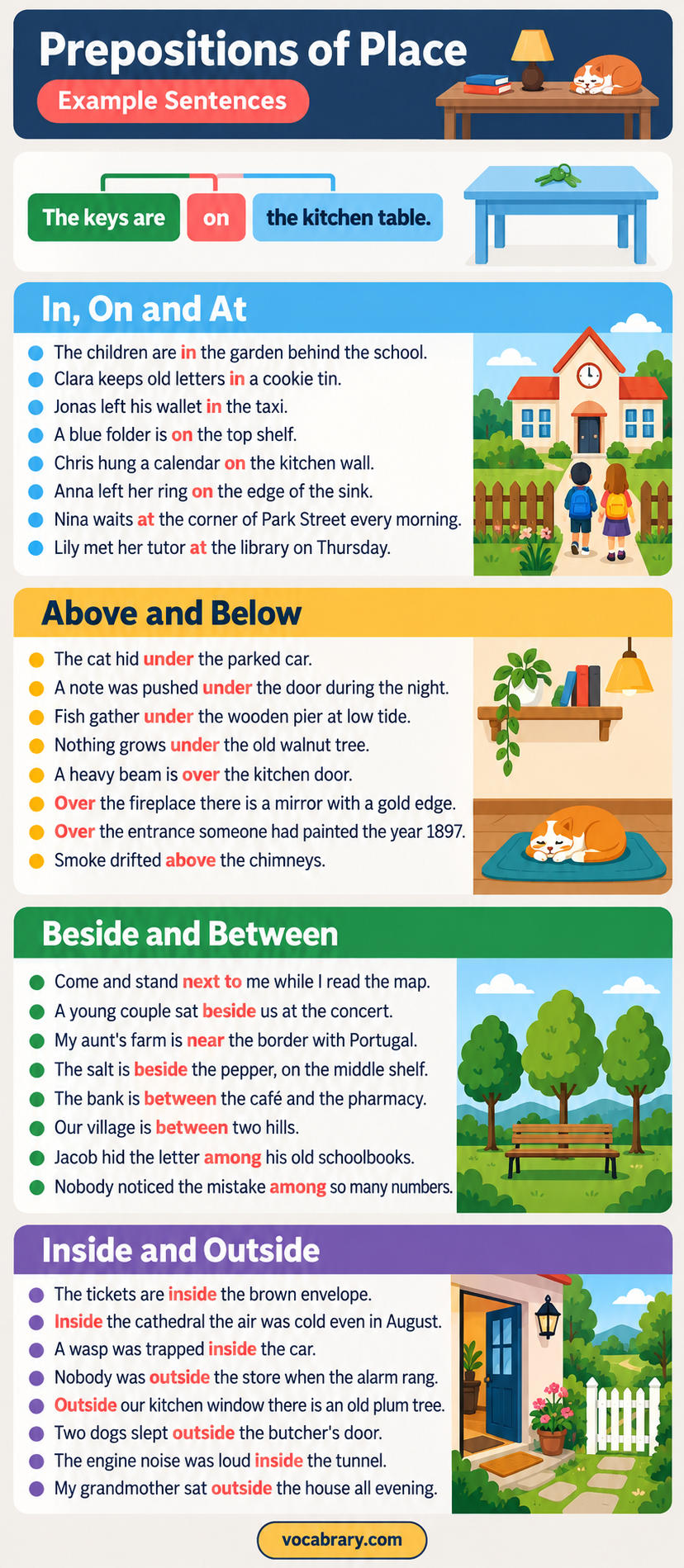
Common Prepositions of Place Example Sentences
Keys on the kitchen table, a grey cat behind a flowerpot, and a café between the library and the bank are the everyday prepositions of place example sentences. Each one fixes the position of one thing against another.
- The keys are on the kitchen table.
- Maya waited at the bus stop for twenty minutes.
- Under the stairs there is a cupboard full of winter coats.
- My passport is in the top drawer of the desk.
- A grey cat sleeps behind the flowerpot every afternoon.
- Omar parked his van in front of the bakery.
- Two brass lamps hang above the dining table.
- Between the library and the bank there is a café with four tables outside.
- Her office is opposite the lift on the fourth floor.
- Lucas sat next to his grandmother at dinner.
- Priya’s dog lies under the bench while she reads the newspaper.
- Photographs of the whole family hang on the wall of the narrow hallway.
- Nobody was inside the classroom when the bell rang.
- Diego’s flat is near the railway station.
- Snow covered the roof over the porch.
- Beside the sink there is a green soap dish.
- Aisha keeps her running shoes beside the front door.
- The pharmacy is across from the school gate.
- Ravi found his glasses among the papers on his desk.
- Clouds gathered above the mountain all morning.
- Children played around the fountain in the town square.
- Outside the window a blackbird sings every morning at six.
- Sofia’s bicycle is behind the wooden shed.
- Is the milk in the fridge or on the counter?
- Elena hung her coat on the hook by the door.
- The temple is at the top of a long stone staircase.
Ten Prepositions of Place With Meanings and Sentences
Milk in a fridge, a map on a wall, and a taxi in front of a hotel show ten prepositions of place at work. Each one names an enclosed place, a surface, an exact position, or one object set against another.
| Preposition | Meaning | Example sentence |
|---|---|---|
| In | Inside an enclosed place | The milk is in the fridge. |
| On | Touching a flat surface | A world map is on the wall. |
| At | One exact point or address | Kofi waited at the corner of Mill Street. |
| Under | Lower than and covered by something | Two slippers wait under the bed. |
| Over | Higher than and reaching across something | A blue awning hangs over the shop window. |
| Behind | At the back of something | The garden is behind the house. |
| In front of | At the front side of something | A yellow taxi waits in front of the hotel. |
| Between | In the middle of two separate objects | The bank is between the bakery and the chemist. |
| Next to | At the side of something, with nothing in the middle | Hana sat next to the window. |
| Opposite | Facing something from the other side | The bookshop is opposite the station. |
- Tomas keeps his medicine in a wooden cabinet.
- A thin layer of dust lay on the piano lid.
- Kofi and his sister met at the entrance of the sports hall.
- Under the sofa cushion Leila found her missing earring.
- The old oak spreads its branches over the whole garden.
- Marco hid the birthday present behind the curtain.
- A queue of parents formed in front of the school gate at three o’clock.
- Mei sat between her two cousins during the ceremony.
- Next to the bakery there is a shop that sells bicycle parts.
- Our hotel was opposite a small church with a blue door.
- Ines parked her scooter in front of the pharmacy for five minutes.
- Wet towels lay on the bathroom floor all afternoon.
In, On and At for Place
Three prepositions answer most questions about position. In suits a drawer or a city, on suits a wall or a street, and at marks a door or a house number.
In for Rooms, Cities and Enclosed Places
Half a lemon in a fridge, old letters in a biscuit tin, and a village near the Black Sea show the reach of in. The preposition wraps something on every side, from a drawer to a whole country.
- The children are in the garden behind the school.
- Yusuf grew up in a small village near the Black Sea coast.
- A pair of scissors is in the second drawer.
- In the fridge there is half a lemon, a jar of olives and yesterday’s soup.
- My cousin works in Barcelona for a design studio.
- Clara keeps old letters in a biscuit tin.
- Passengers waited in the departure hall for two hours.
- Nothing was in the envelope except a photograph of two children.
- Rain collected in the hollow of the stone step.
- Jonas left his wallet in the taxi.
- The bread knife is in the top cupboard, on the left of the dinner plates.
- Are the towels in the blue basket?
- Sofia swims in the lake every Sunday morning.
- A family of sparrows nests in the hedge beside the gate.
On for Surfaces, Walls and Floors
Crumbs on a tablecloth, a calendar on a kitchen wall, and ice on a windscreen mark what on does: it puts one thing in contact with the surface of another, flat, upright or overhead.
- A blue folder is on the top shelf.
- Marta wrote the date on the whiteboard.
- On the third floor there is a dentist and a language school.
- Crumbs from breakfast lay on the tablecloth.
- The cat sleeps on the windowsill whenever the sun reaches it.
- Chen hung a calendar on the kitchen wall.
- Two boats waited on the river beside the old bridge.
- Our flat is on Maple Street, three doors from the bakery.
- Ice formed on the windscreen during the night.
- Amara left her ring on the edge of the basin.
- On the ceiling of the old church there are painted stars and a ring of golden letters.
- A spider walked on the bathroom mirror.
- Where did you leave the tickets, on the hall shelf?
- Fresh paint dried on the garden fence all afternoon.
At for Exact Positions, Addresses and Events
A corner of Park Street, gate twelve at an airport, and 14 Rosewood Lane all take at. The preposition treats a position as one exact point rather than a surface or a room.
- Nina waits at the corner of Park Street every morning.
- The whole class stood at the door until the teacher arrived.
- At the bottom of the garden there is a pond with three frogs.
- My uncle works at the airport.
- A crowd gathered at the entrance of the stadium an hour before the concert began.
- Pablo sat at his desk until midnight.
- Somebody is at the door.
- Our team stayed at a hotel opposite the sports ground.
- Leila met her tutor at the library on Thursday.
- Two taxis waited at the traffic lights.
- At the end of the corridor there is a fire exit.
- The wedding reception was at 14 Rosewood Lane.
- Is your brother at home this evening?
- Passengers queued at gate twelve for the delayed flight to Lisbon.
Under, Below, Over and Above
Four prepositions handle vertical position: two for the lower object and two for the higher one, with contact and covering deciding which of each pair fits the sentence.
Under and Below in Example Sentences
Suitcases under a bed, ferns under tall trees, and a village at the foot of castle walls separate the two words. Under suggests something directly covered, while below marks a lower level with distance kept.
- The cat hid under the parked car.
- Sunlight never reaches the ferns below the tallest trees.
- Under my bed there are two suitcases and a tennis racket.
- Amir keeps his tools under the kitchen sink.
- A note was pushed under the door during the night.
- The village lies below the castle walls.
- Fish gather under the wooden pier at low tide.
- Below the painting there is a small label with the artist’s name and the date of the work.
- Nadia found her phone under a pile of folded laundry.
- Our seats were below the scoreboard, so the referee was hard to see.
- Two rabbits sleep under the hedge every night.
- Under the carpet Marco found the original wooden floor.
- Her signature was below the date at the end of the letter.
- Nothing grows under the old walnut tree.
- The car park is below the shopping centre.
- Is your suitcase under the stairs or in the hall cupboard?
Over and Above in Example Sentences
A mirror over a fireplace, a flat above a shoe shop, and swallows circling a courtyard separate the pair: over suggests covering or reaching across, while above marks a higher level with nothing touching.
- A heavy beam is over the kitchen door.
- Clouds hung above the harbour all morning.
- Over the fireplace there is a mirror with a gold edge.
- Ravi’s flat is above a shoe shop.
- The helicopter hovered above the burning field for ten minutes.
- A striped awning stretches over the fruit stall.
- Above the sink Hana fixed a narrow shelf for her spice jars.
- Wires hang over the narrow street between the two buildings.
- Mountains rose above the lake on both sides of the valley.
- My name was printed above the team photograph in the school magazine.
- Over the entrance someone had painted the year 1897.
- The sun was already above the rooftops at six o’clock.
- Smoke drifted above the chimneys.
- Two swallows circled over the courtyard.
- Her room is above the bakery, so the smell of warm bread wakes her.
- Is there a light above the bathroom mirror?
In Front Of and Behind in Example Sentences
A police car outside a bank, recycling bins at the back of a supermarket, and a bronze horse facing a museum give the pair its work. One preposition puts the object at the face of a place, the other at its back.
- A police car stopped in front of the bank.
- The recycling bins are behind the supermarket.
- In front of the museum there is a bronze statue of a horse.
- Elif sat behind me during the whole exam.
- Our garage is behind the house, at the end of a gravel path.
- Two photographers waited in front of the theatre door.
- Behind the curtain the children were getting ready for the school play.
- Tomas parked in front of the wrong building.
- A tall man was in front of her in the queue, so Ana saw nothing of the stage.
- The moon appeared behind the church tower.
- Nobody was waiting behind the counter when we arrived.
- In front of the fireplace there is an old rug.
- My keys fell behind the radiator.
- Kofi stood in front of the class and read his poem aloud.
- The bus shelter is in front of the hospital gate.
- Is the parcel behind the plant pot?
Next To, Beside and Near in Example Sentences
A chemist beside a bus station, a glass of water next to a bed, and a farm near the Portuguese border sort the three words. Next to and beside mean side by side, while near allows a short distance in between.
- Come and stand next to me while I read the map.
- The chemist is beside the bus station.
- Next to the fridge there is a tall cupboard for brooms and mops.
- Hana’s desk is near the window, so she has daylight all afternoon.
- A young couple sat beside us at the concert.
- Our school is next to a park with two football pitches.
- Beside the river path there are benches every hundred metres.
- Ben keeps a glass of water next to his bed.
- Two chairs were placed near the fire for the older guests.
- My aunt’s farm is near the border with Portugal.
- Near the entrance a security guard checked every bag.
- Leo parked next to a red van.
- The salt is beside the pepper, on the middle shelf.
- Nobody wanted a chair beside the noisy radiator.
- Aisha’s cousin works near the docks in Rotterdam.
- Is the hotel near the airport, or is it near the old town by the river?
Between and Among in Example Sentences
A bank between a café and a chemist, a coin among beach pebbles, and a deer at the edge of a field split the pair. Between needs two separate objects on either side, and among needs a group too large to count.
- The bank is between the café and the chemist.
- A narrow path leads between the two houses.
- Between the sofa and the wall there is just enough room for a reading lamp.
- Elena sat among the older students at the back of the hall.
- Our village is between two hills.
- Mei found a coin among the pebbles on the beach.
- Among the trees at the edge of the field a deer watched us.
- The referee stood between the two captains before the coin toss.
- A thin strip of grass grows between the pavement and the road.
- Pablo’s photograph was among the winners on the school noticeboard.
- Between Lisbon and Porto there are fast trains every hour.
- Yusuf hid the letter among his old schoolbooks.
- The cat squeezed between the fence posts.
- Nobody noticed the mistake among so many numbers.
- Her seat was between two strangers who talked all night.
- Is the switch between the two doors?
Opposite, Across From, Inside and Outside
Facing and enclosure divide these four words: two of them put one building face to face with another across a street, and two of them decide whether someone is within four walls or beyond them.
Opposite and Across From in Example Sentences
A museum facing a station, a bakery facing an office window, and two old men playing chess by a fountain give these two prepositions their meaning. One object faces another with a street, a desk or a square in between.
- The museum is opposite the main station.
- Chen’s office is across from a bakery, so the smell of fresh bread reaches his window at eight.
- Opposite our house there is a small playground with two swings.
- Nina sat opposite her interviewer at a narrow wooden desk.
- A pharmacy is across from the school gate.
- Across from the cathedral there is a market that opens at dawn.
- My seat was opposite the emergency exit.
- Two old men played chess opposite the fountain every afternoon.
- The shoe repair shop is across from the library.
- Leila’s flat is opposite a quiet churchyard.
- Opposite the ticket machine a guard answered questions about the timetable.
- Our hotel was across from a beach with black sand.
- Ravi parked opposite the pharmacy and waited for his mother.
- Is the dentist opposite the supermarket or beside it?
Inside and Outside in Example Sentences
Tickets in a brown envelope, a wasp trapped in a car, and two dogs asleep at a butcher’s door draw the line these two prepositions of place keep: within the walls, or beyond them.
- The tickets are inside the brown envelope.
- Marco waited outside the head teacher’s room for ten minutes.
- Inside the cathedral the air was cold even in August.
- A wasp was trapped inside the car.
- Nobody was outside the shop when the alarm rang.
- Outside our kitchen window there is an old plum tree.
- Her name was written inside the cover of the dictionary.
- Two dogs slept outside the butcher’s door.
- Priya keeps her savings inside a metal tin at the back of the wardrobe.
- The engine noise was loud inside the tunnel.
- Inside the suitcase Yusuf packed three shirts and a pair of boots.
- Children were playing outside the flats until the rain started.
- My grandmother sat outside all evening.
- Is the switch inside the cupboard?
Around, Along and the Edges of a Place
Circles, lines and edges need their own prepositions. Around encircles an object, along follows a length, and at the top of, at the bottom of, on the left and on the right fix a position within something.
Around and Along in Example Sentences
Roses planted by a front door, houseboats on a canal, and cyclists on a riverbank separate the two words. Around encircles an object, while along follows the length of a wall, a path or a shelf.
- Children ran around the fountain until their parents called them.
- A stone wall goes around the whole orchard.
- Along the canal there are twelve houseboats painted green and red, each one with flowers on the roof.
- Tourists walked along the harbour wall in the evening light.
- Our grandmother planted roses around the front door.
- Around the corner there is a shop that repairs bicycles.
- Lamps are placed every twenty metres along the coastal path.
- Sara tied a ribbon around the parcel.
- Two cyclists rode along the riverbank towards the old mill.
- Snow lay around the base of every tree in the park.
- Along the top shelf Marco keeps his grandfather’s books.
- The fence around the tennis court needs paint.
- My cousin’s café is around the corner from the theatre.
- Is there a footpath along the lake?
At the Top Of and At the Bottom Of in Example Sentences
A stone tower on a hill, a suitcase in the base of a wardrobe, and a five-euro note in a coat pocket show these two prepositions of place at work. Each one measures height inside one single object.
- The kitchen is at the bottom of a steep staircase.
- Nina’s name was at the top of the attendance sheet.
- At the top of the hill there is a stone tower with a flag.
- My suitcase waits at the bottom of the wardrobe.
- A date is printed at the bottom of every receipt.
- Yusuf built a shed for his tools at the bottom of the garden, beside the old plum tree.
- Two eagles nested at the top of the cliff.
- Snow stayed at the top of the mountain until June.
- Her signature came at the bottom of the form.
- Hana keeps her old atlases at the top of the bookcase.
- Ben found a five-euro note at the bottom of his coat pocket.
- Is the library at the top of this street?
On the Left and On the Right in Example Sentences
A bathroom on one side of a hallway, a photograph beside a fireplace, and a water bottle by a keyboard are the positions these two prepositions of place give, always from the speaker’s own side.
- The bathroom is on the left, next to the linen cupboard.
- Marta’s photograph hangs on the right of the fireplace.
- On the left of the entrance there is a machine that sells train tickets.
- Our seats were on the right, three rows from the stage.
- A blue folder is on the left of the printer.
- Take the first turning on the right after the bridge.
- My brother slept on the left side of the tent.
- The chemist is on the right, opposite a small hotel.
- Tomas keeps his water bottle on the right of his keyboard.
- On the right of the painting there is a tall window with blue shutters and a view of the sea.
- Leila’s desk is on the left of the door.
- Is the switch on the left or on the right of the mirror?
Prepositions of Place in the Classroom
A whiteboard at the front, a schoolbag under a chair, and a solar system poster on the wall make the classroom the first place learners practise prepositions of place. Every object there has a fixed position the whole class agrees on.
- The whiteboard is at the front of the classroom.
- Ben’s schoolbag lies under his chair.
- On the wall there is a large poster of the solar system.
- Our teacher stood between the two rows of desks.
- A globe is on the shelf beside the window.
- Behind the teacher’s desk there is a cupboard full of dictionaries and atlases.
- Hana’s place is next to the radiator, which keeps her warm through the whole winter term.
- Twenty-six chairs face the board in three straight rows.
- The projector hangs above the first row of desks.
- Marta left her lunch inside her locker.
- In front of the door there is a small bin for waste paper.
- My pencil case is in the drawer under the desk.
- Children queue outside the classroom before the bell.
- Is the attendance sheet on the teacher’s desk?
Prepositions of Place in the House Room by Room
Kettles, cushions, slippers and toothbrushes each have their own position, so one house supplies dozens of prepositions of place example sentences without anyone leaving the front door.
In the Kitchen and the Living Room
A kettle on a worktop, cleaning cloths under a sink, and two cushions lost at the back of a sofa are the positions every family knows, and each one takes a different preposition of place.
- The kettle is on the worktop beside the sink.
- Plates are stacked inside the tall cupboard.
- Under the sink Nadia keeps the cleaning cloths.
- A basket of onions waits on the bottom shelf.
- Our sofa faces the television, and a striped rug lies between the two, exactly in the middle.
- Above the cooker there is an extractor fan.
- Marco’s guitar is behind the armchair.
- Two cushions fell behind the sofa last night.
- The remote control was under a newspaper all evening.
- In the fridge door there are three bottles of juice.
- My mother keeps the biscuits in a blue tin.
- Is the vacuum cleaner in the hall cupboard?
In the Bedroom and the Bathroom
Slippers under a wardrobe, a mirror over a basin, and towels on a rail give the bedroom and bathroom their own set of prepositions of place, most of them about surfaces and enclosed furniture.
- The lamp is on the table beside my bed.
- Slippers wait under the wardrobe.
- Behind the bedroom door there are two hooks for dressing gowns.
- A mirror hangs above the basin.
- Leila keeps her jewellery inside a small wooden case.
- On the shelf over the bath there are shampoo bottles and a yellow plastic duck.
- Our towels hang on a rail behind the door.
- Two pillows lay on the floor after the pillow fight.
- My winter jumpers are in the drawer under the bed.
- Between the bed and the window Priya put a small reading chair.
- Toothbrushes are kept in a glass beside the tap.
- Is the hairdryer inside the bathroom cabinet?
Prepositions of Place in the City and Giving Directions
A bakery on a corner, an underground car park facing a town hall, and buses stopping outside a hospital turn prepositions of place into directions a stranger follows without a map.
- The bakery is on the corner of Green Street.
- Turn left at the traffic lights, and the museum is on the right.
- Opposite the town hall there is an underground car park.
- Omar’s hostel is near the old market.
- A fountain is in the middle of the square.
- Behind the cinema there is a narrow street full of small restaurants.
- Buses stop in front of the hospital every ten minutes.
- My hotel is between two banks on the main avenue.
- The chemist is next to the bookshop, halfway down the hill.
- At the end of this road there is a low stone bridge over the canal and a row of poplars.
- Tourists gather around the cathedral steps each morning.
- Walk along the river until you reach a red footbridge.
- Aisha’s office is above a Greek restaurant.
- Is the station behind the shopping centre?
Prepositions of Place at Work and in Nature
An office and a forest measure position in the same way, one with desks, folders and reception counters, the other with branches, reeds and the edge of a wood.
Prepositions of Place at Work
A printer in a corner, a coffee machine at the end of a corridor, and files kept one floor down describe an ordinary working day through prepositions of place.
- The printer is in the corner next to the recycling bin.
- Diego’s desk is opposite the meeting room.
- On my screen there are four folders and a photograph of my daughter.
- A coffee machine waits at the end of the corridor.
- Our manager sat at the head of the long table.
- Behind the reception counter there is a board with the names of all the staff.
- Files from last year are stored in the basement.
- Two visitors waited in the lobby for half an hour.
- My badge was under a pile of papers.
- Between the two offices there is a small kitchen with a kettle and a fridge.
- Hana parked behind the warehouse.
- Is the meeting in room four or in the studio?
Prepositions of Place in Nature
Mushrooms under beech trees, a heron beside the reeds, and deer at the edge of a forest put prepositions of place outdoors, where the objects are trees, water and hills.
- Mushrooms grow under the beech trees after heavy rain.
- The nest is in the highest branch of the oak.
- Along the shore there are flat black stones that the children use for skimming across the water.
- A heron waited beside the reeds without moving.
- Our tent was pitched between two pine trees.
- Above the valley an eagle circled for ten minutes.
- Frogs hid among the tall grass at the pond edge.
- Two deer appeared at the edge of the forest at dusk.
- Below the waterfall the river widens into a green pool.
- Wild garlic grows around the roots of the old ash.
- My father fishes near the stone bridge every Saturday.
- Is the campsite behind those hills?
Describing Where Objects Are in a Photograph
A woman beside a red bicycle, children on a low wall, and sunflowers at the front of a house fill one family photograph. A speaker names each position for a listener who has never seen the picture.
- In the photograph a woman is standing beside a red bicycle.
- Two children perch on a low wall in the foreground.
- Behind the family there is a white house with green shutters.
- A dog lies at the woman’s feet.
- Mountains rise above the roofs in the distance.
- In front of the house there is a garden full of sunflowers and a wooden bench.
- Her hat lies on the grass beside her.
- Three bicycles are near the gate.
- On the left of the picture an old man reads a newspaper.
- Under the table a grey cat waits for crumbs.
- My grandmother is between her two sisters in this photograph.
- Is the church in the background of the picture?
Prepositions of Place With There Is and There Are
A radiator under a window, coats on hooks, and a football pitch behind a school pair naturally with there is and there are, because both structures announce what exists in one named position.
- There is a lamp on the small table.
- Under the window there is a radiator painted white.
- On the hooks by the door there are three coats.
- In the garage there is an old motorbike.
- There are two cafés opposite the theatre.
- Between the two windows there is a tall mirror with a wooden edge.
- Behind the school there is a football pitch with new nets and a running track.
- Near our flat there is a supermarket that opens at seven.
- At the end of the platform there is a waiting room with six chairs.
- Inside the cupboard there are fresh towels for the guests.
- Above the sofa there are two shelves of paperbacks.
- Are there any bicycles in the courtyard?
Prepositions of Place in Questions and Negative Sentences
Lost glasses, an empty station platform and a cat that never comes indoors turn the same prepositions into questions and denials, where the position itself is what the speaker doubts.
Prepositions of Place in Questions
Missing glasses, a hidden ticket, and a bus stop nobody remembers produce the questions learners hear daily, each one asking for a position rather than a name or a time.
- Where are my glasses, on the bedside table?
- Is the cheese in the fridge or in the cupboard?
- Which shelf are the plates on?
- Are the children playing outside the house?
- Under which chair did you find the ticket?
- Who is standing in front of the camera in the photograph on your desk?
- At which corner does the bus stop?
- Was your hotel near the beach?
- How many books are on that shelf?
- Between which two stations is the tunnel?
- Did Marco park behind the supermarket?
- Is the pharmacy opposite the bank or beside it?
Prepositions of Place in Negative Sentences
Keys missing from a coat pocket, a bakery gone from a street, and a bag left somewhere other than a bench show the negative at work. The preposition stays, and the position is denied.
- The keys are not in my coat pocket.
- Nadia was not at the station when the last train from Vienna finally arrived.
- There is no bakery on this street.
- My brother does not work near the harbour any more.
- Behind the curtain there was nothing except dust.
- Our cat is never inside the house at night.
- Two seats were not next to each other.
- Priya did not leave her bag under the bench.
- In front of the hotel there is no parking for guests.
- Nobody was waiting outside the theatre.
- The chemist is not opposite the school; it is beside the bank.
- Your phone is not among these papers.
Prepositions of Place Example Sentences for Kids and Beginners
A ball under a table, a cat asleep in a basket, and a kite over the trees keep the vocabulary small, so young learners practise position with words they already know.
- The ball is under the table.
- Sam’s cat sleeps in a basket.
- On the plate there are two apples.
- A red bird is on the roof.
- Our dog waits behind the gate.
- Between the swings there is a slide.
- My teddy is inside the toy cupboard.
- Two frogs are beside the pond.
- Under the bed Lily keeps her crayons, her stickers and a small blue notebook.
- Grandma’s glasses are on her nose.
- The kite flew above the trees.
- Is your brother in the garden?
Short Prepositions of Place Sentences for Young Learners
A dog, a cat, a bike and a cup of milk fill these five-word and six-word sentences, short enough for a first English lesson about position.
- The dog is under the chair.
- Anna is at the door.
- On the mat there is a cat.
- My book is in the bag.
- Two birds are on the wire.
- Behind the tree there is a bike.
- Tom is next to Ben.
- Inside the cup there is milk.
- Is Lily in the car?
Prepositions of Place in Short Paragraphs
A flat over a bakery, a morning market, a summer campsite and a walk to school each run for six sentences, so the prepositions of place build one whole scene instead of one position.
- My flat is above a bakery on Green Street. In the kitchen there is a narrow table with two chairs. The kettle is on the worktop, and the bread is inside a wooden bin. Behind the door there are three hooks for coats. Between the window and the bed my desk faces the yard. Outside the window an old plum tree loses its leaves in October.
- Our market opens at seven every Saturday in the main square. Fruit stalls are opposite the church, and the cheese van waits beside the fountain. Under each table there are crates of apples from the valley. Behind the flower stall an old woman sells honey and candles. Around the square the cafés put chairs on the pavement. By two o’clock nothing is left on the ground except paper.
- Last August we camped beside a lake below the mountains. Our tent stood between two pine trees, with the fire pit in front of it. At the top of the hill there was a hut that sold milk and eggs. Frogs hid among the reeds at the edge of the water. Above us the stars appeared before nine. Nothing was near the camp except one farmhouse across the valley.
- Every morning Kofi walks along the canal to school. The path runs between the water and a row of old warehouses. Under the iron bridge pigeons wait for crumbs. Opposite the lock there is a café with a red awning. At the end of the path the school gate is on the right. Inside the gate his friends wait near the bicycle shed.
- Nina’s grandmother keeps everything in the same place. Her glasses are on the little table beside the armchair. The photographs are inside a tin at the bottom of the wardrobe. Behind the kitchen door there is a calendar from 1998. Under the sink she keeps a torch for power cuts. Nothing in that house changes from one year to the next.
Related
- Parts of Speech Example Sentences
- Prepositions of Time Example Sentences
- Prepositions of Movement Example Sentences
FAQs
An everyday example is "The keys are on the kitchen table." Another is "Maya waited at the bus stop for twenty minutes."
For rooms, one example is "A pair of scissors is in the second drawer." Another is "My cousin works in Barcelona for a design studio."
A surface example is "Marta wrote the date on the whiteboard." Another is "Chris hung a calendar on the kitchen wall."
With an address, one example is "The wedding reception was at 14 Rosewood Lane." Another is "Nina waits at the corner of Park Street every morning."
For height, one example is "The cat hid under the parked car." Another is "Two swallows circled over the courtyard."
A school example is "Ben’s backpack lies under his chair." Another is "The projector hangs above the first row of desks."
For a pair, one example is "Our teacher stood between the two rows of desks." For a group, another is "Pablo’s photograph was among the winners on the school bulletin board."
A direction example is "The bakery is on the corner of Green Street." Another is "Walk along the river until you reach a red footbridge."
One question is "Is the cheese in the fridge or in the cupboard?" Another is "Under which chair did you find the ticket?"
A negative example is "The keys are not in my coat pocket." Another is "There is no bakery on this street."
Related:

Leave a Comment