
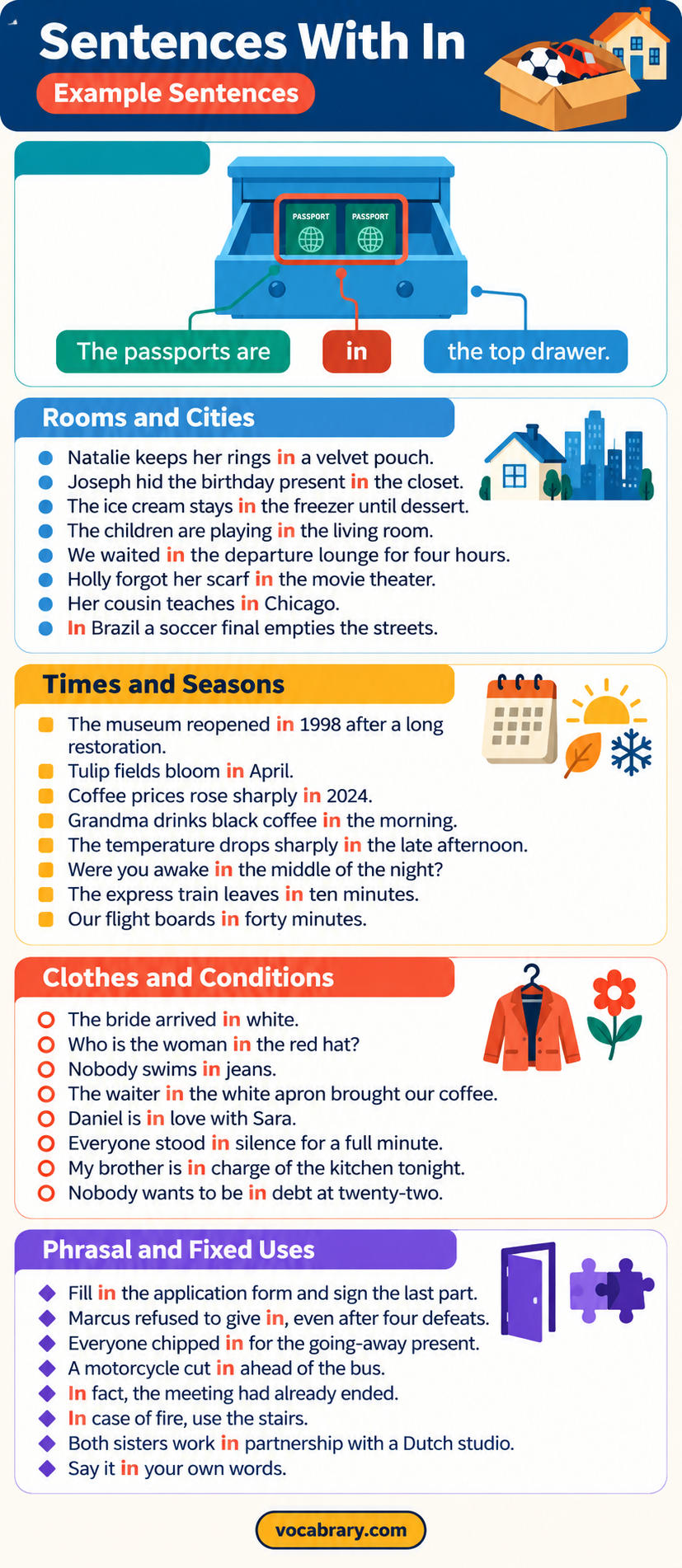
In is a preposition that marks a position inside something with walls, borders, or limits, as in the passports are in the top drawer. Sentences with in answer where someone is, when an event happened, and what state a person is in, starting with the everyday ones learners repeat daily.
What Is the Preposition In?
In marks a position with something all around it: the walls of a room, the borders of a country, or the limits of a month or a year. On marks contact with a surface, and at marks one precise location, while in marks the inside.
Ayesha left her umbrella in the hallway cupboard.
Common Sentences With In
Passports in a drawer, milk in the fridge, and a bus that leaves in twenty minutes are the everyday sentences with in, where the preposition names whatever surrounds a person, an object, or an event.
- The passports are in the top drawer.
- Mina keeps her medicine in the kitchen cupboard.
- We ate dinner in the garden because the evening was warm and the mosquitoes stayed away.
- There is no milk in the fridge.
- Your appointment is in twenty minutes.
- Diego grew up in Bogotá and later studied law in Madrid.
- Put the wet towels in the laundry basket by the door.
- She wrote the whole letter in French.
- In winter the lake freezes and the village children skate across it.
- My grandfather worked in a shoe factory for thirty years.
- Are the tickets still in your bag?
- Nobody was in the office when the fire alarm went off at midnight.
- Farah left her phone in the taxi.
- The twins were born in 2011.
- Salt dissolves in warm water faster than in cold water.
- He is in trouble again.
- Kofi found the missing receipt in an old coat pocket.
- The meeting starts in an hour, so finish the report now.
- Rain fell all night, and by morning deep puddles stood in the school yard.
- Tomás keeps every family photograph in a wooden album.
- In June the whole family drives to the coast for two weeks.
- Her name is printed in the third paragraph.
- Do not leave the puppy alone in the car.
- Ravi has been in hospital since Tuesday.
In for Places and Enclosed Spaces
Drawers, lifts, wardrobes, and the pocket of a winter coat give the preposition its core job, since each one surrounds whatever goes inside it with sides, a lid, or four walls.
| Use | Pattern | Example sentence |
|---|---|---|
| Enclosed places | In + container or room | Nadia keeps her rings in a velvet pouch. |
| Towns, countries, continents | In + place name | Her cousin teaches in Nairobi. |
| Months and years | In + month or year | The museum reopened in 1998. |
| Seasons and centuries | In + season or century | Farmers plant rice in spring. |
| Parts of the day | In + the morning or the evening | We run together in the evening. |
| Time ahead | In + length of time | The express train leaves in ten minutes. |
| Languages and materials | In + language, ink, or paint | Sign both forms in blue ink. |
| Clothing and colour | In + garment or colour | The bride arrived in white. |
| States and feelings | In + love, trouble, pain | Daniel is in love with Sara. |
| Cars and taxis | In + car, taxi, ambulance | Grandma waited in the taxi. |
| Fixed phrases | In + fact, general, time | We arrived in time for the ceremony. |
- Nadia keeps her rings in a velvet pouch.
- The spare batteries are in that rusty tin on the shelf.
- Two climbers sheltered in a cave until the storm passed.
- Wet paint dries slowly in a cold garage.
- Yusuf hid the birthday present in the wardrobe.
- In the lift a stranger asked me which floor I wanted.
- Fish were swimming in the shallow pool near the rocks.
- Did you leave your wallet in the jacket you wore yesterday?
- Our neighbour grows tomatoes in plastic buckets on her balcony.
- A wasp was trapped in the empty jam jar for an hour before we freed it.
In for Rooms and Buildings
Playing children, muddy boots, a chemistry lesson on the second floor, and a cat asleep beside a radiator put the preposition inside rooms, where in names the four walls around the action.
- The children are playing in the living room.
- Mr. Okafor teaches chemistry in the laboratory on the second floor.
- Leave your muddy boots in the hallway.
- Nobody smokes in the hospital corridors.
- In the attic they discovered a trunk of wartime letters.
- Is your sister still in the bathroom?
- We waited in the departure lounge for four hours.
- Priya studies in the university library every evening until the doors are locked.
- The cat sleeps in a cardboard crate beside the radiator.
- Rats were found in the basement of the old bakery.
- Marco proposed to Elena in a tiny restaurant near the harbour.
- She left the keys in the kitchen, next to the bread bin.
- Please do not run in the corridor.
- A fire broke out in the warehouse after midnight, and the whole street was evacuated.
- They rehearse in the church hall on Thursdays.
- My office is in the grey building opposite the station.
- In the classroom the pupils whisper, though outside they shout.
- Hana forgot her scarf in the cinema.
In for Cities, Countries, and Continents
Nairobi, Portugal, Botswana, and the cherry trees of Japan show the second use of in, where the borders around a town, a country, or a whole continent replace the walls of a room.
- Her cousin teaches in Nairobi.
- We spent two weeks in Portugal last autumn.
- Elephants are protected in Botswana.
- In Japan the cherry blossom season draws millions of visitors every spring.
- Ahmed was born in Cairo but grew up in Toronto.
- Rice grows well in the Mekong Delta.
- My aunt has worked in Germany since 2014.
- Are there wolves in Poland?
- The tallest tower in Dubai draws long queues of tourists all year.
- Snow rarely falls in Athens.
- Sofia studied medicine in Bologna and now practises in Milan.
- Thousands of students learn English in India every year.
- In Brazil a football final empties the streets.
- Kangaroos are found only in Australia.
- He spent his childhood in a small village in the Atlas Mountains.
- Winters are long and bitter in Siberia.
- The company opened three new factories in Vietnam within a single year, most of them near Hanoi.
- Have you ever lived in another country?
In for Months, Years, Seasons, and Centuries
January weddings, a museum reopened in 1998, monsoon rains in July, and railways built in the nineteenth century show the calendar use of in. The preposition puts an event inside a month, a year, a season, or a whole century.
- The museum reopened in 1998 after a long restoration.
- Nadia and Sam were married in January.
- Monsoon rains arrive in June across most of southern India.
- In autumn the vineyards near Bordeaux fill with pickers.
- My parents met in the summer of 1987.
- Railways spread across Europe in the nineteenth century.
- Do the shops close early in December?
- She finished her doctorate in 2022 and started teaching that same autumn.
- Tulip fields bloom in April.
- In spring the river rises and floods the lower fields.
- Argentina won the World Cup in 2022.
- The first Olympic marathon for women was run in 1984.
- Bears sleep through the coldest weeks in winter.
- Grandpa was born in 1946, three years before his sister.
- Were you in Lisbon in August?
- Examinations are held twice a year, in March and in September.
- Emperor penguins breed in the Antarctic winter, when the sea ice is thickest and the light has gone.
- Coffee prices rose sharply in 2024.
In for Parts of the Day
Black coffee in the morning, an office that empties in the afternoon, and a dog walked in the evening show where in governs the long parts of a day, while night takes at instead.
- Grandma drinks black coffee in the morning.
- In the afternoon the office empties and the phones stop ringing.
- We walk the dog in the evening, never at night.
- Does your class meet in the morning or after lunch?
- Luis revises in the early hours of the morning when the whole house is silent.
- The temperature drops sharply in the late afternoon.
- In the evening the whole family eats together in the kitchen.
- Buses run every ten minutes in the morning rush.
- She never drinks tea in the afternoon because it keeps her awake.
- Nurses on the night shift sleep in the middle of the day.
- In the morning a thick mist over the fields hides the road.
- Call me in the afternoon.
- Fishermen return to the harbour in the early evening with the day’s catch.
- My headache started in the morning and lasted until bedtime.
- Training sessions are held in the afternoon on Tuesdays and Fridays.
- Were you awake in the middle of the night?
In for Periods of Time Ahead
A train that leaves in ten minutes, marks that arrive in three weeks, and a bakery opening in two years’ time measure forward from the moment of speaking. This second time use of in never looks backwards.
- The express train leaves in ten minutes.
- Your exam marks arrive in three weeks.
- In two years’ time they hope to open a second bakery.
- Dinner will be ready in half an hour.
- Call back in five minutes.
- Ibrahim graduates in June, so in four months he starts his first teaching job.
- Fresh plaster dries in twenty-four hours.
- She promised to answer in a day or two.
- In a fortnight the builders finish the roof, and the family moves back home before the winter rains.
- Wait another ten minutes, because the cake sets in an hour.
- Our flight boards in forty minutes.
- Doctor Ahmed will see you in a moment.
- The snow melted in three days and the mountain pass reopened to lorries.
- Rahul learned the entire poem in twenty minutes.
In for Languages, Materials, and Clothing
Blue ink, marble, a diary kept in Igbo, and a bride dressed in white take the same preposition. In names the language of a message, the material of a work, and the clothes on a person.
In for Languages and Materials
Forms signed in blue ink, a lecture delivered in Mandarin, sunflowers painted in oils, and a statue carved in marble put in front of the medium rather than the place.
- Sign both forms in blue ink.
- The lecture was delivered in Mandarin and translated in real time.
- In Arabic one root gives dozens of related words.
- Amara wrote her diary in Igbo.
- Their wedding invitation was printed in gold lettering.
- Draw the first sketch in pencil, then go over the outline in pen.
- Nobody answered in English, so our teacher repeated the question in Spanish.
- The statue was carved in marble by a sculptor from Carrara.
- Please write your name in capital letters.
- Van Gogh painted his sunflowers in oils.
- Did she reply in Portuguese or in Galician?
- Cartographers drew that old map in faded brown ink three centuries ago.
- Payment was made in cash.
- In Welsh the word for milk is llaeth.
In for Clothing and Appearance
A bride in white, officers in uniform, toddlers in pyjamas, and farmers in straw hats describe people by what they wear, a use where in replaces a longer phrase such as wearing a hat.
- The bride arrived in white.
- Officers in uniform guarded both entrances.
- Sanjay came to the party in jeans and a faded band shirt.
- In that yellow raincoat you are visible from the far end of the street.
- Who is the woman in the red hat?
- A choir of forty sang in black gowns.
- Toddlers in pyjamas waved at us from the upstairs window.
- She looked elegant in a long linen dress.
- In heavy boots and a thick coat, Erik set off across the ice field.
- Nobody swims in jeans.
- The guard in the blue cap checked every ticket twice.
- Dressed in her grandmother’s sari, Meera walked slowly to the stage.
- Are you going out in that shirt?
- Farmers in straw hats worked the rice terraces from dawn.
In for States and Conditions
Love, trouble, debt, silence, and pain follow the same preposition, because a mood or a condition surrounds a person the way a room does, which is why English says in love and in a hurry.
- Daniel is in love with Sara.
- We were in a hurry, so breakfast was two bites of cold toast.
- Marta is in trouble with her landlord again.
- In shock after the crash, the driver forgot his own address.
- The company has been in debt since the factory closed.
- Everyone stood in silence for a full minute.
- Are you in pain?
- In despair, she sold the piano her father had given her.
- Their marriage is in danger.
- The teacher kept the class in order all afternoon.
- Kwame has been in prison for two years.
- My brother is in charge of the kitchen tonight.
- Half the audience was in tears by the final scene.
- The old mill has been in ruins since the great flood.
- Nobody wants to be in debt at twenty-two.
- In good health at ninety, Great-aunt Rosa still swims every morning.
In for Cars, Taxis, and Other Transport
A grandmother waiting in a taxi, children asleep in the back of a car, and a patient rushed in an ambulance take in, while buses, trains, and planes take on instead.
- Grandma waited in the taxi while we paid the bill.
- The children were asleep in the back of the car.
- Paramedics rushed him in an ambulance to the nearest hospital.
- In a rented van the band drove from Lyon to Berlin.
- Do not eat in my car.
- Two divers sat in a small boat waiting for the current to slacken.
- She left her laptop in an Uber and never saw it again.
- In the cab of the tractor there is room for one passenger.
- Four of us rode in a rickshaw meant for two.
- The dog barks whenever it is in the car.
- Journalists were driven in armoured jeeps to the border crossing, three hours before dawn.
- Were you in the taxi when the accident happened?
In as a Particle in Phrasal Verbs
Filling in a form, checking in at an airport, handing in homework, and a neighbour dropping in without warning turn in into a verb particle. The word then changes the verb instead of naming a place.
- Fill in the application form and sign the last part.
- We checked in at the airport three hours early.
- Hand in your homework before Friday.
- The roof caved in during the earthquake.
- Marcus refused to give in, even after four defeats.
- Drop in whenever you are near the shop.
- The new tenants move in on Saturday.
- Please plug in the charger before the battery dies.
- It took an hour for the bad news to sink in.
- Everyone chipped in for the leaving present.
- Log in with your student number and password.
- Shy at first, Amira soon joined in with the singing and clapped louder than anyone.
- Burglars broke in through the kitchen window.
- The head teacher called in a colleague to settle the argument.
- Let the cat in before you go to bed.
- A motorbike cut in ahead of the bus.
- Take in the washing, because rain is coming.
- Tune in on Sunday for the second half of the interview.
Fixed Expressions With In
In fact, in advance, in a row, in vain, and in touch behave as whole phrases, so the preposition never changes and learners memorise each one as a whole phrase.
- In fact, the meeting had already ended.
- Book the tickets in advance.
- Our train arrived in time for the connection.
- Nadia apologised in person rather than by email.
- In case of fire, use the stairs.
- The twins won three medals in a row.
- Keep in touch after you move to Oslo.
- In general, summers along this coast stay dry and windy.
- We are in favour of the new timetable.
- Both sisters work in partnership with a Dutch studio.
- Cadets marched in step.
- She explained the recipe in detail.
- Nobody spoke, and we drove the last sixty kilometres home in complete silence through heavy rain.
- Letters were filed in order of arrival.
- Say it in your own words.
- The machine washes and dries in one cycle, at least in theory.
- His effort was in vain, because the deadline had already passed.
- Pilar speaks Catalan and Basque in addition to Spanish.
In and Into in the Same Sentence
Running into a kitchen and then searching in it, or pouring batter into a tin and baking it in the oven, splits the pair. Into marks the crossing, and in marks the position that follows.
- Rosa ran into the kitchen, and a minute later she was still in the kitchen looking for the jam.
- Pour the batter into the tin, then leave it in the oven for forty minutes.
- The cat jumped into the suitcase and slept in it all afternoon.
- Do not step into the road; wait in the doorway until the bus stops.
- Samir dived into the lake and swam in the cold water for an hour.
- She put the letter into an envelope and hid it in her desk.
- Water leaked into the cellar, and now ten centimetres of water lie in the cellar.
- The children climbed into the tent and whispered in the dark.
- Karl moved into a flat in Hamburg last spring.
- Throw the peel into the compost bin and leave nothing in the sink.
- Translate the poem into Turkish, then read it aloud in Turkish.
- He stuffed the receipts into his wallet and forgot they were in there.
In Compared With On and At
Photographs in an album on a shelf, a student at Cambridge who lived in Cambridge, and milk in the fridge beside a bowl on the counter separate the three prepositions learners confuse most.
In and On in the Same Sentence
Albums on shelves, cases left on a pavement, ducks in a pond under gulls resting on the water, and a birthday in March on the fourteenth split the two. In takes the inside, on takes the surface.
- The photographs are in the album, and the album is on the shelf.
- Leila sat in the taxi while her cases stayed on the pavement.
- We slept in a tent pitched on wet grass.
- Your keys are in the drawer, not on the worktop.
- Milk goes in the fridge, and the fruit bowl stays on the counter.
- Ducks swim in the pond while gulls rest on the water.
- She was born in March, on the fourteenth of the month.
- Meetings are held in the morning on Tuesdays.
- Grandad reads in bed every night, though the newspaper always ends up on the bedroom floor.
- Diamonds sparkle in the ring on her finger.
- Write your answers in ink on both sides of the sheet.
- The band played in a club on Market Street.
In and At in the Same Sentence
A tower with a street address, guests waiting at an entrance while others stay in the hall, and a concert at eight in the evening separate the pair. At names one precise location or clock time.
- Sara works in a glass tower, and her office is at 40 Baker Street.
- We waited at the entrance for twenty minutes while the others stayed in the warm hall.
- My nephew is in school in Leeds, and this afternoon he is at the library.
- The concert starts at eight in the evening.
- Nobody was at the bus stop, and nobody was in the shelter either.
- She studies at Cambridge and has lived in Cambridge for four years.
- Guests wait at reception before the tour in the museum begins.
- Ali is at work now, but his coat is in the car.
- Meet me at the corner of the street, not in the corner of the cafe.
- Fireworks began at midnight in the main square.
- The train stops at Lyon, though we stay in France for another week.
- Dinner is served at seven in the dining room.
Short Sentences With In for Young Learners
A cat in a basket, a fish in a bowl, and a pencil in a bag are the first sentences with in that five-year-olds read aloud. Each line is short enough to copy.
- The cat is in the basket.
- My pencil is in my bag.
- A fish swims in the bowl.
- Mum is in the kitchen.
- We play in the park.
- The ball is in the net.
- Birds sing in the tree.
- Put the toys in the crate.
- In July we swim every day.
- Grandma is in the garden.
- The bread is in the oven.
- I sleep in my own bed.
- Ducks swim in the pond.
- Her doll is in the pram.
- Sam is in my class.
- Socks go in the drawer.
- My little brother keeps his toy cars in a red tin under his bed.
- In the morning we line up in the playground before the bell rings.
Sentences With In in a Short Paragraph
Eight lines about the Okonkwo family moving to Lagos put in to work for a month, a house, a market, a printing shop, and a river, so learners see the preposition inside connected writing.
- In April the Okonkwo family moved to a narrow house in Lagos.
- The boys slept in the back room, and their books stayed in two cardboard crates.
- Mrs. Okonkwo sold bread in the market every morning.
- Their father worked in a printing shop and came home in the evening covered in ink.
- Rain fell every afternoon in June, so the children played indoors in the hallway.
- Cousins arrived in August, and the whole family swam in a cold river near Ibadan.
- School started again in September, and Chidi was placed in the top set for mathematics.
- By December the house felt like home, and nobody spoke in whispers any more.
Related
- Parts of Speech Example Sentences
- Sentences with On
- Sentences with At
- Prepositions of Place Example Sentences
FAQs
An everyday example is "The passports are in the top drawer." Another is "Your appointment is in twenty minutes."
For a room, one example is "The children are playing in the living room." Another is "Leave your muddy boots in the hallway."
With a place name, one example is "Her cousin teaches in Chicago." Another is "Kangaroos are found only in Australia."
For a month, one example is "Tulip fields bloom in April." Another is "The twins were born in 2011."
In a daily routine, one example is "Grandma drinks black coffee in the morning." Another is "We walk the dog in the evening, never at night."
When a length of time follows, one example is "The express train leaves in ten minutes." Another is "Dinner will be ready in half an hour."
In a language sentence, one example is "She wrote the whole letter in French." Another is "Please write your name in capital letters."
For clothing, one example is "The bride arrived in white." Another is "Who is the woman in the red hat?"
A state example is "Daniel is in love with Sara." Another is "Their marriage is in danger."
With a phrasal verb, one example is "We checked in at the airport three hours early." Another is "Burglars broke in through the kitchen window."
Related:

Leave a Comment