
At is a preposition that marks one exact place or one exact moment in time, as in at the door and at six o’clock. Most sentences with at name a meeting place, a building where something happens, or a figure on the clock, so doors, weddings, and prices share one small word.
What Is the Preposition At?
At fixes a person, an event, or a price to one exact place, one exact time, or one exact figure, and the noun after it names that place, time, or figure. In names the inside of a larger place or a longer period, and on names a surface or a dated day, while at narrows both place and time to a single meeting point.
At + exact place, time, or figure
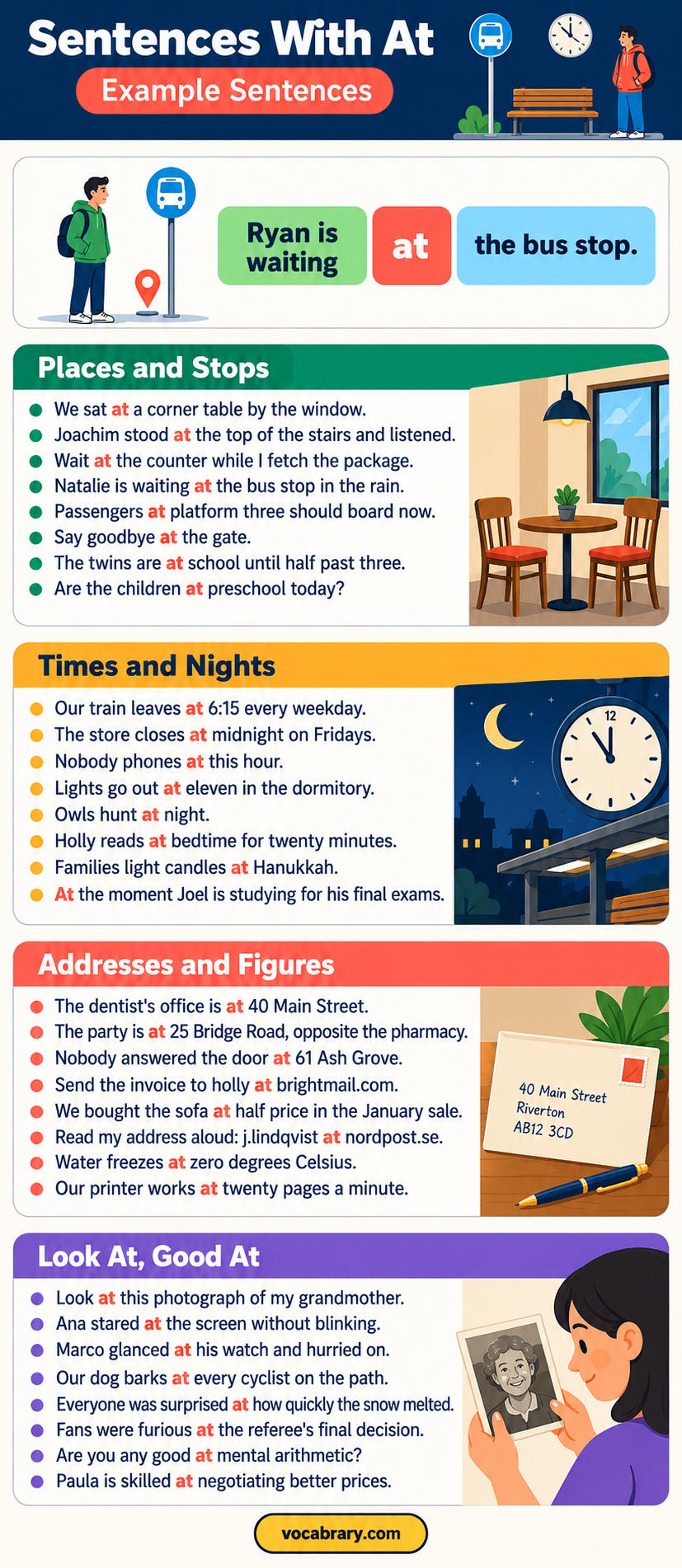
Ravi waited at the gate at half past seven.
Common Sentences With At
A queue at the bus stop, a meeting at nine, and a brother who is good at chess are the everyday sentences with at, where one word fixes a place, a moment, or an ability.
- Ravi is waiting at the bus stop.
- The meeting starts at nine o’clock.
- My brother is very good at chess.
- We ate lunch at a small cafe near the harbour.
- Nobody was at home when the parcel arrived.
- Sofia works at a hospital in Valencia.
- Look at that enormous kite.
- Daniel met his future business partner at a conference in Helsinki three winters ago.
- I met Amara at a wedding last summer.
- She screamed at the sight of the spider in the bath.
- Our train leaves at midnight.
- Knock at the green door, not the blue one.
- The dog barked at the postman every morning.
- Tickets are on sale at twelve euros each.
- Are you at the airport yet?
- Priya laughed at her own mistake.
- Her fever peaked at thirty-eight degrees.
- Grandpa naps at two every afternoon.
- He threw a snowball at his sister and missed by a metre.
- The bakery at the corner opens at six.
- I will phone you at lunchtime.
- They arrived at the theatre ten minutes late.
- Marta is terrible at remembering birthdays.
- At last the rain stopped.
- Write to me at my new address.
Main Uses of At in Sentences
Gates, school, weddings, house numbers, clock times, email addresses, prices, and abilities each take at for a different reason, and one pattern serves them all.
| Use | Pattern | Example sentence |
|---|---|---|
| Exact place | At + the place | Rosa waited at the gate. |
| Building or activity | At + school, work, the shops | The twins are at school until three. |
| Event | At + a party, a wedding, a match | We met at a wedding in Cork. |
| Street address | At + number + street name | The dentist is at 40 High Street. |
| Clock time | At + the hour | The film begins at eight. |
| Festival or period | At + Christmas, night, the weekend | Our family gathers at Christmas. |
| Email address | Name + at + domain | Send it to hana at brightmail.com. |
| Price | At + an amount | Rye loaves sell at two pounds. |
| Speed or temperature | At + a figure | Water freezes at zero degrees Celsius. |
| Reaction or ability | Adjective + at | Kofi is brilliant at mental arithmetic. |
| Verb link | Verb + at | Stop shouting at the referee. |
| Fixed expression | At + noun | At last the bus turned the corner. |
- Rosa waited at the locked gate for twenty minutes.
- Twins in my class are at school until three.
- Kirsty and Owen first met at a wedding in Cork.
- Her dental surgery is at 40 High Street, opposite the old fire station in town.
- This film begins at eight.
- Our whole family gathers at Christmas.
- Send the form to hana at brightmail.com.
- A village baker sells rye loaves at two pounds.
- Water freezes at zero degrees Celsius.
- Kofi is brilliant at mental arithmetic.
- Stop shouting at the referee.
- At last the bus turned the corner.
At for Exact Places and Positions
A gate, a corner table, the top of the stairs, and the entrance to a car park are the exact places that take at, where the noun names one position rather than a whole town.
- Hugo waited at the gate until the security guard opened it.
- We sat at a corner table by the window.
- Someone is at the front door.
- Meet me at the entrance to the car park.
- Joachim stood at the top of the stairs and listened.
- The cat sleeps at the foot of my bed.
- Turn left at the traffic lights.
- A crowd gathered at the edge of the lake after the storm broke the wooden pier.
- My keys are at the bottom of my rucksack.
- Wait at the counter while I fetch the parcel.
- Two swans were swimming at the far end of the canal.
- Stop at the crossing.
At the Door, the Gate, and the Corner
Doors that somebody knocks at, gates where parents wait, and corners where two streets meet give at its plainest job, naming the one place where a person stops.
- Knock at the door twice so the nurse hears you.
- Grandma waits at the school gate every afternoon.
- The newsagent at the corner of Bell Street sells stamps.
- Someone was standing at the window, watching the rain.
- Leave the parcels at the back door.
- Yusuf tapped at the window until his friend looked up from her book and waved.
- We shook hands at the garden gate and said goodbye.
- A busker plays the violin at the corner near the bank.
- Wait at the gate.
- Two cyclists stopped at the corner to check their map.
At the Bus Stop, the Station, and the Airport
Commuters queueing at the barriers, a suitcase left at the left-luggage desk, and four hours spent at an airport cafe show at with every place where travellers wait.
- Nadia is waiting at the bus stop in the rain.
- Our flight was delayed, so we spent four hours at the airport cafe.
- I will meet you at the station entrance.
- Passengers at platform three should board now.
- He left his suitcase at the left-luggage desk.
- At the ticket machine, Lucia realised her bank card had expired.
- The coach stops at the roundabout, not at the terminal.
- Say goodbye at the gate.
- Hundreds of commuters queue at the barriers every morning.
- Marek slept at the airport because his connection left after midnight.
At for Buildings, Schools, and Events
School, work, the supermarket, a wedding in Cork, and a jazz concert take at whenever the sentence names the activity somebody attends rather than the walls around it.
At School, at Work, and at the Shops
School, the dentist’s surgery, the supermarket, and a law firm near the cathedral take at because each one means the activity, so at school means studying and at work means working.
- The twins are at school until half past three.
- Dad is still at work, so dinner will wait.
- Amina is at the supermarket buying flour and eggs.
- I have an appointment at the dentist on Thursday morning.
- Nobody answered at the reception desk.
- My cousin studies at the University of Bologna.
- We were at the library when the fire alarm went off.
- Sam spent the whole afternoon at the gym.
- Are the children at nursery today?
- Petra works at a law firm near the cathedral.
- Helena was at the hairdresser when her landlord phoned about the broken boiler in the flat.
- Buy the bread at the bakery on Mill Lane.
- Every Friday the whole team eats lunch at the canteen upstairs.
- He is at home with a cold.
- Students at our college pay nothing for the bus.
- Meet me at the swimming pool.
At a Party, a Wedding, and a Concert
A wedding in Cork, a graduation, a football match between Milan and Napoli, and a school play are the occasions that take at, where the sentence names the event rather than the room.
- We met at a wedding in Cork three summers ago.
- Nobody danced at the office party until midnight.
- Ella sang at her sister’s graduation.
- Were you at the concert on Saturday?
- Thousands of fans cheered at the match between Milan and Napoli.
- My parents first spoke at a poetry reading in Edinburgh.
- The band played two encores at the festival.
- Lucas cried at the christening, and so did his mother.
- At the school play, the youngest child forgot every line and grinned at the audience anyway.
- I ate far too much at the barbecue.
- Diego proposed at a concert in Seville, right before the last song.
- Guests at the reception each received a small bag of almonds.
- She spoke at the conference on Tuesday.
- Half the village turned up at the funeral.
At for Street Addresses With a House Number
A dentist at 40 High Street, a flat at 18 Green Lane, and a bell rung at number 44 all take at. The house number narrows a whole street to one building.
- The dentist’s surgery is at 40 High Street.
- Our new flat is at 18 Green Lane.
- Send the parcel to Amina at 7 Rose Lane.
- The party is at 25 Bridge Road, opposite the chemist.
- Deliveries for the cafe arrive at 3 Market Square.
- She grew up at 12 Oak Street, three doors from her grandmother.
- Ring the bell at number 44 and ask for Yasmin.
- My office is at 220 Riverside Drive, on the fourth floor.
- Kofi rented a room at 9 Chapel Street while he studied nursing at a college in Leeds.
- Nobody answered the door at 61 Ash Grove.
- We stopped at 5 Fountain Place to collect the keys.
- At 88 Lake Road you will find the old bookshop.
At for Clock Times and Exact Moments
Six fifteen, nine sharp, midnight, noon, and the second a whistle blows are the exact times that take at, where the clock gives one figure instead of a whole day.
- Our train leaves at 6:15 every weekday.
- Class begins at nine sharp.
- We eat dinner at eight in Spain.
- Farid wakes at dawn to feed the goats.
- The shop closes at midnight on Fridays.
- At noon the church bells rang across the valley.
- Call me at half past four.
- Her flight lands at 23:40.
- Nobody phones at this hour.
- A whistle blew at the exact moment the ball crossed the line.
- I finish work at five and reach home at six.
- At sunset the whole beach turned orange.
- Breakfast is served at seven in the hostel.
- Marta was born at ten past two on a Tuesday morning in March 1998.
- Please be ready at quarter to eight.
- Lights go out at eleven in the dormitory.
- Are you free at lunchtime?
- Every alarm in the building rang at the same second.
At for Night, Christmas, and the Weekend
Night, bedtime, Christmas, Easter, Diwali, and the weekend in British English are the periods that take at, where the phrase names a whole season of celebration rather than one dated day.
- Owls hunt at night.
- At Christmas the whole family gathers in Kilkenny.
- We visit my grandparents at Easter every year.
- British speakers relax at the weekend, while American speakers relax on the weekend.
- Hana reads at bedtime for twenty minutes.
- The bridge is closed for repairs at present.
- Are the streets safe at night in this part of town?
- My aunt always sends cards at New Year.
- Crowds fill the temple at Diwali.
- Every farmer in the valley works late at harvest time.
- Shops in Lisbon stay open until eleven at Christmas.
- We were painting the kitchen at the weekend when the ceiling started leaking.
- At the moment Youssef is studying for his final exams.
- Fireworks light the harbour at midnight on New Year’s Eve.
At for Email Addresses and Prices
An email address read aloud, rye loaves at two pounds, shares opening at forty euros, and a sofa bought at half price put at between a name and a figure.
- Send the invoice to hana at brightmail.com.
- My work address is r.okafor at citylibrary.org.
- A baker on Mill Lane sells rye loaves at two pounds each.
- We bought the sofa at half price in the January sale.
- Shares in the company opened at forty euros and closed at thirty-eight this afternoon.
- Tickets for the ferry start at nine pounds fifty.
- Nobody sells fresh mangoes at that price in winter.
- At ninety cents a litre, the milk was the cheapest in the market.
- Read my address aloud: j.lindqvist at nordpost.se.
- The painting sold at auction for a figure nobody expected.
- Petrol is selling at one euro seventy a litre this week.
- Email the photographs to studio at lumenworks.co.uk before Friday.
At for Speed, Temperature, and Other Measurements
Water that freezes at zero, a lorry driving at sixty kilometres an hour, an oven set at 180 degrees, and a plane flying at thirty thousand feet all take at with a measured figure.
- Water freezes at zero degrees Celsius.
- A lorry was driving at sixty kilometres an hour.
- Bake the bread at 180 degrees for forty minutes.
- Our plane is flying at thirty thousand feet.
- Her fever peaked at thirty-nine degrees on the second night.
- Nobody swims at that depth without a trained partner.
- Our printer works at twenty pages a minute.
- At full speed the ferry crosses the strait in ninety minutes.
- Milk keeps longest at four degrees.
- The wind was gusting at eighty kilometres an hour when the roof tiles came loose.
- Sofia types at ninety words a minute.
- Set the thermostat at nineteen degrees overnight.
At for Reactions and Feelings
Surprised at melting snow, furious at a referee, good at chess, hopeless at spelling, and delighted at an invitation are the adjectives that take at, linking a feeling or an ability to its cause.
- Everyone was surprised at how quickly the snow melted.
- My brother is very good at chess.
- Lena is hopeless at spelling, though she reads three books a week.
- Fans were furious at the referee’s final decision.
- I was delighted at the invitation to Nadia’s wedding.
- He is bad at keeping secrets.
- Nobody was shocked at the result.
- Ana felt angry at herself for forgetting the appointment.
- The teacher was amazed at the progress her quietest student made in one single term.
- Are you any good at mental arithmetic?
- Tom is quick at crosswords and slow at everything else.
- We were astonished at the size of the crowd.
- Grandpa is brilliant at telling stories about his years in the merchant navy.
- She is useless at parking, and she admits it cheerfully.
- Marek was annoyed at the delay but said nothing.
- Priya is skilled at negotiating better prices.
At With Verbs Such as Look, Laugh, and Arrive
Looking at a photograph, laughing at an impression, arriving at the airport, shouting at a dog, and staring at a screen are the verbs that need at before their object.
- Look at this photograph of my grandmother.
- Everyone laughed at Sam’s impression of the head teacher.
- We arrived at the airport two hours early.
- Stop shouting at the dog.
- Ana stared at the screen without blinking.
- The baby smiled at the postman.
- Someone knocked at the door just after midnight.
- Do not point at strangers.
- Marco glanced at his watch and hurried on.
- Aisha shouted at her brother, then apologised a minute later.
- Protesters threw paper cups at the empty stage.
- I guessed at the answer and got it right.
- Nobody hinted at the surprise waiting in the kitchen.
- She waved at the train until it disappeared round the bend.
- Children were peering at the lizards through the glass wall of the reptile house.
- Karim worked at the same crossword for an hour before asking for help.
- Our dog barks at every cyclist on the towpath.
- Will you look at these figures before the meeting?
At in Phrasal Verbs
Jumping at a chance, picking at peas, snapping at a sister, chipping away at a loan, and keeping at a half-painted wall are the phrasal verbs built on at.
- Yusuf jumped at the chance to study in Berlin.
- The toddler picked at his peas and ate none of them.
- Do not snap at your sister just because you are tired.
- Keep at it and the whole wall will be painted by lunchtime.
- We have been chipping away at the loan for six years.
- Nobody understood what the minister was getting at.
- Rain hammered at the windows all night.
- She clutched at the railing as the boat rolled.
- Sam is only playing at being a chef.
- The puppy nibbled at my shoelaces.
- Critics hit out at the council’s decision to close the pool.
- Amara plugged away at her thesis every evening until she finished it in April.
At in Fixed Expressions Such as At Last and At Once
At last, at least, at once, at first, at all, at random, and at the same time are the set phrases where at joins a noun and neither word ever changes.
- At last the bus turned the corner.
- Come here at once, please.
- Nadia disliked the flat at first, and now she refuses to move out of it.
- The recipe needs at least four eggs.
- Nobody spoke at all during the interview.
- Two alarms rang at the same time.
- At any rate, the roof survived the storm.
- The inspector chose three folders at random.
- Marek was at a loss for words when the award was announced.
- Add the sugar one spoonful at a time.
- Repairs will last one more winter at best.
- We will miss the first ferry at worst.
- Everything is quiet here at present.
- Sara took in the whole chart at a glance.
- The whole team is at ease with the new manager.
- Ravi will finish the job at any cost, even if he works all weekend.
- At length the judge delivered her verdict.
- Nobody is at fault for the flat tyre.
At and In, At and On in the Same Sentence
A hotel at the harbour in Lisbon, a lesson at nine in the morning, and a corner at Bridge Street on Friday set at beside in and on. Each preposition narrows a place or a time by a different amount.
At and In Compared
Staying at a hotel in Lisbon, waiting at a gate in the rain, and starting at nine in the morning pair the two words. At gives the one position, and in gives the wider place or the longer period.
- We stayed at a small hotel in Lisbon.
- Nadia is at the office, and her passport is in her bag.
- The lesson starts at nine in the morning.
- Tom is at school, and his sister is in the classroom next door.
- Sofia works at a clinic in the old quarter of Naples.
- I waited at the gate in the pouring rain for twenty minutes.
- Meet me at the museum entrance, not in the main hall.
- Her flight lands at midnight in the middle of a snowstorm that closed two runways.
- Karim studies at a college in Manchester.
- Nobody was at the reception desk in the hotel lobby.
- Dinner is at eight, and the kitchen closes in an hour.
- Grandma sat at the kitchen table in her old blue cardigan.
At and On Compared
A concert at eight on Friday, keys on the table at the back of the kitchen, and a shop at the corner on Bridge Street show the pair together. On needs a surface or a dated day.
- The concert starts at eight on Friday.
- Meet me at the corner on Bridge Street.
- Your keys are on the table at the back of the kitchen.
- British speakers rest at the weekend, while American speakers rest on the weekend.
- We arrived at the hotel on Tuesday evening.
- Nadia was at her desk on the day the exams finished.
- The painting hangs on the wall at the top of the stairs.
- Ravi phoned at six on my birthday.
- Please eat at the table, not on it.
- Passengers on the ferry queue at the counter for hot chocolate.
- At Christmas my cousins arrive on the same train every year.
- Her name is on the envelope at the bottom of the pile of unopened letters.
Sentences Rewritten With the Correct Preposition
In the bus stop, on eight o’clock, and good in football are the three slips learners repeat, and each one turns back into at once the place, the time, or the ability decides.
- Ana waits at the bus stop ✅, not in the bus stop ❌.
- The film begins at eight ✅, never on eight ❌.
- Our meeting is at 14 Green Lane ✅, not in 14 Green Lane ❌.
- Yusuf is good at football ✅, not good in football ❌.
- Look at the board ✅, never look on the board ❌.
- We arrived at the station ✅, not arrived to the station ❌.
- Nobody was at home ✅, not in home ❌.
- My cousin was surprised at the size of the bill ✅, not surprised from the size of the bill ❌.
- Grandma naps at noon ✅, never in noon ❌.
- Sam laughed at the joke ✅, not laughed on the joke ❌.
- They are at a wedding ✅, not in a wedding ❌.
- Call me at half past six ✅, not on half past six ❌.
Short Sentences With At for Kids and Beginners
A cat at the door, a bus at the stop, and a party at four keep these lines to four or five words, with one bold at in each.
For Kids
A red door, a big dog, and a party at four give young children sentences short enough to read aloud in one breath.
- The cat is at the door.
- We are at the park.
- Look at the big dog.
- Mum is at work.
- I get up at seven.
- Sam is at school.
- Dad waits at the gate.
- My party starts at four.
- Nana smiles at me.
For Young Learners
A red light, a bus stop, and stars that come out at night keep beginners to one bold at and no other tricky word.
- Bella is good at running.
- Stop at the red light.
- The bus is at the stop.
- We eat lunch at noon.
- Ravi is at his desk.
- Stars come out at night.
- Grandpa laughs at my jokes.
- Kim is at the shop.
- Knock at the blue door.
A Market Morning Told With At
A stall at the corner of the square, a bus at half past five, and a queue at the bread van run through one paragraph, where every stage of the morning takes at.
Ines leaves home at half past five and waits at the bus stop with two empty crates. At six the market gates open, and she sets up her stall at the corner of the square. Her neighbour sells honey at four euros a jar and laughs at every joke about bees. A queue forms at the bread van by nine, and nobody minds the rain. Ines is good at guessing what each customer wants before they ask for it. At noon she counts the coins, surprised at how quickly the strawberries sold. At last, at two o’clock, she locks the crates and walks home along the river.
Related
- Parts of Speech Example Sentences
- Sentences with In
- Sentences with On
- Prepositions of Time Example Sentences
FAQs
An everyday example is "Ryan is waiting at the bus stop." Another is "The meeting starts at nine o’clock."
For a place, one example is "Meet me at the entrance to the parking lot." Another is "Someone is at the front door."
With a clock time, one example is "Class begins at nine sharp." Another is "Please be ready at quarter to eight."
A school example is "The twins are at school until half past three." Another is "Dad is still at work, so dinner will wait."
For an event, one example is "Ella sang at her sister’s graduation." Another is "Were you at the concert on Saturday?"
With an address, one example is "Our new apartment is at 18 Green Lane." Another is "My office is at 220 Riverside Drive, on the fourth floor."
A price example is "Tickets are on sale at twelve euros each." For speed, one example is "Our plane is flying at thirty thousand feet."
After an adjective, one example is "My brother is very good at chess." Another is "We were astonished at the size of the crowd."
With a verb, one example is "Look at this photograph of my grandmother." Another is "Ana stared at the screen without blinking."
A fixed expression example is "Come here at once, please." Another is "The recipe needs at least four eggs."
Related:

Leave a Comment