
A reporting verb is a verb that relays what someone said, asked, or believed, as in the witness told the court what happened. These reporting verbs examples pair ten high-frequency verbs such as said, told, and denied with everyday speech across statements, questions, warnings, and refusals.
What Is a Reporting Verb?
A reporting verb introduces the words, thoughts, or beliefs of another person inside reported speech and names the purpose of the original statement. A cognitive verb such as know or think describes the speaker’s own mental state, while a reporting verb passes on what someone else stated, asked, or promised.
Reporting verb + (that) + reported clause
The manager explained that the deadline had moved to Friday.
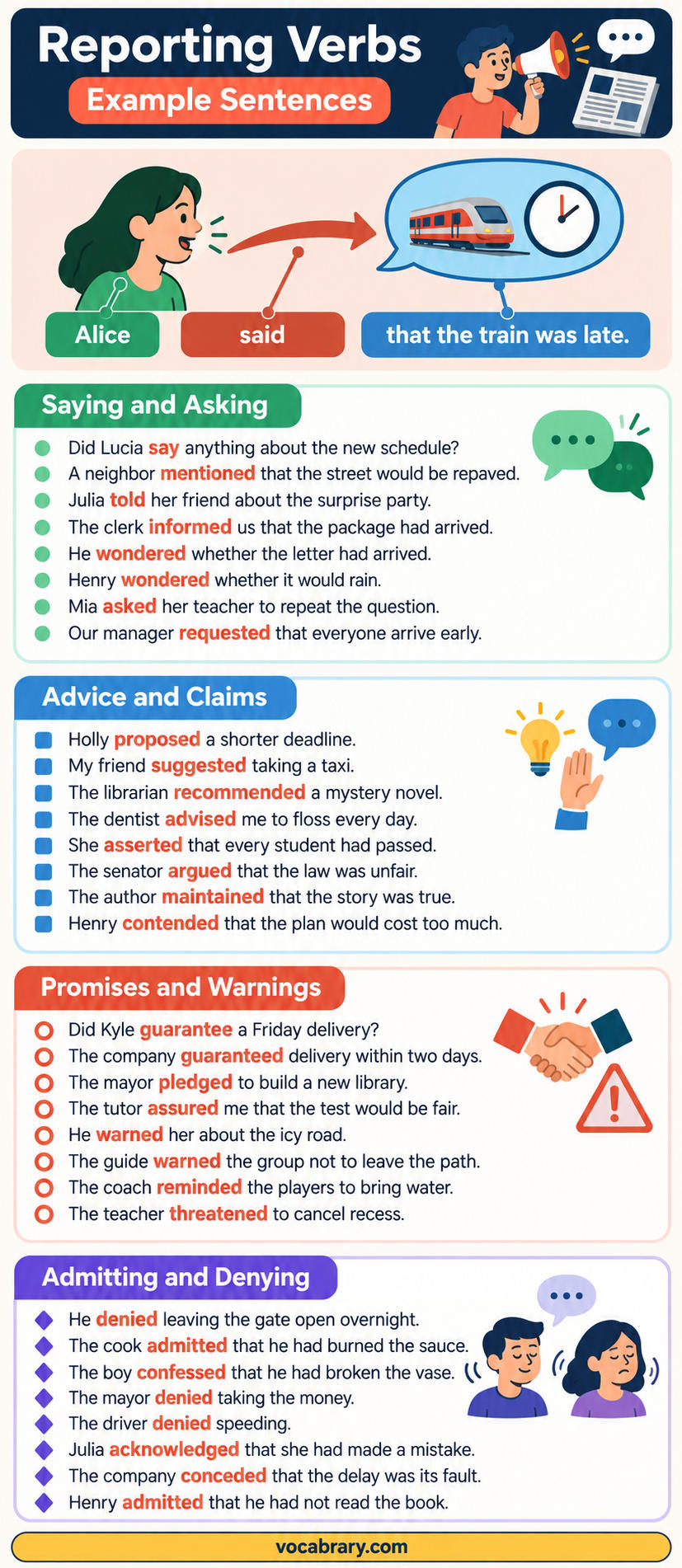
Common Reporting Verbs Examples in Sentences
Omar’s late shipment, Marta’s broken printer, and Jonas’s half-finished fence are three everyday scenes that told, denied, and promised turn into reported speech.
- Priya said that the meeting had been moved to Thursday afternoon.
- Omar told his manager that the shipment was three days late.
- A passenger asked the conductor when the next train would arrive.
- Dr. Patel explained that the test would take about forty minutes.
- The spokesperson announced that the building would reopen in April.
- Nadia suggested taking the coast road instead of the motorway.
- Two witnesses claimed that the car had run a red light.
- He admitted that he had forgotten to lock the front door.
- Marta denied breaking the office printer.
- Jonas promised to finish the fence before the weekend.
- A lifeguard warned the swimmers that the current was too strong near the rocks.
- Our neighbour insisted that the noise had started well before midnight.
- She refused to sign the contract without reading every paragraph first.
- Kwame agreed to drive the children to school on Tuesday morning.
- The coach reminded the team that practice would start an hour earlier the next week.
- Diego mentioned that his sister had moved to Vancouver in January.
- Did the receptionist confirm that the appointment was at ten?
- Mrs. Okafor advised her students to revise the chapter on cell division before the final exam.
Reporting Verb Patterns: Verb, Structure, and Sentence
Said, told, and asked each follow a different grammar pattern: said takes a that-clause, told needs a personal object before the clause, and asked pairs with a to-infinitive or a question word.
| Reporting verb | Pattern | Sentence |
|---|---|---|
| Say | say + (that) + clause | She said that the shop was closed. |
| Tell | tell + object + (that) + clause | He told her that dinner was ready. |
| Ask | ask + object + to-infinitive | I asked him to wait outside. |
| Explain | explain + (that) + clause | She explained that the road was blocked. |
| Suggest | suggest + -ing | He suggested walking to the park. |
| Claim | claim + (that) + clause | They claimed that the price was fair. |
| Admit | admit + -ing / that-clause | She admitted losing the receipt. |
| Deny | deny + -ing | He denied touching the alarm. |
| Promise | promise + to-infinitive | I promised to arrive on time. |
| Warn | warn + object + not + to-inf. | She warned us not to swim after dark. |
Reporting Verbs for Saying and Telling
A pharmacy closing at nine, a prime minister resigning, and a fox in a back garden are three of the neutral facts that said, announced, and mentioned relay without adding the speaker’s opinion.
- Fatima said that the pharmacy closed at nine on weeknights.
- He told the receptionist that his appointment was at half past three.
- A news anchor announced that the prime minister had resigned earlier that morning after weeks of pressure from within the party.
- Ravi mentioned that he had seen a fox in the back garden at dawn.
- The head teacher stated that all uniforms needed to be labelled by Monday.
- She told her sister that the bakery on Mill Road sold fresh sourdough every morning.
- Mr. Chen reported that four windows on the second floor had been broken during the storm.
- Ingrid said the ferry would leave from pier nine instead of pier twelve.
- A paramedic informed the family that the patient was awake and asking for water.
- Our captain declared that the season would be his last.
- Emilia remarked that the sunset looked brighter than it had in weeks.
- Kofi told his landlord that the heating had stopped working three days earlier.
- Did Lucia say anything about the new timetable?
- Ahmed added that the second chapter also needed revision before the print run.
Reporting Verbs for Asking and Inquiring
A detective who demanded a licence plate number, passengers who questioned a pilot’s decision, and a grandmother who inquired about a chemist’s reopening use reporting verbs that introduce questions and requests.
- Aisha asked her brother to turn the music down before bedtime.
- The detective demanded that the witness repeat the licence plate number and spell out the driver’s surname one more time for the transcript.
- He wondered whether the letter had arrived.
- Ms. Rivera inquired about the price of a return ticket to Edinburgh.
- Passengers questioned the pilot’s decision to delay the flight by two hours.
- She asked me not to mention the surprise party to anyone in the office.
- A reporter demanded an explanation for the missing funds from the quarterly budget.
- Jamal wondered whether the library stayed open past seven on Fridays.
- My grandmother inquired when the chemist next door would reopen after the renovation.
- Did the officer ask who had left the parcel at the back door?
- The interviewer requested that all candidates arrive fifteen minutes before the scheduled start time.
- Li Wei questioned the accuracy of the final score after reviewing the footage.
- Nobody asked why the meeting had been cancelled without notice.
Reporting Verbs for Explaining and Clarifying
A doctor who explained a surgery, an auditor who noted missing invoices, and a technician who revealed a wiring fault all use reporting verbs that make another person’s meaning easier to follow.
- Dr. Kim explained that the surgery would take three hours and that recovery would last about six weeks.
- She pointed out that the budget did not allow for a second round of testing.
- A technician revealed that a wiring fault had caused the blackout on the fourth floor.
- Ravi clarified that his earlier comment was about the Tuesday deadline, not the Friday one.
- The auditor noted that two invoices were missing from the March folder.
- Erik pointed out that the graph showed a sharp drop in sales during the third quarter of the previous year.
- Our instructor explained that the brake pedal needed to be pressed before the engine would start.
- Marta added that the hotel booking also needed a credit card number on file.
- A witness revealed that the warehouse had been empty for three months before the fire.
- Sofia clarified that her resignation would take effect at the end of the month, not immediately.
- The librarian noted that overdue fines had doubled since the new policy started in September.
- He pointed out that the two contracts had different return dates printed on the first draft.
- Did the professor explain how the experiment was supposed to be set up?
Reporting Verbs for Suggesting and Advising
A cafe meeting instead of the office, repainting a hallway before a viewing, and a new supplier for the timber are three proposals that suggested, recommended, and advised put into reported speech.
- Clara suggested meeting at the cafe on Bridge Street instead of the office lobby.
- The doctor recommended resting for at least two full days after the procedure.
- My father advised me to read the contract twice before signing anything.
- Hana proposed a shorter deadline.
- A counsellor urged the family to attend every session for the next six weeks.
- She suggested repainting the hallway before the property viewing on Saturday.
- The mechanic recommended replacing the brake pads within the next two hundred miles.
- Omar advised his younger brother to start the essay at least a week before the deadline.
- Our team leader proposed moving the weekly meeting to Wednesday mornings.
- Did anyone suggest trying a new supplier for the timber?
- A teacher encouraged her pupils to read one full chapter every night before bed.
- Pavel urged the committee to vote before the funding window closed at the end of the quarter.
- Ms. Rivera recommended booking the flights early, because prices were rising every day.
Reporting Verbs for Claiming and Arguing
A politician who claimed the figures were wrong, a scientist who argued for more data, and a tenant who insisted the leak was the landlord’s problem all add force to the original statement.
- The politician claimed that the unemployment figures were lower than the opposition had reported.
- Dr. Patel argued that the trial needed another six months of data before a conclusion was possible.
- A tenant insisted that the leak was entirely the landlord’s responsibility.
- She asserted that every student had passed.
- Kwame maintained that the delivery van had arrived before nine o’clock, not after.
- The defence lawyer contended that the evidence was not strong enough to support the charge.
- He declared that the company would not accept the terms of the new agreement.
- A union representative argued that wages had not risen in line with the cost of food and housing.
- Ingrid claimed that her train had been cancelled three mornings in a row.
- My neighbour insisted on paying for the broken window even though nobody had asked him to.
- Andrei asserted that the original manuscript had been lost during the move to the new archive.
- Did the manager maintain that the policy was fair to every member of staff?
- Two parents contended that homework for children under eight did more harm than good.
Reporting Verbs for Admitting and Denying
A goalkeeper who admitted the second goal was his mistake, a politician who denied accepting gifts, and a driver who admitted not seeing the cyclist pair honesty with denial through opposite reporting verbs.
- The goalkeeper admitted that the second goal was his mistake.
- She confessed that she had eaten the last slice of cake before anyone else woke up.
- A politician denied accepting gifts from the construction firm.
- Jonas acknowledged that his first draft needed far more research before it was ready.
- Rosa conceded that the new system was slower than the old one.
- He denied leaving the gate open overnight.
- Priya admitted forgetting to send the invitations until the morning of the event.
- Our coach confessed that he had never won a match against that particular rival.
- Did the company deny that the fault was present in earlier models?
- A witness acknowledged that she had been standing too far away to read the number plate.
- Leyla conceded that the second proposal was stronger than her own.
- Nadia denied saying anything negative about the project during the morning briefing.
- The driver admitted that he had not seen the cyclist before turning left at the roundabout.
Reporting Verbs for Promising and Agreeing
A father who promised to be home by six, a colleague who agreed to swap shifts, and a builder who guaranteed the roof for ten years all bind the speaker to a future act. Every reporting verb in this group names a verb that commits the speaker to something.
- My father promised to be home by six o’clock for the birthday dinner.
- Clara agreed to swap her Saturday shift with Tomas so that he was free to attend the wedding.
- The builder guaranteed that the roof would last at least ten years without any repair.
- He vowed to finish the marathon even if it took him five hours.
- Aisha swore that she had locked every window before leaving the house.
- A diplomat pledged that the country would reduce its emissions by forty per cent before the next summit.
- She assured the headmaster that the choir would be ready for the concert by Friday.
- Omar agreed to collect the parcel from the sorting office on his way home from work.
- The prime minister promised that taxes on groceries would not increase during the current term.
- Did Kofi guarantee a Friday delivery?
- Mei vowed never to miss another parents’ evening at the school.
- Two contractors pledged to complete the roadwork ahead of the original schedule.
- Ravi assured his mother that the dentist appointment was at eleven, not twelve.
Reporting Verbs for Warning and Threatening
A lifeguard who warned bathers about the tide, a landlord who threatened eviction, and a pharmacist who cautioned a patient about medication use reporting verbs that signal danger or consequence.
- The lifeguard warned the bathers that the tide was turning and the current was growing stronger.
- A landlord threatened to begin eviction proceedings if the rent was not paid by Friday.
- She cautioned her colleagues that the wet floor near the entrance was not yet marked.
- Mr. Chen reminded the tenants that noise after eleven o’clock was against the building’s rules.
- He warned her about the icy road.
- A pharmacist cautioned the patient that the new medication needed to be taken with food.
- The professor threatened to cancel the field trip if the permission slips were not returned by Wednesday.
- Jamal reminded his flatmate that the electricity bill was due at the end of the week.
- Did the pilot warn the passengers about the expected turbulence over the mountains?
- My supervisor alerted the team that the server would be offline between midnight and five in the morning.
- Sofia cautioned the new intern that the laboratory door locked automatically from the outside.
- Two rangers warned the hikers that a storm was forecast for the ridge before noon.
- Ingrid threatened to report the noise to the council if the late-night music continued for another week.
Reporting Verbs in Negative Sentences
Marta’s silence about a rescheduled meeting, Omar’s refusal to promise a delivery date, and an invoice that was never explained are three negative statements built on reporting verbs.
- Marta did not tell anyone that the meeting had been rescheduled.
- He never admitted that the delay was his fault.
- The spokesperson did not confirm whether the director had resigned or been dismissed.
- Nobody suggested postponing the match despite the heavy rain.
- She never explained why the invoice was three weeks overdue.
- Omar did not promise anything about the delivery date.
- The witness did not deny that she had been present at the scene.
- My brother has not mentioned the accident to our parents.
- Mrs. Okafor never warned the staff about the inspection date.
- Leyla did not agree to extend the deadline for the third time.
- Nobody claimed that the new route was faster than the old one.
- He has not told his employer about the job interview he attended at the London office last Tuesday.
Reporting Verbs in Questions
Who told the principal, when did she explain the absence, and why did nobody warn the neighbours are three questions built on a reporting verb, and the auxiliary in front takes the tense.
- Who told the principal about the broken window in the science lab?
- When did she explain the reason for her absence to the department?
- Why did nobody warn the neighbours about the water being shut off for the whole afternoon?
- Did Ravi admit that he had borrowed the ladder without asking?
- Has the doctor advised you to stop running until the swelling goes down?
- Had anyone suggested moving the printer to the back room?
- Did the company deny that the leak had affected the drinking water?
- When did Clara promise to return the book she borrowed in March?
- Has anyone mentioned the change of address to the insurance company?
- Why did the manager refuse to approve the travel request for the Berlin conference?
- Who asked the guests to remove their shoes before stepping onto the new carpet?
- Had the coach reminded the players that the bus would leave at exactly half past six that morning?
Reporting Verb Examples for Students
Lab data that missed a prediction, an unfinished chapter before a seminar, and a denied accusation of copying are three student exchanges where reporting verbs pass on academic speech. The parts of speech example sentences show every word type that a sentence depends on, and reporting verbs belong to the verb family.
- Nadia explained to her tutor that the lab data did not match the original prediction.
- He argued in his essay that trade restrictions had slowed economic growth in the region during the previous decade.
- The professor stated that assignments submitted after midnight would lose ten marks.
- Ahmed admitted that he had not finished reading the final chapter before the seminar.
- She claimed in her dissertation that early childhood nutrition shaped academic performance later in life.
- My study group suggested splitting the revision into three separate sessions across the week.
- Erik denied copying any part of his lab report from an online source.
- Did the examiner ask the candidate to define the term before answering the essay question?
- Two classmates agreed to share their lecture notes with anyone who had missed the Friday class.
- The dean warned first-year students that plagiarism would result in immediate suspension from the programme.
- Li Wei recommended using at least five peer-reviewed sources in every research paper.
- Priya told her supervisor that she needed an extension for the methodology chapter because the survey data had arrived late.
Related
FAQs
An everyday example is "Paula said that the meeting had been moved to Thursday afternoon." Another is "Oliver told his manager that the shipment was three days late."
For students, one example is "Natalie explained to her tutor that the lab data did not match the original prediction." Another is "Two classmates agreed to share their lecture notes with anyone who had missed the Friday class."
With neutral verbs, one example is "He told the receptionist that his appointment was at half past three." Another is "Our captain declared that the season would be his last."
In asking, one example is "Passengers questioned the pilot’s decision to delay the flight by two hours." Another is "My grandmother inquired when the pharmacy next door would reopen after the renovation."
A suggestion example is "The doctor recommended resting for at least two full days after the procedure." Another is "My father advised me to read the contract twice before signing anything."
In claims, one example is "A tenant insisted that the leak was entirely the landlord’s responsibility." Another is "Two parents contended that homework for children under eight did more harm than good."
For admitting, one example is "The goalkeeper admitted that the second goal was his mistake." For denying, one example is "A politician denied accepting gifts from the construction firm."
A promise example is "My father promised to be home by six o’clock for the birthday dinner." Another is "Two contractors pledged to complete the roadwork ahead of the original schedule."
As a warning, one example is "The lifeguard warned the bathers that the tide was turning and the current was growing stronger." Another is "He warned her about the icy road."
A negative example is "Marta did not tell anyone that the meeting had been rescheduled." Another is "He never admitted that the delay was his fault."
Related:

Leave a Comment