
A linking verb is a verb that joins the subject to a word describing or renaming it, as in the soup tastes salty. Most linking verb example sentences use be, become, or one of the sense verbs, so the word after the verb describes the person or thing in front of it.
What Is a Linking Verb?
A linking verb shows no action of its own. It ties the subject to a complement, either an adjective that describes the person or thing or a noun that renames it. An action verb tells what somebody does, while a linking verb tells what somebody is, becomes, or feels like.
Subject + linking verb + adjective or noun
The bread smells wonderful, and Mateo is the baker.
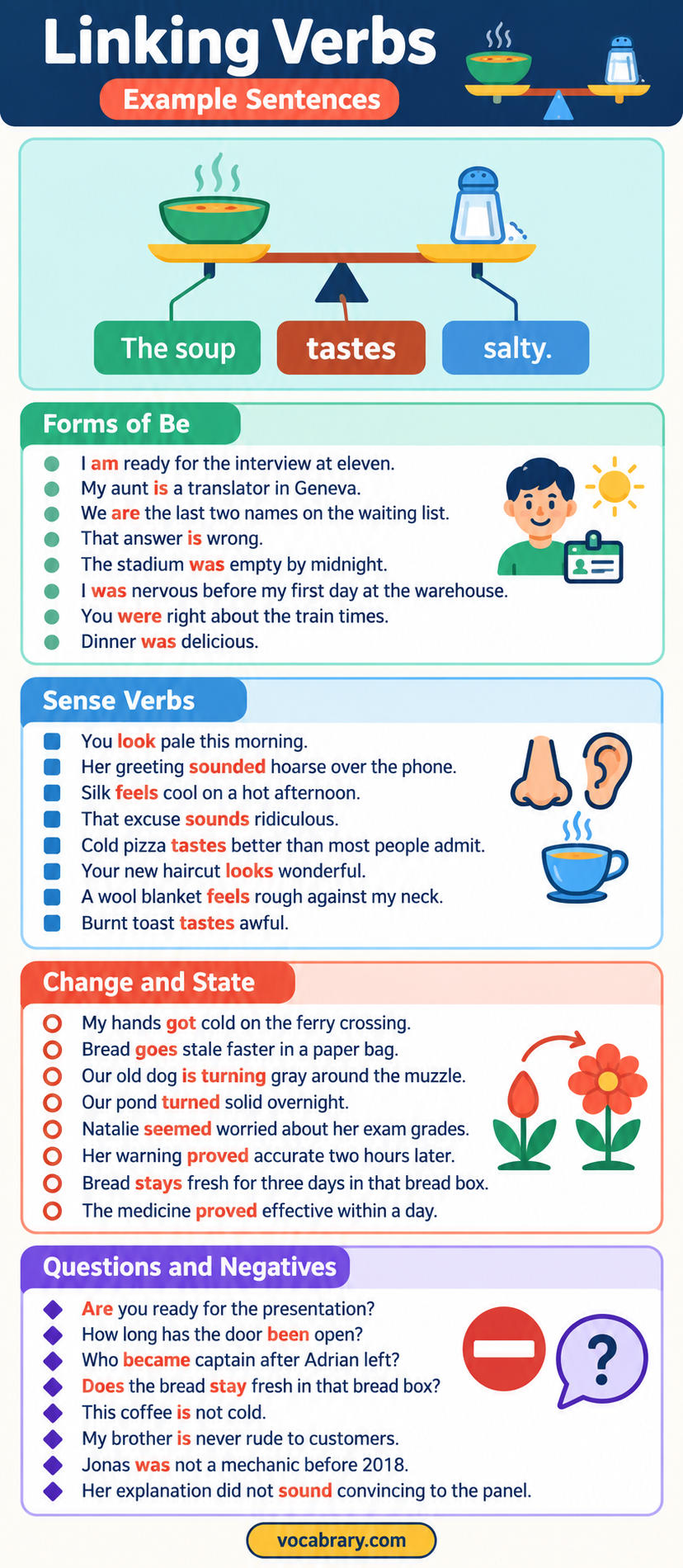
Common Linking Verb Example Sentences
Salty soup, a pharmacist on Nile Street, and a classroom that goes quiet after an announcement fill most linking verb example sentences. In each one the verb ties a person or thing to the word that describes or renames it.
- The soup tastes salty, so nobody asked for a second bowl.
- Fatima is a pharmacist at the clinic on Nile Street.
- My grandfather looks tired after the long drive from Bursa.
- Those mangoes smell ripe.
- After the announcement, the whole classroom grew quiet.
- Kwame became a firefighter three years ago.
- Outside, the weather turned cold overnight.
- Her explanation sounded honest to everyone at the table.
- Both windows remained open during the storm.
- I feel hungry already.
- That old bridge is unsafe for lorries.
- Diego seemed nervous before his driving test, although his instructor praised his parking.
- Milk goes sour fast in this heat.
- You are the only person with a spare set of keys.
- A rumour about the merger proved false within a week.
- Our kitchen floor stays cold from November until March.
- Ines is a violinist from Bogota.
- Lena felt proud of her younger brother.
- Tea gets cold quickly in a thin cup.
- His hands were rough from the fishing nets.
- Everything inside the abandoned museum appeared untouched since the flood of 1970.
- This jacket is mine.
- The twins look identical in old photographs.
- Nadia has been ill since Tuesday.
- By nine o’clock the corridor fell silent.
Linking Verbs With Be in Sentences
Be is the linking verb English uses most, and am, is, are, was, were, and been supply its forms. A goalkeeper, an empty stadium, and a translator in Geneva all reach their description through one of these six words.
Am, Is, and Are in Present Sentences
I takes am, a single person or thing takes is, and a group takes are. A hungry swimmer, a library open until nine, and two cousins named Priya and Tom show the three present forms tying a person or thing to what describes it.
- I am ready for the interview at eleven.
- Hassan is the goalkeeper this season.
- These peaches are ripe enough to eat.
- My aunt is a translator in Geneva.
- You are late again.
- The library is open until nine on Thursdays.
- We are the last two names on the waiting list.
- Rain is heavy along the coast tonight.
- Priya and Tom are cousins.
- That answer is wrong.
- I am the shortest player on the whole basketball team.
- Both parcels are heavy, so the courier needs a trolley for the stairs.
- Amara is hungry after swimming for an hour.
- Your shoes are wet.
Was, Were, and Been in Past Sentences
Was and were push the same link into the past, and been follows has, have, or had. A tiny first flat, two classmates in Tunis, and a widow since 2009 all take a past description this way.
- The stadium was empty by midnight.
- Our first flat was tiny, cold, and two floors over a bakery.
- Karim and Sofia were classmates in Tunis.
- I was nervous before my first day at the warehouse.
- Those instructions were wrong.
- Grandma has been a widow since 2009.
- Every pavement in the old town was slippery after the frost.
- You were right about the train times.
- Marco has been cheerful all week.
- Dinner was delicious.
- The players were exhausted by the final whistle.
- My cousins have been vegetarians since childhood.
- It was a mistake.
- Everyone in the waiting room was silent except a toddler with a toy drum.
Sense, Change, and State Linking Verbs
Beyond be, three families of linking verbs make the same connection: the five sense verbs, the verbs of change, and the verbs of unchanged condition. Ripe mangoes, a sky that turns orange, and a locked door all depend on one of them.
| Linking verb | What it joins | Example sentence |
|---|---|---|
| Is | A person to a job title | Fatima is a pharmacist in Cairo. |
| Are | Two people to a shared quality | The twins are hungry after practice. |
| Was | A place to a past condition | The hall was empty at midnight. |
| Been | A person to a long-held mood | Marco has been cheerful all week. |
| Look | A person to a visible condition | You look pale this morning. |
| Sound | A spoken excuse to an impression | Her excuse sounded false. |
| Smell | A thing to an odour | The kitchen smells wonderful. |
| Taste | Food to a flavour | This mango tastes sweet. |
| Feel | A person to a physical sense | My fingers feel numb. |
| Become | A person to a new role | Hana became a pilot in June. |
| Seem | A person to an apparent mood | The visitors seemed nervous. |
| Remain | A thing to an unchanged condition | The gate remained locked. |
Sense Linking Verbs: Look, Sound, Smell, Taste, and Feel
Look, sound, smell, taste, and feel stop being actions when nobody performs them. A pale face, a hoarse greeting, a bakery at six in the morning, and bitter medicine all describe themselves through one of these five verbs.
- You look pale this morning.
- Her greeting sounded hoarse over the phone.
- The bakery on the corner smells wonderful at six in the morning.
- This mango tastes sweet.
- Silk feels cool on a hot afternoon.
- Dad looked delighted when the parcel arrived.
- That excuse sounds ridiculous.
- Gauze from the clinic smelled of iodine and old plaster.
- Cold pizza tastes better than most people admit.
- I feel dizzy whenever I stand up too fast.
- Your new haircut looks wonderful.
- The engine sounded rough on the climb out of the valley.
- Wet dog smells terrible in a small car.
- The medicine tasted bitter, so Amina hid it in a spoonful of yoghurt.
- A wool blanket feels rough against my neck.
- Marco looks older in his passport photograph than in real life.
- Once the choir left, the hall sounded empty.
- These roses smell sweeter than the white ones by the gate.
- Burnt toast tastes awful.
- My fingers felt numb after the bus ride.
Change Linking Verbs: Become, Get, Grow, Turn, and Go
Become, get, grow, turn, and go mark a move from one condition to another. Sour milk, an orange sky before a storm, green traffic lights, and a well that runs dry all end up somewhere new.
- Kwame became a paramedic after two years of training at the city hospital.
- Over the harbour, the sky turned orange before the storm.
- My hands got cold on the ferry crossing.
- Nights in the desert grow freezing within an hour of sunset.
- The milk went sour before anyone opened it.
- Elena became impatient with the delay.
- Bread goes stale faster in a paper bag.
- Traffic lights turned green at last.
- Everyone got quiet when the head teacher walked in.
- Saplings grow tall beside the river.
- Our old dog is turning grey around the muzzle.
- Yusuf grew restless during the second half of the film.
- Soup gets thick as it cools.
- Her dream of owning a bookshop came true in March.
- Our pond turned solid overnight.
- Leaves become brittle by late October.
- The well ran dry during the third summer without rain.
- Hassan got angry about the parking fine.
State Linking Verbs: Seem, Appear, Remain, Stay, and Prove
Seem, appear, remain, stay, and prove report a condition without any movement at all. A worried student, a calm suspect, locked doors, and an accurate warning show how each verb ties a description to the person or thing in front of it.
- Nadia seemed worried about her exam marks.
- Marek appeared calm throughout the police interview.
- Both doors remained locked all weekend.
- Please stay calm.
- Her warning proved accurate two hours later.
- Your plan seems sensible to me.
- Nothing in the report appeared unusual.
- Prices remained steady for the whole quarter.
- Bread stays fresh for three days in that tin.
- His alibi proved worthless once the footage arrived.
- Tomas seemed older than his twenty years.
- From a distance the water appeared shallow, and three swimmers misjudged it badly.
- Our seats remained empty because the train broke down at Crewe.
- Grandpa stayed silent through the whole argument.
- The medicine proved effective within a day.
- Everything seemed normal until the lights flickered.
- The dressing room remained quiet after the defeat.
- That shortcut proved longer than the main road.
Linking Verbs Followed by an Adjective
An adjective after a linking verb describes the person or thing itself, never the verb. A narrow corridor, a frozen lake, sour grapes, and a golden garden in October all take their description from the word straight after the verb.
- The corridor is narrow.
- Amina felt confident before the oral exam.
- Those instructions sound confusing to a first-time user.
- My tea has gone cold.
- Rafael looks exhausted after the night shift.
- The lake stayed frozen until the middle of March.
- Grapes taste sour before they ripen fully.
- Everyone in the queue grew impatient.
- Her new flat is bright and quiet.
- The referee seemed unsure about the penalty.
- Winter mornings feel longer in the north of Sweden.
- Salted butter smells richer than the unsalted kind.
- Omar became hoarse after two hours of shouting on the terraces.
- That story proved untrue.
- Both goalkeepers remained alert until the final minute of a tense extra time.
- Our garden turns golden in October.
Linking Verbs Followed by a Noun
A noun after a linking verb renames the person or thing instead of describing it. An architect in Rotterdam, a retired postman who won a prize, and a school that turned into a hotel each get a second name this way.
- Nelson Mandela became president of South Africa in 1994.
- My sister is an architect in Rotterdam.
- Those two boys are twins.
- Amir remained captain for another season.
- The winner was a retired postman from Leeds.
- Chess is my grandmother’s only hobby.
- You are the reason this team qualified.
- Frida Kahlo became one of Mexico’s best-known painters.
- Our old school is a hotel now.
- Kenji stayed a vegetarian for eleven years.
- The parcel on the step was a birthday present from Lagos.
- Mount Everest is the highest mountain on the planet.
- Both candidates were teachers before the election.
- That building became a hospital during the war.
- Rain is the one hope every farmer in the valley has right now.
- Hana is a pilot with a regional airline.
Linking Verbs in Past Tense Sentences
Was, became, looked, felt, and proved move the link back in time. A freezing concert hall, a cold coffee beside unanswered emails, and an unpopular verdict all describe a condition that has already passed.
- Friday night in the concert hall was freezing.
- Yusuf became a father in September.
- Everything on the table looked delicious.
- My coffee turned cold while I answered emails.
- Their verdict proved unpopular with both families.
- Ana felt guilty about missing the funeral.
- Both tyres were flat by the time we reached Perugia.
- Dinner smelled wonderful from the corridor.
- The crowd grew restless after the third delay.
- Leila stayed cheerful through six hours of rain.
- His excuse sounded rehearsed.
- The old cinema remained shut for eleven years.
- Snow got deeper with every kilometre.
- Nothing in the attic appeared valuable until the auctioneer opened the trunk.
Linking Verbs in Questions and Negatives
Turning a linking sentence into a question or a denial changes the word order, not the link. Sour milk, an icy road, a jacket that looks ridiculous, and bread that has not gone stale all keep their description on the far side of the verb.
Linking Verbs in Question Sentences
Questions put be in front of the noun or pronoun, and they hand every other linking verb to do, does, or did. A jacket, a pot of soup, a tin of bread, and a suddenly quiet room each get checked this way.
- Are you ready for the presentation?
- Why does the milk taste sour already?
- Is Nadia a nurse or a paramedic?
- How long has the door been open?
- Were the roads icy last night?
- Does this jacket look ridiculous on me?
- Who became captain after Amir left?
- Am I late?
- Why did everyone grow so quiet?
- Is the soup hot enough for you?
- Does the bread stay fresh in that tin?
- Which of these two paintings seems older to you?
- Was the hotel expensive?
- How did the tomatoes turn ripe so fast in a cold greenhouse?
Linking Verbs in Negative Sentences
Not and never come before the linking verb and cancel the description behind it. Coffee that is not cold, forged documents, unripe tomatoes, and a doctor who never qualified show the denial at work.
- This coffee is not cold.
- Marta did not seem worried about the interview.
- Those documents were not genuine.
- My brother is never rude to customers.
- The bread has not gone stale yet.
- Nothing about that offer sounds honest.
- Jonas was not a mechanic before 2018.
- Our flight is not full.
- Kids in the back row did not stay quiet for long.
- Her explanation did not sound convincing to the panel.
- These tomatoes are not ripe.
- Karim never became a doctor, although his parents expected it from the day he was born.
- The lake is not deep enough for diving.
- Rain in July is not unusual in Manchester.
Linking Verb Sentences at School, Work, and Home
Three familiar settings supply most practice sentences. A freezing Monday classroom, an office that smells of burnt coffee, and a broken kettle put the same verbs into places learners already recognise.
Linking Verb Sentences at School
A Ghanaian science teacher, a head girl chosen in September, and two broken projectors give the school day its descriptions. Classrooms, corridors, and timetables take their description from the word after the verb.
- The new science teacher is Ghanaian, and her lessons start with a puzzle.
- Maths feels harder this term.
- Our classroom was freezing on Monday.
- Ayesha became head girl in September.
- Between lessons the corridor grew noisy.
- Exam week seems endless.
- Both projectors are broken again.
- Daniel looked relieved after the oral test.
- School dinners taste better than their reputation.
- The library stays open until six on Fridays.
- My timetable is a mess this year.
- Twelve students were absent with flu.
Linking Verb Sentences at Work
A patient manager, a head of payroll appointed last spring, and two printers with no toner run the working week. Colleagues, warehouses, and frozen wages all reach their description through a linking verb.
- My manager is patient with new staff.
- The office smells of burnt coffee every afternoon, and nobody admits to leaving the pot on.
- Rosa became head of payroll last spring.
- Deadlines feel tighter since the merger.
- Our warehouse stays cold all year.
- Her interview seemed shorter than twenty minutes.
- Both printers are empty.
- Tomas looks exhausted after four night shifts in a row.
- That client was rude to the receptionist.
- Wages remained frozen for two years.
- The lift is out of order again.
- Ahmed proved reliable during the busiest week of the year.
Linking Verb Sentences at Home
A broken kettle, a lumpy sofa, and tea that tastes of cardamom describe a house through its linking verbs. Kettles, sofas, and grandmothers take their quality from the word after the verb.
- The kettle is broken.
- My little sister became afraid of the dark after a storm.
- Dinner smells wonderful from the hallway.
- Our sofa feels lumpy in the middle.
- Grandma stays cheerful even on long grey afternoons in the middle of February.
- Water from the bathroom tap sounds like a drum at night.
- Both bedrooms are tiny.
- My father looks younger than his sixty years.
- That old fridge went empty three days before payday.
- Laundry day is every Saturday morning in our house.
- Tea in this house tastes of cardamom.
- Rahul got hungry an hour after lunch.
Linking Verb Sentences About Weather, Food, and Health
Descriptions of the sky, the dinner table, and the body use linking verbs more than any other verb type. A threatening sky, metallic tap water, a swollen ankle, and a bruise that turns yellow all need one.
Weather and Food Sentences With Linking Verbs
A threatening sky over the hills, a curry hotter than last week’s, and tap water with a metallic edge belong to the same group. Each one takes its description from a sense verb or a verb of change.
- The sky looks threatening over the hills.
- This curry tastes hotter than the one we ordered last week.
- November evenings grow dark before five.
- Fresh basil smells wonderful on warm bread.
- After midnight the wind turned bitter.
- Pineapple is sweeter when the skin has gone slightly brown.
- Our tap water tastes metallic.
- Thunder sounded close, and the family dog hid under the stairs until morning.
- Snow in the valley stayed deep for three weeks.
- Melted butter feels greasy on the fingers.
- Yesterday was the hottest day of the year in Seville.
- Rice gets sticky when the pot loses its lid.
- Onions smell sharp before frying.
- The forecast proved wrong again.
Health and Feelings Sentences With Linking Verbs
A feverish patient, a pale face after a blood test, a swollen ankle, and a mood that stays low all winter belong to the language of health. Feel, look, grow, and remain report the condition without any action.
- I feel feverish.
- Amara looked pale after the blood test.
- My ankle is swollen.
- Grandpa became breathless on the second flight of stairs.
- Everyone seemed relieved once the ward doors opened.
- Your hands feel freezing.
- The waiting room was silent.
- Malik grew anxious during the long wait for a diagnosis from the specialist.
- This cough sounds worse than yesterday.
- Rita is allergic to penicillin.
- His mood stayed low for most of the winter.
- The bruise turned yellow within four days.
- I felt faint on the crowded platform.
- Nadia remained calm while the nurse searched for a vein.
The Same Verb as a Linking Verb and an Action Verb
A chef who tastes the soup performs an action, while soup that tastes salty only receives a description. Taste, smell, look, feel, and sound belong to both groups, and so do grow, turn, prove, and get.
- Soup in the blue pot tasted salty, while the chef tasted it twice before serving.
- Fresh bread smelled wonderful, and Daniel smelled each loaf at the counter.
- Her face looked calm, though she looked at the clock twice in a minute.
- Our towel felt damp, so Aisha felt the radiator to check the heat.
- Milk went sour, and Tom went to the shop.
- That old radio sounded faint, and the driver sounded his horn at the crossing.
- Tomatoes grew ripe in August, and my uncle grew them from seed.
- The sky turned orange while the pilot turned the aircraft toward the coast.
- A ghost appeared harmless in the opening scene, and the actor who played it appeared on stage at eight.
- His excuse proved false, and the lawyer proved her case within an hour.
- Hassan got hungry by noon, so he got a sandwich from the canteen.
Sentences Rewritten With the Correct Word After the Linking Verb
An adjective follows a linking verb, never an adverb, because the word describes the person or thing rather than the verb. Bad and badly, delicious and deliciously, sweet and sweetly are the pairs learners swap most.
- Rosa feels bad about the broken window ✅, never Rosa feels badly about the broken window ❌, because a linking verb takes an adjective.
- This stew tastes delicious ✅, not this stew tastes deliciously ❌.
- You look wonderful in that jacket ✅, never you look wonderfully in that jacket ❌.
- Our choir sounded beautiful last night ✅, not our choir sounded beautifully last night ❌.
- The roses smell sweet ✅, not the roses smell sweetly ❌.
- Nadia became quiet after the phone call ✅, never Nadia became quietly after the phone call ❌.
- Milk goes sour overnight in this weather ✅, not milk goes sourly overnight ❌.
- Everyone remained calm during the fire drill ✅, never everyone remained calmly during the fire drill ❌.
- Their plan seemed reasonable to the committee ✅, not their plan seemed reasonably to the committee ❌.
- Karim felt confident before the interview ✅, not Karim felt confidently before the interview ❌.
- That engine sounds rough this morning ✅, not that engine sounds roughly this morning ❌.
- Everything tasted strange after the antibiotics ✅, not everything tasted strangely after the antibiotics ❌.
Linking Verb Examples for Kids and Students
Classroom practice starts with a brown puppy and a sweet apple, then moves to burnt union coffee and a repetitive final paragraph. The verb behaves identically at both levels.
Linking Verb Examples for Kids
A brown and white puppy, red balloons, a muddy playground, and a birthday boy give young readers their first linking verbs. Every sentence names something a child already sees at home or in the playground.
- My puppy is brown and white.
- The apple tastes sweet.
- Sam feels happy on his birthday.
- Those balloons are red.
- Mum looks pretty in her blue dress.
- That playground gets muddy after rain.
- Our cat became fat over the winter holidays.
- Grandpa is seventy today.
- Ice cream feels cold on my teeth.
- The story sounded funny.
- Lily is the tallest girl in class two.
- Popcorn smells amazing at the cinema, and my brother always wants two bags.
- Our teacher seemed tired this morning.
- Frogs become noisy after heavy rain.
Linking Verb Examples for Students
A repetitive final paragraph, lecture halls that stay cold, burnt coffee in the union bar, and a generous deadline that shrinks by reading week belong to student writing. Each one joins a person, place, or task to its description.
- The final paragraph sounds repetitive in your essay.
- Referencing becomes easier after the second assignment.
- My flatmate is a chemistry student from Seoul.
- Lecture halls stay cold.
- That deadline seemed generous until reading week.
- Both supervisors were patient with my first draft.
- Coffee in the union bar tastes burnt.
- Priya became editor of the student paper in her second year.
- The exam timetable is brutal this term.
- Nights in the library grow long in April.
- His dissertation proved stronger than he expected after three months of quiet panic.
- Group work feels slower than working alone.
Short Linking Verb Sentences for Young Learners
Three or four words are enough for a first linking verb. A blue sky, a pink hat, cold milk, and busy bees let five-year-olds meet the pattern before they meet the name for it.
- The sky is blue.
- I am six.
- Dad looks happy.
- Milk tastes sweet.
- We are twins.
- Her hat is pink.
- The soup smells good.
- Bees are busy.
- My shoes are new.
- Rain feels wet.
- Tom is my best friend in the whole of year three.
- Cats become sleepy after lunch.
Linking Verbs in Stories and Paragraphs
Narrative writing uses linking verbs to set a mood before anything happens. A lonely lighthouse keeper, blood that looks fresh on a doorstep, and a manor where every clock runs slow arrive through description rather than action.
Linking Verbs in Short Stories
A lighthouse keeper who grows lonelier each winter, a stranger who turns less trustworthy by chapter three, and a cellar that smells foul open most suspense scenes. Description sets the mood before the plot starts.
- A lighthouse keeper grew lonelier with every winter.
- By the third chapter the stranger seemed less trustworthy.
- Her cottage was the last house before the marsh.
- Blood on the doorstep looked fresh.
- By the final chapter the detective became certain of the butler’s guilt.
- Something in the cellar smelled foul.
- Wind through the broken shutters sounded human.
- Prince Anton remained silent while his brothers argued over the crown for a whole evening.
- Every clock in the manor was ten minutes slow.
- Elias felt small beside the frozen river.
- Their map proved useless once the fog closed in.
- The courtyard turned gold at dawn.
Linking Verb Sentences in Short Paragraphs
A dark kitchen before an interview, a carpenter whose hands roughen over thirty years, and a village river that runs brown after a factory opens each need five or six linking verbs in a row.
- The kitchen was dark when Nadia woke. Coffee from the night before smelled bitter, and the bread had gone stale. Outside, the street looked empty. By seven the sky turned pale grey and the air grew warmer. Nadia felt ready for the interview at last.
- Marek was a carpenter for thirty years. His hands became rough, his shoulders grew heavy, and the workshop smelled of pine every evening. Customers remained loyal because his shelves never sagged. After he retired the workshop stayed silent for a month. Then his daughter became the new owner.
- Amira felt calm until the first bell sounded loud in the corridor. The exam hall seemed enormous at half past eight. Paper on every desk looked identical. Her pen was dry after twenty minutes, and her handwriting grew untidy. By noon the room smelled of warm dust, and every candidate appeared exhausted.
- Rain on the tin roof sounded gentle at first. Within an hour the yard became a pond, the path grew slippery, and the goats were restless. My uncle stayed calm, because floods are normal here in March. By evening the water was low again and the air smelled sweet.
- Our village was quiet until the factory opened. Within two years the river turned brown, the air smelled of chemicals, and the old well went dry. Farmers grew angry at every meeting. The mayor remained silent for months. Last spring the factory became a warehouse, and the water is safe again.
Related
FAQs
An everyday example is "The soup tastes salty, so nobody asked for a second bowl." Another is "Frances is a pharmacist at the clinic on Maple Street."
With "be", one example is "The library is open until nine on Thursdays." Another is "Grandma has been a widow since 2009."
Among sense verbs, one example is "The bakery on the corner smells wonderful at six in the morning." Another is "My fingers felt numb after the bus ride."
A change example is "Over the harbor, the sky turned orange before the storm." Another is "Leaves become brittle by late October."
One state example is "Everything seemed normal until the lights flickered." Another is "Prices remained steady for the whole quarter."
With an adjective complement, one example is "Everyone in line grew impatient." Another is "Our garden turns golden in October."
A noun example is "My sister is an architect in Rotterdam." Another is "That building became a hospital during the war."
From the classroom, one example is "Between lessons the hallway grew noisy." Another is "The library stays open until six on Fridays."
As a question, one example is "How long has the door been open?" A negative example is "Rain in July is not unusual in Manchester."
For young children, one example is "My puppy is brown and white." Another is "Frogs become noisy after heavy rain."
Related:

Leave a Comment