
Was and were are the past tense forms of the verb "be", as in the museum was closed and the twins were late. Most was and were example sentences describe people, places, and weather at a finished moment in the past, so the pronoun before the verb decides which form is correct.
What Are Was and Were?
Was and were mark the past of "be", and the word in front of them settles the choice: was follows I, he, she and it, while were follows you, we and they. The present forms am, is and are describe the moment of speaking, while was and were describe a time already finished.
I, he, she, it + was … you, we, they + were
The concert hall was empty, and the streets outside were silent.
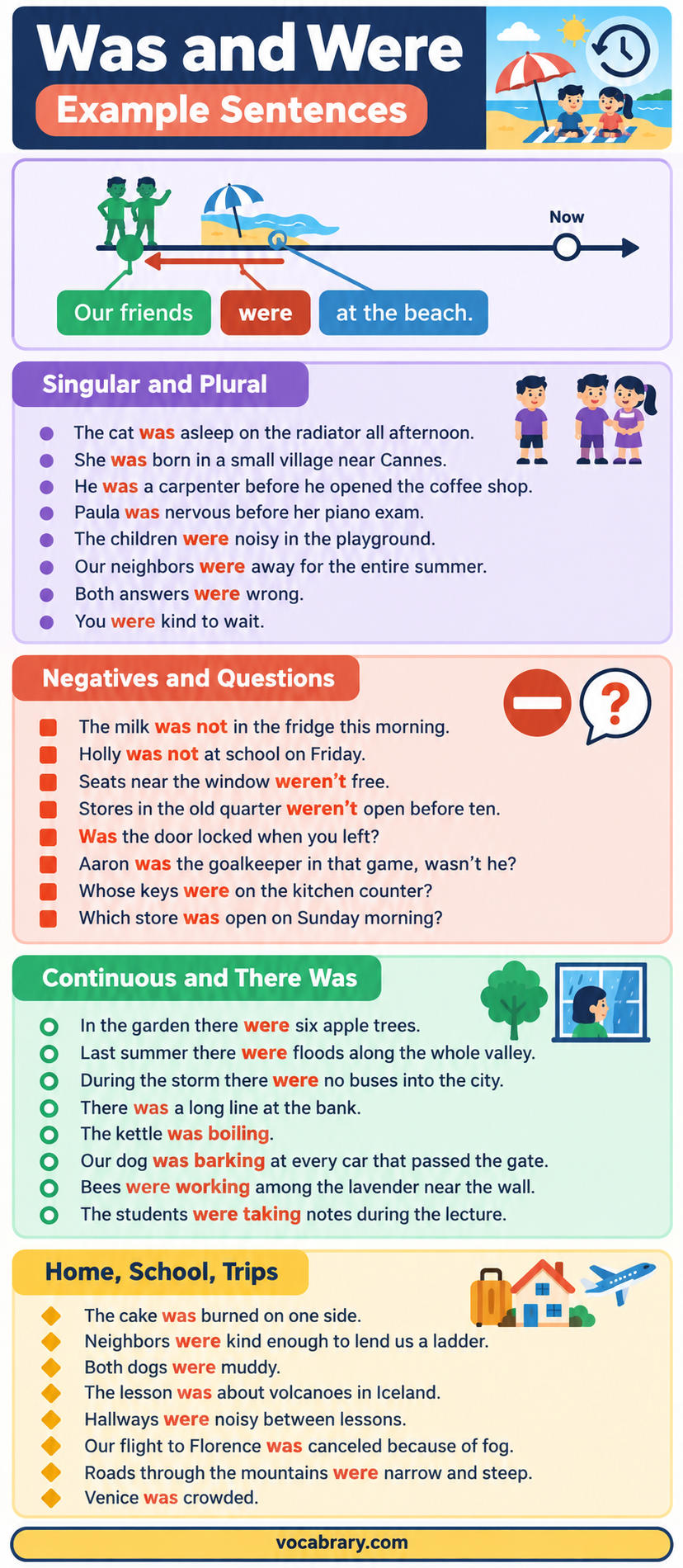
Common Was and Were Example Sentences
A museum closed for repairs, twins born in Manila, and empty streets at dawn fill the everyday was and were example sentences, one form for a single thing, the other for several.
- The museum was closed for repairs last Monday.
- My cousins were at the airport three hours early.
- Sara was the only student in the class who finished the whole test before the bell.
- Both teachers were pleased with the science project.
- It was colder in Oslo than the forecast promised.
- We were neighbours for eleven years before they moved to Cairo.
- The bread was still warm.
- Those shoes were far too small for Amir.
- Her answer was correct.
- You were right about the train timetable.
- I was at the dentist all Tuesday morning.
- Rain was heavy on the night of the concert.
- The twins were born in Manila.
- His hands were covered in paint after the art lesson.
- Grandma was a nurse for thirty years in Glasgow.
- Everyone in the audience was surprised by the ending of the film.
- Diego and Lucia were partners for the debate competition.
- Tickets were cheaper before the festival began.
- Nobody was hungry after such a long lunch.
- Outside, the streets were empty at five in the morning.
Sentences With Was
A cat asleep on the radiator, a bus twenty minutes late, and one loaf of bread on the shelf all take was, the form used for a single person or thing.
- The cat was asleep on the radiator all afternoon.
- Yusuf was captain of the school football team.
- My phone was flat by the middle of the day.
- She was born in a small village near Kandy.
- Our bus was twenty minutes late again.
- Winter was mild.
- Mei was first in the queue outside the bakery.
- Water in the lake was warmer than anyone had expected during the first week of April.
- One loaf of bread was left on the shelf.
- He was a carpenter before he opened the coffee shop.
- That old car was noisy but reliable.
- It was a Tuesday when the letter finally arrived.
- The film was longer than three hours.
- Priya was nervous before her piano exam.
- Every window in the house was covered with frost that morning.
- Her party was over by nine.
Sentences With Were
Noisy children in a playground, neighbours away all summer, and a friend addressed directly as you all take were, the plural past form of be.
- The children were noisy in the playground.
- You were the fastest runner in the whole race.
- Kofi and his brother were late for the wedding.
- Our neighbours were away for the entire summer.
- They were best friends from the age of six.
- Street lights were off when we arrived.
- Several passengers were asleep on the night train from Budapest to Vienna.
- Elena and I were in the same class for four years.
- Both answers were wrong.
- Mountains behind the town were hidden by thick cloud.
- We were at the museum when the storm started.
- My shoes were wet after the walk through the field.
- Eggs from the farm down the road were fresh that morning.
- You were kind to wait.
- Nkechi’s paintings were the best in the gallery that evening.
- Those questions were harder than last year’s.
Was and Were Forms for Every Pronoun
I, he, she and it take was, while you, we and they take were, so a library visit and a shared flight to Lagos change form with the pronoun in front of the verb.
| Pronoun | Form | Example sentence |
|---|---|---|
| I | Was | I was at the library all morning. |
| You | Were | You were the fastest runner in the race. |
| He | Was | He was nervous before the interview. |
| She | Was | She was the first to arrive. |
| It | Was | It was colder than the forecast promised. |
| We | Were | We were neighbours for eleven years. |
| They | Were | They were on the same flight to Lagos. |
- I was tired after the long drive from Porto.
- You were already awake when the alarm rang.
- He was the tallest boy in the family.
- She was proud of her younger sister.
- It was windy on the coast road yesterday.
- We were together at the concert in Berlin.
- They were hungry after the football match.
- Rahul and you were the last two people in the hall.
Negative Sentences With Was Not and Were Not
Milk missing from the fridge, a phone with no charge, and builders absent on a public holiday give was not and were not, shortened to wasn’t and weren’t in speech.
- The milk was not in the fridge this morning.
- They were not ready when the taxi arrived.
- My phone wasn’t charged, so I missed the call.
- Those instructions weren’t written in English.
- Hana was not at school on Friday.
- We weren’t hungry after the enormous breakfast that Ingrid cooked for the whole family.
- It wasn’t raining when the parade started.
- Builders were not on site because of the public holiday.
- I wasn’t angry.
- You weren’t listening while Omar explained the route.
- Dinner was not ready until nine o’clock.
- Seats near the window weren’t free.
- Tomas wasn’t aware of the change to the timetable.
- Our bags were not heavy.
- She wasn’t the person who signed the form on Monday.
- Shops in the old quarter weren’t open before ten.
Question Sentences With Was and Were
A locked door, a cancelled train and the pyramids at Giza turn into questions with was and were in front of the pronoun or noun.
- Was the door locked when you left?
- Were they at the party until midnight?
- Where were you yesterday afternoon?
- Why was the train cancelled again?
- Amir was the goalkeeper in that match, wasn’t he?
- How were the exam questions this year?
- Who was the first person to reply to the wedding invitation that Lucia sent?
- Were the tickets expensive?
- What was the weather like in Lisbon?
- When were the pyramids at Giza built?
- Whose keys were on the kitchen counter?
- Tell me honestly, was it your idea to walk the whole way home?
- How much was the taxi from the airport?
- Were you asleep when Fatima knocked on the door?
- Which shop was open on Sunday morning?
- Was the thunder frightening for the children?
Short Answers With Was and Were
A late bus, unfinished homework and a passport in the drawer produce Yes, it was and No, they weren’t, replies that repeat only the pronoun and the past form of be.
- Asked whether the bus was late, Tom nodded and said, "Yes, it was."
- Marta wondered if the twins were asleep, and their father whispered, "No, they weren’t."
- "Were you at the meeting?" the manager asked. "Yes, I was."
- When Noor asked if the shops were open, Samir answered, "No, they weren’t."
- "Was the film any good?" Lucia asked. "No, it wasn’t."
- Olu checked whether his passport was in the drawer, and his sister replied, "Yes, it was."
- "Were the seats comfortable?" "Yes, they were."
- Dmitri asked whether we were hungry, and every one of us said, "Yes, we were."
- "Was she angry?" "No, she wasn’t."
- Leila asked if the homework was finished, and Pedro admitted, "No, it wasn’t."
There Was and There Were in Sentences
Apple trees in a garden, a noise in the attic and three missed calls give there was for one thing and there were for several.
- In the garden there were six apple trees.
- There was a strange noise in the attic last night.
- Last summer there were floods along the whole valley.
- Behind the house there was a narrow path to the river.
- Yesterday there were three missed calls from an unknown number.
- On the shelf there was a jar of honey from Aiko’s farm.
- Before the match there were fireworks over the stadium.
- Under the bed there was nothing.
- During the storm there were no buses into the city.
- After the earthquake there was no electricity for two days.
- Near the station there were dozens of bicycles chained to the railings outside the ticket office.
- There were only four people in the cinema.
- At the back of the hall there was a piano nobody played.
- Outside the bakery there were queues every Saturday morning.
Was and Were in the Past Continuous
Children playing in the street, a kettle boiling and passengers waiting on a cold platform put was and were before an -ing verb, which is how the past continuous tense is built.
- Children were playing in the street when the rain started.
- I was reading a novel by Chinua Achebe on the flight to Accra.
- Zara was cooking dinner while her brother set the table.
- The kettle was boiling.
- Passengers were waiting on a cold platform for the delayed train.
- We were walking home from the market when we met Grandpa.
- You were talking in your sleep again.
- Our dog was barking at every car that passed the gate.
- My parents were arguing about the price of the new sofa.
- Snow was falling steadily on the roofs of the old town.
- Marcus was studying for his medical exams all through August.
- Hundreds of fans were singing outside the stadium for two hours before the match started.
- She was writing an email when the power went out.
- Bees were working among the lavender near the wall.
- Chen was fixing his bicycle in the yard.
Was and Were in Passive Sentences
A bridge built in 1889, invitations sent by email and a wallet found on a bus give was built, were sent and was found, with a past participle after the verb.
- The bridge was built in 1889 by a local engineer.
- Invitations were sent by email on Friday.
- My wallet was found on the bus and returned to me the same afternoon.
- Those houses were painted white after the storm damage.
- Her novel was translated into fourteen languages.
- Two hundred trees were planted along the new cycle path.
- Our order was delivered to the wrong address.
- Windows were cleaned before the inspection.
- A new hospital was opened in Nairobi last spring.
- Documents were signed in front of two witnesses.
- Dinner was served.
- All the tickets were sold within an hour of going on sale online.
Was and Were With Time Expressions
Yesterday, last night, two years ago and in 2019 fix the moment for was and were, alongside a wedding in Seville and a power cut on Tuesday.
- Yesterday was the coldest day of the month.
- Last night was quiet.
- In 2019 we were living in a flat over a bakery in Lima.
- Two years ago Ingrid was still a trainee at the hospital.
- Last Tuesday there was a power cut across three streets.
- The wedding in Seville was on the last Saturday in June.
- At six o’clock the shop was already closed.
- My grandparents were young during the 1960s.
- This time last week we were on a ferry that sailed overnight to Santorini.
- In those days flights were far cheaper than trains.
- On Monday morning the office was empty.
- Olympic Games in Tokyo were delayed until 2021.
Was and Were in Everyday Places
Kitchens, classrooms, offices and airport halls supply most of the past forms of be that learners need, among them a burnt cake and a cancelled flight.
At Home and With Family
A burnt cake, a washing machine broken for a fortnight and cousins asleep on the sofa are the household cases of was and were.
- The cake was burnt on one side.
- My cousins were asleep on the sofa when I came in from work.
- Mum was in the garden, planting onions.
- Our washing machine was broken for a fortnight.
- Neighbours were kind enough to lend us a ladder.
- Dad was the one who forgot the shopping bag.
- Curtains in the living room were new last month.
- Both dogs were muddy.
- Breakfast was late on Sunday.
- Grandma’s stories about her childhood in Cork were longer than anyone remembered.
At School and in the Classroom
A lost pencil case, twelve pupils absent with flu and a class trip to the natural history museum come from school days, where was follows one pupil and were the whole class.
- The lesson was about volcanoes in Iceland.
- Twelve pupils were absent with flu.
- My pencil case was at the bottom of my bag.
- Exam questions were fair.
- Ana was the only one who solved the last problem on the maths paper.
- We were on a class trip to the natural history museum.
- Corridors were noisy between lessons.
- Her marks in chemistry were the highest in the year.
- The library was open until six on weekdays.
- Rulers and compasses were in short supply that term.
At Work and in the Office
A jammed printer, a meeting moved to Thursday and two colleagues stuck in traffic describe a finished working day with was and were.
- The printer was jammed again this morning.
- Two colleagues were stuck in traffic on the ring road.
- Our meeting was moved to Thursday afternoon.
- Sales in March were better than anyone on the team had predicted at the start of the year.
- My laptop was slow after the update.
- Interviews were held in a small room on the fourth floor.
- Emeka was promoted to shift manager in the spring.
- Deadlines were impossible.
- The coffee machine was out of order.
- Clients were patient about the delay.
On Holiday and on Trips
A flight cancelled because of fog, a hotel beside the sea and a suitcase left in Rome are the travel cases of was and were.
- Our flight to Marrakesh was cancelled because of fog.
- We were at the beach every morning before eight.
- The hotel was right beside the sea.
- Roads through the mountains were narrow and steep.
- My suitcase was left behind in Rome.
- Tour leaders were friendly and well informed.
- Venice was crowded.
- Both ferries were full by midday.
- Postcards from Kyoto were still on the kitchen table in the middle of November.
- The hostel near the harbour was cheaper than any hotel in the old town.
Describing People and Places in the Past
A grandfather with silver hair, a harbour full of fishing boats and a square under snow show was and were attaching a quality to a person or a place.
- My grandfather was tall, with silver hair and a very slow walk.
- The harbour was full of fishing boats painted blue and green.
- Her eyes were darker than her sister’s.
- That old library was cold in winter and dusty in summer.
- Tourists in the square were wrapped in scarves against the snow.
- Lagos was louder and brighter than any city Jonas had visited before that summer.
- Walls of the castle were three metres thick.
- Mrs Alvarez was strict.
- Those mountains were covered in pine forest.
- His singing on the old recording was softer than I remembered.
- Rooms over the shop were small, dark and very cheap.
- Everything in the village was made of the same grey stone.
Was and Were in Stories and Narration
A ship lost in fog, letters under a floorboard and gates rusted shut open the narrative use of was and were, which sets the scene before the action begins.
- The ship was three days out of port when the fog closed in.
- Nobody was awake in the house except the youngest boy.
- Gates of the old factory were rusted shut.
- Anton was certain that somebody had followed him from the station to his door.
- Letters from the soldier were hidden under a loose floorboard.
- It was almost dawn.
- Wolves were rare in that part of the forest.
- The innkeeper was the last person to see the traveller alive.
- Two candles were still burning in the empty chapel.
- Her hands were shaking as she opened the envelope.
If I Were and I Wish Sentences for Unreal Situations
Advice that starts If I were you, a wish for a longer holiday and a daydream about Kyoto use were after I, he and she, the form English keeps for unreal situations.
- If I were you, I would apologise before Monday.
- I wish I were taller.
- She would know what to do about the leak if she were here.
- Marco talks as if he were the owner of the whole building.
- Every August I wish the summer holiday were twice as long.
- The picnic would go ahead if it were not for the rain.
- Suppose you were the head teacher for one day.
- I wish my flat were closer to the station in Kyoto.
- Omar would admit the mistake to his team if he were honest with himself.
- She treats the puppy as though it were a small child.
- If I were in charge of the timetable, nobody would start before nine.
- Nina wishes today were Friday.
Was and Were Examples for Kids
Birthday cake, a puppy under the kitchen table and a rainy sports day give children their first past forms of be, with was for one and were for many.
- My birthday cake was chocolate with orange icing.
- Friends from my class were at the party on Saturday.
- The puppy was under the kitchen table.
- Our shoes were muddy after the rainy sports day.
- I was six years old in that photograph.
- Balloons were red, yellow and green.
- Grandpa was funny.
- We were happy because the ice cream van came to our street on Sunday afternoon.
- That story about the giant was a bit frightening at bedtime.
- Two kittens were asleep in the basket by the door.
- It was my turn to feed the rabbit.
- The swings in the park were wet.
Short Was and Were Sentences for Young Learners
A black cat, a new ball and cold hands keep these sentences to four or five words, so young learners hear was and were with nothing extra around them.
- The cat was black.
- We were happy.
- My ball was new.
- They were at home.
- It was very hot.
- You were first.
- Our hands were cold.
- She was my friend.
- Dad was at work.
Was and Were Sentences for Beginners
A bus stop in the rain, a homework book left at school and soup hot on the stove keep beginner sentences to one idea, with was and were as the only past verb.
- I was at the bus stop in the rain.
- My homework book was still at school.
- Soup on the stove was hot.
- They were in the garden with their bicycles.
- You were at work on Saturday.
- The film last night was very good.
- We were in the same hotel in Prague for three nights last summer.
- His jacket was too big.
- Both doors were already locked.
- She was busy.
- Our tea was cold.
- The children were at the swimming pool until four o’clock.
Was and Were in a Short Paragraph
A power cut on a July evening, candles in the kitchen and neighbours laughing on the pavement join eight sentences into one story told with was and were.
- The evening of the fourth of July was unusually warm in our street.
- At half past eight the lights were flickering, and then the whole road went dark.
- My parents were in the kitchen, searching the drawers for candles.
- For the first time in years, the fridge was completely silent.
- Outside, our neighbours were standing on the pavement, laughing about the timing.
- Stars over the rooftops were brighter than anyone had seen them.
- Nadia was certain that a storm had knocked down a cable.
- By eleven o’clock the power was back, and the street was quiet again.
Related
FAQs
Was and were divide by number: was follows the singular pronouns I, he, she and it, while were follows we, they and you in both its singular and plural senses. The bakery was closed and the shops were closed do the same job, one for a single thing and one for several.
You say I was for anything that really happened, because was is the past form that follows I in ordinary statements such as I was at the dentist on Tuesday. I were survives only in unreal sentences after if and wish, as in If I were you or I wish I were taller.
There was goes with one thing and there were goes with more than one, so there was a jar of honey and there were six apple trees are both correct. The noun after the verb decides the form. The same agreement governs there is and there are in the present.
If I were is the standard form for unreal situations, because English keeps the old subjunctive were after if, wish and as though for every pronoun. If I was suits real past conditions instead, as in If I was rude yesterday, I apologise.
Were combines with the singular pronouns I, he, she and it only in unreal sentences, such as I wish he were here or She acts as if it were her house. In every real past statement those four pronouns take was.
Was and were are verbs, since both are past tense forms of be, which works as a main verb in she was a nurse and as a helping verb in they were waiting. Be is the most irregular verb in English, with eight forms in all: be, am, is, are, was, were, being and been.
Was and were are two forms of one tense, because both are past forms of be and differ only in number. Was matches I, he, she and it, while were matches you, we and they, so a sentence that mixes the two stays entirely in the past.
Ten sentences using was and were start with the singular pronouns: "I was at home", "He was tired", "She was happy", "It was cold", and "The dog was hungry". The other five take plural pronouns and you: "You were early", "We were busy", "They were late", "The boys were noisy", and "There were no eggs left".
Was and were work together whenever one part of a sentence describes a single thing and another part describes several, as in The kitchen was warm, but the bedrooms were freezing. Each form agrees with the noun or pronoun nearest to it.
Where were you is the correct question, because you takes were in the singular and in the plural alike. Where was you turns up in some regional dialects, though examiners and editors treat it as a mistake in written English.
Negative sentences add not straight after the verb, giving was not and were not, which shorten to wasn’t and weren’t in speech and in relaxed writing. The milk wasn’t in the fridge and the builders weren’t on site follow that pattern. Printable practice on both forms is in englishan’s was and were worksheets.

Leave a Comment