
Has, have, and had are the three forms of the verb have, as in she has a bicycle and they had a picnic. Most has have had example sentences name something a person owns or has already finished, so the pronoun in front and the time of the action decide the form.
What Are Has, Have, and Had?
Has, have, and had share one verb between three jobs. Has goes with he, she, it and one named person or thing, have goes with I, you, we, they and every plural noun, and had takes over once the moment is past. Am, is, and are describe what somebody is, while has, have, and had name what somebody owns or what somebody has finished.
He, she, it + has / I, you, we, they + have / Any pronoun + had
Nadia has two brothers, and both of them had the flu last week.
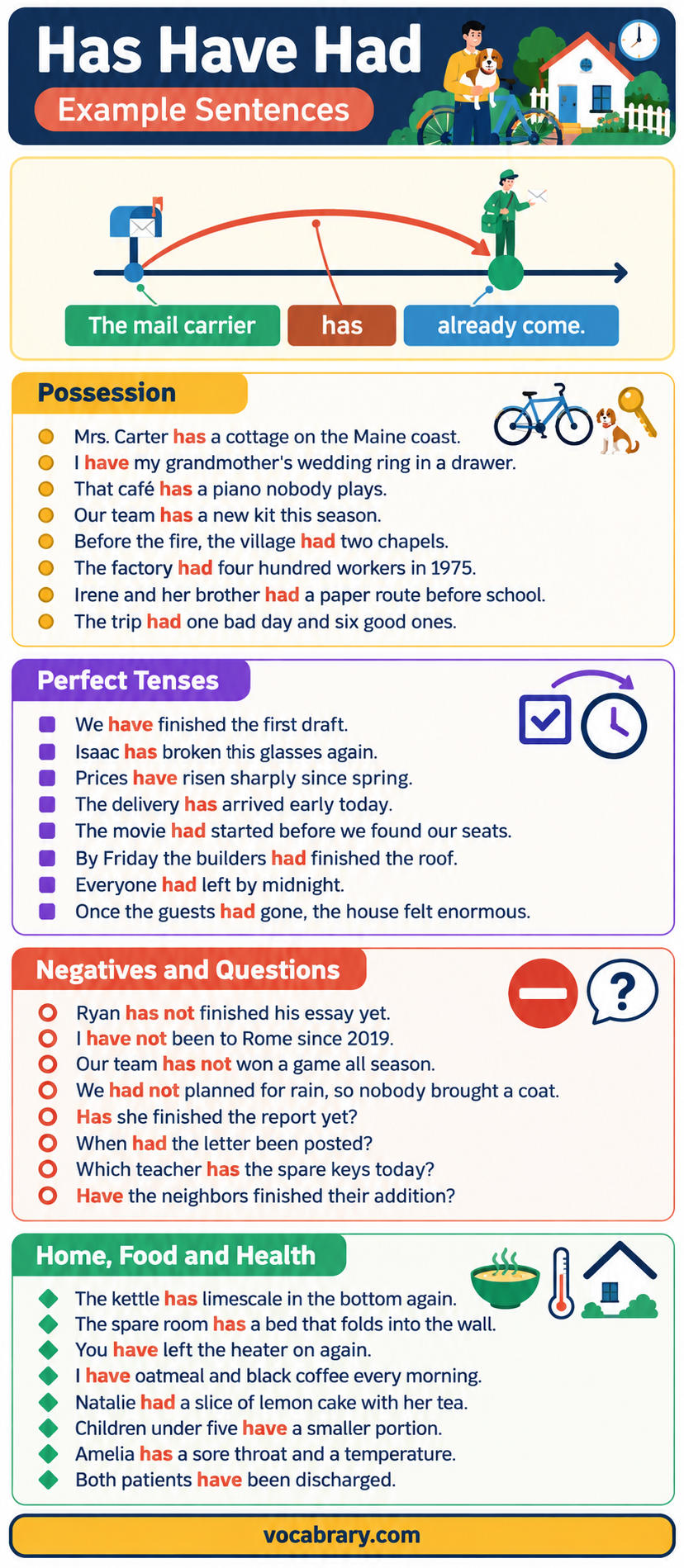
Common Has Have Had Example Sentences
A bicycle with a blue basket, two cats and an old dog, and a riverside picnic run through most has have had example sentences, where each form names what somebody owns or what somebody finished.
- Nadia has a bicycle with a blue basket.
- We have two cats and a very old dog.
- They had a picnic by the river last Sunday.
- My uncle has a small bakery near the station.
- I have a driving lesson at four.
- The twins had chickenpox in the same week.
- Everyone in the choir has a folder of songs.
- You have enough flour for two loaves.
- Our school has three computer rooms.
- Diego had a part-time job in a music shop while he studied law in Seville.
- Both of my sisters have curly hair.
- It has a crack along the handle.
- She has finished her homework already.
- Grandma had a garden full of roses when she lived in Kent.
- The hotel has a pool on the roof.
- Ravi and Sam have tickets for the late show.
- That old radio had a wooden case.
- Amelia has a headache after the long drive.
- Nobody has the keys to the side door.
- We had a long talk about the move to Porto.
- His laptop has a cracked screen.
- I had a cheese sandwich for lunch.
- Our village has one shop and one bus a day.
- Sara and Tom have season tickets for the rugby.
Has, Have, and Had With Every Pronoun
I, you, we, and they take have, while he, she, it and one named person take has. Had ignores the pronoun altogether, so a train ticket, a dented car door, and a puppy named Biscuit all work in the past.
| Pronoun | Form | Example sentence |
|---|---|---|
| I | Have | I have a ticket for the early train. |
| You | Have | You have my number already. |
| He | Has | He has a workshop behind the house. |
| She | Has | She has two exams on Friday. |
| It | Has | It has a dent on the left door. |
| We | Have | We have enough chairs for everyone. |
| They | Have | They have a new puppy named Biscuit. |
| Singular noun | Has | The kettle has a broken lid. |
| Plural noun | Have | The children have new shoes. |
| Any pronoun, past | Had | She had a puppy named Biscuit. |
Sentences With Has
A violin lesson every Thursday, a pocket watch from 1954, and a balcony facing the harbour show has at work with he, she, it, and one named person.
- Priya has a violin lesson every Thursday.
- The bakery on Mill Road has the best sourdough in town.
- My grandfather has a pocket watch that his own father bought in Geneva in 1954.
- Ahmed has three older brothers.
- Our car has a flat tyre again.
- She has a meeting with the head teacher at noon.
- The museum has no charge on the first Sunday of every month.
- Everybody in the class has a partner for the project.
- Marco has a scar over his right eyebrow.
- This recipe has only four ingredients.
- The baby has your mother’s eyes.
- Lena has enough money saved for the trip to Oslo and back.
- It has rained since breakfast.
- No one here has a spare charger.
- That library on the corner has a quiet room upstairs.
- Wei has a cough that keeps him awake.
- Her flat has a balcony facing the harbour.
- Each player has a number on the back of the shirt.
Sentences With Have
A caravan parked in a drive, an olive grove outside Seville, and two weeks off in August pair have with I, you, we, they, and every plural noun.
- I have a dentist appointment on Monday morning.
- We have enough eggs for the cake.
- The neighbours have a caravan parked in the drive.
- You have paint on your sleeve.
- Both goalkeepers have broken fingers this season.
- My parents have a small olive grove outside Seville and press their own oil each November.
- They have two weeks off in August.
- Rosa and Dan have a stall at the Saturday market.
- These trousers have a hole in the pocket.
- Children under six have free travel on the tram.
- I have no clue where my keys went.
- Our cousins have a farmhouse in Tuscany with six bedrooms.
- People in this village have long memories.
- You and I have the same birthday.
- Some of the books have missing pages.
- The visitors have questions about the new timetable.
- We have a long drive ahead of us tomorrow.
- Farmers in the valley have a hard winter every year.
Sentences With Had
A red tractor sold with the farm, a goldfish called Pepper, and velvet cinema seats put had in front of every pronoun once the moment has gone.
- We had a power cut during the storm on Tuesday.
- Grandpa had a red tractor before he sold the farm.
- I had a terrible cold last week.
- The old cinema had velvet seats and a single screen.
- They had a long wait at the border.
- Sofia had a goldfish called Pepper when she was seven, and she cried for a week after it died.
- You had every reason to be angry.
- My first bicycle had no brakes worth trusting.
- Both teams had a penalty in the first half.
- She had a job in Dubai for three years.
- Our old flat had damp in the back bedroom.
- Nobody had an umbrella, so we ran to the bus stop.
- The children had ice cream after the swim.
- Karim had a beard until his wedding day.
- It had a strange smell, so I threw it away.
- Last winter had more snow than the two before it.
- Ellie and Marcus had front-row seats at the concert.
- I had three missed calls from an unknown number.
Has and Have for Possession
A cottage on the Norfolk coast, a parrot that whistles the national anthem, and a boat nobody uses show has and have naming what somebody owns right now.
- Mrs Okafor has a cottage on the Norfolk coast.
- The twins have matching rucksacks.
- Yusuf has a passport from two countries.
- I have my grandmother’s wedding ring in a drawer.
- Every flat in the building has a storage cage in the basement.
- We have three bicycles and nowhere to keep them.
- Her dog has one brown ear and one white one.
- Theo and Ana have a boat they never use.
- That café has a piano nobody plays.
- You have more books than shelf room.
- The school has a kiln for pottery classes.
- My aunt has a parrot that whistles the first line of the national anthem.
- Bees have five eyes, though three of them are tiny.
- Our team has a new kit this season.
- Sanjay has a motorbike older than he is.
- Those houses have solar panels on the south roof.
- She has a scar on her knee from a childhood fall.
- Nobody in my family has a driving licence except my sister.
Had for Past Ownership and Past Events
Two village chapels lost to a fire, a rabbit called Nutmeg, and a phone with real buttons belong to had, the form that works for every pronoun once the time is past.
- Before the fire, the village had two chapels.
- I had long hair until the summer I turned sixteen.
- We had a rabbit called Nutmeg in our first flat.
- The factory had four hundred workers in 1975.
- Mona had a stammer as a child and speaks to crowds for a living now.
- They had no running water at the campsite.
- My old phone had a keyboard with real buttons.
- Ines and her brother had a paper round before school.
- Our grandparents had an accordion nobody tuned.
- You had the last word, as always.
- The trip had one bad day and six good ones.
- He had a stall at the flea market every Sunday for years.
- Sara had a fear of lifts until she worked on the tenth floor.
- Nobody had change for the parking machine.
- That winter had more rain than snow.
- I had two hours between trains in Lyon.
Negative Sentences With Has Not, Have Not, and Had Not
An unfinished essay, a parcel that missed the airport run, and a team without a win all season turn positive lines into negatives by adding not after has, have, or had.
- Ravi has not finished his essay yet.
- We have not seen our neighbours since March.
- The parcel had not arrived when we left for the airport.
- My brother has not eaten since breakfast.
- They have not paid the water bill.
- I have not been to Rome since 2019.
- That machine has not worked properly since the storm.
- You have not answered my question.
- Elif had not driven in snow before that morning.
- Our team has not won a match all season.
- The twins have not met their new cousin yet.
- He had not slept for two nights before the exam, and it showed in his handwriting.
- Grandma has not used the oven since she moved.
- Marta has not replied to any of my messages.
- We had not planned for rain, so nobody brought a coat.
- Those files have not been saved.
- Kenji has not had a holiday in four years.
- I had not heard that song before yesterday.
- The shop has not opened yet this morning.
Short Negative Forms With Hasn’t, Haven’t, and Hadn’t
A puppy still without a name, a bus that never came, and a coat unworn for years show the shortened negatives that speakers use in conversation.
- Priya hasn’t eaten anything since lunch.
- We haven’t decided on a name for the puppy.
- I hadn’t met his parents before the wedding.
- The bus hasn’t come, and it is already half past eight.
- They haven’t finished painting the hall.
- My phone hasn’t charged overnight.
- You haven’t missed much.
- Selim hadn’t touched his food.
- Our cousins haven’t written since New Year.
- She hasn’t worn that coat in years.
- We hadn’t expected the road to be closed, so the drive took three hours.
- It hasn’t rained here for six weeks.
Question Sentences With Has, Have, and Had
A missing blue folder, a stairwell light out for the third time, and a shop already shut by six turn into questions when has, have, or had moves in front of the pronoun.
- Has she finished the report yet?
- Have they arrived at the hotel?
- Had you eaten before the film started?
- Where has my blue folder gone?
- Why have the lights in the stairwell gone out for the third time this month?
- When had the letter been posted?
- Who has seen my glasses?
- How long have you known Diego and his family?
- What had she done to upset him so badly before the holiday?
- Have you ever been to Istanbul?
- Which teacher has the spare keys today?
- How many cousins have you got?
- Had the shop closed by six?
- Who has my umbrella?
- Have the neighbours finished their extension?
- Where had they parked the van?
- Has it stopped raining?
- Why has nobody answered the phone?
Short Answers With Has, Have, and Had
A phone call returned, a landing in Doha, and a missing cat draw three-word replies, where the answer repeats only has, have, or had.
- Has she called back? Yes, she has.
- Mum, have I got time for a shower? No, you have not.
- Have they landed in Doha? Yes, they have.
- Quickly, has anyone seen the cat? No, nobody has.
- Had you met Rosa before the party in Cardiff? No, I had not.
- Tell me straight, has the doctor phoned about the test since this morning? Yes, she has.
- Listen, have we paid the electricity bill? No, we have not.
- Sorry, has this seat got somebody in it? No, it has not.
- Had the train left before you reached the platform at Leeds? Yes, it had.
- Dad, have you fixed my bike? Yes, I have.
- So, has Karim finished his shift? No, he has not.
- Wait, have the twins had their supper? Yes, they have.
- Have you ever eaten octopus? Yes, I have, in Lisbon.
- Honestly, had nobody noticed the broken window? No, nobody had.
Contractions With I’ve, He’s, and They’d
Speech shortens the three forms to I’ve, she’s, and they’d, so a finished pile of washing-up, a jacket worn for ten years, and two trees lost in a storm all sound faster.
- I’ve finished the washing-up.
- By nine o’clock they’d eaten everything on the plate and started on the biscuits.
- She’s got a new job in Rotterdam.
- We’ve lived here since 2014.
- He’s had that jacket for ten years.
- Since March he’s worked every weekend.
- You’ve left your scarf on the chair.
- It’s been a long week.
- They’ve booked the hall for Saturday.
- After the storm we’d lost two trees in the garden.
- I’d never seen snow before that winter.
- She’d finished her shift by the time I arrived.
- You’d better ask Omar first.
- We’d had enough of the noise, so we moved to a quieter street.
- I’ve got a spare pen if you need one.
- She’s never tried oysters.
Has, Have, and Had as Helping Verbs
A stopped rain shower, a novel read twice, and a film that began before anyone found a seat take has, have, and had before a past participle, where they mark time instead of possession.
Present Perfect Sentences With Has and Have
Eleven years in Lisbon, a water bowl knocked over twice, and four wins in a row put has and have before a past participle for actions that reach into the present.
- Ana has lived in Lisbon since 2011 and still gets lost in the old quarter.
- We have finished the first draft.
- The rain has stopped at last.
- My cousins have moved to Vancouver.
- Ibrahim has broken his glasses again.
- You have grown since Christmas.
- The cat has knocked over the water bowl twice since breakfast.
- Night nurses have worked three double shifts this week.
- I have read that novel twice.
- She has taught at the same school for nineteen years.
- Prices have risen sharply since spring.
- Our team has won four matches in a row.
- Nobody has touched the cake.
- Leo and Dara have started a band.
- The delivery has arrived early today.
- Tourists have booked every hotel in the old town.
- I have never eaten durian.
- Winter has come early this year.
Past Perfect Sentences With Had
A film already running, a pizza eaten before it arrived, and a roof finished by Friday need had, the form that marks the earlier of two past moments.
- The film had started before we found our seats.
- I had never seen the sea until that trip to Split.
- She had already eaten when the pizza arrived.
- By Friday the builders had finished the roof.
- We had locked the door, yet the cat got out.
- Omar had studied Russian for a year before he moved to Almaty for the winter.
- They had sold the last ticket an hour earlier.
- My phone had died, so nobody reached me.
- Everyone had left by midnight.
- The letter had been posted to the old address.
- Nina had worked two jobs before she qualified as a midwife.
- You had warned me, and I ignored it.
- Once the guests had gone, the house felt enormous.
- The shop had closed, so we ate crisps for dinner.
- I had forgotten how steep the hill was.
- Hassan had promised to call, but the line was dead.
Has Got, Have Got, and Had Got in Sentences
Two tickets for Saturday, thin walls in a rented flat, and mud across the sofa show the got forms that British speakers use for possession in conversation.
- Priya has got two tickets for Saturday.
- We have got a spare room if you need it.
- Have you got change for a ten?
- My brother has got a motorbike licence.
- They have got three weeks of holiday left.
- Has she got your new address?
- I have got a splitting headache.
- Our flat has got thin walls.
- You have got the wrong number.
- The dog has got mud all over the sofa.
- Had you got any money left by the end of the trip?
- Both cars have got winter tyres.
- Nobody has got an answer to that yet.
- Karim has got a cousin who plays for the reserves at a club near Ankara.
Has Have Had at Home and With Family
Limescale in the kettle, mice in the loft, and Sunday lunch at an aunt’s house give the three forms the household work they do every day.
At Home
A leaky kitchen sink, a bed that folds into the wall, and a cat basket by the radiator keep has, have, and had inside four walls.
- The kettle has limescale in the bottom again.
- We have a leak under the kitchen sink.
- My mother had a washing line across the yard.
- Our landlord has replaced the boiler.
- The spare room has a bed that folds into the wall.
- I have three loads of washing to do before Sunday.
- Dad has painted the fence a deep green.
- Both bathrooms have new taps.
- Ice had sealed the freezer shut, so we left the door open overnight.
- You have left the heater on again.
- Grandma has keys to every room in the house.
- We had mice in the loft last autumn.
- That old clock has a chime nobody likes.
- Our cat has a basket by the radiator.
With Family and Friends
A hundred retellings of one story, a falling-out over nothing, and a group chat with four hundred unread messages put the three forms among relatives and old friends.
- My sister has two children and a very patient husband.
- We have Sunday lunch at my aunt’s every fortnight.
- Rashid had a nickname nobody in the family explains.
- Our cousins have invited us to Cork for New Year.
- Grandad has told that story a hundred times.
- I have known Mia since primary school.
- The boys have the same laugh as their father.
- Nadia and I had a falling-out over nothing.
- Everyone in my family has a sweet tooth.
- You have met my brother already.
- Their youngest has started nursery.
- We had a big party when Uncle Sam turned seventy.
- Old schoolfriends have a group chat with four hundred unread messages nobody dares to leave.
- Layla has had the same best friend since nursery.
Has Have Had at School and at Work
A new science lab, a forgotten gym kit, and a nine o’clock Monday meeting show where learners meet these forms outside the home.
At School
Double maths after break, a fire drill in the rain, and a note from the school nurse fill the classroom sentences with has, have, and had.
- Our school has a new science lab.
- The pupils have an exam on Thursday.
- Miss Farrell has taught here since 2009.
- I have double maths after break.
- Every classroom has a projector.
- We had a fire drill in the rain.
- Tom has forgotten his gym kit again.
- Our library has copies of every set text.
- You have a note from the nurse.
- Both Year Six classes have gone to the museum.
- My little brother has a reading book from school.
- The head teacher had a word with the whole year group about the noise in the corridor.
- Nobody in this class has finished the essay.
- Hana had extra time in her exams.
At Work
An invoice sent twice, a printer jammed on its first week, and a warehouse run for a decade give the three forms their office and shop-floor sentences.
- The night shift has been short of staff all week.
- We have a meeting at nine every Monday.
- My manager has approved the leave.
- Accounts have sent the invoice twice.
- I had a call from head office this morning.
- The new printer has already jammed.
- Both branches have hired extra staff for December.
- You have an interview at two.
- Ola has worked here longer than anyone.
- Our team had no budget for travel last year.
- Every delivery driver has a scanner.
- Helen had run the warehouse for a decade before she retired to a cottage in Wales.
- Nobody has signed the health and safety sheet.
- They have moved my desk near the window.
Has, Have, and Had With Food and Meals
Porridge before work, tacos from a roadside stall in Oaxaca, and bread gone stale show the three forms where have also means eat and drink.
- I have porridge and black coffee every morning.
- We had tacos at a roadside stall in Oaxaca.
- The soup has too much salt in it.
- My uncle has never eaten fish.
- Nadia had a slice of lemon cake with her tea.
- You have eaten my sandwich.
- The bread has gone stale.
- Guests have a choice of two starters.
- Children under five have a smaller portion.
- We have nothing in the fridge except mustard.
- Omar had rice and dal for lunch.
- Both pizzas have olives on them.
- She has had a stomach ache since the curry on Friday night.
- Our neighbours had a barbecue that lasted until midnight and woke up half the street.
Has, Have, and Had With Health and Illness
A sore throat with a temperature, a wrist broken at cricket, and stitches after a fall on the stairs are where has, have, and had describe a body rather than a possession.
- Amelia has a sore throat and a temperature.
- We have all had the flu this month.
- My grandfather had a heart operation in April.
- The baby has a rash on both arms.
- You have a splinter in your thumb.
- Ravi has broken his wrist playing cricket.
- Both patients have been discharged.
- I had a migraine for two days last week and lay in a dark room.
- Nurses have long shifts at the county hospital.
- She had stitches after the accident on the stairs.
- Nobody in the office has had a cold since September.
- Our dentist has an appointment free on Friday.
- Tom has had asthma since he was four.
- The clinic had no vaccine left by noon.
Has Have Had With Time Expressions
Since Monday, for eleven years, by last Christmas: words like these pin a sentence to a stretch of time, and has, have, or had answers each one.
- Since Monday, Kira has worked from home.
- We have lived in this flat for eleven years.
- By last Christmas, they had sold the shop.
- The parcel has been at the depot for a week.
- I have already eaten.
- Anwar had finished his shift before the storm broke over the harbour that night.
- You have not called me since your birthday.
- My cousin has just landed in Doha.
- They have worked here for six months.
- Before the wedding, she had never worn heels.
- The village has had no doctor since the spring.
- We had just sat down when the phone rang.
- Yasmin has studied French for three years.
- Our team had already scored twice by half-time.
- I have known her since we were ten.
- Farmers have waited all summer for rain.
Sentences Rewritten With the Correct Form of Have
Plural nouns pulled toward has, single names pulled toward have, and had used for something still true are the three slips learners repeat, and the noun or the time decides each one.
- My sister has two cats ✅, never My sister have two cats ❌.
- The twins have the same birthday ✅, not The twins has the same birthday ❌.
- Everybody has a ticket for the seven o’clock show ✅, not Everybody have a ticket ❌.
- We have already paid the deposit on the flat in Leeds ✅, not We has already paid the deposit ❌.
- Ravi had a bicycle when he was twelve ✅, not Ravi has a bicycle when he was twelve ❌.
- My parents have been married for thirty years ✅, not My parents has been married for thirty years ❌.
- Yusuf has not finished his homework ✅, never Yusuf have not finished his homework ❌.
- Our train had already left when we reached the station ✅, not Our train has already left when we reached the station ❌.
- Has your brother found a flat yet? ✅ Never Have your brother found a flat yet? ❌
- I have had this watch since my eighteenth birthday ✅, not I have this watch since my eighteenth birthday ❌.
- That bakery has had three owners in five years ✅, not That bakery have had three owners ❌.
- Our neighbours have got a new dog ✅, not Our neighbours has got a new dog ❌.
- You have a message from the dentist ✅, never You has a message from the dentist ❌.
Short Has Have Had Sentences for Kids and Beginners
A red ball, a blue bike, and two cats: four-word sentences let young learners copy the pattern without losing track of the form.
For Kids
A red ball, a puppy, and a big hat keep these lines to four or five words, with one bold form of have in each.
- I have a red ball.
- She has a puppy.
- We have two cats.
- He has a blue bike.
- They have new books.
- It has four legs.
- My dad has a big hat.
- You have my pencil.
- Sam had cake today.
For Young Learners
A green bag, a toy train, and white paws on a cat give beginners sentences short enough to say aloud in one breath.
- The baby has small hands.
- I have a green bag.
- Grandma has a garden.
- They had fun at the park.
- He has a toy train.
- We have milk and bread.
- She had a bath.
- Our cat has white paws.
- You have a nice smile.
A Baker’s Day Told With Has, Have, and Had
A bakery on Green Street, a late flour delivery, and a queue that reaches the door run through one paragraph, where every stage of the day takes has, have, or had.
Marcus has a bakery on Green Street, and by five in the morning he has already lit the ovens. Yesterday had a rough start, because the flour delivery had not arrived on time. His two assistants have worked with him since the shop opened, so they had a plan ready before he asked for one. By nine the shelves have nothing left except rye, and the queue has reached the door. Marcus has had eleven years of mornings like this one, and he has no wish to trade them for an easier job.
Related
FAQs
Has, have, and had are the three forms of the main verb have, which doubles as an auxiliary verb in the perfect tenses. As a main verb it names what somebody owns, eats, or goes through, as in Priya has a motorbike. As an auxiliary it comes before a past participle, as in Priya has ridden to work since June.
You use has with he, she, it and any single person or thing, have with I, you, we, they and any plural noun, and had with every pronoun once the action is finished and past. The pronoun in front decides between has and have, while the time decides whether had replaces both.
Has had and have had differ only in the pronoun in front of them. Has had follows he, she, it or one named person, and have had follows I, you, we, they or a plural noun. Both name something that started earlier and still counts today, as in Dario has had that scar since childhood and We have had three power cuts this week.
Has, have, and had work as helping verbs whenever a past participle follows them, as in she has finished or they had left. With a noun after them instead, the same three words are main verbs, as in she has a scooter. The word that follows decides the job. Further perfect-tense lines are gathered at present perfect tense example sentences.
Has, have, and had are not linking verbs, because a linking verb joins a noun to a word that renames or describes it, which is the work of am, is, are, was, and were. Has, have, and had take an object instead, so Kofi has a passport names a thing he owns rather than a quality he shows. More am is are example sentences set the two verbs side by side.
Am, is, and are describe what a person is or where a person is, while has, have, and had name what a person owns or what a person has already done. Lina is a nurse gives her role, and Lina has a nurse’s badge gives her possession. Both sets change with the pronoun, so he takes is and has, and they take are and have.
Has, have, and had build the perfect tenses and name possession, while do, does, and did build questions and negatives in the present and past tenses. Did you have breakfast? uses did as the helper and have as the main verb in one question. More sentences with the second set are gathered at do does did example sentences.
You put has, have, and had in one sentence by giving each form its own owner and its own time. Rosa has a car, her brothers have bicycles, and their father had a motorbike in the 1980s. The two present forms split by pronoun, and had takes the clause that already moved into the past.
Has been, have been, and had been put the verb be into the perfect tenses, so they describe a state that lasted rather than a thing owned. The road has been closed since Tuesday keeps the closure open today, while The road had been closed for a week before the repairs started pushes it behind another past moment. The choice between has been and have been still follows the pronoun in front.
After did the verb returns to its plain form have, so Did she have a passport? is right and Did she had a passport? is wrong. Did already marks the past, and a second past marker on the main verb repeats the same work. The same rule applies after do and does.
After will every pronoun takes have, never has or had, so He will have a new timetable in September is right for he as much as for they. Will marks the future by itself, and the verb behind it stays in its plain form. Future lines with will are gathered with the other tense sets at tense sentences.
Five sentences using has, have, and had work best with two singular names, one plural noun, one first-person pronoun, and one past line. My sister has a guitar. Her teacher has a violin. My cousins have a piano. I have a set of drums. We had a school band last year. The first four stay in the present, and the last one moves to had.

Leave a Comment