
There is and there are are the English forms used to say that something exists, as in there is a bakery on the corner and there are two cafés beside it. Most there is there are example sentences describe a place or a moment, so the noun after the verb decides which form fits.
What Are There Is and There Are?
There is and there are announce something for the first time and name where or when it exists. Am, is, and are describe someone the listener already knows, while have and has name an owner. Sara has a bicycle names the owner, and There is a bicycle outside names only its presence.
There + is + singular or uncountable noun / There + are + plural noun
There is a bakery on the corner, and there are two cafés beside it.
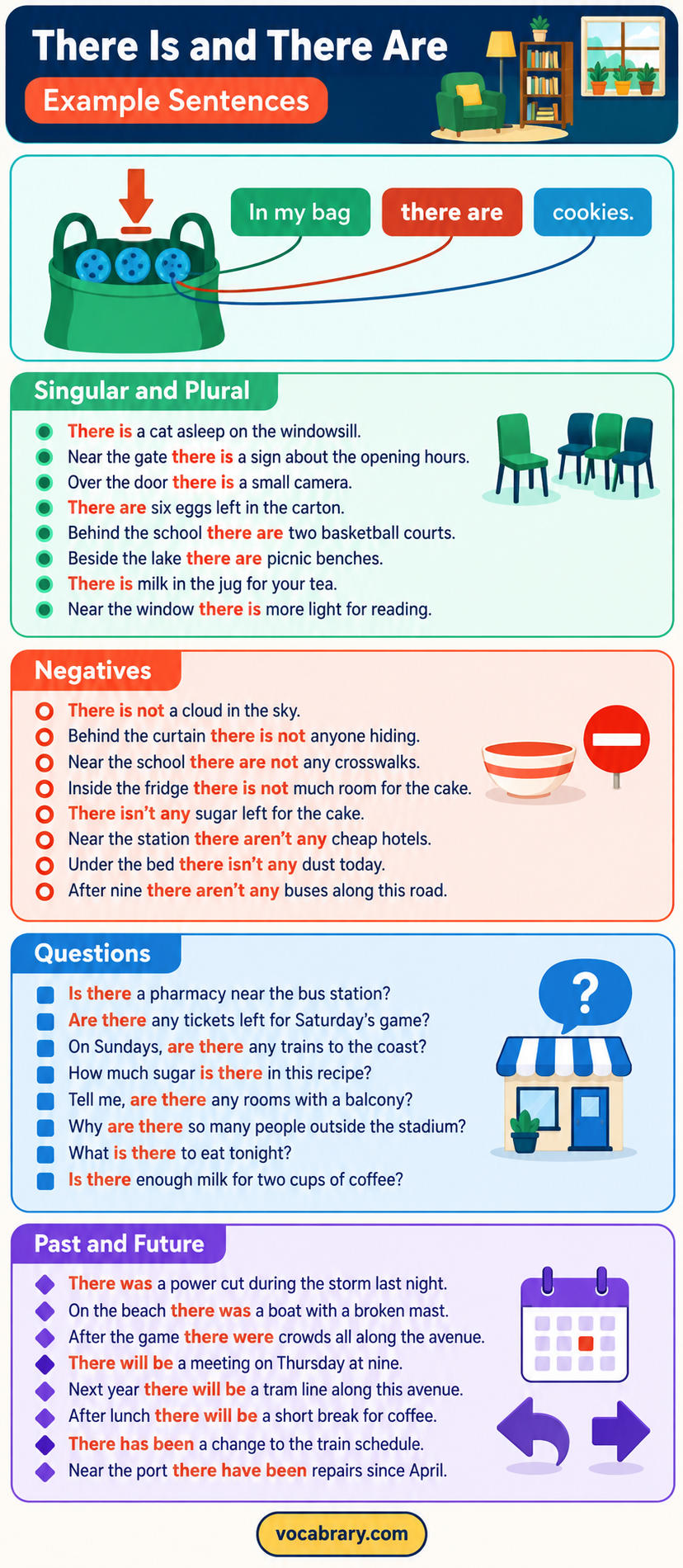
Common There Is There Are Example Sentences
A bakery on the corner, twenty-four students in one class, and three oranges on the kitchen table fill most there is there are example sentences, each one naming what exists in a place.
- There is a bakery on the corner of Green Street.
- On the kitchen table there are three oranges and a jug of water.
- There are twenty-four students in my English class.
- Behind the house there is a small garden with two apple trees.
- Every Saturday morning there is a fruit and vegetable market in the main square beside the town hall.
- In my bag there are two notebooks and a blue pen.
- There is a bus stop right outside the library.
- Near the river there are four wooden benches for visitors.
- Under the stairs there is a cupboard full of winter coats.
- Across the road there are two pharmacies that open until ten at night, and one of them also sells bus tickets.
- At the back of the classroom there is an old map of Africa.
- Inside the envelope there are photographs from my grandmother’s wedding.
- During the summer there are concerts in the park every Friday evening.
- Next to the sofa there is a lamp with a green shade.
- On Mondays there is a yoga class at the community centre.
- Beside the front door there are two pairs of muddy boots.
- Over the fireplace there is a painting of a fishing boat.
- Downstairs there is one bathroom.
- Upstairs there are three bedrooms.
- Inside the fridge there is enough milk for breakfast tomorrow.
There Is and There Are With Different Nouns
A single lamp takes there is, two lamps take there are, and uncountable nouns such as milk, rice, and traffic keep the singular form however much of them exists.
There Is With Singular Nouns
One cat on a windowsill, one taxi outside the station, and one pink house at the end of the road show there is before a noun that counts as one.
- There is a cat asleep on the windowsill.
- In the hallway there is a mirror with a wooden edge.
- Upstairs there is a study.
- Behind the counter there is a young man in a green apron.
- On the desk there is a calculator from my sister’s old school bag.
- Near the gate there is a sign about the opening hours.
- Under the bed there is a suitcase full of summer clothes.
- Beside the oven there is a jar of olive oil.
- At the end of the road there is a pink house with a blue door and a letterbox shaped like a small bird.
- Inside the drawer there is a pair of scissors.
- Over the door there is a small camera.
- Outside the window there is a cherry tree that flowers in April.
- Between the two shops there is a narrow alley.
- Every morning there is a queue at the coffee machine.
- There is one taxi waiting outside the station.
There Are With Plural Nouns
Six eggs in a carton, twelve cookbooks on a shelf, and two basketball courts behind a school mark the plural side, where there are counts more than one.
- There are six eggs left in the carton.
- On the shelf there are twelve cookbooks in three languages.
- In the car park there are forty numbered bays.
- Behind the school there are two basketball courts.
- Near the harbour there are several fishing boats with red sails, and most of them go out before five in the morning.
- Along the river there are cycling tracks for beginners and for racers.
- Under the sink there are two buckets and a mop.
- At the airport there are four cafés after the security check.
- Inside the museum there are rooms devoted to Roman pottery.
- Across from my flat there are three identical white houses.
- During the festival there are dancers from six different countries in the square.
- Beside the lake there are picnic benches.
- Every December there are lights along the whole high street.
- Opposite the bank there are two cash machines that work all night.
- There are nine steps.
There Is With Uncountable Nouns
Milk in a jug, heavy traffic after six, and snow on the branches take there is, because nouns of this kind never turn plural in English.
- There is milk in the jug for your tea.
- In the jar there is enough rice for four people.
- On the motorway there is heavy traffic after six o’clock, so the drive to the airport takes almost two hours tonight.
- Under the table there is sand from yesterday’s trip to the beach.
- In the garden there is fresh snow on the branches.
- There is hot water again.
- Near the window there is more light for reading.
- At this hour there is no noise from the street.
- Inside the bottle there is olive oil from my uncle’s farm in Crete.
- After the storm there is mud all over the path.
- Beside the fire there is wood for the whole evening.
- During exam week there is silence in every corridor.
Negative Sentences With There Is Not and There Are Not
No cloud in the sky, no bank in a small village, and not enough chairs for a meeting give the negative forms, where not follows is or are.
- There is not a cloud in the sky.
- In this village there are not any banks or pharmacies.
- There are not enough chairs for everyone in the meeting.
- On the last Sunday of the month there is not a single bus to the airport before nine o’clock in the morning.
- Behind the curtain there is not anyone hiding.
- In my wallet there is not enough cash for a taxi.
- Near the school there are not any zebra crossings.
- At the moment there is not a doctor on duty.
- Under the sink there is not any washing powder left.
- After midnight there are not any trains from this platform.
- Inside the fridge there is not much room for the cake.
- Around here there are not many places to eat after ten.
- Beside the bed there is not a lamp for reading.
- During the holidays there are not any classes at the college.
There Isn’t Any and There Aren’t Any
No sugar for a cake, no glasses in a cupboard, and no cheap hotels near a station show the short negative with any, the form most speakers use out loud.
- There isn’t any sugar left for the cake.
- In the cupboard there aren’t any glasses for the juice.
- On this floor there isn’t any hot water until Monday, because the plumbers have taken the whole heating system apart.
- Near the station there aren’t any cheap hotels.
- There aren’t any eggs.
- At this cinema there isn’t any parking for motorbikes.
- Under the bed there isn’t any dust today.
- Inside the envelope there isn’t any money, only a photograph.
- After nine there aren’t any buses along this road.
- Behind the counter there aren’t any staff to ask.
- In August there aren’t any lessons at the language school.
- Beside the door there isn’t any room for another coat rack.
Question Sentences With Is There and Are There
A pharmacy near the bus station, tickets for Saturday’s match, and the number of students in a class turn into questions when is or are moves in front of there.
- Is there a pharmacy near the bus station?
- Are there any tickets left for Saturday’s match?
- How many students are there in your class?
- In your town, is there a public library with books in English for children and teenagers?
- On Sundays, are there any trains to the coast?
- How much sugar is there in this recipe?
- Excuse me, is there a seat free beside the window?
- Tell me, are there any rooms with a balcony?
- After the film, is there a bus back to the city?
- Why are there so many people outside the stadium?
- What is there to eat tonight?
- Where are there good places to swim near here?
- Is there enough milk for two cups of coffee?
- Are there two bathrooms in the flat or only one?
Short Answers With There Is and There Are
A lift in a building, seats on a late train, and eggs in a cake draw the short answers yes, there is and no, there aren’t, with the verb repeated after there.
- Is there a lift in this building? Yes, there is.
- Are there any seats left on the ten o’clock train? No, there aren’t.
- In your school, is there a swimming pool? No, there isn’t.
- Are there eggs in this cake? Yes, there are.
- On Mondays, is there a late class for people who work during the day? Yes, there is.
- After the concert, are there taxis outside? Yes, there are.
- Excuse me, is there a doctor in the building? No, there isn’t.
- Behind the hotel, are there parking places? No, there aren’t.
- Is there any homework tonight? Yes, there is, two pages of reading.
- Near the beach, are there any cheap cafés? Yes, there are.
- During the holidays, is there a bus to the lake? No, there isn’t.
- Tell me, are there any tickets for tonight? Yes, there are four.
There Is and There Are in Every Tense Form
A storm on Tuesday night, six children in a pool, and a test on Friday morning move the same structure into the past and the future, where only the verb after there changes.
| Form | Use | Example sentence |
|---|---|---|
| There is | One thing or an uncountable noun in the present | There is a letter for you on the shelf. |
| There are | Two or more countable nouns in the present | There are four letters in today’s delivery. |
| There was | One thing or an uncountable noun in the past | There was a storm on Tuesday night. |
| There were | Two or more countable nouns in the past | There were six children in the pool. |
| There will be | A singular or a plural noun in the future | There will be a test on Friday morning. |
| There has been | One thing completed or continuing up to now | There has been a change to the timetable. |
There Was and There Were for the Past
A power cut during a storm, two cafés in a town in 1995, and thirty guests at a birthday lunch take there was and there were, the past of the same structure.
- There was a power cut during the storm last night.
- In 1995 there were only two cafés in this town.
- There were thirty people at my grandmother’s birthday lunch.
- On the beach there was a boat with a broken mast.
- Before the fire there was a wooden bridge over the river.
- At the meeting there were four people from the Madrid office and two from the factory in Porto.
- Behind the old cinema there was a garden with roses.
- During the war there were no lights in the streets at night.
- Near the station there was a small hotel with a red roof.
- Yesterday there were twelve messages on the answering machine.
- Inside the trunk there were letters from 1940.
- After the match there were crowds all along the avenue.
- Last winter there was snow for three weeks.
- Under the carpet there was a small door to the cellar.
There Will Be for the Future
A meeting on Thursday, two new teachers in September, and fireworks over the harbour take there will be, which stays the same before singular and plural nouns.
- There will be a meeting on Thursday at nine.
- In September there will be two new teachers at the school.
- Next year there will be a tram line along this avenue.
- There will be rain in the north tomorrow.
- After lunch there will be a short break for coffee.
- On Saturday there will be fireworks over the harbour, and the whole seafront closes to traffic at seven in the evening.
- By Friday there will be enough chairs for the whole audience.
- At the end of the term there will be a concert in the hall.
- Tomorrow there will be three doctors on duty.
- During the holidays there will be classes for young learners.
- Before the film there will be ten minutes of advertisements.
- Inside the new library there will be a room for children.
There Has Been and There Have Been
A change to a train timetable, four phone calls since Monday, and repairs near the port take there has been and there have been, which tie a past event to the present moment.
- There has been a change to the train timetable.
- Since Monday there have been four phone calls from the bank.
- There have been two accidents on this corner this year.
- In the last month there has been heavy rain in the valley.
- Near the port there have been repairs since April.
- Over the summer there has been a rise in ticket prices.
- Inside the office there have been complaints about the heating, and the manager has ordered two electric radiators for the winter.
- Since the new law there have been fewer cars in the centre.
- At the hospital there has been a new entrance since June.
- After the storm there have been problems with the phone line.
There Is and There Are Before a Mixed Group of Nouns
A jug and two glasses, thirty children and one teacher, four chairs and a wooden table: the noun nearest the verb decides whether a mixed sentence opens with there is or there are.
- On the tray there is a jug of water and two tall glasses.
- In the hall there are thirty children and one teacher with a microphone.
- There is a sofa, two armchairs, and a rug in the front room.
- Beside the till there are newspapers, a jar of sweets, and a card machine.
- In my bag there is a purse, a phone charger, and three old tickets.
- Under the olive tree there are four chairs and a wooden table.
- Near the door there is an old umbrella and two raincoats.
- At the entrance there are two guards and a metal gate.
- There is milk, butter, and four eggs on the top shelf.
- Outside the tent there are boots, a lamp, and a bag of firewood.
- In the drawer there is a passport and two bank cards.
- Behind the counter there are shelves of bread and one large cake.
- There is rice and beans tonight.
- Under the window there are two plants and a radiator.
- At the back of the van there are two suitcases, a folding chair, and a crate of tools that my father has kept since 1998.
There Is and There Are in the Classroom
Twenty-eight desks, a whiteboard with four markers, and a globe on a low cupboard are what learners name first when they describe a classroom with there is and there are.
- There are twenty-eight desks in our classroom.
- On the wall there is a whiteboard with four coloured markers.
- Beside the teacher’s desk there is a globe on a low cupboard.
- There are two windows that look onto the playground.
- At the back there are shelves of dictionaries and story books for the reading hour on Friday afternoon.
- In my pencil case there is a ruler, a rubber, and two pencils.
- Is there a projector in room 12?
- Along the corridor outside there are hooks for coats and bags.
- High on the wall there is a clock that runs three minutes fast.
- There aren’t any posters on the back wall this term.
- Near the window there are pots of basil that the class waters every Monday.
- How many teachers are there in your school?
- Under each desk there is a tray for notebooks.
- During the last lesson there is silence for ten minutes of reading.
- In the corner there are thirty chairs, and every one of them has a number painted on the back.
- Today there is no chalk.
Describing a Photo in Class With There Is and There Are
Three children building a sandcastle, a man reading under a tall tree, and clouds over a mountain are the scenes learners describe aloud in speaking exams with there is and there are.
- In this photograph there are three children building a sandcastle.
- There is a man reading a newspaper under a tall tree.
- On the left there is a red bicycle against a wall.
- There are clouds over the mountain behind the village.
- In the background there are two boats and a lighthouse painted white and green.
- On this road there isn’t any traffic at all.
- At the front there is a woman with a basket of apples.
- Beside the stone house there are four narrow windows.
- To the right there is a dog asleep beside a door.
- Over the roofs there are birds in a long line.
- Behind the market stalls there are hills that turn brown in August, and a narrow road climbs towards them.
- Right in the centre there is a fountain with three steps around it.
There Is and There Are in the House Room by Room
A green sofa under the front window, six eggs in the fridge door, and a kettle beside the sink are what there is and there are name in a home, room by room.
In the Living Room and the Bedroom
A green sofa, a bookcase of paperbacks, and a wardrobe with a mirrored door name what furnishes the two rooms where families relax and sleep.
- In the front room there is a green sofa under the window.
- There are two lamps beside the television.
- Against the far wall there is a bookcase full of paperbacks.
- On the armchair there are four cushions.
- Upstairs there is a wardrobe with a mirrored door and a small chest of drawers beside it.
- Under the bed there are two suitcases of winter clothes.
- There isn’t any television in my brother’s bedroom.
- Beside the bed there is a lamp and a glass of water.
- On my side of the bed there are three pillows.
- Over the sofa there is a photograph of my parents on their wedding day in Lahore.
- Near the door there are slippers for guests.
- In the corner there is a plant that my sister has grown from a cutting.
In the Kitchen and the Fridge
Milk for tomorrow’s breakfast, six eggs on the top shelf, and a pan of soup on the cooker are what learners count when they open the fridge and name a kitchen.
- In the fridge there is milk for tomorrow’s breakfast.
- On the top shelf there are six eggs and a bowl of olives.
- There isn’t any butter left.
- Beside the sink there is a kettle and two wooden spoons.
- In the freezer there are three bags of peas and a tub of ice cream from last summer.
- There are four plates in the cupboard over the cooker.
- Near the window there is a jar of coffee beans.
- Is there any orange juice in the door of the fridge?
- On the cooker there is a pan of soup for lunch.
- Tonight there aren’t any forks left in the drawer.
- Inside the bread bin there are two rolls from yesterday.
- Under the sink there is washing powder and a packet of cloths.
There Is and There Are in the City
A cathedral with a copper dome, two tram lines along the river, and a Saturday market outside the town hall are the cases that city sentences name most.
- In the old square there is a cathedral with a copper dome.
- There are two tram lines along the river.
- Near the station there are four hotels and a bus terminal.
- There is a cinema on Baker Road that shows films in three languages.
- Every Saturday there is a market outside the town hall.
- Around the centre there are more than forty restaurants.
- Opposite the museum there is a park with a fountain.
- After six o’clock there aren’t any cars in the old quarter.
- Along the seafront there are benches painted blue.
- Is there a metro station near the airport?
- In this city there is a river that divides the old streets from the new offices on the east bank.
- At the crossroads there are traffic lights and a zebra crossing.
- Between the two banks there is one bridge.
- During the festival there are stages in three different squares.
Outdoors in the Park and the Countryside
Ducks on a pond, a path through pine trees, and sheep on a hillside take there is and there are outside, where learners name what grows and moves in the open.
- On the pond there are ducks and one grey heron.
- There is a path through the pine trees behind the farm.
- Near the gate there is a wooden sign about the walking route.
- There are sheep on the hillside behind the village.
- In spring there are wild flowers along the whole valley, and the bees arrive before the walkers do.
- At noon there isn’t any shade beside the lake.
- Under the old oak there is a picnic table.
- Beyond the fence there are four horses.
- Beside the river there are stones flat enough for crossing.
- Is there a campsite near the waterfall?
- Today there is a strong wind from the sea.
- After the rain there are puddles along the whole track.
There Is and There Are at Work
A meeting with the Milan office, two printers on the third floor, and a coffee machine beside the lift are the cases office workers name with there is and there are.
- On Thursday there is a meeting with the Milan office at nine.
- There are two printers on the third floor.
- Beside the lift there is a coffee machine that takes cards.
- There are fourteen people in the accounts team.
- In my inbox there are twenty-one unread messages from the supplier about a delivery that has not left the warehouse.
- Behind the building there isn’t any parking for visitors.
- Near reception there is a screen with the day’s appointments.
- Are there any free meeting rooms at eleven?
- On Friday there is a deadline for the quarterly figures.
- At the end of the month there are two training days for the new software.
- Inside the store cupboard there are reams of paper and a stack of envelopes.
- From this floor there are three exits.
- During the summer there is flexible working for parents of young children.
- Beside my keyboard there is a photograph of my dog.
There Is and There Are With Numbers and Quantities
Twelve months in a year, sixty minutes in an hour, and three hundred seats in a theatre show how a number over one pulls there are into a sentence.
- There are twelve months in a year.
- In an hour there are sixty minutes.
- There are two hundred and forty pages in this novel.
- On the team there are eleven players and three substitutes.
- In this flat there is one bathroom for six people, so mornings run to a strict timetable.
- Inside the tin there are five litres of paint.
- Among my classmates there are nineteen girls and eleven boys.
- Tonight there is half a cake left.
- Along this street there are thirty-two houses with red front doors.
- Inside the theatre there are three hundred seats.
- Until the train leaves there is one hour and ten minutes.
- At the bottom of the screen there are two small icons.
There Is and There Are With Some, Any, Many and a Lot Of
Bread in the bin, milk in the fridge, tourists in August, and noise after midnight pair the four quantity words with there is and there are.
- There is some bread in the bin for breakfast.
- Is there any milk in the fridge?
- In August there are many tourists in the old town.
- After midnight there is a lot of noise from the bar downstairs.
- There aren’t many seats left for the evening performance.
- On the shelf there are some magazines from last year.
- In this soup there isn’t any salt.
- At the market there are a lot of stalls selling cheese and honey.
- Are there any letters for me?
- Before the spring there is a lot of work in the garden.
- Outside the gate there are some children waiting for a bus.
- Right now there isn’t much petrol in the tank, and the next station is forty kilometres along this road.
- Near the harbour there are many small restaurants with tables outside.
- This morning there is some good news from the hospital.
There Is There Are Example Sentences for Kids and Beginners
A cat on the mat, two birds in a nest, and a red ball under the chair are the first sentences young learners build with there is and there are.
- There is a cat on the mat.
- Under the chair there is a red ball.
- There are two birds in the nest.
- In the basket there are three apples.
- On the table there is a glass of milk.
- Beside the door there are two small shoes.
- There are four cows in the field.
- In my pencil case there are five pencils.
- Near the gate there is a brown dog.
- Inside the tank there are six orange fish.
- Over the trees tonight there is a big yellow moon.
- On the farm there is a horse with a white nose.
- Behind the house there are ten oranges on one tree.
- At school there is a playground with two swings.
- In my grandmother’s garden there are apple trees, a green bench, and a pond with three fish.
Short There Is There Are Sentences for Young Learners
A bus, a toy under the sofa, and stars in the sky run to four or five words each, the shortest patterns young learners repeat with there is and there are.
- There is a bus.
- In my bag there are sweets.
- On my desk there is a book.
- Under the sofa there is a toy.
- Are there six eggs?
- Beside the door there are two shoes.
- Is there a pen in your case?
- Near the gate there is a dog.
- Inside the tin there are cakes.
- At the window there is a bird.
- There are ten fingers on my hands.
- Behind the door there are boots.
- Over the bed there is a lamp.
- In the sky tonight there are stars, and the moon is bright over the trees.
- There are two doors.
There Is and There Are in Short Paragraphs
A flat over a bakery, a school trip to a lake, and a snowed-in village each run for six sentences, so there is and there are name a whole scene at once.
- My flat is over a bakery. There is one bedroom, and there is a small kitchen with a window onto the yard. At the table there are two chairs. In the hall there is a bicycle that never moves. There aren’t any neighbours on my floor. Every morning there is the smell of hot bread at six.
- Our school trip goes to a lake every June. There are forty students and four teachers on the bus. Near the water there is a wooden hut that sells ice cream. There are boats for six people each. There isn’t any phone signal on the island. By four o’clock there is a queue for the bus home.
- On Sunday morning there is a market in my street. There are stalls of cheese, honey, and winter apples. Beside the fountain there is a man who sells old maps. There aren’t any cars from seven until two. In the middle of the street there is a van with fresh fish from the coast. After lunch there is nothing left but paper and crates.
- Last winter there was heavy snow in our village for three weeks. There were no buses, and there wasn’t any delivery of letters. In every garden there were children with plastic sledges. There wasn’t any bread in the shop after Tuesday. Beside the church there was a fire for anyone who wanted tea. By March there was water in every ditch.
- Next year there will be a new library beside the park. There will be a room for young readers and two study rooms upstairs. There will be computers for anyone with a card. On Saturdays there will be story hours for children under seven. There won’t be a charge for any of it. Until then there is a mobile library on Wednesdays.
Related
FAQs
There is and there are differ in number: there is goes before one thing or an uncountable noun, while there are goes before two or more. There is a bus outside names one vehicle, and there are two buses outside names a pair. The noun after the verb, never the word there, settles the choice, and the same agreement governs am, is and are in sentences.
We use there is and there are to announce something for the first time and to say where or when it exists. English speakers reach for them before a noun the listener has not met yet, which is why there is a problem opens a conversation and it is a problem continues one. Descriptions of rooms, towns, timetables, and photographs run on these two forms.
You say there is or there are according to the noun nearest the verb. There is a jug and two glasses on the tray and there are two glasses and a jug on the tray are both correct. Careful speakers put the plural noun first when the group is mostly plural, because there are sounds better before a long run of nouns.
Uncountable nouns such as milk, rice, traffic, money, and snow take there is, because English never counts them as two or more. There is milk in the jug and there is heavy traffic on the ring road stay singular whatever the quantity. A measure word turns them plural: there are three bottles of milk in the door.
Three mistakes repeat in learner writing: there are a book for there is a book, there is many people for there are many people, and there have a park for there is a park. The third comes from Spanish hay and French il y a, which use one form for both numbers. Reading each sentence aloud and checking the noun after the verb removes all three.
There’s is the contraction of there is, and it suits speech and informal writing, as in there’s a taxi outside. There are shortens to there’re in fast speech, though writers keep the full form on paper. The negatives contract to there isn’t and there aren’t, and the past contracts to there wasn’t and there weren’t.
Negative sentences add not after is or are, as in there is not a cloud in the sky and there are not enough chairs for everyone. Speech shortens these to there isn’t and there aren’t. Any replaces some after a negative, which gives there isn’t any sugar left and there aren’t any trains after midnight.
Questions move is or are in front of there, which gives is there a pharmacy near the station and are there any tickets left. How many and how much go first when the question asks about quantity, as in how many students are there in your class. The short answers repeat the verb: yes, there is and no, there aren’t.
A number over one takes there are, so there are two hundred seats in the theatre and there are twelve months in a year. The number one and the words a and an take there is, as in there is one bathroom in the flat. A plural measure of an uncountable noun also takes there are: there are five litres of paint in the tin.
The past forms are there was for one thing or an uncountable noun and there were for two or more. There was a power cut last night and there were thirty guests at the lunch show the pair at work. The future stays as there will be before singular and plural nouns alike, and the verb be behaves the same way in was and were sentences.
Beginners practise by naming what exists in one room at a time: ten sentences about the kitchen, ten about the bedroom, then ten questions about a neighbour’s flat. Swapping each statement into a negative and then into a question drills all three forms from a single noun. Saying the sentences aloud fixes the agreement faster than silent copying.
ESL learners need there is and there are because every spoken description of a room, a street, a photograph, or a timetable starts with one of them. A speaker who mixes the two forms is still understood, yet grammatical accuracy is scored in the speaking part of IELTS and Cambridge B1 Preliminary. Learners who want the whole verb system move on to tense sentences examples once the agreement is automatic.
Teachers use these sentences for dictation, for a fill-in exercise with is and are taken out, and for a describe-your-room game in pairs. A harder version hides a picture from one partner, who then asks is there and are there questions until both drawings match. Beginner classes act the same sentences out with objects on a desk.

Leave a Comment