
Present continuous for future is a verb form that reports an arrangement fixed for a later time, as in I am meeting the dentist on Thursday. Most present continuous for future example sentences name a time or a place, so the verb looks forward instead of describing this minute.
What Is the Present Continuous for Future?
The present continuous for future names a plan that two or more people have already settled, with the day, the hour, or the place decided before anyone speaks. Be going to reports an intention nobody has booked yet. Will reports a decision taken at the moment of speaking, with nothing booked beforehand.
Subject + am / is / are + verb-ing + future time reference
Hannah is flying to Oslo on Saturday morning.
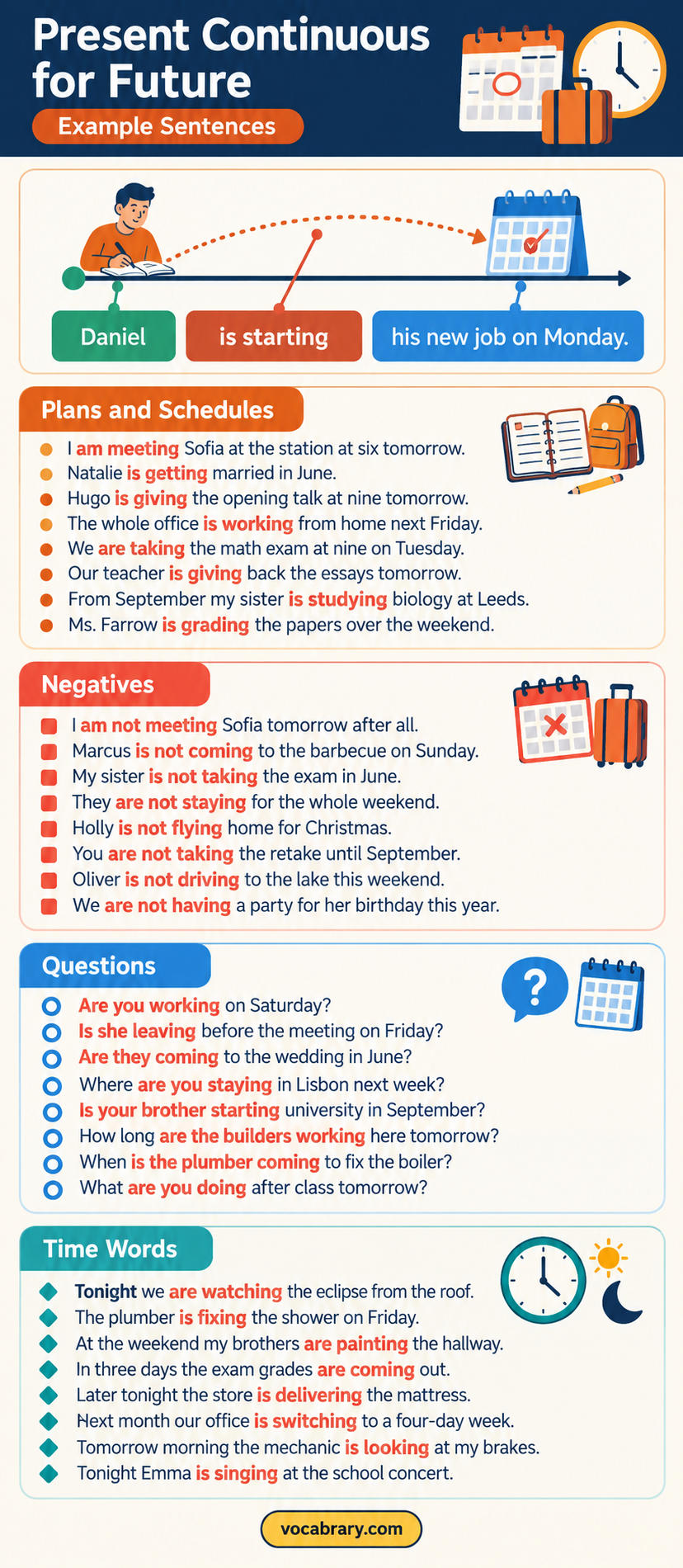
Common Present Continuous for Future Example Sentences
A dentist at four, a train on Saturday, and a birthday dinner on Friday night run through the everyday present continuous for future example sentences. In each one the plan is settled and the hour is known.
- I am meeting Sofia at the station at six tomorrow.
- We are having dinner with the Okonkwos on Friday night.
- Daniel is starting his new job on Monday.
- My parents are driving to Bristol next weekend.
- She is seeing the dentist at four on Thursday.
- The team is training at seven tomorrow morning.
- Nadia is getting married in June.
- They are moving into the flat on the first of March.
- Our flight is leaving at ten past eight tonight.
- Lucas is taking his driving test on Wednesday.
- Grandma is coming to stay for a fortnight in August.
- The builders are finishing the roof before the end of the month.
- You are sitting with me at the concert on Saturday.
- Hiroshi is giving the opening talk at nine tomorrow.
- Two of my cousins are arriving from Lagos on Sunday evening.
- Rain or no rain, the market is opening at dawn tomorrow.
- I am collecting my glasses from the shop this afternoon.
- Mrs Alvarez is retiring at the end of next term.
- We are catching the early ferry on Tuesday.
- Their daughter is starting school in September.
- Amir is playing in goal on Saturday afternoon.
- The whole office is working from home next Friday.
- Zara and Tom are hosting the book club in a fortnight.
- After lunch tomorrow, the inspector is visiting every classroom.
- My brother is flying home for Eid next week.
- Because the hall is booked from two, the rehearsal is beginning an hour earlier on Sunday.
Fixed Arrangements With a Time and a Place
Tickets bought, a corner seat reserved at eight, and a hall hired for Saturday give these sentences their certainty. Each one names both a clock time and a place, so the verb looks forward rather than describing this minute.
- We are eating at Sultan’s on Church Street at eight on Friday.
- The choir is singing in the cathedral at seven on Christmas Eve.
- Lena is waiting for us outside gate twelve at half past five.
- My uncle is picking me up from the bus station at noon tomorrow.
- On Tuesday at ten, the notary is signing the papers in his office.
- Our class is visiting the science museum on the twelfth of March.
- Priya is speaking at the town hall on Thursday evening at six.
- They are camping beside Lake Bled from the ninth to the fourteenth.
- I am starting work at the harbour office at eight on Monday morning.
- The band is playing two sets at the Blue Room tomorrow night.
- Karim is teaching the beginners in studio three at four on Wednesday.
- Everyone is gathering at the fountain at quarter to seven tonight.
- Later this week the surveyor is measuring the garden at the back.
- Marta and her sister are swimming at the lido at six tomorrow morning.
- Since the cafe closes early, we are meeting in the library at four instead.
Appointments at the Dentist, Doctor, and Bank
Appointments with a dentist, an eye doctor, and a bank manager go into a diary weeks ahead, so the present continuous reports each one as settled business with a named hour.
- I am seeing the dentist at nine on Monday.
- Dad is having his eyes tested tomorrow afternoon.
- My mother is visiting the heart specialist on the third of April.
- We are meeting the bank manager about the loan at two on Friday.
- Ravi is giving blood at the clinic on Saturday morning.
- The physiotherapist is treating my knee again next Tuesday.
- Sarah is bringing the baby for her vaccination on Wednesday.
- At eleven tomorrow, Mr Haddad is collecting his new hearing aid.
- Our accountant is going through the tax forms with us next week.
- Grandpa is having the operation on the ninth of November.
- Tomorrow morning the nurse is calling every patient still waiting for a date.
- Because the surgery closes at one, Nina is booking the first appointment of the day on Thursday.
Travel Plans and Booked Flights
Flights to Dublin, an overnight train to Milan, and a ferry booked for Sunday show the verb form at work in travel, where a ticket already names the date before anyone packs.
- We are flying to Dublin on the seventeenth of June.
- My sister is taking the overnight train to Milan on Thursday.
- Ahmed is driving to the coast at dawn tomorrow.
- They are sailing from Piraeus at six on Sunday morning.
- I am catching the last bus to Galway tonight.
- The tour group is landing in Reykjavik just after midnight.
- Next month Yuki and her husband are cycling across the Netherlands.
- Our cousins are staying at a guesthouse in Fez for ten nights in July.
- Bea is renewing her passport before the trip in August.
- On the fifth, a coach is taking the whole class to the border.
- The ferry is running every two hours during the holiday week.
- Karl is spending three nights in Prague before the conference starts.
- Since the strike ends on Friday, we are travelling on Saturday instead.
- Sunrise or not, the balloon is lifting off at half past five tomorrow.
Meetings and Dates in the Work Diary
A budget review at ten, a client call on Thursday, and a night shift on Sunday come straight from a work diary, where every arrangement already has a day and an hour beside it.
- We are holding the budget review at ten on Tuesday.
- Our manager is interviewing three candidates on Thursday morning.
- I am presenting the quarterly figures at the board meeting next week.
- The Berlin office is joining the call at four our time.
- Priyanka is training the new starters for two days in October.
- On Monday the auditors are checking every invoice from last year.
- My colleague is covering my desk while I am away in July.
- Tomorrow at eight, the warehouse team is loading the Marseille order.
- Deliveries are arriving before the shop opens on Saturday.
- Gabriel is working the night shift on Sunday and Monday.
- Because the server moves on Friday, nobody is logging in before noon.
- The whole department is relocating to the second floor in January.
Meals and Social Plans With Friends
Dinner with Priya on Friday, a barbecue at noon on Sunday, and coffee with a cousin after work are plans two people agreed out loud. The present continuous reports each one as fixed.
- I am having lunch with Priya on Friday.
- The neighbours are throwing a barbecue at noon on Sunday.
- We are ordering a curry when the film finishes tonight.
- Chloe is baking a cake for the picnic on Saturday.
- My flatmates are cooking a Moroccan supper for eight guests next Thursday.
- Tonight after work, Samir is meeting his cousin for coffee.
- They are bringing the dessert tomorrow, so we only need bread.
- Our book club is eating at the Turkish place before the discussion on Monday.
- Grandma is making her lentil soup for the family lunch tomorrow.
- Ella is paying at the dinner on Friday, because I paid in August.
- On Saturday afternoon a few of us are picking strawberries at the farm.
- Rosa and her brother are joining us for breakfast at nine.
Weddings, Parties, and Events
Nadia’s wedding in June, a surprise party on Saturday, and a school concert next month all come with a printed invitation, and the verb form treats every one of those dates as certain.
- Nadia and Idris are marrying on the twentieth of June.
- We are throwing a surprise party for Mum on Saturday evening.
- The school choir is performing at the festival next month.
- My cousin is celebrating her eighteenth birthday at the bowling alley in July.
- Guests are arriving from Karachi three days before the wedding.
- On the eve of the ceremony, the caterers are setting up the marquee.
- Leo is proposing to Marta on their anniversary in October.
- A brass band is opening the village fair at eleven on Sunday.
- We are hiring a photographer for the christening in April.
- The gallery is showing Aisha’s paintings from the first of December.
- Tickets go on sale tomorrow, because the theatre is closing for repairs in October.
- Everyone is wearing white to the anniversary dinner next Friday.
School Timetables and Exam Dates
Exams on Tuesday, a museum trip in March, and a chemistry lesson moved to period three come from a school timetable, where the dates are published weeks before the pupils walk in.
- We are taking the maths exam at nine on Tuesday.
- Our teacher is giving back the essays tomorrow.
- The whole year group is sitting mock papers during the last week of term.
- Tomas is repeating the chemistry practical on Friday afternoon.
- Year eight is visiting the planetarium on the twelfth of March.
- From September my sister is studying biology at Leeds.
- The library is staying open until nine during exam week.
- Miss Farrow is marking the papers over the weekend.
- On Wednesday the head teacher is announcing the new timetable.
- Two exchange students from Seoul are joining our class after the holidays.
- Because the hall is in use, the assembly is finishing ten minutes early tomorrow.
- I am handing in my history project before Thursday.
Sports Fixtures and Match Days
A Wednesday cup tie, a Sunday marathon, and a title fight in March are printed on a calendar months before anyone kicks a ball, so the present continuous states each fixture as settled fact.
- City are playing United in the cup on Wednesday night.
- Our netball team is hosting the league leaders next Saturday.
- Thousands are running the marathon on the first Sunday of April.
- Ibrahim is boxing for the title in Manchester in March.
- The swimmers are competing in Rotterdam from the ninth.
- Kickoff is at three on Saturday, and the away fans are travelling by coach.
- Serena is coaching the under-tens every Saturday from next month.
- We are watching the final on the big screen at Dario’s flat on Sunday evening with half the street.
- Because the pitch is frozen, the referee is inspecting it again at noon tomorrow.
- My father is umpiring the village cricket match on Sunday.
Arrangements Made With Other People
Two friends who agreed a time, a family sharing one taxi to the airport, and neighbours taking turns at the school run fill these sentences. An arrangement needs a second person expecting you.
- Farah and I are studying together at her place on Sunday.
- The four of us are sharing a taxi to the airport at five.
- My neighbour is driving the children to school all next week.
- We are swapping shifts with Damian on Thursday.
- Hugo is lending me his van on the day of the move.
- Tomorrow evening the two families are eating together at ours.
- Aunt Kiona is looking after the twins during the wedding on Saturday.
- From Monday I am walking Mrs Deng’s dog every morning until she comes home.
- They are collecting the keys from us before we leave on Friday.
- Since Paul has the tent, he is bringing it to the campsite on Saturday morning before the rest of us arrive.
Negative Sentences With Am Not, Is Not, and Are Not
Am not meeting, is not coming, and are not travelling cancel a plan that once stood in the diary, and each sentence keeps the future time word so the refusal names a day.
- I am not meeting Sofia tomorrow after all.
- Marcus is not coming to the barbecue on Sunday.
- We are not travelling to Spain this summer.
- My sister is not taking the exam in June.
- The shop is not opening on the bank holiday.
- Tonight the band is not playing, because the singer is ill.
- They are not staying for the whole weekend.
- Dr Osei is not working on Friday, so the appointment moved.
- I am not joining the trip to the lakes next month.
- Our neighbours are not selling the house this year, whatever the estate agent told the family next door.
- Hana is not flying home for the holidays.
- Because of the strike, the ferry is not sailing on Tuesday.
- You are not sitting the retake until September.
- Nobody is using the hall on Wednesday evening.
Question Sentences With Are You and Is She
Are you working, Is she leaving, and Are they coming ask about somebody else’s fixed plan, so the answer names a day or an hour rather than a habit.
- Are you working on Saturday?
- Is she leaving before the meeting on Friday?
- What time are we meeting at the cinema tonight?
- Are they coming to the wedding in June?
- Where are you staying in Lisbon next week?
- Am I sitting next to you at the dinner tomorrow?
- Is your brother starting university in September?
- How long are the builders working here tomorrow?
- Who is bringing the cake to the party on Sunday?
- When is the plumber coming to fix the boiler?
- Why are the girls swimming at six instead of seven on Thursday?
- Which train are you catching to Cardiff on Monday morning, the seven o’clock or the nine?
Short Answers About Future Arrangements
Yes, I am and No, he is not close a question about a booked plan in three or four words, with the pronoun swapping to match whoever was asked about.
- "Are you coming to the barbecue on Sunday?" "Yes, I am."
- "Is Paolo flying with us tomorrow?" "No, he is not."
- "Am I meeting you at the gate at six?" "Yes, you are."
- Asked whether her parents are visiting at Easter, Leila said, "Yes, they are."
- "Are the twins starting school in September?" "No, they are not, not until next year."
- When I asked whether the doctor is seeing patients on Friday, the nurse replied, "No, she is not."
- "Is your team playing away on Saturday?" "Yes, it is."
- Someone asked whether we are keeping the old dresser after the move, and Dad said, "No, we are not."
- My aunt asked if the two of us are eating with them tonight, and I said, "Yes, we are."
- Mum wanted to know whether Rafi is staying over on Friday, and his brother said, "Yes, he is."
Sentences With Tomorrow, Tonight, and Next Week
Tomorrow, tonight, next week, on Friday, and at the weekend are the words that force a future reading, since the same verb form without them describes an action happening at this moment.
- Tomorrow I am collecting the tickets from the ticket office.
- Tonight we are watching the eclipse from the roof.
- Next week Hassan is moving to a flat near the river.
- The plumber is fixing the shower on Friday.
- At the weekend my brothers are painting the hallway.
- In three days the exam grades are coming out.
- This evening Mariam is practising with the orchestra.
- The day after tomorrow, we are driving to the airport at four.
- Later tonight the shop is delivering the mattress.
- On Thursday of next week, Ana is defending her thesis in front of the committee.
- Soon after the holidays, the council is repairing the bridge on Mill Lane.
- In August my grandparents are celebrating fifty years of marriage.
- On the thirtieth, the landlord is showing the flat to two other couples.
- Next month our office is switching to a four-day week.
Arrangements That Changed
A dentist visit pushed to Monday, a flight moved after the strike, and a dinner cancelled by rain each need a second sentence. The verb form then reports the new plan.
- The dentist is seeing me on Monday now, not on Thursday.
- Because of the strike, we are flying on Saturday instead of Friday.
- Rain stopped the picnic, so everyone is eating indoors tomorrow.
- Marek is starting on the ninth, a week later than the contract said.
- Our meeting is moving to three o’clock on Wednesday.
- After the postponement, the team is playing the semi-final in April.
- I am taking the later train tonight, since the early one is full.
- They are holding the wedding in a smaller hall next June.
- Since the hall flooded, the exam is taking place in the sports centre on Tuesday.
- Yasmin is returning on the fourteenth, two days after the date on her old ticket.
Sentences Rewritten With the Correct Present Continuous
A dentist at nine on Monday, a flight to Cairo on the eleventh, and a barbecue on Sunday turn correct once am, is, or are joins the verb. Every wrong version drops that auxiliary or leaves the -ing ending off.
- I meeting Sofia at the station at six tomorrow ❌ / I am meeting Sofia at the station at six tomorrow ✅
- They is arriving from Lagos on Sunday evening ❌ / They are arriving from Lagos on Sunday evening ✅
- She is meet the dentist at nine on Monday ❌ / She is meeting the dentist at nine on Monday ✅
- We will meeting the landlord at noon tomorrow ❌ / We are meeting the landlord at noon tomorrow ✅
- Do you coming to the barbecue on Sunday? ❌ / Are you coming to the barbecue on Sunday? ✅
- Amir not playing in goal on Saturday afternoon ❌ / Amir is not playing in goal on Saturday afternoon ✅
- Where you are staying in Lisbon next week? ❌ / Where are you staying in Lisbon next week? ✅
- My parents driving to Bristol next weekend ❌ / My parents are driving to Bristol next weekend ✅
- He is going to flying to Cairo on the eleventh ❌ / He is flying to Cairo on the eleventh ✅
- The builders am finishing the roof next month ❌ / The builders are finishing the roof next month ✅
- Tonight the band is not play at the club ❌ / Tonight the band is not playing at the club ✅
- Because the hall is booked, we meeting the choir at seven on Sunday ❌ / Because the hall is booked, we are meeting the choir at seven on Sunday ✅
Present Continuous, Be Going To, and Will Compared
One evening plan shifts meaning three ways. Am having dinner with Sam reports a booking, am going to cook reports an intention nobody wrote down, and will order reports a decision taken while the phone rings.
| Form | Use | Example sentence |
|---|---|---|
| Present continuous | Arrangement settled with another person | We are meeting the landlord at noon tomorrow. |
| Present continuous | Booking with a date and a place | She is flying to Dublin on Friday evening. |
| Present continuous | Plan the diary already shows | Dad is working the night shift on Sunday. |
| Be going to | Intention with nothing booked yet | I am going to learn Spanish next year. |
| Be going to | Prediction drawn from what you see now | Those black clouds are going to soak us tonight. |
| Will | Decision taken while speaking | That is the doorbell, so I will get it. |
| Will | Offer or promise made while speaking | Leave the dishes, and I will wash them after supper. |
| Will | Prediction about a distant future | Most classrooms will look different in fifty years. |
- Sara is having dinner with Sam at eight, because the two of them booked it yesterday.
- Nothing is booked yet, so Sara is going to have dinner with Sam one evening soon.
- With no plan for tonight, Sara will have dinner with whoever calls first.
- We are painting the kitchen on Saturday, since the decorator starts at nine.
- My flatmates are going to paint the hallway before winter, with no date agreed.
- Fine, the wall looks terrible, so I will paint it myself this afternoon.
- Ahmed is flying to Cairo on the eleventh with a ticket in his bag.
- Before his sister’s baby arrives in spring, Ahmed is going to fly to Cairo.
- If nobody else volunteers, Ahmed will fly out on Sunday.
Short Present Continuous Future Sentences for Students and Beginners
A dentist on Monday, a party on Saturday, and a bus at eight keep these lines under ten words, which gives a beginner one pattern to copy aloud.
For Students
Homework due on Thursday, a class trip in March, and an exam at nine give students sentences they reuse in class with their own dates.
- I am handing in my essay on Thursday.
- We are studying together at six tonight.
- My class is visiting the museum in March.
- Ines is sitting the exam at nine tomorrow.
- The library is closing early on Friday.
- Next term I am taking German instead of Latin.
- Our teacher is marking the tests this weekend.
- Two students from Osaka are joining us on Monday.
- Because the bus leaves at seven, we are meeting outside the gate at quarter to.
- I am not staying for practice on Saturday.
For Beginners
A bus at eight, a party on Saturday, and a dentist on Monday keep the pattern to a name, am, is, or are, one verb with -ing, and a day.
- I am going to the dentist on Monday.
- We are playing football tomorrow.
- She is coming at eight.
- They are eating here tonight.
- My bus is leaving at seven.
- He is working on Sunday.
- The party is starting at four.
- You are helping me tomorrow.
- Amina is flying home to Lagos on Friday morning with her two sisters.
- I am not working tomorrow.
For Young Learners
A birthday cake on Saturday, a swimming lesson on Tuesday, and Grandma’s visit tomorrow keep every line to five or six words for a young child.
- We are baking a cake tomorrow.
- Grandma is coming on Sunday.
- I am swimming on Tuesday.
- My party is starting at three.
- Dad is driving us tomorrow.
- The cat is going to the vet on Friday.
- Sam is seeing the puppies on Saturday.
- Ben is sleeping here tonight.
- Our class is singing tomorrow.
Arrangements in a Short Paragraph
A hospital shift on Monday, a cousin’s flight on Wednesday, and a wedding in Galway on Saturday run through one family’s week, with every verb reporting a plan somebody already agreed.
Our week is filling up fast. On Monday my mother is working the early shift at the hospital, so Dad is taking the children to school. On Wednesday my cousin Fionn is landing at Shannon just before noon, and I am driving out to meet him. On Thursday evening the four of us are eating at the Greek place near the harbour, because Fionn booked it weeks ago. On Friday the plumber is coming at eight, and nobody is leaving the house until he finishes. On Saturday we are going to Galway for Aoife’s wedding, and on Sunday we are sleeping until noon.
Related
FAQs
We use the present continuous for the future when a plan already has a fixed hour, a fixed place, or another person waiting for us. A booked flight, a dentist appointment, and a dinner two friends agreed on all qualify. The verb keeps am, is, or are plus the -ing form, and a future time reference tells the listener that the action has not started.
The present continuous is wrong for a plan that nobody has booked, because the form reports an arrangement other people already know about. An intention with no date behind it takes be going to, as in I am going to learn Spanish next year. More sentences of that kind fall under be going to example sentences.
The present continuous reports an arrangement two people have settled, be going to reports an intention with no booking behind it, and will reports a decision taken while speaking. We are meeting the landlord at noon tomorrow names a settled appointment, while I am going to learn Spanish names an intention with no date. That is the doorbell, so I will get it names a choice made during the conversation. Only the first of the three promises a day and an hour. More sentences with the third form fall under will for the future sentences.
The present continuous for future arrangements takes a noun or pronoun, then am, is, or are, then a verb with -ing, then a phrase that names the future time. Hannah is flying to Oslo on Saturday morning follows that order exactly. Negatives add not after am, is, or are, and questions move am, is, or are to the front.
Speakers choose the present continuous instead of will because the arrangement already exists and nobody is deciding anything during the conversation. I am seeing the dentist at nine on Monday tells a listener that the appointment is booked, while I will see the dentist sounds like a decision reached mid-conversation. English speakers keep will for offers, promises, and predictions.
The present progressive for the future and the future continuous are two separate forms with two separate jobs. The present progressive uses am, is, or are plus -ing to report a settled arrangement, as in We are flying to Dublin on the seventeenth. The future continuous uses will be plus -ing to describe an action in progress at a named future moment, as in We will be flying over the Alps at nine tomorrow.
Words such as tomorrow, tonight, next week, on Friday, at the weekend, in June, and the day after tomorrow turn a present continuous sentence into a future one. Without one of them, Amir is playing in goal describes this minute, and that everyday use is shown in present continuous tense example sentences. With one of them, Amir is playing in goal on Saturday afternoon reports a fixture.
Three present continuous for future example sentences show the form at work: I am meeting Sofia at six tomorrow, Daniel is starting his new job on Monday, and Nadia is getting married in June. Each one names a day or an hour that two people settled in advance. A learner swaps in local names and dates and keeps the same pattern.
A negative adds not straight after am, is, or are, as in Marcus is not coming to the barbecue on Sunday. A question moves am, is, or are in front of the person doing the action, as in Are you working on Saturday? Short answers repeat the pronoun with be on its own, as in Yes, I am and No, he is not.
Stative verbs such as know, believe, own, need, prefer, and hate stay out of the present continuous, even when the meaning looks forward. I am owning a car next year is wrong, while I will own a car next year is right. Verbs of arrangement such as meet, fly, start, see, and leave take the -ing form without trouble.
Teachers introduce the present continuous for future plans with a blank week planner, where each pupil writes one arrangement per day and reads it aloud. Pairs then ask What are you doing on Thursday? and answer with a real plan of their own. Drilling the negative and the short answer in the same lesson stops learners from reaching for will every time.
The present continuous for future is tested in English exams from A2 upward, most of all in multiple-choice tasks that set it against be going to and will. Cambridge B1 Preliminary and similar papers ask candidates to pick the form that matches a booked arrangement. Writing five dated arrangements of your own each week prepares a candidate for those tasks.

Leave a Comment