
Future in the past is the set of verb forms that names an event still ahead at a past moment, as in he said he would ring back. Most future in the past example sentences use would, was going to, was about to, or a past continuous, all of them anchored in past time.
What Is the Future in the Past?
Future in the past takes a plan, promise, or prediction that belonged to a past moment and keeps the whole sentence inside past time. Every form matches: the reporting verb stays past, and the forward-looking verb shifts back with it. Be going to for present plans speaks from today about tomorrow, while the future in the past speaks from last Tuesday about last Wednesday.
Subject + would / was-were going to / was-were about to / past continuous / was-were to + verb
Marta was going to sell the flat before the interest rates changed.
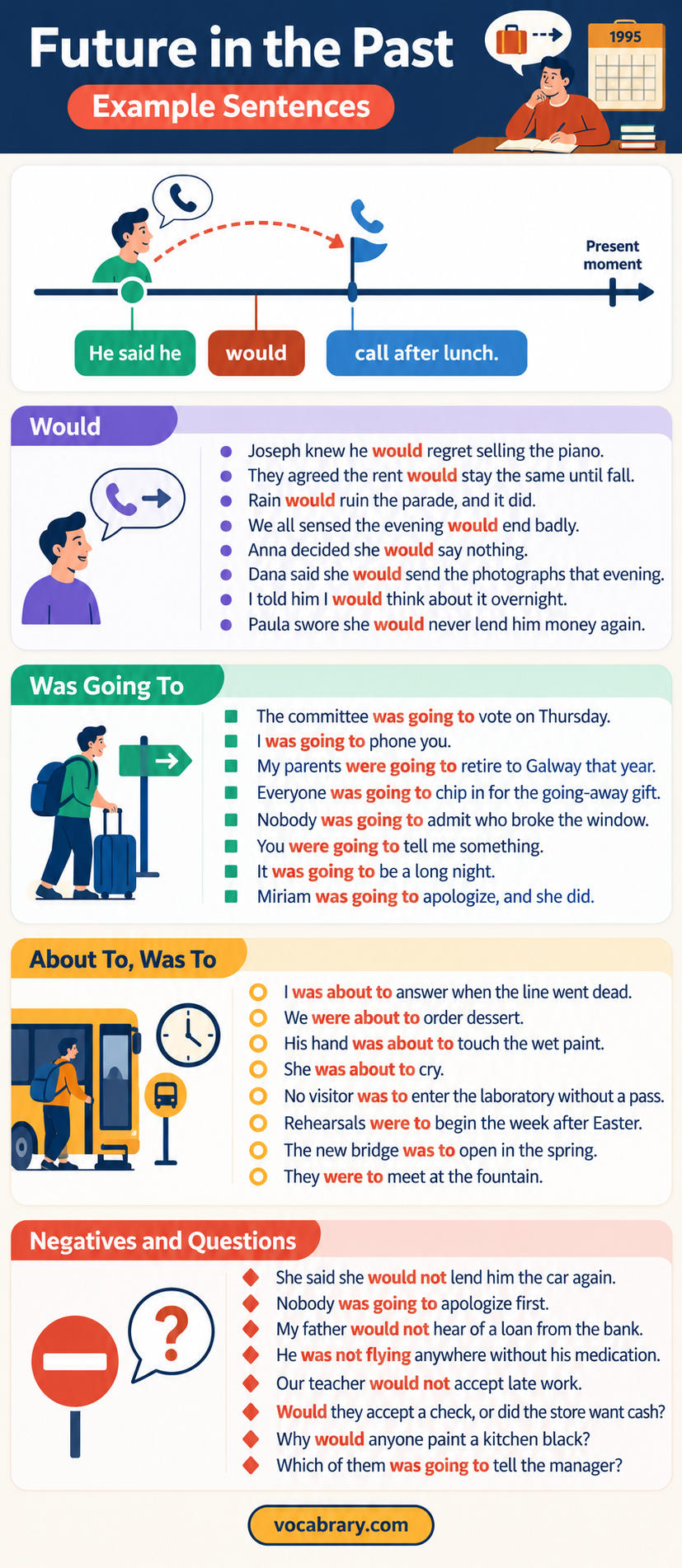
Common Future in the Past Example Sentences
A fence left unpainted, a promised phone call from Leeds, and a kettle that never boiled make up the common future in the past example sentences. Each one sets a past moment that already had something waiting ahead of it.
- Dad was going to repaint the fence, but the rain never stopped.
- She said she would ring me the moment the train left Leeds.
- At half past eight the film was about to start.
- We were meeting the architect at noon that Friday.
- Ibrahim was to report to the harbour office before sunrise.
- Nobody told me the shop was going to close at four.
- My grandmother promised she would teach me her bread recipe that winter.
- The kettle was about to boil when the power went out.
- Lena was flying to Oslo on the Tuesday after the exam.
- I thought the parcel would arrive before the weekend.
- Our coach was going to rest the goalkeeper for the second half.
- He knew the interview was going to run long.
- Rosa was about to apologise when her brother walked in and cut her off.
- They were driving to the coast that evening, tent and all.
- The letter said the inspection was to take place on 3 March.
- Tomas swore he would never eat oysters again.
- Everyone in the room sensed the manager was going to resign.
- Nothing was going to stop her.
- The captain was about to call the toss when the umpires stopped play for rain.
- Priya was starting her new job on the first of April.
- I had a feeling the answer would matter later.
- Before the storm arrived, the fishermen were going to haul the nets in early.
Future in the Past With Would
Marta’s thesis deadline, a forecast of lifting frost, and a piano that Yusuf regretted selling run on would, the past of will, which reports promises, predictions, and decisions that once faced forward.
- Marta announced that she would finish the thesis before Christmas.
- The forecaster said the frost would lift by mid-morning.
- I promised my sister I would collect her from the airport myself.
- He believed the price of flour would fall again after harvest.
- Nobody guessed the little café would grow into a chain of eleven shops.
- Our teacher warned us the second paper would be harder than the first.
- She hoped the letter would reach Karachi before the wedding.
- The doctor assured him the swelling would go down within a week.
- Yusuf knew he would regret selling the piano.
- They agreed the rent would stay the same until autumn.
- Grandpa always said the old bridge would outlast us all.
- Rain would ruin the parade, and it did.
- Every villager expected the river would flood the lower fields again that March.
- Passengers heard the flight would land twenty minutes early.
- Clara wrote in her diary that she would leave the island in spring.
- We all sensed the evening would end badly.
- My uncle swore the recipe would never leave the family.
- At the interview they hinted the job would suit a graduate.
- The letter explained that the payment would arrive by bank transfer on the last Friday of the month.
- Anna decided she would say nothing.
Was Going To and Were Going To in Sentences
Lakeside camping, a blue van rejected after a mechanic looked underneath, and thirty extra pounds of rent belong to was going to and were going to. Both forms name a decision already taken at that past moment.
- We were going to camp beside the lake until the forecast turned.
- Hannah was going to study architecture before she discovered ceramics.
- The committee was going to vote on Thursday.
- I was going to phone you, honestly.
- Those clouds were going to break over the valley within the hour.
- Farid was going to buy the blue van until the mechanic looked underneath.
- My parents were going to retire to Galway that year.
- Everyone was going to chip in for the leaving present.
- She was going to wear the green dress, then changed her mind at the door.
- Nobody was going to admit who broke the window.
- The builders were going to start on Monday, rain or shine.
- You were going to tell me something.
- Aisha and Ben were going to share a stall at the Saturday market.
- Our landlord was going to raise the rent by thirty pounds a month from June.
- It was going to be a long night.
- Kwame was going to train for the marathon until his knee gave way in February.
- They were going to name the baby after his grandfather.
- The film was going to finish at eleven, so we ordered a taxi for quarter past.
- Miriam was going to apologise, and she did.
- Six of us were going to take the exam in June.
Was About To and Were About To in Sentences
A bus pulling away from Leo, a dead phone line, and an organist dropping her music catch the instant before an action starts, which is the work of was about to and were about to.
- The bus was about to pull away when Leo banged on the door.
- I was about to answer when the line went dead.
- Sara was about to leave the building, and the alarm sounded.
- We were about to order pudding.
- His hand was about to touch the wet paint.
- The choir was about to sing when the organist dropped her music.
- Outside, the storm was about to break over the roofs of the old town.
- Marcus was about to confess, then he saw his mother in the doorway.
- They were about to give up the search when the dog barked twice.
- She was about to cry.
- Everyone stood as the referee was about to blow the final whistle.
- My laptop battery was about to die halfway through the presentation.
- Ravi was about to sign the lease when the agent mentioned the extra fee.
- Winter was about to settle on the mountain villages for another five months.
- You were about to say something rude.
- The train doors were about to close, so I jumped on with one shoe untied.
Past Continuous Sentences for Fixed Arrangements
Flights to Lisbon, a solicitor booked for ten, and a wedding in a Galway chapel show the past continuous doing future work: an arrangement fixed with another person, complete with a time.
- Nadia was flying to Lisbon on the Sunday after the conference.
- We were meeting the solicitor at ten the next morning.
- My cousins were arriving from Cape Town on the overnight flight.
- The dentist was seeing her at half past three that afternoon.
- Owen was starting at the new school in September.
- They were moving house on the last weekend of the month.
- I was having dinner with the Hendersons that Friday.
- Her sister was getting married in a small stone chapel near Galway on the last Saturday in June.
- Four candidates were coming in for interview on the Tuesday.
- Tom was driving the minibus to the tournament that Saturday.
- Lucia was singing at the festival on the closing night.
- Our neighbours were leaving for Greece the next morning.
- Ahmed was collecting the keys at noon.
- That evening the orchestra was playing Sibelius in the cathedral by the river.
Was To and Were To for Formal Plans
Treaties, wills, registers, and night-watch orders call for was to and were to, the formal pattern that states a plan laid down by an authority rather than chosen by the speaker.
- The delegates were to assemble in the great hall at nine sharp.
- Under the treaty signed that autumn, both armies were to withdraw from the border within thirty days.
- Miss Blake was to mark the attendance book every morning without fail.
- According to the will, the cottage was to pass to the youngest daughter.
- No visitor was to enter the laboratory without a pass.
- Rehearsals were to begin the week after Easter.
- The new bridge was to open in the spring.
- Every applicant was to submit two references with the form.
- Sailors on the night watch were to report any light on the horizon.
- She was to become the first woman elected to the council.
- Deliveries were to arrive before the kitchen opened at six.
- They were to meet at the fountain.
The Same Plan in Five Forms
Locking a shop at six and flying a squad to Turin appear five times each, once per pattern. The difference between a promise, a settled plan, an imminent act, a diary date, and an order becomes audible in one situation.
| Form | Use | Example sentence |
|---|---|---|
| Would | Promise, prediction, or will reported in past time | She said she would send the parcel that afternoon. |
| Was going to / were going to | Plan already settled at the past moment | We were going to camp beside the lake that weekend. |
| Was about to / were about to | Action on the edge of starting | The bus was about to pull away from the stop. |
| Past continuous | Arrangement fixed with a time and a person | Nadia was flying to Lisbon on the Sunday. |
| Was to / were to | Formal plan, order, or duty | Delegates were to assemble in the hall at nine. |
| Was supposed to / were supposed to | Duty set by somebody else | Ferris was supposed to staff reception until two. |
| Was due to / were due to | Timetabled event with a fixed hour | The ferry was due to dock at half past six. |
- Maya would lock the shop at six, whatever the weather.
- At six o’clock Maya was about to lock the shop door.
- Her rota said she was closing the shop at six that Thursday.
- The owner told her that she was going to lock up at six and walk straight home along the canal.
- Under the new rules the manager was to lock the shop at six.
- They were flying to Turin on the Thursday before the final.
- Everyone knew the squad would fly to Turin once the paperwork cleared.
- Coach Ferrara announced the team was going to fly to Turin that week.
- Bags packed, the players were about to board the coach.
- By order of the federation, the squad was to fly to Turin on Thursday.
Plans Made at a Past Moment
A half marathon in April, a shed that went up in a weekend, and a wedding called off in April divide past plans into the ones that arrived and the ones that never did.
Plans That Happened
Ines under two hours, a blanket finished before the birth, and Bell Street resurfaced on schedule show the future in the past followed by the outcome it predicted.
- Ines was going to run the half marathon in April, and she crossed the line in under two hours.
- He said he would pay back every penny, and the money arrived on the first of March.
- We were meeting the surveyor at eleven, and she turned up five minutes early.
- Karim was about to propose on the bridge, and he did exactly that.
- The council was to resurface Bell Street in July, and the work finished on schedule.
- My aunt promised she would knit a blanket for the baby, and it arrived before the birth.
- Ola was going to learn Polish before the move, and she managed a whole conversation at the airport.
- They were driving to Edinburgh overnight, and the car pulled in at dawn.
- Everyone expected the choir would win, and the trophy came home.
- Sam was about to hand in his notice, and by Friday he had.
- The letter said the grades were to appear on the twentieth, and they did.
- Our neighbour was going to build a shed, and the shed went up in a weekend.
- She would finish the puzzle before midnight, and she did.
- Before the term ended, Mr Okafor was going to mark every essay, and he marked every one.
Plans That Fell Through
A dead alternator on the ring road, three letters in two years, and a tour cancelled after Madrid give the future in the past its most familiar job: naming the plan that reality overruled.
- We were going to drive to the coast, but the alternator died on the ring road.
- Nadia was about to accept the offer when a better one came by email.
- He said he would write every week, and three letters arrived in two years.
- The wedding was to take place in June, and the couple parted in April.
- I was meeting Dan at the gallery, then the strike closed every line.
- Tariq was going to sell the shop, but his daughter took it over instead.
- Nobody was going to mention the missing money, and within an hour everybody had.
- The tour was going to end in Seville, and the band cancelled after Madrid.
- She would apologise in person, or so she told her mother.
- Our flight was leaving at six, and fog kept us on the tarmac until noon.
- Ben was about to dive in when he saw the jellyfish.
- The festival was to run for three days, and the storm shut it after one.
- They were going to adopt a greyhound, then the landlord refused.
- Grandad was going to teach me chess that summer, and the summer ran out.
- My sister was flying home for the holidays, and the airline went bust in November.
- Everything was about to change.
Future in the Past in Reported Speech
Dana’s photographs, a forty-pound school trip, and a nurse promising an answer in three days all started as will, am going to, or a present continuous. The reporting verb then pulled each one back a step.
- Dana said she would send the photographs that evening.
- He told the class the trip was going to cost forty pounds each.
- My boss explained that the office was closing early on the Friday before Christmas.
- The nurse promised the blood test would come back within three days.
- Yasmin whispered that she was about to faint.
- They announced that the shop was to reopen under new owners.
- I told him I would think about it overnight.
- The email confirmed that the interview was going to last an hour.
- Ade replied that he was flying to Lagos the next morning.
- She admitted she was never going to finish the course.
- Our instructor warned that the path would get steeper after the waterfall.
- The captain reported that the ship was to dock at dawn.
- Priya swore she would never lend him money again.
- He mentioned that his brother was going to open a bakery in the spring.
- Everyone agreed the meeting would achieve nothing.
- A tenant’s letter stated that the rent was going to rise in September.
- Lucas said he was about to leave the house when the courier rang the bell.
- She wrote that the family were moving to Vancouver in the new year.
Future in the Past in Stories and News
A ferryman reading the tide, a letter deciding which brother inherits a mill, and a spokesperson confirming an appeal give narrative and reporting their forward pull inside past time.
Story and Narration Sentences
An old ferryman, twins opening a letter by candlelight, and a sailor wondering about his name push the plot forward while every verb stays in past time.
- The old ferryman knew the tide would turn before midnight.
- Elena packed the suitcase she was going to take across the border.
- Nobody in the village guessed the harvest would fail twice.
- As the candle burned low, the twins were about to open the letter.
- Detective Morrow sensed the suspect was going to run.
- Winter was closing in, and the shepherd was moving the flock down that week.
- A dying king had decided his youngest son would inherit the orchard.
- She was about to knock when the door opened on its own.
- Far from home, the sailor wondered whether anyone would remember his name.
- Their guest was leaving in the morning, trunk already strapped shut.
- Jonas was to meet the stranger at the crossroads at midnight.
- Everything was going to change for the family in that one hour.
- Rain would come by morning.
- The letter in her pocket was going to decide which brother inherited the mill.
News Report Sentences
A hospital opening in autumn, flights resuming at midnight, and a parade starting an hour late are the plans that reporters attribute to ministers, airlines, and organisers.
- Ministers announced that the new hospital was going to open in the autumn.
- The airline confirmed that all flights were to resume at midnight.
- Reporters learned the factory was closing at the end of the quarter.
- A spokesperson said the company would appeal the ruling.
- Organisers warned that the parade was going to start an hour late.
- City officials promised the flood defences would be finished before winter.
- Police said the road was going to stay shut until the recovery lorry arrived.
- Farmers feared the drought would ruin a second harvest.
- Union leaders confirmed that members were about to vote on the offer.
- Weather forecasters said the front was going to reach the coast by dawn.
- The broadcaster stated that the debate was to run for ninety minutes without a break.
- Doctors warned the outbreak would spread.
Everyday Settings for Past Plans
Essays handed back on Thursday, a client meeting in Rotterdam, a sleeper train to Budapest, and a childhood band all place the future in the past inside one ordinary setting at a time.
School and Classroom Sentences
Essays returned on Thursday, a fire alarm cutting off Zainab’s poem, and five marks lost for late homework put past plans inside the school week.
- Our teacher said the test would come from chapters four and five.
- Mrs Adeyemi was going to hand back the essays on Thursday.
- I was about to raise my hand when somebody else answered.
- The head announced that assembly was to move to the sports hall.
- Half the class were going to join the trip to the science museum.
- Daniel was meeting his tutor at four for extra help with fractions.
- Nobody thought the school play would sell out in two days.
- We were going to revise together in the library after lunch.
- Miss Farrow warned that late homework would cost five marks.
- Zainab was about to read her poem aloud to the whole year group when the fire alarm went off in the corridor.
- The exam timetable said the maths paper was to begin at nine.
- They would never finish the project in time.
Work and Office Sentences
A report due before the board, a wrong attachment spotted in time, and a branch closing in March give the office its own set of plans made one step earlier.
- My manager said the report would go to the board on Monday.
- We were meeting the client at their Rotterdam office that Wednesday.
- Accounts were going to query the invoice before paying it.
- Jonas was about to send the email to the whole department when he noticed the wrong attachment at the bottom.
- The rota said Ferris was to staff reception until two.
- Nobody in the team was going to volunteer for the night shift.
- I promised the supplier I would confirm the order by noon.
- Head office announced that the branch was closing in March.
- She was going to resign, and then the promotion came through.
- Our new starter was arriving on the first Monday of the month.
- The union warned that overtime would disappear after the merger.
- Everyone knew the deadline would slip.
Travel Plans Made in the Past
A sleeper train from Warsaw, a split rucksack in Norway, and a connection nearly missed in Doha turn itineraries into future in the past sentences.
- We were going to take the sleeper train from Warsaw to Budapest.
- Our ferry was leaving Holyhead at ten past three.
- Hassan was about to miss his connection in Doha.
- The travel agent said the visa would take two weeks.
- I was going to hitchhike through Norway until my rucksack split.
- They were flying home on the red-eye from Toronto.
- According to the itinerary, the group was to reach Cusco on day four.
- Maria thought the coach would stop in Verona for lunch.
- Nobody was going to cancel the trip over a little snow.
- Her brother was driving them to the ferry port at four in the morning.
- The hostel said the room was to be free by eleven.
- We would be there by nightfall.
Childhood Plans and Early Ambitions
An astronaut at seven, a swimming pool dug in the garden every summer, and a band formed by a whole class are the ambitions that past plan forms record best.
- At seven I was going to be an astronaut, no argument.
- My brother swore he would live on a boat one day.
- Every summer we were going to dig a swimming pool in the garden.
- Rosa was going to marry the boy from the corner shop.
- Nobody told us the treehouse would last only one winter.
- He was about to spend his pocket money on a plastic sword.
- Our whole class was going to form a band and play at the end-of-term show.
- She said she would train tigers when she grew up.
- Grandma promised the kittens were to stay in the shed.
- Kofi was going to be a goalkeeper for Ghana.
- We were meeting at the oak tree every morning of that August.
- I knew the summer would end.
Historical Sentences With Dates Named
Kitty Hawk in 1903, the South Pole in 1911, and Berlin in November 1989 supply dated plans that either arrived on time or collapsed, each one written with the year stated.
- In 1903 the Wright brothers were going to fly a powered machine at Kitty Hawk, and on 17 December they did.
- When Titanic left Southampton on 10 April 1912, she was to reach New York within a week.
- Robert Falcon Scott was going to be first at the South Pole, and Roald Amundsen arrived on 14 December 1911.
- Gustave Eiffel’s tower was to come down twenty years after the 1889 World’s Fair, and Paris kept it.
- Tokyo was going to host the Olympic Games of 1940, and the war cancelled them.
- Amelia Earhart was going to circle the globe in 1937, and her plane vanished over the Pacific on 2 July.
- On 20 July 1969 Neil Armstrong was about to step onto the Moon.
- Ernest Shackleton was going to cross Antarctica on foot in 1915, and pack ice crushed Endurance first.
- Edmund Hillary and Tenzing Norgay knew the summit would decide everything on 29 May 1953.
- Few Berliners believed on 8 November 1989 that the wall would open the next evening.
Negatives, Questions, and Short Answers
A boiler left unrepaired, a question about who feeds the cat, and a two-word reply about Nasir driving home show the future in the past outside plain statements.
Negative Sentences With Was Not Going To and Would Not
A chainsaw argument avoided, a boiler left cold all winter, and neighbours refusing to turn the music down put not straight after was, were, or would.
- I was not going to argue with a man holding a chainsaw.
- She said she would not lend him the car again.
- We were not meeting the inspector until the week after.
- Nobody was going to apologise first.
- The landlord was not going to repair the boiler before winter.
- Amir was not about to hand over his passport at a roadside stall.
- They were not going to win, and the scoreboard said so by half time.
- My father would not hear of a loan from the bank.
- The committee was not to publish the names under any circumstances.
- Rosa was not going to spend another summer behind a till.
- He was not flying anywhere without his medication.
- Our teacher would not accept late work.
- You were not going to get away with it.
- Even after three warnings, the neighbours were not going to turn the music down.
Questions With Was Going To and Would
Who feeds the cat, why anyone paints a kitchen black, and where the driver waited on Sunday morning show was, were, and would landing in front of whoever did the planning.
- Who was going to feed the cat while the family was in Spain?
- Would they accept a cheque, or did the shop want cash?
- When was the committee to publish the shortlist?
- Were you about to leave without saying goodbye?
- Why would anyone paint a kitchen black?
- Was the train leaving from platform four that morning?
- How would she explain the broken window to her landlord?
- What were they going to do with an empty warehouse?
- Was Daniel about to quit?
- Where were we meeting the driver on the Sunday morning?
- Which of them was going to tell the manager?
- Would the referee really send off the captain in a cup final?
- Whose idea was it going to be this time?
- At what time were the delegates to assemble in the hall?
Short Answers About Past Plans
Ana calling back, twins staying put, and Nasir driving home afterwards are answered by repeating was, were, or would and nothing else.
- Was Ana going to call back? Yes, she was.
- Were the twins about to leave? No, they were not.
- Would Hugo pay the fine? Yes, he would.
- Wasn’t Lena going to join us at the lake? No, she wasn’t.
- Weren’t the shops going to close early on Christmas Eve? Yes, they were.
- So the driver was going to wait outside for us? Yes, he was.
- And you were about to say something? Yes, I was.
- Was the parcel going to arrive before noon? No, it wasn’t.
- Were we meeting at the station that morning? Yes, we were.
- Would the class finish at three? No, it wouldn’t.
- Who was going to drive home afterwards? Nasir was.
- Surely they were not going to cancel the whole festival at the last minute? Yes, they were.
Future in the Past Sentences for Students
A moved deadline, a missing reference caught one second before submission, and marks posted on the fifteenth make up the university version of past plans.
- Our lecturer said the deadline would move to the tenth.
- I was going to revise all weekend, then my laptop died.
- Priya was about to submit the assignment at one minute to midnight when she noticed a missing reference in the bibliography.
- The department announced that fees were to rise in September.
- We were meeting our study group in the library at six.
- Nobody was going to read every book on the syllabus.
- He said he would email the lecture slides that night.
- My flatmate was going to cook, and we ended up with noodles again.
- The exam board confirmed that marks would appear online on the fifteenth.
- Sara was flying home the day after her last paper.
- Everyone thought the seminar would overrun.
- You were going to ask a question, weren’t you?
Short Sentences for Beginners
Four-word and five-word lines about sleeping, eating, waiting, and rain give beginners the pattern without a subordinate clause to untangle.
- I was going to sleep.
- She would come later.
- We were about to eat.
- Tom was going to help.
- They were leaving soon.
- He said he would wait.
- The bus was about to go.
- My mum was going to cook rice.
- You would like it.
- Anna was meeting her friend.
- Nobody was going to speak.
- It was going to rain.
- The dog was about to bark at the postman on the garden path.
- We were to wait outside.
- Leo was going to buy new shoes for the first day of school.
- She was about to cry, and then the puppy licked her hand.
A Paragraph Built on Past Plans
Leila’s resignation letter, a sister’s promised phone call, and a door that swung open from inside run on as one short narrative, each line looking ahead from that Friday morning.
- That Friday morning Leila was going to hand in her notice.
- She was meeting her manager at eleven, and the letter sat folded in her bag.
- By ten she was about to lose her nerve.
- Her sister had promised she would ring at half past, and the phone stayed silent.
- The manager was to arrive from the Leeds office at half past ten.
- Leila knew the conversation would last four minutes at most.
- At eleven exactly she was about to knock, and the door swung open from inside.
- Nothing after that was going to go the way she had planned.
Related
- Tense Sentences Examples
- Future Perfect Continuous Tense Example Sentences
- Be Going to Example Sentences
FAQs
The future in the past is not a tense of its own but a family of past forms that point forward. The family is made up of would, was going to, was about to, the past continuous, and was to. English marks a verb as past or present and nothing else, so each of these patterns is already a past form doing a second job. Grammar books teach them together because they answer one question: what was still ahead at that past moment?
We use the future in the past once the story has moved into past time and something was still waiting to happen at that moment. A narrator describing Tuesday while pointing at Wednesday needs it, and so does anyone reporting a promise made last month. Plans that never came off take these forms more than any other situation, because was going to and was about to both leave room for the plan to collapse.
Would and was going to divide the work by how settled the plan was. Would reports a promise, a prediction, or a decision taken in the moment, while was going to reports an intention fixed before anyone spoke. She said she would help means the offer arrived with the words; she was going to help means the intention existed first. Was going to also leaves room for the plan to fail, and would rarely does.
Would acts as the past of will, so any will sentence turns into a would sentence the moment the reporting verb moves back. She says she will call becomes she said she would call, with nothing else changed but the time word. Would suits promises, predictions, and refusals, and narrators reach for it whenever a character faces an event still ahead.
The future in the past continuous uses would be plus an -ing verb, as in he knew that by noon she would be driving through the tunnel. It names an action in progress at a point still ahead of the past moment. The plain past continuous does a separate job here, naming a fixed arrangement such as Nadia was flying to Lisbon on the Sunday.
Would have plus a past participle names a past plan that never reached completion, as in the builders would have finished the roof, but the scaffolding arrived late. It joins was going to in the same family of unrealised plans, though it pushes the failure further into the open. Plain would leaves the outcome unstated, while would have announces that the event stayed undone.
Would drops out of a time clause and the past tense takes its place, so the sentence reads she said she would ring when she arrived, never when she would arrive. Time clauses opening with when, before, after, as soon as, and until obey this rule in past narration exactly as they do in present narration. The main clause keeps would, and the time clause takes the plain past.
The passive keeps the same forward-looking pattern and adds be plus a past participle, as in the delegates were told the scores would be posted on Friday. Was going to behaves the same way: the shop was going to be sold before the auction was called off. Both stay inside past time, and only the main verb changes.
Was to and was supposed to both name a duty set by somebody other than the speaker, and they part company over formality and outcome. Was to suits treaties, wills, rotas, and written orders, as in the delegates were to assemble at nine. Was supposed to sounds like ordinary speech and almost always names a duty that went unmet, as in Ferris was supposed to staff reception until two.
Reported speech pulls will back to would, am going to back to was going to, and the present continuous back to the past continuous, so every verb agrees in past time. I will send it tonight becomes he said he would send it that night, and tonight becomes that night alongside the verb. Reporting verbs such as said, promised, warned, and admitted set the whole backshift going.
Beginners do best with short was going to and would sentences of four or five words, such as I was going to sleep or she would come later. A second clause buries the pattern under grammar a learner has not met yet, so beginner lines keep one person and one verb. Once those feel natural, adding a but clause turns each sentence into a plan that failed.
Was going to and be going to are the past and present halves of one pattern, and only the form of be separates them. I am going to sell the flat speaks from today about tomorrow, while Marta was going to sell the flat speaks from a past moment about what came next. The past version also hints that the sale never happened, a hint the present version never gives.
Students meet the future in the past in reported speech tasks and in sentence transformation questions on B2 and C1 papers. An exam writer gives a direct line such as I will phone you tomorrow and asks for the reported version, which turns will into would and tomorrow into the next day. Steady practice across tense sentences of every kind makes the backshift automatic.

Leave a Comment