
"Would" is a modal verb that expresses hypothetical results, polite requests, offers, past habits, advice, and the future seen from the past, and its form never changes. These 308 would example sentences are written for imagined situations, shop and office requests, invitations, childhood routines, reported speech, and past regrets, so you study the word in each situation. You use "would" in polite requests, past habits, and imagined situations alongside "could" and "will," and practice with these sentences improves your accuracy.
Quick Answer: Would Example Sentences
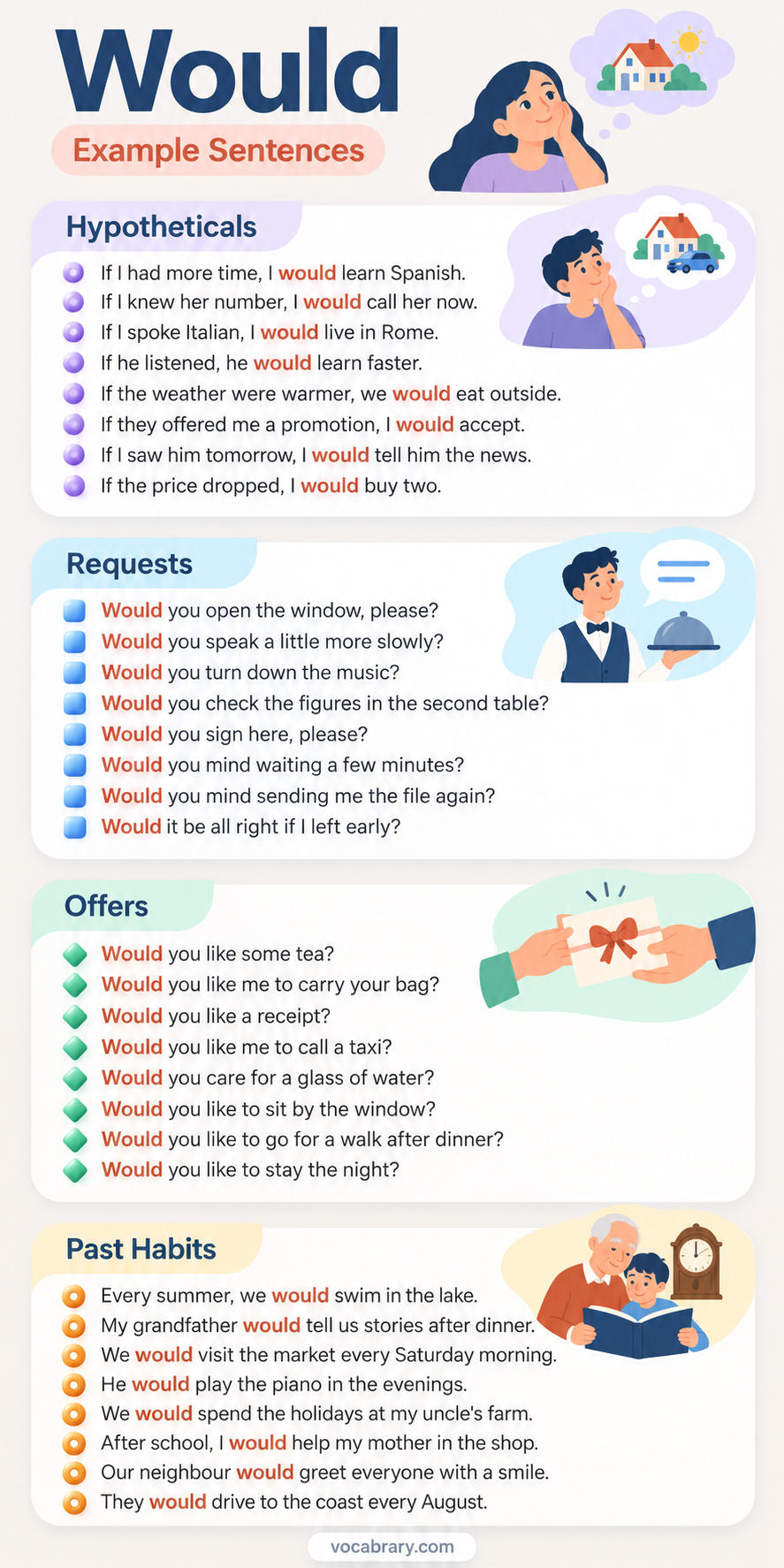
- Hypothetical result: If I had more time, I would learn Spanish.
- Polite request: Would you open the window, please?
- Polite offer: Would you like some tea?
- Past habit: Every summer, we would swim in the lake.
- Future in the past: She said she would call later.
- Refusal in the past: The car wouldn’t start this morning.
- Advice: If I were you, I would apply today.
- Past hypothetical: If I had known, I would have helped.
Would Example Sentences for Everyday Use
These sentences state imagined results, polite requests, offers, wishes, past habits, reported speech, refusal, advice, opinions, regrets, assumptions, questions, contractions, and passive forms.
- If I lived by the sea, I would swim every morning.
- If the tickets were free, half the town would come.
- Would you please lower your voice in the library?
- Would you mind if I borrowed your charger?
- Would you like a glass of orange juice?
- I would like to book a table for six at eight.
- Every winter, my uncle would take us ice skating.
- She said the parcel would arrive on Thursday.
- The old tractor wouldn’t start in the cold.
- Our guide would help anyone with a heavy bag.
- I would ask your supervisor before you decide.
- I would say the second draft is stronger.
- If we had taken the highway, we would have arrived by noon.
- I wish the neighbours would close their windows at night.
- That would be the courier at the gate.
- What would you do with an extra week of holiday?
- She’d call you back if she had your number.
- The prize would be awarded at the end of the ceremony.
Second Conditional Sentences with Would
These sentences describe results of imagined situations, from learning Spanish with more time to hiring designers with a bigger budget.
Would Sentences for Imagined Present Situations
These sentences describe what happens in a situation that is not true now, such as a taller basketball player, a cheaper service, and a flat with a balcony.
- If I had more time, I would learn Spanish.
- If she lived nearby, she would visit more often.
- If we had a bigger kitchen, we would cook for the whole family.
- If he were taller, he would play basketball.
- If I knew her number, I would call her now.
- They would drive to the coast if they had a car.
- If the shop were open, I would buy some bread.
- If I spoke Italian, I would live in Rome.
- You would understand the system if you worked here.
- If it were cheaper, more people would use the service.
- If the flat had a balcony, I would grow herbs.
- She would buy a house if she earned more.
- If he listened, he would learn faster.
- We would go every week if the museum were closer.
- If I were you, I would not sign that contract.
- If the weather were warmer, we would eat outside.
- The team would win more matches if it trained harder.
- If I had a bigger budget, I would hire two more designers.
Would Sentences for Imagined Future Situations
These sentences describe unlikely events ahead, such as winning the lottery, getting a job in Berlin, and a late train.
- If I won the lottery, I would travel for a year.
- If she got the job, she would move to Berlin.
- If they offered me a promotion, I would accept.
- If it rained tomorrow, we would cancel the picnic.
- If you asked politely, he would help.
- If the company grew, it would open a second office.
- If I saw him tomorrow, I would tell him the news.
- We would arrive before dark if we left now.
- I would answer if she called.
- If the price dropped, I would buy two.
- We would go if they invited us.
- If the train were late, we would take a taxi.
Polite Request Sentences with Would
These sentences ask another person to act, from passing the salt to checking figures, in shops, offices, and everyday conversations.
Would Sentences for Direct Requests
These sentences start with "Would you" and ask for a specific action, such as opening a window, repeating a sentence, and signing a form.
- Would you open the window, please?
- Would you send me the report by Friday?
- Would you pass the salt?
- Would you speak a little more slowly?
- Would you tell me where the station is?
- Would you help me carry these boxes?
- Would you turn down the music?
- Would you repeat the last sentence?
- Would you lend me a pen for a moment?
- Would you check the figures in the second table?
- Would you hold the lift?
- Would you call me when you arrive?
- Would you sign here, please?
- Would you keep an eye on my bag?
Would Sentences for Courteous Requests
These sentences use "Would you mind" and "Would it be possible" to ask for a favour, such as closing a door, moving a car, or speaking to a manager.
- Would you mind closing the door?
- Would you mind waiting a few minutes?
- Would you mind if I opened the window?
- Would you mind moving your car?
- Would you mind sending me the file again?
- Would you mind if I joined you?
- Would it be possible to change the date?
- Would it be all right if I left early?
- Would it be possible to speak to the manager?
- Would it be a problem if we arrived late?
Offer and Invitation Sentences with Would
These sentences offer food, help, and company, from tea and cake to a taxi ride and a stroll after dinner.
Would Sentences for Offers
These sentences offer a drink, a seat, or help with a task, such as tea, a menu, a receipt, and a taxi.
- Would you like some tea?
- Would you like a seat?
- Would you like to see the menu?
- Would you like me to carry your bag?
- Would you like another slice of cake?
- Would you like a refill?
- Would you like a receipt?
- Would you like some help with the form?
- Would you like to leave a message?
- Would you like me to call a taxi?
- Would you like to try on the jacket?
- Would you like your coffee with milk?
- Would you care for a glass of water?
- Would you like to take a look at the garden?
- Would you like me to explain the next step?
- Would you like to sit by the window?
Would Sentences for Invitations and Plans
These sentences invite a person to a party, a meal, a stroll, a film, or a committee.
- Would you like to come to my party on Saturday?
- Would you like to have lunch with us?
- Would you like to go for a walk after dinner?
- Would you like to see a film tonight?
- Would you like to meet my sister?
- Would you like to stay the night?
- Would you like to join the committee?
- Would you like to visit the gallery with me?
Preference Sentences with Would Like and Would Love
These sentences state a wish, a want, or a choice in a polite way, from ordering soup to booking a room and asking for a window seat.
- I would like a table for two.
- I would like to speak to the manager.
- We would like to book a room for three nights.
- She would like a window seat.
- I would love to visit Japan.
- They would love to hear from you.
- He would love a quiet weekend.
- I would prefer the earlier flight.
- We would prefer to pay by card.
- She would prefer tea to coffee.
- I would like to thank everyone for coming.
- They would like more information about the course.
- I would love to see the new house.
- We would like to ask a few questions.
- He would like to change his reservation.
- I would like the soup, please.
Past Habit Sentences with Would
These sentences describe actions that people repeated in the past, such as swimming in a lake every summer, baking bread on Sundays, and reading the newspaper on a balcony.
- Every summer, we would swim in the lake.
- When I was a child, I would walk to school with my brother.
- My grandfather would tell us stories after dinner.
- On Sundays, she would bake bread for the whole street.
- We would visit the market every Saturday morning.
- He would play the piano in the evenings.
- In winter, the children would build snowmen in the garden.
- She would write a letter to her aunt every month.
- Every morning, he would read the newspaper on the balcony.
- We would spend the holidays at my uncle’s farm.
- After school, I would help my mother in the shop.
- Our neighbour would greet everyone with a smile.
- The class would sing a song at the end of each week.
- They would drive to the coast every August.
- As a student, I would study at the library until closing time.
- My father would wake us at six and make pancakes.
Future in the Past Sentences with Would
These sentences describe planned events and later results, in reports of what people said and in stories.
Would Sentences for Reported Speech
These sentences describe promises, plans, and predictions, such as a call later, a meeting at nine, and a road closing on Monday.
- She said she would call later.
- He promised that he would be on time.
- They told us they would arrive on Friday.
- The manager said the meeting would start at nine.
- I thought it would rain.
- She said she would help with the project.
- He assured me he would send the file by noon.
- They said the shop would open at eight.
- The teacher said the test would be difficult.
- I knew you would like the film.
- She told me she would never forget the trip.
- The guide said we would see the castle after lunch.
- He said it would take an hour.
- We hoped the plan would work.
- They announced that the road would close on Monday.
- I promised I would not tell anyone.
Would Sentences for Stories and Biographies
These sentences describe later events in a life or a history, such as a painter’s fame, a village hosting the Olympic Games, and a storm lasting three days.
- She would later become a famous painter.
- He did not know that he would never see his home again.
- The company would grow into a global brand within ten years.
- Nobody realised that the storm would last three days.
- The decision would change his life.
- They would meet again, but only after many years.
- That small village would one day host the Olympic Games.
- She would remember this moment for the rest of her life.
Willingness and Refusal Sentences with Would
These sentences describe people who agreed to help and people or machines that refused, from a neighbour watching a house to a car that did not start.
Wouldn’t Sentences for Refusal
These sentences describe a past refusal by a person or an object, such as a car, a door, a printer, and a dog.
- The car wouldn’t start this morning.
- He wouldn’t tell me where he went.
- She wouldn’t listen to our advice.
- The door wouldn’t open.
- The child wouldn’t eat his vegetables.
- They wouldn’t accept the offer.
- The printer wouldn’t print the last page.
- My boss wouldn’t let me leave early.
- The dog wouldn’t come inside.
- He wouldn’t apologise, even after the argument.
- The window wouldn’t close properly.
- She wouldn’t take the money.
- The company wouldn’t refund the ticket.
- The engine wouldn’t turn over.
Would Sentences for Willingness
These sentences describe people who were ready to help, share, or pay, such as a neighbour watching the house and an old man sharing his lunch.
- He would help anyone who asked.
- She would always lend me her notes.
- They would gladly pay the extra cost.
- My neighbour would watch the house whenever we travelled.
- The old man would share his lunch with strangers.
- I would do anything for my sister.
Advice Sentences with Would
These sentences give personal recommendations, such as seeing a doctor, taking an earlier train, and checking an address.
- If I were you, I would apply today.
- I would see a doctor about that cough.
- I would take the earlier train.
- In your position, I would ask for a written contract.
- I would not wait any longer.
- It would be wise to call her before it gets late.
- If I were in your place, I would say yes.
- I wouldn’t spend that much on a phone.
- I would double-check the address.
- My advice would be to start with the easier chapters.
- I wouldn’t mention the problem at the meeting.
- I would book the hotel now, before the prices rise.
- Taking an umbrella would be a good idea, just to be safe.
- I wouldn’t trust a site that hides its fees.
Opinion Sentences with Would
These sentences state a personal view in meetings and interviews, from a project schedule to a candidate, a cost estimate, and a recommended option.
- I would say the project is on schedule.
- I would think she is the best candidate.
- I would imagine the roads are busy today.
- My suggestion would be a different approach.
- I would argue that the results support the plan.
- I would expect the price to rise next month.
- I would assume he is still at work.
- I would not call the result a failure.
- We would hope that everyone can attend.
- My estimate of the cost would be two thousand pounds.
- I would recommend the second option.
- I would agree with most of the report.
Would Sentences for Polite Disagreement
These sentences voice doubt about a plan, such as a date that is hard to arrange, a budget, a longer deadline, and an unwise signature.
- That would be difficult to arrange.
- It would be better to wait until Monday.
- That would not be my first choice.
- It would seem that the plan needs more work.
- That would depend on the budget.
- It would be unwise to sign without reading the terms.
- That would make the process longer.
- A longer deadline would not suit the client.
- It would be a mistake to ignore the warning.
- I wouldn’t put it that way.
Third Conditional Sentences with Would Have
These sentences describe past results that did not happen, such as a caught train, a passed exam, a missed bus, and a spreading fire.
Would Have Sentences for Unreal Past Results
These sentences describe a different outcome in the past, such as passing an exam, saving money by booking early, and arriving on time on an empty road.
- If I had known, I would have helped.
- If she had studied, she would have passed the exam.
- If we had left earlier, we would have caught the train.
- If he had called, I would have answered.
- If they had booked in advance, they would have saved money.
- If it had rained, the match would have been cancelled.
- If you had asked, I would have lent you the book.
- I would have bought the cake if the shop had been open.
- I would have turned left if I had seen the sign.
- If she had taken the job, she would have moved to Paris.
- If we had brought a map, we would not have got lost.
- If the road had been clear, we would have arrived on time.
- He would have won if he had trained harder.
- If they had listened, they would not have made the mistake.
- If I had checked the address, I would have found the house.
- She would have bought the flat if she had saved more.
Wouldn’t Have Sentences for Avoided Results
These sentences describe a bad outcome that was avoidable, such as missing a bus, getting wet, and a fire spreading.
- I wouldn’t have gone if I had known the price.
- If she had left earlier, she wouldn’t have missed the bus.
- We wouldn’t have got wet if we had brought umbrellas.
- He wouldn’t have failed if he had revised.
- They wouldn’t have lost the match if they had had a better plan.
- If I had known her story, I wouldn’t have said that.
- You wouldn’t have been late if you had set an alarm.
- The fire wouldn’t have spread if the doors had been closed.
Wish and Complaint Sentences with Would
These sentences express a wish for a change in another person or in the situation, such as an interruption, loud music, a late bus, and rain.
- I wish you would stop interrupting.
- I wish he would call more often.
- I wish it would stop raining.
- If only the neighbours would turn down the music.
- I wish she would tell me the truth.
- If only they would fix the heating.
- I wish the bus would arrive on time.
- I wish you would listen to me.
- If only the manager would reply to my email.
- I wish the weather would improve.
Assumption Sentences with Would
These sentences state a confident guess about a person, a time, or a location, such as a visitor at the door, a closed shop, and a person’s age.
- That would be Tom at the door.
- She would be about forty now.
- It would have been around noon when he left.
- That would explain the delay.
- You would know the answer better than I do.
- The shop would be closed by now.
- He would be at work at this hour.
- That would be the postman.
- The accident would have happened at night.
- She would still be on holiday.
Question Sentences with Would
These sentences ask for help, ask about choices, and ask about imagined situations, in yes or no questions, wh-questions, and short answers.
Would Sentences for Yes or No Questions
These sentences ask about willingness, preference, and likelihood, such as accepting an offer, borrowing a car, and a faster train.
- Would you help me with this?
- Would she come if we asked?
- Would they accept the offer?
- Would it be possible to extend the deadline?
- Would you rather stay or go?
- Would your brother mind if I borrowed the car?
- Would the train be faster?
- Would you like some more?
- Would you do the same thing again?
- Would that work for you?
Would Sentences for Wh-Questions
These sentences ask where, what, who, when, why, how, and which, as in questions about travel, a lottery win, and a repair cost.
- Where would you go if you could travel anywhere?
- What would you do if you won the lottery?
- Who would you invite to the party?
- When would you like to start?
- Why would he say that?
- How would you describe the situation?
- Which option would you choose?
- What would happen if the power failed?
- How much would it cost to repair the roof?
- What time would suit you best?
Would Sentences for Short Answers
These sentences pair a question with a brief reply, such as "Yes, I would," "No, she wouldn’t," and "Not at all."
- Would you help me? Yes, I would.
- Would she come? No, she wouldn’t.
- Would they accept? Yes, they would.
- Would you like some soup? Yes, please.
- Would you mind waiting? Not at all.
- Would it work? It would, I think.
- Would you do it again? I wouldn’t.
- Would he agree? He would.
Contraction Sentences with Would
These sentences use the short form "’d" in speech and informal writing, in invitations, plans, and preferences, as in "I’d love to," "She’d help," and "We’d like."
- I’d go if I had time.
- She’d help if you asked.
- They’d love to come.
- He’d rather stay home.
- We’d like a table for two.
- I’d love to see your new office.
- I’d suggest an earlier meeting.
- You’d enjoy the museum on a quiet weekday.
- It’d be quicker by train.
- We’d never leave without saying goodbye.
- He’d call every Sunday when he lived abroad.
- They’d say yes if you offered.
- I’d rather walk than wait for the bus.
- She said she’d bring dessert.
- I’d prefer the window seat.
- Where’d you like to meet?
Passive Sentences with Would
These sentences describe planned or expected events, such as a report finished by noon, a meeting in the main hall, and tickets sold by the end of the week.
- The report would be finished by noon.
- The meeting would be held in the main hall.
- The building would be demolished next year.
- The workers would be paid on Friday.
- The data would be stored on a secure server.
- The bridge would be repaired in the spring.
- If we asked, the fee would be waived.
- The results would be posted online.
- The room would be cleaned every morning.
- The tickets would be sold by the end of the week.
- The students would be given extra time.
- The files would be sent by email.
FAQs
A standard example of "would" in a sentence is "If I had more time, I would learn Spanish," which describes an imagined result. Other common examples are "Would you open the window, please?" and "She said she would call later."
You use "would" in a sentence to describe an imagined result, make a polite request, offer something, recall a past habit, report speech, or give advice. Each use has a typical sentence, such as "If she got the job, she would move to Berlin," "Would you pass the salt?", and "I would take the earlier train."
Example sentences with "would" for hypothetical results describe what happens in an imagined situation. "If we had a bigger kitchen, we would cook for the whole family" is set in the present, and "If I won the lottery, I would travel for a year" is set in the future. "If it had rained, the match would have been cancelled" is set in the past.
Polite requests with "would" ask another person to act in a courteous tone. "Would you send me the report by Friday?" asks for a task, and "Would you mind waiting a few minutes?" asks for a favour. "Would it be possible to change the date?" asks for a change in a formal tone.
Offers and invitations with "would" start with "Would you like" and name something for the listener to accept. "Would you like another slice of cake?" is an offer, and "Would you like to come to my party on Saturday?" is an invitation. Both sentences are common in restaurants, shops, and homes.
Past habit sentences with "would" describe actions that a person repeated in the past. "On Sundays, she would bake bread for the whole street" and "As a student, I would study at the library until closing time" are two models. The phrases "On Sundays" and "As a student" state when the habit happened.
Sentences with "wouldn’t" describe a past refusal or an avoided result. "The car wouldn’t start this morning" and "She wouldn’t listen to our advice" describe refusals. "We wouldn’t have got wet if we had brought umbrellas" describes a result that was avoidable.
Advice sentences with "would" describe a recommendation from the speaker’s own position. "I would see a doctor about that cough" and "In your position, I would ask for a written contract" are two models. A negative form such as "I wouldn’t spend that much on a phone" warns against an action.
Sentences with "would like" state a polite wish or ask about the listener’s wish. "I would like a table for two" is a request at a restaurant, and "Would you like some help with the form?" is an offer. "I would love to visit Japan" states a wish to travel.
Sentences with "would have" describe results that did not happen in the past. "If she had studied, she would have passed the exam" and "If we had left earlier, we would have caught the train" are two models. Each sentence pairs a past condition with a result that did not occur.

Leave a Comment