
“Have to,” “has to,” and “had to” are semi-modal verbs that express obligation, necessity, and, in the negative, a lack of obligation. These 330 have to has to and had to example sentences are written for laws, school duties, past events, future plans, choices, and questions. You use these forms of “have to” next to modal verbs such as “must” and “should” in daily speech and writing, and practice with example sentences improves your accuracy.
Quick Answer: Have to, Has to, and Had to Example Sentences
- Present obligation: We have to wear uniforms at work.
- Third-person obligation: She has to submit the form by Friday.
- Past obligation: I had to leave early yesterday.
- Future obligation: You will have to show your ticket at the gate.
- No obligation: You don’t have to come tomorrow.
- Question: Do you have to work on Saturdays?
- Deduction: That has to be the right address.
- Informal strong need: I’ve got to go now.
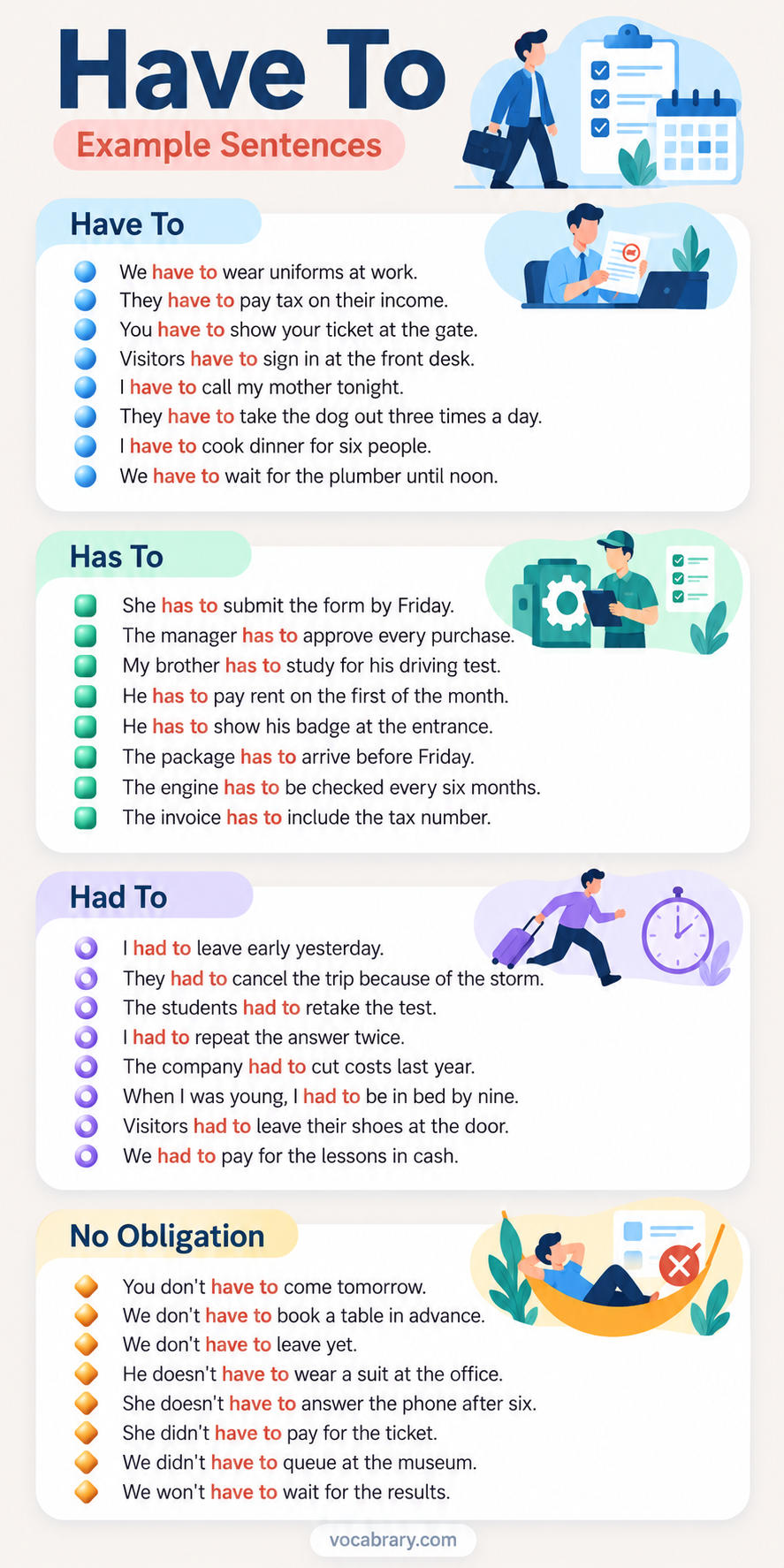
Have to Has to and Had to Example Sentences
These sentences use “have to,” “has to,” and “had to” in each main situation, from laws and daily duties to past events, future plans, choices, questions, and deductions.
- All new staff have to attend the safety briefing on their first morning.
- I have to renew my library card before the end of the month.
- Amira has to take two trains to reach her university campus.
- Tomás had to borrow a jacket because he left his coat on the bus.
- Our grandparents had to carry water from a well every morning.
- The new interns will have to learn the filing system by Friday.
- We are going to have to replace the old boiler before winter.
- Priya has had to rewrite her presentation three times this month.
- You don’t have to bring a gift to the party.
- Kenji doesn’t have to wake up early on Sundays.
- Do you have to show an ID at the entrance?
- Why did Mei have to cancel her appointment?
- You have to taste the mango sticky rice at that night market.
- That has to be Fatima’s bicycle outside the shop.
- I’ve got to finish this application before midnight.
- We may have to postpone the picnic if the rain continues.
- If the flight is cancelled, we will have to book a hotel.
- The coach told us we had to arrive thirty minutes before kickoff.
Present Obligation Sentences with Have to
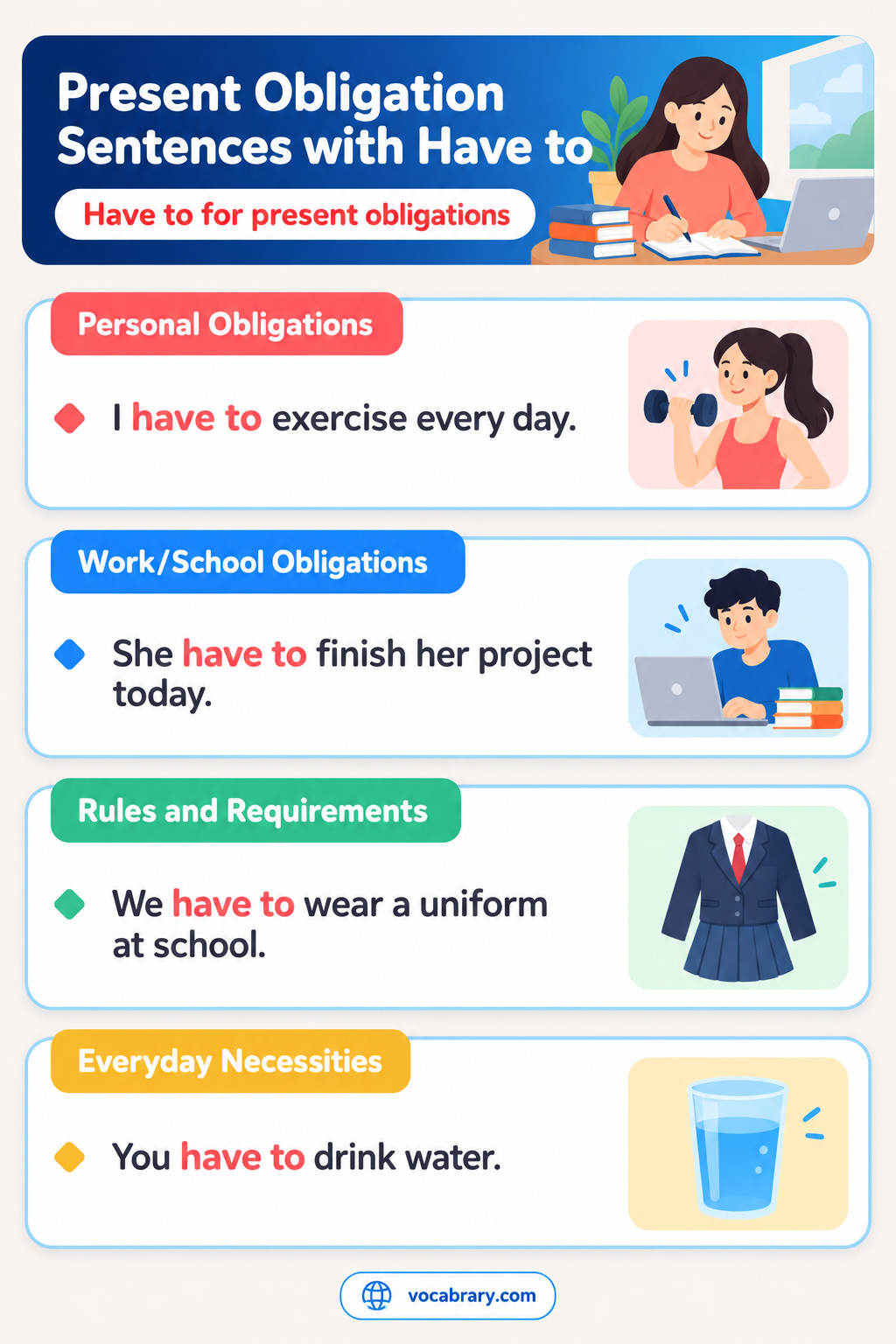
These sentences state present duties that come from laws, jobs, schools, and daily needs.
Have to Sentences for Laws and Workplace Requirements
Laws and employers set duties such as stopping at a red light, wearing a helmet on a construction site, and signing in at a front desk.
- We have to wear uniforms at work.
- You have to stop at a red light.
- Students have to attend at least eighty percent of the classes.
- I have to be at the office by eight.
- They have to pay tax on their income.
- Drivers have to carry a licence at all times.
- We have to renew our passports every ten years.
- You have to show your ticket at the gate.
- Employees have to report any accident immediately.
- We have to submit the application before the deadline.
- I have to wear a helmet on the construction site.
- You have to be eighteen to vote in this country.
- Visitors have to sign in at the front desk.
- We have to follow the safety regulations.
- They have to register the car within thirty days.
- Candidates have to bring two forms of identification.
Have to Sentences for Personal Duties
Personal duties include calling a parent, buying groceries, picking up children, and studying for an exam.
- I have to call my mother tonight.
- We have to buy groceries on the way home.
- I have to finish the report by noon.
- They have to take the dog out three times a day.
- We have to leave now if we want to catch the train.
- I have to pick up the children at four.
- You have to eat something before the long trip.
- We have to change the tyre before we go.
- I have to cook dinner for six people.
- They have to move out by the end of the month.
- I have to study for the exam this weekend.
- We have to wait for the plumber until noon.
- I have to renew the car insurance this week.
- I have to charge my phone before the trip.
- We have to clean the house before the guests arrive.
- I have to book a flight for next month.
Third-Person Obligation Sentences with Has to
These sentences state duties of people and objects, from a doctor with many patients to a password with eight characters.
Has to Sentences for People
People in jobs and at school have duties such as waking at five, marking essays, checking the weather before a flight, and renewing a visa.
- She has to submit the form by Friday.
- He has to wake up at five every morning.
- My sister has to take two buses to school.
- The manager has to approve every purchase.
- The doctor has to see forty patients a day.
- He has to wear a suit to the office.
- My brother has to study for his driving test.
- She has to finish the project before the holidays.
- The teacher has to mark fifty essays tonight.
- He has to pay rent on the first of the month.
- The pilot has to check the weather before every flight.
- My neighbour has to leave early for work.
- She has to renew her visa next month.
- The waiter has to learn the whole menu.
- He has to show his badge at the entrance.
- The judge has to explain every decision.
Has to Sentences for Objects and Systems
Objects and systems have requirements such as a password with eight characters, an engine checked every six months, and a soup served hot.
- The form has to be signed by a parent.
- The package has to arrive before Friday.
- The machine has to be switched off after use.
- The bridge has to be repaired before winter.
- The password has to contain at least eight characters.
- The engine has to be checked every six months.
- The report has to be ready by noon.
- The room has to be cleaned before the next class.
- The invoice has to include the tax number.
- The software has to run on any laptop.
- The door has to stay closed.
- The soup has to be served hot.
Past Obligation Sentences with Had to
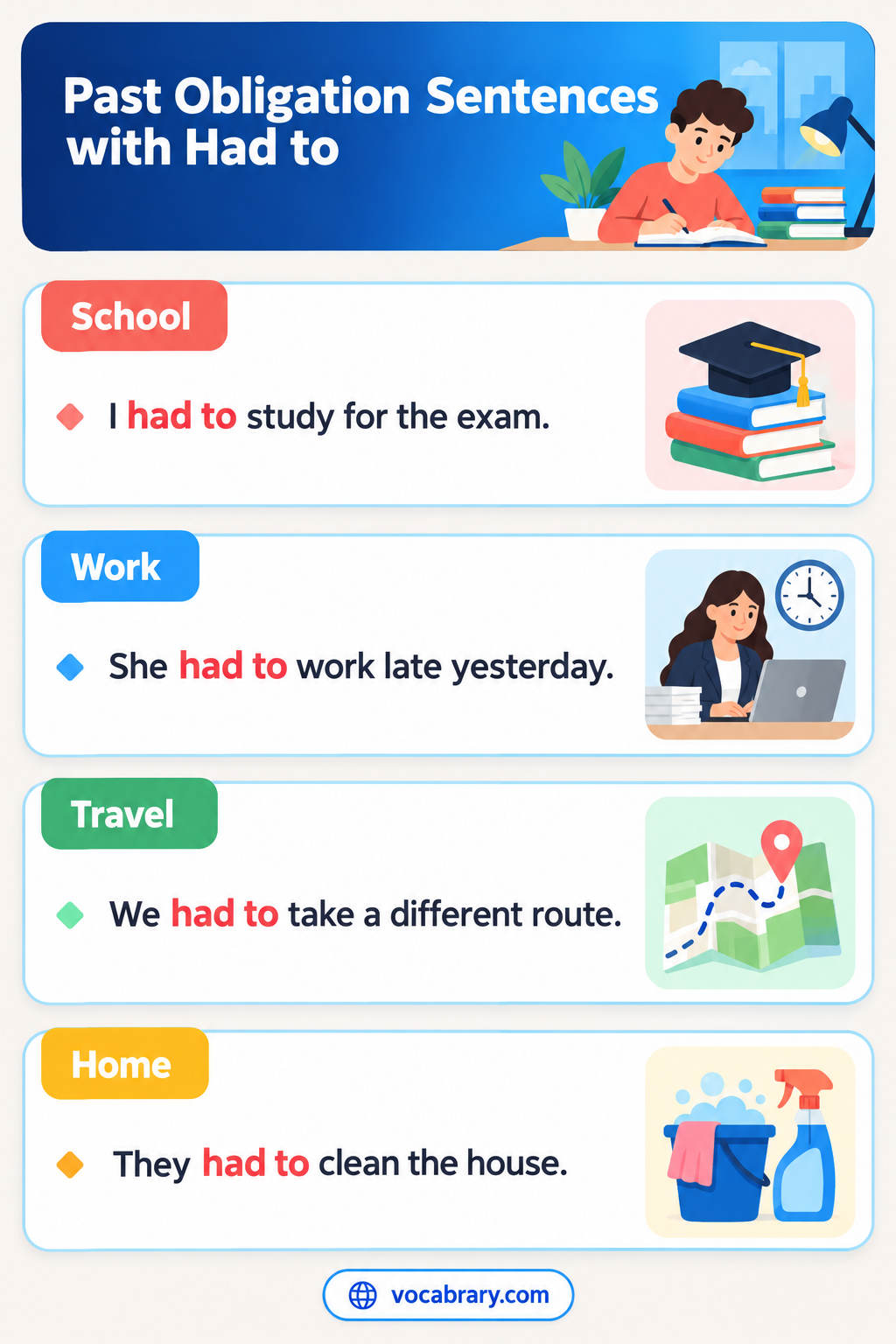
These sentences state duties from earlier times, from a long wait for a bus to childhood bedtimes.
Had to Sentences for Specific Events
Specific events include waiting an hour for a bus, paying a fine, cancelling a trip in a storm, and evacuating a building at noon.
- I had to leave early yesterday.
- We had to wait an hour for the bus.
- She had to pay a fine for the late return.
- They had to cancel the trip because of the storm.
- He had to sign a contract before he started.
- I had to ask for help with the form.
- The students had to retake the test.
- We had to change our plans at the last minute.
- She had to walk home in the rain.
- They had to evacuate the building at noon.
- I had to repeat the answer twice.
- He had to call a taxi after the car broke down.
- We had to show our passports at the border.
- The company had to cut costs last year.
- I had to rewrite the whole essay.
- They had to move to a smaller flat.
Had to Sentences for Past Routines and Regulations
Past routines include going to bed at nine, wearing a uniform at a first job, a long trip to school, and paying a toll to cross.
- When I was young, I had to be in bed by nine.
- At my first job, I had to wear a uniform.
- In the old school, we had to stand when the teacher entered.
- As a student, he had to share a room with two others.
- Our grandparents had to walk five miles to school.
- At that time, drivers had to pay a toll on the bridge.
- We had to hand in our phones at the start of every lesson.
- She had to practise the piano for an hour every day.
- The soldiers had to rise at dawn.
- Visitors had to leave their shoes at the door.
- In those days, women had to ask permission to open a bank account.
- He had to cycle ten kilometres to the factory.
- Employees had to clock in before eight.
- We had to pay for the lessons in cash.
- The children had to finish their chores before dinner.
- I had to learn the poem by heart.
- The team had to train twice a day.
- Passengers had to go through two security checks.
Future Obligation Sentences with Will Have to
These sentences state duties that are still ahead, such as leaving early, finding another hotel, and applying again next year.
Will Have to Sentences for Plans and Requirements
Plans and requirements include presenting a ticket at an entrance, repairing a roof before winter, and taking a test before starting.
- I will have to leave early tomorrow.
- We will have to find another hotel.
- She will have to apply again next year.
- They will have to move out by June.
- He will have to pay the difference.
- You will have to show your ticket at the entrance.
- The company will have to reduce costs.
- I will have to ask my manager for a day off.
- We will have to wait for the results.
- The students will have to submit a second draft.
- You will have to take a test before you start.
- They will have to repair the roof before winter.
Going to Have to Sentences for Expected Duties
Expected duties include cancelling an event in the rain, selling a car, finding a new flat, and updating a password.
- We are going to have to cancel the event if it rains.
- I am going to have to work late again tonight.
- She is going to have to find a new flat.
- They are going to have to sell the car.
- You are going to have to be more careful.
- He is going to have to explain the mistake.
- My parents are going to have to sell the farm next year.
- You are going to have to update your password soon.
- We are going to have to take the bus because the car is in the garage.
- Nadia is going to have to repeat the course if she fails the exam.
Present Perfect Obligation Sentences with Have Had to
These sentences state duties that began in the past and continue until now, such as late evenings this week, caring for a parent since January, and plans changed several times.
- I have had to work late every day this week.
- She has had to take care of her mother since January.
- We have had to change our plans several times.
- They have had to pay extra for the repairs.
- He has had to learn three new systems this year.
- I have had to explain the rules to every new student.
- The team has had to adapt to the new software.
- We have had to cut back on spending since the move.
- She has had to walk to work since the bus strike began.
- I have had to remind him twice already.
- They have had to postpone the wedding.
- The shop has had to close early because of the shortage.
No Obligation Sentences with Don’t Have to
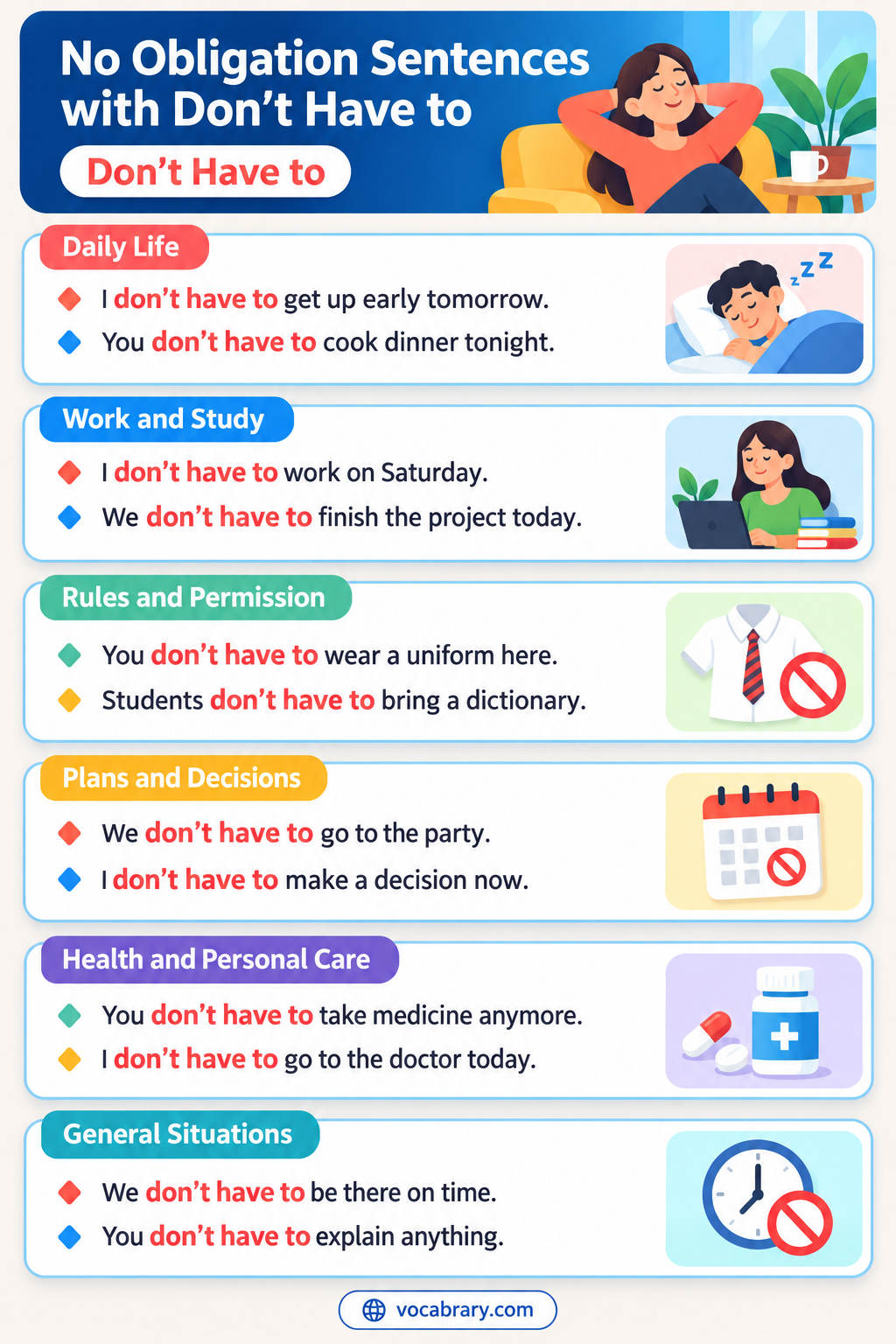
These sentences state that an action is not required, from skipping a tie on Fridays to a free weekend.
Don’t Have to Sentences for Choices
Choices include skipping a tie on Fridays, bringing nothing, deciding later, and joining a club without experience.
- You don’t have to come tomorrow.
- We don’t have to wear a tie on Fridays.
- I don’t have to work this weekend.
- They don’t have to pay for parking.
- You don’t have to answer every question.
- We don’t have to book a table in advance.
- I don’t have to be there until noon.
- Students don’t have to wear a uniform in the summer.
- You don’t have to bring anything. I have everything.
- We don’t have to decide today.
- They don’t have to wait in line.
- You don’t have to say sorry.
- We don’t have to leave yet.
- I don’t have to explain myself to you.
- You don’t have to be an expert to join the club.
- Members don’t have to pay an entrance fee.
Doesn’t Have to Sentences for People and Objects
Cases include a sister who is free on Sundays, a form without a signature, and a report that is short.
- She doesn’t have to pay in advance.
- He doesn’t have to wear a suit at the office.
- My sister doesn’t have to work on Sundays.
- The manager doesn’t have to approve small purchases.
- It doesn’t have to be perfect.
- The form doesn’t have to be signed.
- He doesn’t have to come with us.
- The dog doesn’t have to stay outside.
- She doesn’t have to answer the phone after six.
- The meeting doesn’t have to last an hour.
- The report doesn’t have to be long.
- He doesn’t have to explain the delay.
Didn’t Have to Sentences for Past Choices
Past choices include a short wait, a free ticket, a day without a trip to the office, and bringing a gift.
- We didn’t have to wait long.
- She didn’t have to pay for the ticket.
- I didn’t have to go to the office yesterday.
- They didn’t have to cancel the event.
- He didn’t have to ask for help.
- The students didn’t have to retake the test.
- We didn’t have to queue at the museum.
- I didn’t have to explain the problem twice.
- She didn’t have to wear a uniform at her old school.
- They didn’t have to book a room, because the hotel was empty.
- He didn’t have to leave early after all.
- You didn’t have to bring a gift.
Won’t Have to Sentences for Future Relief
Future relief includes free repairs, a late start tomorrow, a short trip, and no worry about a bill.
- You won’t have to pay for the repairs.
- We won’t have to wait for the results.
- She won’t have to work on Monday.
- I won’t have to wake up early tomorrow.
- They won’t have to travel far.
- He won’t have to attend the meeting.
- You won’t have to carry anything. We will send it.
- We won’t have to worry about the bill.
Question Sentences with Have to Has to and Had to
These sentences ask about duties in the present, the past, and the future, from Saturday shifts to forms and fees.
Have to Sentences for Do Questions
Do questions ask about duties such as Saturday shifts, uniforms, early arrivals, and registration.
- Do you have to work on Saturdays?
- Do we have to bring our own food?
- Do I have to pay now?
- Do they have to wear uniforms?
- Do you have to be there by eight?
- Do we have to register before the event?
- Do I have to sign the form?
- Do students have to buy their own books?
- Do you have to take a test to enter the course?
- Do we have to leave right now?
- Do I have to show my passport?
- Do they have to book in advance?
Have to Sentences for Does Questions
Does questions ask about duties such as a form due today, a helmet for a child, and a letter for a boss to sign.
- Does she have to submit the form today?
- Does he have to travel for work?
- Does the manager have to approve this?
- Does your sister have to pay for the course?
- Does it have to be that loud?
- Does the child have to wear a helmet?
- Does the machine have to be switched off?
- Does he have to come with us?
- Does your boss have to sign the letter?
- Does the report have to be in English?
Have to Sentences for Did Questions
Did questions ask about past duties such as a long wait, a fine, a signed contract, and a trip home in the rain.
- Did you have to wait long?
- Did she have to pay a fine?
- Did they have to cancel the trip?
- Did he have to sign a contract?
- Did you have to show your passport?
- Did we have to bring a gift?
- Did the students have to retake the test?
- Did I have to fill in the form twice?
- Did you have to walk home in the rain?
- Did they have to leave early?
Have to Sentences for Wh Questions
Wh questions ask why, what, when, where, who, how much, and how long about a duty.
- Why do you have to leave so early?
- What do I have to bring?
- When does she have to submit the form?
- Where do we have to register?
- How much do they have to pay?
- Who has to sign the document?
- Why did he have to cancel?
- What did you have to do?
- How long do we have to wait?
- When will you have to leave?
- Which form do I have to complete?
- How often do you have to renew the licence?
Have to Sentences for Short Answers
These replies answer questions about duties with answers such as “Yes, I do” and “No, she doesn’t.”
- “Do you have to work on Saturday?” “Yes, I do.”
- “Does she have to pay?” “No, she doesn’t.”
- “Did they have to cancel?” “Yes, they did.”
- “Do we have to leave now?” “No, we don’t.”
- “Does he have to sign?” “Yes, he does.”
- “Did you have to wait?” “No, I didn’t.”
- “Will we have to pay?” “Yes, we will.”
- “Do I have to come?” “No, you don’t have to.”
Strong Recommendation Sentences with Have to
These sentences recommend a restaurant dish, a film, a town, a book, and a person with enthusiasm.
- You have to try the soup here.
- You have to see this film before it leaves the cinema.
- When you are in Prague, you have to visit the old town.
- Her latest novel is one you have to read.
- You have to taste the cake my aunt made.
- You have to meet my sister. You have a lot in common.
- This album is one you have to listen to from start to finish.
- You have to see the sunrise from the top of the hill.
- You have to stay at the hotel by the lake.
- You have to ask Maria about her trip to Japan.
- You have to watch the first episode.
- You have to try the local bread at the market.
Deduction Sentences with Has to
These sentences state a confident judgment about an address, a joke, a tired traveller, a battery, and the time of night.
- That has to be the right address.
- He has to be joking.
- She has to be tired after the flight.
- There has to be a better way to do this.
- This has to be a mistake.
- They have to be at home. The lights are on.
- It has to be the battery.
- You have to be kidding.
- He has to know the answer. He wrote the book.
- That has to hurt.
- This has to be the best meal I have eaten.
- It has to be after midnight by now.
Informal Obligation Sentences with Have Got to
These sentences state duties in spoken English with “‘ve got to” and “‘s got to,” from leaving before six to paying a bill.
- I’ve got to go now.
- We’ve got to leave before six.
- She’s got to finish the report tonight.
- You’ve got to see this.
- He’s got to be at the airport by noon.
- They’ve got to pay the bill today.
- I’ve got to call my sister.
- We’ve got to find a new plumber.
- It’s got to be perfect.
- You’ve got to be careful on the stairs.
- The team’s got to win this match.
- I’ve got to pick up the children.
Combined Modal Sentences with Have to
These sentences state uncertain, possible, and imagined duties with “may,” “might,” “would,” “should,” and “could.”
Have to Sentences with May and Might
Uncertain duties include late hours tomorrow, cancelling a picnic, repeating an exam, and paying a fine.
- I may have to work late tomorrow.
- We might have to cancel the picnic.
- She may have to repeat the exam.
- They might have to move to a smaller flat.
- He may have to pay a fine.
- We might have to take a taxi.
Have to Sentences with Would and Should
Imagined duties include signing a contract first, staying inside in the rain, leaving at six, and showing proof of address.
- You would have to sign a contract first.
- If it rained, we would have to stay inside.
- She would have to leave at six to catch the train.
- Applicants should have to show proof of address.
- Drivers should have to retake the test every ten years.
- Everyone would have to agree for the plan to work.
- Nobody should have to work for free.
Have to Sentences with Could
Possible duties include paying extra after a cancellation, waiting for a table, and closing a shop for a week.
- We could have to pay extra if we cancel.
- You could have to wait an hour for a table.
- The team could have to work over the weekend.
- The shop could have to close for a week after the flood.
- Visitors could have to leave their bags at the entrance.
Conditional Sentences with Have to
These sentences state duties that depend on a condition, such as a rainy picnic, a missed deadline, and a late train.
- If it rains, we will have to cancel the picnic.
- If you miss the deadline, you will have to pay a fine.
- If the train is late, I will have to take a taxi.
- When you arrive, you will have to show your passport.
- If she fails the test, she will have to take it again.
- Unless the printer can be repaired, we will have to buy a new one.
- Once you register, you will have to pay the fee.
- If I had a car, I wouldn’t have to take the bus.
- If we had more staff, we wouldn’t have to work weekends.
- If you leave now, you won’t have to rush.
- If the road is closed, we’ll have to turn back.
- If he refuses, we will have to find someone else.
Passive and Reported Speech Sentences with Have to
These sentences describe duties assigned to objects and duties reported from other speakers.
Have to Sentences for Passive Duties
Passive duties include fees paid by Friday, documents translated into English, and seat belts worn at all times.
- All fees have to be paid by Friday.
- The documents have to be translated into English.
- Seat belts have to be worn at all times.
- The report has to be submitted before noon.
- The walls have to be painted twice.
- Every application has to be checked by two people.
- The machine has to be serviced once a year.
- The permission slip has to be returned to the teacher.
Had to Sentences for Reported Speech
Reported duties include leaving early, wearing a coat, attending a meeting, and registering online.
- She said she had to leave early.
- He told us we had to wear a coat.
- The manager said all staff had to attend the meeting.
- They said we had to pay before we entered.
- The teacher told the students they had to read the first chapter.
- I told her she had to be careful.
- He said he had to cancel the trip.
- She explained that she had to renew her visa.
- They told me I had to register online.
- The sign said that visitors had to report to reception.
FAQs
A standard example of "have to" in a sentence is "We have to wear uniforms at work", which states a duty set by an employer. Another example is "You have to stop at a red light", which states a duty set by law. A third example is "Drivers have to carry a licence at all times", which states a duty for one group of people.
Example sentences with "has to" state duties of one person or one object. "She has to submit the form by Friday" and "My sister has to take two buses to school" are two models for people. "The password has to contain at least eight characters" is a model for an object.
Example sentences with "had to" state duties from the past. "I had to leave early yesterday" and "They had to cancel the trip because of the storm" describe single events. "When I was young, I had to be in bed by nine" describes a routine from childhood.
You use "have to" in a sentence to state a duty from a law, a school, an employer, or a daily task. "I have to pick up the children at four" states a family duty. "Visitors have to sign in at the front desk" states a requirement at a building.
Sentences with "have to" for laws and workplace requirements state duties set by an authority. "Drivers have to carry a licence at all times" and "Employees have to report any accident immediately" are two models. "I have to wear a helmet on the construction site" states a requirement for one person.
Sentences with "will have to" state duties that are still ahead. "I will have to leave early tomorrow" and "We will have to find another hotel" are two models. "We are going to have to cancel the event if it rains" states a duty that the speaker expects.
Sentences with "don’t have to" state that an action is not required. "You don’t have to come tomorrow" and "We don’t have to wear a tie on Fridays" describe free choices. "They don’t have to pay for parking" describes a free service.
Sentences with "didn’t have to" state that an action was not required in the past. "We didn’t have to wait long" and "You didn’t have to bring a gift" are two models. "She didn’t have to pay for the ticket" describes a free ticket.
Questions with "have to" ask about duties in the present, the past, and the future. "Do you have to work on Saturdays?" and "Did she have to pay a fine?" are two models. "Why do you have to leave so early?" is a question that starts with a question word.
Sentences with "have had to" and "has had to" state duties that began in the past and continue until now. "I have had to work late every day this week" and "She has had to take care of her mother since January" are two models. "They have had to postpone the wedding" describes a recent change of plan.

Leave a Comment