
“Be able to” is a semi-modal expression that states ability, and its form changes with the subject and the tense. These 330 be able to example sentences are written for present skills, past achievements, future plans, polite requests, conditions, reported speech, and job requirements. If you read these examples, you practise phrases for skills, plans, and achievements and use them with modal verbs such as “can,” “will,” and “must” in speech and writing.
Quick Answer: Be Able to Example Sentences
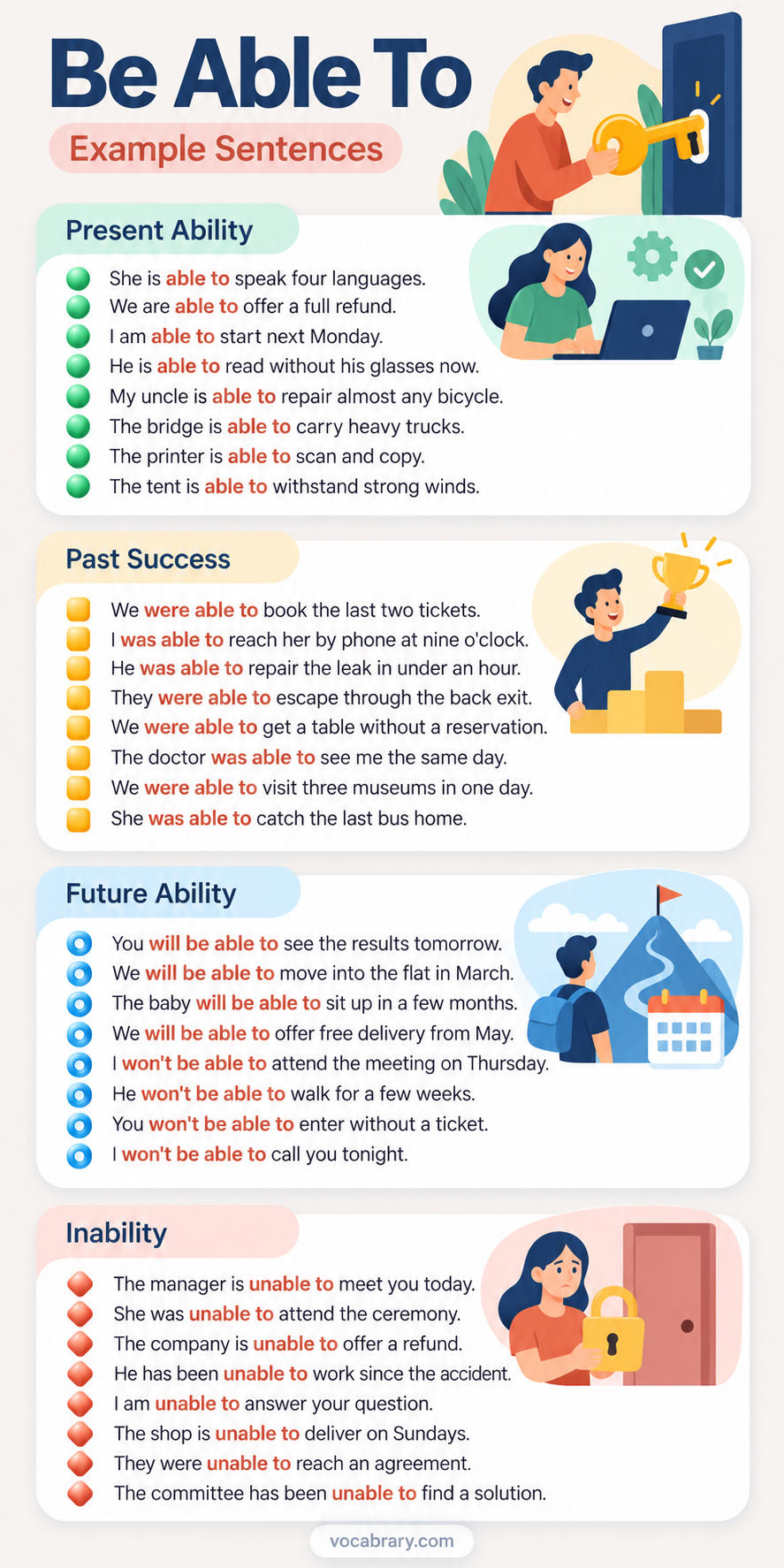
- Present ability: She is able to speak four languages.
- Past achievement: We were able to book the last two tickets.
- Future ability: You will be able to see the results tomorrow.
- Perfect ability: I have been able to finish most of the work.
- Inability: He wasn’t able to attend the meeting.
- After a modal: You might be able to get a refund.
- Polite request: Would you be able to send me the file?
- Formal inability: The manager is unable to meet you today.
Be Able to Example Sentences for Everyday Use
These sentences are written for each main situation: present skills, past achievements, future plans, perfect forms, modal combinations, polite requests, questions, conditions, and reported speech.
- My neighbour is able to fix almost any kitchen appliance.
- The new tablet is able to run for twelve hours without charging.
- We were able to reserve two seats on the early train.
- Nobody was able to open the gate this morning.
- She will be able to join the video call after lunch.
- They won’t be able to deliver the parcel before the weekend.
- I have been able to practise every evening this month.
- By midnight, they had still not been able to find the leak.
- You might be able to find a cheaper flight on Tuesday.
- Employees must be able to use the booking system.
- I would love to be able to cook like my grandfather.
- Being able to cycle to the office saves her an hour a day.
- The clinic is unable to take new patients this month.
- Would you be able to hold this door for a moment?
- Is your sister able to pick up the children today?
- If the rain stops, we will be able to eat outside.
- The coach said the players would be able to rest on Sunday.
- Candidates will be able to choose an interview time online.
Present Ability Sentences with Be Able To
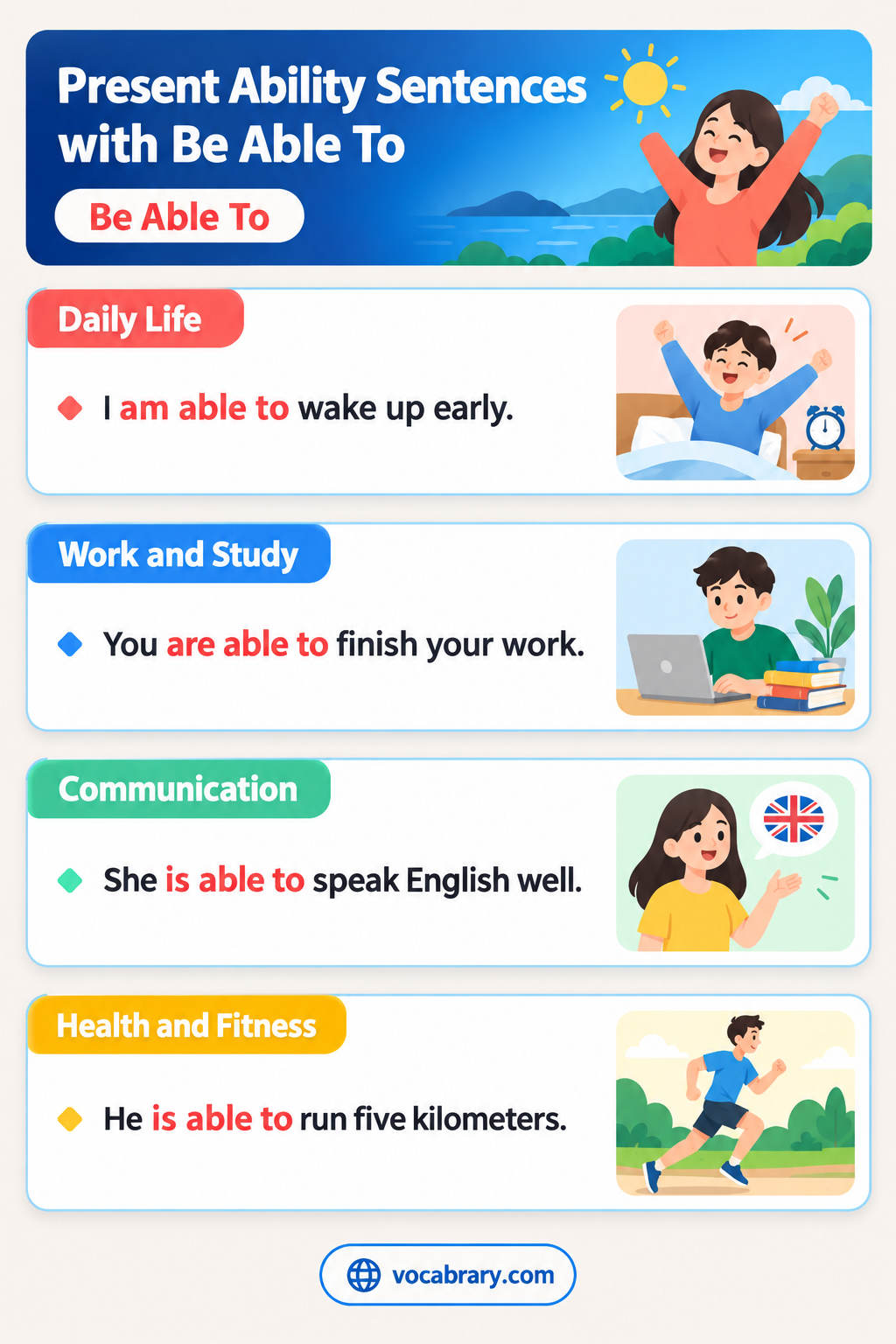
This group states what people and machines do now, from speaking languages and lifting weights to recording video.
Be Able To Sentences for Personal Skills
These sentences state skills and options that people have now, such as speaking four languages, lifting sixty kilograms, and paying by card.
- She is able to speak four languages.
- I am able to work from home on Fridays.
- He is able to lift sixty kilograms.
- We are able to offer a full refund.
- The students are able to use the library until midnight.
- My sister is able to translate legal documents.
- They are able to travel without a visa.
- I am able to start next Monday.
- The team is able to deliver the project on time.
- She is able to solve complex problems under pressure.
- We are able to accommodate groups of up to twenty.
- He is able to read without his glasses now.
- You are able to pay by card or in cash.
- The manager is able to see you at three o’clock.
- Our staff are able to answer questions in English and French.
- My grandmother is able to walk to the shop on her own.
- We are able to ship orders to forty countries.
- My uncle is able to repair almost any bicycle.
- Our receptionist is able to greet guests in three languages.
- I am able to cycle to the office in twenty minutes.
Be Able To Sentences for Machines and Systems
These sentences describe the features of phones, printers, and tents, such as recording in 4K, scanning documents, and lasting two days on a single charge.
- The new phone is able to record in 4K.
- The software is able to process a thousand records per second.
- This car is able to reach 200 kilometres per hour.
- The bridge is able to carry heavy trucks.
- The robot is able to recognise faces.
- The app is able to translate speech in real time.
- The printer is able to scan and copy.
- The machine is able to work without a break for ten hours.
- The dishwasher is able to clean a full load in thirty minutes.
- The new engine is able to run on recycled fuel.
- The system is able to detect errors automatically.
- The tent is able to withstand strong winds.
- The battery is able to last two days on a single charge.
- The new camera is able to focus in low light.
- The scanner is able to read handwritten notes.
- This oven is able to heat up in two minutes.
- The smartwatch is able to track sleep and heart rate.
- The database is able to store records from the last ten years.
Past Achievement Sentences with Was and Were Able To
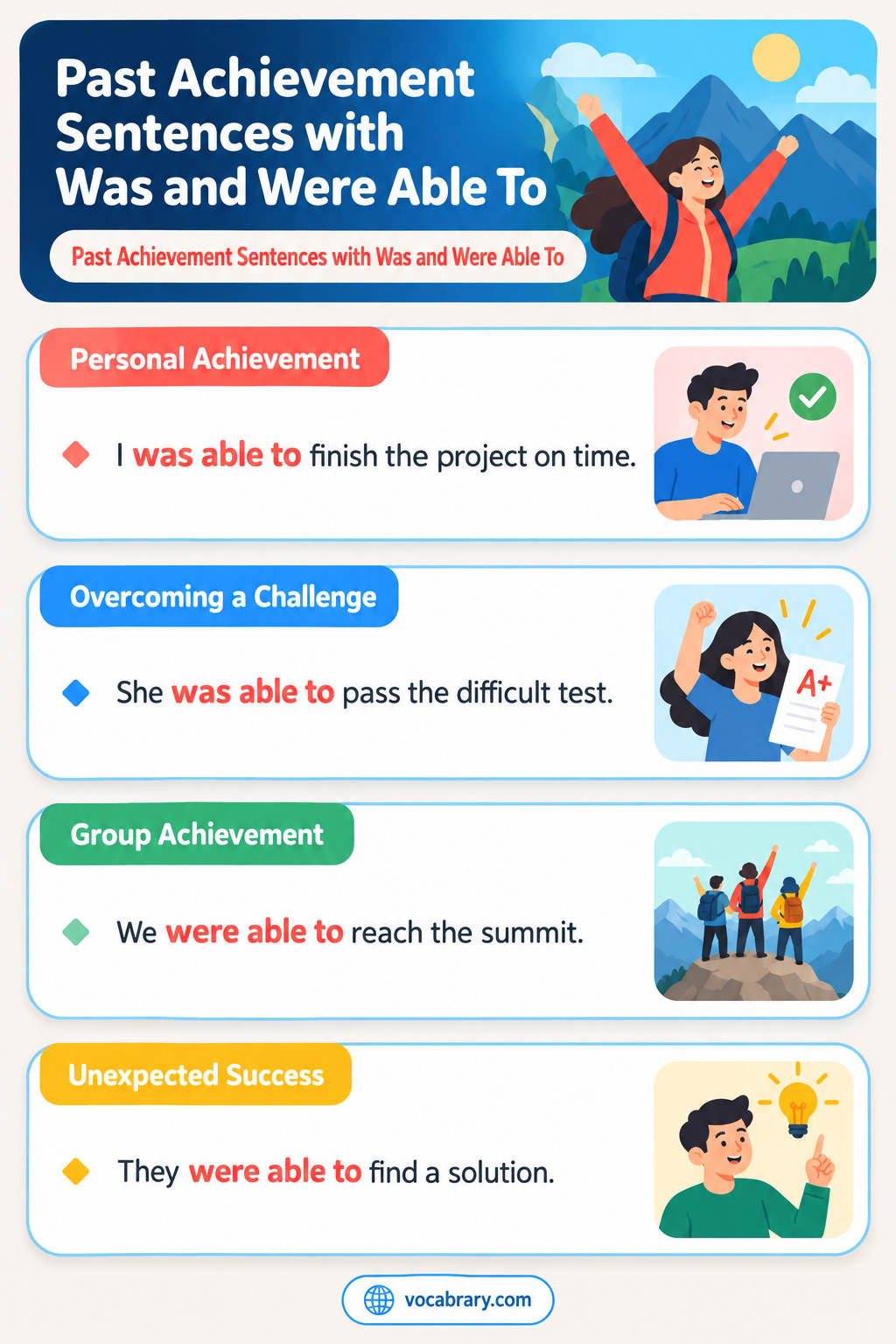
This group describes single successful actions and failed attempts in the past, from rescuing people to missing a meeting.
Was and Were Able To Sentences for Single Successes
These sentences describe one successful action in the past, such as booking the last tickets, landing a plane, and finishing an exam early.
- We were able to book the last two tickets.
- After three attempts, she was able to open the jar.
- I was able to reach her by phone at nine o’clock.
- The firefighters were able to rescue everyone from the building.
- He was able to repair the leak in under an hour.
- The team was able to fix the server before the morning meeting.
- They were able to escape through the back exit.
- The pilot was able to land the plane safely in the storm.
- We were able to get a table without a reservation.
- She was able to finish the exam with ten minutes to spare.
- I was able to find the missing file in the old folder.
- The doctor was able to see me the same day.
- They were able to raise enough money for the new library.
- He was able to persuade the landlord to lower the rent.
- The company was able to pay all its debts last year.
- We were able to visit three museums in one day.
- The students were able to complete the project ahead of schedule.
- She was able to save the document before the power went out.
- She was able to catch the last bus home.
- The engineers were able to restore power within an hour.
- The volunteers were able to clean the whole beach in one morning.
- Our guide was able to answer every question about the old town.
Wasn’t and Weren’t Able To Sentences for Failed Attempts
These sentences describe attempts that did not succeed, such as missing a meeting, failing to find a parking space, and being unable to sleep.
- He wasn’t able to attend the meeting.
- We weren’t able to find a parking space.
- She wasn’t able to open the file.
- They weren’t able to reach the summit because of the snow.
- I wasn’t able to sleep last night.
- The shop wasn’t able to deliver the sofa before Friday.
- The team wasn’t able to solve the problem.
- We weren’t able to hear the speaker from the back row.
- He wasn’t able to afford the ticket.
- She wasn’t able to get through to the helpline.
- They weren’t able to agree on a date.
- I wasn’t able to finish the book before the deadline.
- The students weren’t able to log in to the system.
- The ambulance wasn’t able to pass through the narrow street.
- I wasn’t able to download the update last night.
- The driver wasn’t able to see the road through the fog.
Future Ability Sentences with Will Be Able To
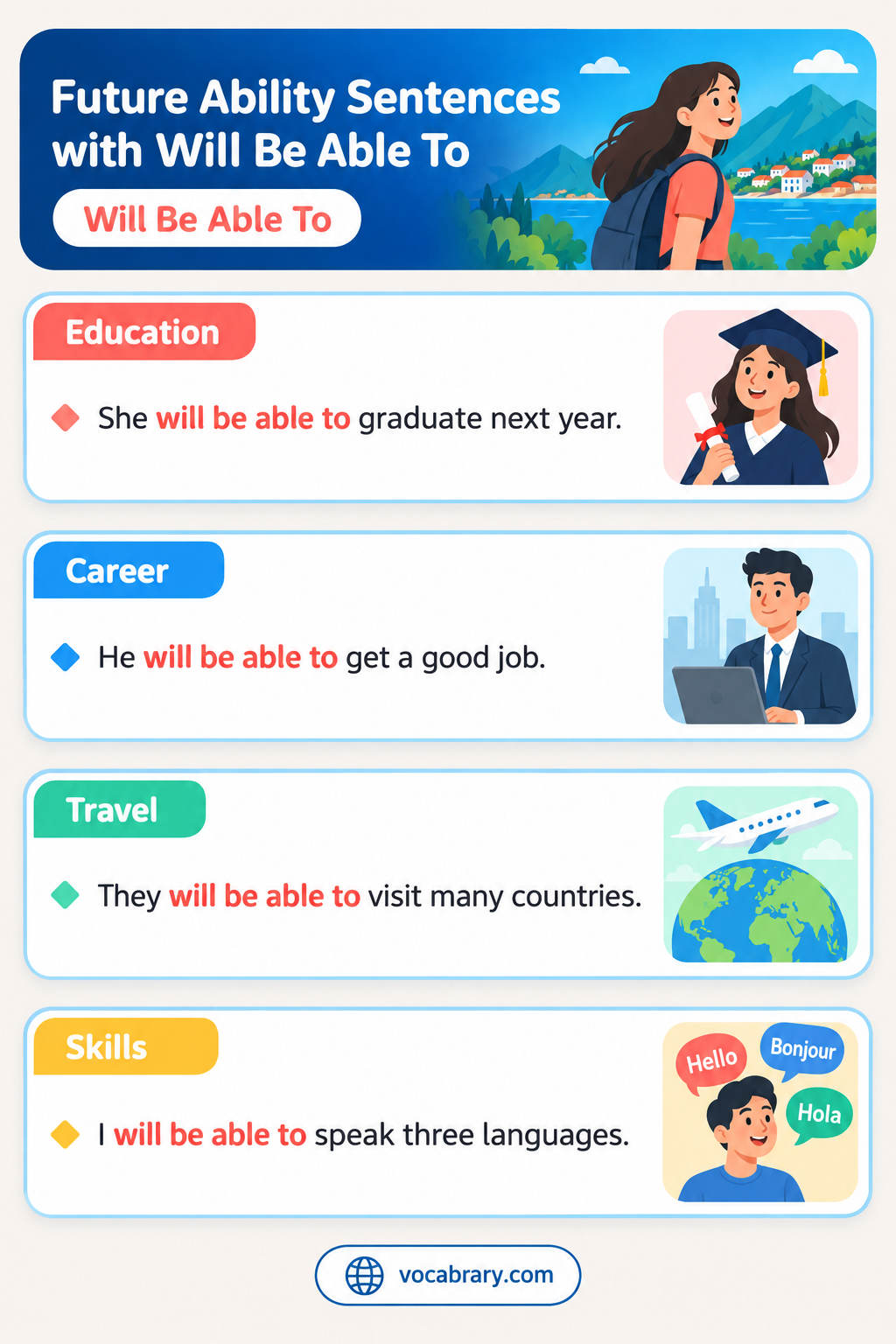
This group states what will or will not be possible later, from starting a job to missing a meeting.
Will Be Able To Sentences for Future Plans
These sentences state results, plans, and changes that are coming, such as seeing test results, moving into a flat, and swimming by the end of a course.
- You will be able to see the results tomorrow.
- I will be able to start the night shift in June.
- She will be able to walk without a cane in a few weeks.
- We will be able to move into the flat in March.
- The students will be able to use the new lab from September.
- After the course, you will be able to write a full report.
- He will be able to drive once he passes the test.
- They will be able to pay off the loan in two years.
- The baby will be able to sit up in a few months.
- Customers will be able to track their orders online.
- The new bridge will be able to carry twice the traffic.
- By next year, I will be able to speak Italian.
- We will be able to offer free delivery from May.
- The shop will be able to open earlier in the summer.
- You will be able to download the file after you register.
- The company will be able to hire more staff next quarter.
- The children will be able to swim by the end of the course.
- Residents will be able to vote online from next year.
- Tourists will be able to visit the castle again in spring.
- My parents will be able to retire in five years.
Won’t Be Able To Sentences for Apologies and Warnings
These sentences give apologies and warnings about the future, such as missing a Thursday meeting, a late delivery, and entering without a ticket.
- I won’t be able to attend the meeting on Thursday.
- She won’t be able to travel until her visa arrives.
- We won’t be able to finish the project by Friday.
- He won’t be able to walk for a few weeks.
- They won’t be able to pay the rent this month.
- You won’t be able to enter without a ticket.
- The shop won’t be able to deliver before Monday.
- I won’t be able to call you tonight.
- The students won’t be able to submit late work.
- The road won’t be able to reopen until the repairs are done.
- We won’t be able to see the show if we arrive late.
- She won’t be able to hear the speaker from that seat.
- The printer won’t be able to work until the new part arrives.
- Guests won’t be able to park in front of the hotel on Saturday.
- I won’t be able to see you off at the airport.
Present Perfect Sentences with Have Been Able To
This group describes results and skills up to now and events before a past moment, from saving money to repairing a roof.
Have Been Able To Sentences for Recent Results
These sentences describe results up to now, such as saving for a deposit, reducing costs, and failing to find keys.
- I have been able to finish most of the work.
- She has been able to save enough for a deposit.
- We have been able to reduce costs by ten percent.
- They have been able to contact all the guests.
- He has been able to walk without help since March.
- The company has been able to double its profits.
- I have been able to find a few useful sources.
- The team has been able to fix most of the bugs.
- She has been able to speak French since she was a child.
- We have not been able to reach the manager today.
- They have been able to keep the shop open all year.
- He hasn’t been able to sleep well for a week.
- Scientists have been able to measure the effect.
- I haven’t been able to find my keys.
- The school has been able to hire three new teachers.
- We have been able to keep prices low this year.
- The farmers have been able to harvest early because of the warm spring.
- My daughter has been able to read on her own since January.
Had Been Able To Sentences for Earlier Events
These sentences describe events that came before another moment in the past, such as speaking English before a move, repairing a roof before a storm, and clearing a road.
- She had been able to speak English for years before she moved to Dublin.
- We had not been able to contact him before the meeting.
- He had been able to save enough money before he moved.
- They had been able to hear the music from the garden until the wind changed.
- I had been able to finish the report before the deadline.
- The team had been able to repair the roof before the storm.
- She said she hadn’t been able to open the door.
- By the time we arrived, they had been able to clear the road.
- He told me he had been able to meet the director.
- The company had been able to avoid layoffs until then.
- The hikers had been able to follow the trail until the snow covered it.
- I had never been able to swim before that summer.
Modal Verb Sentences with Be Able To
These sentences are written with “be able to” after other modal verbs, for possibility, expectation, requirement, and hypothetical results.
Be Able To Sentences for Possibility with Might and May
These sentences state possibilities with “might” and “may,” such as getting a refund, joining a dinner, and moving a meeting.
- You might be able to get a refund.
- I may be able to help you with the form.
- She might be able to join us for dinner.
- They may be able to finish the work by Friday.
- He might be able to fix the radio.
- We may be able to move the meeting to Tuesday.
- She may be able to move her flight to Thursday.
- They might be able to offer a discount if you pay in cash.
Be Able To Sentences for Expectations with Should
These sentences state expectations with “should” and “ought to,” such as seeing the sea from a balcony, arriving before dark, and handling thousands of users.
- You should be able to see the sea from the balcony.
- The app should be able to handle thousands of users.
- The students should be able to read the text without help.
- After this lesson, you ought to be able to write a short email.
- The new engine should be able to run for ten years.
- We should be able to arrive before dark.
- The new tunnel should be able to cut travel time by half.
- Our guests ought to be able to check in by noon.
Be Able To Sentences for Requirements with Must
These sentences state requirements with “must” and “have to,” such as speaking English, lifting ten kilograms, and swimming before a course.
- Candidates must be able to speak English fluently.
- Drivers must be able to read a map.
- You have to be able to swim to join the course.
- Employees must be able to lift ten kilograms.
- Applicants must be able to work on weekends.
- A good teacher has to be able to explain a difficult idea in simple words.
- Pilots must be able to read weather reports quickly.
- Lifeguards have to be able to swim two hundred metres.
Be Able To Sentences for Hypothetical Results with Would
These sentences state results that depend on an imagined situation with “would,” such as visiting every week with a car or serving customers faster with more staff.
- If I had a car, I would be able to visit her every week.
- You would be able to save time with a faster laptop.
- If the shop opened earlier, we would be able to buy bread before work.
- With more staff, we would be able to serve customers faster.
- With a bigger budget, we would be able to hire two more nurses.
- He would be able to join the trip if his passport arrived on time.
- A second oven would be able to double our output.
- You would be able to hear the lecture better from the front row.
Infinitive and Gerund Sentences with Be Able To
This group has “to be able to” in wishes and plans and “being able to” in feelings and benefits.
To Be Able To Sentences for Wishes and Plans
These sentences express wishes, hopes, and plans, such as speaking Spanish, travelling next year, and playing the piano.
- I want to be able to speak Spanish.
- She hopes to be able to travel next year.
- We would like to be able to offer a refund.
- He needs to be able to drive for the job.
- They expect to be able to start in May.
- I would love to be able to play the piano.
- She wants to be able to work from home.
- We hope to be able to finish by Friday.
- He studied every night to be able to pass the test.
- You need to be able to explain your answer.
- They are saving money to be able to move in June.
- I’d like to be able to help you.
- He practises daily to be able to perform at the festival.
- I am learning Japanese to be able to read the original novels.
Being Able To Sentences for Feelings and Benefits
These sentences express pride, worry, gratitude, and benefits, such as running a marathon, paying the rent, and speaking two languages.
- She is proud of being able to run a marathon.
- I enjoy being able to work from home.
- Being able to read in English improves your job options.
- He is worried about not being able to pay the rent.
- We appreciate being able to use your office.
- Being able to swim saved his life.
- They are excited about being able to travel again.
- I don’t mind not being able to stay.
- She is thankful for being able to see her family.
- After being able to rest for an hour, he felt much better.
- Being able to speak two languages helps in this job.
- We are grateful for being able to join the course.
- Nadia is delighted about being able to study abroad.
- They are looking forward to being able to vote online.
Formal Inability Sentences with Unable To
These sentences are written for official letters and notices, such as declined requests, closed services, and cancelled flights.
- The manager is unable to meet you today.
- We are unable to process your request at this time.
- She was unable to attend the ceremony.
- The company is unable to offer a refund.
- He has been unable to work since the accident.
- I am unable to answer your question.
- The shop is unable to deliver on Sundays.
- They were unable to reach an agreement.
- The council is unable to approve the permit this year.
- We regret that we are unable to accept your application.
- The bank was unable to verify the signature on the form.
- Due to the weather, the airline is unable to operate flights.
- The committee has been unable to find a solution.
- I am sorry that I am unable to help.
- The library is unable to lend books during the renovation.
- Sadly, the bakery is unable to take large orders this week.
Polite Request Sentences with Be Able To
These sentences ask for help, time, or a favour in a courteous way, such as sending a file, moving a car, and covering a shift.
- Would you be able to send me the file?
- Are you able to join us on Thursday?
- Would you be able to help me with the form?
- Are you able to speak a little louder?
- Would you be able to move your car?
- Are you able to meet at ten?
- Would you be able to review my application?
- Would you be able to give me a lift to the station?
- Are you able to confirm the date today?
- Would you be able to check the figures again?
- I was wondering if you would be able to recommend a hotel.
- Would you be able to attend the briefing on Monday?
- Are you able to take a look at this contract?
- Would you be able to cover my shift on Saturday?
- Would you be able to translate this letter?
- Are you able to call me back after lunch?
- Would you be able to wait until Friday?
- Are you able to bring the documents with you?
- Would you be able to turn the music down a little?
- Are you able to give me directions to the museum?
Question Sentences with Be Able To
These sentences are questions and replies about ability in the present, past, and future, with yes or no questions, question words, and short answers.
Be Able To Sentences for Yes or No Questions
These sentences ask about ability with a yes or no answer, such as driving, finding a house, and delivering on Friday.
- Are you able to drive?
- Is she able to come tomorrow?
- Were they able to find the house?
- Was he able to finish the report?
- Will you be able to attend the meeting?
- Have you been able to contact him?
- Are the students able to use the library?
- Was the team able to fix the problem?
- Will the shop be able to deliver on Friday?
- Is the machine able to run all night?
- Are you able to open this file?
- Will the lift be able to carry six people?
- Is the hotel able to arrange a late checkout?
- Has the team been able to test the new feature?
Be Able To Sentences for Wh-Questions
These sentences ask about time, reason, location, number, and choice, such as when someone starts, why someone was absent, and how many languages someone speaks.
- When will you be able to start?
- How long were you able to stay?
- Why wasn’t she able to attend?
- Where were they able to park?
- How many languages are you able to speak?
- What will you be able to do after the course?
- Who was able to open the door?
- How much weight is the bridge able to carry?
- When are you able to meet?
- Which options are you able to offer?
- How soon are you able to send the invoice?
- Why weren’t the guests able to enter the hall?
Be Able To Sentences for Short Answers
These replies answer questions with short forms, such as “Yes, I am,” “No, she wasn’t,” and “I hope so.”
- “Are you able to drive?” “Yes, I am.”
- “Was she able to come?” “No, she wasn’t.”
- “Will they be able to attend?” “Yes, they will.”
- “Were you able to find it?” “Yes, I was.”
- “Is he able to walk?” “No, he isn’t.”
- “Have you been able to call him?” “No, I haven’t.”
- “Are they able to help?” “Yes, they are.”
- “Will she be able to join us?” “I hope so.”
- “Were the children able to see the parade?” “Yes, they were.”
- “Will you be able to come on Sunday?” “I’m afraid I won’t.”
Conditional Sentences with Be Able To
These sentences state results that depend on a condition, such as leaving at noon after finishing early, walking to the beach after the rain, and joining a course after registering.
- If you finish early, you will be able to leave at noon.
- If I had more time, I would be able to help you.
- She would be able to pass the exam if she studied harder.
- If it stops raining, we will be able to walk to the beach.
- If you register today, you will be able to join the course.
- If we were able to leave earlier, we would avoid the traffic.
- If he were able to attend, he would bring the documents.
- If I had been able to come, I would have helped.
- We would have ordered more if the shop had been able to deliver.
- If they are able to pay, the deal will go ahead.
- If you aren’t able to attend, please let us know.
- I will call you if I am able to finish early.
- The pilots will be able to take off if the weather clears.
- If you had been able to call earlier, we would have saved the booking.
Reported Speech Sentences with Be Able To
These sentences report what people said about their ability, such as speaking four languages, joining later, and reaching a manager.
- She said she was able to speak four languages.
- He told us he would be able to join us later.
- They said they hadn’t been able to reach the manager.
- The doctor said I would be able to walk in a week.
- She explained that she wasn’t able to attend.
- He said he had been able to finish the report.
- The teacher said the students would be able to use the lab.
- They told me they would not be able to deliver on Friday.
- She said she was unable to help.
- He mentioned that he might be able to come.
- The agent said we would be able to collect the keys at noon.
- My cousin told me she wasn’t able to find a hotel near the station.
Job Requirement Sentences with Be Able To
These sentences state requirements and features in job advertisements and product descriptions, such as managing a team, handling complaints, and exporting reports.
- Candidates must be able to work under pressure.
- The successful applicant will be able to manage a team of ten.
- Staff should be able to handle customer complaints.
- The system is able to store up to one terabyte of data.
- Applicants must be able to communicate clearly in writing.
- The role requires someone who is able to travel at short notice.
- Employees will be able to access their payslips online.
- The new device is able to monitor heart rate continuously.
- Participants should be able to commit to six weeks of training.
- Managers must be able to explain company policy.
- The tool is able to export reports in three formats.
- Technicians must be able to work from heights.
- Volunteers should be able to give four hours a week.
FAQs
A standard example of "be able to" in a sentence is "She is able to speak four languages," which states a present skill. Other common examples are "We were able to book the last two tickets" and "You will be able to see the results tomorrow."
You use "be able to" in a sentence to state present ability, a past achievement, future ability, or ability after another modal verb. Examples are "I am able to start next Monday," "She was able to catch the last bus home," and "You should be able to see the sea from the balcony."
Present ability sentences state what a person or a machine does now. "My sister is able to translate legal documents" and "The software is able to process a thousand records per second" are two models. Both describe a skill or a feature that exists at the moment of speaking.
Past achievement sentences describe one successful action that already happened. "The firefighters were able to rescue everyone from the building" and "She was able to finish the exam with ten minutes to spare" are two models. Both name a specific action and its successful outcome.
Future ability sentences state what a person or a thing will be capable of doing later. "Customers will be able to track their orders online" and "After the course, you will be able to write a full report" are two models. Words such as "tomorrow," "next year," and "from May" indicate the time.
Negative sentences state that an action did not happen or will not happen. "We weren’t able to find a parking space" refers to the past, and "I won’t be able to call you tonight" refers to the future.
Sentences with "have been able to" describe results up to the present. "I have been able to finish most of the work" and "The team has been able to fix most of the bugs" are two models. "She has been able to speak French since she was a child" describes a skill that continues until now.
Sentences with "be able to" after a modal verb state possibility, expectation, requirement, or a hypothetical result. "You might be able to get a refund" states a possibility, and "Candidates must be able to speak English fluently" states a requirement. "The app should be able to handle thousands of users" states an expectation.
Sentences with "unable to" are written for official letters and notices. "We are unable to process your request at this time" and "The company is unable to offer a refund" are two models. "She was unable to attend the ceremony" refers to the past.
Polite requests ask whether the listener has the time or the ability to help. "Would you be able to send me the file?" and "Are you able to join us on Thursday?" are two models. Both questions leave the listener free to answer yes or no.

Leave a Comment