
“May” is a modal verb that expresses formal permission, present or future possibility, concession, and wishes, and its form never changes. These 295 may example sentences are written for polite questions, official notices, academic claims, blessings, and casual suggestions, so you study the word in each situation where it is used. You use “may” in formal requests and polite statements alongside “might” and “could,” and practice with example sentences improves your accuracy in speech and writing.
Quick Answer: May Example Sentences
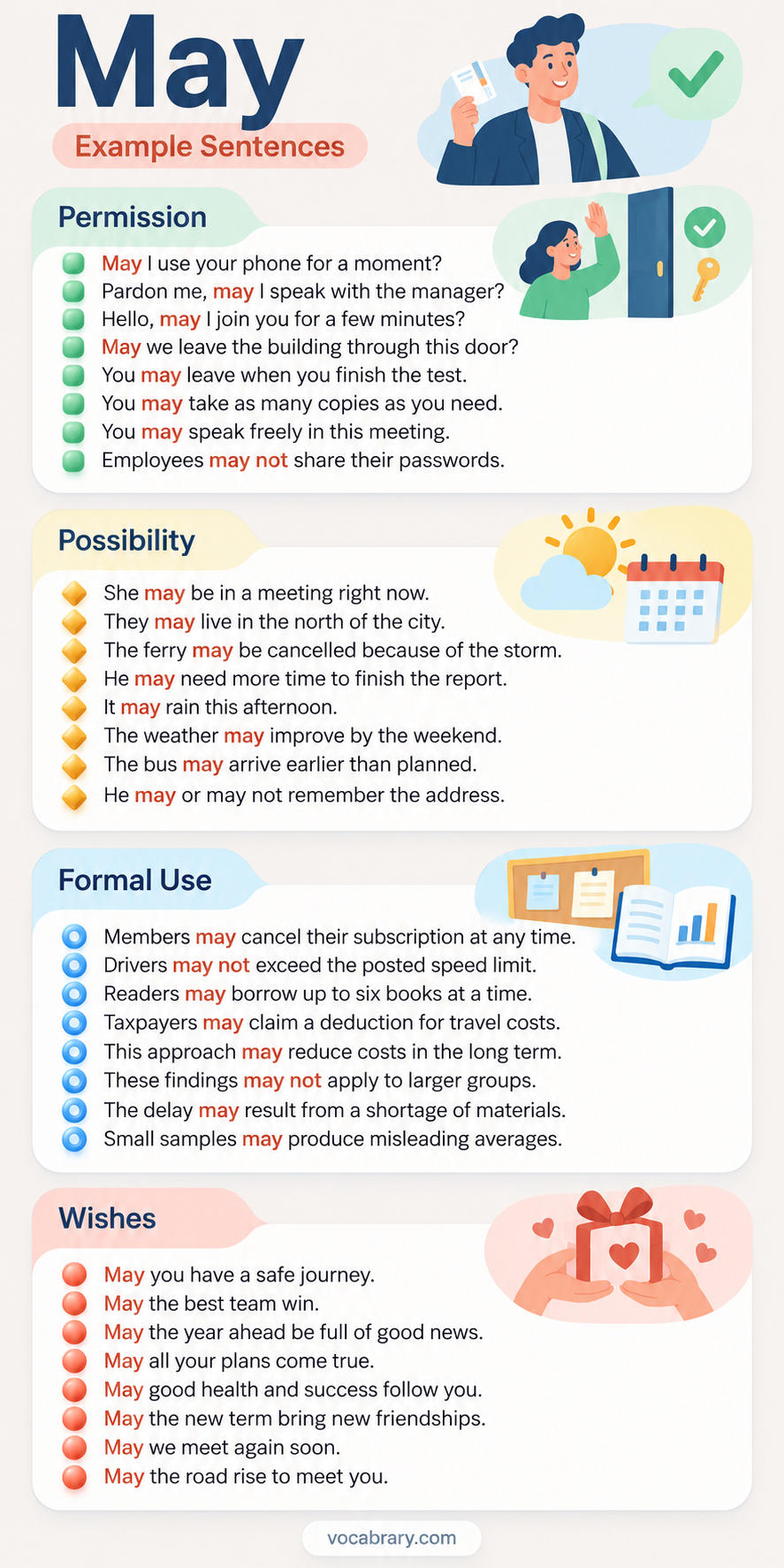
- Asking permission: May I use your phone for a moment?
- Giving permission: You may leave when you finish the test.
- Denying permission: Visitors may not enter the staff area.
- Present possibility: She may be in a meeting right now.
- Future possibility: It may rain this afternoon.
- Concession: The flat may be small, but it is bright.
- Wish: May you have a safe journey.
- Formal offer: May I help you with your bags?
May Example Sentences for Everyday Use
These sentences are written for polite questions, official notices, possibility, concession, wishes, and academic claims, from a request to borrow an umbrella to a wish for a blooming garden.
- May I borrow your umbrella until the rain stops?
- May we reserve the back table for our group?
- You may use the side entrance after the ceremony.
- Visitors may not touch the exhibits.
- Tenants may request repairs through the housing office.
- Mr. Okafor may be on the phone with a client.
- Our flight may leave from a different gate this evening.
- The committee may or may not approve the budget.
- The kitchen may be tiny, but it has a beautiful window.
- May your garden bloom through the whole summer.
- Maps are posted at each entrance so that visitors may find the exits.
- May I carry your suitcase to the car?
- Early results may suggest a link between exercise and mood.
- Where may I find the nearest pharmacy?
- Applications may be sent by email until noon.
- We may as well take a taxi, since the last train has gone.
- Tomorrow’s match may well be the best of the season.
- The courier may have delivered the parcel to the wrong flat.
Permission Question Sentences with May
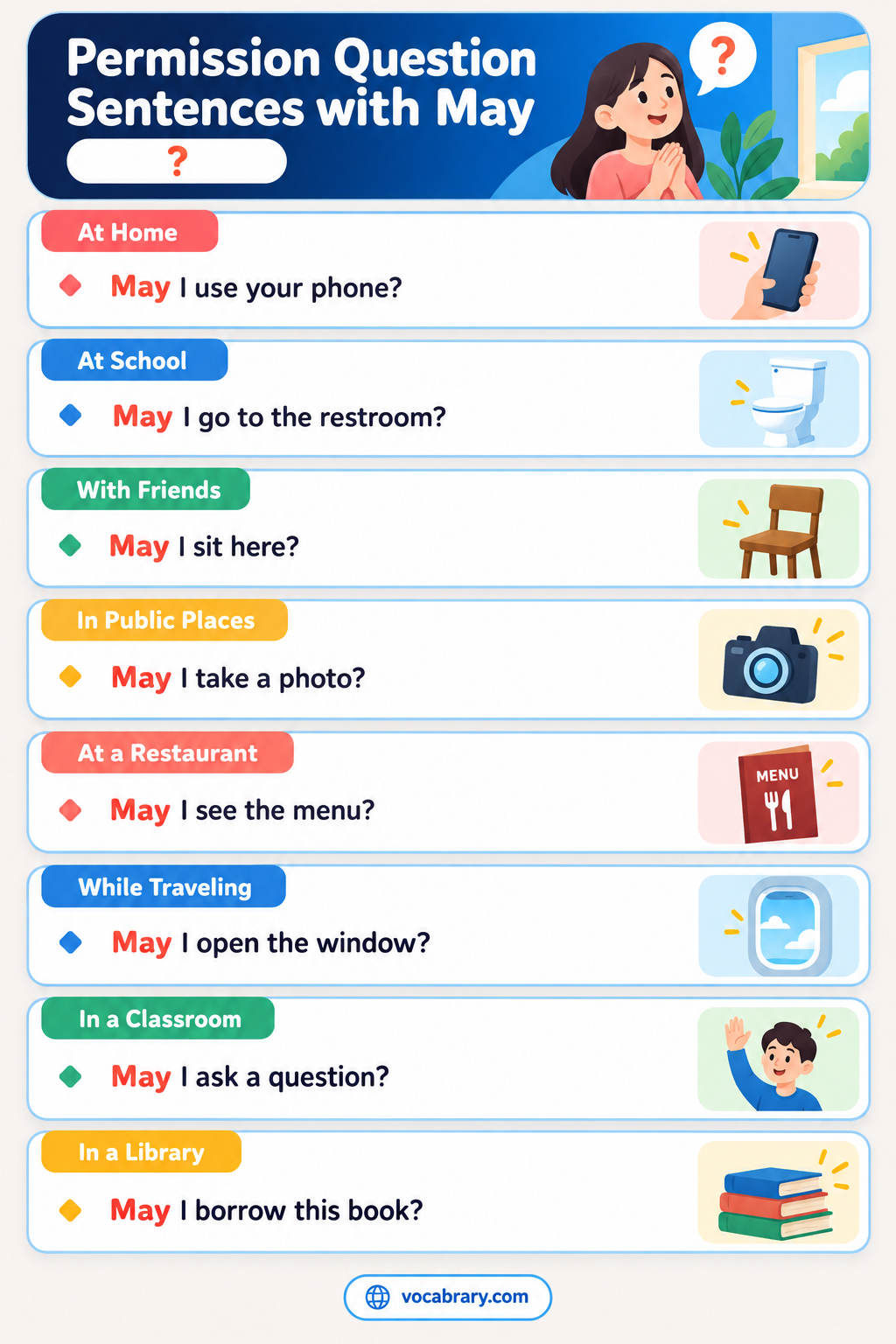
These sentences ask for permission to act, such as borrowing a pen, using a phone, or taking a break.
May Sentences for Personal Requests
These sentences ask permission for the speaker with “may I”, as in borrowing a pen, using the restroom, or joining a conversation.
- May I come in?
- May I use your phone for a moment?
- May I sit here?
- Excuse me, may I ask a question?
- May I borrow your pen?
- May I leave the room?
- Sorry, may I open the window?
- May I see your ticket, please?
- May I have a glass of water?
- Pardon me, may I speak with the manager?
- May I take a photograph of the painting?
- May I use the restroom?
- If it is no trouble, may I leave my bag here for an hour?
- May I make a suggestion?
- May I have your attention, please?
- Excuse me, may I look at the schedule?
- May I park my car in this space?
- Hello, may I join you for a few minutes?
May Sentences for Group Requests
These sentences ask permission for two or more people, or for a third person, as in changing an appointment, bringing a guest, or using the lab.
- May we start the presentation now?
- Sorry, may we come back tomorrow?
- May we take a short break?
- May we use the conference room this afternoon?
- May we sit by the window?
- If it is allowed, may we bring a guest to the dinner?
- May we change the date of the appointment?
- May we leave the building through this door?
- May he join us for the first session?
- May she present her results before the others?
- May the children go outside during the break?
- May the committee meet again next week?
- May we sit together at the next table?
- May the students use the lab after class?
Giving and Denying Permission Sentences with May
These sentences state what an authority allows or forbids, such as using a dictionary in an exam or taking photographs in a gallery.
May Sentences for Giving Permission
These sentences allow an action, as in leaving after a test, sitting anywhere, or borrowing a laptop for the weekend.
- You may leave when you finish the test.
- You may begin now.
- Students may use a dictionary during the exam.
- You may sit anywhere you like.
- Guests may use the garden at any time.
- You may take as many copies as you need.
- Residents may park in the courtyard after six o’clock.
- You may call me at the office if the problem continues.
- Members may bring one guest to each event.
- You may keep the book until the end of the month.
- The participants may ask questions at the end.
- You may enter once the green light comes on.
- Applicants may submit their forms in person or by post.
- You may borrow the laptop for the weekend.
- You may speak freely in this meeting.
- Passengers may board once their row is called.
May Not Sentences for Refusing Permission
These sentences forbid an action, such as entering a laboratory without a coat, using phones in an exam, or parking in front of a fire exit.
- You may not enter the laboratory without a coat.
- Visitors may not take photographs inside the gallery.
- Students may not use phones during the exam.
- You may not park in front of the fire exit.
- Guests may not bring food into the cinema.
- Employees may not share their passwords.
- You may not leave the room until the bell rings.
- Children under twelve may not ride without an adult.
- Candidates may not speak to one another during the test.
- You may not copy this material without permission.
- Passengers may not use electronic devices during take-off.
- Residents may not keep pets in the building.
- You may not use the lift during a fire alarm.
- Visitors may not enter the staff area.
Official Notice Sentences with May
These sentences state what customers, tenants, members, and employees are allowed or not allowed to do under a policy or contract, such as returning items or requesting leave.
- Customers may return items within thirty days of purchase.
- Tenants may install shelves with the landlord’s written consent.
- The borrower may repay the loan in monthly instalments.
- Members may cancel their subscription at any time.
- The licence holder may not transfer the licence to another person.
- Employees may request leave through the online portal.
- The committee may meet at the request of three members.
- Visitors may not remove any items from the exhibition.
- Drivers may not exceed the posted speed limit.
- Shareholders may attend and vote at the annual meeting.
- The company may amend these terms with thirty days’ notice.
- Applicants may appeal the decision within fourteen days.
- A guest may stay in the hostel for a maximum of seven nights.
- Contractors may not subcontract the work without approval.
- Readers may borrow up to six books at a time.
- Taxpayers may claim a deduction for travel costs.
Present Possibility Sentences with May
These sentences state a present situation that the speaker cannot confirm, such as a meeting, a closed shop, or a phone in another room.
- She may be in a meeting right now.
- He may know the answer.
- The shop may be closed on Mondays.
- They may live in the north of the city.
- This may be the right road.
- The manager may be waiting in the lobby.
- It may be a mistake in the invoice.
- The ferry may be cancelled because of the storm.
- Your phone may be in the other room.
- The doctor may have time to see you this afternoon.
- That may be the reason for the noise.
- The museum may be open until eight.
- He may need more time to finish the report.
- The answer may be on the next page.
- The meeting may be on the third floor.
- She may be waiting at the wrong entrance.
Future Possibility Sentences with May
These sentences state a chance of a later event, such as rain this afternoon, rising prices, or a late start to a meeting.
- It may rain this afternoon.
- We may move to a larger flat next year.
- The meeting may start late.
- Prices may rise before the end of the month.
- She may accept the job offer next week.
- The shop may reopen in spring.
- The weather may improve by the weekend.
- I may visit my cousin in Toronto in the summer.
- The company may announce its results on Friday.
- They may decide to cancel the event.
- We may see snow by December.
- He may join the team after his exams.
- The new law may come into force next January.
- The bus may arrive earlier than planned.
- The concert may sell out by Friday.
- I may call you later this evening.
May or May Not Sentences for Open Outcomes
These sentences state an outcome that is undecided, such as attending a ceremony, receiving a package, or needing a visa.
- She may or may not attend the ceremony.
- The plan may or may not work.
- It may or may not rain tomorrow.
- He may or may not remember the address.
- The store may or may not have your size.
- They may or may not accept the offer.
- The flight may or may not leave on time.
- You may or may not need a visa, depending on your passport.
- The manager may or may not agree to the new schedule.
- The package may or may not arrive before Friday.
- The tenants may or may not renew their lease.
- It may or may not be possible to reschedule.
Concession Sentences with May
These sentences admit one fact and then add another, such as a small but bright flat, a young but experienced worker, and a plain but tasty meal.
- The flat may be small, but it is bright.
- He may be young, but he has years of experience.
- Although the food may look plain, it tastes excellent.
- She may not be famous, but she is respected in her field.
- It may be cold outside, but the sun is out.
- The test may seem long, but you have plenty of time.
- Even though the hotel may be old, the rooms are spotless.
- You may disagree with me, but you should read the report first.
- The book may be short, but it covers the whole period.
- He may have the title, but she does the work.
- Though the price may be high, the quality justifies it.
- They may be rivals, but they respect each other.
- Even though the road may be longer, it is much quieter.
- I may not agree with the decision, but I understand it.
- The task may take time, but the result will last.
- The room may be cramped, but the view is excellent.
Wish and Blessing Sentences with May
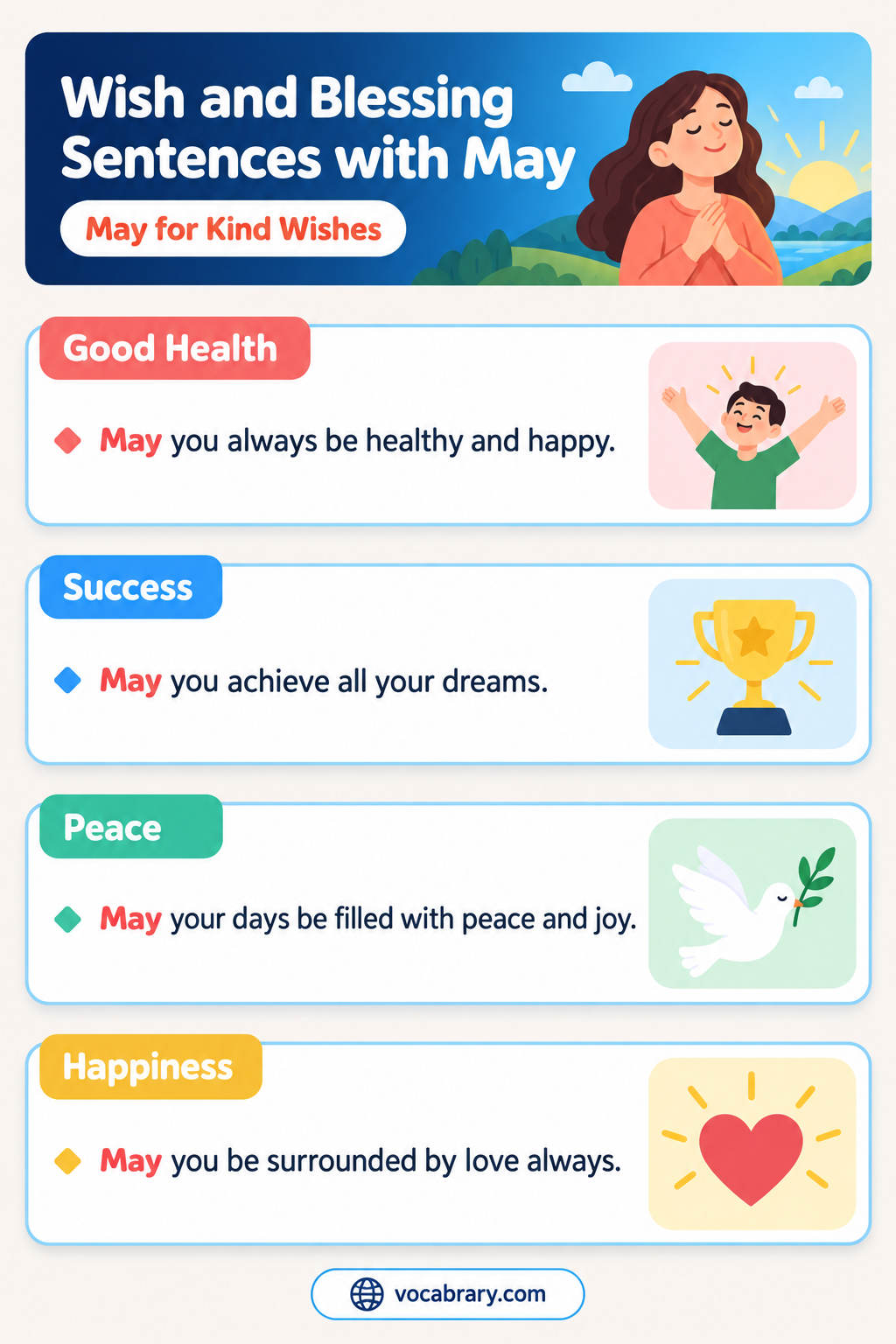
These sentences express good hopes for another person or a group, such as safe travel, a fair contest, or a joyful home.
- May you have a safe journey.
- May the best team win.
- May your new home bring you joy.
- May the year ahead be full of good news.
- May she rest in peace.
- May all your plans come true.
- May you enjoy many happy years together.
- May good health and success follow you.
- May the new term bring new friendships.
- May your hard work be rewarded.
- May we meet again soon.
- May everyone find what they are looking for.
- May the road rise to meet you.
- May your days be calm and your nights restful.
Purpose Clause Sentences with May
These sentences state the reason for an action, such as a short report, a wide path, a schedule posted online, and extra chairs.
- The report is short so that readers may finish it in one sitting.
- The path is wide so that visitors may pass in both directions.
- In order that students may revise at home, the notes are published.
- She leaves early so that she may avoid the traffic.
- So that guests may find their seats, the doors open an hour earlier.
- We repeat the safety instructions so that everyone may understand them.
- The fee is fixed so that applicants may plan their budget.
- The library extends its hours in exam week so that students may study at night.
- So that clients may trust the service, the data is stored securely.
- The schedule is posted online so that members may check it at any time.
- Extra chairs are added so that every guest may sit.
- The form is short so that applicants may complete it quickly.
Formal Offer and Suggestion Sentences with May
These sentences offer help or introduce a proposal politely, such as taking a coat, recommending a dish, or proposing a short break.
- May I help you with your bags?
- May I offer you a cup of tea?
- May I suggest a different approach?
- Madam, may I take your coat?
- May I recommend the fish?
- Sir, may I walk you to the door?
- May I add something to what she said?
- May I propose a short break?
- Good evening, may I show you to your table?
- May I draw your attention to the second chart?
- May I remind everyone about tomorrow’s deadline?
- Excuse me, may I hold the door for you?
- May I be of any assistance?
- Before we continue, may I clarify one point?
- May I pour you some coffee?
- If there is time, may I propose a second meeting next week?
Academic Writing Sentences with May
These sentences state research claims with caution, such as a link between sleep and memory, side effects of a treatment, or the limits of small samples.
- The results may indicate a link between sleep and memory.
- This approach may reduce costs in the long term.
- The increase may be due to a change in the survey method.
- Some students may find the first chapter difficult.
- The treatment may cause mild side effects in a small number of patients.
- Further research may reveal new patterns in the data.
- These findings may not apply to larger groups.
- The delay may result from a shortage of materials.
- Readers may notice a difference between the two editions.
- Higher humidity may slow the drying time of the samples.
- The policy may affect small businesses more than large ones.
- The results of the first trial may need a second check.
- Changes in temperature may alter the growth of the crop.
- Participants may experience mild fatigue after the second session.
- The pattern may reflect a change in consumer habits.
- Small samples may produce misleading averages.
Question Sentences with May
These sentences ask for permission, a location, a time, or a method, and the replies give or refuse permission.
May Sentences for Yes or No Questions
These sentences ask a question that has a yes or no reply, such as beginning a meeting, paying by card, or copying a page.
- May I turn on the lights?
- May we begin?
- May I interrupt for a moment?
- May we ask you a few questions?
- May I see the menu?
- May I pay by card?
- May I make a copy of this page?
- May the visitors enter now?
- May I take a seat?
- May the speaker continue with the next slide?
May Sentences for Wh-Questions
These sentences start with where, what, when, how, or who, as in leaving a coat, expecting results, or contacting a person.
- Where may I leave my coat?
- What may I do to help?
- When may we expect the results?
- How may I contact you?
- Who may sign the form?
- Which door may we use?
- How may I be of service?
- What time may guests check in?
- Where may visitors park?
- Which form may I use for the refund?
May Sentences for Short Answers
These replies give or refuse permission in a few words, as in “Yes, you may” and “No, you may not”. The questions ask about sitting, leaving early, and taking photographs.
- “May I sit here?” “Yes, you may.”
- “May I leave early?” “No, I’m afraid you may not.”
- “May we start now?” “Yes, you may start.”
- “May I use your phone?” “Of course you may.”
- “May the children play outside?” “Yes, they may.”
- “May she join us?” “Yes, she may.”
- “May we take photographs?” “No, you may not.”
- “May I ask something?” “Certainly, you may.”
- “May he borrow the car?” “No, he may not.”
- “May we use the side door?” “Yes, you may.”
Passive Sentences with May
These sentences describe actions on an object or a document, such as payment by card, a form submitted online, exchanged tickets, and a booked room.
- Payment may be made by card or by cash.
- The form may be submitted online.
- Pets may not be brought into the hall.
- Tickets may be exchanged up to two days before the show.
- The meeting may be postponed if the weather turns bad.
- The room may be booked for up to three hours.
- Samples may be requested through the website.
- The contract may be cancelled with written notice.
- The report may be read by anyone in the department.
- Complaints may be sent to the customer service team.
- The file may be opened with any standard program.
- Food may not be consumed in the laboratory.
- The entrance may be used only by staff.
- The results may be published in the spring.
May as Well Sentences for Casual Suggestions
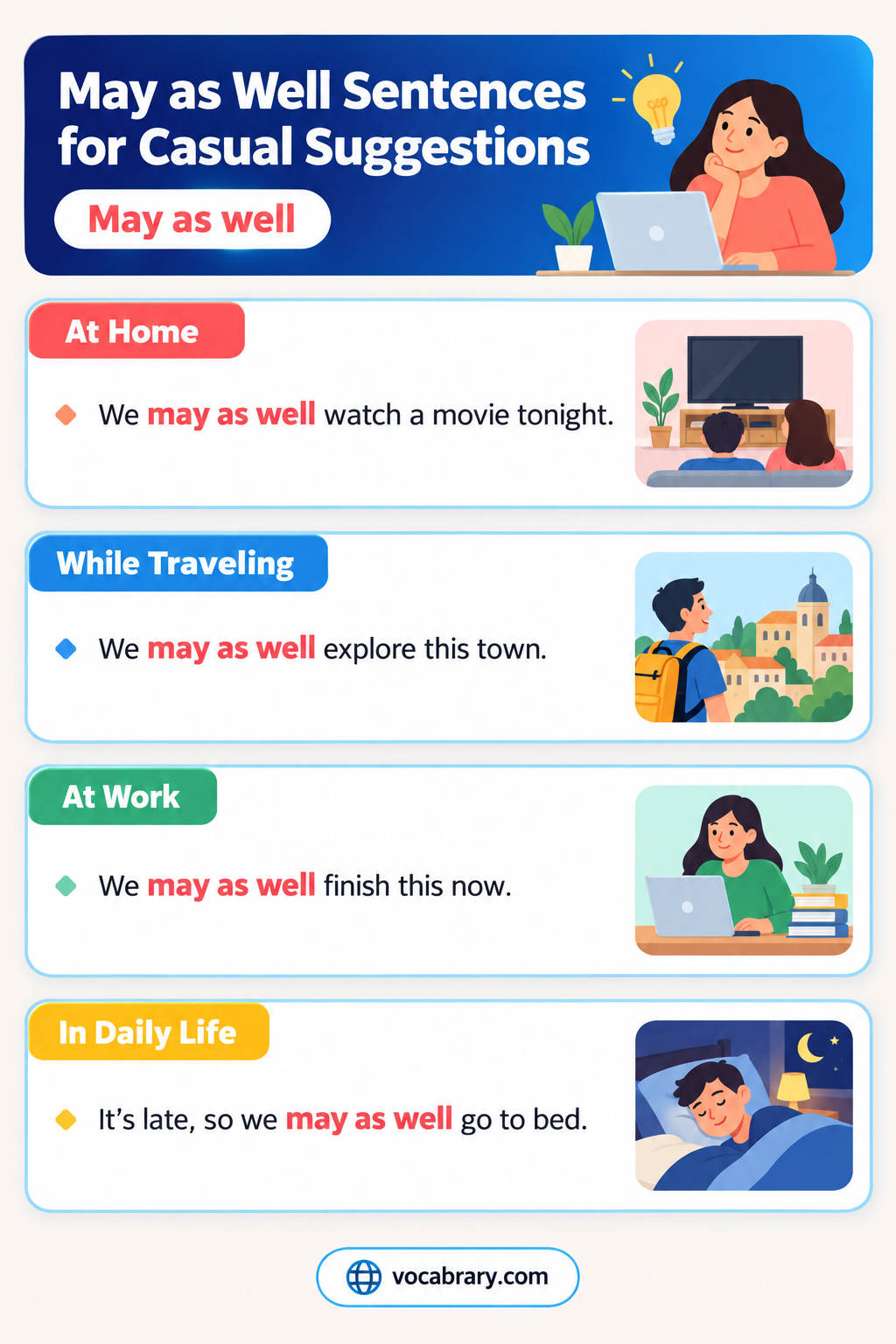
These sentences suggest casual actions, such as starting without a late friend, taking an earlier train, and ordering before the kitchen closes.
- We may as well start without him.
- You may as well take the earlier train.
- I may as well finish the report tonight.
- She may as well tell him the truth.
- We may as well order now, since the kitchen closes soon.
- They may as well stay for dinner.
- You may as well ask. The worst answer is no.
- He may as well sell the car if he never drives it.
- We may as well walk, because the bus is late.
- You may as well keep the receipt.
- I may as well go to bed early.
- She may as well apply, since the deadline is Friday.
May Well Sentences for Strong Possibility
These sentences state a strong chance, such as being right, winning an election, and a storm reaching town.
- She may well be right.
- The plan may well succeed.
- You may well need a coat tonight.
- The new rule may well change how schools plan the year.
- He may well win the election.
- It may well be the best solution.
- The storm may well reach us by midnight.
- They may well have left already.
- Her answer may well surprise the committee.
- This may well be our last chance to see the exhibition.
- The delay may well cost us the contract.
- The shop may well close before we arrive.
Past Possibility Sentences with May Have
These sentences state a possibility about an earlier event, such as a missed bus, a forgotten meeting, or a letter sent to the wrong address.
- She may have missed the bus.
- He may have forgotten the meeting.
- They may have missed the last ferry.
- The letter may have gone to the wrong address.
- I may have lost my keys at the station.
- The team may have made an error in the calculation.
- She may have changed her mind.
- The shop may have closed early because of the holiday.
- He may have heard the news by now.
- The train may have been delayed by the storm.
- The waiter may have written the wrong table number.
- They may have taken a different road.
- She may have left her umbrella on the train.
FAQs
A standard example of "may" in a sentence is "May I use your phone for a moment?", which asks for permission politely. "She may be in a meeting right now" expresses a present possibility. "It may rain this afternoon" expresses a future possibility.
You use "may" in a sentence to ask permission, give permission, state a possibility, admit a point, or express a wish. "You may begin now" gives permission, and "The shop may reopen in spring" states a possibility. "May you have a safe journey" expresses a wish.
Example sentences with "may" for asking permission use "may I" or "may we" and ask for permission to act. "May I borrow your pen?" and "May we take a short break?" are two models. Both ask a polite question about a single action.
Example sentences with "may" for giving permission state that an action is allowed by a person or an institution with authority. "You may begin now" and "Students may use a dictionary during the exam" are two models. Both allow a single action.
Example sentences with "may not" refuse permission or state a ban, and they also state a negative possibility. "Visitors may not take photographs inside the gallery" and "Students may not use phones during the exam" refuse permission. "These findings may not apply to larger groups" states a negative possibility.
Example sentences with "may" for present possibility state a present situation that the speaker cannot confirm. "He may know the answer" and "The shop may be closed on Mondays" are two models. "The manager may be waiting in the lobby" is a third model.
Example sentences with "may" for future possibility state that an event has a real chance of happening later. "Prices may rise before the end of the month" and "We may move to a larger flat next year" are two models. A time phrase such as "next year" indicates when the event happens.
Example sentences with "may" in official notices state what a person is allowed to do under a policy or a contract. "Customers may return items within thirty days of purchase" and "Members may cancel their subscription at any time" are two models. "Employees may request leave through the online portal" is a third model.
Example sentences with "may" in academic writing state a research claim with caution. "The results may indicate a link between sleep and memory" and "Small samples may produce misleading averages" are two models. "The treatment may cause mild side effects in a small number of patients" is a third model.
Example sentences with "may as well" suggest a casual action. "We may as well start without him" and "You may as well take the earlier train" are two models. "I may as well finish the report tonight" is a third model.

Leave a Comment