
A modal verb is a helping verb that expresses ability, permission, possibility, obligation, advice, or prediction, and its form never changes. These 256 modal verbs example sentences are written for ability, permission, possibility, obligation, advice, deduction, past regret, questions, and reported speech, so you study each modal verb in the situations where it is used. You use modal verbs such as "can," "could," "may," "might," "must," "should," and "would" in daily speech and writing, and repeated practice with example sentences improves your accuracy and confidence.
Quick Answer: Modal Verbs Example Sentences
- Ability: She can play the piano.
- Permission: You may leave the room now.
- Possibility: It might rain this afternoon.
- Obligation: Drivers must stop at a red light.
- Advice: You should drink more water.
- Prediction: The meeting will start at nine.
- Preference: I would rather stay home tonight.
- Deduction: He must be tired after the flight.
- Past regret: I should have called her.
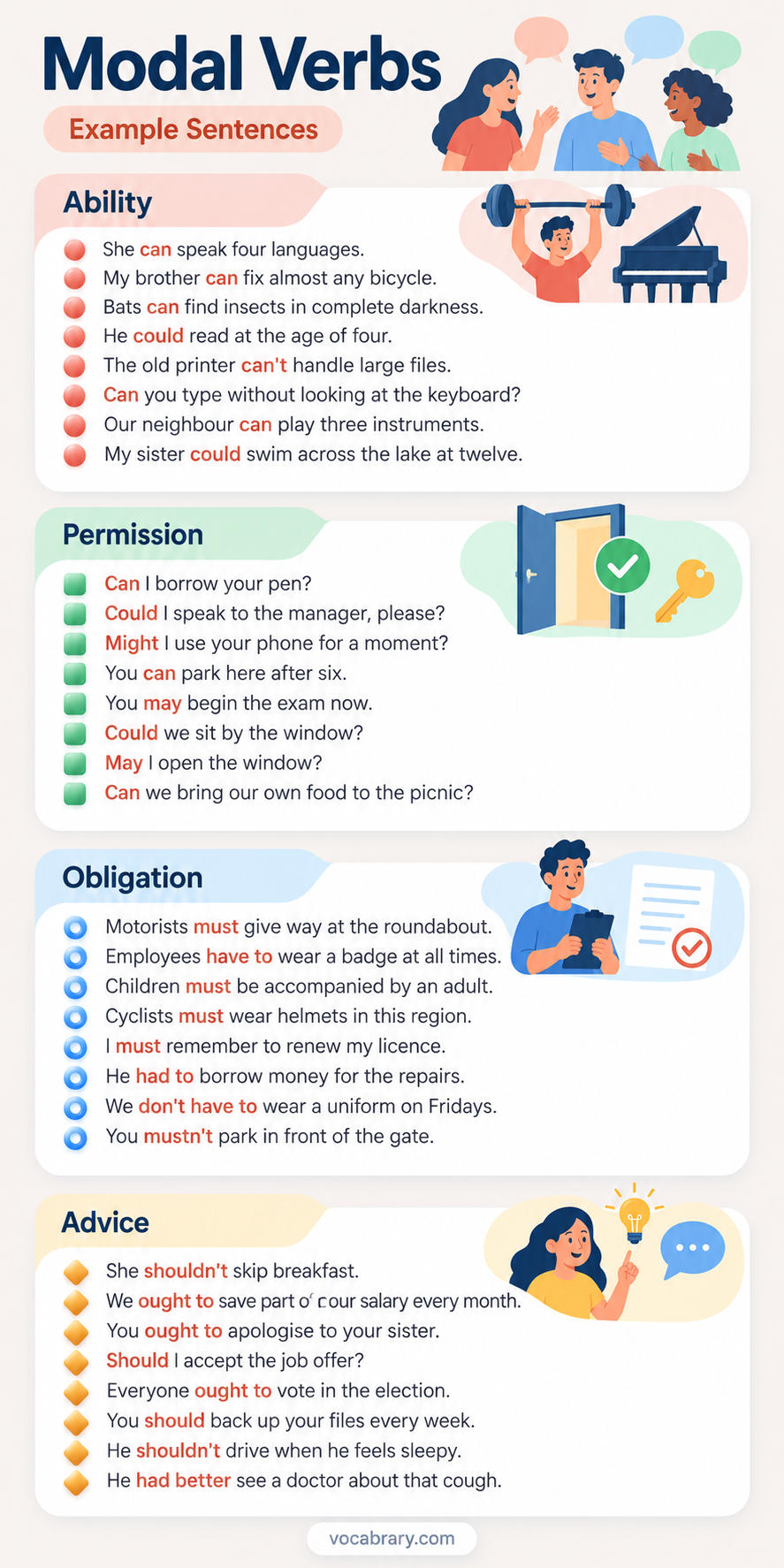
Modal Verbs Example Sentences for Everyday Use
These sentences state ability, permission, requests, possibility, obligation, advice, suggestions, offers, predictions, habits, preference, deduction, regret, questions, and reported speech in the order of the groups that follow.
- Her cousin can solve a Rubik’s cube in under a minute.
- My grandfather could repair radios when he was a boy.
- May I use the restroom before the film starts?
- Could you forward the invoice to the accounts team?
- The ferry might be cancelled because of the wind.
- It may snow in the mountains tonight.
- Passengers must fasten their seatbelts during takeoff.
- Residents have to renew the parking permit every year.
- You should stretch before you run.
- You had better leave now if you want to catch the train.
- We could try the new Thai restaurant on Friday.
- Shall I carry your suitcase upstairs?
- The new library will open in September.
- My aunt would bake bread every Sunday when we were small.
- I would rather read a novel than watch television.
- Her coat is here, so she must be in the office.
- They should have taken the earlier bus.
- Where should we meet after the show?
- The pilot said we would land at noon.
Ability Sentences with Modal Verbs
These sentences state what people, animals, and machines are able to do, from speaking languages to storing photographs.
Modal Verb Sentences for Present and Past Ability
Present and past ability appear in sentences about languages, bicycle repairs, swimming, and marathons.
- She can speak four languages.
- My brother can fix almost any bicycle.
- I can’t swim without a life jacket.
- Bats can find insects in complete darkness.
- He could read at the age of four.
- We couldn’t hear the speaker from the back row.
- When I was young, I could run for an hour without stopping.
- The old printer can’t handle large files.
- Can you type without looking at the keyboard?
- She was able to finish the marathon despite the heat.
- The new tablet can store ten thousand photographs.
- Our neighbour can play three instruments.
- My sister could swim across the lake at twelve.
- Dolphins can recognise themselves in a mirror.
Modal Verb Sentences for Future and Perfect Ability
These sentences describe ability after a course, ability since a move, and ability in a month, as in booking tickets and walking without crutches.
- You will be able to book tickets online next week.
- I haven’t been able to reach him all day.
- After the course, you will be able to read technical manuals.
- Will you be able to attend the conference?
- They won’t be able to enter the building after six.
- We have been able to save more money since we moved.
- He will be able to walk without crutches in a month.
- Have you been able to contact the landlord?
Permission Sentences with Modal Verbs
Permission sentences ask or state whether an action is allowed, such as parking, using a library, or leaving a table, and request sentences ask another person for help.
Modal Verb Sentences for Asking and Giving Permission
These sentences ask for permission to borrow a pen or take a window seat and state what visitors, residents, and employees are allowed to do.
- Can I borrow your pen?
- Could I speak to the manager, please?
- May I leave the table?
- Might I use your phone for a moment?
- You can park here after six.
- Visitors may not take photographs inside the gallery.
- Students can use the library until midnight.
- You may begin the exam now.
- You can’t enter without a ticket.
- Could we sit by the window?
- May I open the window?
- Residents can use the rooftop garden until ten.
- Can we bring our own food to the picnic?
- Employees may use the gym before their shift.
Modal Verb Sentences for Polite Requests
Polite requests ask another person to pass the salt, close a window, sign a page, or wait a few minutes.
- Could you pass the salt, please?
- Would you mind closing the window?
- Can you give me a hand with these boxes?
- Would you open the door for me?
- Could you tell me where the station is?
- Would you please sign at the bottom of the page?
- Can you turn the volume down a little?
- Could you recommend a good bookshop nearby?
- Would you mind waiting a few minutes?
- Will you hold my seat while I buy a drink?
Possibility Sentences with Modal Verbs
Possibility sentences describe an uncertain situation, such as bad weather, a delayed train, or a closed shop.
Modal Verb Sentences for Present Possibility
These sentences describe a situation that is uncertain now, such as a late arrival, a closed shop, and a parcel at the front desk.
- The shop could be closed on Sundays.
- She might be late because of the traffic.
- That restaurant could be the best in town.
- He may be at the gym right now.
- The noise might come from the neighbours’ flat.
- It may not be safe to swim here.
- The meeting room could be occupied this morning.
- Your parcel might be at the front desk.
Modal Verb Sentences for Future Possibility
These sentences describe events that are uncertain later, such as rain tomorrow, a delayed train, and a lower price after the holidays.
- It may rain tomorrow.
- We may move to a new city next year.
- He might not come to the party.
- The results may arrive by Friday.
- I might call you later this evening.
- The train might be delayed again.
- The museum may close early on public holidays.
- Prices might fall after the holiday season.
- She could win the scholarship this year.
- The road could flood after the heavy rain.
- Our team might reach the final this season.
Obligation Sentences with Modal Verbs
Obligation sentences state what people are required to do, are not required to do, or are forbidden to do.
Modal Verb Sentences for Regulations and Laws
Regulations and laws are stated for motorists, passengers, cyclists, tenants, and employees, as in presenting a passport and wearing a helmet.
- Motorists must give way at the roundabout.
- You must not use your phone during the exam.
- Employees have to wear a badge at all times.
- She has to submit the form by Monday.
- Passengers must show a passport at the gate.
- Children must be accompanied by an adult.
- Visitors must sign the register at the front desk.
- You have to renew your passport every ten years.
- Cyclists must wear helmets in this region.
- Workers must wear gloves near the machinery.
- The tenant shall pay the rent on the first day of each month.
Modal Verb Sentences for Duties and Necessity
These sentences describe duties and needs, such as leaving early, renewing a licence, and approving a budget.
- We had to leave early because of the storm.
- I must remember to renew my licence.
- Do you have to work this Saturday?
- I have to pick up my daughter at four.
- He had to borrow money for the repairs.
- The committee must approve the budget before March.
- They will have to wait until the road reopens.
Modal Verb Sentences for Absence of Necessity
These sentences state that an action is not required, as in parking on weekends, wearing a uniform, and bringing a gift.
- You don’t have to pay for parking on weekends.
- We don’t have to wear a uniform on Fridays.
- You needn’t bring a gift to the party.
- She doesn’t have to cook tonight.
- They didn’t have to queue because they had tickets.
Modal Verb Sentences for Prohibition
Prohibition sentences name actions that are forbidden, such as feeding animals, running in a corridor, and parking in front of a gate.
- Visitors must not feed the animals.
- You mustn’t park in front of the gate.
- Pupils mustn’t run in the corridor.
- Guests may not smoke inside the hotel.
- You cannot bring liquids through the security gate.
Advice Sentences with Modal Verbs
Advice sentences recommend an action, from drinking water and backing up files to seeing a doctor.
Modal Verb Sentences for Mild Advice
Mild advice concerns health, money, and manners, as in skipping breakfast, saving a salary, and apologising to a sister.
- You should drink a glass of water before each meal.
- She shouldn’t skip breakfast.
- We ought to save part of our salary every month.
- You ought to apologise to your sister.
- They shouldn’t leave valuables in the car.
- Should I accept the job offer?
- Everyone ought to vote in the election.
- You should back up your files every week.
- She ought to thank the neighbours for their help.
- He shouldn’t drive when he feels sleepy.
Modal Verb Sentences for Urgent Advice
Urgent advice concerns seeing a doctor about a cough, locking a door, charging a phone, and calling a plumber before a leak spreads.
- He had better see a doctor about that cough.
- You’d better lock the door before you go.
- You had better not miss the deadline.
- You’d better charge your phone before the trip.
- We had better call a plumber before the leak spreads.
- They’d better leave now to avoid the traffic.
Suggestion and Offer Sentences with Modal Verbs
Suggestion sentences propose a plan, and offer sentences state what the speaker is ready to do for another person.
Modal Verb Sentences for Suggestions
These sentences propose a coastal road, a short chapter, a warm jacket, a question for a librarian, and a meeting spot outside a cinema.
- We could take the coastal road to the village.
- Shall we begin with the shortest chapter?
- You might want to bring a jacket tonight.
- You could ask the librarian for a recommendation.
- Shall we meet outside the cinema at seven?
Modal Verb Sentences for Offers
These sentences offer a bag, a cup of tea, a glass of water, a lift, and help with a coat.
- Shall I carry your bag?
- I’ll carry that bag for you.
- Would you like a cup of tea?
- Can I get you a glass of water?
- I can give you a lift to the station.
- Shall I open the window for you?
- May I help you with your coat?
- We’ll take care of the dishes tonight.
Prediction and Habit Sentences with Modal Verbs
Prediction sentences describe a future event or a decision, and habit sentences describe a repeated action in the past.
Modal Verb Sentences for Predictions and Decisions
These sentences predict an opening, a price rise, an announcement, a festival, a delivery, and sunny weather, and state a decision to call a restaurant.
- The new bridge will open next spring.
- The festival will attract thousands of visitors this summer.
- I think the price will rise again.
- The company will announce the results on Tuesday.
- I’ll call the restaurant and reserve a table.
- Tomorrow will be sunny in the south.
- The package will arrive before noon.
Modal Verb Sentences for Past Habits and Refusals
Habit sentences describe repeated actions in the past, such as swimming every summer and telling stories after supper, and refusal sentences describe a door, an engine, and a man who ignored advice.
- Every summer, we would swim in the river.
- He would always arrive ten minutes early.
- My grandfather would tell us stories after supper.
- We would visit the market every Saturday morning.
- The door won’t open.
- He wouldn’t listen to any advice.
- My dad would whistle while he cooked.
- The engine wouldn’t start in the cold.
Preference Sentences with Modal Verbs
Preference sentences name what a person prefers, such as taking the train, staying at home, waiting until Monday, or living near the sea.
- I would rather take the train than drive.
- She’d rather eat at home tonight.
- We would rather not discuss the price.
- Would you rather have tea or coffee?
- I’d rather you called before you visit.
- He would rather have gone by bus.
- They’d rather wait until Monday.
- I would rather walk than wait for a taxi.
- Would you rather sit inside or outside?
- My parents would rather live near the sea.
Deduction Sentences with Modal Verbs
Deduction sentences state what the speaker infers from evidence such as a parked car, lights that are off, or the smell of soup.
- She must be at work because her car is outside.
- That can’t be his number, because it starts with the wrong code.
- The lights are off, so they might be asleep.
- He could be waiting at the other entrance.
- You must be exhausted after the trip.
- It may be a problem with the battery.
- They can’t be serious about leaving.
- The package should be here by now.
- That must be the postman at the door.
- She might not know about the change.
- The soup smells wonderful, so dinner must be nearly ready.
- He can’t be hungry after such a large lunch.
Past Deduction and Regret Sentences with Modal Verbs
Past modal sentences describe an inference about earlier events, regret about an action, and a missed chance.
Modal Verb Sentences for Past Deduction
These sentences state an inference about a past event, such as a colleague leaving early, a thief entering through a window, and rain overnight.
- She must have left early because her desk is empty.
- He can’t have forgotten the meeting.
- They might have taken the wrong road.
- The thief must have entered through the window.
- She may have lost her keys.
- The ground is wet, so it must have rained overnight.
Modal Verb Sentences for Regret and Criticism
These sentences express regret or criticism about a past action, such as not calling, shouting at a waiter, or booking late.
- I should have called you yesterday.
- You shouldn’t have shouted at the waiter.
- We should have booked earlier.
- They shouldn’t have left the window open.
- He should have listened to his coach.
Modal Verb Sentences for Missed Chances
These sentences describe an opportunity that was not taken, such as winning a match, going to a concert, or accepting a job in Lisbon.
- We could have won if we had played better.
- I could have gone to the concert, but I was too tired.
- She could have taken the job in Lisbon.
- They could have saved money by cooking at home.
- We might have caught the train if we had left earlier.
Everyday Setting Sentences with Modal Verbs
These sentences are written for three settings: the workplace, the classroom, and travel.
Modal Verb Sentences for the Workplace
Workplace sentences state deadlines, requests, and procedures, such as sending figures, finishing an audit, and booking a conference room.
- All reports must reach the finance team by Friday.
- You should confirm the schedule with the client before the call.
- Could you send me the updated figures this afternoon?
- We have to finish the audit before the end of the quarter.
- The new software will save the team several hours each week.
- Employees may work from home on Wednesdays.
- I can join the meeting at ten, but I can’t stay after eleven.
- You needn’t attend the briefing if you have read the notes.
- Would you like me to book the conference room?
- The manager might approve the request next week.
Modal Verb Sentences for the Classroom
Classroom sentences state instructions and advice, such as handing in an essay, leaving the room, and reviewing vocabulary.
- Students must hand in the essay before the lesson starts.
- You should read the chapter twice before the test.
- May I leave the classroom for a moment?
- Can anyone explain the second question?
- You mustn’t talk during the exam.
- She could solve every equation by the age of ten.
- Pupils don’t have to bring a calculator to the lesson.
- We ought to review the vocabulary every evening.
- The teacher said that the test would begin at nine.
- You had better revise the grammar rules tonight.
Modal Verb Sentences for Travel
Travel sentences concern luggage, platforms, check-in, buses, museums, and taxis.
- Passengers must keep their luggage with them at all times.
- Could you tell me which platform the train leaves from?
- You should arrive at the airport two hours before departure.
- Can I check in online?
- We might miss the connection if the flight is late.
- You don’t have to book a seat on this bus.
- Visitors may not take food into the museum.
- Would you recommend a restaurant near the hotel?
- The taxi should arrive within ten minutes.
- I would rather travel by night than by day.
Question Sentences with Modal Verbs
Question sentences ask for permission, facts, and help, from sitting down to buying a ticket.
Modal Verb Sentences for Yes and No Questions
These sentences ask a question answered with yes or no, such as swimming, joining a group, sitting down, and leaving now, and each is followed by a short answer.
- Can you swim? Yes, I can.
- Could she join us? No, she couldn’t.
- May I sit here? Yes, you may.
- Must we leave now? No, we needn’t.
- Should I call him? Yes, you should.
- Will they come? No, they won’t.
- Would he agree? Yes, he would.
- Could the shop still be open? Yes, it could.
- Shall we begin? Yes, please do.
- Can they hear us? No, they can’t.
Modal Verb Sentences for Wh-Questions
These sentences start with where, what, when, why, how, which, or who, as in buying a ticket, choosing a bus, and waiting for a visa.
- Where can I buy a ticket?
- What should we do next?
- When will the results arrive?
- Why would anyone refuse a free gift?
- How could they miss the signs?
- Which bus should I take to the airport?
- Who can help me with this form?
- How long must we wait for the visa?
- What would you like for dessert?
- When can you start the new job?
Reported Speech Sentences with Modal Verbs
Reported speech sentences repeat what a teacher, doctor, manager, pilot, or parent said about ability, advice, permission, and plans.
- She said that she could swim.
- He promised that he would call me.
- The teacher said that we might leave.
- The doctor said that I should rest.
- They explained that they had to go.
- She said that she would send the files by noon.
- The manager told us that we could finish early.
- He asked if he could borrow my charger.
- The pilot said the plane might land late.
- My mother said I must call her every Sunday.
- They told us that the shop would open at eight.
- She added that we ought to book early.
Modal Verb Example Sentences by Verb
Each modal verb has its own page of example sentences, linked here with one new sentence for each.
- Can Example Sentences: "She can lift a fifty-kilogram bag without help."
- Could Example Sentences: "We could see the mountains from the hotel balcony."
- May Example Sentences: "May I take a seat next to you?"
- Might Example Sentences: "The bus might arrive a few minutes late."
- Must Example Sentences: "You must switch off your phone in the cinema."
- Should Example Sentences: "You should wash your hands before dinner."
- Would Example Sentences: "Would you like another slice of cake?"
- Ought To Example Sentences: "We ought to call our grandparents more often."
- Have To, Has To, and Had To Example Sentences: "I have to finish the report tonight."
- Be Able To Example Sentences: "Will she be able to join us on Saturday?"
- Had Better Example Sentences: "You had better take an umbrella."
- Would Rather Example Sentences: "I would rather paint the fence than mow the lawn."
- Modals of Deduction Example Sentences: "The windows are dark, so they must be asleep."
- Must Have, Should Have, Could Have Sentences: "He must have missed the last bus."
FAQs
A common example of a modal verb in a sentence is "She can speak four languages". In this sentence, "can" expresses ability. Another example is "You should back up your files every week", which gives advice.
You use modal verbs in sentences about ability, permission, obligation, advice, and possibility. Typical sentences are "He could read at the age of four", "May I leave the table?", "Cyclists must wear helmets in this region", and "It may rain tomorrow".
Ability sentences describe what a person, an animal, or a machine is able to do. "My brother can fix almost any bicycle" and "Bats can find insects in complete darkness" describe present ability. "My sister could swim across the lake at twelve" describes ability in the past.
Permission sentences ask whether an action is allowed, and request sentences ask another person for help. "May I open the window?" asks for permission, and "Could you pass the salt, please?" makes a polite request. "Students can use the library until midnight" states what is allowed.
Possibility sentences describe an uncertain situation that exists now or is expected later. "The shop could be closed on Sundays" refers to the present, and "The results may arrive by Friday" refers to the future. "Prices might fall after the holiday season" is a third model.
Obligation sentences state what people are required to do or are forbidden to do. "Passengers must show a passport at the gate" states a requirement, and "Visitors must not feed the animals" states a prohibition. "We don’t have to wear a uniform on Fridays" states that an action is not required.
Advice sentences recommend an action to another person without forcing the listener to act. "You should back up your files every week" and "We ought to save part of our salary every month" give mild advice. "You’d better lock the door before you go" gives urgent advice.
Suggestion sentences propose a plan, and offer sentences state what the speaker is ready to do. "We could take the coastal road to the village" is a suggestion. "Shall I carry your bag?" and "Can I get you a glass of water?" are offers.
Deduction sentences state what a speaker infers from evidence in the situation. "She must be at work because her car is outside" is one model, and "The lights are off, so they might be asleep" is another. "That must be the postman at the door" is a third.
Past modal sentences describe regret, missed chances, and inferences about earlier events. "I should have called you yesterday" expresses regret, and "She could have taken the job in Lisbon" describes a missed chance. "She must have left early because her desk is empty" states an inference about the past.
Related Modal Verb Example Sentences
- Can Example Sentences
- Could Example Sentences
- May Example Sentences
- Might Example Sentences
- Must Example Sentences
- Should Example Sentences
- Would Example Sentences
- Ought to Example Sentences
- Had Better Example Sentences
- Would Rather Example Sentences
- Have to Has to and Had to Example Sentences
- Be Able to Example Sentences
- Modals of Deduction Example Sentences
- Must Have Should Have Could Have Sentences

Leave a Comment