
“Could” is a modal verb that expresses past ability, polite requests, permission, possibility, suggestions, and offers, and its form never changes. These 320 could example sentences are written for childhood skills, office requests, travel plans, warnings, wishes, and reported speech, so you study the word in each situation where it is used. You use modal verbs such as “can,” “would,” “might,” and “should” in daily speech and writing, and repeated practice with example sentences improves your accuracy and confidence.
Quick Answer: Could Example Sentences
- Past ability: I could read before I started school.
- Polite request: Could you open the window, please?
- Permission: Could I borrow your notes for tonight?
- Possibility: The delay could last another hour.
- Suggestion: You could ask the manager for a later start.
- Offer: I could drive you to the station.
- Hypothetical: If I had more time, I could learn the piano.
- Inability in the past: We couldn’t find a parking space.
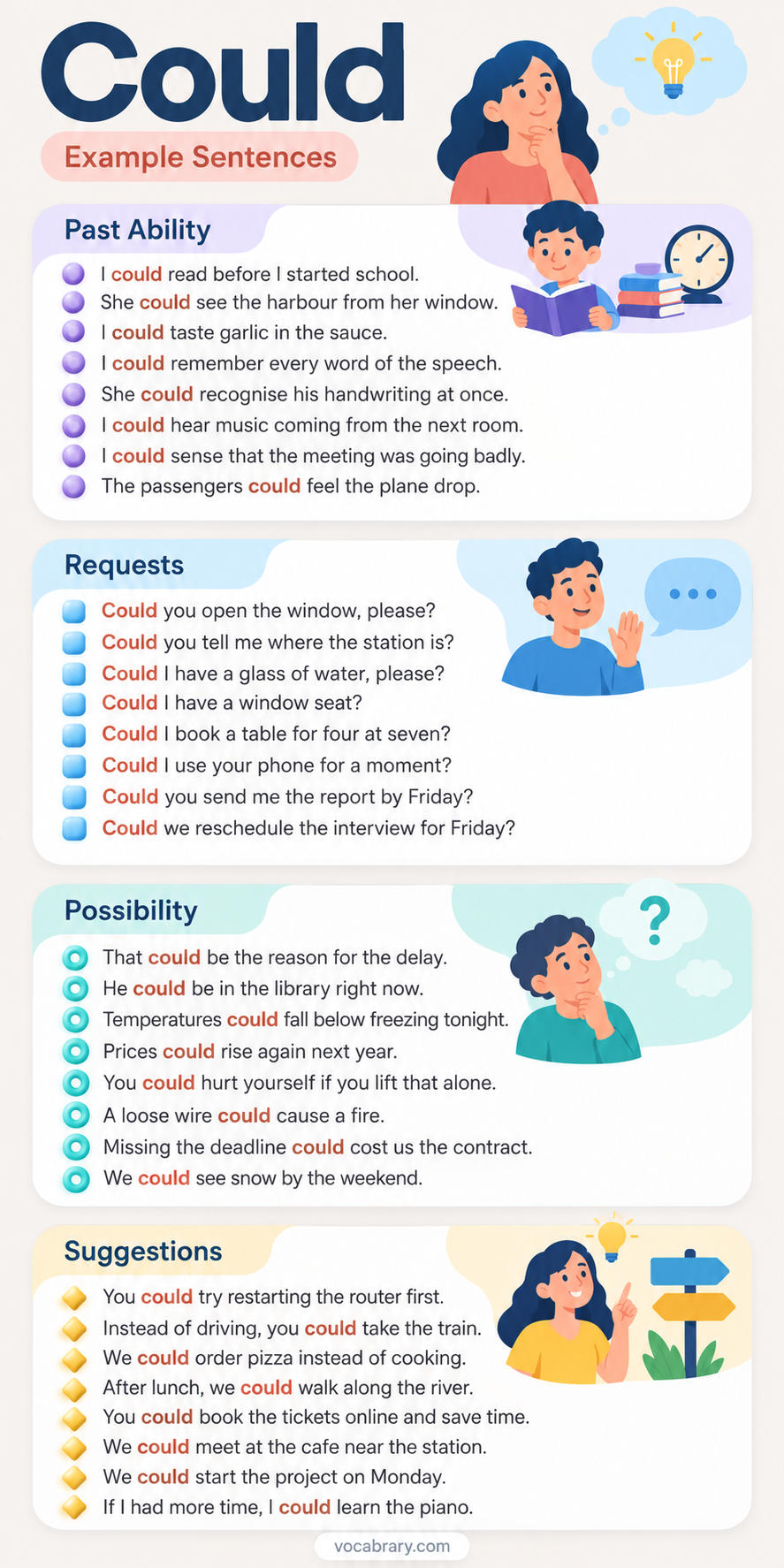
Could Example Sentences for Everyday Use
These sentences include past ability, requests, permission, possibility, suggestions, offers, hypothetical situations, wishes, inability, questions, reported speech, and passive forms.
- I could read long books before I turned eight.
- As a teenager, she could run a mile in six minutes.
- Could you send me the final draft today?
- Could we reschedule the interview for Friday?
- Could I sit by the window?
- The flight could arrive early this evening.
- The roads could freeze overnight.
- You could compare prices before you buy.
- We could share a taxi to the airport.
- I could proofread your cover letter tonight.
- If I had a day off, I could repaint the kitchen.
- I wish I could join you for dinner.
- We couldn’t see the stage from the last row.
- That couldn’t be the final score.
- Could she speak Italian before she moved to Rome?
- “Could he play chess as a child?” / “No, he couldn’t.”
- He said he could pick us up at six.
- The seats could be reserved online.
Past Ability Sentences with Could
These sentences describe what people and animals were able to do in the past, from reading before school to climbing trees as a child.
Could Sentences for Childhood Skills
These sentences describe skills from early life, such as swimming, riding a bicycle, and counting to one hundred. Phrases like “as a child” and “when he was young” appear in several of them.
- I could read before I started school.
- She could swim a full length of the pool at the age of seven.
- When he was young, he could run faster than anyone in his class.
- We could speak French fluently when we lived in Montreal.
- As a child, I could climb any tree in the neighbourhood.
- My brother could ride a bicycle without training wheels at four.
- She could count to one hundred in three languages by the time she was six.
- He could draw a perfect circle freehand when he was still in primary school.
- The twins could sing the whole alphabet before their second birthday.
- I could touch my toes easily when I was a teenager.
- My cousin could whistle any tune by the age of five.
- They could play the recorder at the age of eight.
- As a boy, he could remember every player on the national team.
- She could solve long division problems in her head at nine.
- We could walk to school on our own when we were ten.
Could Sentences for Changing Abilities
These sentences describe abilities that no longer apply, such as a father who fixed engines and a runner whose knees now hurt. Phrases like “but now” and “no longer” appear in several of them.
- I could run ten kilometres every morning, but now my knees hurt.
- He could see the stars clearly before the city grew.
- She could hear every word in the lecture hall when she was younger.
- My father could fix any engine, but he no longer works on cars.
- We could swim in the river every summer until the water became polluted.
- The old dog could jump onto the sofa in one leap.
- In his twenties, he could stay awake for two days without a break.
- She could play the violin beautifully before the injury to her wrist.
- They could afford a large house when prices were lower.
- I could eat anything without feeling ill when I was a student.
- The village could support three shops before the highway opened.
- My eyesight was perfect, and I could read the smallest print on the label.
- He could lift heavy boxes all day, but he cannot do that now.
- She could speak Russian fluently until she stopped practising.
- Back then, we could leave the front door open at night.
Could Sentences for Perception and Understanding
These sentences describe what someone perceived or understood in the past, from hearing music in the next room to smelling smoke at the door.
- I could hear music coming from the next room.
- She could see the harbour from her window.
- We could smell smoke as soon as we opened the door.
- He could feel the floor shaking during the storm.
- I could taste garlic in the sauce.
- They could see the lights of the city from the hill.
- She could understand most of the lecture, but not the last ten minutes.
- I could remember every word of the speech.
- He could tell from her voice that something was wrong.
- We could hear the children laughing in the garden.
- I could sense that the meeting was going badly.
- She could recognise his handwriting at once.
- The passengers could feel the plane drop.
- I could just make out a figure at the end of the road.
Polite Request Sentences with Could
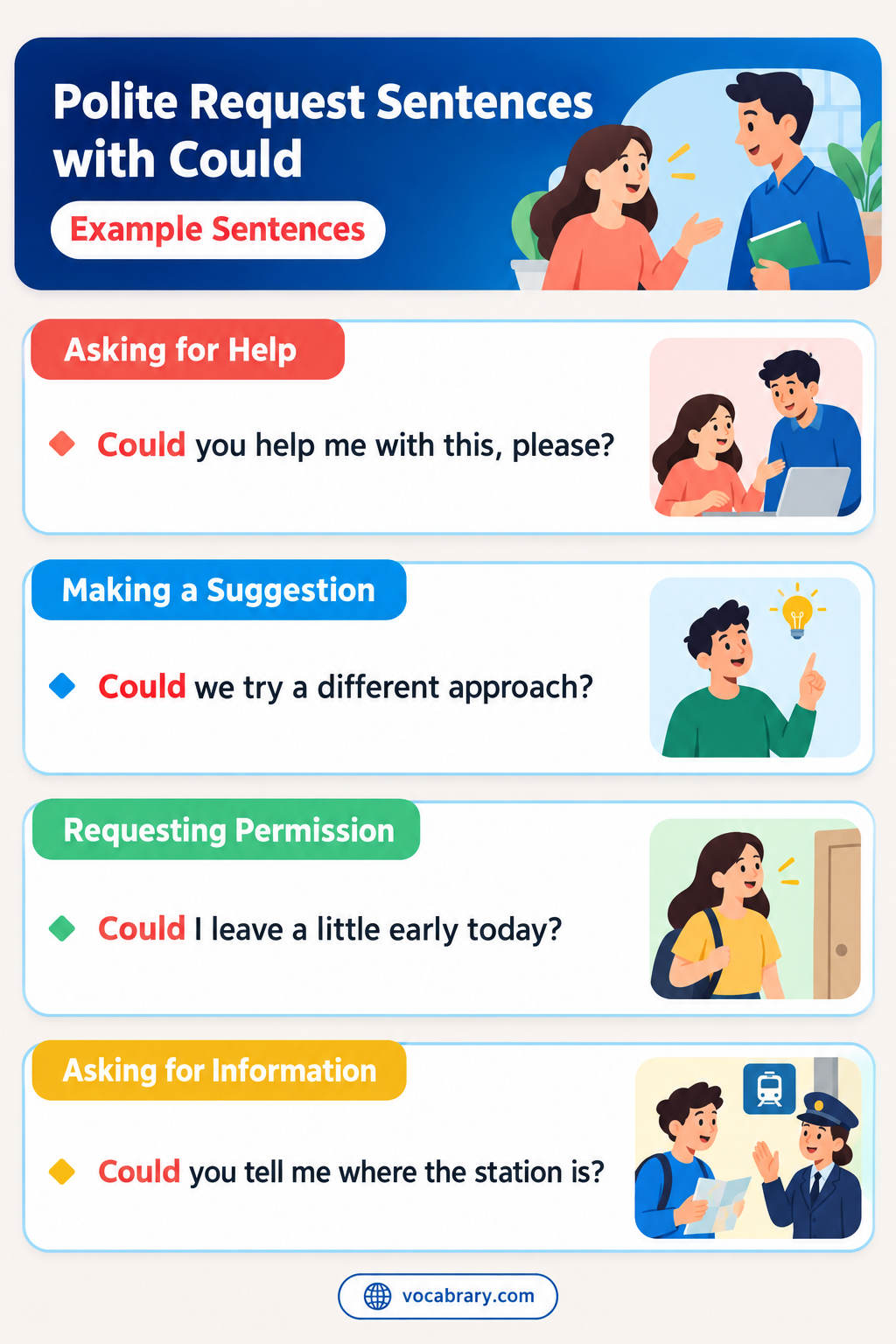
These sentences are written for shops, offices, hotels, and conversations with strangers, such as asking for the salt, a receipt, or a table.
Could Sentences for Asking Someone to Do Something
These sentences ask another person to act, such as opening a window, passing the salt, or sending a report.
- Could you open the window, please?
- Could you send me the report by Friday?
- Could you pass the salt?
- Please could you speak a little more slowly?
- Could you tell me where the station is?
- Could you help me carry these boxes upstairs?
- Could you turn down the music? I’m trying to concentrate.
- Sorry, could you repeat the last sentence?
- Could you lend me a pen for a moment?
- Could you check the figures in the second table?
- Could you hold the lift for me?
- When you arrive, could you give me a call?
- Could you bring an extra chair from the other room?
- Could you forward this message to the whole team?
- Could you keep an eye on my bag for a minute?
- Before we start, could you explain how the booking system works?
Could Sentences for Asking for Something
These sentences ask for an item or a service for the speaker, such as a glass of water, a window seat, or the bill.
- Could I have a glass of water, please?
- Could I see the menu?
- Sorry, could I get a receipt for that?
- Could I have a window seat?
- Excuse me, could I speak to the manager?
- Could I have the bill when you have a moment?
- Could I get a refund on this jacket?
- Could I have another copy of the form?
- Hello, could I leave a message for Mr. Evans?
- Could I book a table for four at seven?
- Could I have your name and contact number?
- Could I borrow the charger from your desk?
Could Sentences for Longer Polite Requests
These sentences add polite openings such as “I was wondering if,” “Do you think,” and “I’d be grateful if,” as in asking someone to review an application or take a shift.
- I was wondering if you could review my application.
- I wonder if you could recommend a good dentist.
- Would it be possible for you to join us on Thursday? Or could you suggest another day?
- I was hoping you could look at my essay before Monday.
- Do you think you could cover my shift on Saturday?
- Excuse me, could you point me towards the exit?
- Sorry to bother you, but could you move your bag a little?
- I’d be grateful if you could confirm the date by email.
Permission Sentences with Could
These sentences ask whether an action is allowed, such as using a phone or leaving early, and report what was allowed in the past.
Could Sentences for Asking Permission
These sentences ask whether an action is allowed, such as using a phone, leaving early, or taking a photo.
- Could I use your phone for a moment?
- Could we sit at this table?
- Do you think I could leave a little early today?
- Could we borrow your projector for the afternoon?
- Could I open the window?
- Could I take a photo of the painting?
- Excuse me, could we change our appointment to Wednesday?
- Could I try this jacket on?
- Could he join us for the first half of the meeting?
- Could I park my bike by the entrance?
- If it’s not a problem, could we stay a few extra minutes?
- Could I join your group for the project?
Could Sentences for Past Permission
Past permission sentences describe what a rule allowed over time, such as wearing jeans on Fridays or borrowing ten library books.
- When I was a child, I could stay up until ten on Fridays.
- Students could use their phones during breaks last year.
- In the old library, we could borrow ten books at a time.
- My parents said I could go to the party if I finished my homework.
- Visitors could enter the garden for free on Sundays.
- At my first job, we could wear jeans on Fridays.
- The staff could take a long lunch break in the summer.
- When she was a student, she could use the lab at night.
- Children could play in the courtyard until sunset.
- Employees could work from home two days a week under the old policy.
Possibility Sentences with Could
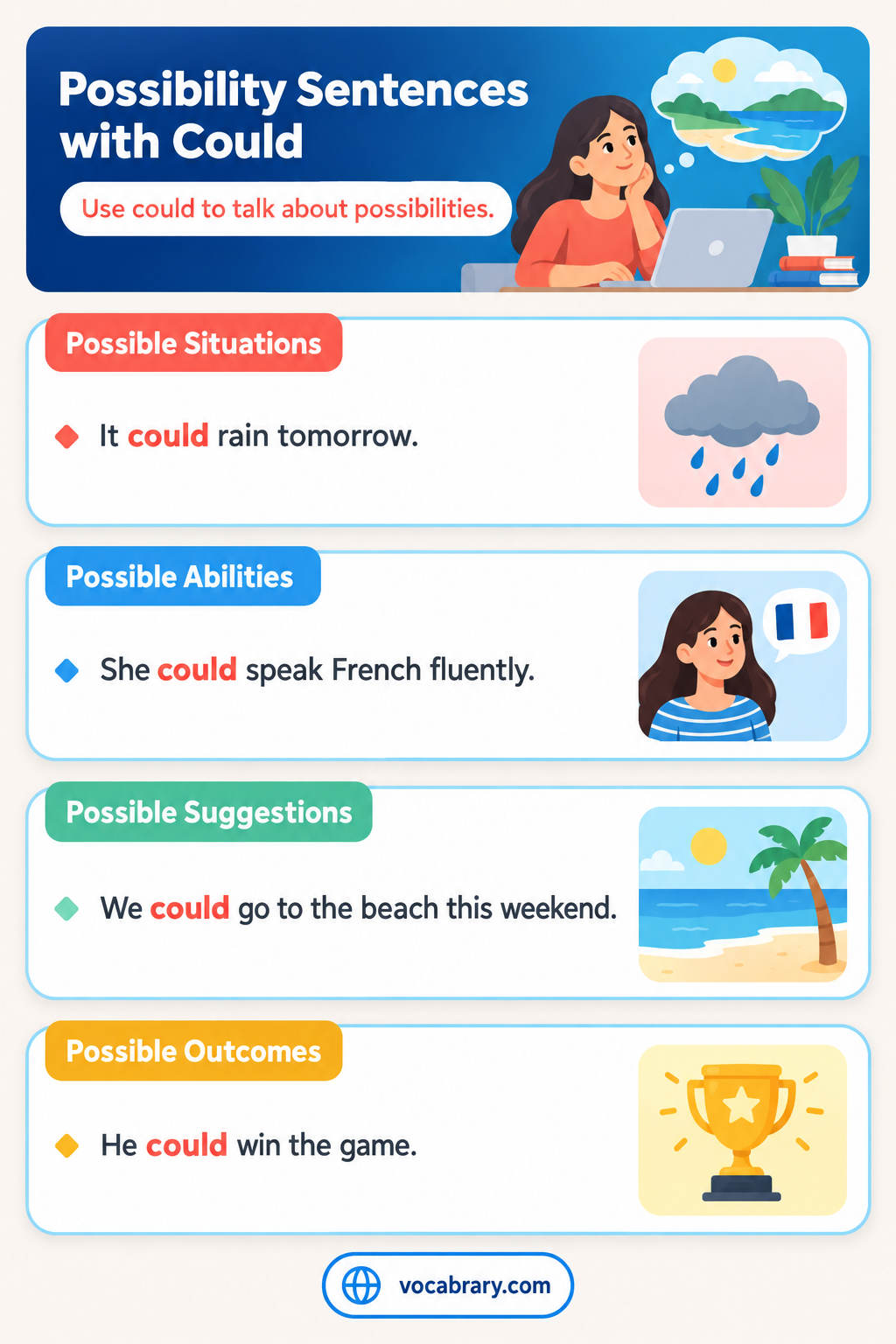
These sentences describe events and facts that are possible, such as a delay, a rainstorm, or a price rise.
Could Sentences for Present Possibility
These sentences state a possibility about now, such as a delay, a noise upstairs, or a package at the post office.
- That could be the reason for the delay.
- He could be in the library right now.
- The noise could be coming from the apartment upstairs.
- She could still be waiting at the station.
- This could be the solution to our problem.
- They could be asleep by now.
- The package could be at the post office.
- It could be a mistake in the schedule.
- The meeting room could be free at this hour.
- The key could be in the pocket of your other coat.
- She could be stuck in traffic on the ring road.
- Someone could be using the printer right now.
Could Sentences for Future Possibility
These sentences state a possibility about later, such as rain this afternoon, a price rise, or a storm on the coast.
- It could rain this afternoon, so take an umbrella.
- The match could finish late because of the delay.
- Prices could rise again next year.
- The new bridge could open before the end of the month.
- We could see snow by the weekend.
- The storm could reach the coast tomorrow evening.
- This update could solve the connection problem.
- The company could announce the merger next week.
- Temperatures could fall below freezing tonight.
- She could win the competition if she keeps this pace.
- The package could arrive as early as Tuesday.
- The strike could affect flights across the country.
- A small change in the plan could save us a full day.
- The new rule could reduce waiting times at the clinic.
Could Sentences for Warnings
Warning sentences name an action and the harm that follows, such as lifting a heavy load alone or leaving a door unlocked.
- You could hurt yourself if you lift that alone.
- Careful, that shelf could fall.
- Skipping breakfast could make you tired before noon.
- Leaving the door unlocked could invite a break-in.
- A loose wire could cause a fire.
- Driving that fast on wet roads could end badly.
- Missing the deadline could cost us the contract.
- That ladder could slip on the wet floor.
- Touching that wire could give you a shock.
- Ignoring the symptoms could make the illness worse.
- A sudden stop could throw the passengers forward.
- Sharing your password could put your account at risk.
Suggestion Sentences with Could
These sentences recommend a course of action to one person or to a group, such as restarting a router or meeting at a cafe.
Could Sentences for Suggesting Options
These sentences give another person an option, such as restarting the router, taking the train, or asking a tutor.
- You could ask the manager for a later start time.
- You could try restarting the router first.
- Instead of driving, you could take the train.
- You could write down the main topics before the call.
- You could talk to a tutor about the essay.
- Or you could use a different password for each account.
- You could book the tickets online and save time.
- You could ask your neighbour to water the plants.
- On the weekend, you could rent a bike.
- You could split the work into two smaller tasks.
- You could visit the museum on a weekday to avoid crowds.
- Maybe you could send a short message to confirm the time.
Could Sentences for Group Plans
These sentences propose a plan for a group, such as meeting at a cafe, ordering pizza, or walking along the river.
- We could meet at the cafe near the station.
- We could order pizza instead of cooking.
- We could start the project on Monday.
- After lunch, we could walk along the river.
- We could ask Maria to join the committee.
- To save time, we could take a taxi.
- We could watch a film at my place on Friday.
- We could invite the whole team to the launch.
- If the item arrives damaged, we could ask for a refund.
- We could spend the afternoon at the beach.
- We could set up a shared folder for the documents.
- This time, we could try a different restaurant.
Offer Sentences with Could
These sentences state what the speaker is ready to do for another person, such as driving a friend to the airport or carrying bags.
- I could drive you to the airport in the morning.
- I could carry those bags for you.
- I could look at your CV before you send it.
- We could lend you our tent for the trip.
- I could cook dinner tonight if you’re tired.
- I could pick up the children from school on Thursday.
- We could help you move on Saturday.
- I could call the hotel and ask about the late checkout.
- I could translate the letter into English for you.
- I could show you how to set up the account.
- We could bring dessert if you’re hosting.
- I could stay late and finish the invoices.
Hypothetical Sentences with Could
These sentences describe imagined situations, such as having more time, living near the sea, or playing the guitar like a friend.
Could Sentences for Second Conditionals
These sentences describe results of imagined conditions, such as having more time and learning the piano.
- If I had more time, I could learn the piano.
- If she studied harder, she could pass the exam.
- If we left earlier, we could avoid the traffic.
- I could swim every morning if I lived near the sea.
- If they had a bigger budget, they could hire two more people.
- If he spoke Spanish, he could work in Madrid.
- If the shop opened earlier, we could buy bread before work.
- I could travel for a year if I won the lottery.
- If she had a car, she could visit her parents every weekend.
- We could eat outside if the weather were better.
- If you moved closer to the office, you could save an hour a day.
- He could become a professional if he practised daily.
- If we had a garden, our dog could play outside.
- If the tickets were cheaper, more students could attend.
Could Sentences for Wishes
These sentences state a wish for an ability or chance that someone lacks now, such as playing the guitar, staying for the weekend, or finding lost keys.
- I wish I could play the guitar like you.
- She wishes she could stay for the weekend.
- I wish we could speak to him in person.
- He wishes he could remember her name.
- They wish they could afford a larger flat.
- I wish I could sleep past six on weekends.
- If only I could find my keys.
- She wishes she could travel more often for work.
Inability and Impossibility Sentences with Couldn’t
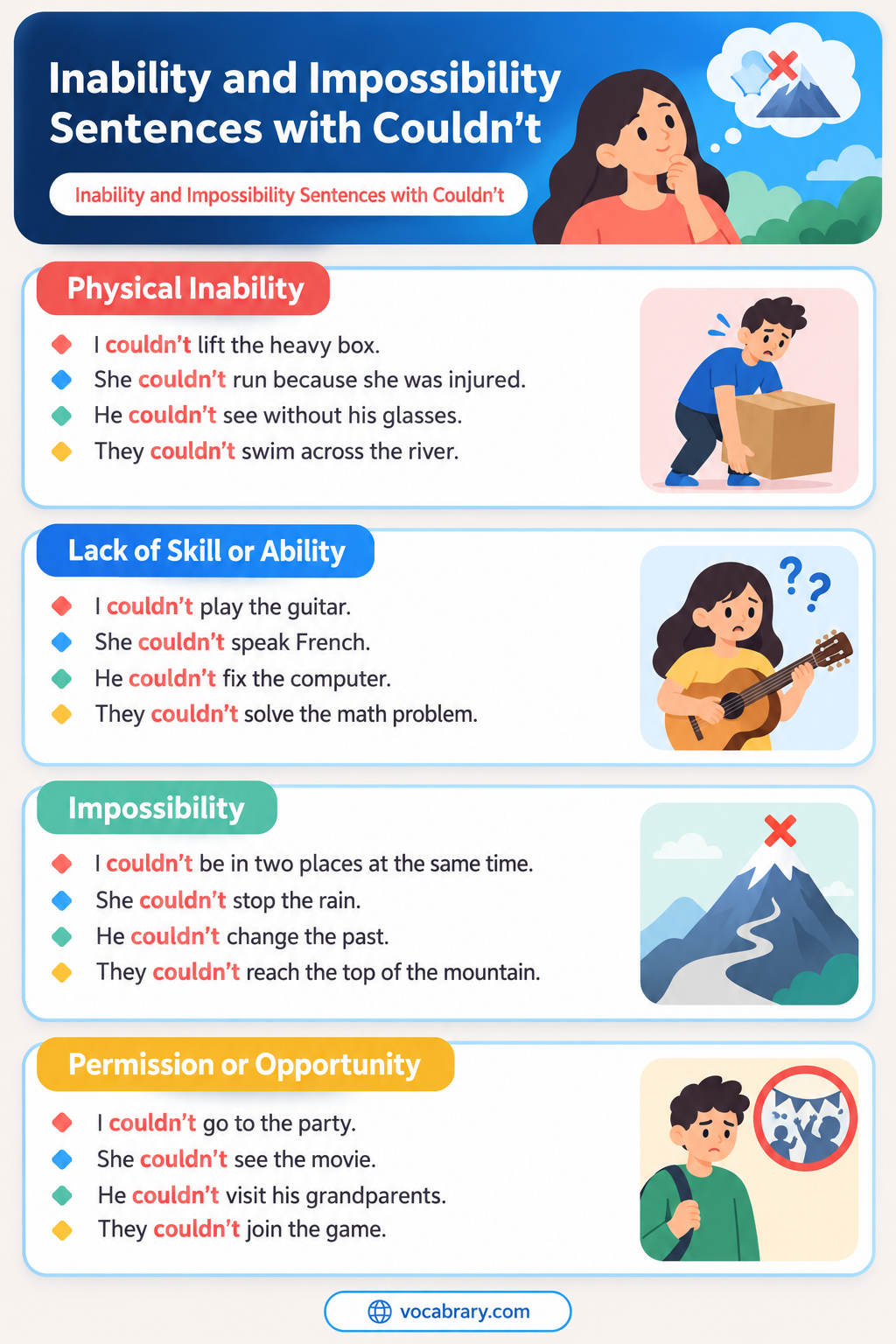
Negative sentences with “couldn’t” state what someone was unable to do and reject claims as impossible, such as a wrong address or an unlikely age.
Couldn’t Sentences for Past Inability
These sentences name what someone was unable to do, such as sleeping, finding a parking space, or reaching a summit.
- I couldn’t sleep last night because of the noise.
- She couldn’t attend the meeting because of a family emergency.
- We couldn’t find a parking space near the venue.
- He couldn’t read the sign without his glasses.
- They couldn’t open the file on their old computer.
- I couldn’t remember where I had left my umbrella.
- The children couldn’t reach the top shelf.
- She couldn’t swim until she was twelve.
- We couldn’t hear the speaker from the back row.
- He couldn’t afford the ticket at the time.
- I couldn’t get through to the helpline all morning.
- The shop couldn’t deliver the sofa before Friday.
- They couldn’t agree on a date for the wedding.
- I couldn’t carry both bags at once.
- I couldn’t open the door yesterday, so I called a locksmith.
- She couldn’t find her passport before the flight.
- We couldn’t reach the summit because of the snow.
- He couldn’t solve the last question on the test.
- They couldn’t get a signal in the tunnel.
- The car couldn’t start this morning.
- He couldn’t finish the race because of a sore ankle.
- We couldn’t get into the museum because the doors were locked.
- The students couldn’t solve the final puzzle in time.
- I couldn’t contact her because my phone was dead.
- The pilot couldn’t see the runway through the fog.
- They couldn’t pay the rent in December.
- She couldn’t walk without a stick after the accident.
- My uncle couldn’t read until he was nine.
Couldn’t Sentences for Disbelief and Impossibility
These sentences treat a claim as impossible, such as a wrong address, an unlikely age, or a person who is not at home.
- That couldn’t be the right address. There are no houses here.
- He couldn’t be older than twenty-five.
- She couldn’t have meant what she said.
- You couldn’t be serious about leaving now.
- It couldn’t be that easy, could it?
- They couldn’t be in the building. The lights are off.
- That couldn’t be true. I saw him an hour ago.
- The answer couldn’t be wrong. I checked it twice.
- She couldn’t be at home. Her car is gone.
- That couldn’t be his brother. They look nothing alike.
- The test couldn’t be this hard for everyone.
- He couldn’t have left yet. His coat is still here.
Question Sentences with Could
These sentences ask politely, check a possibility, or ask about past ability, such as swimming at five or finding a restaurant for lunch.
Could Sentences for Yes or No Questions
These sentences ask a question answered with yes or no, such as swimming at five or meeting on Thursday.
- Could you swim when you were five?
- Could she speak English before she moved here?
- Could the delay be caused by the weather?
- Could he have a word with you?
- Could we meet on Thursday instead?
- Could the report wait until Monday?
- Could they hear us from the other room?
- Could this be the right train?
- Could I ask you a quick question?
- Could the problem be in the software?
- Could your sister ride a bicycle at six?
- Could your brother see the stage from his seat?
Could Sentences for Wh-Questions
These sentences use a question word, such as where, how, or when, as in finding a restaurant for lunch.
- Where could we find a good place for lunch?
- How could I improve my writing?
- What could she have forgotten?
- When could you start the new job?
- Why couldn’t he attend the meeting?
- Who could help me with this form?
- How many languages could he speak as a child?
- What time could we check in at the hotel?
- Which route could we take to avoid the roadworks?
- How could anyone miss such an obvious sign?
- Where could the keys be?
- How long could you hold your breath when you were a swimmer?
Could Sentences for Short Answers
These sentences pair a question with a brief reply, such as “Yes, I could” and “No, she couldn’t.”
- “Could you swim as a child?” / “Yes, I could.”
- “Could she read at four?” / “No, she couldn’t.”
- “Could they hear the announcement?” / “No, they couldn’t, because the speakers were broken.”
- “Could your uncle fix the engine?” / “Yes, he could.”
- “Could you come on Friday?” / “I’m afraid I couldn’t. I have a meeting.”
- “Could he drive when he was seventeen?” / “Yes, he could.”
- “Could they park near the entrance?” / “Yes, they could.”
- “Could she see the board from the back?” / “No, she couldn’t.”
Reported Speech Sentences with Could
These sentences report what someone said about ability, permission, or possibility, such as a delivery on Friday or leaving early.
- She said she could meet me at noon.
- He told us he couldn’t attend the ceremony.
- They said they could deliver the sofa on Friday.
- The manager said we could leave early.
- I asked if I could use the printer.
- He explained that he couldn’t find the file.
- She said she could speak four languages.
- The teacher said we could start the exam.
- They told me that the system could be upgraded.
- My friend said she could lend me her car.
- The guide said we could take photographs outside.
- He said nobody could enter the building after six.
- She asked whether we could reschedule the call.
- The doctor said the results could take a week.
- He assured us he could finish the report by noon.
- They explained that the museum couldn’t admit visitors after four.
Passive Sentences with Could
These sentences state actions done to a thing, such as an error being fixed, a meeting being moved, or a seat being changed.
- The error could be fixed in a few minutes.
- The meeting could be moved to Wednesday.
- Could the window be opened from the inside?
- This task could be finished by tomorrow.
- The files could be shared with the whole team.
- The old house could be restored with some effort.
- Nothing could be done about the delay.
- The road could be closed at short notice.
- These tickets could be exchanged for a later date.
- The answer could be found in the appendix.
- The problem could be avoided with better planning.
- A taxi could be booked for the early flight.
- The boxes could be stored in the garage.
- Your seat could be changed at the desk.
- This recipe could be made without eggs.
- The email could be sent again from the draft folder.
FAQs
A standard example of "could" in a sentence is "I could read before I started school," which describes a past ability. Other common examples are "Could you open the window, please?" and "The flight could arrive early this evening."
You use "could" in a sentence to describe past ability, make a polite request, ask permission, state a possibility, give a suggestion, or make an offer. Examples are "I could read before I started school," "Could you pass the salt?" and "You could try restarting the router first." An offer is "I could carry those bags for you."
Example sentences with "could" for past ability describe skills a person had earlier in life. "She could swim a full length of the pool at the age of seven" and "When he was young, he could run faster than anyone in his class" are two models. Both sentences name a skill from childhood.
Polite requests with "could" ask another person for help or for an item in a courteous tone. "Could you send me the report by Friday?" asks another person to act. "Could I have a window seat?" asks for something for the speaker.
Permission sentences with "could" ask whether an action is allowed or report what was allowed. "Could I use your phone for a moment?" asks for permission now. "Students could use their phones during breaks last year" reports a rule from the past.
Possibility sentences with "could" describe delays, weather, prices, and other events or facts that are possible. "The new bridge could open before the end of the month" and "Prices could rise again next year" refer to the future. "He could be in the library right now" refers to the present.
Suggestion sentences with "could" give another person an option, such as a step to take or a plan to follow. "You could try restarting the router first" suggests a step to another person. "We could meet at the cafe near the station" suggests a plan for a group.
Offer sentences with "could" state what the speaker is ready to do for another person. "I could drive you to the airport in the morning" and "I could look at your CV before you send it" are two models. Both start with "I could" and name a specific action.
Sentences with "couldn’t" state past inability or reject a claim as impossible. "We couldn’t find a parking space near the venue" expresses past inability. "That couldn’t be the right address" rejects a claim as impossible.
Questions with "could" ask politely, check a possibility, or ask about past ability. "Could you speak a little more slowly?" is a polite request, and "Where could we find a good place for lunch?" is a wh-question. Short answers include "Yes, I could" and "No, she couldn’t."

Leave a Comment