
Past modals are verb phrases that combine a modal verb, "have," and a past participle to express deduction, regret, and missed chances about earlier events. These 313 must have should have could have sentences are written for deduction, regret, criticism, missed chances, hypothetical results, and unnecessary actions in news reports, apologies, and reviews. You use related forms such as "may have," "might have," "would have," and "ought to have" in speech and writing, and reading these sentences improves your accuracy with past events.
Quick Answer: Must Have, Should Have, and Could Have Sentences
- Deduction: She must have left already.
- Negative deduction: He can’t have finished so quickly.
- Possibility: They might have missed the bus.
- Missed chance: We could have won the match.
- Regret: I should have called her yesterday.
- Criticism: You shouldn’t have shouted.
- Hypothetical result: If I had known, I would have helped.
- Unnecessary action: You needn’t have brought a gift.
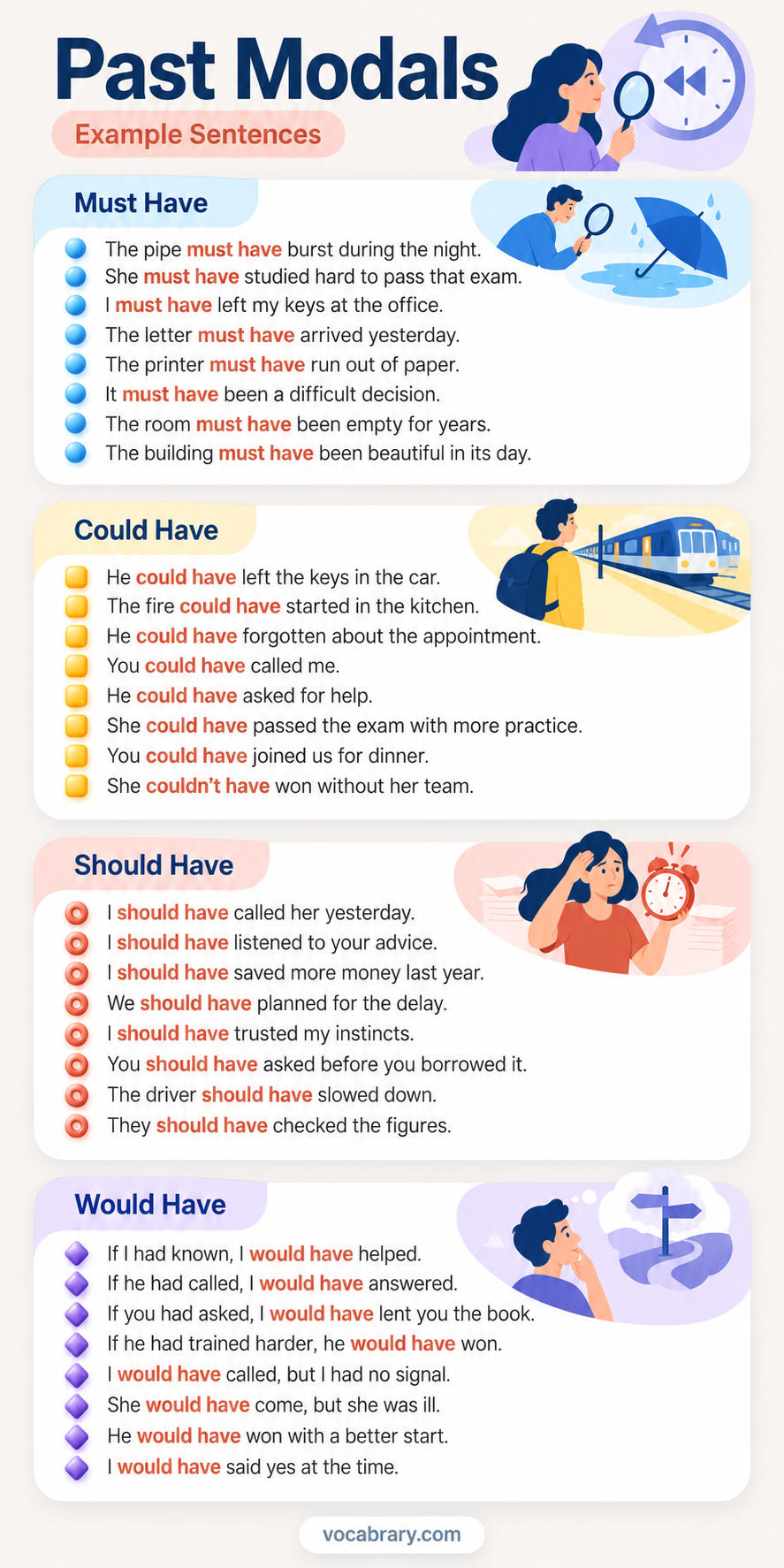
Must Have Should Have Could Have Sentences for Everyday Use
This group uses "must have," "should have," and "could have" for deduction, regret, missed chances, hypothetical results, and unnecessary actions.
- The pavement is wet, so it must have rained while we slept.
- Dmitri can’t have written this essay in an hour.
- Priya may have taken the night train to Hamburg.
- The courier might have left the parcel with a neighbour.
- Laila could have studied medicine in Cairo, but she chose music.
- I should have packed a raincoat for the trip to Bergen.
- You shouldn’t have opened the email from an unknown sender.
- The coach ought to have substituted the injured striker earlier.
- If Mateo had set an alarm, he would have caught the early flight.
- You needn’t have ironed the shirts, because we are wearing casual clothes.
- Could the waiter have misheard our order?
- The contract should have been signed before the deadline.
- Keiko must have been rehearsing for hours when we arrived.
- The doctor said Grandpa could have recovered faster with more rest.
- The council said the flood may have damaged the old bridge.
- We should have warned you about the construction noise.
- The finale could have been more surprising.
- I wish I could have attended your graduation in Lagos.
Deduction Sentences with Must Have
These sentences explain a past event from present evidence, such as wet ground, an empty desk, or a missing umbrella.
Must Have Sentences for Evidence-Based Conclusions
These sentences explain what happened from what is seen now, such as wet ground, an empty desk, or a burst pipe.
- It must have rained overnight. The ground is wet.
- She must have left already. Her desk is empty.
- They must have forgotten the meeting. Nobody is here.
- He must have worked all night. His desk is covered with papers.
- The pipe must have burst during the night.
- Someone must have taken my umbrella.
- The neighbours must have gone away for the weekend.
- The shop must have closed early because of the holiday.
- She must have studied hard to pass that exam.
- The team must have trained for months.
- I must have left my keys at the office.
- They must have heard the news by now.
- He must have missed the bus. He is never late.
- The letter must have arrived yesterday.
- The thief must have entered through the window.
- The children must have gone to bed early.
- She must have noticed the mistake before the meeting.
- The printer must have run out of paper.
Must Have Been Sentences for Past States
These sentences describe a past feeling, age, or state, such as a nervous candidate before an interview, a difficult decision, and a room that was empty for years.
- She must have been nervous before the interview.
- It must have been a difficult decision.
- He must have been about twenty when he moved here.
- The room must have been empty for years.
- You must have been surprised by the news.
- The building must have been beautiful in its day.
- They must have been exhausted after the hike.
- That must have been the reason for the delay.
Negative Deduction Sentences with Can’t Have and Couldn’t Have
These sentences reject an explanation, such as a coat that is still here, a bolted door, or a task that started ten minutes ago.
- She can’t have finished already. She started ten minutes ago.
- He can’t have left. His coat is still here.
- They can’t have arrived yet. The train was late.
- You can’t have eaten the whole cake. It was enormous.
- The package can’t have arrived. I sent it an hour ago.
- He can’t have known about the plan. We told nobody.
- She can’t have been at the party. She was on holiday.
- The driver can’t have seen the sign. It was covered in snow.
- The bank can’t have made a mistake. I checked the balance twice.
- They couldn’t have heard us from the other room.
- He couldn’t have lost the keys here. We searched the house.
- She couldn’t have forgotten. I reminded her twice.
- The door couldn’t have been locked. I opened it with one push.
- You couldn’t have seen him. He was abroad.
- The thief couldn’t have entered through the front. The door was bolted.
- It can’t have been a mistake. The records are clear.
- He couldn’t have known the answer.
Possibility Sentences with May Have and Might Have
These sentences name possible past events, such as a missed bus, a forgotten meeting, or a ferry cancelled by fog.
May Have Sentences for Possible Past Events
These sentences offer one explanation for a past event, such as a missed bus, a forgotten meeting, or a letter sent to the wrong address.
- She may have missed the bus.
- He may have forgotten the meeting.
- They may have left already.
- The letter may have gone to the wrong address.
- I may have lost my keys at the station.
- The team may have made an error in the calculation.
- The ferry may have been cancelled because of the fog.
- He may have heard the news on the radio.
Might Have Sentences for Possible Explanations
These sentences suggest a cause that is not confirmed, such as a changed mind, a storm delay, or a misunderstood instruction.
- She might have changed her mind.
- He might have caught the nine o’clock coach.
- They might have got lost on the way.
- The package might have been delayed by the storm.
- I might have left the window open.
- The manager might have forgotten to send the email.
- She might have misunderstood the instructions.
- The shop might have run out of stock.
May Not Have and Might Not Have Sentences for Doubt
These sentences state doubt that an event happened, such as a message that was not received, a sign that was not seen, or a door that was not locked.
- She may not have received the message.
- He might not have seen the sign.
- They may not have known about the change.
- The email might not have reached him.
- I might not have locked the door.
- The shop may not have opened yet.
- He might not have understood the question.
- They may not have finished the work.
Possibility and Missed Chance Sentences with Could Have
These sentences name past possibilities, missed chances, and best outcomes, such as a noise from a neighbour’s flat, a match that was not won, or better weather.
Could Have Sentences for Past Possibility
These sentences name a cause that was possible, such as a noise from a neighbour’s flat, keys left in a car, or a file lost during an update.
- The delay could have been caused by a signal fault on the line.
- The noise could have come from the neighbour’s flat.
- He could have left the keys in the car.
- They could have been delayed by the weather.
- The damage could have happened during the move.
- The fire could have started in the kitchen.
- She could have misread the address.
- The email could have ended up in the spam folder.
- The smell could have come from the drain.
- He could have forgotten about the appointment.
- The decision could have been made last week.
- They could have lost the file during the update.
Could Have Sentences for Missed Chances
These sentences state an opportunity that was not used, such as winning a match, becoming a doctor, or booking early to save money.
- We could have won the match.
- You could have called me.
- She could have become a doctor.
- I could have gone to the party, but I was tired.
- They could have saved money by booking early.
- He could have asked for help.
- We could have taken the train instead.
- You could have told me earlier.
- She could have passed the exam with more practice.
- I could have bought the house when prices were low.
- The team could have scored in the first half.
- They could have avoided the problem with a better plan.
- He could have accepted the offer.
- We could have left earlier.
- You could have joined us for dinner.
- She could have stayed another week.
Couldn’t Have Sentences for Gratitude and Best Outcomes
These sentences thank a helper or state that no better result was available, such as better weather, a better location, or a kinder teacher.
- I couldn’t have done it without your help.
- We couldn’t have asked for better weather.
- She couldn’t have won without her team.
- They couldn’t have chosen a better location.
- I couldn’t have been happier.
- She couldn’t have asked for a kinder teacher.
Regret and Criticism Sentences with Should Have
These sentences express regret and criticism about past choices, such as not calling, not booking early, or not replying to an email.
Should Have Sentences for Personal Regret
These sentences express regret about the speaker’s own choices, such as not calling, not studying, or not booking a hotel in advance.
- I should have called her yesterday.
- I should have studied harder for the test.
- We should have left earlier.
- I should have listened to your advice.
- I should have taken a photograph.
- We should have booked the hotel in advance.
- I should have checked the address first.
- I should have saved more money last year.
- We should have read the instructions first.
- I should have said thank you.
- We should have planned for the delay.
- I should have asked for a receipt.
- I should have taken the job.
- We should have brought an umbrella.
- I should have trusted my instincts.
- We should have started sooner.
Should Have Sentences for Criticism of Others
These sentences criticise another person’s choice, such as a driver who did not slow down, a company that gave no warning, or a manager who did not reply.
- She should have told us about the problem.
- You should have asked before you borrowed it.
- He should have apologised at once.
- They should have asked for help.
- The company should have warned its customers.
- The driver should have slowed down.
- You should have locked the door.
- The manager should have replied to the email.
- They should have checked the figures.
- He should have been more careful.
- The school should have informed the parents.
- You should have seen the doctor earlier.
Wrong Action Sentences with Shouldn’t Have
These sentences criticise or regret actions that did happen, such as shouting at someone, eating too much, or ignoring a warning.
- You shouldn’t have shouted at him.
- I shouldn’t have eaten so much.
- We shouldn’t have waited so long.
- She shouldn’t have said that in public.
- I shouldn’t have trusted him with the keys.
- They shouldn’t have left the door open.
- You shouldn’t have spent so much on the gift.
- He shouldn’t have driven in such weather.
- We shouldn’t have taken the shortcut.
- I shouldn’t have replied so quickly.
- You shouldn’t have lied to her.
- They shouldn’t have ignored the warning.
- The company shouldn’t have raised prices without notice.
- I shouldn’t have stayed up so late.
Past Duty Sentences with Ought to Have
These sentences name past duties and wrong actions, such as introducing yourself earlier, accepting a scholarship, reading a diary, and selling property cheaply.
- You ought to have introduced yourself earlier.
- She ought to have accepted the scholarship.
- We ought to have asked for permission.
- They ought to have prepared for the strike.
- He ought not to have said that.
- I ought to have thanked the volunteers.
- The committee ought to have published the results sooner.
- You ought not to have read her diary.
- The council ought to have repaired the road before winter.
- They oughtn’t to have sold the land so cheaply.
Hypothetical Result Sentences with Would Have
These sentences describe results that did not happen, such as catching a train, passing an exam, or arriving on time.
Would Have Sentences for Third Conditional Results
These sentences join an if-clause to a result, such as catching a train, saving money, or not getting lost.
- If I had known, I would have helped.
- If she had studied, she would have passed the exam.
- If we had left earlier, we would have caught the train.
- If he had called, I would have answered.
- If they had booked in advance, they would have saved money.
- If it had rained, the match would have been cancelled.
- If you had asked, I would have lent you the book.
- If the shop had been open, I would have bought the cake.
- If I had seen the sign, I would have turned left.
- If she had taken the job, she would have moved to Paris.
- If we had brought a map, we would not have got lost.
- If the road had been clear, we would have arrived on time.
- If he had trained harder, he would have won.
- If they had listened, they would not have made the mistake.
- If I had checked the address, I would have found the house.
- If she had saved more, she would have bought the flat.
Would Have Sentences for Results Without an If-Clause
These sentences state results without an if-clause, such as a missing signal, an illness, a last train at eleven, and advice from a friend.
- I would have called, but I had no signal.
- She would have come, but she was ill.
- We would have stayed longer, but the last train was at eleven.
- They would have helped, but nobody asked.
- He would have won with a better start.
- I would have said yes at the time.
- The result would have been different with another coach.
- Without your advice, I would have made a mistake.
Unnecessary Action Sentences with Needn’t Have
These sentences name an action that happened without being necessary, such as bringing a gift, hurrying for a late train, or worrying about a test.
- You needn’t have brought a gift.
- We needn’t have hurried. The train was late.
- She needn’t have worried about the test.
- I needn’t have taken an umbrella.
- They needn’t have waited for us.
- He needn’t have paid in advance.
- You needn’t have cooked so much food.
- We needn’t have booked the hotel so early.
Question Sentences with Past Modals
These sentences ask about past events and give short answers, such as a missed train, a forgotten date, or a letter sent to the wrong address.
Past Modal Sentences for Yes or No Questions
These questions ask whether a past event was possible or right, such as a missed train, a forgotten date, or a company that warned its customers.
- Could she have missed the train?
- Should we have waited longer?
- Might he have forgotten the date?
- Could the letter have gone to the wrong address?
- Would you have helped if I had asked?
- Should I have called first?
- Could they have known about the plan?
- Might the shop have closed early?
- Could it have been a mistake?
- Would she have accepted the offer?
- Should the company have warned its customers?
- Could he have heard us?
Past Modal Sentences for Wh-Questions
These questions ask about a cause, a location, a person, or a route, such as a package, a taken file, or a missed sign.
- What could have happened to the package?
- Where might she have left her keys?
- Why would he have said that?
- How could they have missed the sign?
- Who could have taken the file?
- When should we have left?
- What should I have done?
- How might the accident have been avoided?
- Why might the driver have ignored the signal?
- Which route could we have taken?
Past Modal Sentences for Short Answers
These answers reply to questions about a wrong platform, a tip, a forgotten password, and a worse outcome.
- Could she have taken the wrong platform? Yes, she could have.
- Should we have tipped the driver? No, we shouldn’t have.
- Would you have helped her? Yes, I would have.
- Might he have forgotten the password? Yes, he might have.
- Could they have known about the delay? No, they couldn’t have.
- Should I have written a note? Yes, you should have.
- Would she have accepted the job? Yes, she would have.
- Could it have been worse? Yes, it could have.
Passive Sentences with Past Modals
These sentences describe actions without naming who did them, such as a letter that was sent, a file that was deleted, or a door that was left unlocked.
- The letter must have been sent yesterday.
- The window might have been left open.
- The file could have been deleted by mistake.
- The meeting should have been postponed.
- The decision can’t have been made without a vote.
- The accident could have been avoided.
- The report should have been checked twice.
- The room must have been cleaned this morning.
- The tickets may have been sold out by now.
- The door shouldn’t have been left unlocked.
- The error might have been caused by the update.
- The road would have been closed if the storm had continued.
Ongoing Action Sentences with Have Been
These sentences describe what someone was doing or failed to do at a past time, such as late hours at the office, sleeping, or studying.
Have Been Sentences for Ongoing Deduction
These sentences explain what someone was doing at a past time, such as late hours at the office, sleeping during a call, or repairing a road.
- She must have been working late. Her light was on.
- They must have been sleeping when we called.
- He might have been driving at the time.
- The children could have been playing outside.
- I must have been dreaming.
- She might have been waiting for us at the wrong entrance.
- The workers must have been repairing the road.
- He could have been studying in the library.
Should Have Been Sentences for Neglected Tasks
These sentences state what someone failed to do at the time, such as studying, paying attention, or preparing for an exam.
- You should have been studying, not watching television.
- He should have been paying attention.
- We should have been preparing for the exam.
- The guard should have been watching the door.
- They should have been working on the report.
- I should have been sleeping, but I was reading.
Reported Speech Sentences with Past Modals
These sentences report what a friend, a teacher, or a doctor said about a past event, such as a call that was not made, an earlier finish, or a worse injury.
- She said I should have called her.
- He told us that she must have left already.
- The teacher said we could have finished earlier.
- They said the letter might have gone astray.
- My friend said I shouldn’t have waited.
- The doctor said the injury could have been worse.
- He admitted that he should have asked for help.
- She said they would have come if they had known.
News Report Sentences with Past Modals
These sentences report unconfirmed causes in news stories, such as a fire in a kitchen, a software fault, or storm damage.
- Police said the fire may have started in the kitchen.
- The fault could have been caused by a software update.
- Investigators believe the driver must have lost control on the bend.
- The storm might have damaged the power lines.
- The suspect can’t have acted alone.
- Officials said the data may have been copied before the system shut down.
- The painting must have been taken from the gallery during the night.
- Experts say the bridge could have collapsed under the weight of the snow.
- The pilot might have missed the signal from the tower.
- The files can’t have been deleted by accident.
- The leak may have begun weeks before it was found.
- Detectives believe the thief must have used a spare key.
Apology Sentences with Past Modals
These sentences admit a mistake or explain a missed chance, such as telling someone late, a dead phone, or a misread email.
- I should have told you sooner. I’m sorry.
- We should have confirmed the date before booking.
- I could have called, but my phone was dead.
- I would have come if I had known about the change.
- I shouldn’t have raised my voice. That was unfair.
- We should have checked the order before it was sent.
- I must have misread the email.
- I might have left the file at home.
- I should have asked for help earlier.
- We could have avoided the delay with better planning.
- I would have replied sooner, but I was travelling.
- I should have told her about the change myself.
Review Sentences with Could Have and Should Have
These sentences criticise an ending, a hotel, an essay, and a film by naming what was missing.
- The ending could have been stronger.
- The author should have developed the second character.
- The hotel could have offered more breakfast options.
- The essay should have included more evidence.
- The director should have shortened the middle section.
- The speaker could have used fewer slides.
- The report should have explained the method.
- The service could have been faster.
- The team should have tested the product before the launch.
- The film could have been better as a series.
- The chapter should have started with a clear question.
- The design could have used a simpler layout.
Wish Sentences with Could Have
These sentences express regret about the past with "I wish" and "if only," such as missing an event, offering help, or leaving earlier.
- I wish I could have been there.
- If only I had listened, I could have saved time.
- I wish I could have called her yesterday.
- If only we could have stayed longer.
- I wish I could have met her before the meeting.
- If only they had arrived earlier, we could have started on time.
- I wish I could have helped.
- If only the weather had been better, we could have gone to the beach.
- I wish we could have left earlier.
- If only I could have seen her before she left.
FAQs
A standard example of "must have" in a sentence is "She must have left already," which makes a deduction from an empty desk. Other examples are "It must have rained overnight" and "She must have been nervous before the interview."
Example sentences with "should have" for regret describe a past choice that the speaker wishes had been different. "I should have called her yesterday" and "We should have booked the hotel in advance" are two models. Both sentences describe an action the speaker did not do.
Example sentences with "could have" for missed chances describe an opportunity that existed but was not used. "We could have won the match" and "She could have become a doctor" are two models. Another model is "I could have bought the house when prices were low."
Example sentences with "can’t have" reject an explanation for a past event on the basis of evidence. "She can’t have finished already" and "They can’t have arrived yet" are two models. The evidence follows in "She started ten minutes ago" and "The train was late."
Example sentences with "may have" and "might have" state that a past event is possible without confirming it. "She may have missed the bus" and "She might have changed her mind" are two models. The negative forms are "She may not have received the message" and "He might not have seen the sign."
Example sentences with "would have" for hypothetical results join an unreal past condition to a result that did not happen. "If I had known, I would have helped" and "If we had left earlier, we would have caught the train" are two models. The result also stands alone in "I would have called, but I had no signal."
Example sentences with "shouldn’t have" name an action that was unwise and did happen. "You shouldn’t have shouted at him" and "I shouldn’t have eaten so much" are two models. The first criticises another person, and the second expresses regret about the speaker’s own action.
Example sentences with "needn’t have" name an action that happened without being necessary. "You needn’t have brought a gift" and "We needn’t have hurried" are two models. Another model is "He needn’t have paid in advance."
Example yes or no questions with "could have" ask whether a past event was possible. "Could she have missed the train?" and "Could the letter have gone to the wrong address?" are two models. A short answer is "Yes, she could have."
Example sentences with "must have been" and an -ing verb explain what someone was doing at a past time. "She must have been working late" and "They must have been sleeping when we called" are two models. Another model is "You should have been studying, not watching television."

Leave a Comment