
"Ought to" is a modal verb that expresses advice, moral duty, and expectation, and its form never changes. These 298 ought to example sentences are written for health advice, office tasks, social duty, etiquette, safety, formal recommendations, and regret about the past. You use "ought to" alongside "should" and "had better" when you give advice in speech and writing, and practice with example sentences improves your accuracy.
Quick Answer: Ought to Example Sentences
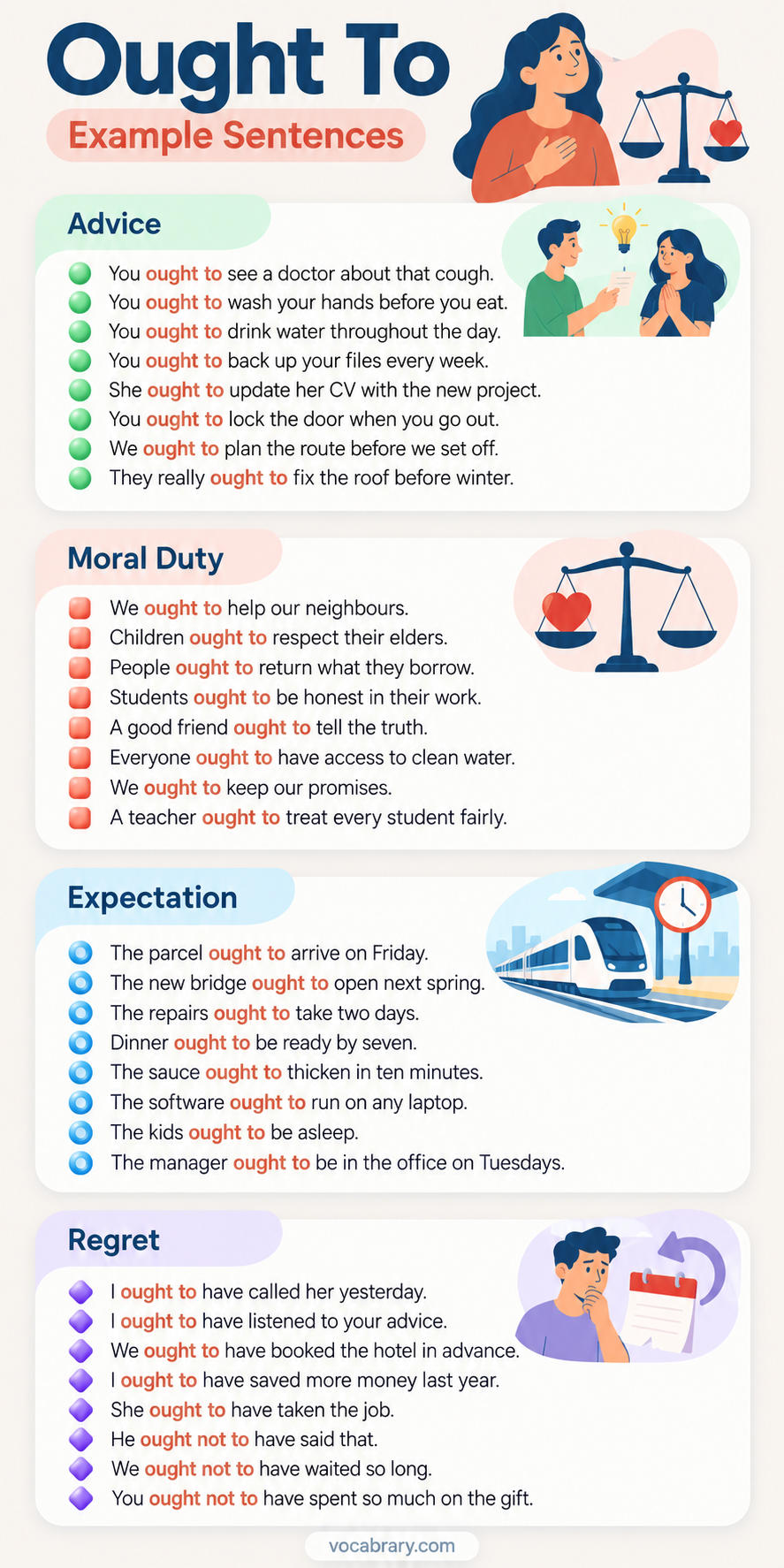
- Advice: You ought to see a doctor about that cough.
- Moral duty: We ought to help our neighbours.
- Expectation: The parcel ought to arrive on Friday.
- Advice against: You ought not to drive in this weather.
- Self-reminder: I ought to call my mother tonight.
- Regret: You ought to have told me earlier.
- Criticism: He ought not to have said that.
- Reproach: You ought to know better.
Ought to Example Sentences for Everyday Use
These sentences include advice, moral duty, self-reminders, expectation, etiquette, safety, opinion, emphasis, present activities, formal recommendations, advice against, regret, reproach, questions, passive forms, and reported speech.
- You ought to book a health check before the winter starts.
- Maya ought to ask her supervisor about the deadline for the thesis.
- You ought to set aside part of your salary each month.
- We ought to treat every colleague with respect.
- I ought to send Grandpa a birthday card this week.
- The bus ought to reach the terminal by half past nine.
- Guests ought to greet the host before they start eating.
- Riders ought to fasten their helmets before the trip.
- A fair society ought to look after its weakest members.
- You really ought to call your sister back.
- Dmitri ought to be sleeping at this hour.
- Employers ought to publish salary ranges in job advertisements.
- You ought not to open attachments from unknown senders.
- I ought to have thanked the organisers after the event.
- He ought not to have ignored the customer’s complaint.
- You ought to know better than to skip the safety briefing.
- Ought we to inform the neighbours about the party?
- The windows ought to be cleaned before the inspection.
- My aunt said we ought to leave before the traffic gets heavy.
Advice Sentences with Ought to
These sentences tell the listener which action the speaker thinks is right, from a medical visit to comparing prices and arriving early for an interview.
Ought to Sentences for Health and Habits
These sentences give health advice, such as sleep, food, exercise, or sunscreen.
- You ought to see a doctor about that cough.
- You ought to get more sleep.
- He ought to eat more vegetables.
- You ought to stretch before you run.
- She ought to take a break from the screen.
- You ought to wash your hands before you eat.
- They ought to cut down on sugar.
- You ought to rest your knee for a few days.
- You ought to wear sunscreen in the summer.
- He ought to visit the dentist twice a year.
- You ought to drink water throughout the day.
- She ought to talk to someone about the stress.
- You ought to keep a regular sleep schedule.
- We ought to start the day with a proper breakfast.
Ought to Sentences for Work and Study
These sentences give advice to colleagues and pupils, such as reading a contract, revising notes, or arriving early for an interview.
- You ought to read the contract carefully before you sign.
- You ought to ask your manager for feedback.
- She ought to apply for the position before Friday.
- You ought to back up your files every week.
- You ought to revise the notes the night before the test.
- He ought to speak to his tutor about the essay.
- You ought to arrive early for the interview.
- We ought to check the figures once more.
- You ought to keep a copy of every email.
- She ought to update her CV with the new project.
- You ought to plan the essay before you start writing.
- They ought to hire an assistant for the busy season.
- You ought to ask questions when something is unclear.
- He ought to practise the presentation out loud.
Ought to Sentences for Money and Daily Life
This advice names household decisions, such as comparing prices, saving each month, buying travel insurance, and locking the door.
- You ought to compare prices before you buy.
- She ought to save a small amount every month.
- You ought to check the weather forecast before the hike.
- They ought to buy travel insurance.
- You ought to lock the door when you go out.
- You ought to keep your receipts for a year.
- He ought to switch to a cheaper phone plan.
- You ought to take a jacket. It gets cold at night.
- We ought to leave early to avoid the traffic.
- You ought to reply to the landlord today.
- She ought to talk to the bank about the fee.
- You ought to read the reviews before you book the hotel.
- We ought to plan the route before we set off.
- You ought to exchange some money before you arrive.
Moral Duty Sentences with Ought to
These sentences state duties of fairness and kindness, such as helping neighbours, keeping promises, and treating people fairly.
- We ought to help our neighbours.
- Children ought to respect their elders.
- You ought to apologise to her.
- People ought to return what they borrow.
- Drivers ought to give way to pedestrians.
- Students ought to be honest in their work.
- You ought to thank him for his help.
- A good friend ought to tell the truth.
- Everyone ought to have access to clean water.
- Employers ought to pay their staff on time.
- We ought to keep our promises.
- You ought to tell your parents where you are going.
- Visitors ought to leave the room as they found it.
- We ought to look after the elderly in our community.
- A teacher ought to treat every student fairly.
- Citizens ought to vote in local elections.
- We ought to protect the places where wildlife lives.
- Rich countries ought to share their knowledge with poorer ones.
Self-Reminder Sentences with Ought to
Speakers name a task they have not yet done, such as calling a mother, renewing a passport, or visiting the dentist.
- I ought to call my mother tonight.
- I ought to finish this report before the meeting.
- We ought to leave now if we want to catch the train.
- I ought to remember to buy milk on the way home.
- I ought to get more sleep this week.
- We ought to talk to the landlord about the heating.
- I ought to renew my passport before the trip.
- I ought to write down the address before I forget it.
- We ought to be careful with the budget this year.
- I ought to visit the dentist soon.
- We ought to reply to the invitation by Friday.
- I ought to start saving money for the holiday.
- I ought to study harder for the next exam.
- We ought to find a solution before the end of the month.
Expectation Sentences with Ought to
These sentences state what the speaker expects, such as a parcel arriving, a person being home, or a train at the platform.
Ought to Sentences for Future Expectation
Future expectation names a planned event, such as a parcel arriving on Friday, a flight landing, or a meeting ending by noon.
- The parcel ought to arrive on Friday.
- The meeting ought to finish by noon.
- The new bridge ought to open next spring.
- The results ought to be ready in an hour.
- It ought to be a quiet weekend.
- The repairs ought to take two days.
- The flight ought to land on time.
- The update ought to install in a few minutes.
- Dinner ought to be ready by seven.
- The weather ought to improve tomorrow.
- The students ought to finish the exam before eleven.
- The new policy ought to save us a lot of time.
- The sauce ought to thicken in ten minutes.
- The concert ought to start at eight.
- The software ought to run on any laptop.
- The tickets ought to sell quickly.
Ought to Sentences for Present Expectation
Present expectation describes what the speaker believes is true now, such as a person being home by now, children being asleep, or keys being on the table.
- She ought to be home by now.
- The kids ought to be asleep.
- He ought to know the answer. He studied the topic.
- The keys ought to be on the kitchen table.
- They ought to be at the airport already.
- The manager ought to be in the office on Tuesdays.
- The printer ought to have enough paper.
- The train ought to be at the platform.
Etiquette Sentences with Ought to
These sentences describe polite behaviour, such as thanking a host, knocking before entering an office, and offering a seat to an elderly passenger.
- You ought to say thank you after a meal at someone’s home.
- Guests ought to arrive within fifteen minutes of the time on the invitation.
- You ought to knock before you enter a colleague’s office.
- Passengers ought to offer their seats to the elderly.
- You ought to reply to a wedding invitation promptly.
- Diners ought to wait until everyone has been served.
- You ought to keep your phone on silent in the theatre.
- A host ought to introduce new guests to the others.
- You ought to remove your shoes when you enter a Japanese home.
- Speakers ought to thank the audience at the end.
- You ought to bring a small gift when you visit someone for the first time.
- Colleagues ought to share the credit for a joint project.
- You ought to let others finish before you speak.
- Neighbours ought to warn each other about noisy events.
Safety Sentences with Ought to
Safety sentences name a precaution, such as wearing a helmet, testing a smoke alarm, or storing medicine out of reach of children.
- You ought to wear a helmet when you cycle.
- Workers ought to check the equipment before each shift.
- Hikers ought to tell someone their route before they leave.
- You ought to keep a first-aid kit in the car.
- Parents ought to store medicine out of reach of children.
- You ought to test the smoke alarm every month.
- Swimmers ought to avoid the water after a meal.
- Drivers ought to take a break every two hours.
- You ought to unplug the iron after use.
- Climbers ought to carry a rope and a whistle.
- You ought to keep the ladder on level ground.
- Cooks ought to wash their hands after handling raw meat.
- You ought to charge your phone before a long journey.
- Travellers ought to keep copies of their documents in separate bags.
Opinion Sentences with Ought to
These sentences state a position on how people and institutions act, as in sentences about education, journalism, public transport, and tax.
- Society ought to value care work as highly as other jobs.
- Education ought to prepare students for life, not only for exams.
- A just law ought to apply to everyone in the same way.
- Public transport ought to be affordable for all.
- Doctors ought to explain every treatment in plain language.
- Journalists ought to check their sources before they publish.
- Leaders ought to admit their mistakes.
- Cities ought to protect green space for future generations.
- Employers ought to respect the time workers spend with their families.
- The media ought to report on science with care.
- Every child ought to have the chance to learn a musical instrument.
- Consumers ought to know where their products come from.
- Technology ought to serve people, not replace them.
- Wealthy citizens ought to pay a fair share of tax.
Emphatic Advice Sentences with Ought to
These sentences add "really," "certainly," "definitely," or "at least," as in seeing a doctor, fixing a roof, or reading a contract.
- You really ought to see a doctor.
- You certainly ought to apologise.
- We really ought to leave before it gets dark.
- He definitely ought to take the offer.
- They really ought to fix the roof before winter.
- You ought at least to say hello.
- She ought at least to call and explain.
- You ought to at least read the contract.
- We ought really to ask for a second opinion.
- He ought surely to know the answer by now.
- You really ought not to eat that.
- They ought certainly to be told.
- I really ought to start exercising.
- You ought to try, at least once.
- You really ought to try the new restaurant.
Present Activity Sentences with Ought to
These sentences name what a person is expected to be doing at the moment, such as studying, sleeping, waiting at a gate, or training with a team.
- You ought to be studying, not playing games.
- The children ought to be sleeping by now.
- He ought to be working on the report.
- We ought to be leaving in five minutes.
- She ought to be resting after the operation.
- They ought to be waiting at the gate.
- You ought to be paying attention.
- The team ought to be training today.
- I ought to be calling the client.
- The trains ought to be running again by noon.
- He ought to be working, not watching television.
- The children ought to be doing their homework.
- You ought to be packing for the trip.
- We ought to be getting ready.
- She ought to be thanking you, not blaming you.
Formal Recommendation Sentences with Ought to
These sentences recommend an action for schools, banks, hospitals, and councils, as in a policy report.
- Schools ought to teach financial skills.
- Governments ought to protect public parks.
- Companies ought to publish their safety records.
- Hospitals ought to reduce waiting times.
- Applicants ought to read the guidelines before they apply.
- Employers ought to offer clear career paths.
- Banks ought to explain their fees in plain language.
- Researchers ought to share their data openly.
- Local councils ought to consult residents before building.
- Airlines ought to compensate passengers for long delays.
- Universities ought to support first-generation students.
- The committee ought to review the policy every year.
Advice Against Sentences with Ought Not to
These sentences tell the listener to avoid an action, such as driving in bad weather, sharing a password, or lifting a heavy box alone.
- You ought not to drive in this weather.
- You ought not to stay up so late.
- He ought not to drive when he is tired.
- You ought not to ignore the warning light.
- We ought not to wait until the last minute.
- You ought not to share your password with anyone.
- She ought not to walk home alone at night.
- You oughtn’t to touch the screen with wet hands.
- They oughtn’t to leave the food out in the sun.
- You oughtn’t to buy it without reading the reviews.
- We oughtn’t to spend all our savings on one trip.
- You oughtn’t to lift heavy boxes without help.
- He oughtn’t to take on any more projects.
- You ought not to answer an email when you are angry.
- We ought not to judge people by their first impression.
- You ought not to leave the oven on when you go out.
Regret Sentences with Ought to Have
These sentences state regret and criticism about past actions, such as a missed call, a late departure, or a shouted remark.
Ought to Have Sentences for Regret and Missed Actions
These sentences express regret about a missed call, a late departure, or ignored advice, and name similar misses by other people.
- I ought to have called her yesterday.
- I ought to have studied harder for the test.
- We ought to have left earlier.
- I ought to have listened to your advice.
- She ought to have told us about the problem.
- I ought to have taken a photograph.
- We ought to have booked the hotel in advance.
- I ought to have checked the address first.
- They ought to have asked for help.
- I ought to have saved more money last year.
- He ought to have apologised at once.
- We ought to have read the instructions first.
- You ought to have told me earlier.
- She ought to have taken the job.
- I ought to have said thank you.
- They ought to have planned for the delay.
Ought Not to Have Sentences for Criticism
These sentences criticise a past action, such as shouting at someone, taking a shortcut, or lying to someone.
- He ought not to have said that.
- You ought not to have shouted at him.
- I ought not to have eaten so much.
- We ought not to have waited so long.
- She ought not to have said that in public.
- They ought not to have left the door open.
- You ought not to have spent so much on the gift.
- He ought not to have driven in such weather.
- We ought not to have taken the shortcut.
- I ought not to have replied so quickly.
- You oughtn’t to have lied to her.
- They oughtn’t to have ignored the warning.
Reproach Sentences with Ought to Know Better
These sentences criticise a person for a careless act, such as trusting a stranger, leaving a door unlocked, or climbing onto a roof.
- You ought to know better than to trust a stranger.
- He ought to know better at his age.
- She ought to know better than to leave the door unlocked.
- Teenagers ought to know better than to post their passwords online.
- I ought to have known better than to lie to my parents.
- They ought to have known better.
- At forty, Marcus ought to know better than to ignore a contract.
- Adults ought to have known better than to cheat in a game with children.
- The manager ought to have known better than to send such a careless reply.
- Priya ought to know better than to open an unknown attachment.
- The twins ought to know better than to climb onto the roof.
Question Sentences with Ought to
These formal questions ask about the right action, such as calling someone, waiting for others, or paying for damage.
Ought to Sentences for Yes or No Questions
Yes or no questions ask whether an action is right, such as calling her now, bringing a gift, or telling the manager.
- Ought I to call her now?
- Ought we to wait for the others?
- Ought he to apply for the job?
- Ought the students to wear uniforms?
- Ought I to bring a gift?
- Ought they to leave now?
- Ought we to tell the manager?
- Ought she to see a doctor?
Ought to Sentences for Wh-Questions
These questions ask about a reply, a venue, a payment for damage, and a way to respond.
- What ought I to say?
- Where ought we to meet?
- When ought they to arrive?
- Who ought to pay for the damage?
- How ought we to respond?
- Why ought he to apologise?
Ought to Sentences for Short Answers
These answers reply to questions about calling someone, waiting outside, leaving early, and bringing flowers.
- Ought I to call her tonight? Yes, you ought to.
- Ought we to wait outside? No, we oughtn’t to.
- Ought he to apply this week? Yes, he ought to.
- Ought they to leave early? No, they ought not to.
- Ought she to see a specialist? Yes, she ought to.
- Ought I to bring flowers? No, you oughtn’t to.
Passive Sentences with Ought to
Passive sentences name the object of an action, such as a form to be signed, fees to be paid, or old batteries to be recycled.
- The form ought to be signed by a parent.
- The fees ought to be paid by Friday.
- The documents ought to be translated into English.
- Seat belts ought to be worn at all times.
- The door ought to be kept closed.
- Every sentence ought to be checked for errors.
- The report ought to be submitted before noon.
- Passwords ought to be changed every three months.
- The machine ought to be switched off after use.
- Children ought to be accompanied by an adult.
- The soup ought to be served hot.
- Old batteries ought to be recycled.
Reported Speech Sentences with Ought to
These sentences report what a doctor, a teacher, a manager, or a brother said, such as resting, reading a chapter, or staying on the path.
- She said I ought to see a doctor.
- He told us we ought to leave early.
- The teacher said the students ought to read the first chapter.
- My brother said I ought to apply for the job.
- The manager said we ought to finish the report by Friday.
- They told me I ought to bring a jacket.
- The doctor said I ought to rest.
- She said the train ought to arrive at six.
- He said we ought not to wait for him.
- The guide said we ought to stay on the path.
FAQs
The sentence "You ought to see a doctor about that cough" is a standard example of "ought to" for advice. The speaker advises the listener to visit a doctor. Other examples are "We ought to help our neighbours" and "The parcel ought to arrive on Friday."
You use "ought to" in a sentence to give advice, state a moral duty, or express an expectation. Typical sentences are "You ought to rest your knee for a few days" and "The flight ought to land on time." A first-person example is "I ought to call my mother tonight."
Example sentences with "ought to" for advice name an action that the speaker thinks is right for the listener. "You ought to read the contract carefully before you sign" is office advice, and "You ought to wear sunscreen in the summer" is health advice. A money example is "You ought to compare prices before you buy."
Moral duty sentences with "ought to" state what a good person, citizen, or neighbour does. "We ought to help our neighbours" and "Employers ought to pay their staff on time" are two models. "Citizens ought to vote in local elections" states a duty to the community.
Expectation sentences with "ought to" state what the speaker believes will happen or is true now. "The meeting ought to finish by noon" refers to the future, and "She ought to be home by now" refers to the present. Both sentences are based on a schedule or a routine.
Self-reminder sentences with "ought to" name a task that the speaker plans to do soon. "I ought to renew my passport before the trip" and "We ought to reply to the invitation by Friday" are two models. Each sentence states a pending task in the first person.
Sentences with "ought not to" tell the listener to avoid an action. "You ought not to share your password with anyone" and "She ought not to walk home alone at night" are two models. A contracted example is "You oughtn’t to buy it without reading the reviews."
Sentences with "ought to have" describe an action that was the right choice but did not happen. "I ought to have studied harder for the test" expresses personal regret, and "He ought not to have said that" expresses criticism. A regret about yesterday is "I ought to have called her yesterday."
Etiquette sentences with "ought to" describe polite behaviour, and safety sentences name a precaution. "You ought to knock before you enter a colleague’s office" is an etiquette example. "You ought to wear a helmet when you cycle" and "Drivers ought to take a break every two hours" are safety examples.
Questions with "ought" are formal and ask about the right action. "Ought I to call her now?" is a yes or no question, and "Where ought we to meet?" is a wh-question. Short answers are "Yes, you ought to" and "No, we oughtn’t to."

Leave a Comment