
Modals of deduction are modal verbs that express an inference about a present or past situation based on evidence, and their form never changes. These 338 modals of deduction example sentences are written for present certainty, impossibility, possibility, past events, continuous actions, detective clues, and questions, so you study each form in the situation where it is used. You use "must," "can’t," "might," and "could" to state conclusions in speech and writing, and practice with these example sentences improves your accuracy.
Quick Answer: Modals of Deduction Example Sentences
- Present certainty: She must be at home. The lights are on.
- Present impossibility: He can’t be at work. It is Sunday.
- Present possibility: They might be stuck in traffic.
- Probable inference: The train should be here by now.
- Past certainty: They must have left already.
- Past impossibility: She can’t have finished so quickly.
- Past possibility: He could have missed the bus.
- In progress: She must be working late.
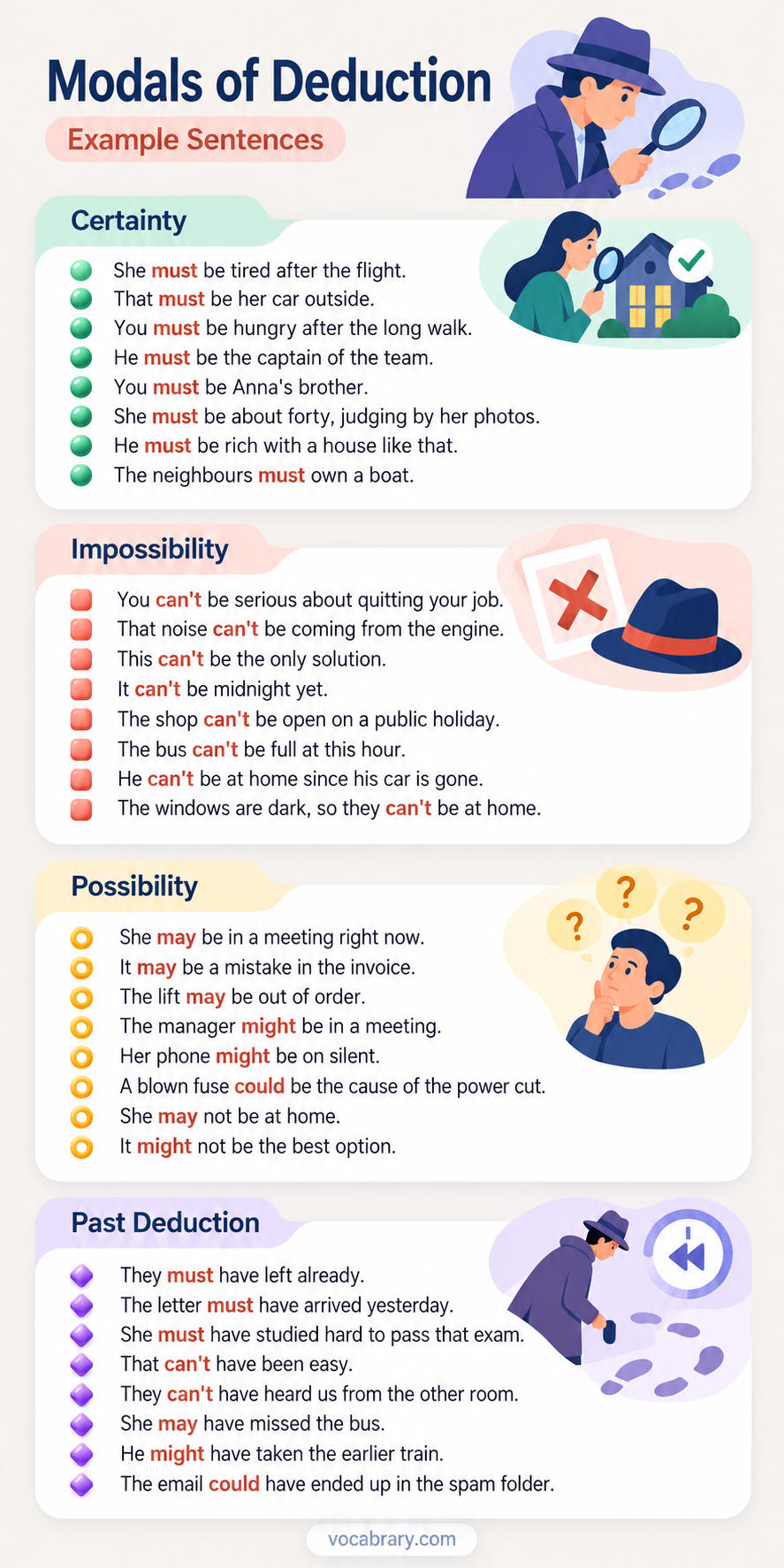
Modals of Deduction Example Sentences for Everyday Use
These sentences state inferences with "must," "can’t," "might," "may," "could," "should," and "will" about present and past situations, continuous actions, future events, questions, and passive sentences.
- Maria must be home because her bicycle is in the hallway.
- That can’t be Daniel’s coat. It is far too small for him.
- The bakery can’t be open at this hour. The shutters are down.
- Samira might be in the garden right now.
- The delay could be caused by the snow on the tracks.
- Your passport may be in the bottom drawer.
- The bus should be here in five minutes.
- That will be the courier ringing the bell.
- Kenji must be practising the violin. I can hear scales from his room.
- The Okafors must have left early, since their car is gone.
- Lucia can’t have read the whole novel in one evening.
- Someone might have borrowed my umbrella.
- The children must have been playing in the mud, judging by their clothes.
- The neighbours must be away on holiday.
- The man in the white coat must be a surgeon.
- The thief must have used the back door.
- Prices could fall next spring.
- Who could be knocking at this hour?
- Her lights are off, so she must be asleep.
- The window must have been broken during the storm.
Present Certainty Sentences with Must Be
These sentences state a firm inference about now from visible or audible evidence, such as a tired traveller, a quiet house, or a dark shop.
Must Be Sentences for States and Identities
These sentences name a state or a person, such as being tired after a flight, being the new manager, or being Anna’s brother.
- She must be tired after the flight.
- He must be the new manager.
- That must be her car outside.
- They must be very proud of their daughter.
- You must be hungry after the long walk.
- This must be the right address.
- It must be late. The streets are empty.
- He must be the captain of the team.
- There must be a mistake in the report.
- The baby must be asleep. The house is quiet.
- You must be Anna’s brother.
- That must be the reason for the delay.
- The soup must be ready. It smells wonderful.
- They must be at home. The lights are on.
- She must be about forty, judging by her photos.
- The meeting must be over by now.
- He must be rich with a house like that.
- The shop must be closed. There is no light.
Must Sentences for Habits and Preferences
These sentences state inferences about what a person owns, speaks, or does regularly, such as translating for an embassy, owning a boat, or driving long distances.
- He must know the answer. He has worked here for ten years.
- She must live nearby. She walks to work.
- They must have a big garden. I can hear the dog from here.
- You must work very hard to run a business like this.
- He must earn a lot of money in that job.
- She must speak four languages. She translates for the embassy.
- The neighbours must own a boat.
- You must enjoy your work. You always look cheerful.
- He must play the guitar. He has calluses on his fingers.
- They must want the contract. They have called three times.
- She must read a lot. Her shelves are full.
- The students must like the new teacher.
- He must drive a lot. The car has 200,000 kilometres on it.
- She must care about the project. She stayed until midnight.
Present Impossibility Sentences with Can’t Be
These sentences reject a possibility from evidence, such as an office on a Sunday, numbers that do not add up, or an unlikely age.
- He can’t be at work. It is Sunday.
- That can’t be right. The numbers don’t add up.
- She can’t be thirty. She looks twenty.
- You can’t be serious about quitting your job.
- This can’t be the correct address. There is nothing here.
- They can’t be twins. They look nothing alike.
- That noise can’t be coming from the engine.
- He can’t know about the surprise party. We told nobody.
- This can’t be the only solution.
- It can’t be midnight yet.
- You can’t be hungry. You just ate lunch.
- The answer can’t be wrong. I checked it twice.
- The pool can’t be closed. I can hear swimmers.
- It can’t be that easy to learn a language in a week.
- They can’t be in the building. The lights are off.
- That can’t be true. I saw him an hour ago.
- The shop can’t be open on a public holiday.
- She can’t be angry with you. She smiled all evening.
- That can’t be his sister. She is far too young.
- The bus can’t be full at this hour.
Present Possibility Sentences with Modals of Deduction
These sentences state that a situation is possible, as with a late train, a lost phone, or a software error.
May Be Sentences for Places and Problems
These sentences name a possible location or problem, such as a meeting, a closed shop on Mondays, or a train held up by a storm.
- She may be in a meeting right now.
- The shop may be closed on Mondays.
- This may be the right road.
- It may be a mistake in the invoice.
- The train may be delayed by the storm.
- Your phone may be in the other room.
- Dinner may be late tonight.
- The lift may be out of order.
Might Be Sentences for People and Situations
These sentences name a possible person or situation, such as a library visitor, a manager in a meeting, or a software error.
- She might be at the library right now.
- He might be the person we need.
- They might be waiting outside.
- The manager might be in a meeting.
- It might be a software error.
- Your keys might be in the car.
- The lecture might be cancelled.
- Her phone might be on silent.
Could Be Sentences for Causes and Faults
These sentences name a possible cause, such as a delay, a noise upstairs, or a fault in the wiring.
- That could be the reason for the delay.
- The problem could be a loose cable.
- The noise could be coming from the apartment upstairs.
- This could be the solution to our problem.
- A blown fuse could be the cause of the power cut.
- It could be a fault in the wiring.
- The rattle could be a loose panel.
- The smell could be coming from the drain.
May Not and Might Not Sentences for Doubt
These sentences state a chance of absence or untruth, such as a person not at home, a shut shop, or an answer missing from a page.
- She may not be at home.
- He might not know about the change.
- They may not be ready yet.
- The shop might not be open.
- It might not be the best option.
- The answer may not be on this page.
- The museum may not be open on Mondays.
- Their flight might not be on time.
Deduction Sentences with Should Be and Will Be
These sentences state an expected inference from a schedule or routine, and a confident guess about who or what is present.
Should Be Sentences for Probable Deduction
These sentences state expected situations, such as a train due now, a parcel due on Friday, or a road due in spring.
- The train should be here by now.
- She should be home by six.
- The shop should be open at this hour.
- He should know the answer. He studied the subject.
- The keys should be on the kitchen table.
- They should be at the airport already.
- The manager should be in the office on Tuesdays.
- The printer should have enough paper.
- She should be about fifty now.
- The meeting should be over by noon.
- The kids should be asleep by now.
- The results should be ready in an hour.
- The parcel should be here on Friday.
- The new road should be open by spring.
Will Be Sentences for Confident Deduction
These sentences name a person or an object from a sound or a routine, such as a postman at the door, hungry children, or a shop closed on Sunday.
- That will be the postman.
- This will be the book you wanted.
- He will be at work by now.
- You will be tired after the journey.
- That will be Tom at the door.
- The kids will be hungry.
- She will be in her office at this hour.
- The shop will be closed on Sunday.
- That will be the plumber you called.
- They will be waiting for us at the gate.
Continuous Sentences with Modals of Deduction
These sentences state inferences about what is happening now or was happening earlier, from evidence such as lights, noise, and closed doors.
Must Be Doing Sentences for Present Evidence
These sentences name an activity from evidence, such as a lit office, a closed door, or loud music.
- She must be working late. Her office light is on.
- They must be having dinner. Nobody answers the phone.
- He must be studying. The door is closed.
- The children must be playing outside. I can hear them.
- Someone must be using the shower. I can hear the water.
- She must be waiting for us at the station.
- It must be raining. Everyone has an umbrella.
- They must be celebrating. The music is very loud.
- He must be driving, since his phone is off.
- The workers must be repairing the road.
Might Be Doing Sentences for Possible Activities
These sentences guess at an activity with "might" and "could," such as a home office, a dinner in the kitchen, or a car trip.
- He might be working from home today.
- She might be sleeping at this hour.
- They might be playing football in the park.
- The children could be doing their homework.
- The doctor might be seeing another patient.
- My sister could be cooking dinner.
- The team might be rehearsing for the show.
- He could be driving, so don’t call.
Can’t Be Doing Sentences for Impossible Activities
These sentences rule out an activity, such as sleeping during a phone call or a shift in a closed office.
- He can’t be sleeping. I can hear him on the phone.
- She can’t be working. The office is closed.
- They can’t be waiting outside. It is pouring.
- You can’t be leaving already.
- The children can’t be studying with that noise.
- He can’t be joking about something like this.
Past Activity Sentences with Modals of Deduction
These sentences state inferences about what was in progress at a past time, such as a late shift, sleep during a call, or standing in the rain.
- She must have been working late. Her light was on.
- They must have been sleeping when we called.
- He might have been driving at the time.
- The children could have been playing outside.
- I must have been dreaming.
- She might have been waiting for us at the wrong entrance.
- The builders must have been drilling all morning.
- He could have been studying in the library.
- They can’t have been waiting long. Their coffees are still hot.
- She can’t have been sleeping. I heard her typing.
- He may have been joking.
- The neighbours might have been having a party.
- You must have been standing in the rain for an hour.
- The driver could have been texting.
Past Certainty Sentences with Must Have
These sentences state a firm inference about a finished event from present evidence, such as a missed bus, a burst pipe, or wet ground.
- They must have left already.
- She must have forgotten the meeting.
- He must have missed the bus.
- The letter must have arrived yesterday.
- You must have been very tired after the trip.
- Someone must have taken my umbrella.
- The shop must have closed early because of the holiday.
- He must have worked all night. His desk is covered with papers.
- They must have heard the news by now.
- She must have studied hard to pass that exam.
- The pipe must have burst during the night.
- I must have left my keys at the office.
- The team must have trained for months.
- It must have rained overnight. The ground is wet.
Past Impossibility Sentences with Can’t Have
These sentences rule out a past event from evidence, such as a coat left behind, a late train, or a parcel sent an hour ago.
- She can’t have finished already. She started ten minutes ago.
- He can’t have left. His coat is still here.
- They can’t have arrived yet. The train was late.
- You can’t have eaten the whole cake. It was enormous.
- The package can’t have arrived. I sent it an hour ago.
- He can’t have known about the plan. We told nobody.
- She can’t have been at the party. She was on holiday.
- That can’t have been easy.
- The bank can’t have made a mistake. I checked the balance twice.
- They can’t have heard us from the other room.
- He can’t have lost the keys here. We searched the house.
- She can’t have forgotten. I reminded her twice.
Past Possibility Sentences with Might Have
These sentences state that a past event is possible, as with a missed bus, lost keys, or a changed mind.
May Have Sentences for Missed Events
These sentences guess at a missed bus, a forgotten meeting, a letter sent to the wrong address, lost keys, and a missed deadline.
- She may have missed the bus.
- He may have forgotten the meeting.
- They may have left already.
- The letter may have gone to the wrong address.
- I may have lost my keys at the station.
- The team may have missed the deadline.
Might Have Sentences for Changed Plans
These sentences guess at a changed mind, an earlier train, getting lost, and a delayed package.
- She might have changed her mind.
- He might have taken the earlier train.
- They might have got lost on the way.
- The package might have been delayed by the storm.
- I might have left the window open.
- The manager might have forgotten to send the email.
Could Have Sentences for Possible Causes
These sentences name a possible cause of a past event, such as a noise from a neighbour’s flat, a delay from the weather, or an email in the spam folder.
- She could have gone home early, since her desk is empty.
- The noise could have come from the neighbour’s flat.
- He could have left the keys in the car.
- They could have been delayed by the weather.
- The damage could have happened during the move.
- The email could have ended up in the spam folder.
Might Not Have Sentences for Past Doubt
These sentences state a chance that a past event did not happen, such as a message not received, a sign not seen, or a door not locked.
- She may not have received the message.
- He might not have seen the sign.
- They may not have known about the change.
- The email might not have reached him.
- I might not have locked the door.
- He might not have understood the question.
Sensory Clue Sentences with Must Be
These sentences state inferences from sounds, smells, and touch, such as a siren, smoke, or frost on the windows.
- That must be a siren.
- Something must be burning. I can smell smoke.
- It must be cold outside. The windows are covered in frost.
- That sound must be the washing machine.
- The cake must be done. The kitchen smells of vanilla.
- Someone must be playing the piano upstairs.
- The floor must be wet. It feels slippery.
- That must be thunder.
- The milk must have gone off. It smells sour.
- The neighbours must be cooking. I can smell garlic.
- The engine must be overheating. I can hear a hissing noise.
- That must be a truck. The noise is too deep.
- Someone must have been smoking in here.
- The heating must be on. The room feels warm.
Job and Feeling Sentences with Must Be
These sentences state inferences about people from clothes, behaviour, and words, such as a white coat, a guitar case, or a silent day.
- He must be a teacher. He talks about students all the time.
- She must be a doctor. She is wearing a white coat.
- He must be very proud of his work.
- She must be shy. She never speaks in meetings.
- They must be good friends. They finish each other’s sentences.
- He must be a pilot, judging by his uniform.
- She must be a student. She is carrying a lot of books.
- He must be the manager. The staff stand up when he enters.
- She must be upset. She hasn’t said a word all day.
- They must be tourists. They are taking photographs of every building.
- He must be a musician. He has a guitar case.
- You must be an engineer. You are wearing a hard hat.
- She must be disappointed about the news.
- He must care a lot about his team.
Detective Story Sentences with Modals of Deduction
These sentences state a detective’s inferences from clues, such as a broken window, a stopped clock, and a door left ajar.
- The thief must have entered through the window. The glass is broken.
- The butler can’t have done it. He was in the kitchen all evening.
- Someone must have known the safe combination.
- The footprints might belong to a child.
- The letter could have been written by anyone in the house.
- The killer must have left in a hurry. The door is still open.
- The clock can’t be right. It stopped at midnight.
- The key must have been copied.
- She might have been lying about her alibi.
- The suspect can’t have crossed the river without a boat.
- The lamp must have been moved. There is a mark on the table.
- He could have escaped by the back stairs.
Logic Deduction Sentences with Must and Can’t
These sentences state inferences from numbers and facts, such as sums that do not add up, an expired ticket, or a two-hour trip on foot.
- The total can’t be fifty. The parts add up to forty.
- The answer must be even. Both numbers are even.
- The distance must be about ten kilometres. The walk took two hours.
- The shop can’t have made a profit with those prices.
- The package must weigh more than five kilograms. The courier charged extra.
- She must be older than her brother. She started school first.
- The recipe must serve six. It calls for a dozen eggs.
- The flight can’t have taken less than nine hours.
- The bill must include tax. The total is higher than the menu prices.
- It can’t be a prime number. It is divisible by three.
- The battery must have charged overnight. It shows one hundred percent.
- The ticket can’t be valid. It expired last year.
Future Prediction Sentences with Modals of Deduction
These sentences predict what happens next, such as a train arrival, a dry weekend, or a meeting that ends at noon.
- The train will arrive at six.
- The meeting should finish by noon.
- It could snow in the mountains.
- The prices may fall next year.
- The parcel will reach us by Thursday.
- The match might finish late.
- She will probably accept the offer.
- He should pass the test with this much practice.
- The tickets could sell out by Friday.
- It should stay dry this weekend.
- They could announce the results on Friday.
- The ferry might not run in this wind.
- The new bridge should open before winter.
- The guests will arrive before eight.
Question Sentences with Could and Might
These sentences ask for a guess about a situation, such as a visitor at the door, a noise from the roof, or lost keys.
Yes or No Question Sentences with Could and Might
These sentences ask whether a guess is true, such as the caller being the postman or the keys being in the car.
- Could that be the postman?
- Might he have forgotten the meeting?
- Could it be true?
- Could she be waiting at the wrong entrance?
- Could the keys be in the car?
- Might the shop be closed?
- Could this be the right address?
- Could they have missed the train?
- Could the noise be coming from the roof?
- Might she have taken the wrong bus?
Wh-Question Sentences with Could and Might
These sentences ask who, what, where, why, how, or which, such as who is at the door or where the keys were left.
- Who could that be at this hour?
- What could be causing the noise?
- Where might she have left her keys?
- Why might he have said that?
- Who might be at the door?
- Where could they have gone?
- What might have happened to the package?
- How could they have missed the sign?
- Who might have left the door open?
- Which of them could have sent the letter?
Evidence Sentences with Must and Can’t
These sentences give an inference and its evidence with "because," "since," and "judging by," as in empty desks, a warm oven, or a dark window.
- She must be tired because she travelled all night.
- He can’t be at home since his car is gone.
- They must have left, judging by the empty desks.
- It must be late as the streets are empty.
- The door is open, so someone must be inside.
- From the look of the sky, it might rain.
- Judging by his accent, he must be from Scotland.
- The windows are dark, so they can’t be at home.
- There are footprints here. Someone must have walked through.
- The oven is still warm, so she must have baked this morning.
- Since the phone is off, he might be on a plane.
- The roads are empty, which means it must be very early.
Conversation Sentences with Modals of Deduction
These exchanges state a clue and an inference, such as a dark shop, a missing car, or an unanswered phone.
- "The lights are on," Ana said. "They must be at home," Ben replied.
- "Nobody answers the phone," Carla said. "They might be out," Dev answered.
- Emma remarked, "His car is gone." Farid agreed, "He can’t be at home."
- "She hasn’t replied for two days," Grace said. "She could be on holiday," Hugo suggested.
- "I smell smoke," Isla said. "Something must be burning," Jon replied.
- Kira said, "He looks exhausted." Leo added, "He must have worked all night."
- "The shop is dark," Maya noticed. "It must be closed," Noah guessed.
- "The package hasn’t arrived," Olga said. "It might have been delayed," Pablo answered.
- Quinn said, "She isn’t at her desk." Rosa replied, "She may be in a meeting."
- "Their flight landed an hour ago," Sam said. "They should be here soon," Tara answered.
- "The light in his office is off," Uma said. "He must have gone home," Victor replied.
- Wendy said, "Her coat is still on the chair." Xavier agreed, "She can’t have left yet."
Passive Sentences with Modals of Deduction
These sentences state inferences about what was done to an object, such as a letter sent, a painting stolen, or a room cleaned.
- The letter must have been sent yesterday.
- The window might have been left open.
- The file could have been deleted by mistake.
- The painting must have been stolen during the night.
- The decision can’t have been made without a vote.
- The accident could have been caused by ice on the road.
- The room must have been cleaned this morning.
- The last tickets may have been sold by now.
- The error might have been caused by the update.
- The report must have been written by an expert.
- The invitations should have been sent by now.
- The bridge can’t have been built in a year.
FAQs
A standard example of a modal of deduction is "She must be tired after the flight," which states an inference from the traveller’s situation. The word "must" expresses near certainty in this sentence. Other examples are "He can’t be at work" and "Samira might be in the garden right now."
You use "must be" in sentences that state a firm inference about the present. "That must be her car outside" names an object, and "You must be hungry after the long walk" describes a state. "She must be working late" describes an action in progress.
Sentences with "can’t be" reject a possibility on the basis of evidence. "This can’t be the correct address" describes a street with nothing on it, and "She can’t be thirty" describes a person who looks twenty.
These sentences state that a situation is possible, such as a person at a library or a reason for a delay. "She might be at the library right now" and "That could be the reason for the delay" are two models. The negative forms "She may not be at home" and "The shop might not be open" state a chance of absence.
Sentences with "should be" state an expected inference from a schedule or a routine. "The train should be here by now" and "She should be home by six" are two models. "The kids should be asleep by now" and "The results should be ready in an hour" are two more.
Sentences with "will be" name a person or an object with confidence. "That will be the postman" and "That will be Tom at the door" name a person at the door. "The kids will be hungry" states a confident guess about people.
These sentences name an activity that is in progress, based on evidence such as a light or an umbrella. "She must be working late" is based on an office light that is on, and "It must be raining" is based on people carrying umbrellas. A past example is "They must have been sleeping when we called."
Sentences with "must have" state a firm inference about a finished event. "They must have left already" and "The pipe must have burst during the night" are two models. In "It must have rained overnight," the evidence is wet ground outside.
Sentences with "can’t have" rule out a past event from evidence. "She can’t have finished already" and "They can’t have arrived yet" are two models. The first is based on a start ten minutes ago, and the second on a late train.
These sentences state that a past event is possible without proof. "She might have changed her mind" and "The noise could have come from the neighbour’s flat" are two models. "She may not have received the message" states a chance that something did not happen.

Leave a Comment