
Used to is a verb form that names a past habit or a past state that has stopped, as in we used to walk to school through the woods. Most used to example sentences pair a finished routine with the change that ended it, starting with the everyday ones learners repeat first.
What Is Used To?
Used to marks a habit or a state that ran across a stretch of past time and then ended, which is why the sentence hints at a different present. Be used to and get used to mean something else, being familiar with something, and they take an -ing form or a noun after to.
Subject + used to + base verb (Did + subject + use to + base verb)
Priya used to cycle to the market before the new bus route opened.
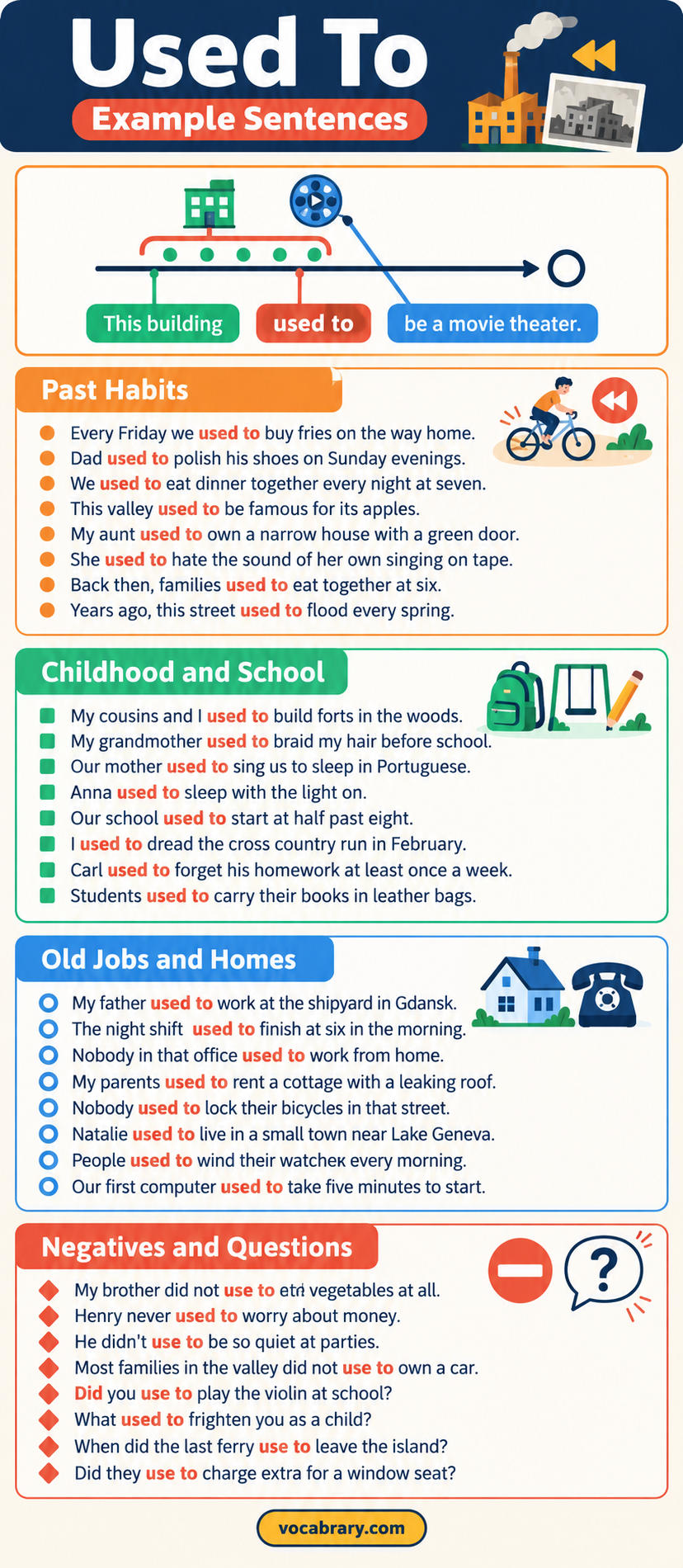
Common Used To Example Sentences
A newspaper round before school, a grandmother’s Sunday phone call, and a corner shop that shut last year fill most used to example sentences, where a finished routine meets the change that ended it.
- I used to deliver newspapers before school every morning.
- My grandmother used to phone us every Sunday at six.
- There used to be a corner shop at the end of our street.
- Daniel used to smoke, but he gave up three years ago.
- We used to walk to the market together.
- She used to have long hair.
- Before the motorway opened, buses used to take four hours to reach the coast.
- They used to rent a flat over a bakery in Lyon.
- Our teacher used to read to us for ten minutes at the end of every lesson.
- Farid used to work nights at the hospital.
- This building used to be a cinema.
- I used to hate olives.
- Cars used to park on both sides of the square until the council changed the law.
- My sister used to collect stamps from every country her pen friends wrote from.
- People used to write letters by hand.
- Karim used to run marathons in his twenties.
- That pond used to freeze hard enough for skating.
- Every winter we used to visit my aunt in Krakow.
- He used to be afraid of dogs.
- The old mill used to grind flour for the whole valley.
Used To in Affirmative, Negative, and Question Form
One swimmer, Hana, and her early morning swim show all three forms of the verb. The plain statement keeps used to, while the negative and the question drop the d after did and leave use to.
| Form | Pattern | Example sentence |
|---|---|---|
| Affirmative | Subject + used to + base verb | Hana used to swim before work. |
| Negative (full) | Subject + did not use to + base verb | Hana did not use to swim before work. |
| Negative (short) | Subject + didn’t use to + base verb | Hana didn’t use to swim before work. |
| Negative (never) | Subject + never used to + base verb | Hana never used to swim before work. |
| Question | Did + subject + use to + base verb | Did Hana use to swim before work? |
| Wh question | Wh word + did + subject + use to + base verb | When did Hana use to swim? |
| Subject question | Who + used to + base verb | Who used to swim with Hana? |
| Short answer | Yes/No + subject + did/didn’t | Yes, she did. |
Affirmative Sentences With Used To
A tram past the old library, a father baking bread on Saturdays, and a pool open until ten give the statement form, with the subject first and the base verb straight after used to.
- A tram used to run past the old library.
- My father used to bake bread every Saturday morning.
- The pool used to stay open until ten at night.
- Lucia used to sing in a church choir in Naples.
- We used to own a green van with a broken radio.
- Tom used to cut his own hair.
- Both my cousins used to study in Manchester before the family moved south.
- Winters used to bring so much snow that the school shut for a whole week.
- You used to call me every evening without fail.
- Our dog used to sleep under the kitchen table.
- Grandpa used to mend watches for the whole street.
- I used to believe that story about the lake.
- Trains from the village used to leave twice a day and never on time.
- That cafe used to serve the best almond cakes in town.
Negative Sentences With Did Not Use To
Coffee before university, a brother who refused vegetables, and a town with no traffic lights turn the form negative, where did not and didn’t leave the verb as use to.
- Nadia didn’t use to drink coffee before she started university.
- My brother did not use to eat vegetables at all.
- We didn’t use to lock the front door in that village.
- This town did not use to have traffic lights.
- Hassan never used to worry about money.
- I didn’t use to enjoy long walks in the rain.
- Trains didn’t use to run on Sundays.
- She never used to answer the phone after nine.
- Our parents did not use to let us watch television on school nights, however loudly we complained.
- He didn’t use to be so quiet at parties.
- Football never used to interest me until my daughter joined a club.
- You didn’t use to mind the noise from the main road.
- Beata did not use to speak a word of Spanish before her exchange year.
- The bakery never used to open on Mondays.
- They didn’t use to charge for parking here.
- Most families in the valley did not use to own a car.
Question Sentences With Did You Use To
A violin at school, a motorbike, and a ferry timetable turn the form into a question, where did takes the tense and the verb stays as use to.
- Did you use to play the violin at school?
- Where did your family use to spend the summer?
- So did Marta use to work in the same office as you?
- What used to frighten you as a child?
- How many hours a day did she use to practise?
- Didn’t he use to own a motorbike?
- Which school did the twins use to attend?
- Did your grandparents use to keep chickens in the yard?
- When did the last ferry use to leave the island?
- Who used to have the desk by the window?
- Why did people use to boil milk before putting it in the fridge for their children?
- Tell me, did it use to snow this early in November?
- What time did the market use to open on Fridays?
- Honestly, did they use to charge extra for a window seat?
Short Answers With Did and Didn’t
A pigeon racer, a hotel receptionist, and a milk round give the short replies, where did and didn’t answer alone and used to returns in the sentence that follows.
- Did you use to smoke? Yes, I did.
- Did your uncle use to race pigeons? No, he didn’t, but his neighbour did.
- Yes, she did, because she used to manage the front desk at that hotel.
- Yes, we did, and our garden used to reach as far as the old fence.
- No, they didn’t, though they used to travel across Europe by coach every August with two children and a heavy tent.
- No, I didn’t, but my brother used to deliver milk before dawn.
- Didn’t Sam use to teach here? Yes, he did, for eleven years.
- So did I, because I used to catch the same early train from Bristol.
- Neither did we, although the shop used to stay open late on Thursdays.
- Of course they did, since the whole street used to gather for the summer fair.
Used To for Past Habits
A postman whistling along the road, Friday chips on the walk home, and a weekly visit to the video shop make the habit sentences, where an action repeated for years and then ended.
- Every Friday we used to buy chips on the way home.
- My mother used to hang the washing outside whenever the sun came out.
- The postman used to whistle the same tune along our road.
- Jorge used to train with the city team twice a week.
- I used to read two novels a month before the baby was born.
- They used to rent films from the video shop on Saturday nights.
- Our class used to line up in the playground before the bell.
- Sofia used to call her sister in Lima every Sunday afternoon.
- We used to swim in the river until the water turned brown with silt.
- He used to cycle eleven miles to the factory in all weather.
- Dad used to polish his shoes on Sunday evenings.
- Villagers used to gather at the well before the pipes reached the houses.
- At sixteen I used to stay awake half the night writing songs.
- She used to feed the neighbourhood cats.
- During harvest the whole family used to work in the fields from dawn until dark.
- Kemal used to pray at the mosque near the market before he moved north.
Used To for Past States That Changed
Long hair, a fear of the dark, and a house with a green door make the state sentences, where used to joins be, have, know, or like and nothing repeats at all.
- This valley used to be famous for its apples.
- Omar used to have a beard down to his chest.
- I used to know every street name in that city.
- There used to be two bakeries on the square.
- My aunt used to own a narrow house with a green door.
- We used to be neighbours.
- Hospitals used to be far smaller than the enormous ones of today.
- Ines used to like horror films until she watched one alone at midnight.
- You used to be the quietest child in the family.
- That road used to be a muddy track.
- Amir used to weigh a great deal more before his illness.
- The garden used to stretch all the way down to the river.
- Books used to cost less than a loaf of bread in that country.
- She used to hate the sound of her own singing on tape.
Used To in Childhood Memories
Climbing an apple tree, sharing one bicycle with a bent wheel, and Saturday cartoons in pyjamas make the childhood sentences, where an adult looks back at a routine that ended with school.
- As a boy, Peter used to climb the apple tree behind the shed.
- My cousins and I used to build dens in the woods.
- We used to ride one bicycle between three of us because the wheel was bent.
- Sabrina used to hide sweets under her pillow.
- I used to watch cartoons every Saturday morning in my pyjamas.
- Children used to play in the street until the lamps came on.
- My grandmother used to braid my hair before school.
- He used to be terrified of the dark cupboard on the landing.
- Every summer we used to stay at my uncle’s farm near Cork.
- Anya used to keep a diary with a tiny brass lock.
- The twins used to swap clothes to confuse their teachers.
- On rainy afternoons I used to draw maps of countries that never existed, with rivers and railways marked in red ink.
- Our mother used to sing us to sleep in Portuguese.
- Boys in my street used to race trolleys down the hill on old pram wheels.
Used To in School Days
A Friday spelling test, fountain pens in the top class, and a bell that rang twice before assembly make the school sentences, where the rules of one classroom have long since gone.
- Our school used to start at half past eight.
- Mrs Doyle used to give a spelling test every Friday.
- We used to write with fountain pens in the top class.
- I used to dread the cross country run in February.
- Pupils used to rise whenever a teacher entered the room.
- The bell used to ring twice before assembly.
- Karim used to forget his homework at least once a week.
- Lunch used to cost thirty pence.
- My best friend used to save me a seat at the back of the bus.
- Teachers used to write school reports by hand at the end of every term.
- Before the new hall opened, exams used to take place in the gym.
- She used to play netball for the county while she was still at school.
Used To for Old Jobs and Workplaces
Shipyard workers, a busy call centre, and a night shift that ended at six give the work sentences, where a job or a workplace routine finished long before today.
- My father used to work at the shipyard in Gdansk.
- Before she retrained, Ella used to answer calls in a busy call centre.
- Factories along the canal used to employ half the town.
- I used to wait tables in a hotel by the sea.
- Our manager used to print every email and file it in a cabinet.
- Ravi used to drive a delivery van across three counties.
- The night shift used to finish at six in the morning.
- We used to clock in with a paper card at the gate.
- Sara used to teach geography before she opened the bookshop.
- Miners in this valley used to walk to the pit head in the dark and come home black with coal dust.
- He used to earn more as a plumber than he earns today as a manager.
- Nobody in that office used to work from home.
Used To for Places People Lived
Riga, a cottage with a leaking roof, and a flat over a barber shop make the address sentences, where used to marks a home the speaker has left behind.
- We used to live on the third floor of an old building near the station.
- Anton used to live in Riga before his family moved to Sweden.
- My parents used to rent a cottage with a leaking roof.
- They used to have a flat overlooking the harbour in Split.
- I used to share a house with four students in Leeds.
- Her grandparents used to farm a small plot of land in Kerala.
- Before the war, thousands used to live in the old quarter, and only a few families remain there today.
- Nobody used to lock their bicycles in that street.
- The family used to move every two years for my mother’s job.
- We used to fetch water from a pump at the end of the lane.
- Dilan used to live over his uncle’s barber shop.
- Neighbours used to leave their doors open all summer long.
Used To With Old Technology and Old Prices
Cassette tapes, watches wound by hand, and one telephone in the hallway give the sentences about what has gone, and old prices such as bread and petrol work the same way.
- People used to wind their watches every morning.
- We used to record songs from the radio onto cassette tapes.
- A phone call to another country used to cost a fortune.
- My uncle used to develop his photographs in a dark room at home.
- Letters used to take a fortnight to reach Australia.
- Bread used to cost a few pence when my grandmother married.
- Computers used to fill an entire room at the university.
- I used to keep a paper map in the glove compartment.
- Television used to finish at midnight with the national anthem, and the screen turned to grey static afterwards.
- You used to queue at a public telephone in the rain.
- Petrol used to be under a pound a litre.
- Our first computer used to take five minutes to start.
- Newspapers used to arrive through the door before breakfast.
- Families used to share one telephone in the hallway.
Used To for Food Habits That Changed
Three spoons of sugar in a cup of tea, instant noodles for a year abroad, and a plate of bitter olives make the food sentences, where a taste or an eating routine changed for good.
- I used to skip breakfast every single morning.
- My father used to put three spoons of sugar in his tea.
- We used to eat meat at every meal before the doctor spoke to us.
- Lina used to hate mushrooms as a child.
- Nobody in our house used to drink water from a bottle.
- He used to live on instant noodles during his first year abroad.
- Sunday dinner used to last three hours at my grandmother’s table.
- They used to bake their own bread every Tuesday.
- Olives used to taste bitter to me.
- Before she went vegan, Marta used to order steak whenever she ate out.
- Children used to drink milk from small bottles at morning break.
- Our neighbours used to preserve tomatoes in glass jars for the winter, and the shelves in their cellar were full by September.
Used To for Sports and Hobbies Given Up
A chess board on Sunday, ballet six days a week, and cycling races cut short by an accident make the hobby sentences, where used to marks the year the speaker gave up.
- Tomas used to wrestle at a club over the bus garage.
- I used to play chess against my grandfather every Sunday.
- She used to dance ballet six days a week.
- My brother used to collect model aeroplanes.
- We used to climb in the Pyrenees before his knee gave out.
- Grandma used to knit jumpers for all eleven grandchildren.
- They used to fish from the pier at first light.
- Hugo used to ride in local cycling races until an accident ended it.
- Amira used to play the flute in a youth orchestra.
- Our team used to train on a muddy field behind the church.
- He used to swim competitively, and his medals are still in a drawer.
- Yusuf used to paint watercolours before the shop took all his hours, and the brushes dried out in a jar.
Used To With Time Expressions
When I was young, back then, and in those days are the phrases that open a used to sentence and fix it in a stretch of past time that has closed.
- When I was young, I used to believe every word of that song.
- Back then, families used to eat together at six.
- In those days, farmers used to cut the hay by hand.
- Years ago, this street used to flood every spring.
- As a teenager, Nour used to argue with her father about music.
- Before the bridge was built, we used to cross the water by ferry.
- Football crowds in the 1980s used to watch the whole match standing up.
- At university, Paolo used to survive on four hours of sleep.
- Once upon a time, the postman used to come twice a day.
- During the winter months, the family used to sleep in one warm room.
- When she was a nurse, my mother used to work every other weekend and sleep through most of Sunday.
- Weddings in my grandfather’s time used to last three days.
Used To and Would for Repeated Past Actions
A grandfather with the same Christmas story, a beach visited every August, and a dog at the gate take used to and would together, since both name an action repeated across past years.
- My grandfather used to tell stories by the fire, and he would repeat the same one every Christmas.
- Dad used to whistle, and the dog would howl.
- We used to spend August at the same beach, and we would swim before breakfast.
- Every evening our dog used to wait at the gate, and she would bark at the postman.
- Sara used to cook on Sundays, and the whole family would arrive at noon.
- In winter the lake used to freeze, and children would skate across it until dusk.
- I used to work in a bakery, and I would light the ovens at four in the morning.
- They used to run a fair in the square, and farmers would come from three valleys.
- Ahmed used to drive at night, and he would stop at the same roadside cafe.
- Before the mill closed, a whistle used to sound at six, and the whole town would wake.
- She used to walk the cliff path, and her sister would follow with the dog.
- As students we used to argue about politics, and the arguments would last until dawn.
Used To and Be Used To in the Same Sentence
Used to names a habit that stopped, while be used to and get used to name a familiarity that grew. An early shift, a motorway drive, and tea without sugar take both forms in one sentence, and be used to and get used to example sentences go further with the second one.
- I used to hate mornings, and I am used to them now.
- Rafael used to panic in heavy traffic, and he has got used to the motorway at last.
- We used to dread the winter here, though we are used to the cold after four years.
- She used to find the accent hard, and she is used to it now.
- My father used to cook everything in butter, and he is still not used to olive oil.
- They used to live in a quiet village, so they are not used to city noise at night.
- Ayesha used to write with her right hand and never got used to the change.
- Our dog used to bark at the postman, and he has got used to him since.
- Students at this college used to hand in paper essays, and their teachers are now used to marking everything on a screen.
- I used to drink tea with sugar, and my tongue is used to the bitter taste today.
- Did you use to find night shifts hard before you got used to them?
- He used to miss his family badly, yet he never got used to living alone.
- Winters in Helsinki used to shock her, and she is thoroughly used to them now.
Then and Now in One Used To Sentence
Twenty cigarettes a day against a morning run, a shy boy against a drama teacher, and thirty pence against three pounds put the past half and the present half in one sentence.
- I used to smoke twenty a day, but now I run five kilometres before work.
- This street used to be quiet, and today lorries pass every minute.
- Nadia used to hate flying, yet she now works as cabin crew.
- Trams used to run here, and buses do the same work now.
- My father used to weigh ninety kilos, though he is far lighter since his operation.
- Letters used to take a week, while a message now arrives in a second.
- He used to be the shyest boy in the class, and he now teaches drama to teenagers.
- Our village used to have three shops, and only the chemist remains.
- Marina used to speak no English at all, and she now writes her own reports in it without a dictionary beside her.
- Coffee used to cost thirty pence in this market, and the same small cup is nearly three pounds today.
- They used to walk everywhere, but a car does those trips now.
- Public speaking used to frighten me, and today I teach a class of forty.
Short Used To Sentences for Kids and Beginners
A cat, a red hat, a blue bicycle, and a park slide keep these sentences to five or six words, so a young learner hears the form once and repeats it without trouble.
For Kids
A baby photograph, short hair, and a slide in the park give the smallest sentences, each with one bold used to and nothing after it to slow a child down.
- I used to be a baby.
- My hair used to be short.
- We used to have a cat.
- He used to cry a lot.
- She used to love pink shoes.
- Our house used to be smaller.
- They used to play here.
- The park used to have a slide.
- You used to wear that red hat.
For Young Learners
A blue bicycle, a grandmother walking to school, and a shop that sold sweets give beginners six word sentences they say aloud in one breath.
- Grandma used to walk to school.
- My bicycle used to be blue.
- We used to live near the sea.
- Dogs used to sleep in the yard.
- I used to eat rice every day.
- Sam used to sing in class.
- That shop used to sell sweets.
- Books used to cost one coin.
- She used to wake up early.
Used To in a Short Paragraph
A railwayman named Elias, a two mile walk to the depot, and a Sunday table with eleven plates make one paragraph where nearly every sentence takes used to or its negative.
Grandpa Elias used to work on the railway, and his day used to start before the sun. He used to walk two miles to the depot in boots that leaked. My grandmother used to pack him bread and cheese in a tin. They didn’t use to own a car, and nobody on the street used to mind. Every Sunday the whole family used to eat together, and the children used to wash the plates afterwards. The railway closed in 1987, the depot is a supermarket today, and Elias never used to imagine such a thing.
Related
FAQs
After did, the correct spelling is use to without the d, because did already marks the past tense. Write Did you use to live here? and She didn’t use to eat fish, never did used to. The d returns the moment did disappears, as in She used to eat fish, and do does did example sentences show did at work with other verbs.
Used to is proper English and suits formal writing as much as speech, and every major dictionary treats it as a standard past form. Newspapers, textbooks and examiners all accept this town used to have three shops. The rule to watch in writing is the missing d after did and didn’t.
Used to and be used to differ in meaning: used to names a past habit that stopped, while be used to names familiarity with something that continues. I used to work nights reports a finished routine, and I am used to working nights reports comfort with a present one. Be used to and get used to take an -ing form or a noun after to, never a base verb.
Used to and would overlap for repeated past actions, and they differ over past states. Both fit every summer we used to swim and every summer we would swim, yet only used to fits there used to be a bakery here. Would with a state verb such as be, have or know is wrong.
Used to is not a tense of its own but a past form built from the verb use plus a to-infinitive, and grammar books treat it as a semi-modal. It behaves like a past tense in questions and negatives, where did takes the tense and leaves use to behind. English has no present version of it at all.
Used to has no present form, so a present routine takes the present tense instead, as in She cycles to work every day. English keeps be used to and get used to for present time, though those two mean familiarity rather than habit. I am used to the cold names a state today, while I used to be cold names a past one.
A sentence takes used to when a past action repeated across a stretch of time or a past state lasted for years, and it takes the plain past tense for one finished event. I used to visit Rome reports a habit, while I visited Rome in 2019 reports a single trip. A date or a marker such as last Tuesday rules used to out, and tense sentences examples put the past forms next to one another.
A did you use to question takes a short answer with did or didn’t, exactly as any other past question does: Yes, I did or No, I didn’t. The full form returns in the sentence after it, as in Yes, I did, and I used to practise every evening. Repeating use to inside the short answer is wrong.
Never used to keeps the d, because never is not did and nothing else in that sentence marks the past tense. Write He never used to worry about money, and keep use to for sentences with did or didn’t. He didn’t use to worry about money says the same with the other pattern.
Had used to is not standard English, and grammar books reject it outright. Used to already refers to a stretch of time before now, so an extra had adds nothing: write He used to live in Cairo, not He had used to live in Cairo. For an action finished before another past action, the past perfect on its own is enough, as in He had lived in Cairo before he moved to Tunis.
Used to pairs with time expressions that fix an action in closed past time, such as when I was young, back then, in those days, years ago, and before the bridge was built. These phrases open the sentence and a comma follows them: Back then, families used to eat together at six. A precise date such as on 4 March suits the plain past tense better.
Beginners practise used to with five word sentences about themselves, such as I used to be a baby or My hair used to be short. A second round turns each sentence into a question with did and use to, then into a negative with didn’t use to. A then and now pair finishes the drill: I used to drink milk, and now I drink tea.

Leave a Comment