
Used to in be used to and get used to is a verb phrase that describes familiarity, as in she is used to the noise. Be used to and get used to example sentences name new jobs, night shifts, and cold winters, always with a noun or an -ing verb after the phrase.
What Are Be Used To and Get Used To?
Be used to means a person already finds something normal, while get used to means the person is becoming familiar with something new. Both differ from used to, which names a past habit that has stopped, and both take a noun or an -ing verb, never a base verb.
Subject + be/get + used to + noun or -ing verb
Ravi is used to the traffic, and his wife is getting used to driving in it.
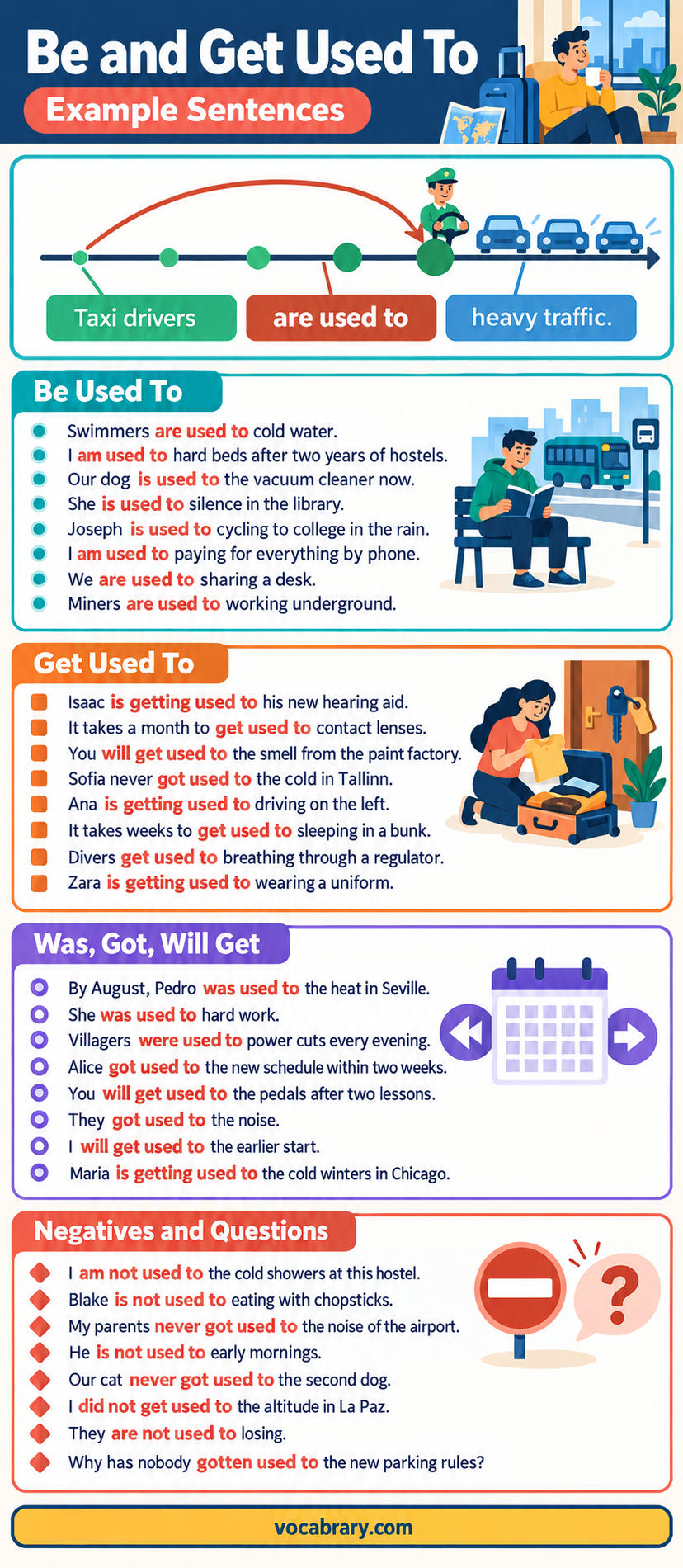
Common Be Used To and Get Used To Example Sentences
Nurses on long shifts, a puppy learning its crate, and Diego facing dark Helsinki mornings make up the common be used to and get used to example sentences. One phrase names a settled habit, and the other names a habit still forming.
- Nurses are used to long shifts and broken sleep.
- Hana is getting used to her new glasses.
- After six months in Helsinki, Diego is used to the dark mornings.
- My grandfather never got used to mobile phones.
- Farmers are used to waking before dawn, so a five o’clock alarm surprises nobody on the farm.
- Lucia is not used to the spicy food in Chennai yet.
- Children get used to a new school faster than their parents expect.
- We are used to the noise from the motorway.
- It took Omar three winters to get used to driving on ice.
- Tom is used to working from home.
- The puppy is getting used to its crate at night, and the whining has almost stopped.
- Nobody gets used to bad news overnight.
- Amara was used to cooking for eight people when she lived with her grandparents in Lagos.
- You will get used to the keyboard after a week of practice.
- Doctors on night duty are used to the smell of disinfectant and the hum of machines.
- Priya has got used to the long commute into Mumbai.
- My brother is used to sharing a room.
- Sam never got used to the taste of black coffee.
- Two weeks in, Elena is getting used to her wheelchair ramp and the new bathroom rails.
- Soldiers are used to discipline, early drills, and orders that arrive without warning.
Be Used To in Sentences
A night nurse who no longer hears the monitors, a taxi driver who reads Rome traffic without thinking, and a teacher facing thirty pupils describe what already feels normal. Be used to then takes either a noun or an -ing verb.
Be Used To With a Noun
Cold water, the smell of fresh paint, nine-hour flights, and hard hostel beds are the nouns that follow be used to in these sentences, each naming something the speaker no longer notices.
- Swimmers are used to cold water.
- Mateo is used to the smell of fresh paint in his father’s workshop.
- I am used to hard beds after two years of hostels.
- Flight attendants are used to nine-hour journeys across several time zones and meals at odd hours.
- Our dog is used to the vacuum cleaner now.
- Students in Tokyo are used to crowded trains every morning.
- Rosa is used to the heat, because she grew up in Seville.
- Mountain guides are used to thin air, sudden storms, and clients who arrive with the wrong boots.
- She is used to silence in the library.
- Fishermen are used to early tides and wet clothes.
- My aunt is used to village life after thirty years in Kerala.
- Emre is used to the noise of the market under his window.
- Teachers are used to thirty different handwriting styles.
- Border officers are used to long queues, tired travellers, and questions about lost passports.
- Nobody in the village is used to the new traffic lights yet.
Be Used To With an -ing Verb
Starting work at three, cycling to college in the rain, paying by phone, and sharing a desk are the -ing verbs after be used to here. Each one names a routine repeated long enough to stop feeling strange.
- Bakers are used to starting work at three in the morning.
- Yusuf is used to cycling to college in the rain.
- I am used to paying for everything by phone.
- Nurses on the ward are used to explaining the same instructions to worried families several times a day.
- We are used to sharing a desk.
- Kofi is used to speaking three languages at home, English with his sister and Twi with his parents.
- Translators are used to listening and writing at the same moment.
- My mother is used to getting up at four to prepare breakfast.
- Miners are used to working underground.
- Lena is used to being interrupted during meetings, so she keeps her notes short.
- Pilots are used to landing in crosswinds.
- Freelancers are used to waiting weeks for payment, chasing invoices, and planning for months with no income.
- Grandma is used to walking to the market every morning with her neighbour.
- Shepherds in the hills are used to sleeping outdoors in summer.
Get Used To in Sentences
Ibrahim with a new hearing aid, Nina with braces, and British drivers meeting their first Spanish roundabout are all partway through a change, which is the work get used to does in a sentence.
Get Used To With a Noun
A hearing aid, contact lenses, hospital food, and a third coach in two seasons are the nouns after get used to here, each one new enough that the person is still adjusting.
- Ibrahim is getting used to his new hearing aid.
- It takes a month to get used to contact lenses.
- Recruits get used to the routine within a fortnight.
- My sister got used to the quiet after moving from Cairo to a farm in Wales.
- Patients get used to hospital food, though few praise it.
- Nina is getting used to her braces, and eating apples is already less painful.
- Drivers from Britain get used to roundabouts on the wrong side after a few nervous weeks abroad.
- You will get used to the smell from the paint factory.
- Sofia never got used to the cold in Tallinn.
- New parents get used to broken nights.
- The team is getting used to its third coach in two seasons.
- Refugee families in the camp are getting used to tents, rations, and a language nobody taught them.
Get Used To With an -ing Verb
Driving on the left, eating dinner at ten in Madrid, sleeping in a bunk, and breathing through a regulator are the -ing verbs after get used to. Each one names a habit under construction.
- Ana is getting used to driving on the left.
- It takes weeks to get used to sleeping in a bunk.
- Carlos got used to eating dinner at ten after his first summer in Madrid.
- New teachers get used to speaking in front of thirty pupils.
- I am getting used to waking at five for the gym.
- Ravi is getting used to taking the metro instead of his motorbike, though he misses the fresh air.
- Divers get used to breathing through a regulator.
- My uncle got used to living alone after my aunt moved to Toronto.
- Students get used to typing exam answers rather than writing them by hand.
- Zara is getting used to wearing a uniform.
- Night guards get used to hearing every pipe, door, and floorboard in an empty building.
- We are getting used to cooking for one.
- Hikers get used to walking twenty kilometres with a full pack.
- Farida never got used to working weekends, so she changed jobs after a year.
Used To, Be Used To and Get Used To Forms
A past habit that stopped, a present habit that feels normal, and a new habit still forming separate used to, be used to, and get used to. Marco used to smoke, his brother is used to smoking, and their father is getting used to smoking less.
| Form | Meaning | Example sentence |
|---|---|---|
| Used to + base verb | A past habit or state that has stopped | Marco used to smoke twenty a day. |
| Did not use to + base verb | A past habit that never existed | She did not use to drink coffee. |
| Be used to + noun | Something that already feels normal | Nurses are used to night shifts. |
| Be used to + -ing verb | An action that already feels normal | Yusuf is used to cycling to college. |
| Am not used to + noun | Something that still feels strange | I am not used to the cold. |
| Get used to + noun | Becoming familiar with something new | Ibrahim is getting used to his hearing aid. |
| Get used to + -ing verb | Becoming familiar with a new action | Ana is getting used to driving on the left. |
| Got used to + -ing verb | Became familiar at a past time | Carlos got used to eating dinner at ten. |
| Will get used to + noun | Becoming familiar in the future | You will get used to the keyboard. |
| Are you used to + -ing verb | Asking about a present habit | Are you used to working nights? |
- Marco used to smoke, but now he is used to life without cigarettes.
- Sandra used to live in Cairo, and she never got used to the silence of the countryside.
- We used to eat at six, and the children are still getting used to dinner at eight.
- Ben used to hate running, but he is used to it now.
- My father used to work day shifts, then got used to nights at the factory, and today he is used to neither pattern of sleep.
- Ella used to cycle everywhere, so she is used to hills that leave other riders breathless.
- They used to own three shops, and the family is getting used to owning one.
- Zoe used to dread exams, though she got used to them by her final year.
- I used to hate seafood, and I am still not used to oysters.
- Grandad used to walk five miles a day, so he is used to long distances at eighty.
- She used to smoke; now she is used to fresh air.
Negative Sentences With Am Not Used To and Did Not Get Used To
Cold hostel showers, chopsticks, heavy March rain, and altitude in La Paz are what these speakers still find strange, so the negative word falls on the verb be or on the auxiliary did.
- I am not used to the cold showers at this hostel.
- Bilal is not used to eating with chopsticks.
- My parents never got used to the noise of the airport.
- We are not used to such heavy rain in March, and the drains outside our building failed within an hour.
- She did not get used to the new software until the third month.
- Vegetarians at a barbecue are not used to the smell of grilled meat filling the whole garden.
- He is not used to early mornings.
- Our cat never got used to the second dog.
- The new interns are not used to speaking in front of clients, so their first presentations were nervous.
- Lina is not used to silence after eight years in Manila.
- I did not get used to the altitude in La Paz.
- Tourists are not used to paying for tap water in restaurants.
- My grandmother is not used to video calls, and she still shouts into the microphone.
- They are not used to losing.
Question Sentences With Are You Used To and Did You Get Used To
Manchester weather, night shifts, contact lenses, and a flatmate’s cooking prompt these questions, where be used to asks about a settled habit and get used to asks how a change went.
- Are you used to the weather in Manchester yet?
- Did Farid get used to working nights?
- How long did it take you to get used to your contact lenses?
- Is your brother used to living alone?
- When will the children get used to their new school, or do they still ask about the old one?
- Did you get used to driving on the left in Dublin?
- Are nurses ever used to losing a patient?
- Why has nobody got used to the new parking rules?
- Have you got used to your flatmate’s cooking?
- Was your father used to hard work before the accident?
- Does your sister get used to new places quickly?
- How many weeks did it take Sofia to get used to the altitude in Bogota?
Was Used To in Past Sentences
A grandmother with a wood stove, miners on twelve-hour shifts, and soldiers asleep in tents had settled into those habits before the story began. Was used to and were used to name that settled past, alongside the past tense forms of be.
- Grandmother was used to a wood stove long before the gas arrived.
- The miners were used to twelve-hour shifts underground.
- By August, Pedro was used to the heat in Seville.
- Soldiers in the camp were used to sleeping in tents through the rainy season.
- She was used to hard work.
- We were not used to the formality of the old hotel, and the waiters noticed at once.
- My father was used to driving a lorry before his back gave out.
- Villagers were used to power cuts every evening.
- Anita was used to being the youngest in every class until she skipped a year.
- Nobody was used to the new manager’s silence during meetings.
Got Used To and Will Get Used To in Sentences
Aisha after a fortnight of the new timetable, a puppy after three noisy nights, and passengers facing new ticket machines show the change finished in the past and the change promised for later.
- Aisha got used to the new timetable within a fortnight.
- You will get used to the pedals after two lessons.
- The puppy got used to sleeping alone after three noisy nights.
- My brother will get used to his hearing aid, though he complains about it every morning.
- They got used to the noise.
- Passengers will get used to the new ticket machines once the staff stop apologising for them.
- Kenji got used to British food faster than his mother expected.
- I will get used to the earlier start.
- After a month at sea, the crew had got used to the constant motion of the deck.
- Marta got used to speaking Spanish all day, and by June she dreamed in it.
- Drivers will get used to the speed cameras after the first fine.
- Nobody will get used to losing a job, however many times it happens.
Be Used To and Get Used To in Everyday Settings
A new office phone system, a school bell, snow tyres in Canada, and a four o’clock bakery alarm are the changes people meet in these settings, some already absorbed and some still under way.
New Jobs and the Office
An intern shaking through her first client call, a manager at ease with Monday reports, and staff waiting for the new software split between what already feels normal and what is still being learned.
- Our new receptionist is getting used to the phone system.
- Managers are used to Monday reports and quarterly targets.
- Chidi got used to the open-plan office after a month of headphones.
- I am not used to meetings that start at eight.
- The intern is getting used to speaking on client calls, and she stammers less each week.
- Accountants are used to long hours in tax season.
- You will get used to the software.
- After twenty years in the same firm, Helena was used to every footstep in the corridor.
- Warehouse staff are used to lifting heavy crates all day.
- Nobody is used to the new dress code yet.
New Schools and Classrooms
First-graders learning the bell, Maya meeting new classmates in Bristol, and boarders spending their first weekend away from home show the school version of the same change.
- First-graders get used to the school bell within a week.
- Maya is getting used to her new classmates in Bristol.
- Pupils at this school are used to silent reading every morning after registration.
- I am not used to writing essays in English.
- The teacher is used to noise, so a talkative class never troubles her.
- Older students get used to exam pressure, though few enjoy it.
- Hamid got used to wearing a uniform after his first term.
- Parents are used to homework arguments at seven o’clock.
- You will get used to the timetable.
- New boarders are getting used to sleeping away from home, and the first weekend was hard for two of them.
New Cities and Countries
The call to prayer at dawn in Doha, shops closed on a Munich Sunday, and snow tyres in Canada mark what movers must absorb, while lifelong residents stopped noticing years ago.
- Anna is getting used to life in Berlin.
- Expats in Doha are used to the call to prayer at dawn.
- My cousin never got used to the pace of New York.
- We are not used to such wide streets.
- Tourists get used to the metro map faster than they expect.
- Jae-won is getting used to shops that close on Sundays in Munich.
- Londoners are used to rain in every season, and few of them own an umbrella.
- After three years in Nairobi, Bruno was used to matatu drivers and their horns.
- She will get used to the accent.
- Families who move to Canada get used to snow tyres, winter boots, and salt on every path.
Weather and Climate
December darkness in Norway, humidity in Singapore, forty-degree afternoons in Rajasthan, and wind on the Faroe Islands separate the people who stopped noticing from the ones still adjusting.
- Norwegians are used to darkness in December.
- I am getting used to the humidity in Singapore.
- Farmers in Rajasthan are used to temperatures over forty degrees.
- Visitors never get used to the wind on the Faroe Islands, however long they stay.
- We got used to the rain during our year in Galway.
- Oliver is not used to snow.
- People in Bergen are used to carrying an umbrella every day of the year.
- You will get used to the heat by July.
- Desert guides are used to cold nights, since the sand loses its warmth within an hour of sunset.
Food and Diet
Chillies in every Chengdu dish, four years of vegan cooking, fasting during Ramadan, and black tea without sugar show tastes that settled long ago beside tastes still being learned.
- Hugo is getting used to eating less sugar.
- Students get used to cheap pasta.
- My sister is used to a vegan diet after four years.
- Diners in Chengdu are used to chillies in every dish, and mild food disappoints them.
- I am not used to breakfast at six.
- Ahmed got used to fasting during Ramadan when he was twelve.
- Athletes are used to weighing every portion of rice before training camp.
- You will get used to the taste of black tea without sugar.
- Nobody in my family is used to eating dinner in front of the television.
Night Shifts and Early Starts
A four o’clock bakery alarm, empty corridors on a security round, and sleep that has to happen in daylight are the hours here. One speaker has settled into them, and the next still fights the clock.
- Bakers are used to a four o’clock alarm.
- Sami is getting used to night shifts at the hospital.
- I never got used to sleeping during daylight.
- Security guards are used to empty corridors and their own footsteps.
- My mother got used to the early start after two weeks on the ward.
- Pilots are used to crossing time zones twice in a day, though jet lag still catches them.
- You will get used to the rota.
- Taxi drivers in Cairo are used to working until three in the morning.
- Nobody gets used to an alarm at half past four in January.
New Technology
A grandfather with a tablet, paperless boarding passes, two-factor codes, and software updates that move every button are the changes behind these sentences about screens and devices.
- Grandpa is getting used to his tablet.
- Teachers are used to marking work on screen.
- I am not used to smart speakers in the kitchen.
- Passengers got used to paperless boarding passes within a single season.
- My uncle never got used to typing, so he still writes letters by hand.
- Designers are used to software updates that move every button.
- You will get used to the new keyboard.
- Banks assume customers are used to two-factor codes, though many older clients still telephone for help.
- Nobody in the office is used to the new printer yet.
Driving on the Other Side of the Road
British drivers meeting French traffic, a gear stick on the wrong hand, clockwise roundabouts, and narrow Irish lanes give get used to its most common travel setting.
- British drivers get used to the right-hand side after a week in France.
- Ana is getting used to the gear stick on her left.
- I am not used to roundabouts that turn clockwise.
- My father got used to driving in Ireland during his first posting to Cork.
- Tourists are not used to narrow lanes with stone walls on both sides, so the hire cars come back scratched.
- She will get used to it.
- Delivery riders in Tokyo are used to traffic on the left and pavements full of pedestrians.
- Nobody gets used to overtaking from the wrong side overnight.
Life Changes at Home
Broken sleep for new parents, a baby sister, a grandmother moving in, and an empty house after the students leave are the home changes these sentences track.
- New parents are getting used to broken sleep.
- Leo got used to his baby sister faster than anyone predicted.
- We are not used to the size of this kitchen.
- My grandmother is getting used to living with us, and she has claimed the corner armchair.
- Couples get used to each other’s habits.
- Samir is used to the stairs in the new flat now.
- You will get used to the empty house once the students call every Sunday.
- Dogs get used to a second home faster than cats.
- Nobody got used to the silence after Grandad died.
Be Used To and Get Used To Sentences for Students
Shared kitchens in October, eighty pages before a Tuesday seminar, and lectures given entirely in Portuguese are the student changes here, half of them already absorbed and half still under way.
- Undergraduates are used to deadlines that arrive three at a time.
- Priyanka is getting used to taking notes in a lecture hall of four hundred.
- First-year students get used to shared kitchens by the end of October.
- I am not used to reading eighty pages before a Tuesday seminar.
- Erasmus students in Lisbon are getting used to classes held entirely in Portuguese.
- Medical students are used to early ward rounds.
- Tomasz got used to referencing every quotation after his tutor returned the first essay.
- You will get used to it.
- Boarders are used to studying in silence from seven until nine each evening.
- Nobody is used to exam halls in the first week.
- Research students get used to waiting months for a reply about one chapter.
- My roommate is getting used to cooking for herself.
- Language students are used to speaking before they feel ready, since the tutor calls on everyone.
- Amina never got used to group projects where two members disappear.
- Part-time students are used to lectures after a full day at work.
- Did you get used to the library opening hours?
Short Be Used To and Get Used To Sentences for Beginners
Five-word lines about rain, an early bus, and a dog that no longer barks at visitors give beginners the shortest working patterns of be used to and get used to.
- I am used to it.
- She is getting used to school.
- We are used to the rain.
- He is not used to the cold.
- They get used to new rules fast.
- Ali is used to early mornings.
- You will get used to the bus.
- My dog is used to visitors.
- Nina got used to the noise last year.
- Are you used to the food here?
- Farmers are used to hard work.
- Children get used to new teachers quickly.
- Sara is getting used to her new bike.
- Nobody is used to the new timetable yet.
- Did he get used to the long walk to school?
- Our class is used to a test every Friday morning.
- Every new pupil gets used to the morning bell after a week or two.
Short Sentences for Young Learners
A puppy on a lead, new shoes, a school bus, and Grandma with noisy children keep these lines under fourteen words, so young learners read each one in a single breath.
- I am used to my new shoes.
- Sam is used to dogs.
- We are used to our teacher.
- The cat is getting used to the baby.
- You will get used to it.
- Mia is not used to swimming.
- Kids get used to new games fast.
- My baby brother is getting used to his cot.
- Tom got used to the school bus.
- Are you used to the big playground?
- Grandma is used to noisy children.
- Our puppy is used to the lead now.
- Ben is getting used to his glasses.
- Is she used to the water?
- Everyone gets used to the bell.
- Little Amy is getting used to sleeping in her own room at last.
Used To, Be Used To and Get Used To in Short Paragraphs
Marco leaving a village near Naples, Aisha through her first Toronto winter, and Halima moving from day shifts to nights run all three forms together, with used to for the habit that stopped.
- Marco used to live in a quiet village near Naples. Now he is used to sirens, buses, and neighbours who argue at midnight. His wife is still getting used to the noise. She did not get used to the traffic during her first month. By June she had got used to crossing four lanes without pausing. Both of them are used to the rent as well.
- When Aisha moved to Toronto, she used to phone home every night. Ice on the pavement frightened her, and she was not used to boots that heavy. By February she was getting used to the walk to the station. Her children got used to snow before she did. Today the whole family is used to winter, and nobody complains about January.
- Our grandfather used to write every letter by hand. He is not used to email, and he never got used to predictive text. My sister is getting used to reading his handwriting on the envelopes. She is used to screens, so the loops and curls slow her down. Both of them are getting used to the other’s habits.
- Before the factory closed, Halima used to work a fixed day shift. She got used to night hours within three weeks of the new contract. Her body is still not used to sleeping in daylight. The other packers are used to the rota and eat breakfast at six in the evening. Halima will get used to it by spring.
- Diego used to drive everywhere in Bogota. Since the accident he has got used to buses, queues, and standing for half an hour. His daughter is getting used to walking to school. She did not get used to the early start at first. Now the family is used to a quieter Saturday, and the car has not moved since March.
- Nobody in our house used to eat vegetables. My mother got used to cooking two dinners, one for the children and one for herself. The children are getting used to spinach now. My father is used to her lentil soup, though he still asks for bread. Everyone will get used to smaller portions of meat.
Related
FAQs
Used to, be used to and get used to differ in both time and grammar. Used to takes a base verb and names a past habit that stopped, as in Marco used to smoke. Be used to names present familiarity and get used to names the change from strange to normal, and both take a noun or an -ing verb.
No base verb ever follows be used to or get used to, because both phrases end in the preposition to and need a noun or an -ing verb. She is used to get up early is wrong, while She is used to getting up early is right. The same rule governs got used to and will get used to.
Be used to and get used to work with a person or a thing, the verb be or get, the phrase itself, and then a noun or an -ing verb. Nurses are used to night shifts describes a settled habit, and Sami is getting used to night shifts describes one still forming. Change be or get to move the whole sentence into the past or the future.
Get used to suits the moment a habit is still forming, while be used to suits a habit that already feels normal. A driver on her third day in Dublin is getting used to the left-hand side, and after a year she is used to it. Become, grow and start mark the same forward movement as get.
Did you get used to is the correct version, because the auxiliary did marks the past and the main verb returns to its base form get. Did you get used to the night shifts? works as a question, and I did not get used to them works as a negative. Got used to works only without did, as in I got used to them.
Have to get used to means a person faces a change that will take time to absorb, with no choice about it. New parents have to get used to broken sleep names an adjustment ahead rather than one behind. Will have to get used to names the same pressure for a change further in the future.
Be used to has a past form built on was and were: Grandmother was used to a wood stove and The miners were used to twelve-hour shifts. Get used to becomes got used to in the past, and had got used to for an adjustment finished before another past action. Other past forms of be appear across the tense sentences collection.
The negative of be used to puts not after am, is, are, was or were, as in I am not used to the cold. The negative of get used to needs do, does or did with not, as in She did not get used to the software. Never and still not work in the same position for a stronger refusal.
Ten short sentences with get used to run like this: She is getting used to school. You will get used to the bus. Children get used to new teachers quickly. Nina got used to the noise. He is getting used to his glasses. Everyone gets used to the bell. Did he get used to the walk? We are getting used to cooking for one. My dog got used to the lead. Nobody gets used to bad news overnight.
Get used to it in conversation tells a listener that a situation will not change and that acceptance is the only route left. A parent saying the rules are the rules, so get used to it ends the argument there. Said gently to a newcomer, the same phrase promises that strangeness fades.
Getting used to something new takes days for small changes and months for large ones, which is why English pairs the phrase with time markers. It takes a month to get used to contact lenses and After three winters he got used to driving on ice both mark the stretch of adjustment. Within, after, by and it takes are the markers that appear most.
Be used to as familiarity differs from the passive be used to do something, where a tool or a method has a purpose. A hammer is used to drive nails describes function, while A carpenter is used to hammers describes familiarity. A base verb after to marks the passive, and a noun or an -ing verb marks familiarity.

Leave a Comment