
Am, is, and are are the three present tense forms of the verb be, as in I am late, she is a nurse, and they are at home. Most am is are example sentences describe a person, a place, or a mood, so the noun or pronoun before the verb decides which form fits.
What Are Am, Is, and Are?
Am, is, and are give the verb be its present tense in three parts, one for a speaker, one for a single person or thing, and one for a group. Was and were do the same work in the past, so she is happy becomes she was happy once the moment has gone.
I + am / He, she, it + is / You, we, they + are
Kenji is the goalkeeper, and the rest of us are defenders.
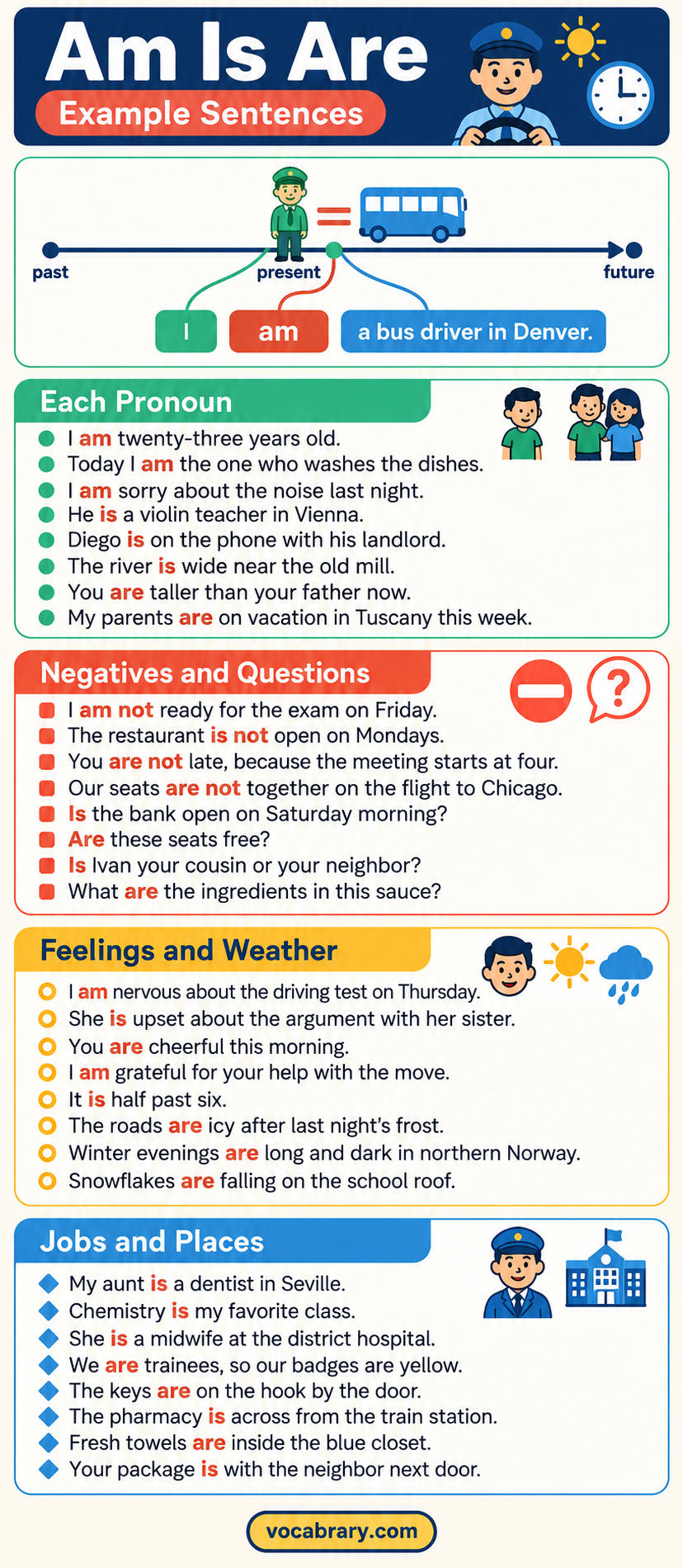
Common Am Is Are Example Sentences
A nurse on a night shift, a cold cup of coffee, and two cousins from Casablanca fill most am is are example sentences. In each one the verb ties a person or thing to whatever describes it.
- I am a student at the community college on Mill Road.
- Maria is a nurse, and her night shift starts at seven.
- We are ready for the trip to the coast tomorrow morning.
- My brother is eleven years old today.
- The coffee is cold.
- Those shoes are mine.
- Omar and Leila are cousins from Casablanca.
- It is almost midnight.
- You are the fastest runner on the whole team.
- Both windows in the front room are open.
- Her father is a bus driver in Lisbon.
- Our neighbours are away until the end of August.
- This soup is salty.
- Two of my classmates are twins.
- Kenji is the goalkeeper this season.
- Everyone in the hall is quiet.
- Amina and I are partners for the science project.
- That parcel is heavy.
- The kittens under the porch are three weeks old and still blind.
- Lucas is afraid of thunder, although his sister laughs at it.
Am, Is, and Are With Every Pronoun
I takes am, he, she, and it take is, and you, we, and they take are. A thirsty speaker, a carpenter in Warsaw, and a windy balcony each need a different form of be.
| Pronoun | Form | Example sentence |
|---|---|---|
| I | Am | I am thirsty after the long walk. |
| You | Are | You are early for once. |
| He | Is | He is a carpenter in Warsaw. |
| She | Is | She is the tallest girl in the choir. |
| It | Is | It is windy on the balcony. |
| We | Are | We are neighbours now. |
| They | Are | They are waiting by the gate. |
Sentences With Am
A twenty-three-year-old on a train to Milan, a swimmer who joined a club in June, and a boy in a red scarf all take am, the one form reserved for the speaker.
- I am twenty-three years old.
- Right now I am on the train to Milan.
- Honestly, I am too tired to cook tonight.
- Today I am the one who washes the dishes.
- I am hungry.
- At seven every morning I am already awake.
- Whenever the phone rings after midnight, I am the one who answers it.
- Yes, I am the girl who returned your wallet last Thursday.
- On Tuesday evenings I am at the swimming club.
- I am sorry about the noise last night.
- Here on the fourth floor I am far from the traffic.
- As the youngest cousin, I am always last to choose a seat.
- Frankly, I am afraid of heights.
- Because the bus broke down, I am late for my own birthday dinner.
- In this photograph I am the boy with the red scarf.
Sentences With Is
He, she, and it govern is, and so does any single noun, from a violin teacher in Seoul to a broken lift and a dog named Biscuit.
- He is a violin teacher in Seoul.
- She is the only person here with a spare set of keys.
- It is raining again.
- My grandmother is eighty-one and still swims every Sunday.
- The lift is broken, so we walk up six flights.
- Biscuit is the noisiest dog on our street, and he barks at bicycles.
- Diego is on the phone with his landlord.
- The bread is fresh from the bakery on the corner.
- Her handwriting is neater than mine.
- Nobody is in the office before eight.
- That song is thirty years old.
- The river is wide near the old mill.
- Sana is proud of her younger brother.
- One of my shoes is missing.
- Nothing is sadder than a rained-out picnic.
- Everything in the fridge is frozen solid.
Sentences With Are
You, we, and they govern are, and every plural noun follows them, whether the sentence names two brothers, a pile of dishes, or a group of tourists.
- You are taller than your father now.
- We are the last customers in the shop.
- They are brothers, though nobody believes it.
- The dishes are still in the sink.
- Tourists are everywhere in the old town during July.
- Both answers are wrong.
- My parents are on holiday in Kerala this week.
- These oranges are sweeter than the ones from the market.
- Rohan and Chloe are in the same reading group.
- All the seats near the window are taken.
- Your keys are on the shelf by the door.
- Several roads into the city are closed for repairs.
- The twins are four years old already.
- We are hungry.
- Grace and her sisters are singers in a gospel choir in Accra.
- Wet socks are the worst part of a rainy morning.
Negative Sentences With Am Not, Is Not, and Are Not
A pupil who is not asleep, a restaurant that is not open on Mondays, and shoes that are not waterproof show the negative forms, made by adding not straight after am, is, or are.
- I am not ready for the exam on Friday.
- She is not angry with you.
- They are not at home this weekend.
- The restaurant is not open on Mondays.
- We are not the first family to complain about the noise.
- My laptop is not working after the latest update.
- These boots are not waterproof.
- Tariq is not afraid of the dark any more.
- You are not late, because the meeting starts at four.
- It is not cold enough for gloves.
- Nadia and Wei are not in the same year at university in Cairo.
- I am not the person who left the gate open.
- The milk is not sour yet.
- Our seats are not together on the flight to Nairobi.
- His excuse is not true.
- Children under six are not allowed in the pool without an adult.
- That is not my signature.
- Amina is not at her desk, so leave the envelope with me.
Question Sentences With Am, Is, and Are
Questions put the verb in front of the pronoun, so you are ready turns into are you ready, and the same swap produces is the bank open and am I late again.
- Am I late again?
- Is the bank open on Saturday morning?
- Are you ready to leave?
- Am I the only one who forgot the tickets?
- Is your sister still at the hospital?
- Are these seats free?
- Am I right about the meeting time?
- Is it cold outside?
- Are the children asleep already?
- Am I in the correct queue for passport control?
- Is Ivan your cousin or your neighbour?
- Are we allowed to park here overnight, or is the barrier locked at ten?
- Why is the road closed this morning?
- Where are my glasses?
- When is the next train to Bristol?
- What are the ingredients in this sauce?
- Who is the woman in the blue coat?
- How are your grandparents after the move?
- Which of these bags is yours?
- Whose shoes are on the stairs?
Short Answers With Am, Is, and Are
Short answers repeat the verb instead of the whole sentence, so a question about being ready, being a teacher, or being at home gets back a two-word reply with am, is, or are inside it.
- Are you ready? Yes, I am.
- So, is she a teacher? Yes, she is.
- Mum, am I in trouble? No, you are not.
- Excuse me, are these seats free? No, they are not.
- Is this your bicycle? Yes, it is.
- Quick, are we late? No, we are not.
- Am I next? Yes, you are.
- Tell me honestly, is the hotel far from the beach at Alanya? No, it is not.
- Are the shops open on Sunday? Yes, they are.
- Sorry, am I on the team sheet for the match in Prague? Yes, you are.
- Is Pedro your brother? No, he is not.
- Wait, are those apples ripe? No, they are not.
- Am I too early for the dentist? Yes, you are, by an hour.
- Dad, is the car fixed? Yes, it is.
Contractions With Am, Is, and Are
Speech shortens am, is, and are to I’m, he’s, and they’re, and the negatives turn into isn’t and aren’t, as in a friend who isn’t hungry or a shop that’s closed for lunch.
- I’m hungry.
- He’s a plumber with a white van.
- They’re from Ghana, though they grew up in Toronto.
- She’s the only doctor on duty tonight.
- It’s freezing in this room.
- We’re almost at the station.
- You’re standing on my foot.
- That’s my umbrella, not yours.
- There’s a spider in the bath.
- Honestly, I’m not angry about the broken plate.
- Fatima isn’t hungry, because she ate on the train.
- What’s the name of your street in Valencia?
- Your parents aren’t late, so stop worrying.
- He’s not the tallest player, yet he scores every week.
- After nine o’clock we’re still awake and reading.
- They’re not twins, although their birthdays match.
- It’s my turn to choose the film.
- Once the heating starts, it’s warm in the whole flat within ten minutes.
Am Is Are With Names and People
A cousin from Pune, a retired baker, and two sisters who share a flat show how a person’s name behaves like he, she, or they, taking is for one person and are for several.
- Anika is my cousin from Pune.
- My uncle is a retired baker.
- Mr Novak is the caretaker of this building.
- Grandpa and Grandma are married, and their anniversary is in June.
- Both of my sisters are older than me.
- The Ortegas are our new neighbours downstairs.
- Sofia is the girl with the purple bicycle.
- Yara and her flatmate are vegetarians.
- Kwame is a referee at weekend matches.
- Our coach is stricter than the last one.
- Ahmed is the tallest boy in year nine.
- Nobody in my family is left-handed except me.
- Hanna is eighteen tomorrow, so the birthday cake is already in the oven.
- Viktor and Emma are engaged.
- Lin is a translator for a publishing house.
- Juan is the only person here who speaks Basque.
Am Is Are With Places and Prepositional Phrases
Keys on a hook, a cat under the stairs, and a pharmacy opposite the station follow am, is, and are with a phrase of place that answers where the person or thing stays.
- The keys are on the hook by the door.
- I am at the bus stop outside the library.
- Our cat is under the stairs again.
- The pharmacy is opposite the railway station.
- We are in the third carriage from the front.
- Your boots are behind the sofa.
- Rohan is at his grandmother’s house in Jaipur until Sunday.
- Fresh towels are inside the blue cupboard.
- My office is between a bakery and a barber shop.
- Ducks are on the pond every morning in spring.
- Your parcel is with the neighbour at number twelve.
- Amina and Noor are near the fountain in the main square.
- It is in your pocket.
- Their village is twelve kilometres along the coast road.
- Two police officers are beside the entrance to the football stadium in Turin.
- Her passport is among the papers in the brown envelope.
Sentences With Adjectives After Am, Is, and Are
An adjective straight after the verb describes the person or thing named before it, as with soup that is salty, boots that are muddy, and a corridor that is dark.
- The soup is salty.
- My boots are muddy after the walk through the field.
- This corridor is dark, so use the handrail.
- You are kind.
- Those chairs in the hall are wooden and rather hard.
- I am thirsty.
- The paint on the garden gate is fresh.
- These grapes are sour.
- Elena is patient with beginners.
- Our windows are dusty after a summer without rain.
- It is noisy in the courtyard tonight.
- Samuel is generous, and his brother is stubborn.
- Both roads are narrow.
- That knife is sharp enough for bread and tomatoes.
- We are proud of the whole team.
- The water in the mountain lake is colder than the sea in winter.
Feelings and Moods
Nerves before an exam, boredom on a wet afternoon, and relief once a test is over run through these sentences, where am, is, and are join a person to a mood.
- I am nervous about the driving test on Thursday.
- Tariq is bored on wet afternoons.
- We are relieved that the exam is over.
- She is upset about the argument with her sister.
- They are excited about the school trip to Vienna.
- My father is calm in a crisis.
- You are cheerful this morning.
- Zara is homesick during her first term in Dublin.
- The children are scared of the neighbour’s goose.
- I am grateful for your help with the move.
- Ivan is jealous of his brother’s new bicycle.
- Our grandparents are content in the small stone house by the harbour at Split.
- It is frightening to drive in thick fog.
- Mateo is lonely after his friends moved away.
Am Is Are With Jobs and Classroom Lessons
A dentist, a lorry driver, a chemistry lesson on Tuesday mornings, and a geography teacher who marks slowly appear here, where am, is, and are name what somebody does or studies.
- My aunt is a dentist in Seville.
- I am an apprentice electrician.
- Chemistry is my favourite lesson.
- The new pupils are in the third classroom on the left.
- Kwame and Daniel are lorry drivers for the same firm.
- Our geography teacher is slow with marking.
- She is a midwife at the district hospital.
- History and art are the lessons I look forward to each week.
- You are a better cook than anyone in this family.
- Mateo is an architect, though he trained first as a builder in Lima.
- The head teacher is on leave until the end of term.
- Algebra is harder for me than geometry.
- We are trainees, so our badges are yellow.
- Hiro is a pastry chef in a hotel kitchen in Osaka.
- Two of my classmates are already fluent in Portuguese.
- Physical education is on Tuesday and Friday afternoons.
Am Is Are With Time and Weather
Half past six, a foggy Tuesday, a heatwave in August, and a clock that runs fast give am, is, and are their most frequent work outside of people.
- It is half past six.
- The sky is grey this morning, so take an umbrella to the station.
- Mornings in November are foggy near the river.
- It is my birthday on Sunday.
- The roads are icy after last night’s frost.
- Today is the hottest day of the summer so far.
- We are in the middle of a heatwave that started in July.
- Is it already time for the bus?
- Winter evenings are long and dark in northern Norway.
- The clock in the kitchen is ten minutes fast.
- April is wetter than March in this part of Wales.
- My favourite hour is early morning, before the traffic starts.
- Snowflakes are falling on the school roof.
- It is Thursday, and the bins go out tonight.
- Nights by the coast are warmer than nights inland.
- Harvest time is in late September.
Sentences With There Is and There Are
A spider in the bath, three eggs in the fridge, and fireworks over the bay every August show there is with one thing and there are with several.
- There is a spider in the bath.
- In the fridge there are three eggs, half a lemon, and a jar of olives.
- There are sixty seats in the small cinema on Green Street.
- Behind the school there is a football pitch.
- Near the harbour there are two fish restaurants.
- Is there a pharmacy on this street?
- Are there any tickets left for Saturday?
- Under the stairs there is a cupboard full of winter coats.
- Every August there are fireworks over the bay.
- There is not enough milk for four cups of tea.
- On the kitchen table there are two letters for you.
- Once a week there is a market in the square.
- Right now there is nobody at the reception desk.
- Along the river there are benches for walkers.
- Beside the bed there is a lamp with a cracked shade.
- After ten o’clock there are no buses to the village.
Am Is Are in a Daily Routine
Breakfast at seven, a locked classroom door, and a printer that runs out of paper mark the hours of an ordinary day, each one described with am, is, or are.
At Home
Porridge on the stove, a dog waiting by the lead, and a washing machine halfway through its cycle describe a morning at home in the present tense.
- Breakfast is at seven in our house.
- Porridge is still on the stove.
- My father is in the garden with the hose.
- We are all awake before the alarm on Saturdays.
- Our dog is by the front door with his lead already in his mouth.
- The washing machine is halfway through its cycle.
- I am in the shower when the postman knocks.
- Sofia and her mother are in the kitchen making bread.
- Bedtime for the twins is half past eight.
- Rubbish bins are out on Tuesday nights.
- It is my turn to lock the back door.
- Dinner is ready, so wash your hands.
At School
A nine o’clock bell, a locked science room, and a queue in the canteen make up a school day, and am, is, and are place every part of it in the present.
- Registration is at nine o’clock sharp.
- We are in the library during the first lesson.
- Our science room is locked until the technician arrives.
- I am on the name sheet for the trip to the museum.
- The canteen queue is longest at half past twelve.
- Two teachers are on duty in the playground.
- Homework is due on Wednesday morning.
- My locker is the one with the dented door.
- The exam marks are on the notice board by the office.
- She is captain of the netball team this year.
- Football practice is after school on Thursdays.
- Younger pupils are in the hall for assembly with the deputy head at nine.
At Work
A printer out of paper, a meeting moved to three, and a colleague on leave fill an office day, where am, is, and are report what every person and machine does now.
- I am at my desk by half past eight.
- The printer is out of paper again.
- Our meeting is at three.
- Two colleagues are on leave this week.
- The lift is under repair, so use the stairs.
- My manager is on a call with the supplier in Hamburg until lunchtime.
- Wages are paid on the last Friday of the month.
- We are short of one driver for tomorrow’s delivery.
- Our warehouse is cold in February.
- Nadia is the person who orders the stationery.
- All the parking places are full by nine.
- It is quiet in the office during August.
A Day Described With Am, Is, and Are
A pharmacist’s morning shift, a rushed walk to school, and a quiet flat after bedtime run through one paragraph, where every part of the day takes am, is, or are.
Amina is a pharmacist in Leeds, and her mornings are busy from the first minute. At seven she is already awake, and the kettle is on before the radio starts. Her two children are slow at breakfast, so the walk to school is always a rush. The pharmacy is open by half past eight, and the first patients are at the counter within minutes. By six she is tired, but the evening is hers, and the flat is quiet once the children are asleep.
Short Am Is Are Sentences for Kids and Beginners
Four-word sentences about a cat, a ball, a mother, and a red bag give young learners a pattern they copy without fear of getting the form wrong.
For Kids
A cat on a mat, a red ball, and a mother in the kitchen keep these sentences to four or five words, with one bold form of be in each.
- I am six years old.
- The cat is on the mat.
- My ball is red.
- We are in the park.
- She is my mother.
- They are my friends.
- It is hot today.
- Our dog is small.
- You are funny.
For Young Learners
A pencil, a school bag, a brother, and a glass of milk give the three forms sentences short enough to say aloud in one breath.
- My pencil is yellow.
- Those grapes are green.
- He is my brother.
- The milk is in the glass.
- Books are on the shelf.
- I am happy today.
- Grandma is in the garden.
- We are hungry now.
- Your bag is heavy.
Related
FAQs
Am, is, and are split the present tense of be between three groups of pronouns. Am goes with I, is goes with he, she, it and any single noun, and are goes with you, we, they and every plural noun. The noun or pronoun in front of the verb decides the choice every time, which is why the boys are late takes are while the boy is late takes is.
Am, is, and are are called the present tense forms of the verb be. Grammarians also name them linking verbs when a noun or adjective follows, as in she is a vet, and auxiliary verbs when another verb follows, as in they are running. All three belong to the wider family of tense sentences built on be.
No, am goes with I alone, so a sentence such as he am late is wrong and needs is instead. In a question the pronoun moves behind the verb, as in am I early, yet the pairing of am with I stays unbroken. Every other person and every plural noun takes is or are.
Am, is, and are differ from do, does, and did in the work they do. The be forms link a person or thing to a description, as in she is a nurse, while do, does, and did build questions and negatives around an action verb. A sentence never needs both, so is she does work is wrong.
You takes are whether it names one person or a whole crowd, so both you are my best friend and you are all welcome are correct. English lost its singular thou art form centuries ago, which is why a single listener and a group share the same verb today.
The short form of I am is I’m, with the apostrophe standing in for the missing letter a, as in I’m hungry. The other two forms shorten in the same way, giving he’s for he is and they’re for they are. Fuller lists of these forms are on the englishan contractions lesson.
Am and is both become was in the past, and are becomes were, so I am tired turns into I was tired and they are ready turns into they were ready. The was and were example sentences set pairs each present form with its past partner.
A sentence takes there is when one thing follows, as in there is a spider in the bath, and there are when two or more follow, as in there are three eggs in the fridge. The noun after the verb decides the form, never the word there, and the there is there are example sentences set gives many more cases.
No, the pairing I is is never correct in standard English, because the pronoun I takes am and nothing else. Learners who reach for is after I are copying the pattern of he is and she is, so the fix is to say I am aloud until it settles. The same rule applies in questions: am I right, never is I right.
Data takes are in scientific and academic writing, where it stays the plural of datum, as in the data are consistent. In everyday business English, writers treat data as a mass noun and write the data is ready. Both forms turn up in edited prose, so follow the house style you write for.
Learners make three recurring mistakes with am, is, and are: putting is after I, putting is after a plural noun, as in the boys is late, and dropping the verb altogether, as in she happy. Naming the noun or pronoun in front of the verb before writing prevents all three errors.
Negative sentences with am, is, and are take not straight after the verb, which gives I am not ready, he is not ready, and they are not ready. Speech shortens the second and third to isn’t and aren’t, while the first shortens to I’m not.
Am not has no standard one-word contraction in written English, so I’m not stays the normal short form. The dialect form amn’t survives in Irish and Scottish speech, and question tags use aren’t I, as in I’m next, aren’t I? Written work keeps I am not or I’m not.

Leave a Comment