
With is a preposition that joins a person, a tool, or a quality to the rest of a sentence, as in she walked home with her sister. Sentences with with turn up in everyday speech more than almost any other preposition, starting with the common patterns for company, instruments, and descriptions.
What Is the Preposition With?
With marks whatever goes along with the action: the person beside you, the object you use, or the feature something has. Its closest relative is by, which marks the doer or the method rather than the tool.
Verb or noun + with + noun (person, tool, or quality)
Ravi opened the tin with a blunt knife.
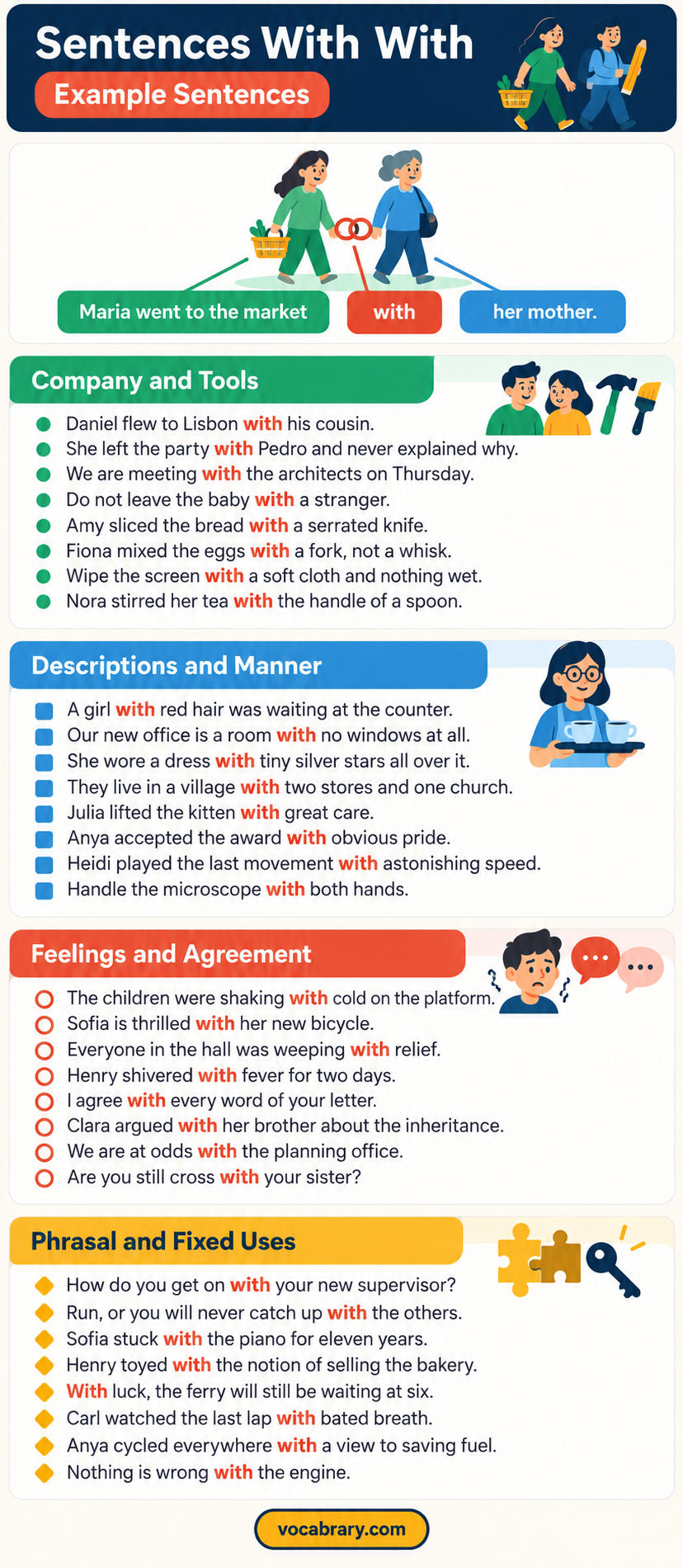
Common Sentences With With
A market trip with your mother, rope cut with scissors, and a tall man with a grey beard are the first three patterns learners meet, and each attaches an extra noun to a finished clause.
- Maria went to the market with her mother.
- Cut the rope with these scissors, not your teeth.
- He filled the kettle with cold water.
- A tall man with a grey beard opened the gate.
- Please do not argue with the referee.
- Ravi answered every question with total confidence.
- Sofia shares a flat with two nurses from Manila.
- The toddler was trembling with excitement.
- I disagree with almost everything in that report.
- Chen fixed the shelf with a borrowed drill.
- Nobody wanted to deal with the broken boiler.
- Our teacher spoke with a soft Irish accent.
- She came home with three bags of groceries.
- With any luck, the rain will stop before noon.
- Tomas painted the fence with a wide brush.
- That house with the blue door was once a bakery.
- Hassan travelled across eastern Turkey with an old backpack and a phrasebook he never opened.
- The bowl was heaped with roasted almonds.
- Do you get on with your new flatmate?
- Amina wrote the address with a leaky pen that smudged the whole envelope.
- Leila danced with her grandfather at the wedding.
- My coffee comes with two slices of toast.
- We compared the new phone with last year’s model and found almost no difference in battery life.
- Jonas listened with enormous patience.
- The cat glared at me with its one good eye.
- Priya is staying with her aunt until August.
- Nobody else agreed with my plan.
- Every street was white with snow by dawn.
- Peel the ginger with a teaspoon instead of a knife.
- Kofi greeted each customer with a wide smile.
- Are you happy with the final price?
- Grandma stirred the soup with a wooden spoon.
With for Company, Tools, and Descriptions
A cousin on the flight to Lisbon, a serrated knife through the bread, and a flat with a balcony over the sea are the three most frequent uses of with: company, instrument, and description.
| Use | Pattern | Example sentence |
|---|---|---|
| Company | Verb + with + person | Daniel flew to Lisbon with his cousin. |
| Tool | Verb + with + object | Amina sliced the bread with a serrated knife. |
| Description | Noun + with + feature | A girl with red hair was waiting at the counter. |
| Manner | Verb + with + abstract noun | Yuki lifted the kitten with great care. |
| Feeling | Adjective + with + cause | The children were shaking with cold. |
| Agreement | Agree or argue + with + person | Nobody sided with the manager. |
| Filling | Filled or covered + with + substance | The bath was filled with warm water. |
| Comparison | Compared + with + noun | Compared with last winter, this one was mild. |
| Phrasal verb | Verb + particle + with | Priya refuses to put up with the noise. |
| Fixed phrase | With + set noun | With luck, the ferry will still be waiting. |
| Separation | Part or break + with + noun | Marco parted with his old guitar last spring. |
| Reason | Adjective + with + trouble | My aunt was bent with arthritis. |
With for Company and Shared Plans
Badminton on Saturday mornings, a tutor booked for three months, and an August spent near Alexandria all name the person beside the doer, which is the oldest meaning of with.
- Daniel flew to Lisbon with his cousin.
- I had lunch with two colleagues from the Berlin office.
- Ngozi plays badminton with her neighbours every Saturday morning.
- The twins refuse to share a room with anyone.
- Aisha studied with a tutor for three months before the entrance exam.
- Will you come with us to the harbour?
- My brother went camping with four friends from university.
- Viktor argued the whole evening with his landlord about the broken heating in the front room.
- She left the party with Pedro and never explained why.
- Children under twelve must travel with an adult.
- Elena sat with the visitors until their taxi arrived.
- We are meeting with the architects on Thursday.
- Kenji shares an office with a very loud salesman.
- Grace danced with every single guest at her retirement party.
- The dog sleeps with the youngest boy.
- Nadia has been working with the same editor since 2019.
- Do not leave the baby with a stranger.
- Omar spent August with his grandparents near Alexandria.
- Our neighbours are going to Greece with their two teenagers.
- Bianca walks to school with the girl from the flat downstairs.
- Talk with your manager before you sign anything.
- Lars had already quarrelled with three of the organisers.
With for Tools and Instruments
Six neat stitches, a bent nail in a shed door, and a straight razor kept for sixty years all follow the verb directly, because with names the object the doer picks up.
- Amina sliced the bread with a serrated knife.
- He opened the envelope with his thumb.
- Tighten the last screw with the small blue screwdriver.
- Mei drew the map with a fountain pen.
- The surgeon closed the wound with six neat stitches.
- I dried my hair with a towel because the dryer had broken.
- Farah mixed the eggs with a fork, not a whisk.
- Sweep the hallway with the stiff broom.
- Pablo unlocked the shed with a bent nail he found under a flowerpot near the steps.
- She measured the curtain with a metal tape.
- Thabo lit the lamp with a single match.
- Wipe the screen with a soft cloth and nothing wet.
- The baker marked each loaf with a floured blade.
- Arjun caught the spider with an upturned glass.
- Did you really cut that shelf with a bread knife?
- Nour stirred her tea with the handle of a spoon.
- Firefighters forced the door with a heavy bar.
- My grandfather shaved with a straight razor until he was eighty.
- Ines painted the whole staircase with a two-inch brush.
- Pour the oil with the funnel so nothing spills.
- Polish the strings with a dry rag after every practice.
- Marco signed the contract with a pen borrowed from the waiter.
With for Descriptions of People and Objects
Red hair, a blue door, one black ear, and a dented bumper come straight after the noun they describe, so with here replaces a relative clause such as who has or that has.
- A girl with red hair was waiting at the counter.
- The house with the blue door sold in a week.
- Hugo married a woman with a wicked sense of humour.
- I want the jacket with the wooden buttons.
- Rosa bought a flat with a balcony facing the sea.
- Our new office is a room with no windows at all.
- Zara adopted a puppy with one black ear.
- A soldier with a limp guided us through the ruins.
- That teacher with the enormous glasses retired last June.
- Mateo drives an old van with a dented bumper.
- Which of you owns the bicycle with the wicker basket?
- She wore a dress with tiny silver stars all over it.
- The cafe with the green awning serves breakfast until noon.
- Emeka keeps a notebook with a cracked leather cover.
- A hotel with forty rooms was built where the old mill had been.
- My uncle is a quiet man with very strong opinions.
- Clara ordered a pizza with anchovies and no cheese.
- They live in a village with two shops and one church.
- Sandra plays a violin with a hairline crack in the neck and a bow older than she is.
- A boy with muddy knees knocked on the window.
- Dmitri wants a laptop with a longer battery.
- The cottage with the slate roof belonged to a fisherman.
With for Manner and Careful Action
Nurses moving a patient, a judge hearing complete honesty, and a choir singing the final verse show with turning an abstract noun into the answer to how.
- Yuki lifted the kitten with great care.
- Ibrahim answered the judge with complete honesty.
- She climbed the last hundred metres with enormous difficulty.
- Speak to the old man with patience.
- The choir sang the final verse with real feeling.
- Anya accepted the award with obvious pride.
- He drove the whole way home with one hand on the wheel and a coffee in the other.
- Nurses moved the patient with practised gentleness.
- Pedro described the accident with surprising calm.
- Read the instructions with attention before you start the engine.
- Fatima refused the offer with a short, polite letter.
- The porter carried our cases upstairs with no visible effort.
- Hina played the last movement with astonishing speed.
- They welcomed every refugee with warmth.
- Samuel apologised with genuine regret.
- Jae-won argued her case with cold logic and won.
- Handle the microscope with both hands.
- The old dog climbed the stairs with difficulty.
With for Feelings and Physical Reactions
Cold, shock, hunger, and rage are the causes named after with when a sentence reports trembling, paleness, weakness, or a red face.
- The children were shaking with cold on the platform.
- Nadia went pale with shock when she read the telegram.
- My father was trembling with rage.
- Are you pleased with the way the interview went?
- Sofia is thrilled with her new bicycle.
- He flushed red with embarrassment and left the room.
- The whole class was bored with the same video.
- Karim was furious with himself for forgetting the passports.
- She went weak with hunger before the ferry docked.
- Everyone in the hall was weeping with relief.
- Ravi is disappointed with the hotel and wants a refund.
- My aunt was bent with arthritis.
- Are you angry with me about last night?
- Lucia glowed with happiness during the whole ceremony.
- Hassan shivered with fever for two days.
- The audience roared with laughter at the wrong moment.
- Our hands were numb with cold by the time we reached the mountain hut.
- Amina is delighted with the flat her sister found.
With for Agreement and Disagreement
On a touchline, in a taxi, and across a boardroom table, verbs such as agree, quarrel, side, and settle take with before the person on the other side.
- I agree with every word of your letter.
- Nobody sided with the manager at the meeting.
- Do you disagree with the committee’s decision?
- Clara argued with her brother about the inheritance.
- The union settled with the company on Friday.
- Ngozi sympathises with the striking drivers.
- Ravi differs with his editor about the ending of the novel.
- Pedro fell out with his oldest friend over money.
- We are at odds with the planning office.
- She quarrelled with the taxi driver about the fare.
- Everyone in the room agreed with Aisha.
- The two reports conflict with each other.
- Are you still cross with your sister?
- Farah reasoned with the angry customer for ten minutes and finally persuaded him to calm down.
- Jonas took issue with the second paragraph of the contract.
- Our figures do not tally with the bank’s.
With for Filling and Covering
A bath, a pair of boots, and a field of tents each take a past participle before with: filled, caked, dotted.
- The bath was filled with warm water.
- Every roof was covered with snow.
- Fill the jug with apple juice, please.
- Her desk was piled with unopened letters.
- A hillside beyond the lake was dotted with yellow tents.
- Mei stuffed the cushion with old stockings.
- Every wall was hung with family photographs.
- After the storm, the road was strewn with broken glass and torn branches.
- Ibrahim loaded the van with crates of oranges from his brother’s farm just outside Valencia.
- My boots were caked with mud.
- By August the lake was choked with thick green weed.
- Sprinkle the cake with icing sugar before you take it to the table.
- An old trunk in the attic was crammed with letters from the war.
- Amina’s hands were smeared with engine oil.
- They sealed the crack with fresh cement.
- The hall was decorated with paper lanterns.
With in Comparisons and Contrasts
Compared with measures one thing against another, as when this winter is measured against last, Lisbon against London, and a village school against a town academy.
- Compared with last winter, this one was mild.
- Rosa’s handwriting is neat compared with mine.
- Contrast the new bridge with the wooden one it replaced.
- Lisbon felt almost empty compared with London in February.
- The film has little in common with the novel.
- Chen’s salary is modest compared with what his classmates earn.
- Line the copy up with the original and mark every difference.
- Zara reads very fast compared with most eleven-year-olds.
- Her second album shares nothing with the first.
- Compared with diesel, the electric van is almost silent.
- Put the photograph side by side with the painting.
- Yuki’s accent is soft compared with her brother’s.
- The rebuilt theatre bears no comparison with the original.
- Our village school is tiny compared with the academy in town, which has three separate science laboratories.
With in Phrasal Verbs
Put up with, get on with, come up with, and do away with keep their with at the end, and the object always follows the whole verb rather than breaking it apart.
- Priya refuses to put up with the noise from the flat upstairs.
- How do you get on with your new supervisor?
- Somebody has to deal with the leaking roof before winter.
- Kofi came up with a better name for the shop.
- The council did away with free parking in March.
- I will go along with whatever the group decides.
- Marco parted with his old guitar last spring.
- Run, or you will never catch up with the others.
- Nadia struggles to keep up with the reading.
- Nobody gets away with cheating in Mr Okafor’s class.
- Hina broke up with her boyfriend a week before the trip.
- Ines walked off with the wrong umbrella.
- Ravi ended up with the worst desk in the office.
- Please bear with me while I find the file.
- Sofia stuck with the piano for eleven years.
- Elena copes with far more pressure than I would.
- The auditors met with the finance team on Tuesday.
- Someone has tampered with the lock.
- Dispense with the introductions and start the talk.
- Lars fell in with a bad crowd at seventeen.
- Hassan toyed with the notion of selling the bakery.
- She ran off with the takings and a company car.
- Our team will have to reckon with a much stronger side in the next round of the cup.
- Aisha sided with the students, not the governors.
With in Fixed Expressions
With pleasure, with flying colours, with bated breath, and with immediate effect are frozen phrases, and the noun after with never changes number or takes a new determiner.
- The waiter answered with pleasure and took the tray away.
- With respect to your invoice, we have already paid half of the total.
- With luck, the ferry will still be waiting at six.
- Every student passed with flying colours.
- The village welcomed the new doctor with open arms.
- Museums open daily with the exception of Tuesday.
- With hindsight, we should have booked the earlier train.
- Karim watched the last lap with bated breath.
- The new rules apply with immediate effect.
- Your figure is wrong, with all due respect.
- Three planets are visible with the naked eye tonight.
- Anya cycled everywhere with a view to saving fuel.
- The committee rejected the first design with good reason.
- Summer returned with a vengeance in late September.
- Our prices are in line with the rest of the market.
- Along with two cousins from Casablanca, Fatima opened a small bakery near the station.
- Together with her lawyer, Grace read the whole contract twice before she signed the last sheet.
- Elena is fed up with the constant roadworks.
- With reference to your email, the meeting has moved to Friday.
- Nothing is wrong with the engine.
- Get on with it, or we will miss the first act.
- Dmitri bought a small orchard with an eye to retirement.
With and By for Tools and Doers
A locksmith and his paperclip, an auditor and her software, a boy and his brick: by names the doer or the method, and with names the object in the doer’s hand.
- A locksmith opened the lock with a bent paperclip, watched by the landlord.
- Amina wrote the note with a pencil and sent it by courier.
- Two workers felled the ash with a chainsaw ordered by the council.
- We travelled by train and cut our sandwiches with a penknife.
- Letters are signed by the headmaster with a fountain pen.
- Ravi paid by card and marked the receipt with a red pen.
- Volunteers painted the wall with rollers lent by the school.
- She finished the drawing with charcoal and sent it by email.
- Bread is kneaded by hand, never with a machine.
- The window was smashed by a boy with a single brick.
- Marco reached the village by bus and found the cabin with a map.
- Our accounts are checked every spring by an independent auditor with software written by a small firm in Munich.
- The second chef thickened the soup with cornflour supplied by a local mill.
- Nadia booked the room by phone and confirmed it with an email.
- Farmer Kowalski ploughed the field with a borrowed tractor lent by his cousin.
- Hassan was woken by thunder and covered his ears with a pillow.
With and And in the Same Sentence
A manager with two assistants takes a singular verb, while a manager and two assistants take a plural one, which is the sharpest difference between with and and.
- Jonas and Mei arrived together, but Jonas came with a broken suitcase.
- The coach with his players was late, while the referee and the linesman were early.
- Rice and beans were served, each plate with a wedge of lime.
- Nour and her sister sing, though Nour never sings with a microphone.
- The teacher, along with two parents, was waiting; the pupils and the driver were already on the bus.
- Bread and cheese filled the basket, with a flask of coffee beside it.
- Chen goes everywhere with a driver, and his wife goes alone.
- A pen and a notebook lay on the desk, with a lamp between them.
- Aisha and Karim disagreed, so Aisha sided with the caretaker instead.
- Our director, with her assistant, was interviewed; the actors and the crew waited outside.
- Fish and chips came with two sachets of vinegar.
- Elena washed the plates and dried them with a linen cloth.
- Hugo and Rosa danced, while Marco sat with the grandparents.
- Milk and sugar are on the tray, with a spoon for each cup.
Without as the Opposite Form
Coffee without sugar, a room without a view, and a test finished without a single mistake reverse whatever with had added to the noun.
- Ravi drinks his coffee without sugar, but his wife takes hers with two spoonfuls.
- You will not board the plane without a visa.
- Grace left without saying goodbye.
- A room with a view costs double; a room without one is half price.
- Fatima answered without hesitation.
- My aunt is unable to read the timetable without her glasses.
- He passed the test without a single mistake.
- Tea with milk tastes nothing like tea without it.
- Nadia walked home without an umbrella and arrived soaked.
- Without your help, the concert would have been cancelled.
- Karim flies without luggage and buys clothes when he lands.
- The soup is better with salt than without.
- Children without tickets were turned away at the gate.
- Omar finished the puzzle without looking at the picture once.
Short Sentences With With for Beginners
A dog to play with, a spoon for rice, and a black pen for an examination hall give young learners and exam candidates the same preposition at two levels.
Sentences With With for Young Learners
Playing with a dog, eating rice with a spoon, and walking to school with a father keep each sentence down to five or six words.
- I play with my dog.
- Sara eats rice with a spoon.
- Come with me.
- He writes with a blue pen.
- The cat is with the baby.
- We sing with Mrs Ali.
- Mum cuts apples with a knife.
- Ben walks with his father.
- She draws with crayons.
- My book is with Tom.
- Stay with us.
- Dad paints with a brush.
- The girl with long hair is my friend.
- Amy shares her cake with Leo.
- Play with the ball outside.
- Grandpa sleeps with the light on.
- I am happy with my new shoes.
- The dog with black ears is Max.
- Rosa colours the map with pencils.
- Go with your sister.
- Kim plays with her cousins in the garden after school.
- The boy with the red bag is waiting for his mother.
- Eat your soup with this spoon.
- Nina goes to the park with her grandmother every Sunday.
Sentences With With for Students and Exams
Answering with a black pen, matching a verb with its past participle, and replacing a word with a synonym are the instructions that examination papers repeat year after year.
- Candidates must answer with a black pen only.
- The essay ends with a short conclusion.
- Priya revised with a study partner every evening.
- Fill in the blanks with the correct preposition.
- Compare the graph with the figures on the opposite side.
- Students with extra time work in room 12.
- Label the diagram with the words given.
- Ravi finished the paper with ten minutes to spare.
- Begin each answer with a complete sentence.
- The examiner was pleased with the oral performance.
- Match each verb with its past participle.
- Anya left the hall with a calm expression.
- Write your name with capital letters at the top.
- Candidates with medical notes report to the front desk.
- Replace the underlined word with a synonym.
- Hina passed the interview with a strong recommendation from the tutor who taught her physics.
- The second task deals with graphs and percentages.
- Check your spelling with a dictionary before you hand the paper in.
Sentences With With in a Short Paragraph
Maria at a dusty cabin and Daniel at a morning meeting each run through six or seven sentences where with marks luggage, a door code, dust, and a handshake.
- Maria arrived at the cabin with two rucksacks and a folding chair.
- She unlocked the door with the code her uncle had texted.
- The kitchen was covered with dust from the building work.
- Maria swept the floor with a broom she found behind the boiler.
- With the windows open, the rooms smelled of pine by evening.
- Her cousin arrived with bread, cheese, and a bottle of cider.
- They ate with the door wide open and talked until midnight.
- With luck, the weather would stay dry for the rest of the week.
- Daniel started the morning with a cold shower and no breakfast.
- He caught the bus with three minutes to spare.
- The manager greeted him with a firm handshake and a thick folder of figures from the Lisbon branch.
- Daniel disagreed with the second paragraph and said so politely.
- He explained the error to the whole team with great care.
- Everyone left the room with a better plan than before.
Related
FAQs
An everyday example is "Maria went to the market with her mother." Another is "Grandma stirred the soup with a wooden spoon."
For company, one example is "Daniel flew to Lisbon with his cousin." Another is "Children under twelve must travel with an adult."
A tool example is "Amy sliced the bread with a serrated knife." Another is "Firefighters forced the door with a heavy bar."
In a description, one example is "A girl with red hair was waiting at the counter." Another is "I want the jacket with the wooden buttons."
For manner, one example is "The choir sang the final verse with real feeling." Another is "Handle the microscope with both hands."
With a feeling, one example is "My father was trembling with rage." Another is "The audience roared with laughter at the wrong moment."
On agreement, one example is "I agree with every word of your letter." Another is "Everyone in the room agreed with Alice."
For filling, one example is "The bathtub was filled with warm water." Another is "Every roof was covered with snow."
A phrasal verb example is "How do you get on with your new supervisor?" Another is "Please bear with me while I find the file."
With a fixed expression, one example is "With luck, the ferry will still be waiting at six." Another is "Nothing is wrong with the engine."
Related:

Leave a Comment