
A verb of perception is a verb that names a sensory experience such as seeing, hearing, or tasting, as in she heard a crash from the kitchen. These verbs of perception example sentences group see, hear, feel, smell, and taste by sense and by grammar pattern.
What Is a Verb of Perception?
A verb of perception describes what someone sees, hears, touches, smells, or tastes in a given moment. It differs from an action verb because the doer receives a sensation rather than performing a physical deed.
Perception verb + object (+ base form / -ing form)
The children watched a fox cross the garden at dawn.
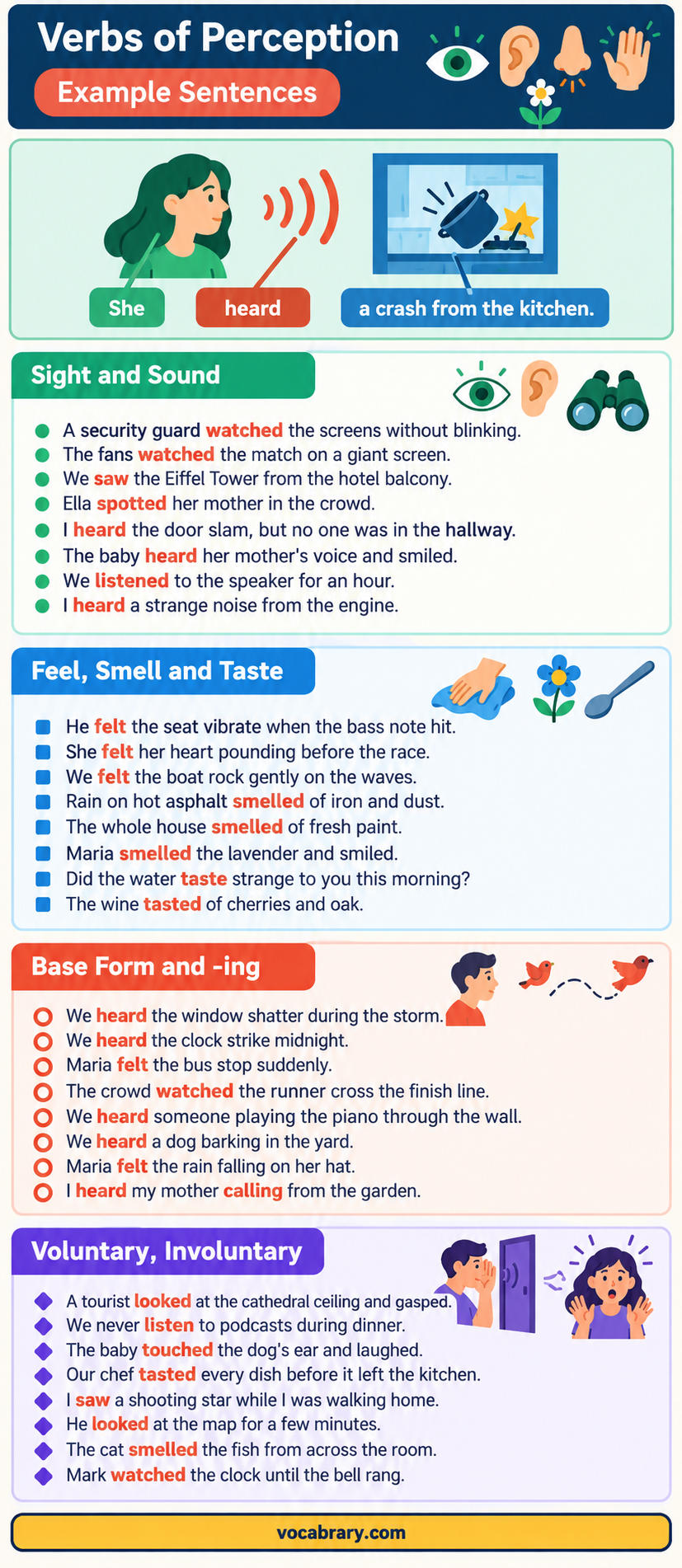
Common Verbs of Perception Example Sentences
Hearing a crash in the kitchen, seeing a deer at a forest edge, and tasting rust in tap water are three perception-verb encounters every learner meets early.
- She heard a crash from the kitchen and ran downstairs in her socks.
- Omar saw a deer at the edge of the forest on his morning run.
- We watched the parade pass our balcony for over an hour.
- My grandmother felt the first drops of rain on her arm and pulled her shawl overhead.
- The vinegar smelled so sharp that everyone in the kitchen turned away from the counter.
- Priya tasted the soup and added a pinch of salt.
- Did you notice the scratch on the front door?
- Our neighbour listened to the same radio station every single morning before breakfast.
- Nobody spotted the typo until the letters had already been posted.
- Hana looked at the old photograph for a long time without saying a word.
- Two hikers smelled wood smoke before they reached the campsite.
- The nurse felt his forehead and frowned.
- Children at the back of the hall heard nothing during the entire address.
- He tasted rust in the tap water and refused to drink a second glass.
- A stray cat watched every pigeon on the rooftop from behind a recycling bin.
Voluntary and Involuntary Verbs of Perception
An involuntary verb of perception such as see or hear fires without effort, while a voluntary one such as watch or listen names a deliberate act. Smell and taste switch between the two roles depending on whether the sensation arrives on its own or the person seeks it out.
| Perception Verb | Sense | Type |
|---|---|---|
| See | Sight | Involuntary |
| Watch | Sight | Voluntary |
| Look at | Sight | Voluntary |
| Notice | Sight | Involuntary |
| Hear | Hearing | Involuntary |
| Listen to | Hearing | Voluntary |
| Feel | Touch | Both |
| Smell | Smell | Both |
| Taste | Taste | Both |
| Touch | Touch | Voluntary |
- She saw the car skid across the wet road before anyone else reacted.
- Ravi watched the chess match for forty minutes without moving from his seat.
- A tourist looked at the cathedral ceiling and gasped.
- We never listen to podcasts during dinner.
- He heard the branch snap and froze on the spot.
- Tomoko noticed a spelling mistake on the restaurant menu.
- The baby touched the dog’s ear and laughed.
- I smelled lavender the moment the window swung open.
- Our chef tasted every dish before it left the kitchen.
- Nadia felt the vibration of the train through the station floor long before it arrived at the platform.
- Nobody overheard the conversation despite the thin walls.
- Did you spot the kingfisher by the river this morning?
See, Watch, Look, and Notice in Sentences
Drivers checking mirrors, birdwatchers scanning treetops, and gallery visitors staring at a painting all rely on see, watch, look, and notice. The four verbs divide the work between what the eye catches without effort and what it chases on purpose.
- Kwame saw lightning strike the old oak tree across the field.
- She watched the surgeon’s hands through the glass partition for twenty minutes.
- He looked at the timetable and realised his train had already left the station.
- I noticed a damp patch spreading across the bedroom ceiling.
- Anya saw her reflection in the shop window and straightened her collar.
- We watched three dolphins leap out of the water near the harbour wall.
- The lifeguard spotted a swimmer drifting too far from the shore.
- Did anyone notice the new fence around the cricket pitch?
- My father looked at the engine for an hour and found nothing wrong.
- Leyla observed the owl from behind a hedge every evening for a full week.
- Passengers on the upper deck saw the coastline appear through the morning fog.
- A security guard watched the screens without blinking.
- He noticed the price had doubled since his last visit to the same shop.
- She glimpsed a fox disappearing behind the dustbin.
- Neighbours looked out of their windows when the ambulance arrived.
- The pilot saw smoke rising from the forest floor and radioed the control tower.
- Ravi never noticed the crack in the wall until paint began to flake off.
- Tourists watched the changing of the guard from behind the palace railings and clapped when the soldiers marched past.
Hear and Listen in Sentences
Concert halls, city streets, and hospital corridors send different sounds to different ears, and hear catches the sounds that arrive without warning while listen names the ones a person chooses to track.
- She heard the ice crack under the bridge during the night.
- We listened to the entire album on the drive to Edinburgh.
- Diego heard his name on the loudspeaker and stood up immediately.
- Nobody listened to the safety announcement on the ferry.
- Our dog hears a siren three streets away and howls every time.
- He listened to the witness for half an hour before writing a single word.
- I heard the door slam, but no one was in the corridor.
- Students listened to the recording twice and then answered the questions on the worksheet.
- A mechanic heard a rattle inside the dashboard and asked for a longer test drive.
- Fatima overheard two colleagues discussing the deadline change in the stairwell and reported it to her manager that same afternoon.
- The audience heard every note because the hall was silent.
- We listened for the owl but only heard the wind in the pines.
- Did you hear the thunder during the second half of the match?
- He listened to the same voicemail three times before he understood the address.
Feel in Sentences
Hot sand underfoot, a cold railing against a palm, and a cat’s fur between the fingers are three textures that the verb feel turns into a full sentence. Each one links a part of the body to a surface or a temperature.
- She felt the hot sand burn through the soles of her sandals.
- Omar felt a sharp stone inside his boot after the first mile.
- I felt the cat’s fur and knew it had been out in the rain.
- The doctor felt for a pulse and found one almost at once.
- My hands felt numb after twenty minutes in the freezer aisle.
- He felt the seat vibrate when the bass note hit.
- Two children felt the moss on the wall and wiped their fingers on their shorts.
- She felt a tap on her shoulder and turned around to find nobody there.
- Luca felt the wind change direction just before the storm arrived.
- Grandmother felt the fabric between her thumb and forefinger, shook her head, and told the shopkeeper she wanted something softer.
- Did you feel the floor shake during the fireworks last night?
- The potter felt the clay spin faster beneath her hands.
Smell in Sentences
Bakers at dawn, gardeners after rain, and commuters passing a coffee shop all receive a scent before they decide whether to follow it. The verb smell reports that first involuntary hit of fragrance or rot.
- Fresh bread smelled so rich that every person walking down the street turned toward the open bakery door.
- She smelled smoke and pulled the plug from the toaster.
- We smelled the sea for the first time when the bus crested the hill.
- He sniffed the milk carton and poured it straight down the sink.
- The dog smelled a fox trail across the wet grass and bolted.
- Nadia smelled perfume in the lift and knew her neighbour had just left.
- Did you smell that gas when you walked past the meter outside?
- Rain on hot pavement smelled of iron and dust.
- I never smell chlorine without thinking of summer swimming lessons.
- The inspector sniffed along the pipe and found the leak under the floorboard.
Taste in Sentences
Burnt toast, unripe mango, and over-salted broth are three flavours that a single verb delivers straight from the tongue to the brain, and taste names the moment the flavour registers.
- Chen tasted ginger in the dressing and asked for a second serving.
- She tasted the strawberry jam before spreading it on the toast.
- That cough syrup tasted of liquorice and left a bitter film on the tongue.
- He tasted nothing all week because a head cold had numbed every flavour on his tongue.
- My daughter tasted olives for the first time and spat them into a napkin.
- The chef sampled the reduction three times before adding more vinegar.
- We tasted five cheeses at the market stall and bought the oldest one.
- Did the water taste strange to you this morning?
- Anya tasted honey in the tea even though nobody had added any.
- The broth tasted of celery and bay leaf.
Verbs of Perception With Object and Base Form
A boy tripping over a kerb, a window shattering in a storm, and a goalkeeper diving to the left all follow the same grammar. The perception verb takes an object and then a bare infinitive that reports the full deed from start to finish.
- She saw the boy trip over the kerb and drop his lunch bag.
- We heard the window shatter during the storm.
- Omar watched the goalkeeper dive to the left and miss the ball.
- I felt the floor shift under my feet during the tremor.
- Neighbours heard the alarm ring for ten straight minutes.
- The referee saw the striker push the defender before the whistle.
- He noticed the waiter drop a glass behind the counter.
- Leyla watched her brother open every birthday present in under a minute.
- Passengers felt the plane descend sharply after the captain’s announcement.
- A jogger saw the gate swing open and a dog run into the road.
- We heard the choir sing the final verse and the audience in the back rows rise to their feet.
- Did anyone see the delivery driver leave the parcel on the step?
Verbs of Perception With Object and -ing Form
A man jogging along a canal towpath, someone playing piano through a wall, and a teenager climbing a fence are actions caught in the middle. The -ing form after the perception verb shows that the deed was still under way at the moment of sensing.
- She saw a man jogging along the canal towpath at five in the morning.
- We heard someone playing the piano through the wall.
- Omar noticed water dripping from the ceiling over the staircase.
- I felt something crawling across my wrist under the blanket.
- The teacher watched the students working in pairs from the back of the classroom and wrote a note in her book.
- He heard his neighbours arguing through the shared wall.
- Priya saw two foxes fighting in the alley behind the restaurant.
- A nurse noticed the patient shivering and brought a second blanket.
- We smelled onions frying the moment we stepped into the house.
- Kwame felt the rope loosening around his waist during the climb.
- The guard spotted a teenager climbing the fence at the far corner.
- Did you hear the baby crying upstairs during dinner?
Verbs of Perception in Negative Sentences
Not seeing a cyclist, not hearing an alarm through a closed door, and not smelling gas through a stuffy nose are three failures of perception. A negative verb reports each one.
- She did not see the cyclist until it was almost too late.
- We never heard the alarm because the bedroom door was closed.
- He did not taste anything wrong with the fish, yet his stomach ached an hour later.
- Nobody noticed the dent in the car door until the insurance inspector arrived.
- I did not feel the injection at all.
- Priya never smelled the gas because a head cold had numbed her nose.
- The security guard did not spot the open window on the third floor.
- Our dog never hears the postman on rainy mornings.
- Nobody saw the owl leave the barn.
- He did not listen to a single word of the presentation.
- She never tasted her grandmother’s apple pie without thinking of childhood summers at the cottage.
- Did you not notice the change in the timetable posted outside the office?
Verbs of Perception Example Sentences for Kids
Seeing a ladybird on a green leaf, tasting chocolate cake, and feeling a worm wriggle in a hand are the sensory firsts that give every child a reason to use a perception verb.
- I saw a ladybird sitting on a green leaf.
- My dog heard a cat outside and barked at the back door.
- She tasted the chocolate cake and smiled with icing on her chin.
- We smelled popcorn at the cinema before the film started.
- He felt a worm wriggle in his hand and dropped it on the grass.
- The baby watched the bubbles float across the garden.
- I heard the birds singing outside my window this morning.
- Dad tasted the porridge and said it needed more honey.
- She looked at the rainbow and counted every colour out loud.
- Our teacher noticed the puddle in the corridor, told us to walk around it, and sent the caretaker to mop it up.
- My sister smelled the flowers and sneezed three times in a row.
- He felt the cold water on his toes and jumped back onto the sand.
Verbs of Perception Example Sentences for Students
Laboratory partners heating a solution, music students tuning an instrument, and geography fieldworkers recording birdsong all need a verb of perception to turn a classroom observation into a written sentence. More stative verb example sentences show the wider family of verbs that describe a state rather than a deed.
- The biology students observed the cells divide under the microscope.
- She heard her professor quote a line from the original Latin text.
- We tasted three soil samples during the agriculture practical and wrote down the pH of each on a shared chart.
- Erik noticed a pattern after reading the data a second time.
- Music students listened to the same passage eight times and marked every accent.
- He saw the experiment fail and wrote a full paragraph on what went wrong.
- Fieldworkers smelled sulphur near the hot spring and moved their equipment uphill.
- Our group watched the documentary twice before writing the review.
- She felt the rock sample crumble under light pressure during the geology lab.
- Did the examiner notice the correction fluid on your answer sheet?
- Two classmates heard a loud pop from the fume cupboard and stepped away at once.
- I looked at the essay prompt for five minutes before writing a single word.
Verbs of Perception and Action Verbs in the Same Sentence
Saw pairs with sprinted, heard pairs with grabbed, and tasted pairs with drank when a perception verb and an action verb share a sentence. The parts of speech example sentences show every word type that a sentence depends on, with verbs of perception among them.
- She heard the alarm and grabbed her coat from the back of the chair.
- Omar saw the ball rolling toward the road and sprinted to stop it.
- We tasted the bitter medicine and drank a full glass of water straight after.
- He felt a splinter in his thumb and pulled it out with tweezers.
- The dog smelled a rabbit and dug under the fence with both front paws.
- I noticed the open gate and locked it before the dog escaped.
- Priya heard the starting pistol and launched herself from the line.
- Two children saw the ice cream van parked at the corner of their street and ran across the playground to reach it before anyone else.
- She watched the news and then wrote a letter to the local council.
- He smelled burning rubber and switched the machine off at the wall.
- Anya tasted the sauce, frowned, and added a whole lemon to the pan.
- We heard a branch crack and ducked behind the nearest wall.
Related
FAQs
An everyday example is "She heard a crash from the kitchen and ran downstairs in her socks." Another is "We watched the parade pass our balcony for over an hour."
For young children, one example is "My dog heard a cat outside and barked at the back door." Another is "My sister smelled the flowers and sneezed three times in a row."
In sight, one example is "Kevin saw lightning strike the old oak tree across the field." Another is "The lifeguard spotted a swimmer drifting too far from the shore."
With hearing, one example is "Diego heard his name on the loudspeaker and stood up immediately." Another is "Nobody listened to the safety announcement on the ferry."
For touch, one example is "The doctor felt for a pulse and found one almost at once." Another is "She felt a tap on her shoulder and turned around to find nobody there."
A smell example is "She smelled smoke and pulled the plug from the toaster." Another is "We smelled the sea for the first time when the bus crested the hill."
In taste, one example is "She tasted the strawberry jam before spreading it on the toast." Another is "We tasted five cheeses at the market stall and bought the oldest one."
With a base form, one example is "We heard the window shatter during the storm." Another is "A jogger saw the gate swing open and a dog run into the road."
For an action in progress, one example is "We heard someone playing the piano through the wall." Another is "A nurse noticed the patient shivering and brought a second blanket."
A negative example is "She did not see the cyclist until it was almost too late." Another is "Nobody saw the owl leave the barn."
Related:

Leave a Comment