
Imagery is a literary device in which a writer uses descriptive language that appeals to the senses, as when a story describes the smell of rain on hot pavement. Strong imagery example sentences name an exact color, sound, smell, taste, or touch from ordinary scenes at home and outdoors.
What Is Imagery?
Imagery is sensory writing: words that let a reader see, hear, smell, taste, or feel a scene, and even sense motion or hunger. Unlike figurative language, which relies on comparison, imagery needs no comparison at all, although a vivid simile or metaphor adds imagery too.
Rain rattled on the tin roof while the smell of wet cedar drifted through the open window.
Common Imagery Example Sentences
Warm bread, crunching leaves, and cold rain on bare skin are the textbook cases of imagery, because each sentence names a sensation the reader has already felt.
- The kitchen smelled of warm bread and melted butter when we came home from school.
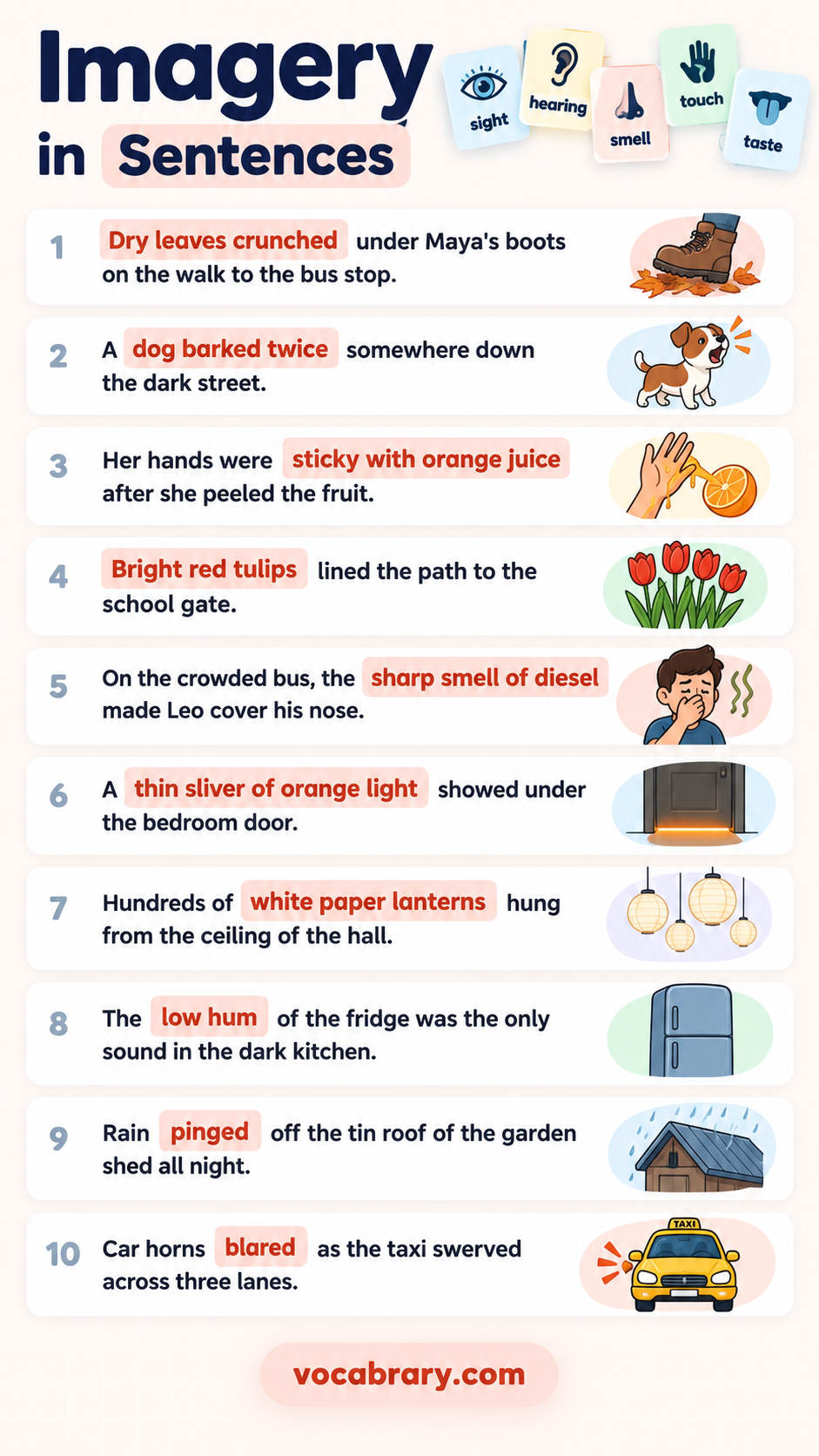
- Dry leaves crunched under Maya’s boots on the walk to the bus stop.
- Cold rain stung my cheeks and soaked through my thin cotton jacket.
- Grandpa’s coffee was bitter, black, and scalding hot.
- A dog barked twice somewhere down the dark street.
- Outside the café, the smell of fresh-cut grass mixed with the aroma of espresso.
- Hot sand burned the soles of our feet as we ran toward the cold, green water.
- Her hands were sticky with orange juice after she peeled the fruit.
- Did you hear the thunder rumble over the hills last night?
- Bright red tulips lined the path to the school gate.
- On the crowded bus, the sharp smell of diesel made Leo cover his nose.
- Nobody spoke, and the only sound was the tick of the kitchen clock.
- Thick wool socks kept my toes warm on the icy wooden floor.
- Every morning, the hiss of the kettle and the clink of spoons wake the whole house.
- Salty popcorn and sweet cola made the movie night complete.
- A thin sliver of orange light showed under the bedroom door.
- My legs ached and my lungs burned after the last mile of the race.
- Sweet jasmine grew along the fence, and its scent drifted into every corner of the yard.
- At the farmers market, ripe peaches felt soft and fuzzy in Ana’s palm.
- Wet paint glistened on the bright yellow door of the corner shop.
- Somewhere upstairs, a baby wailed and a floorboard creaked.
- Smoke from the barbecue stung our eyes and clung to our hair for the rest of the evening.
- One sip of the sour lemonade made Omar pucker his lips.
- Why does the smell of sunscreen always bring back summer holidays?
- Snowflakes melted the second they landed on my warm palm.
Types of Imagery With Example Sentences
The seven types of imagery match sight, sound, smell, taste, touch, movement, and inner feeling, from a red kite in a gray sky to a growling stomach during an exam.
Visual Imagery
Visual imagery names what a reader sees, such as a red kite against a gray sky or pale moonlight on black pine trees, so the reader pictures color, light, and size.
- A red kite darted back and forth against the flat gray sky.
- Pale moonlight fell across the black pine trees and the frozen pond.
- Priya wore a mustard-yellow raincoat with shiny silver buttons.
- Tiny golden specks of dust drifted in the beam of sunlight from the window.
- His old sneakers were scuffed, grass-stained, and split at the toe.
- On the horizon, a thin line of orange turned the sea deep violet.
- Neon signs flickered pink and blue in the puddles outside the diner.
- Hundreds of white paper lanterns hung from the ceiling of the hall.
- Did you see the double rainbow over the stadium after the storm?
- Nothing moved in the silver-gray fog except the blinking red light on top of the radio tower.
- Freckles covered her sunburned nose and pink cheeks.
Auditory Imagery
A slammed door, a humming fridge, and rain pinging off a shed roof are auditory imagery, since each sentence names a sound the reader recalls from daily life.
- A door slammed upstairs, and the windows rattled.
- The low hum of the fridge was the only sound in the dark kitchen.
- Rain pinged off the tin roof of the garden shed all night.
- Car horns blared as the taxi swerved across three lanes.
- Somewhere in the crowd, a child shrieked with laughter.
- Jonah heard the crack of the bat and the roar of the crowd at the same moment.
- Is that the drip, drip, drip of the bathroom tap again?
- Her phone buzzed against the wooden desk three times before she answered.
- Gravel crunched under the tires as the truck rolled into the driveway.
- No music played in the exam hall, and the only sound was the scratch of pencils on paper.
- Wind chimes tinkled on the porch.
- Bees buzzed in the lavender while a lawnmower droned two gardens away.
Olfactory Imagery
Burnt toast, fresh laundry, and wet dog fur are cases of olfactory imagery, and each one names a smell a reader links to a whole room or journey.
- The smell of burnt toast drifted up the stairs and woke my brother.
- Warm towels from the dryer gave off the scent of fresh laundry.
- After the walk in the rain, the car reeked of wet dog fur.
- Chlorine stung Mia’s nose the moment she opened the door to the pool.
- Grandma’s hallway smelled of mothballs, rose soap, and old books.
- A sweet whiff of cinnamon came from the bakery on the corner.
- Nobody wanted to open the fridge again after the sour stench of spoiled milk escaped.
- Cut grass and gasoline always mean Saturday morning in our neighborhood.
- In the garage, motor oil and sawdust mixed into one heavy, sharp smell.
- Did anyone else notice the smoky scent of a campfire on Leo’s jacket?
- Pine needles and damp earth scented the trail after the storm, and the whole forest smelled like the inside of an old wooden cabin.
- The hospital corridor smelled of bleach and hand sanitizer.
Gustatory Imagery
Gustatory imagery names flavors on the tongue, as in salty fries, a tart green apple, and bitter dark chocolate, so readers recall the taste of the food itself.
- The fries were hot, crisp, and heavily salted.
- Ravi bit into a tart green apple and winced at the sourness.
- Bitter dark chocolate melted slowly into a sweet, creamy aftertaste.
- After the dentist visit, everything tasted faintly of mint.
- Grandma’s soup was peppery, thick with garlic, and rich with chicken broth.
- One sip of the ice-cold lemonade left a sugary film on my lips.
- Wasn’t the spicy chili hot enough to make your tongue go numb?
- Salt water filled Sam’s mouth when the wave knocked him over.
- A sweet, sticky mango dripped juice down the child’s chin.
- By the time the budget meeting finally ended at six, my coffee had gone cold and bitter in its paper cup.
- Strawberry ice cream tasted sweet and slightly tangy on the hot afternoon.
- Burnt garlic ruined the whole pan of pasta with a harsh, acrid taste.
Tactile Imagery
Rough bark, an icy metal railing, and a kitten’s soft fur are tactile imagery, because each sentence names how a surface or temperature feels on the skin.
- The rough bark scraped Elena’s palms as she climbed the oak.
- On the ferry deck, the icy metal railing stung my bare fingers.
- A tiny kitten pressed its soft, warm fur against Noah’s cheek.
- Hot sand scorched the soles of our feet.
- The old sweater was scratchy and itchy around my neck.
- Silk sheets felt smooth and cool against the tired traveler’s skin.
- Sticky tape tugged at the hairs on his arm when the nurse pulled it off.
- Wet clay squished between the students’ fingers in pottery class.
- Nothing felt better than a warm bath after a day in the freezing wind.
- Did you feel the jagged edge of the broken tile?
- Raindrops tickled the back of my neck.
- A damp, heavy towel clung to Omar’s shoulders after his swim.
Kinesthetic Imagery
Kinesthetic imagery describes the body in motion, as in a sprint to the finish or a wobbly first bike ride, so readers sense the movement in their own muscles.
- Lucia sprinted the last fifty meters, arms pumping and knees high.
- My little brother wobbled, swerved, and finally pedaled away without training wheels.
- The ferry rocked from side to side, and we grabbed the rail to stay upright.
- Dancers spun, leapt, and landed in perfect silence.
- Two boys scrambled up the rocky slope on hands and knees, grabbing roots and loose stones to pull themselves toward the top.
- When the roller coaster plunged straight down, my stomach dropped.
- Jun stumbled off the treadmill on shaky legs.
- Hundreds of runners surged forward when the starting horn sounded.
- She ducked under the branch, jumped over the stream, and kept running.
- A swimmer kicked hard and glided under the surface of the pool.
- Did you feel the elevator jolt before it stopped?
- Grandpa lowered himself slowly into the armchair with a groan.
Organic Imagery
A growling stomach, a throat dry with thirst, and eyelids drooping after a night shift are organic imagery, which describes feelings inside the body rather than sensations from outside.
- My stomach growled so loudly during the exam that the student next to me laughed.
- By noon on the hike, my throat was dry and my lips had cracked from thirst.
- After the night shift, Dana’s eyelids drooped and her whole body ached for sleep.
- Theo felt sick to his stomach as the boat pitched in the swell, so he kept his eyes on the gray line of the coast until we docked.
- My heart pounded in my ears before I stepped onto the stage.
- Fever left the boy shivering under two blankets, hot and cold at once.
- A dull headache throbbed behind my eyes all afternoon.
- Nobody had eaten since breakfast, and by nine at night we were weak with hunger.
- Have you ever felt a sharp cramp in your side halfway through a run?
- Warmth spread through Sara’s chest when her name was called.
- The spicy curry left Ben sweating and gulping water.
- Jet lag left me dizzy, foggy-headed, and wide awake at three in the morning.
Imagery Examples About Nature
Mossy creek stones, robins at dawn, and the smell of pine resin are familiar nature imagery, and they place the reader outdoors through sight, sound, and smell.
- Green moss covered the stones along the edge of the creek.
- At dawn, robins sang in the hedge before the first car passed.
- The sticky smell of pine resin clung to our hands after we gathered firewood.
- A cold mountain stream splashed over smooth gray rocks.
- Tall grass brushed against my knees as I walked through the meadow.
- Purple heather covered the hills in every direction on our August walk across the Yorkshire moors with Grandpa.
- Somewhere in the forest, a woodpecker drummed on a dead trunk.
- Wild strawberries tasted warm and sweet straight from the plant.
- Under the oak, the ground was soft with fallen acorns and damp leaves.
- Frogs croaked from the pond as the sky turned pink.
- Did you smell the wild garlic growing along the riverbank?
- No sound reached the valley except the rush of the waterfall.
- Sunlight flickered through the leaves and made gold patches on the trail.
- A hawk circled slowly over the wheat field, its brown wings barely moving.
- Mud squelched under our boots on the path to the lake.
Imagery Examples About the Seasons
Cherry blossoms, sticky summer heat, crunching autumn leaves, and frozen breath at a bus stop are the seasonal images most readers recognize from their own year.
Spring Imagery
Pink cherry blossoms, bleating lambs, and warm rain on new leaves mark spring imagery, which describes the first warm days after winter through sight, sound, and touch.
- Pink cherry blossoms drifted onto the wet sidewalk.
- In early April, the air smelled of rain, fresh mud, and cut grass.
- Lambs bleated in the field behind the farmhouse.
- Tiny green buds covered every branch of the maple by the school.
- After the long winter, the sun felt warm on the back of my neck.
- Rows of bright yellow daffodils lined the park path.
- Did you hear the birds chirping at five this morning?
- Warm rain pattered on the new leaves while we waited under the porch roof.
Summer Imagery
Summer imagery is mostly heat and noise: an ice-cream truck’s jingle, buzzing cicadas, and asphalt so hot the tar turns soft under sandals.
- Sticky heat made my shirt cling to my back by ten in the morning.
- At four o’clock, the ice-cream truck jingled down our street.
- The public pool smelled of chlorine, sunscreen, and grilled hot dogs.
- Cicadas buzzed loudly in the trees all afternoon.
- Juice from a cold slice of watermelon ran down Kai’s arm.
- Fireflies blinked yellow-green in the dark backyard.
- Asphalt shimmered with heat, and the tar felt soft under our sandals.
- Nobody moved from the shade during the blazing noon heat.
Autumn Imagery
Red and orange leaves, woodsmoke, and honking geese are the autumn images poets and children both name first, because each one is specific to that season.
- Red and orange leaves crunched under the wheels of my bike.
- The kitchen smelled of baked apples and cinnamon.
- Crisp, cold air stung my nose on the walk to school.
- Woodsmoke drifted from the chimneys along the lane.
- A V of geese honked overhead on their way south.
- Mom’s pumpkin soup was thick, orange, and peppery.
- On the first morning of November, a thin white frost coated the lawn.
- Wet brown leaves stuck to our rubber boots in soggy clumps.
Winter Imagery
Frozen breath, squeaking snow, and hot chocolate on numb fingers are winter imagery about cold, silence, and the relief of warmth.
- Our breath came out in white clouds at the bus stop.
- Fresh snow squeaked under my boots in the minus-ten air.
- Icicles hung from the gutter, glittering in the low sun.
- Hot chocolate scalded my tongue but warmed my frozen fingers.
- The house smelled of pine needles and roasting chestnuts.
- Did you feel how icy the wind was on the bridge?
- After sledding all afternoon, our toes were numb and our ears were bright red.
- A heavy gray sky and bare black trees surrounded the frozen lake.
Imagery Examples About Weather
Thunder shaking the windows, hailstones bouncing off cars, and the smell of rain on hot pavement are weather images that use sound, touch, and smell as much as sight.
- Thunder shook the windows, and lightning lit the whole bedroom purple.
- Hailstones the size of peas bounced off the parked cars.
- The smell of rain on hot pavement rose as the first drops fell.
- Thick fog hid the bridge, and the foghorn sounded every minute.
- A freezing drizzle coated the windshield with a thin layer of ice.
- Gusts ripped the umbrella out of Ana’s hand and flipped it inside out.
- All August in Houston, the air was thick, damp, and heavy.
- Did you see the strange green sky just before the tornado siren went off?
- Rain hammered the car roof so loudly that we stopped talking.
- Under a cloudless blue sky, the heat baked the parking lot.
- Snow fell in fat, wet flakes that melted on the sidewalk as soon as they landed, leaving gray puddles by the school gates.
- Not a single leaf stirred in the still, sticky air before the storm.
- After the storm, water dripped from every branch and steam rose from the road.
Imagery Examples About Food
Sizzling bacon, crusty sourdough, and gooey melted cheese are the favorite images of menus and food writers, since sound, smell, and taste let a reader imagine the first bite.
- Bacon sizzled and popped in the cast-iron pan.
- The sourdough had a crackling crust and a soft, chewy center.
- Melted cheese stretched in long, gooey strands from Nina’s slice of pizza.
- Fresh basil gave the tomato sauce a sweet, peppery smell.
- A cold, fizzy soda stung the back of my throat.
- Their curry was fiery hot with ginger and green chilies, and I finished two glasses of water before the plate was empty.
- Buttery croissants flaked into golden crumbs all over my lap.
- Hot soup steamed in blue bowls on the kitchen counter.
- Didn’t the garlic bread smell amazing when it came out of the oven?
- Crunchy pickles and salty pretzels filled the picnic basket.
- Honey dripped slowly from the spoon in a thin golden ribbon.
- My first bite of the tart lemon pie made my eyes water.
- At the night market, grilled corn, chili oil, and sweet fried dough scented the whole street.
Imagery Examples About the City
Honking taxis, steam rising from a subway grate, and hot pretzels from a street cart are standard city imagery, placing the reader on a crowded sidewalk.
- Taxis honked as the light turned green on Fifth Avenue.
- Steam rose from a subway grate on the corner.
- The smell of hot pretzels and roasted nuts came from a street cart.
- A jackhammer pounded the pavement outside my office all morning.
- At midnight, red brake lights streaked down the wet highway.
- Pigeons scattered as a bus roared past.
- The subway car was hot, packed, and sour with sweat.
- Police sirens echoed between the tall buildings downtown.
- Rain-slick pavement reflected the yellow glow of the streetlights.
- Did you hear the rumble of the train under the sidewalk?
- In the August heat, garbage bags piled on the curb gave off a rotten, sweet smell.
- From the twentieth floor, the cars looked tiny and the street noise was a faint hum.
- Coffee, exhaust fumes, and wet concrete scented the air on my morning walk to work.
- Music thumped from an open car window at the red light.
Imagery Examples About the Beach
Crashing waves, squeaking white sand, and the smell of seaweed and coconut sunscreen are beach imagery that almost every reader has experienced firsthand.
- Waves crashed against the rocks and sprayed us with cold salt water.
- Warm, white sand squeaked under our bare feet.
- The air smelled of salt, seaweed, and coconut sunscreen.
- Seagulls screeched over the fishing boats at the pier.
- A turquoise sea stretched out to a hazy blue horizon, broken only by the white sail of a single fishing boat sailing home.
- Wet sand squished between my toes at the water’s edge.
- By noon, Luca’s shoulders were pink and stinging from the sun.
- Did you taste the salt on your lips after swimming?
- Tiny crabs scuttled sideways into their holes when our shadows fell over them.
- Driftwood, bleached silver-white, lay in a long row along the tide mark.
- Nobody wanted to leave while the sunset glowed orange over the water.
- The cold shock of the first wave made me gasp and laugh at once.
Imagery Examples About Emotions
A pounding heart before a speech, a tight throat at a funeral, and warm cheeks after praise are emotional imagery, which names the body’s reaction instead of the emotion itself.
- My heart pounded and my palms went damp as I walked up to the microphone.
- At the funeral, Dad’s throat tightened and he blinked back tears.
- Her cheeks grew warm when the coach praised her in front of the team.
- Leo clenched his fists so hard that his knuckles turned white.
- The news left me cold all over, with a hollow feeling in my stomach.
- The twins laughed until their sides ached and they gasped for air.
- Waiting for the exam scores, Nadia chewed her nails and tapped her foot.
- Did your stomach lurch when the plane dropped suddenly?
- Hot tears ran down Ben’s face as he read the letter his grandmother had written a week before she died.
- Relief made my shoulders drop, and I let out a long, slow breath.
- A shiver ran down my back when the door creaked open in the empty house.
- Jumping up and down, the children squealed when they saw the snow.
- Anger turned his face red and tightened his jaw.
- My legs trembled and I laughed out loud when I heard I got the job.
Imagery Examples for Kids
Crunchy carrots, a purring cat, and squishy mud in rain boots make short imagery example sentences for kids, and each one uses a sense children know from home, school, or the park.
- The cat purred on my lap, warm and soft.
- Crunchy carrots snapped in half when I bit them.
- Squishy mud oozed over the tops of my rain boots.
- My ice cream was cold, sweet, and dripping down the cone.
- Red, blue, and green balloons floated at the birthday party.
- The puppy’s wet nose tickled my hand.
- I heard the school bell ring and the lockers bang shut.
- Popcorn popped in the microwave and smelled buttery.
- Does your tummy rumble before lunch too?
- In The Snowy Day (1962) by Ezra Jack Keats, Peter’s feet crunch and sink into the deep snow with every step.
- Robert McCloskey’s Blueberries for Sal (1948) repeats the "kuplink, kuplank, kuplunk" of berries dropping into Sal’s tin pail.
- On one Saturday in Eric Carle’s The Very Hungry Caterpillar (1969), the caterpillar eats chocolate cake, Swiss cheese, a pickle, and watermelon.
- At the end of Where the Wild Things Are (1963), Max comes home to find his supper waiting for him, still hot.
- Sandpaper felt rough and scratchy under my fingers in art class.
Imagery Examples for Students and Essays
A grandmother’s kitchen, a silent exam hall, and a first day at a new school are the scenes students describe most in personal and descriptive essays, using sensory words in place of general statements.
- Grandma’s kitchen always smelled of fried onions, cardamom, and strong black tea.
- On my first day at the new school, the hallway echoed with slamming lockers and shouted greetings.
- The exam hall was silent except for the tick of the wall clock and the hum of the heaters.
- My grandfather’s hands were rough and cracked, and they smelled of engine oil.
- When I opened the acceptance email, my hands shook and my eyes blurred with tears.
- Every summer at the farm began with the smell of hay and the sting of mosquito bites, and it ended with the roar of the combine harvester in the wheat fields.
- In the hospital waiting room, fluorescent lights buzzed over rows of orange plastic chairs.
- After two years of losing, the cold, heavy trophy felt strange in my arms.
- My first bite of injera was sour, spongy, and warm, and I asked for more.
- At the bus stop in December, sleet soaked my shoes and numbed my fingers.
- Our apartment was so small that I heard my father’s snoring through the thin wall.
- Nothing prepared me for the roar of forty thousand fans at my first football match.
- The science lab smelled of burnt sugar and vinegar after our failed experiment.
- Under the hot, white stage lights, I felt sweat gather at my hairline.
Imagery Examples in Poetry
Daffodils by a lake, ripe autumn fruit, and a cellar full of apples are among the poetry images students study most, because each one lets a reader see, smell, or hear the poet’s scene.
Imagery in Classic Poems
William Wordsworth, John Keats, and Robert Browning wrote poems around golden daffodils, ripe autumn fruit, and a sea-scented beach, so readers share the scene each poet described.
- In "I Wandered Lonely as a Cloud" (1807), William Wordsworth comes upon a crowd of golden daffodils beside a lake, fluttering in the breeze under the trees.
- Wordsworth ends the same poem on his couch, where the picture of the yellow flowers flashes back into his mind.
- John Keats opens "To Autumn" (1819) with apples bending mossy cottage trees, swelling gourds, and plump hazel shells.
- Keats’s second stanza of "To Autumn" describes the last slow oozings of a cider press.
- The final stanza of "To Autumn" is almost pure sound: gnats by the river willows, bleating lambs, singing crickets, a whistling robin, and twittering swallows.
- Samuel Taylor Coleridge surrounds his becalmed sailors in The Rime of the Ancient Mariner (1798) with sea water while their tongues wither from thirst.
- Robert Browning’s "Meeting at Night" (1845) moves from a gray sea and a warm, sea-scented beach to a tap at the window and the blue flare of a struck match.
- Emily Dickinson’s poem beginning "I heard a Fly buzz" places a single fly’s blue, uncertain, stumbling buzz in a silent deathbed room.
Imagery in Modern Poems
Robert Frost’s apple ladder, Wilfred Owen’s coughing soldiers, and Sylvia Plath’s blackberry-stained fingers show modern poets using touch, sound, and physical strain as much as scenery.
- In "After Apple-Picking" (1914), Robert Frost’s speaker still feels the ache in his instep from the pressure of a ladder rung.
- Frost’s same speaker hears the rumbling of apples rolling into the cellar as he drifts toward sleep.
- Robert Frost’s "Birches" (1916) describes branches coated with ice that click against each other and drop crystal shells onto the snow crust.
- William Carlos Williams’s "The Red Wheelbarrow" (1923) names only a red wheelbarrow, glazed with rainwater, beside white chickens.
- Williams apologizes in "This Is Just to Say" (1934) for eating the plums in the icebox, which were "so sweet and so cold."
- Wilfred Owen’s "Dulce et Decorum Est" shows exhausted soldiers bent double, coughing, and trudging through sludge before a gas attack.
- T. S. Eliot’s "Preludes" (1917) opens on a winter evening with the smell of steaks in the passageways and gusts of rain scattering grimy leaves.
- In "Morning Song," Sylvia Plath’s speaker wakes at her baby’s cry and stumbles from bed, "cow-heavy and floral" in her Victorian nightgown.
- Plath’s "Blackberrying" leads the speaker down a lane of berries as big as the ball of her thumb, with blue-red juice on her fingers.
- Seamus Heaney’s "Digging" (1966) recalls the cold smell of potato mould and the squelch and slap of soggy peat under his grandfather’s spade.
- Heaney’s "Blackberry-Picking" (1966) remembers the sweet flesh of the first ripe berry and, weeks later, the rat-gray fungus on the berries stored in the byre.
Imagery Examples in Literature
A rotting wedding cake, a green light across a bay, and a heart pounding under the floorboards are scenes readers remember from novels, short stories, and plays long after they forget the plot.
Imagery in Novels
Charles Dickens, F. Scott Fitzgerald, and George Orwell give famous scenes a rotting wedding cake, a green dock light, and a hallway that smells of boiled cabbage.
- Charlotte Brontë opens Jane Eyre (1847) on a winter afternoon of cold wind, dark clouds, and soaking rain that rules out any walk.
- In Great Expectations (1861), Charles Dickens gives Miss Havisham a yellowed wedding dress, stopped clocks, and a rotting wedding cake thick with cobwebs.
- The Cratchit home in A Christmas Carol (1843) smells of roast goose, and the pudding arrives steaming, with a smell Dickens compares to washing day.
- F. Scott Fitzgerald’s The Great Gatsby (1925) places a single green light at the end of Daisy’s dock, across the dark water of the bay.
- Fitzgerald’s valley of ashes is a stretch of gray ash, gray houses, and ash-gray men between West Egg and New York.
- George Orwell starts Nineteen Eighty-Four (1949) on a bright, cold April day, with clocks striking thirteen and a hallway that smells of boiled cabbage.
- Marcel Proust’s narrator in Swann’s Way (1913) tastes a madeleine soaked in lime-blossom tea and suddenly recalls Sunday mornings in Combray.
- Perfume (1985) by Patrick Süskind describes eighteenth-century Paris as a city of stinking streets, rotting fish, and unwashed bodies.
- John Steinbeck’s The Grapes of Wrath (1939) opens with fine red and gray dust settling on the dying corn of Oklahoma, and families tie handkerchiefs over their noses.
- Harper Lee’s To Kill a Mockingbird (1960) describes Maycomb summers so hot that men’s stiff collars wilted by nine in the morning.
- Katniss Everdeen tastes lamb stew with dried plums in the Capitol in Suzanne Collins’s The Hunger Games (2008).
- Cormac McCarthy’s The Road (2006) follows a father and son through a world of gray ash, cold rain, and burned forests.
- In E. B. White’s Charlotte’s Web (1952), Zuckerman’s barn smells of hay, manure, and the sweat of tired horses.
Imagery in Short Stories and Plays
Edgar Allan Poe’s heartbeat under the floorboards and Lady Macbeth’s scrubbed hands are two cases of short stories and plays using a single sense to create dread.
- In Edgar Allan Poe’s "The Tell-Tale Heart" (1843), the narrator hears a low, dull, quick sound, like a watch wrapped in cotton.
- By the end of Poe’s story, the pounding under the floorboards grows so loud that the narrator screams his confession to the police.
- James Joyce’s "Araby" (1914) sends a boy through dark, muddy lanes past dripping gardens and smelly stables.
- Katherine Mansfield’s "The Garden Party" (1922) has a florist deliver trays of big pink canna lilies, and the kitchen is full of cream puffs.
- Kate Chopin’s Louise Mallard, at an open window in "The Story of an Hour" (1894), smells rain in the air and hears a peddler calling and sparrows twittering.
- A sleepwalking Lady Macbeth rubs her hands in Macbeth (about 1606) and says all the perfumes of Arabia will never sweeten her little hand.
Literal and Figurative Imagery Examples
Burnt rice and six red candles are literal imagery, while fog as thick as wool is figurative imagery, and both kinds appeal to the senses.
Literal Imagery
Literal imagery describes a scene exactly as it is, such as rain tapping on a tin roof or burnt rice at the bottom of a pot, with no comparison added.
- The burnt rice at the bottom of the pot smelled bitter and smoky.
- Rain tapped on the tin roof of the bike shed.
- A paper bag of warm chestnuts heated my hands on the walk home.
- Her wet hair dripped onto the white tiles of the bathroom floor.
- Six red candles flickered on the chocolate cake.
- By midday, the metal slide was too hot to touch.
- Two gray pigeons pecked at breadcrumbs by the park bench.
- Nobody noticed the faint smell of gas until the neighbor knocked on our door.
Figurative Imagery
Figurative imagery adds a simile or metaphor to the sensory description, such as fog as thick as wool or a sky the color of a bruise.
- Fog as thick as wool hid the harbor from view.
- By evening, the sky was the color of a bruise, purple and yellow at the edges.
- Under the moon, the frozen lake was a sheet of gray glass.
- His handshake was as cold and damp as a fish.
- Fresh snow lay like a white blanket over the whole village.
- The old car’s engine sounded like a bag of loose bolts.
- Langston Hughes’s "Harlem" (1951) asks whether a deferred dream dries up like a raisin in the sun or stinks like rotten meat.
- In "In a Station of the Metro" (1913), Ezra Pound compares faces in a crowd to petals on a wet, black bough.
Related
FAQs
The seven types of imagery are visual, auditory, olfactory, gustatory, tactile, kinesthetic, and organic. The first five match sight, sound, smell, taste, and touch, while kinesthetic imagery describes movement and organic imagery describes inner feelings such as hunger or fatigue.
Five familiar examples of imagery are the smell of burnt toast, the crunch of dry leaves, the taste of a tart apple, the sting of cold rain, and a red kite in a gray sky. Each one appeals to a different sense, so together they show all five main types.
Imagery is not always figurative language, because a literal line such as "the soup was hot and salty" is imagery with no comparison in it. Imagery turns figurative when it adds a simile, a metaphor, or personification, as in "fog as thick as wool." These figurative language examples show those devices on their own.
Imagery and description differ in focus, because description names what is present while imagery names how it looks, sounds, smells, tastes, or feels. "There was a dog in the yard" is description, and "a wet brown dog shook mud across the yard" adds imagery.
Imagery and symbolism differ in purpose, since imagery creates a sensory picture while symbolism gives an object a second meaning. The green light in The Great Gatsby is both at once: a vivid image of a light across dark water and a symbol of Gatsby’s longing for Daisy.
No, imagery does not have to be visual, because it appeals to all five senses as well as to movement and inner feeling. Sound imagery such as "gravel crunched under the tires" and smell imagery such as "the hallway smelled of bleach" count as fully as any picture.
Imagery words are sensory adjectives, nouns, and verbs that name an exact sensation, such as crimson, sizzle, musty, tangy, gritty, and sprint. They replace general words like nice, bad, or loud with a sensation the reader recognizes at once.
Authors use imagery so that readers experience a scene through their own senses instead of being told about it. Imagery also sets the mood, as when Orwell’s hallway smells of boiled cabbage, and it reveals a character’s feelings through the body.
Imagery makes the reader recall real sensations, which produces a stronger emotional reaction and a more memorable scene. A reader who reads the words "tart lemon pie" recalls the sour taste, and that memory lasts longer than a plain statement that the pie was good.
Imagery in poetry is the poet’s use of sensory words to create a full scene in very few lines. William Carlos Williams’s "The Red Wheelbarrow" is only sixteen words long, yet the red wheelbarrow, the rainwater, and the white chickens give a complete picture. Poets pair imagery with other figures of speech such as simile and metaphor.
Abstract imagery is sensory language that describes a feeling or state with no physical form, such as grief described as a cold stone in the chest. It links something a reader is unable to touch or see to a sensation the reader already knows.
Most reading programs introduce imagery in kindergarten through second grade, when children describe objects with their five senses. Students learn to identify and write their own imagery by third or fourth grade, and middle and high school classes add kinesthetic and organic imagery and analysis of poems.
You use imagery in a sentence by replacing a general word with a specific sensation, as when "the food was good" becomes "the soup was hot, peppery, and thick with garlic." Choose one or two senses, name exact colors, sounds, or smells, and prefer strong verbs such as crunched, sizzled, or stung.

Leave a Comment