
Spoonerism is a form of wordplay in which a speaker swaps the first sounds of two words, as when “a crushing blow” comes out as “a blushing crow.” Most spoonerism examples start as accidental slips in everyday talk, where a tired or rushed speaker turns a plain request into a silly new phrase.
What Is Spoonerism?
A spoonerism is a speech error or joke that trades the opening sounds of two nearby words while leaving the rest of each word in place, so “jelly beans” becomes “belly jeans.” Unlike a malapropism, which replaces one whole word with a sound-alike, a spoonerism keeps the right words and mixes up their first sounds.
Raising his glass at the wedding, the best man toasted the nappy hewlyweds (intended: happy newlyweds).
Common Spoonerism Examples in Sentences
Belly jeans, a blushing crow, and a lack of pies are the spoonerism examples most English speakers know, and each one swaps two opening sounds to create a funny new phrase.
- Shaking his head after the loss, the coach called the final score a blushing crow for the whole team (intended: a crushing blow).
- Lily asked her dad for a bag of belly jeans at the checkout (intended: jelly beans).
- “That story is a lack of pies,” Grandpa said when my brother blamed the dog for the broken vase (intended: a pack of lies).
- At the café, Rosa pushed away her wilted lettuce and called it a sad ballad (intended: a bad salad).
- Why is Leo chipping the flannels every five seconds? (intended: flipping the channels)
- From the back of the crowd, Rafael complained that he couldn’t bear the hand (intended: hear the band).
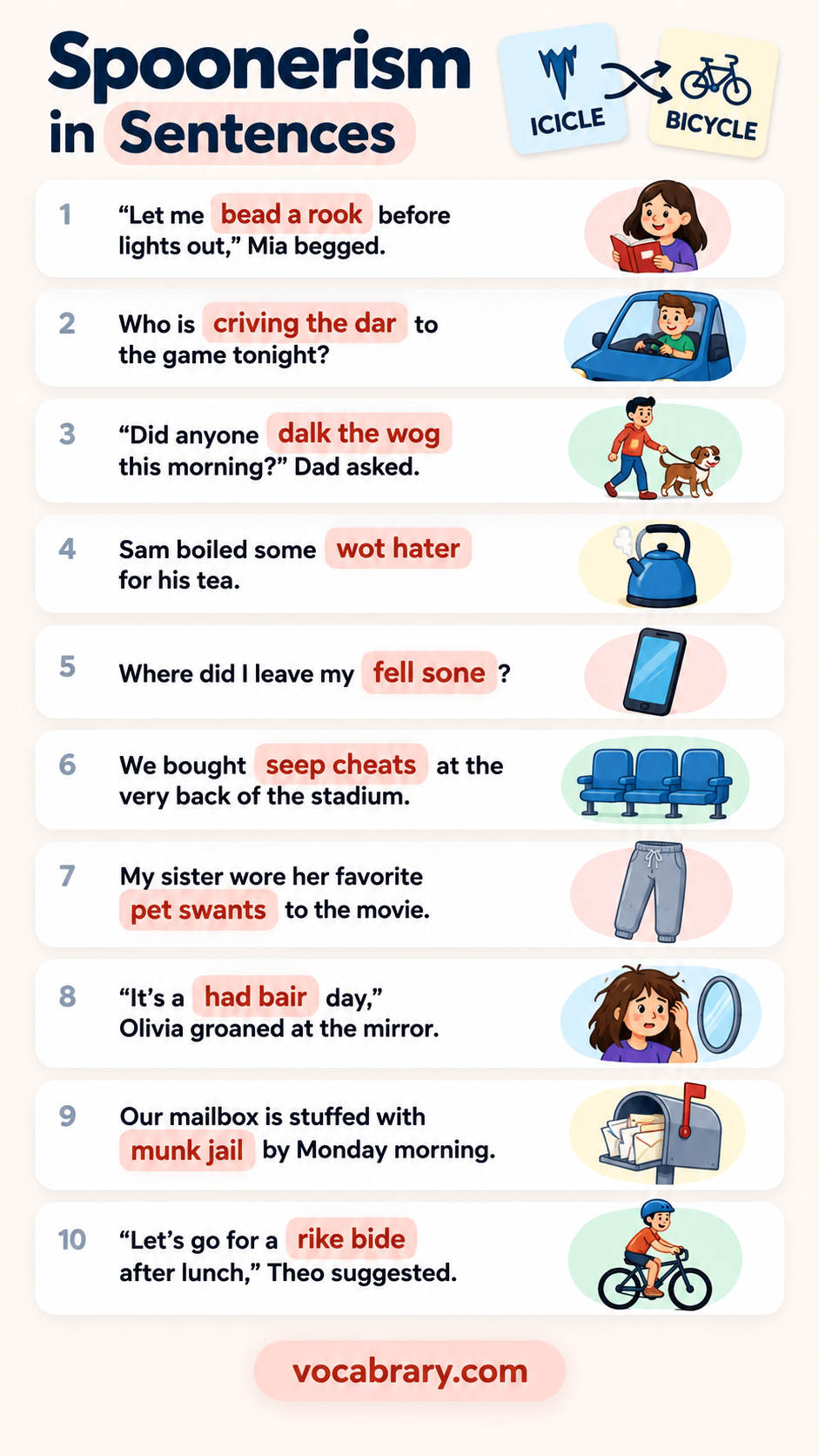
- “Let me bead a rook before lights out,” Mia begged (intended: read a book).
- Our team leader proudly unveiled his plaster man for the spring sale (intended: master plan).
- At eighteen, Jake told his parents he was finally heaving loam (intended: leaving home).
- “I think I have drain bamage,” Kim joked after a four-hour exam (intended: brain damage).
- Halfway up the trail, Owen stopped to share his snail tracks with the group (intended: trail snacks).
- We spent all of Saturday morning caking a bake for Aunt Lou’s retirement party (intended: baking a cake).
- Who is criving the dar to the game tonight? (intended: driving the car)
- Leading the march outside the aquarium, Ben shouted, “Wave the sails!” (intended: save the whales)
- Dad muttered that he still had to bay the pills before Friday (intended: pay the bills).
- “Please dut the shore, it’s freezing in here,” Mom called from the kitchen (intended: shut the door).
- Calling the garage, Hana explained that her star won’t cart on cold mornings (intended: car won’t start).
- Handing over a twenty, the tired driver told the cashier to cheap the kange (intended: keep the change).
- Bumping into her old teacher in Rome, Nora laughed, “It’s a wall smorld!” (intended: small world)
- At the job fair, Victor stepped forward to hake shands with the recruiter (intended: shake hands).
Spoonerism Examples in Everyday Life
Unmade beds, dog walks, and locked doors lead to everyday spoonerisms such as shed beets, dalk the wog, and dock the lore, blurted out by tired or rushed speakers at home.
- Before the guests arrived, Mom asked me to change the shed beets (intended: bed sheets).
- “Did anyone dalk the wog this morning?” Dad asked (intended: walk the dog).
- Every night, Kate checks twice that she remembered to dock the lore (intended: lock the door).
- Sam boiled some wot hater for his tea (intended: hot water).
- On sunny days, Grandma never leaves the house without her hun sat (intended: sun hat).
- “Watch out for the pet waint on the railing,” the painter warned us (intended: wet paint).
- After the storm, Maria had to replace a bight lulb in the hallway (intended: light bulb).
- My brother put off washing his lirty daundry for two whole weeks (intended: dirty laundry).
- Every Sunday, Mr. Lee goes out to low the mawn before lunch (intended: mow the lawn).
- “Don’t forget to keed the fat,” Emma reminded her roommate (intended: feed the cat).
- Paolo got a tarking picket outside the dentist’s office (intended: parking ticket).
- Ruth tripped over the harden gose coiled by the back steps (intended: garden hose).
- Where did I leave my fell sone? (intended: cell phone)
- Hurrying out the door, Jamal grabbed his cane roat from the hook (intended: raincoat).
- Dad promised to six the fink before our relatives arrived for the holidays (intended: fix the sink).
- “Please lurn the tights off when you leave,” Aunt Meg told the kids (intended: turn the lights).
- Stuck behind a bus, Omar waited for the laffic tright to change (intended: traffic light).
- Tina booked a cair hut for Friday afternoon, just two hours before her cousin’s big outdoor wedding in the mountains (intended: haircut).
- “Somebody used my brand-new booth trush!” Lucy yelled from the bathroom (intended: toothbrush).
Two-Word Spoonerism Examples
Tea bag, road trip, and big deal turn into bee tag, toad rip, and dig beal when their first sounds trade places, so each two-word spoonerism produces a pair of new and unrelated words.
- Priya held out her mug and asked for a bee tag (intended: tea bag).
- Our summer toad rip to the coast lasted nine hours because Dad refused to stop and ask for directions (intended: road trip).
- Stretched out on the couch after lunch, Grandpa took a quick nat cap (intended: catnap).
- We bought seep cheats at the very back of the stadium (intended: cheap seats).
- At the beach, the kids collected one she sell after another (intended: seashell).
- Daniel admitted he had fold keet the night before his wedding (intended: cold feet).
- My sister wore her favorite pet swants to the movie (intended: sweatpants).
- “It’s a had bair day,” Olivia groaned at the mirror (intended: bad hair).
- Every morning, Ali buys a paper at the stews nand on the corner (intended: newsstand).
- When I passed my driving test, my brother just shrugged and said, “Dig beal.” (intended: big deal)
- Coach Rivera clapped and yelled “Jood gob!” after the relay (intended: good job).
- “Dell won, everyone,” the conductor said at the end of the final rehearsal (intended: well done).
- Our mailbox is stuffed with munk jail by Monday morning (intended: junk mail).
- “This is your chast lance to buy tickets,” the announcer said (intended: last chance).
- The ferry crossing to the island was a rumpy bide from start to finish (intended: bumpy ride).
Longer Spoonerism Phrases
A trone left on the fain, a pog taken to the dark, and a hoat and cat grabbed in the snow show longer spoonerism phrases, where the swap jumps across several words in one request.
- “We’re taking the pog to the dark,” Hannah told her neighbor (intended: the dog to the park).
- “Oh no, I left my trone on the fain!” cried Marcus as the doors closed (intended: phone on the train).
- “Bime to go to ted,” Mom announced at eight o’clock sharp (intended: time to go to bed).
- “Grab your hoat and cat, it’s snowing,” Dad called up the stairs (intended: grab your coat and hat).
- “Pass me the mutter and the bilk, please,” said Grandpa at breakfast (intended: butter and the milk).
- “My rose is nunning again,” Ella sniffed halfway through the spelling test (intended: nose is running).
- “Let’s go for a rike bide after lunch,” Theo suggested (intended: bike ride).
- “Wait for the leen gright,” the crossing guard told the children lined up at the curb on the first rainy morning of the school year (intended: green light).
- “Deep the noise kown, the baby is asleep,” whispered Aunt Rosa (intended: keep the noise down).
- The best man stood up to hank the thosts for a lovely evening (intended: thank the hosts).
- At the drive-through, Jess ordered “the fricken with a side of chies” (intended: chicken with a side of fries).
- Did you lut the pid on the paint tin? (intended: put the lid)
Food Spoonerism Examples
Grilled cheese, chicken soup, and roast beef become chilled grease, sicken choup, and boast reef when the first sounds switch, so food spoonerisms sound far less tasty than the real dish.
- Our neighbor ordered a chilled grease sandwich and wondered why the waiter laughed (intended: grilled cheese).
- When Josh caught a cold, his grandmother made him a pot of sicken choup (intended: chicken soup).
- Dad carved the boast reef while everyone passed the gravy (intended: roast beef).
- For breakfast, Kai poured himself a bowl of florn cakes (intended: cornflakes).
- “I’d love a beanut putter sandwich,” Zoe told her mom (intended: peanut butter).
- The kids begged for mocolate chilk after soccer practice (intended: chocolate milk).
- Thanksgiving isn’t complete without a mountain of pashed motatoes (intended: mashed potatoes).
- At the county fair, Leon bought a dot hog with extra mustard (intended: hot dog).
- “Who wants a tup of kea?” asked Mrs. Grant (intended: cup of tea).
- For dessert, the bakery sold slices of temon lart (intended: lemon tart).
- Rita’s grandma bakes the best cugar sookies in town (intended: sugar cookies).
- Craving something cold on the drive home, Ethan ordered a shilk make (intended: milkshake).
- Every Friday, our family buys chish and fips at the harbor (intended: fish and chips).
- We stopped at the ship chop on the pier for lunch (intended: chip shop).
- Vera spread a thick layer of cheam creese on her bagel (intended: cream cheese).
- On cold winter evenings, Mom served thick slices of leat moaf with mashed carrots and a side of green beans (intended: meatloaf).
- Nobody ordered the muna telt, so the cook ate it himself (intended: tuna melt).
- “Pass the joast and tam,” Lily said with her mouth full (intended: toast and jam).
- At the Fourth of July cookout, Uncle Ray grilled a dozen dili chogs for the neighbors (intended: chili dogs).
- Freddie stirred the bancake patter until it was smooth (intended: pancake batter).
Spoonerism Examples With Names
Harry Potter, Mary Poppins, and Times Square turn into Parry Hotter, Pary Moppins, and Squimes Tare when a speaker swaps the first sounds of a name, which makes famous people and places sound brand new.
Spoonerisms of People’s Names
- My little brother asked for the next Parry Hotter book for his birthday (intended: Harry Potter).
- At the costume party, Ivy dressed up as Pary Moppins (intended: Mary Poppins).
- The toddler hugged her stuffed Pinnie the Wooh all night (intended: Winnie the Pooh).
- Nico’s favorite toy is a talking Luzz Bightyear (intended: Buzz Lightyear).
- Calling the roll on the first day, Mr. Adams greeted a new student as Bate Kell (intended: Kate Bell).
- “Paging Man Diller to the front desk,” the receptionist announced (intended: Dan Miller).
- At the awards dinner, the host congratulated Bucy Laker on her promotion to regional manager (intended: Lucy Baker).
- “Please welcome our guest speaker, Fam Sisher!” the principal said (intended: Sam Fisher).
- Grandpa introduced his new golf partner as Ken Booper (intended: Ben Cooper).
- On the radio, the DJ dedicated a song to Mina Toss from Dallas (intended: Tina Moss).
Spoonerisms of Place Names
- After her trip, Aunt Carol kept calling the city Yew Nork (intended: New York).
- We took a selfie under the bright billboards of Squimes Tare (intended: Times Square).
- Our bus stopped outside Puckingham Balace to watch the guards (intended: Buckingham Palace).
- Grandpa told stories about hiking the Crand Ganyon in 1975 (intended: Grand Canyon).
- “Which way to Lalt Sake City?” asked the lost driver (intended: Salt Lake City).
- Vince booked a weekend in Vas Legas for his fortieth birthday (intended: Las Vegas).
- The real estate agent promised us a view of the Heverly Bills (intended: Beverly Hills).
- On their road trip through South Dakota, the Garcias stopped to photograph Rount Mushmore (intended: Mount Rushmore).
Spoonerism Examples at School
Spelling bees, fire drills, and report cards turn into belling spee, dire frill, and ceport rard at school, where nervous students and busy teachers swap sounds mid-sentence.
- The principal announced the winner of the belling spee over the loudspeaker (intended: spelling bee).
- Just as the test started, the alarm rang for a dire frill (intended: fire drill).
- Nervous about her grades, Jada hid her ceport rard in her backpack (intended: report card).
- Our class went on a trield fip to the science museum (intended: field trip).
- “Everyone, put on your cab loats,” the chemistry teacher said (intended: lab coats).
- Mr. Patel surprised the class with a quop piz on Monday (intended: pop quiz).
- Tyler forgot his munch loney at home again (intended: lunch money).
- “Do you have a pall hass?” the hall monitor asked (intended: hall pass).
- Ms. Rivera asked us to nopy the coats from the whiteboard before the bell (intended: copy the notes).
- Nobody in the class finished the rook beport on time (intended: book report).
- “Parpen your shencils, everyone,” the teacher said before the exam (intended: sharpen your pencils).
- The fience sair judges loved Maya’s baking-soda volcano (intended: science fair).
- After lunch, we all walked quietly to hudy stall (intended: study hall).
- When the rell bang at three o’clock, the students rushed outside (intended: bell rang).
- Hugo left his kencil pase on the bus (intended: pencil case).
- The kids waited by the gate in the drizzle for the late bool skus to finally pull up (intended: school bus).
Spoonerism Examples at Work
Staff meetings, coffee breaks, and phone calls become maff steeting, boffee crake, and cone fall at work, where a rushed speaker trades sounds in front of colleagues.
- Linda reminded everyone about the maff steeting at nine (intended: staff meeting).
- “How about a quick boffee crake?” the supervisor suggested (intended: coffee break).
- Nervous on his first day, Tariq introduced himself as the hew nire (intended: new hire).
- The finance director warned that the company’s flash cow was shrinking every quarter (intended: cash flow).
- I’ll call you back after this cone fall (intended: phone call).
- Grace practiced her pales sitch in front of the mirror (intended: sales pitch).
- Our boss treated everyone to a leam tunch on Friday (intended: team lunch).
- With the investors watching, the CEO walked through the lottom bine (intended: bottom line).
- “Where’s my pouse mad?” Ravi asked, searching his desk (intended: mouse pad).
- After a long morning of calls, Noah grabbed his jacket and headed out on his brunch lake (intended: lunch break).
- Is the mopy cachine broken again? (intended: copy machine)
- The intern handed out cusiness bards at the conference (intended: business cards).
- Rosa asked her manager for a ray pise after three years (intended: pay rise).
- Everyone signed their shime teets before the weekend (intended: time sheets).
- Standing at the podium, the spokesperson read the ress prelease aloud (intended: press release).
- At the moard beeting, the chairman stumbled over his opening words (intended: board meeting).
- “The tales seam hit its target,” the director announced (intended: sales team).
Famous Spoonerisms Attributed to Reverend Spooner
Reverend William Archibald Spooner, Warden of New College, Oxford, gave his name to lines such as the shoving leopard and the queer old dean. Students and colleagues are thought to have invented most of them.
- One sermon line attributed to Spooner calls the Lord a shoving leopard (intended: a loving shepherd).
- According to Oxford legend, Spooner scolded a student for fighting a liar in the quadrangle (intended: lighting a fire).
- Spooner is said to have raised a toast to our queer old dean (intended: our dear old queen).
- At a wedding, the story goes, he announced that it is kisstomary to cuss the bride (intended: it is customary to kiss the bride).
- A familiar Oxford tale has him asking a secretary, “Is the bean dizzy?” (intended: Is the dean busy?)
- Another line credited to him praises a well-boiled icicle (intended: a well-oiled bicycle).
- Finding a stranger in his church seat, Spooner supposedly complained that someone was occupewing my pie (intended: occupying my pew).
- In the same anecdote, he asks the usher to sew me to another sheet (intended: show me to another seat).
- The best-known classroom story has Spooner telling a lazy student that he has hissed all my mystery lectures (intended: missed all my history lectures).
- That student, the tale continues, had tasted the whole worm (intended: wasted the whole term).
- The anecdote ends with an order to leave Oxford by the next town drain (intended: the next down train).
- A speech to farm workers attributed to him praised them as tons of soil (intended: sons of toil).
- One more attributed line has him confessing that he had a half-warmed fish in his heart (intended: a half-formed wish).
- Yet another story has him calling a snug corner of a room a nosey little cook (intended: a cosy little nook).
- Spooner is reported to have admitted announcing the hymn “Kinquering Congs Their Titles Take” in 1879 (intended: Conquering Kings Their Titles Take).
- The Oxford Dictionary of Quotations accepts only one line as authentic, a warning that the weight of rages would press hard on employers (intended: the rate of wages).
Spoonerism Examples in Comedy, TV, and Radio
Ronnie Barker’s pismronunciation sketch, Archie Campbell’s Rindercella, and Pam’s joke in The Office are deliberate spoonerisms, written for laughs, while Harry von Zell’s 1931 radio slip was a genuine accident.
- Ronnie Barker’s most famous word sketch has him playing a spokesman for the Loyal Society for the Relief of Sufferers from Pismronunciation (intended: mispronunciation).
- Barker’s spokesman explains that for sufferers the words come tumbling out in wuck a say (intended: in such a way).
- Country comedian Archie Campbell, a founding cast member of Hee Haw, retold Cinderella as Rindercella (intended: Cinderella).
- Campbell’s heroine slopped her dripper as she ran from the ball (intended: dropped her slipper).
- In the 2011 episode “Doomsday” of The Office, Pam wins Dwight over with the joke pobody’s nerfect (intended: nobody’s perfect).
- Reading a 1931 birthday tribute on the radio, announcer Harry von Zell called the president Hoobert Heever (intended: Herbert Hoover).
- Capitol Steps, a political comedy troupe, performs a routine called Lirty Dies (intended: dirty lies).
- The title of Van der Graaf Generator’s 1971 album Pawn Hearts grew out of saxophonist David Jackson’s slip of the tongue (intended: horn parts).
- NOFX titled its 1994 album Punk in Drublic (intended: drunk in public).
Spoonerism Examples in Literature
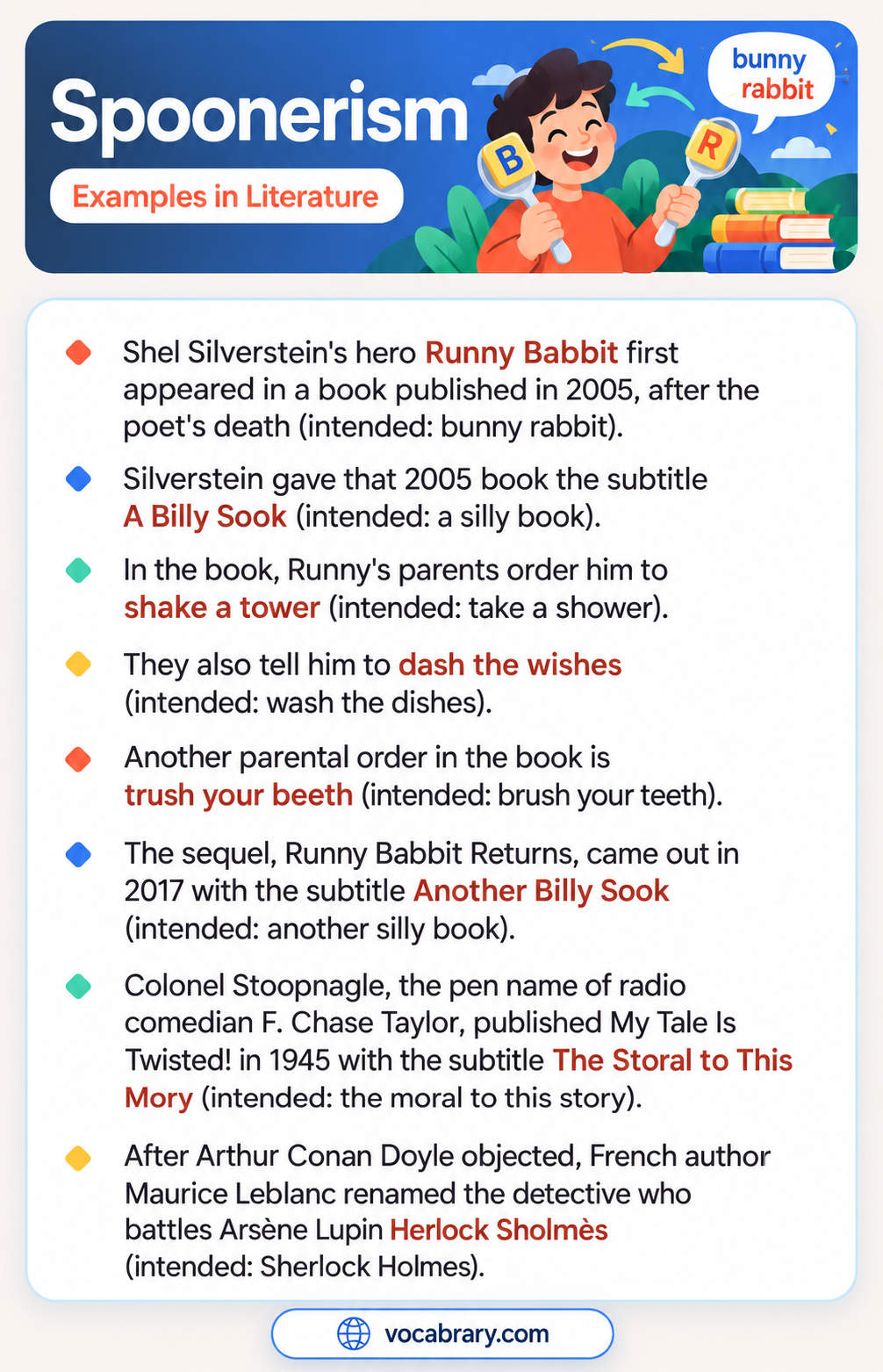
Shel Silverstein’s Runny Babbit, Colonel Stoopnagle’s twisted fairy tales, and Maurice Leblanc’s Herlock Sholmès use spoonerisms on purpose, turning familiar names and stories into wordplay.
- Shel Silverstein’s hero Runny Babbit first appeared in a book published in 2005, after the poet’s death (intended: bunny rabbit).
- Silverstein gave that 2005 book the subtitle A Billy Sook (intended: a silly book).
- In the book, Runny’s parents order him to shake a tower (intended: take a shower).
- They also tell him to dash the wishes (intended: wash the dishes).
- Another parental order in the book is trush your beeth (intended: brush your teeth).
- The sequel, Runny Babbit Returns, came out in 2017 with the subtitle Another Billy Sook (intended: another silly book).
- Colonel Stoopnagle, the pen name of radio comedian F. Chase Taylor, published My Tale Is Twisted! in 1945 with the subtitle The Storal to This Mory (intended: the moral to this story).
- After Arthur Conan Doyle objected, French author Maurice Leblanc renamed the detective who battles Arsène Lupin Herlock Sholmès (intended: Sherlock Holmes).
Funny Spoonerism Examples
A bunny phone, a habbit pulled out of a rat, and a forecast of roaring pain are funny spoonerism examples, because the swapped sounds form real words that paint a ridiculous new picture.
- Tripping on the rug, Marco banged his elbow and yelled that he had hit his bunny phone (intended: funny bone).
- “Oops, that was a tip of the slung,” the newsreader said after mixing up two names (intended: slip of the tongue).
- Furious at his brother, Kevin told him to go lump in the jake (intended: go jump in the lake).
- After a rough day, Bella opened her arms and said, “I heed a nug.” (intended: I need a hug)
- For his big finale, the magician pulled a habbit out of a rat (intended: rabbit out of a hat).
- “Sorry, I have a nain in the peck,” Walter said, rubbing his shoulders (intended: pain in the neck).
- Grandpa reached for a spooden woon to stir the soup (intended: wooden spoon).
- “That was a fig bat lie!” Mia shouted at her brother (intended: big fat lie).
- The weekend forecaster cheerfully promised two full days of roaring pain (intended: pouring rain).
- The flight attendant smiled and asked us to sasten our featbelts (intended: fasten our seatbelts).
- Tony called his eccentric uncle had as a matter (intended: mad as a hatter).
- Jumping off the diving board, Sid landed with a painful felly blop (intended: belly flop).
- “Those two gossips are fords of a bether,” Aunt Tess said (intended: birds of a feather).
- Grandpa loves to broot the sheeze with the mailman every morning (intended: shoot the breeze).
- Before dinner, Dad told the twins to hash their wands (intended: wash their hands).
- “Follow me, I’ll wead the lay,” the scout leader called over his shoulder as the group reached the fork in the muddy trail (intended: lead the way).
- “Excuse me, I dropped my nork and fife,” Grace told the waiter (intended: fork and knife).
- Is the doup of the say tomato again? (intended: soup of the day)
Spoonerism Examples for Kids
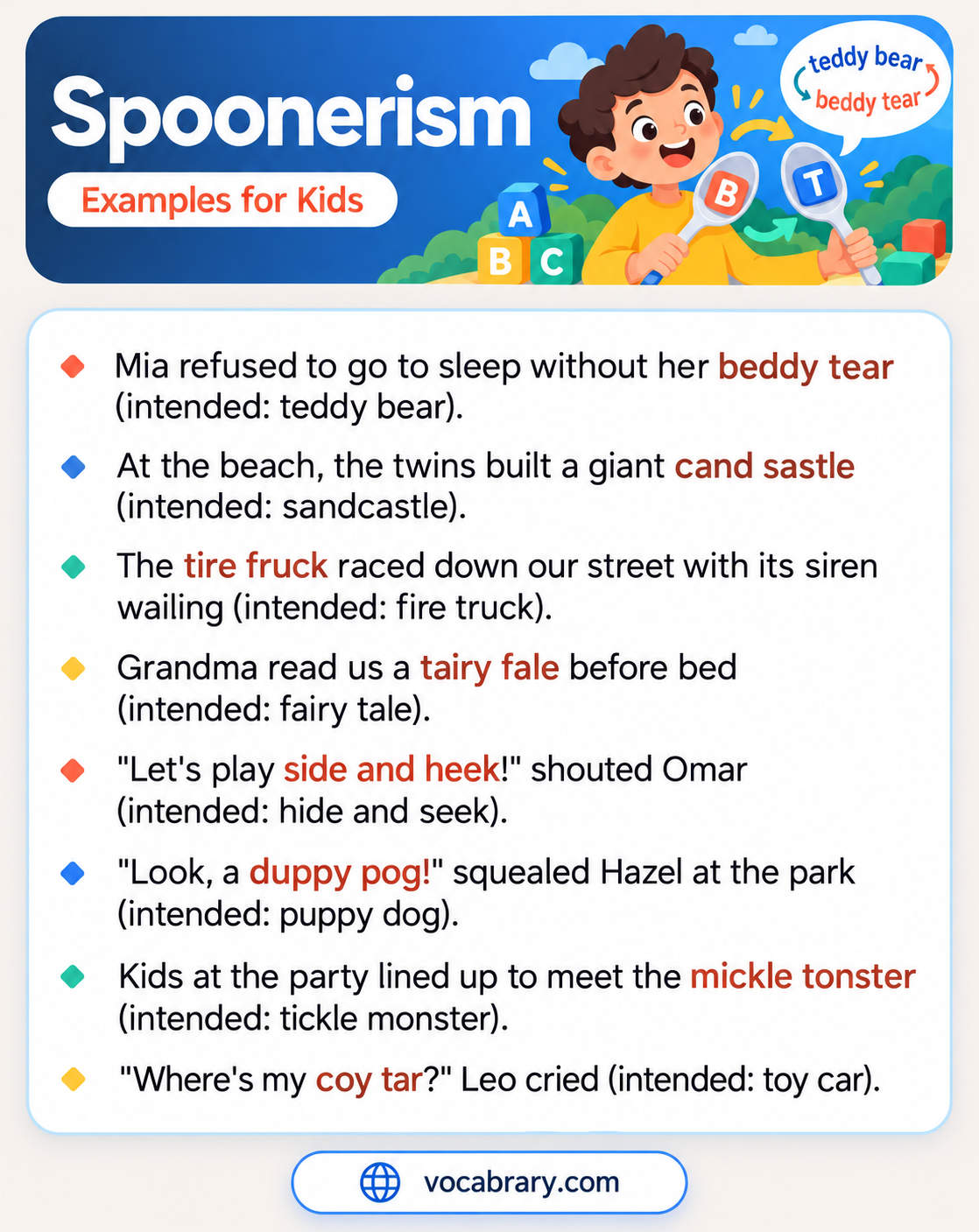
Teddy bears, birthday cakes, and sandcastles become beddy tears, kirthday bakes, and cand sastles in these short spoonerism examples for kids to find and say aloud.
- Mia refused to go to sleep without her beddy tear (intended: teddy bear).
- The whole class sang for Leo’s kirthday bake (intended: birthday cake).
- At the beach, the twins built a giant cand sastle (intended: sandcastle).
- “Is it tap nime yet?” yawned little Ben (intended: nap time).
- The tire fruck raced down our street with its siren wailing (intended: fire truck).
- Rosie invited three friends over for a day plate (intended: playdate).
- Grandma read us a tairy fale before bed (intended: fairy tale).
- Our toddler threw his dubber ruck out of the bath (intended: rubber duck).
- “Let’s play side and heek!” shouted Omar (intended: hide and seek).
- Under his pillow, Sam left a wobbly tooth for the footh tairy (intended: tooth fairy).
- “Look, a duppy pog!” squealed Hazel at the park (intended: puppy dog).
- Ava’s little brother begged for a rony pide at the fair (intended: pony ride).
- “Don’t be such a gilly soose,” Mom laughed as Theo pulled his socks onto his hands and waved them around the kitchen (intended: silly goose).
- Kids at the party lined up to meet the mickle tonster (intended: tickle monster).
- Jenny spent the afternoon filling her boloring cook with purple crayon (intended: coloring book).
- “Where’s my coy tar?” Leo cried (intended: toy car).
Related
FAQs
Two examples are "Lily asked her dad for a bag of belly jeans at the checkout" and "Dad muttered that he still had to bay the pills before Friday." The intended phrases are jelly beans and pay the bills.
Famous spoonerisms credited to Reverend Spooner include "a shoving leopard" for a loving shepherd and "a well-boiled icicle" for a well-oiled bicycle. Another is "the next town drain" for the next down train.
Funny spoonerism examples include "bunny phone" for funny bone and "roaring pain" for pouring rain. Another has a magician pulling a "habbit out of a rat."
Food spoonerisms include "chilled grease" for grilled cheese and "sicken choup" for chicken soup. A third is "boast reef" for roast beef, carved while everyone passed the gravy.
Name spoonerisms include "Parry Hotter" for Harry Potter and "Pary Moppins" for Mary Poppins. Place names change too, as in "Yew Nork" for New York and "Squimes Tare" for Times Square.
"Belling spee" for spelling bee, "dire frill" for fire drill, and "ceport rard" for report card are spoonerisms heard at school. Another is "quop piz" for pop quiz.
"maff steeting" for staff meeting, "boffee crake" for coffee break, and "cone fall" for phone call are spoonerisms heard at work. Another is "leam tunch" for team lunch.
Ronnie Barker’s sketch about "Pismronunciation" and Archie Campbell’s "Rindercella" are spoonerisms written for laughs. Harry von Zell’s "Hoobert Heever" was a genuine slip on radio in 1931.
Shel Silverstein’s Runny Babbit uses lines such as "shake a tower" for take a shower and "dash the wishes" for wash the dishes. Colonel Stoopnagle’s 1945 book closes with "The Storal to This Mory."
Beddy tear, kirthday bake, cand sastle, and tire fruck are spoonerism examples for kids. They stand for teddy bear, birthday cake, sandcastle, and fire truck.