
Slippery slope is a logical fallacy in which one step is claimed to set off a chain ending in an extreme outcome, as when one skipped homework is said to end in a ruined career. Common slippery slope examples start with a small favor and end in a disaster that no evidence supports.
What Is a Slippery Slope?
A slippery slope argues that accepting one modest change forces a run of further changes until something drastic arrives, with no reason given for any link along the way. Unlike a hasty generalization, which jumps from too few cases to a sweeping rule, a slippery slope jumps from one accepted step to a distant ending.
If Ms. Alvarez accepts one essay a day late, nobody will meet a deadline and the whole school year will fall apart.
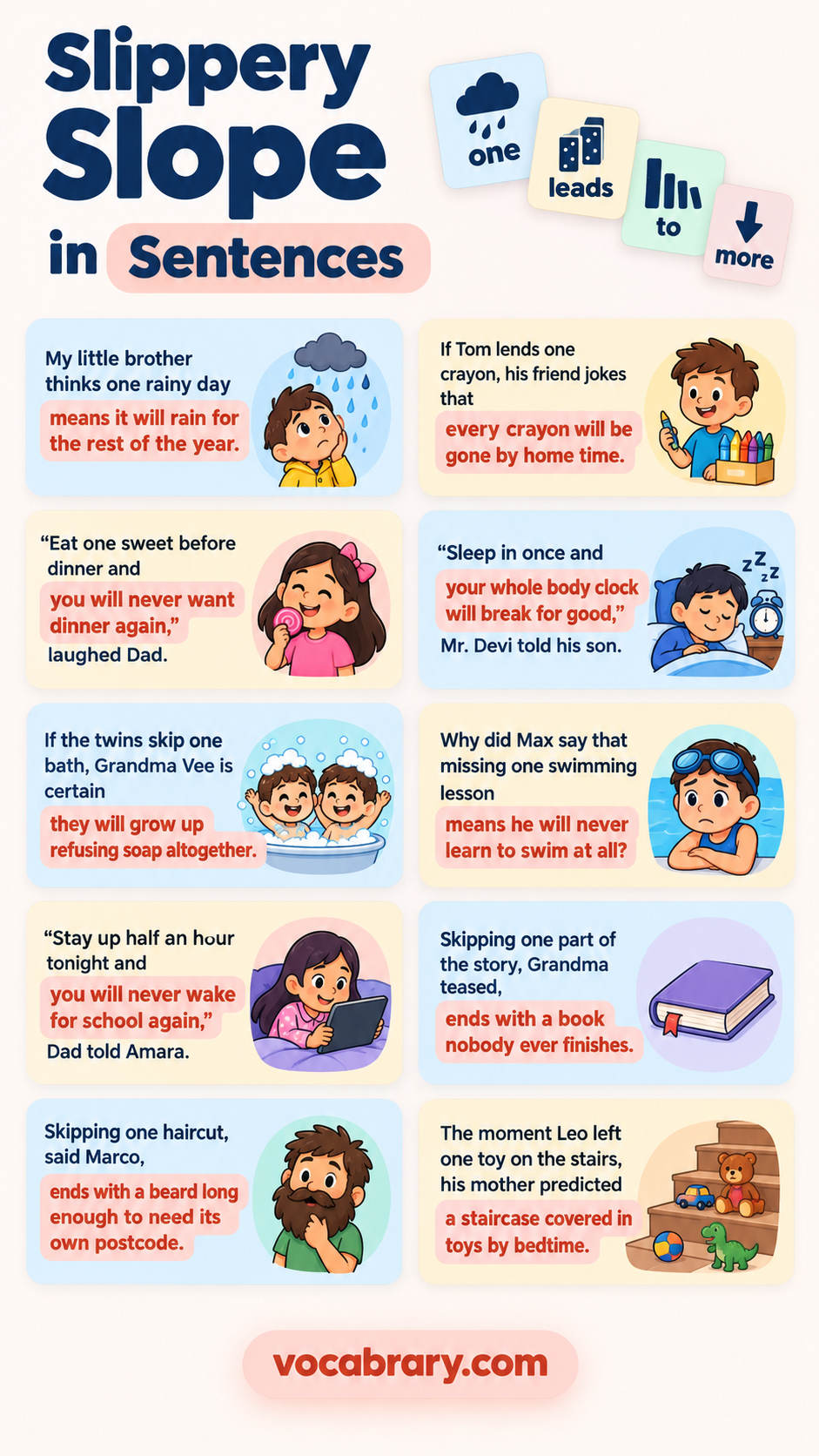
Common Slippery Slope Examples in Sentences
One late essay ending the school year, one shared cookie ruining a child’s diet, and one food truck emptying a town square are the common slippery slope examples. Each sentence races from a modest first step to disaster with nothing to justify the trip.
- If Mr. Hale accepts one assignment a day late, no work will ever arrive on time again and grades across the school will collapse.
- Priya warned that buying one video game leads to a second, then a console, until the family savings are gone by spring.
- Once the council approves a single food truck, the square will fill with trucks and no restaurant will survive the year.
- "Give the toddler one cookie before dinner and he will refuse every vegetable for the rest of his childhood," said Grandpa Otis.
- Nobody proposed closing the library, yet Fiona insisted that trimming its hours by thirty minutes ends with the building sold and the shelves emptied.
- Letting the dog on the sofa tonight means letting him on the bed tomorrow and surrendering the whole house by Friday, Bram announced.
- My neighbor argued that one unmown lawn on our street drags the entire neighborhood into ruin within two summers.
- Skipping the gym on Monday, according to Tess, guarantees a year on the couch and a wardrobe of clothes that no longer fasten.
- Why did Eli claim that lowering the club fee by one dollar wipes out the treasury and shuts the doors forever?
- When the referee allowed one substitution after the whistle, Coach Marsh predicted the rules would dissolve and the league would fold.
- A single unanswered email, Dana told the staff, starts a pile that ends with the firm losing every client it has.
- After the school added one vending machine, Mr. Quill declared that students would abandon lunch entirely and fall ill by June.
- Hana’s father insists that a first tattoo leads straight to a covered arm, then a covered body, then no job offer ever again.
- Allowing phones at dinner, warned Aunt Ruth, ends with a family that never speaks another word to one another.
- The landlord refused one late payment on the grounds that excusing it would empty the building of paying tenants by autumn.
- Tariq predicted that borrowing a pen without asking trains a person to take larger and larger property until the police arrive.
Slippery Slope Examples in Everyday Conversation
Friends, flatmates, and relatives reach for the slope over a borrowed charger, one unwashed mug, and a single missed haircut. Each reply answers a small habit with a prediction of total ruin.
- "Lend Marco your charger once and he will move in and use your electricity forever," laughed Ines.
- Because Sofia said yes to one coffee invitation, her brother teased that every Saturday for the next decade is already spoken for.
- One unwashed mug in the sink, Rory claimed, breeds a kitchen nobody will enter by the end of the month.
- Nobody minded the single open window, though Bea predicted a flat full of insects by Tuesday and no sleep for anyone again.
- If you answer one text at midnight, Kofi argued, your phone will ring at every hour until you never rest again.
- Hugo refused to try a new restaurant, saying that one change of habit ends with a man who never eats a familiar meal again.
- Skipping a haircut this month, said Nadia’s mother, finishes with hair to the floor and a daughter nobody recognizes.
- "Say yes to babysitting once and you will raise the neighbors’ children yourself until they leave for college," warned Gran.
- After Theo agreed to water one plant, Ruth joked that the entire garden would become his second job within a fortnight.
- Why does Lena insist that a single delivered dinner ends with a kitchen nobody has cooked in for years?
- Borrowing a jumper for one evening, Sam insists, begins a slide toward an empty wardrobe and a friendship in ruins.
- The moment Ravi let his flatmate park in the driveway, he announced that the driveway was lost to him for good and the garage would go next.
- My cousin refuses to join one group chat because a single chat, in his telling, turns into forty and a phone that never stops buzzing.
- Letting the children choose dessert tonight, Aunt Pia warned, hands them control of every meal until no vegetable is cooked again.
- Once Dev tried the new bakery, his sister predicted a daily habit, a wrecked budget, and trousers that refuse to fasten.
Slippery Slope Examples From Parents and Children at Home
Kitchen tables and living rooms produce the loudest slopes, over one bedtime extension, one sleepover, and one uneaten plate of peas. Parents and children answer each other with predictions that leap years ahead.
- "Stay up half an hour tonight and you will never wake for school again," Dad told Amara.
- Because Leo was allowed one sleepover, his mother predicted a house full of other people’s children every weekend until he leaves home.
- One uneaten plate of peas, Mrs. Oyelaran argued, teaches a child to refuse every food that is good for him.
- If the twins skip one bath, Grandma Vee is certain they will grow up refusing soap altogether.
- Nobody suggested moving bedtime permanently, though Uncle Ned insisted that a single late night wrecks a child’s sleep for a decade.
- Letting Jonah choose his own shirt this morning means a teenager who obeys no rule in the house, his father claimed.
- Why do the Kowalskis argue that one allowance raise ends with a son who expects the family to fund his entire adult life?
- Paying Rosa for one chore, her aunt warned, guarantees a girl who lifts nothing without a fee.
- After Mina got a puppy, her brother announced that the house would shelter nine dogs before the year ended.
- Skipping one family dinner, Mr. Achebe told his daughter, starts a habit that ends with a daughter who never visits again.
- My mother refuses to buy one packet of sweets because a single packet becomes a cupboard of sweets and a dentist’s bill nobody survives.
- "Say yes to one late film and the children will sleep through every morning for the rest of their school years," sighed Ruth.
- When Dad agreed to one extra story, Sam predicted an hour of stories every night until the boy turns eighteen.
- Once the Farrells excused one broken curfew, they warned their son that the next would be two hours, then a whole night, then a wasted future.
- Allowing a television in the bedroom, Aunt Pia argued, leads to a child who never opens a book and fails every exam.
Slippery Slope Examples About Chores and Bedtime
A slope grows fastest where the rule repeats nightly, so one skipped washing-up, one unmade bed, and one extra half hour turn into predictions of a household with no order left.
- If Nia skips the dishes once, her father predicts a sink nobody empties until the family eats off the floor.
- Making an exception for one unmade bed, Mom argued, produces a bedroom nobody enters by the summer.
- Nobody asked to cancel the chore chart, yet Grandpa Otis warned that one missed Saturday ends the chart and the tidy house along with it.
- "Sleep in once and your whole body clock will break for good," Mr. Devi told his son.
- One skipped tooth brushing, according to Aunt Rae, guarantees a mouth of fillings before high school.
- Because Zara left a single toy out overnight, her mother predicted a floor nobody will cross by Christmas.
- After the boys were excused from raking leaves, their father declared that the garden would disappear under a forest of them by spring.
- Letting Toby play ten minutes past bedtime, his sister teased, starts a slide toward breakfast at four in the afternoon.
- Why did Uncle Ben say that one night without folding laundry ends with a family who wear the same shirt all week?
- Skipping the Sunday tidy this once, Rita’s mother insisted, finishes with a flat the council condemns.
- The moment Hassan was allowed to eat in his room, his father predicted crumbs, then insects, then a house nobody rents again.
- Once the girls stayed up for one film, Dad claimed they would abandon sleep entirely and never pass another test.
Slippery Slope Examples in School Rules and Homework
Teachers, principals, and pupils argue in slopes over one extension, one day without uniform, and one open-book quiz. Every warning finishes with a school where no rule survives.
- If Ms. Alvarez grants Dev one extension, she fears every essay in the class will arrive weeks late for the rest of the year.
- Nobody proposed dropping uniforms, though Mr. Blake warned that one day of trainers ends with pupils in pajamas and a school nobody respects.
- One open-book quiz, argued the department head, turns into open-book exams and a diploma worth nothing.
- Because Amira was excused from one presentation, her teacher predicted a class where nobody ever speaks in front of others again.
- "Let one student chew gum and the floors will be ruined and the building condemned," said the caretaker.
- Allowing calculators in a single lesson, Mr. Perez insisted, produces a generation unable to add two numbers.
- Why did the principal argue that one trip without a written test leads to a school year with no learning at all?
- Skipping the Monday reading log this once, Mrs. Wren warned, ends with a child who never finishes a book again.
- After the debate club met without a teacher present, the deputy predicted that every club would run wild and the school would lose its license.
- The moment homework was cut by ten minutes, Mr. Okafor announced the school would sink to the bottom of the league within three years.
- Letting one pupil retake a test, Ms. Rowe argued, guarantees that nobody prepares for a first attempt again.
- Once the library allowed food at the study tables, the librarian predicted ruined books, then no books, then no library.
- My teacher refuses one late pass because a single pass, in her telling, breeds a class where deadlines mean nothing at all.
- When the school shortened one assembly, a parent complained that the pupils would soon attend nothing and leave without qualifications.
- Giving Marcus a second chance at the science project, his tutor claimed, teaches the whole year group that first attempts never count.
Slippery Slope Examples About Phones in the Classroom
Phone rules produce the steepest classroom slopes, where one calculator app, one photograph of the whiteboard, and one lunchtime message become a prediction that nobody learns anything again.
- If Mr. Sato allows phones for one calculation, he claims the whole lesson will dissolve into games by November.
- Nobody suggested phones during exams, yet the head of year warned that one lunchtime message ends with cheating in every paper.
- One photograph of the whiteboard, argued Mrs. Idris, teaches pupils to stop writing until no child takes a note again.
- Because Sami checked the time on his screen, his teacher predicted an hour lost to videos and a term with no work finished.
- "Unlock one phone in class and the school will be filming instead of learning by Friday," said Mr. Tran.
- Letting students play music while they revise, Ms. Bell insisted, produces a year group that reads nothing in silence ever again.
- Why did the deputy head claim that one educational app opens the door to a classroom where nobody looks up from a screen?
- After Nadia used a translation app for a single word, her tutor announced that she would never learn another language properly.
- Allowing a group chat for homework questions, the principal argued, finishes with answers copied across the entire school.
- Skipping the phone-locker rule for one afternoon, Mr. Dube warned, destroys the locker rule and the quiet classroom together.
- The moment one teacher took a photograph for the newsletter, a parent predicted every pupil would be filmed all day forever.
- Once Priya charged her phone at the back of the room, her teacher said the sockets would be full of devices and no lesson would start on time.
Slippery Slope Examples at Work and in Management
Staff meetings breed slopes over one approved taxi fare, one afternoon off, and one flexible start time. Each manager predicts a company with no rules and no customers left.
- If Dana approves one extra taxi fare, the finance director warns that the budget will vanish and the firm will close its doors.
- Nobody asked for a four-day week, yet Mr. Pryce insisted that one flexible Friday ends with an office empty on all five days.
- One approved afternoon off, argued the supervisor, turns into a workforce that never arrives before noon.
- Because Omar was allowed to start at ten, his manager predicted a team that drifts in at lunchtime and misses every deadline.
- "Give one employee a new chair and the whole floor will demand furniture the accounts never recover from," said Rita.
- Letting Kim leave early for one dentist appointment, the rota manager claimed, produces a shift nobody finishes again.
- Why did the partner argue that one client discount leads to free work for everyone and a practice in administration?
- Skipping a single status meeting, warned the project lead, ends with a team that never speaks and a product that never ships.
- After Lars was praised in front of the group, his manager feared that the rest would demand praise hourly and stop working entirely.
- The moment the company paid for one training course, the owner predicted staff would study full time and nobody would answer a phone.
- Allowing a dog in the office on Wednesday, Nadia argued, finishes with a building nobody rents and an insurer who walks away.
- Once the warehouse skipped a single safety check, the supervisor warned that the next check would go, then all of them, then the license.
- My manager refuses one home-working day because a single day, in his telling, becomes a workforce nobody ever meets in person.
- When the team changed one line in the contract, legal predicted a year of rewrites and clients who trust nothing the firm sends.
- Paying overtime for one late shipment, the director claimed, trains the whole depot to work slowly until nothing leaves on time.
Slippery Slope Examples About Remote Work and Time Off
Managers, rota planners, and new starters trade slopes over one home-working Tuesday, one August holiday, and one late start after a delayed train.
- If Hana works from home on Tuesday, her director fears the office will be abandoned and the lease wasted within a year.
- Nobody requested a month of leave, though the rota planner warned that one August week ends with a depot nobody staffs all summer.
- One approved late start after a delayed train, the supervisor argued, teaches the whole team to arrive whenever they please.
- Because Ana took a Friday off for a wedding, her manager predicted a calendar with no working Fridays left by autumn.
- "Approve one sick day without a note and half the staff will be ill every Monday from now on," warned Mr. Oyelaran.
- Letting Jamal answer emails from a cafe, the partner claimed, produces a firm where nobody ever reaches a desk.
- Why did the board insist that one remote hire leads to a company with no address and no colleagues who know each other?
- Skipping a single return-to-office day, the head of operations warned, finishes with a policy nobody obeys and a floor nobody uses.
- After Mei swapped one shift with a colleague, the rota manager announced that the rota would collapse and the shop would open late every morning.
- Allowing one parent to leave at three for the school run, said Dev, ends with a workplace that empties every afternoon.
- The moment the team met by video instead of in person, Ruth predicted nobody would travel again and the branch would shut.
- Once Ben took his holiday in two halves, his manager claimed staff would split leave into single days until no week was fully covered.
Slippery Slope Examples About Health and Diet
One slice of cake, one skipped run, and one late breakfast become a body ruined for life in these sentences. Each speaker treats a single choice as the first step of an unstoppable decline.
- If Marisol eats one slice of cake tonight, her flatmate claims she will abandon every healthy meal and regain all she lost.
- Nobody suggested quitting the running club, yet Tom warned that one missed Sunday ends with a man who never laces a shoe again.
- One fizzy drink at lunch, according to Mr. Ferris, starts a habit that finishes in the dentist’s chair and the hospital ward.
- Because Ade skipped a single workout, his trainer predicted months on the sofa and a body nobody recognizes by Christmas.
- "Take one biscuit at eleven and you will be eating a whole packet before every meal by Friday," said Aunt Bess.
- Letting yourself sleep until nine on Saturday, Kara argued, produces a person who never rises before noon again.
- Why did the coach insist that one day of recovery leads to a season lost and a place on the team gone forever?
- Skipping breakfast once, warned the school nurse, ends with a teenager who eats nothing until dinner for years.
- After Yusuf ordered a second helping, his brother announced that portions would double each month until the kitchen went bankrupt.
- The moment Nina bought one energy drink, her sister predicted a shelf of them and a heart that never slows.
- Allowing salt on one meal, insisted Grandpa Ray, finishes with a family that tastes nothing without half a spoonful.
- Once Ida walked instead of running, her training partner claimed she would walk the next session, then drive, then never train again.
- My uncle refuses one glass of wine because a single glass, in his telling, becomes a bottle a night and a liver beyond repair.
- When the canteen added one dessert, a parent complained that children would eat nothing but pudding for the rest of their schooling.
Slippery Slope Examples About Technology and Screen Time
Tablets, consoles, and smart speakers draw slopes over one downloaded game, one extra episode, and one late-night video. Each warning ends with a household that has forgotten how to speak.
- If Rafi downloads one game tonight, his mother claims he will play until dawn every night and fail every class he takes.
- Nobody proposed unlimited screen time, though Mr. Vance warned that one extra episode ends with a child who watches from waking to sleeping.
- One smart speaker in the kitchen, argued Aunt Cleo, leads to a house where nobody remembers a single recipe.
- Because Tia watched one video before homework, her father predicted an evening lost and a term of failed assignments.
- "Let the tablet into the car once and no child will look out of a window again," said Grandpa Milo.
- Letting Sanjay keep his laptop in the bedroom, his sister argued, produces a brother nobody meets at breakfast for a decade.
- Why did the parents’ committee claim that one gaming console turns a family into strangers within two years?
- Skipping the screen curfew for one film night, Nadia warned, ends with a curfew nobody obeys and a house that never sleeps.
- After Owen accepted one notification, his friend announced that the phone would buzz every minute until he lost his job.
- The moment the school issued one tablet per pupil, a governor predicted that pens would disappear and handwriting would die out completely.
- Allowing a smart watch in the exam hall, the invigilator insisted, finishes with every candidate reading answers off a wrist.
- Once Priya turned on autoplay, her husband claimed an episode would become a season, then a lost weekend, then a lost year.
- My cousin refuses one social app because a single app, in his telling, breeds twelve more and a phone that governs his whole day.
- When the library added one computer, a member complained that the shelves would empty and reading would vanish from the town.
Slippery Slope Examples About Money and Spending
A spending slope treats the first purchase as the start of a run nobody halts, so one coffee, one borrowed twenty, and one missed payment end in bankruptcy in these sentences.
- If Callum buys one coffee on the way to work, his budgeting app warns that he will spend his rent on cafes by the end of the month.
- Nobody suggested a second credit card, though Ms. Farrow insisted that one card ends with debt no salary will ever repay.
- One borrowed twenty from a friend, argued Gran, turns into a loan, then a mortgage, then a friendship destroyed.
- Because Aisha treated herself to one pair of shoes, her brother predicted a wardrobe of shoes and an empty savings account by June.
- "Skip one payment and the bank will take the car, then the flat, then everything you own," said Mr. Ridley.
- Letting the children buy one toy at the supermarket, Dad argued, produces a trolley of toys on every shopping trip forever.
- Why did the treasurer claim that one unbudgeted repair leads to a club unable to pay a single bill by December?
- Skipping the savings transfer this month, Nina warned, ends with a habit that leaves nothing saved for twenty years.
- After Milo subscribed to one streaming service, his flatmate announced that nine subscriptions would follow and drain the joint account.
- The moment the shop offered one discount, the owner predicted customers would demand money off everything until the business folded.
- Allowing one late invoice, insisted the accountant, finishes with clients who pay nothing and a firm with no cash left.
- Once Farah took one payday advance, her aunt claimed she would borrow every month until the interest swallowed her wages.
- My father refuses one online purchase because a single parcel, in his telling, becomes a doorstep buried in parcels and a card he never pays off.
- When the council raised one parking fee, a shopkeeper complained that every fee would rise until nobody visited the town again.
Slippery Slope Examples in Sports Arguments
Coaches, referees, and supporters slide from one missed practice or one lenient call to a season lost and a club folded. Each speaker treats a single decision as the start of a collapse.
- If Coach Ruiz excuses Mia from one practice, he predicts the whole squad will skip training and lose every match this season.
- Nobody asked to change the offside rule, yet the pundit warned that one small tweak ends with a sport nobody recognizes in ten years.
- One lenient call in the first half, argued the captain, teaches both teams that fouls cost nothing at all.
- Because Ravi played on a sore ankle for one game, the physiotherapist predicted a career finished before his twentieth birthday.
- "Rest one player tonight and the others will demand a night off and the club will be relegated," said the assistant coach.
- Letting the youth side train an hour later, the director argued, produces a squad that never turns up before dark.
- Why did the supporters’ group insist that one ticket price rise leads to an empty stadium and a club in liquidation?
- Skipping a single warm-up, warned the trainer, ends with injuries every week and a season spent watching from the bench.
- After Lena lost one race, her father announced that she would drop out of the sport and regret it for the rest of her days.
- The moment the league allowed one extra substitution, a manager predicted squads of forty and a game nobody follows.
- Allowing video review for one decision, the referee argued, finishes with matches that last five hours and crowds who leave early.
- Once the club sold one sponsor a shirt sleeve, the chairman claimed the kit would disappear under logos and the badge would go too.
- My coach refuses one day of recovery because a single day, in his telling, breeds a squad that never sprints again.
- When the school cut one hour of physical education, a parent complained that sport would vanish from the timetable within three years.
Slippery Slope Examples in Law and Policy Debate
Council chambers produce slopes over one cycle lane, one market stall, and one late-night licence, where a member answers a narrow proposal with the end of the town.
- If the council permits one market stall on Rose Street, Councillor Hobbs warns that the road will close to traffic and every shop will shut.
- Nobody proposed banning cars, yet a resident insisted that one cycle lane ends with a town where driving is outlawed.
- One noise permit for a summer concert, argued Mrs. Falk, leads to festivals every weekend and a neighborhood nobody sleeps in.
- Because the committee funded one bus route, a member predicted free travel for everyone and a transport budget in ruins.
- "Licence one food van and the park will be lined with vans and the grass will die," said the parks officer.
- Letting one shop open on Sunday morning, the trader argued, produces a high street that never closes and staff who never get a day off.
- Why did the planning board claim that one extra storey on a single building leads to towers along the entire riverside?
- Skipping the consultation for one small repair, the clerk warned, ends with a council that consults nobody about anything.
- After the library extended its hours by thirty minutes, a trustee announced that staff costs would double and the branch would close.
- The moment the town waived one parking fine, the treasurer predicted every fine would be waived and enforcement would end.
- Allowing one dog off its lead in the meadow, insisted the warden, finishes with a meadow where no ground bird nests again.
- Once the board approved one late licence, the chair claimed the street would fill with bars and no family would remain.
- My councillor refuses one exception to the height rule because a single exception, in her telling, erases the rule for every future builder.
- When the village allowed one holiday rental, a resident complained that every house would become a rental and nobody local would remain.
Slippery Slope Examples in Advertising
Adverts build slopes toward a rescue, where one wrong toothpaste, one surviving crumb, and one missed vitamin end in the disaster the product prevents.
- If you brush with the wrong toothpaste, the advert warns, cavities will multiply until every tooth is lost.
- Nobody claimed a single stain ruins a shirt, yet the commercial predicts a wardrobe of stains and a job interview lost forever.
- One skipped oil change, according to the garage’s radio advert, destroys the engine, then the car, then the family holiday.
- Because one bulb was left dim, the lighting advert announces that guests will leave early and the party will be remembered as a failure.
- "Miss one vitamin and your energy will fade until you sleep through your own birthday," promises the cheerful narrator.
- Letting a single crumb survive the sweep, the vacuum advert insists, produces a kitchen overrun by insects within a week.
- Why does the insurance advert claim that one unlocked window leads to an empty house and a family with nothing left?
- Skipping one application of sunscreen, warns the poster, ends with skin ruined for a lifetime.
- After a single wash with ordinary shampoo, the commercial announces, hair will break, thin, and disappear altogether.
- The moment a driver buys the cheaper tyre, the campaign predicts a skid, a puncture, and a winter nobody forgets.
- Allowing one night without the new mattress, the showroom advert insists, finishes with a back that never recovers.
- Once a shopper tries a rival cereal, the brand’s advert claims breakfast will be joyless and mornings will never start well again.
Slippery Slope Examples in Online Comment Arguments
Commenters answer a narrow update about a moved button, a changed logo, or a new forum rule with a prediction that the platform, the company, or the community is finished.
- If the app moves one button, a commenter warns, the next update will delete every feature and the app will die.
- Nobody proposed removing replies, though one user insisted that a single moderation rule ends with a site where nobody speaks at all.
- One changed logo, argued a member under the announcement, leads to a rebrand, a price rise, and a company nobody trusts.
- Because a forum added one rule about spelling, a member predicted a hundred rules and a forum with no members left.
- "Charge for one feature and the whole app will be locked behind a paywall by next spring," wrote a reviewer.
- Letting one advert into the feed, a long reply argued, produces a screen of adverts and an app nobody opens.
- Why did a commenter claim that one removed emoji leads to a platform stripped of everything people enjoy?
- Skipping a single weekly update, one user warned, ends with abandoned software and a company that quietly disappears.
- After the site asked for a phone number, a reply announced that every private message would be sold and nobody would be safe online.
- The moment the forum added one paid badge, a member predicted two tiers, then five, then a community split apart.
- Allowing one sponsored review, the top reply insisted, finishes with a rating nobody believes and a shop with no customers.
- Once a moderator deleted one comment, a user claimed the deletions would grow until nothing survived on the site.
- My neighbor reviewed a courier by arguing that one late delivery starts a decline that ends with a firm delivering nothing at all.
- When the platform changed one font, a commenter complained that reading would become impossible and users would leave in millions.
Slippery Slope Examples in Literature and Film
Laura Numeroff’s picture books, Goethe’s poem about a sorcerer’s apprentice, and Mary Shelley’s Frankenstein each build a chain from one small act to a flood of consequences. Writers use the slope both as a joke and as a warning.
- In Laura Numeroff’s 1985 picture book If You Give a Mouse a Cookie, one biscuit leads to milk, a straw, and a mirror, until the mouse asks for another cookie and the chain restarts.
- Goethe’s 1797 poem The Sorcerer’s Apprentice sends one enchanted broom for water, and the fetching never halts until the workshop is flooded.
- Mary Shelley’s Frankenstein, published in 1818, has Victor destroy the second creature because he fears a whole race of such beings spreading across the earth.
- Ray Bradbury’s Fahrenheit 451, published in 1953, has Captain Beatty explain that books were first trimmed, then shortened, then burned once nobody objected to the earlier cuts.
- George Orwell’s Animal Farm, published in 1945, alters the commandments one word at a time, until the farm’s rules say the opposite of what the animals agreed.
- William Golding’s Lord of the Flies, published in 1954, drops one rule after another on the island, and the conch that once ordered the meetings is ignored.
- Lemony Snicket gave the tenth book of A Series of Unfortunate Events the title The Slippery Slope in 2003, naming the descent the Baudelaire children keep sliding down.
- Shakespeare’s Macbeth, first performed around 1606, shows a man who argues that turning back after one crime would be as wearying as going further forward.
- In Aesop’s fable of the camel and the tent, the camel asks only to put his nose inside, and the owner is left outside in the cold while the camel keeps the tent.
- Laura Numeroff’s If You Give a Moose a Muffin, published in 1991, repeats the chain with jam, a sweater, and puppets, and finishes back at the first request.
- Carlo Collodi’s The Adventures of Pinocchio, published in 1883, sends one skipped school day to a puppet theatre, then to Toyland, and finally turns the boy into a donkey.
- The folk tale of Henny Penny turns one acorn falling on a hen’s head into a certainty that the sky is falling and a walk that ends at the fox’s den.
Slippery Slope Examples in Cartoons and Children’s Stories
Children meet the slope early in cumulative tales, where a pig who gets a pancake wants syrup, a bath, and wallpaper, and each new verse of a rhyme repeats every step before it.
- The English nursery rhyme The House That Jack Built adds a rat, a cat, a dog, and a cow to one house, and every verse repeats the whole chain from the start.
- In Laura Numeroff’s If You Give a Pig a Pancake, published in 1998, syrup leads to a sticky pig, then a bath, then wallpaper, and back to a pancake at the end.
- The cumulative folk song about an old lady who swallowed a fly sends a spider after the fly and a bird after the spider, until the swallowing reaches a horse.
- In the Brothers Grimm tale of the fisherman’s wife, first printed in 1812, one wish for a cottage grows into a palace and a throne, until the couple are returned to their old hut.
- Dr. Seuss’s If I Ran the Zoo, published in 1950, grows one boy’s plan from a single new animal into a zoo of impossible creatures gathered from everywhere.
- Judith Viorst’s Alexander and the Terrible, Horrible, No Good, Very Bad Day, published in 1972, piles one setback on another until the boy decides to move to Australia.
- Beatrix Potter’s The Tale of Peter Rabbit, published in 1902, starts with one squeeze under a gate and finishes with a lost jacket, a chase, and chamomile tea at bedtime.
- Maurice Sendak’s Where the Wild Things Are, published in 1963, turns one night of mischief into a forest, an ocean, and an island of monsters.
- Eric Carle’s The Very Hungry Caterpillar, published in 1969, adds one food after another until the caterpillar has a stomach ache on Saturday.
- Julia Donaldson’s The Gruffalo, published in 1999, has a mouse invent one detail after another until the creature he described walks out of the wood.
Funny Slippery Slope Examples
A lost sock ending a marriage, one fed pigeon claiming a balcony, and a single houseplant becoming a rainforest make the funny slippery slope examples. Each leap is far too large to take seriously.
- If Gus feeds one pigeon at lunch, his wife warns that the balcony will be a pigeon colony and the flat will be theirs by August.
- Nobody lost more than one sock, yet Bea insisted that a single missing sock ends with a marriage in ruins and a washing machine on trial.
- One houseplant on the windowsill, Fred claimed, turns into a jungle, then a rainforest, then a mortgage paid to a fern.
- Because Otto named one chicken, his brother predicted a farm of named chickens and a family who never eats an egg again.
- "Buy one novelty mug and the cupboard will be all mugs and the plates will emigrate," warned Aunt Mabel.
- Letting Dennis choose the playlist once, Ruth argued, produces a wedding, a funeral, and a lifetime of accordion music.
- Why does Grandad insist that one garden gnome leads to forty gnomes and a lawn nobody dares to mow?
- Skipping one haircut, said Marco, ends with a beard long enough to need its own postcode.
- After Tilda bought one scented candle, her flatmate announced that the flat would smell of vanilla until the year 2070.
- The moment Ned learned one card trick, his sister predicted a cape, a top hat, and a rabbit in the fridge by Easter.
- Allowing one biscuit at the meeting, insisted the office manager, finishes with a staff too full to speak and a budget spent on shortbread.
- Once Pip started naming his houseplants, his brother claimed he would send them birthday cards and write them into his will.
- My flatmate refuses one karaoke night because a single song, in his telling, breeds a tribute band and a tour of three continents.
- When Juno bought one cushion, her partner complained that the sofa would disappear and the family would sleep on cushions forever.
Slippery Slope Chains Broken Down Step by Step
Each sentence names the steps out loud, from one skipped piano lesson to an abandoned instrument or from one lent pound to an empty account, so the missing link between them is visible.
- One skipped piano lesson becomes two, two become a month away, a month away loses Nadia her place in the recital, and she never touches a piano again.
- A single late arrival turns into a habit, the habit into a warning, the warning into a final warning, and Ivo finishes the month without a job.
- If Rosa lends a pound today, she lends five tomorrow and fifty next month, and her savings are gone before the summer.
- Letting one weed grow lets ten grow, ten become a bed of weeds, the bed swallows the path, and the garden is lost for good.
- Because one email goes unanswered, ten go unanswered, the inbox becomes unreadable, and the whole department stops speaking to the team.
- Skipping one revision session leads to a missed chapter, a missed chapter to a failed test, a failed test to a failed year, and a future nobody wants.
- Once the coach spares one player, the squad expects the same, training softens, fitness drops, and the club falls out of the league.
- After one exception to the parking rule, a second follows, then a third, the rule is forgotten, and the street is impassable by winter.
- Nobody stops at one biscuit, according to Ida, so one becomes three, three become a packet, and a packet becomes a diet abandoned for years.
- When the shop discounts one product, shoppers wait for discounts, full prices vanish, margins disappear, and the shutters come down for the last time.
- My uncle argues that one hour of television becomes two, two become an evening, an evening becomes a routine, and a routine becomes a wasted decade.
- The first missed phone call leads to a missed birthday, the missed birthday to a silence, the silence to a year without speaking, and a family divided for good.
Sentences Rewritten as a Reasoned Prediction
A reasoned prediction names how far the chain reaches and what supports each step, so one missed practice costs a starting place this month rather than a whole career.
- Instead of claiming that one missed practice ends Mia’s career, Coach Ruiz says two missed practices in a month cost a player her starting place.
- Rather than warning that one late essay destroys the school year, Ms. Alvarez explains that three late essays lower a term grade by one band.
- Where Gran predicted that one biscuit wrecks a diet forever, the nurse notes that a daily extra snack adds a few hundred calories a week.
- Nobody now says that one flexible Friday empties the office for good, since the manager reviews attendance and renews the policy each quarter.
- Because the numbers existed, the council replaced the claim that one market stall kills the high street with a six-month trial and a footfall count.
- After hearing that one cycle lane outlaws driving, the planner answered that the lane removes eleven parking places on a single street.
- Skipping the claim that one video ruins a childhood, Tia’s father set a thirty-minute limit and checked her homework each evening.
- The advert argues that one missed vitamin ends a person’s energy, while the pharmacist explains that most adults meet their needs through food.
- Once the treasurer dropped the warning that one unbudgeted repair bankrupts the club, she showed that the repair costs four percent of the reserve.
- My teacher replaced the prediction that one calculator destroys arithmetic with a rule allowing calculators after the mental-maths questions.
- Allowing one dog off its lead, the warden now says, raises the risk to nesting birds in April, rather than wiping out every bird in the meadow.
- When the app moved one button, the reviewer wrote that navigation slowed for a week, not that every feature would be deleted.
Slippery Slope Examples for Kids
Playground rules, one shared crayon, and a single lost glove show young readers how a slope works, where a small first step is said to end in total disaster.
- If Tom lends one crayon, his friend jokes that every crayon will be gone by home time.
- Nobody lost more than one glove, yet Sara warned that one lost glove leads to a winter with no gloves at all.
- One late night before school, said Mum, turns into a week of sleepy mornings and a very grumpy child.
- Because Ben forgot his reading book once, he decided he would forget it every day and never learn to read.
- "Eat one sweet before dinner and you will never want dinner again," laughed Dad.
- Letting the cat into the bedroom once, Ella claimed, means the cat will own the bed forever.
- Why did Max say that missing one swimming lesson means he will never learn to swim at all?
- Skipping one part of the story, Grandma teased, ends with a book nobody ever finishes.
- After Mia shared one sticker, her brother announced that she would have to share every sticker she ever owns.
- The moment Leo left one toy on the stairs, his mother predicted a staircase covered in toys by bedtime.
- Allowing one extra minute in the bath, Dad said, finishes with a child who never comes out of the water.
- Once Rosie chose the yellow cup, her sister claimed she would want the yellow cup at every meal until she is old.
- My little brother thinks one rainy day means it will rain for the rest of the year.
- When the teacher gave one gold star, a pupil worried that stars would be handed out for everything and mean nothing at all.
Slippery Slope Examples for Students
Essay writers, debaters, and exam candidates meet slopes in reading passages and practice questions, over one relaxed deadline, one open-book test, and one funded club.
- If an essay claims that one relaxed deadline ends academic standards forever, a marker asks which step in the chain has evidence behind it.
- Nobody in the reading argued for abolishing exams, though the student’s paragraph warned that one open-book test destroys every qualification.
- One funded club, wrote Dev in his practice essay, leads to funding for every club and a university with no money left.
- Because the source mentioned a single trial policy, Hana’s answer predicted a nation where the policy applies to everyone by next year.
- "Allow one extension and no deadline will survive," wrote Priya, before her tutor asked her to name the missing link.
- Letting one weak argument into a paragraph, Mr. Okafor warns, produces an essay that predicts disaster without proving a single step.
- Why did the debate speaker claim that one change to the timetable ends with a school that teaches nothing?
- Skipping the evidence between steps, the examiner noted, turns a prediction into a slippery slope and loses marks every time.
- After reading one study on sleep, Marco’s essay announced that teenagers would abandon sleep entirely within a generation.
- The moment a student writes that a small reform leads inevitably to collapse, the marker looks for the probability of each step.
- Allowing one unsupported leap, Ms. Rowe told the class, finishes with an argument nobody in the room believes.
- Once Leo noticed the chain in his own draft, he replaced it with a prediction limited to the next school term.
- My tutor rejects a single unproven step because one such step, in her telling, collapses the whole argument.
- When the exam paper asked students to name the fallacy, Amara wrote that the speaker had slid from one small rule to a national catastrophe.
Related
FAQs
A slippery slope argument is not always a fallacy, because a chain of steps with evidence behind each link makes a legitimate prediction. A lawyer who shows that one ruling creates a precedent later courts must follow is arguing a real slope. The fallacy arrives when a speaker asserts the whole chain and supplies no reason for any step in it.
You respond to a slippery slope fallacy by asking the speaker to justify each step on its own instead of the whole chain at once. Name the first link with no support behind it and request evidence for that one. Most slopes fail at the second or third step, and once that link breaks, the disaster at the end falls with it.
Slippery slope fallacies split into three kinds that logicians name separately. A causal slope claims that one event triggers the next until disaster arrives. A precedential slope claims that treating one case leniently forces identical treatment for every later case. A conceptual slope claims that because neighbouring steps differ so little, no line divides the first from the last.
The term slippery slope comes from the picture of a walker who loses their footing on a wet hillside and slides all the way to the bottom. English speakers used the phrase for a dangerous descent long before logicians borrowed it for arguments. Older textbooks label the same error the thin end of the wedge, after a wedge driven a little further into wood with each blow.
A slippery slope is an informal fallacy, which places the error in the content of the argument rather than in its structure. Nothing in the form of a chain breaks a rule of deduction, so each link has to be judged by the evidence behind it. Formal fallacies, by contrast, are invalid no matter what they are about.
You use slippery slope in a sentence as a noun for the argument itself, as in "Warning that one late essay ends the school year is a slippery slope." Speakers also use the phrase for a risky course of action, saying that lending money to a friend starts them down a slippery slope. Debaters name the move out loud mid-argument to force a rival back to the first step.
You identify a slippery slope fallacy by counting the steps between the opening action and the predicted ending, then checking which steps have evidence. Watch for phrases such as inevitably, before you know it, and the next thing, which replace the missing links. If the final disaster dwarfs the first step, the argument owes you a reason for every stage in between.
You avoid a slippery slope fallacy by predicting only as far as your evidence reaches and by naming what moves each step to the next. Write that three late essays lower a grade band rather than that one late essay ruins a career. Markers reward a narrow claim with support behind it and penalise a dramatic one without any.
The phrase slippery slope works as both a metaphor and a settled idiom in everyday English, while in logic it names one specific fallacy. As a metaphor it pictures a descent that nobody halts once it begins. As the name of a fallacy it describes an argument asserting such a descent without proving any part of it.
In ethics a slippery slope argument warns that permitting one practice will force acceptance of related practices that most people reject. Ethicists separate the empirical version, which predicts that one decision causes the next, from the logical version, which argues that no principled line divides the cases. Each version succeeds only when the arguer supplies the missing cause or the missing line.
People use slippery slope arguments because a distant catastrophe frightens an audience far more than the modest proposal under discussion. Predicting ruin pulls the debate away from the first step, which is the only change anyone proposed. Other speakers reach for a slope honestly, out of real fear that one exception will weaken a rule they value, and both uses share the same weakness.
A slippery slope and a hasty generalization differ in what each argument leaps over. A slippery slope leaps forward in time, claiming that one step forces a run of later steps until disaster arrives. A hasty generalization leaps outward from a handful of cases to a rule about everything of that kind. Debate classes teach both beside the straw man, which distorts a claim rather than extending it.

Leave a Comment