
Hasty generalization is a logical fallacy in which a broad conclusion comes from a sample too small to support it, as when two late buses convince a rider that every bus in town runs late. Common hasty generalization examples begin with one bad experience and end with a rule about everyone.
What Is a Hasty Generalization?
A hasty generalization turns a handful of cases into a rule about an entire group, and the rule collapses the moment a wider sample arrives. Unlike the slippery slope, which predicts a chain of consequences from a single step, a hasty generalization jumps straight from a few cases to everybody.
After two visits to Brackenhill, Omar told his brother that nobody in that town ever answers a question politely.
Common Hasty Generalization Examples in Sentences
Late buses, rude clerks, and one flat tire on a quiet road are the common hasty generalization examples. Each sentence starts with two or three cases and finishes with a verdict on an entire group.
- Nina waited twelve minutes for one bus and decided that every bus in Ardmoor runs late.
- After two cold cups at one café, Priya announced that nobody in this city knows how to brew coffee.
- My cousin met three rude clerks on Saturday and now insists that all clerks in Norbridge resent their customers.
- One flat tire on Vantry Road convinced Leo that the whole road is buried in nails.
- Because her first two dates from the app went badly, Maya told her sister that everyone on that app lies.
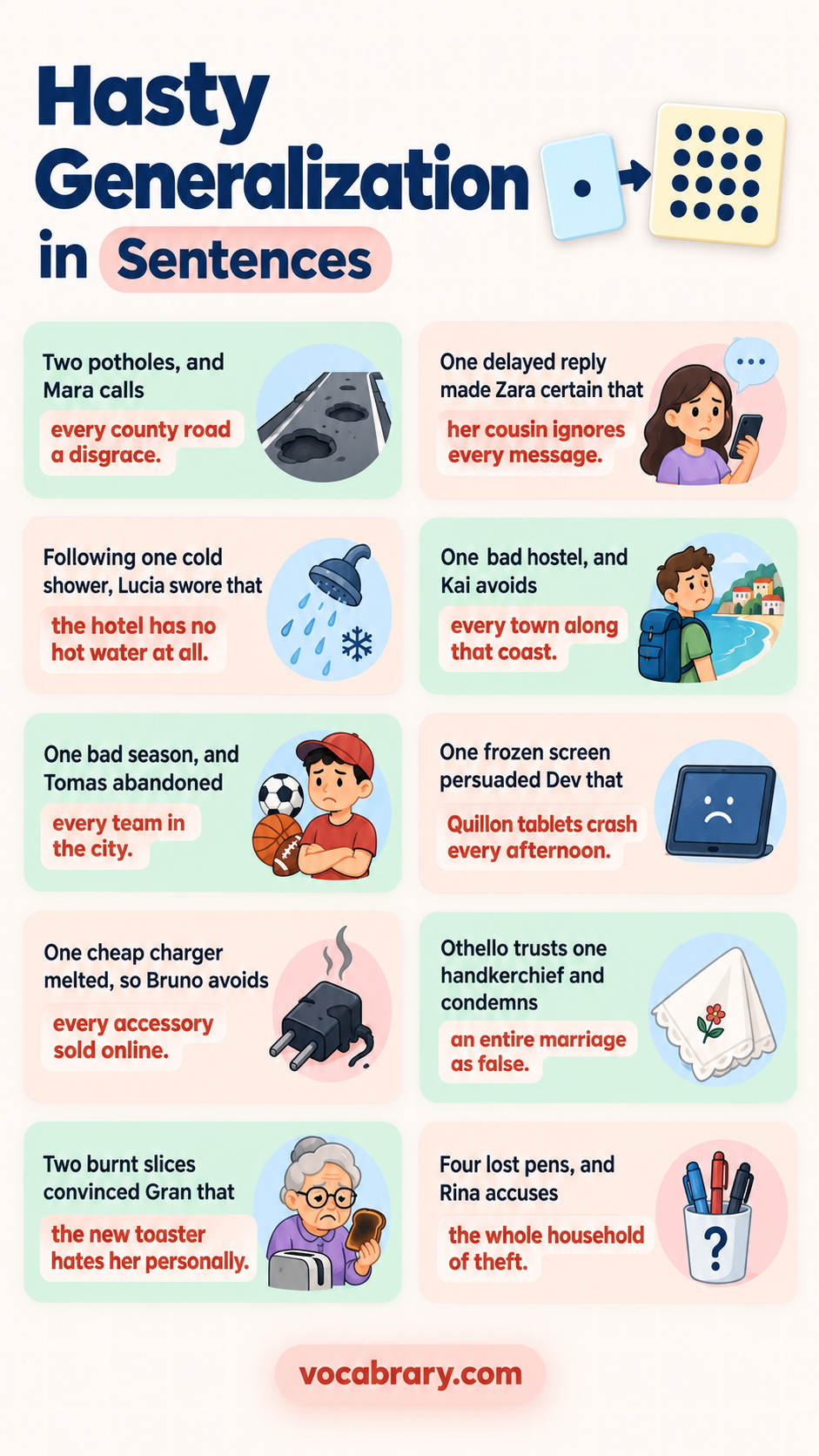
- Two potholes, and Mara calls every county road a disgrace.
- Having eaten one dry sandwich at the airport, Tom swore that airport food everywhere is inedible.
- A single rainy afternoon in Calder Bay left Ruth telling friends that it rains there every day of the year.
- Nobody checked more than four deliveries, yet the committee declared that the new supplier fails on every single one.
- Why did one broken zipper make Dev announce that Quillon jackets all fall apart within a week?
- Three cars passed him without stopping, and Felix concluded that drivers in this town never yield to pedestrians.
- Sofia read one angry review and told the group that the whole hotel chain treats guests badly.
- When his first two experiments failed, Arun decided that the entire method is worthless.
- Ellie tasted one under-salted soup and told the chef that nothing on the menu is worth ordering.
- Two late deliveries from Kestrel Foods persuaded the office that no order from that company ever arrives on time.
- Never having visited in winter, Raj still tells everyone that Pinehollow is warm all year after one August weekend.
- The first three people Dana asked had never heard of the library, so she reported that the town ignores it completely.
- Hugo lost twice at chess to the same opponent and now claims that every player at that club is unbeatable.
- One noisy neighbor made Clara certain that the whole building is awake until dawn.
- Although the survey reached only nine of the four hundred residents, the newsletter announced that the entire neighborhood wants the market moved to Sunday, and the council accepted that claim.
- After a cancelled train on Monday, Bruno told his manager that the railway cancels services every morning.
- Lena met two friendly dogs at the park and told her nephew that all dogs are gentle with children.
- Since her first two paychecks arrived early, Ines assured her coworkers that the company never pays anyone late.
- Four members of a sixty-person club voted against the plan, so the chair reported that the membership rejects it outright.
- Having read one chapter, Noah told the class that the author writes nothing worth finishing.
- Two students forgot their homework, so the substitute concluded that this entire class never studies.
Hasty Generalization Examples in Everyday Conversation
One yoga class, two burnt dinners, and a single dried-out pen turn into household rules in these hasty generalization examples. Ordinary talk reaches a verdict about everyone after two or three cases.
- My aunt tried yoga once, disliked it, and now tells relatives that nobody over fifty enjoys stretching.
- Two burnt dinners in a row convinced Theo that he will never cook anything edible.
- Because the first two houses on the street kept their lights off, Ana said that the whole street sleeps by eight.
- How did one lost umbrella persuade Kofi that every taxi driver in Norbridge keeps whatever passengers leave behind?
- A friend of a friend had a rough flight, so Beth insists that that airline loses everybody’s luggage.
- Three of Mia’s classmates disliked the film, and she now repeats that the whole year group hated it.
- One rude phone call convinced Dad that the bank employs nobody worth speaking to.
- Never having met a hiker on the trail before noon, Yusuf claims that the path stays empty until lunchtime.
- Two friends recommended the same recipe, so Halima concluded that everyone in her book club cooks it weekly.
- Since his neighbor’s car broke down twice, Sami warns relatives that Vanto engines fail before sixty thousand miles.
- Tasting one sour apple from the crate, Rosa told the market that the entire crop has spoiled.
- Four people at the party arrived late, and Georgia announced that nobody in her circle respects a start time.
- Was it fair for Eli to meet two chatty passengers and decide that the whole train line is unbearable?
- My grandmother took one bite of a new dish and ruled that no modern cooking suits her.
- Having watched two episodes, Callum assured us that the entire series goes nowhere.
- The first pen in the drawer had dried out, so Maya reported that every pen in the house is dead.
- One delayed reply made Zara certain that her cousin ignores every message.
- After two cousins moved abroad, Uncle Paulo tells the family that young people all leave Marrow Bay the day they finish school.
- Because two coworkers brought sandwiches, Vera announced that the whole office refuses hot lunches.
- Not one of the three shops she tried had the right size, and Amara concluded that no shop in the district stocks anything larger than a medium, which she repeated all week.
Hasty Generalization Examples From One Bad Experience
A stolen phone, a burnt pizza, and a single bad haircut produce lifelong verdicts here. Each speaker treats one unlucky hour as evidence about every place, every worker, and every future visit.
- Marco’s phone was stolen on his first night in Greyhaven, so he warns travelers that the city robs every visitor.
- One sour meeting with a landlord left Priyanka telling classmates that all landlords in Oakhurst cheat students.
- A single rejection letter convinced Idris that no employer hires anyone without ten years behind them.
- After one cancelled appointment, Nora declared that that clinic never keeps its schedule.
- Because a courier dropped her parcel once, Hana repeats that couriers everywhere throw parcels over fences.
- Tom’s first swimming lesson went badly, and he now says that water sports suit nobody built like him.
- How does one burnt pizza become proof that the whole restaurant has forgotten how to use an oven?
- Three months after a single bad haircut, Dalia still insists that every salon on that street ruins curly hair.
- One argument at a family dinner persuaded Jonas that holidays with relatives end in shouting every year.
- Having been ignored once at the counter, Ana told her sister that the staff there serve nobody under twenty.
- My neighbor slipped on a wet step at the museum and now repeats that the building is a hazard from door to roof, though thousands of visitors pass through it every week.
- Never trusting the route again after one missed sailing, Owen tells everyone that the ferry leaves early every weekend.
- Following one cold shower, Lucia swore that the hotel has no hot water at all.
Hasty Generalization Examples About Travel and First Impressions of a City
Eight hours in one city, a taxi that took the long way, and a single grey afternoon at the coast produce these hasty generalization examples. A traveler’s first day becomes a verdict on a whole country.
- Eight hours in Norbridge left Dana certain that the whole country eats nothing but fried food.
- After a taxi took the long way from the airport, Ravi warned his colleagues that every driver in Greyhaven overcharges.
- One grey afternoon in Calder Bay convinced Nils that the coast never sees sunshine.
- Because two hostels lost her booking, Fatima tells travelers that no hostel in Tarnwick keeps proper bookings.
- My brother spent a single weekend in Westmere and returned announcing that the people there greet nobody.
- Three train delays in four days persuaded Bea that the national railway ignores its own timetable.
- Having landed at midnight and seen only the terminal, Otto told his family that Ashvale is a concrete desert.
- Nobody in the tour group tried a second restaurant, yet the trip diary claims that the island cooks everything in the same sauce.
- A pickpocket on day one made Leah warn her cousins that tourists lose their wallets in every square of that city.
- Why did two unhelpful hotel receptionists convince Marc that hospitality has died across the entire region?
- Two friendly strangers on the tram were enough for Iris to report that everyone in Lindenmoor helps visitors.
- Since the first museum charged for admission, Damon insists that nothing in Redhaven is free to see.
- One expensive breakfast was enough, and Camille now warns readers that Silverbrook empties a traveler’s savings by lunchtime.
- Told by one attendant that the ruins were closed, Amir repeated for years that the whole site shuts every winter.
- Not having left the harbor district, Jules still describes the entire island as a fishing village without shops, a claim residents correct every summer.
- Four hours in a rainy port, and Rosa wrote in her diary that the country drowns from October to March.
- One bad hostel, and Kai avoids every town along that coast.
Hasty Generalization Examples in Restaurant and Shopping Reviews
Sticky tables, a stale roll, and one cracked plate become five-hundred-word verdicts on a whole kitchen. Reviewers write these hasty generalization examples after a single visit or a single order.
- One slow server on a Friday night led Gordon to review the restaurant as hopeless at every hour of the week.
- After a single stale roll, Ida rated the bakery one star and warned that nothing there is baked fresh.
- Because two shirts shrank in the wash, Nabil tells shoppers that Marden clothing survives nothing but a gentle breeze.
- Having waited nine minutes for a coffee, Sun-mi wrote that the staff ignore every customer who walks in.
- My colleague found one cracked plate and concluded that the whole dinner service arrives broken.
- Two shoppers complained about the queue, so the rating warns that checkout at Brightmore takes forever.
- A single cold pizza convinced Freya that the delivery kitchen reheats everything from yesterday.
- Why should one missing button prove that the entire factory skips quality control?
- Three of the twelve tables near the window were sticky, yet the review claims that the dining room is never wiped.
- Since her first online order arrived late, Bella repeats that the shop misses every delivery date.
- One friendly waiter earned Halcyon Bakery a five-star rating claiming that the staff there treat everybody like family.
- Not one reviewer tried the lunch menu, though the rating declares that the kitchen fails at every meal of the day.
- Tasting two desserts from the same tray, Emil announced that the pastry chef repeats a single flavor endlessly.
- The first pair of boots leaked, so Rudi warns hikers that Stonefield boots leak on every trail in the country.
- Four returns in one month persuaded Agnes that the whole store sells nothing but faulty goods, and she told her neighbors to shop elsewhere.
- One rude phone order, and Milo boycotts every branch of the chain.
Hasty Generalization Examples in Online Reviews
Six complaints out of nine hundred sales, two negative comments about a tailor, and one influencer’s verdict on a camera drive these sentences. A handful of loud reviewers speaks for every buyer.
- Six reviews out of nine hundred sales prompted the headline that customers hate the new Corvane headphones.
- After scrolling two comments, Ada told her group chat that the café has lost all its regulars.
- Because the top review mentions a leak, Femi warns buyers that every kettle in that batch leaks.
- One influencer disliked the camera, and her followers now repeat that the model fails in low light every time.
- Nobody counted the five-star ratings, yet the discussion concluded that the product disappoints everyone who buys it.
- Having read three complaints, Wendell canceled his order and told friends that the company ships broken goods to everybody.
- Two glowing reviews persuaded Sadia that the hotel pleases every guest who stays there.
- Why does a single one-star rating outweigh four hundred quiet, satisfied buyers?
- My sister read two negative comments about the tailor and decided that nobody in Hartwell sews a straight seam.
- Four angry reviewers in the same week convinced the editor that the whole product line has collapsed in quality, though sales rose that quarter.
- One typo in a review, and Hugo dismisses every word that reviewer writes.
Hasty Generalization Examples About School and Teachers
A strict substitute, one failed quiz, and three talkative students in the back row produce school-wide verdicts here. A single lesson becomes proof about every teacher or every pupil in the building.
- One strict substitute in September convinced Owen that every teacher at Bellford is unfair.
- After failing a single quiz, Nadia told her parents that she is hopeless at mathematics forever.
- Because two seniors said the course was dull, Hiro decided that the course bores everyone who takes it.
- Three students in the back row talked, so the teacher wrote that the whole class lacks discipline.
- My teacher graded two essays harshly, and now the rumor spreads that she fails everybody who writes about sport.
- Having lost one debate, Kwame concluded that the debating club rejects newcomers.
- Two homeschooled cousins spell beautifully, so Rita insists that home study produces better spellers than any school.
- Nobody surveyed more than five pupils, yet the newsletter reported that the entire school wants shorter holidays.
- A single missed deadline persuaded the tutor that Zain hands in nothing on time.
- Why did one loud corridor convince the inspector that discipline has vanished from every classroom in the building?
- Since two of his friends dropped the course, Hamid tells juniors that the work defeats everyone by November.
- One teenager slammed a locker, and the notice claimed that teenagers damage school property everywhere.
- Four pupils forgot their calculators, so the head declared that this year group prepares for nothing.
- The first two lessons were noisy, and Ms. Arden already believes that she will never control this room.
- Not one parent from the evening class attended, though the report states that families here care nothing about reading, a claim the librarian disputes with her borrowing figures.
- Two spelling errors, and Mr. Falk announced that the essay proves nothing was revised.
Hasty Generalization Examples at Work and in Hiring
Two applicants from one college, three complaints out of a hundred deliveries, and a single missed invoice become judgments about whole departments. Managers reach these hasty generalization examples after one bad week.
- One late arrival in March persuaded the manager that Dilan is unreliable in every task.
- After two candidates from the same college struggled, the recruiter decided that graduates of that college lack practical skills.
- Because her first remote week went smoothly, Priya argues that remote work suits every role in the company.
- Three complaints in a hundred deliveries convinced the director that the night crew has given up.
- Having interviewed two applicants who arrived late, Chen concluded that nobody under twenty-five respects a schedule.
- My supervisor read one project update and decided that the whole department writes badly.
- Two resignations in a quiet month sparked the claim that morale has collapsed across every floor.
- Nobody asked the warehouse staff, yet the memo announced that the entire workforce supports the new shift plan.
- A single missed invoice made Farida certain that the accounts team checks nothing twice.
- Why should two difficult clients prove that the whole market has turned hostile?
- Since one intern wrote an excellent proposal, Ravi claims that interns outperform the permanent staff at every desk.
- Four people left the Friday meeting early, and Dominic reported that nobody in the office values planning.
- One hiring mistake in twelve years convinced Brenda that interviews reveal nothing about anybody.
- The first two salespeople from Verrow Software missed their targets, so the board concluded that the whole purchase was a failure, despite strong orders from the other eleven.
- Told once that the printer jams, Aiden warns every new starter that office equipment here breaks daily.
- Two good quarters, and the founder promises investors permanent growth in every region.
Hasty Generalization Examples About Job Interviews
A nervous answer, a firm handshake, and two applicants in trainers decide entire careers in these sentences. Panels generalize from twenty minutes to a candidate’s whole working life.
- A single nervous answer convinced the panel that the candidate handles no pressure at all.
- After one firm handshake, Delia told colleagues that the applicant will lead the team brilliantly.
- Because two applicants wore trainers, the interviewer noted that young applicants ignore every dress code.
- Having asked the same question twice, Raul assumed that nobody prepares for interviews anymore.
- One spelling error in a cover letter persuaded Nadia that the writer is careless in everything.
- Three candidates in a row mentioned the same course, so Kemal declared that the whole industry now trains identically.
- Why does one weak answer about teamwork prove that a candidate has never worked with anybody?
- Two strong references were enough for Olu to promise that the new hire will never disappoint the department.
- My cousin’s interview ran short, and she now believes that short interviews end in rejection every time.
- Not one of the five interviewers opened the portfolio, yet the panel concluded that the applicant produces nothing original, a verdict three former clients would have overturned.
- One firm refusal, and Sasha stopped applying to every company in the sector.
Hasty Generalization Examples About Health and Home Remedies
Ginger tea, a grandmother’s porridge, and honey for a sore throat drive these hasty generalization examples. One recovery becomes a remedy prescribed to everybody who complains.
- One cup of ginger tea eased Dara’s headache, so she tells relatives that ginger cures every headache.
- After his grandmother reached ninety-six, Milo insists that daily porridge guarantees a long life.
- Because two neighbors recovered without medicine, Yara claims that the illness clears up on its own for everybody.
- Having slept badly after one late coffee, Pavel decided that caffeine ruins sleep for the entire population.
- Three friends tried the new stretching routine and felt better, so Nina promotes it as a cure for all back pain.
- Nobody in the trial group exceeded eight people, yet the advertisement announces that the supplement works for everyone.
- A single feverish week after a flu injection convinced Ida that the injection sickens every patient who takes it.
- Why should one restful night on a firm mattress prove that soft mattresses harm every sleeper?
- Two cousins disliked the new dentist, so Kofi refuses every appointment at that practice.
- Since honey soothed her throat twice, Bea prescribes it to anyone who coughs anywhere.
- One friend recovered quickly after the operation, and Samir now assures patients that recovery takes nobody more than a week.
- Told by a neighbor that lemon water helped, Kemi repeats that lemon water fixes whatever ails a person.
- Four members of the walking club felt stronger within a month, so the flyer claims that walking transforms everybody.
- The first two mornings of the new routine felt wonderful, and Gemma now tells her whole family that the routine repairs every ache, though her doctor asked her to wait a month.
- One bitter tonic, and Uncle Ray swears by every remedy in that old book.
Hasty Generalization Examples About Weather and Seasons
A snowless December, two wet mornings in June, and a single April frost end in verdicts on whole seasons. Each speaker predicts a year from a handful of days.
- Two wet mornings in June convinced Hal that the whole summer will be a washout.
- After one snowless December, Marta told the village that winter has left Thornfield forever.
- Because the first week of her holiday stayed dry, Pia insists that that coast never sees rain in August.
- Three hot afternoons in a row, and the newspaper declared that the region faces its hottest century yet.
- Having endured one storm at sea, Ove warns sailors that October wrecks every crossing.
- Nobody kept a rain diary longer than nine days, yet the farmer concluded that the fields will stay parched all season.
- A single frosty night in April persuaded Dmitri that the whole orchard has been lost.
- Why does one mild January prove that snow will never fall on Dunmore again?
- Two starry nights were enough for Sena to promise her guests that the sky stays cloudless every evening here.
- Since it drizzled on both of his birthdays, Rory believes that the twelfth of June is always wet.
- One warm swim in early spring convinced Tia that the lake is comfortable from March onward.
- Told twice that the pass was blocked by snow, Anders repeats that the mountain road shuts the entire winter, though it stayed open eleven of the last twelve years.
- Four windy weekends, and the sailing club printed that calm water has vanished from the bay.
- One cold August day, and Fen packed every jumper she owned for the rest of the trip.
Hasty Generalization Examples in Sports Team Arguments
Two September defeats, three missed free throws, and a single red card decide entire seasons in these sentences. Supporters and scouts judge a whole squad from ninety minutes.
- Two defeats in September convinced Lars that the whole squad has forgotten how to defend.
- After one poor half, the commentator announced that the new goalkeeper will never win a match.
- Because their striker scored twice against weak opposition, Ida predicts that he will score in every remaining fixture.
- Three missed free throws persuaded the coach that Nadia crumbles under any pressure.
- Having watched one training session, the scout reported that the junior team lacks talent entirely.
- Nobody watched more than two matches, yet the fan forum declared that the manager has lost the dressing room.
- A single red card made Yusuf argue that the referee punishes his club in every fixture.
- Why should one away win prove that Ashvale United has already won the title?
- Two supporters shouted at the linesman, so the report claimed that the whole stand behaves disgracefully.
- Since her club lost both derbies last year, Pilar tells friends that derby day always ends in tears.
- One brilliant substitute appearance, and the newspaper insisted that the club had found its greatest player in decades.
- Told that two rivals had signed veterans, Marcus concluded that every club in the league now ignores young players, a claim the academy figures contradict.
- Four dropped catches in one innings convinced the selectors that the fielding side practices nothing.
- One bad season, and Tomas abandoned every team in the city.
Hasty Generalization Examples About Technology and Gadgets
A frozen screen, a dropped call, and two software updates that broke a printer produce these hasty generalization examples. One faulty device becomes evidence against an entire range.
- One frozen screen persuaded Dev that Quillon tablets crash every afternoon.
- After two software updates broke her printer, Mei told the forum that updates destroy every device.
- Because his first electric car lost range in the cold, Sven warns buyers that electric cars fail every winter.
- Three friends complained about the battery, and Noor concluded that the phone dies before lunchtime for everybody.
- Having used one badly built app, Rami decided that the entire company writes terrible software.
- Nobody tested more than four laptops, yet the buying advice states that every machine in that range overheats.
- A single dropped call convinced Alina that the network fails across the whole county.
- Why did two slow downloads prove that fiber changes nothing for anyone?
- Two colleagues love the new keyboard, so Priya recommends it to every typist she knows.
- Since her smart speaker misheard her twice, Joan tells relatives that smart speakers understand nobody.
- Enjoying one long battery day, Kwesi described the model as unkillable in any conditions.
- Told by one repair shop that the hinge was fragile, Mattis warns students that laptops of that make snap within a year, though his own survived four.
- Four crashes during one video call convinced Ines that the app has never worked for anyone.
- One cheap charger melted, so Bruno avoids every accessory sold online.
Hasty Generalization Examples From Statistics and Small Samples
Nine replies from four hundred residents, six patients in a drug trial, and twelve shoppers outside one store show the arithmetic behind the fallacy. Tiny samples produce national conclusions.
- Nine of four hundred residents answered the survey, yet the headline claimed that the town rejects the new bridge.
- After polling twelve shoppers outside one store, the reporter wrote that the county has chosen its mayor.
- Because the trial enrolled six patients, the press release insisted that the treatment works in every case.
- Three interviews in one street became the basis for the claim that the entire district fears the new road.
- Having sampled two crates from a shipment of nine hundred, the inspector certified that the whole shipment is sound.
- Nobody noticed that the sample held five students, though the chart announces that student opinion has shifted nationwide.
- A single quarter of rising sales convinced the analyst that the industry has recovered completely.
- Why does a survey of eleven members justify saying that the association demands a new chairman?
- Two of the six machines tested failed, so the auditor wrote that a third of all machines nationwide are defective.
- Since both pilots in the study preferred the new layout, the manufacturer advertises unanimous approval from pilots everywhere.
- One classroom of thirty replied, and the ministry published that children across the country read less than ever.
- Told that four customers cancelled in a single week, the board concluded that the entire subscriber base is leaving, although the monthly figures showed steady growth across every region.
- Four positive replies out of eight hundred emails became the boast that clients adore the new billing plan.
- Two weeks of data persuaded the council that traffic has fallen permanently on Vantry Road.
- One sample, one conclusion, and the notice claimed certainty for an entire population.
Hasty Generalization Examples on Social Media
Two angry comments under a photo, three friends pictured on a beach, and four anonymous replies become verdicts on a whole generation. Small feeds produce these hasty generalization examples about everybody.
- Two angry comments under a photo convinced Ravi that the whole internet hates his cooking.
- After seeing three friends on a beach, Maya concluded that everyone she knows is on holiday except her.
- Because her first video reached forty thousand viewers, Dania promised that every clip she uploads will go viral.
- Three replies disagreed, so Luca announced that nobody on that platform accepts a different opinion.
- Having scrolled for ten minutes, Berna decided that teenagers everywhere film themselves all day.
- Nobody counted the quiet accounts, yet the influencer claimed that the entire audience demanded a second series.
- A single viral complaint persuaded thousands of strangers that the café mistreats all its workers.
- Why did two unfollows convince Jonah that his friends have abandoned him completely?
- Two people replied within seconds, so Amira believes that her followers watch every notification.
- Since both of her cousins quit the app in March, Nia tells relatives that the app has lost everybody.
- One perfect kitchen photo left Ola certain that her neighbor’s house is spotless from morning to night.
- Told by four strangers that the recipe failed, Pol deleted it, convinced that nobody in the world will bake it successfully, despite two thousand grateful messages.
- Four hostile replies from anonymous accounts became, in Sami’s telling, the verdict of an entire generation.
- One trending clip, and Rosa insists that the whole country has taken up sea swimming.
Hasty Generalization Examples in Advertising and Product Claims
Nine volunteers who tried a cream, two chefs who endorsed a pan, and one athlete’s medal turn into promises about everybody. Invented companies stretch a tiny sample into a national claim.
- Nine volunteers tried the cream, and Belmark Labs advertises that it erases wrinkles for everyone.
- After four customers wrote thank-you letters, Nordell printed that every household prefers its detergent.
- Because two chefs endorsed the pan, the packaging claims that professional kitchens everywhere rely on it.
- Three testimonials from one town became the slogan that the nation has switched to Ardent Coffee.
- Having asked eleven drivers, Vanto Motors announced that drivers everywhere choose its brakes.
- Nobody asked the other eight hundred buyers, though the advertisement insists that customers adore the redesign.
- A single before-and-after photograph persuaded readers that the routine transforms anyone who tries it.
- Why should six survey replies justify the boast that doctors everywhere recommend the syrup?
- Two five-star ratings in one week let Halbrook Tools claim universal satisfaction among tradespeople.
- Since both testers preferred the quieter motor, the leaflet declares that no rival machine is tolerable.
- One athlete’s medal became the claim that the shoe guarantees a personal best for every runner.
- Told that four hotels had reordered, the sales director boasted that the whole hospitality industry has adopted the system, though that industry counts eleven thousand hotels.
- Four schools joined the pilot, and the flyer announced that teachers nationwide have embraced the new reader.
- One glowing letter, and Kestrel Foods printed praise from every family in the county.
Hasty Generalization Examples in Literature and Film
Elizabeth Bennet after one ball, Marilla after a missing brooch, and Mr. Brocklehurst after a borrowed rumor judge a whole character from a single scene. Novelists and screenwriters expose the leap.
- In Jane Austen’s Pride and Prejudice (1813), Elizabeth Bennet meets Darcy at one ball and decides that his manners are disagreeable through and through.
- Mary Shelley’s creature in Frankenstein (1818) meets rejection from a handful of people and concludes that every human being will hate him.
- After the amethyst brooch goes missing in L. M. Montgomery’s Anne of Green Gables (1908), Marilla treats one suspicion as proof that Anne lies about everything.
- Mr. Brocklehurst, in Charlotte Brontë’s Jane Eyre (1847), repeats Mrs. Reed’s single accusation and tells the whole school that Jane is a liar by nature.
- Shakespeare’s Claudio, in Much Ado About Nothing, watches one staged scene at night and declares that Hero is faithless.
- Othello trusts one handkerchief and condemns an entire marriage as false.
- Harper Lee’s Maycomb, in To Kill a Mockingbird (1960), feeds on rumor until the children believe that Boo Radley is a monster.
- In Sidney Lumet’s 12 Angry Men (1957), one juror argues that everyone from the defendant’s neighborhood is violent, and the other jurors refuse the reasoning.
- Mr. Fang, the magistrate in Charles Dickens’s Oliver Twist (1838), sees a running boy and rules that Oliver is a thief.
- Arthur Miller’s The Crucible (1953) shows a few accusations persuading the Salem court that witchcraft has spread through the whole village.
- Emma Woodhouse, in Jane Austen’s Emma (1815), reads one decent letter from Robert Martin and still insists that no farmer deserves Harriet.
- Pip, in Charles Dickens’s Great Expectations (1861), hears Estella mock his hands once and concludes that his whole upbringing is worthless.
- Scrooge, in Dickens’s A Christmas Carol (1843), reasons from his own ledger and declares that Christmas is humbug for everybody.
Funny Hasty Generalization Examples
Burnt toast, three vanished socks, and one determined wasp turn into private conspiracies in these sentences. The speaker treats two accidents as proof that the world targets him personally.
- Two burnt slices convinced Gran that the new toaster hates her personally.
- After one dog barked at him, Toby announced that every dog in the county keeps a grudge against him.
- Because both of his houseplants died, Ken insists that greenery refuses to grow in his flat.
- Three socks vanished in a fortnight, so Dana concluded that the washing machine eats laundry for sport.
- Having missed two green lights, Felix declared that every traffic signal in town watches for his car.
- Nobody else complained, yet Brenda maintains that the office kettle boils slowly only for her.
- A single wasp at the picnic persuaded Otto that wasps everywhere know his address.
- Why does one unread message convince Nell that the entire group chat is plotting against her?
- Two rainy weddings turned Marco into the man who claims that his presence summons thunderstorms.
- Since both of her cakes sank, Perla informs guests that ovens conspire against short bakers.
- One pigeon landed on his hat, and Bram now says that every bird in the park recognizes him.
- Told twice that his jokes fell flat, Ivo retired from comedy, certain that humour has died everywhere on earth, which his nephew disputes weekly.
- Four lost pens, and Rina accuses the whole household of theft.
Sentences Rewritten With a Fair Sample Size
Nina’s twelve buses, Ida’s single stale roll, and nine replies from four hundred residents come back in honest form. Each rewritten sentence names the real sample instead of everybody.
- Every bus in Ardmoor runs late shrinks to an honest claim when Nina writes that two of her twelve morning buses arrived late.
- Instead of nobody in this city brews decent coffee, Priya now says that the two cafés she tried served cold cups.
- Dev replaced Quillon jackets all fall apart with a note that one zipper broke on one jacket after a month.
- The whole summer will be a washout became a fair sentence once Hal counted two wet mornings out of thirty.
- Rather than claiming the town rejects the bridge, the newsletter reported that nine of four hundred residents answered and six objected.
- Leah softened tourists lose their wallets in every square into a warning that one theft occurred near the harbor in June.
- Ida’s review now reads that a single roll was stale, not that nothing in the bakery is baked fresh.
- Interns outperform the permanent staff turned into a modest sentence when Ravi named the one proposal he had read.
- Yara now states that two neighbors recovered without medicine, rather than that the illness clears up for everybody.
- Before printing customers adore the redesign, Nordell added that eleven of eight hundred buyers replied, and nine praised it.
- Every teacher at Bellford is unfair vanished from Owen’s talk once he counted one substitute across four years.
- Marta swapped winter has left Thornfield forever for a sentence naming one snowless December in a run of twenty.
- Amira stopped saying her followers watch every notification after she compared two quick replies with four hundred silent accounts, a comparison her sister suggested.
- Derby day always ends in tears gave way to two defeats in eleven derbies.
Hasty Generalization Examples for Kids
One spider in the shed, a grumpy cat, and two rainy playtimes give younger readers these hasty generalization examples. A child meets one case and speaks for the whole world.
- One spider in the shed made Tim decide that the garden is full of spiders.
- After two rainy playtimes, Ellie told her class that playtime is indoors from now on.
- Because his sister disliked broccoli, Sam announced that no child on earth eats broccoli.
- Three classmates chose football, so Ravi decided that everyone in school plays football.
- Having met one grumpy cat, Lily told her friends that all cats dislike children.
- Nobody beside Tara finished the pudding, so she reported that the pudding tastes horrible to everybody.
- A single lost mitten convinced Max that mittens vanish every winter without fail.
- Why does one hard spelling test prove that spelling tests are impossible for everyone?
- Two friends fell off the same swing, so Nora warns that that swing throws off every child who tries it.
- Since his first goldfish lasted only a week, Amir believes that goldfish never last long.
- One bumpy bus ride, and Pia insists that school trips make everybody sick.
- Told once that the new boy runs fast, the team assumed that he wins every race.
- Four children wore red on Monday, and Zoe announced to the whole assembly that red is the favourite colour of every child in the school.
- The first pancake tore, so Kai decided that pancakes never work in this kitchen.
- Two spelling mistakes, and Jo was sure that she will fail every test forever.
Hasty Generalization Examples for Students
A single weak source, two studies, and a footnote from 1974 produce essay sentences that overreach. Each one supports a claim about a whole field with almost no evidence.
- One weak source convinced Dariel that the entire theory has been disproved.
- After reading two studies, Nur wrote in her essay that the evidence is settled beyond argument.
- Because three classmates struggled with the reading, Ben argued that the assigned novel defeats every student.
- Three surveys of eight people each became, in Tam’s essay, proof about a whole country.
- Having quoted one economist, Sasha claimed that economists agree on the policy without exception.
- Nobody in the seminar questioned the sample of four, though the presenter concluded that the method suits every laboratory.
- A single counterexample let Mira announce that the rule fails in all conditions.
- Why should two interviews support a thesis about an entire profession?
- Two paragraphs from one critic became Noor’s evidence that scholars reject the novel unanimously.
- Since both of her experiments succeeded, Rina wrote that the procedure works in every laboratory on earth.
- One footnote from 1974 persuaded Kofi that historians have abandoned the question entirely.
- Told that four schools adopted the textbook, Ilse argued in her exam that the textbook now teaches the whole country, a claim her teacher asked her to qualify with numbers.
- Four respondents out of two hundred replied, yet Vik’s conclusion declared that the student body demands longer library hours.
- A strong opening paragraph, and Dorian believed that his draft needed nothing further.
Related
FAQs
Hasty generalization is an informal fallacy of weak induction, which places the error in the evidence rather than in the logical form. The premises about two or three cases stay true, yet they support no conclusion about a whole group. Formal fallacies break a rule of deduction instead, whatever the argument concerns.
The hasty generalization fallacy answers to several other names, among them the fallacy of insufficient sample, converse accident, secundum quid, hasty induction, and the fallacy of the lonely fact. Everyday writers call the same error overgeneralization or jumping to a conclusion. Each name describes one move, where a sample far too small produces a claim about an entire class.
A hasty generalization is not always false, because a conclusion drawn from two cases still turns out true by luck. The fallacy lies in the reasoning and not in the verdict, since the evidence offered fails to support the claim made. A true conclusion reached this way remains unproved until a larger sample arrives.
You avoid a hasty generalization in an essay by counting your evidence before you write the claim. Name the sample size in the sentence, keep the claim as narrow as the data, and replace every, all, and nobody with the real number. Two studies support a statement about two studies and nothing wider.
You identify a hasty generalization by asking how many cases support the sweeping word in the sentence. Underline every, all, none, and always, then hunt for the evidence behind each of them. An argument that offers one anecdote for a claim about millions has committed the fallacy, much as a straw man fallacy answers a claim nobody made.
A hasty generalization and anecdotal evidence differ in what the speaker does with the story: anecdotal evidence offers one memorable case as proof, while a hasty generalization turns that case into a rule about everyone. The anecdote supplies the raw material, and the generalization draws the unearned conclusion. Arguments built on one vivid story commit both errors together.
A hasty generalization and a biased sample fail for separate reasons: the first uses too few cases, and the second uses cases chosen unfairly. Asking three friends about a film produces a hasty generalization, while asking three thousand devoted fans of the director produces a biased sample. Sound reasoning needs a sample large enough and drawn without favoritism.
Hasty generalization and overgeneralization name one error in two settings, the first in logic and the second in everyday speech and psychology. Logicians use hasty generalization for an argument built on a sample too small, and therapists use overgeneralization for the habit of turning a single setback into a permanent verdict. Both jump from a handful of cases to all of them.
The opposite of the hasty generalization fallacy is slothful induction, where a thinker refuses the conclusion that a mountain of evidence demands. A driver who crashes nine times in one year and blames bad luck on every occasion reasons slothfully. One error races ahead of the evidence, and the other refuses to move with it.
Hasty generalization arises in inductive reasoning, where a conclusion reaches beyond the evidence by design. Induction moves from observed cases to a general claim, and the fallacy strikes once the observed cases number two or three. Deduction fails in another way, through invalid form rather than through a thin sample.
Hasty generalizations damage public debate because one incident becomes a rule that policy then follows. A single accident produces demands to close every crossing, and one rude clerk produces a boycott of an entire trade. The fallacy also feeds stereotypes about whole populations, which is why careful debaters answer it with counts rather than with an ad hominem reply.

Leave a Comment