
False equivalence is a logical fallacy in which two cases of very different size or seriousness are treated as equal, as when a forgotten library book is set beside a stolen car. Common false equivalence examples pair a minor slip with a serious harm and then declare the two offences identical.
What Is False Equivalence?
False equivalence flattens a difference of degree, so one shared feature becomes proof that two unequal cases deserve the same verdict. Unlike a false dilemma, which cuts a real choice down to two options when more exist, false equivalence keeps both sides and pretends they match in scale. A straw man fallacy differs again, since it rewrites one side before answering it.
Ravi told the landlord that one late rent payment and a whole year of unpaid rent are the same offence.
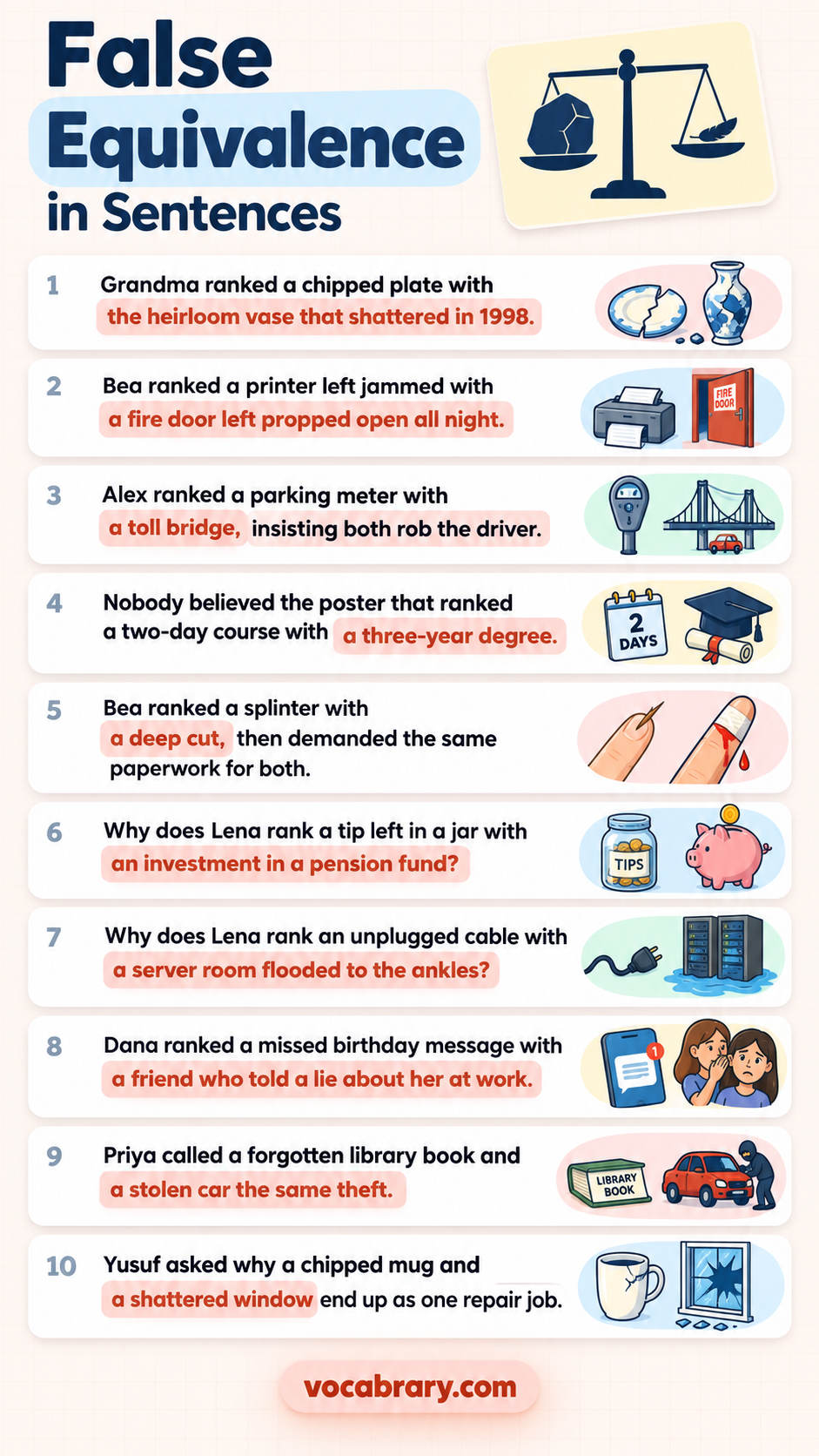
Common False Equivalence Examples in Sentences
Forgotten library books set beside stolen cars, parking tickets ranked with hit-and-runs, and burnt toast matched against a house fire are the common false equivalence examples. Each sentence names one shared feature and treats it as proof that the two cases deserve one verdict.
- Priya called a forgotten library book and a stolen car the same theft.
- "Skipping one class and dropping out are identical failures," Marcus announced in the tutor’s office.
- Because both drivers broke a written rule that morning, Dana insisted in front of the whole street that a parking ticket and a hit-and-run deserve exactly the same punishment.
- Nadia claimed that burning the toast and setting a kitchen alight are both cooking accidents, so neither cook owes an apology.
- My uncle argued that one late rent payment and a year of unpaid rent amount to the same offence.
- Why did Leo treat a spelling mistake and a forged signature as equal acts of dishonesty?
- After the storm, Rita told the insurer that a cracked window and a collapsed roof count as the same damage.
- Tom compared a five-minute delay with a cancelled flight, calling both a broken promise.
- Nobody in the room accepted Hugo’s claim that a snapped pencil and a smashed laptop are equal losses.
- Elena told the committee that one missed rehearsal and a whole term of absence show the same disrespect.
- During Tuesday’s meeting, Carl equated a typo in an email with a false figure in the year-end accounts, then asked for both writers to be suspended without pay.
- Hana said a paper cut and a broken wrist are both workplace injuries, so each deserves a week of paid leave.
- "A puddle and a flood are both water," Omar replied, refusing to move the crates.
- Farah insisted that borrowing a pen without asking and emptying a colleague’s wallet are the same theft.
- When the bill arrived, Ines argued that a rounding error and a deliberate double charge are equally dishonest.
- Ruth told her brother that forgetting a birthday and missing a funeral are the same neglect.
- Not one neighbour agreed that a barking dog and nightly drum practice are identical noise offences.
- Sam compared a nine-pound delivery fee with a monthly mortgage payment, insisting both are money leaving the household.
- Kofi maintained that a scratch on a bumper and a written-off van are the same accident.
- Yusuf asked why a chipped mug and a shattered window end up as one repair job.
- Mei announced that arriving two minutes late and missing an entire shift are equally unprofessional.
- Since both plants died in the end, Theo decided that one forgotten watering and a year of total neglect are the same crime.
- Lara argued in front of the whole tenants’ meeting that a wobbly shelf and an unsafe staircase are one and the same repair.
- Bea claimed that a warning letter and a court summons amount to identical trouble.
False Equivalence Examples in Everyday Conversation
Queue-jumping, cold coffee, and a borrowed umbrella turn into moral arguments the moment a speaker ranks them with something far worse. These false equivalence examples show a small annoyance answered as though it were a serious wrong.
- Jenna told the queue that stepping in front of one shopper and robbing the shop are both taking what is not yours.
- "You reheated my coffee, so you and the café that poisoned me are equally guilty," laughed Alex.
- Because the bus was late once, Lily told her colleagues that the driver and a pilot who abandons a plane share one record.
- A borrowed umbrella returned wet became, in Grace’s telling, proof that her friend destroys other people’s property.
- Rob argued that leaving one crumb on the counter and letting the flat fall into filth are the same habit.
- Nobody believed Bea when she ranked a forgotten text message with a friend who vanished for six years.
- Sam compared his brother’s two-minute shower overrun with the leak that flooded the downstairs flat.
- How did a late RSVP become evidence, in Mina’s account, that her cousin treats every invitation with contempt?
- Told that his music was loud, Pete answered that his speaker and a construction drill are equally noisy.
- Ali insisted at the dinner table that salting a dish twice and serving raw chicken to guests are both careless cooking, then refused to hear the difference.
- Since both were unplanned, Noor treated a missed haircut and a missed hospital appointment as one failure.
- Emma told her flatmate that one dirty mug in the sink and a month of unwashed dishes are equal sins.
- Tariq argued that walking on the grass and cutting down the tree are both damage to the park.
- "A white lie and a courtroom lie are still lies," Marco said, closing the argument.
- Hassan ranked forgetting the shopping with abandoning the family, because both left everyone hungry that evening.
- Vera decided that a friend who arrives ten minutes late and a friend who never shows up have the same attitude.
- Why does Dan treat a dropped call and a year of silence as identical betrayals?
- Although Pablo only spilled a drop of tea, his aunt said the stain and the ruined carpet upstairs are one loss.
False Equivalence Examples Between Friends and Neighbours
Hedges, shared bins, and borrowed ladders give neighbours their arguments, and the reply lifts a small nuisance to the level of a crime. Each sentence ranks an untidy garden or a late bin with something far heavier.
- Glen told the street that a hedge two inches over the line and a fence built on stolen land are the same trespass.
- "Your late bin and a fly-tipper are equally selfish," Roy shouted over the wall on Sunday morning.
- Because both made noise after ten, Ana ranked a slammed door with an all-night party for ninety guests.
- Bill argued that borrowing a ladder without asking and taking the tools from a locked shed are one offence.
- Nobody on Mill Road accepted Ed’s claim that a leaning gatepost and a house with no roof need identical repairs.
- Kofi compared a neighbour’s overgrown lawn with a garden used as a scrapyard, calling both neglect.
- Ruth insisted at the residents’ meeting that one car parked across a driveway and a van abandoned for three years obstruct the road in exactly the same way.
- How did a single barbecue in June become, for Theo, the same nuisance as the factory chimney behind the estate?
- Mina told her friend that forgetting to water the plants and selling the plants for scrap are both letting her down.
- Sofia ranked a misdelivered parcel with a stolen one, since neither reached the right door.
- After one noisy afternoon, Hugo announced that the children next door and a drilling crew are equally disruptive.
- Not a single resident agreed that a cracked paving slab and a sinkhole in the road are one hazard.
- Lena argued that a dog that barks at the postman and a dog that bit a child are both dangerous animals, so the same ban should apply to each.
- Why did Carl treat a dropped sweet wrapper and a lorryload of dumped rubble as the same crime against the street?
False Equivalence Examples in Family Arguments
Unmade beds ranked with a wrecked kitchen, one forgotten chore set beside years of absence, and a broken glass read as proof of a destructive cousin fill the kitchen row. False equivalence examples of this kind answer a small fault with the punishment for a large one.
- Mum told the room that an unmade bed and a kitchen left in ruins are the same laziness.
- "You forgot the milk, so you and the relative who forgot my wedding are equally thoughtless," said Grandad.
- Because both cost money, Dad ranked a single restaurant meal with the holiday that emptied the savings account.
- Ines argued that her sister’s late reply and a brother who has not phoned since 2019 show identical coldness.
- Nobody in the family accepted Ruth’s claim that one burnt dinner and a fortnight of missed meals are the same failure.
- A broken glass became, in Theo’s account, proof that his cousin destroys everything she touches.
- How did one forgotten thank-you card turn into evidence that Mina treats the whole family with contempt?
- Raj insisted over the roast that arriving after the starter and missing the entire wedding are equally rude, then refused to pass the gravy to anyone.
- Since both involve money, Hana treated a five-pound loan between sisters with the deposit her brother never repaid.
- Leo told his parents that one late night and a year of missed curfews deserve the same grounding.
- Grandma ranked a chipped plate with the heirloom vase that shattered in 1998.
- Why does Ali argue that skipping one Sunday lunch and moving abroad without telling anyone are the same abandonment?
- Not once did the twins agree that borrowing a jumper and selling it online count as identical crimes.
- Farah compared her nephew’s unanswered email with the uncle who cut off the family for a decade.
- Told to apologise for a spilled drink, Marco replied that the stain and the flooded bathroom last winter are one and the same accident.
- Yara said that forgetting to feed the cat for an evening and leaving the dog alone for a week are equal cruelty.
- Carl claimed that one sharp word at breakfast and a shouting match that emptied the street come from the same temper.
- Bea argued in front of every cousin that a cousin who replies slowly and a cousin who ignored three funerals treat the family exactly alike.
False Equivalence Examples About Chores and Screen Time
Dishes, laundry baskets, and an hour of gaming supply the evening argument, and each side ranks the other’s habit with something far worse. The comparison makes a small lapse sound like a lifelong pattern.
- Dad told his son that twenty minutes of gaming and a week glued to a screen waste the same childhood.
- "One unwashed plate and a sink of mouldy dishes are both filthy," Nina said, pointing at the counter.
- Because neither chore was done on time, Hugo ranked an unwashed laundry pile with a bedroom nobody had cleaned in a year.
- Sam argued that his sister’s half-hour of videos and his own full weekend online are equal waste.
- Nobody accepted Lara’s claim that forgetting bin day and a garden buried in rubbish are the same neglect.
- How did one evening of television become proof that Theo has abandoned every responsibility in the house?
- Ruth told her daughter, in front of two visiting aunts and a plate of cooling pasta, that a phone at Sunday lunch and a phone during a funeral show identical manners.
- Since both are screens, Kofi insisted that reading a novel and scrolling for six hours waste the same evening.
- Mei compared a forgotten vacuuming turn with the flatmate who never once cleaned anything in three years of shared rent.
- Nobody agreed that a messy desk and a hoarded room are one problem.
- Why did Ivan treat a single late chore and a whole rota ignored since March as equally selfish?
- Told to wash up, Alex replied that his one mug and the pile his brother left are equal contributions to the mess.
- Priya ranked an hour of homework skipped with an entire term of missed assignments, then set the same punishment for both.
- Farah said that a child who forgets to tidy and a child who smashes furniture are equally disrespectful to the house.
False Equivalence Examples in School and Grading
One late essay ranked with a term of missed deadlines, a whispered answer set beside a bought exam paper, and a borrowed pencil case matched with a stolen laptop fill the staffroom debate. Each comparison pulls a small classroom fault up to the level of serious misconduct.
- Mr Halloran told the class that a whispered answer and a bought exam paper are the same cheating.
- "Handing in one essay late and skipping every deadline are equally lazy," Miss Duarte wrote on the report.
- Because both broke a school rule, Theo argued that chewing gum and starting a fire in the science lab deserve one punishment.
- Nina insisted that copying a single reference and buying a whole dissertation online are identical plagiarism, so both students should fail the year outright.
- Nobody on the panel accepted that a missing footnote and a fabricated source are the same dishonesty.
- How did one absent morning become proof, in Mr Oyelaran’s attendance log, that Sam has abandoned education altogether?
- Priya told her tutor that losing a mark for spelling and losing a whole grade for a missing chapter are equal setbacks.
- Since both used a screen, Ruth ranked a calculator in a statistics lesson with an answer sheet smuggled into a closed exam.
- Marcus argued that a pupil who forgets a homework diary and a pupil who never attends are equally uncommitted.
- Not one examiner agreed that a smudged answer and an empty answer booklet earn the same zero.
- Leo compared a five-minute late arrival with a week of truancy, then demanded detention for both pupils.
- Why does the deputy head treat a shirt untucked at lunchtime and a fight in the corridor as one discipline case?
- Hana claimed that a group project where one member did less and a project where one member did nothing at all are identical unfairness.
- Told that his grade had dropped by two marks, Ivan replied that his slip and a classmate’s failed resit are the same disaster.
- Mei argued that forgetting a signed permission slip and forging a parent’s signature both break trust with the school.
- After the mock exams, Farah ranked a borrowed pencil case with a stolen laptop from the IT room.
- Kofi told the debate club that an essay with three typing errors and an essay written by somebody else deserve the same mark of zero, which ended the discussion.
- Yara said that a teacher who marks slowly and a teacher who never returns work at all are equally unreliable.
False Equivalence Examples in Work and Workloads
Two-minute lateness ranked with a missed shift, an unanswered email set beside a lost client contract, and a missing biro matched against a written-off van run through the staff meeting. False equivalence examples of this kind price a small lapse at the cost of a serious one.
- Our manager told the team that a two-minute delay and a missed shift damage the rota in the same way.
- "An unanswered email and a lost client contract are both failures of service," Dana announced at review time.
- Because each involved paperwork, Carl ranked a mistyped postcode with an invoice sent to the wrong company for forty thousand pounds.
- Nobody in payroll accepted Hugo’s claim that one hour of overtime and a month of unpaid weekends are equal sacrifices.
- Ines argued that a colleague who takes long lunches and a colleague who has not appeared since March are equally absent.
- How did a broken stapler turn into evidence, in Ruth’s report, that the office equipment budget has collapsed?
- Theo insisted that his forty-hour week and the night shift’s sixty hours are identical effort, and asked for the same bonus at the end of the quarter.
- Since both cost the firm money, Lena treated a missing biro with the van that was written off in the yard.
- Mei compared one typing error in a memo with a safety report filed with invented figures.
- Why did Sam rank a colleague’s late holiday form with a colleague who never filed a tax return?
- Not one supervisor agreed that a five-minute tea break and a two-hour disappearance are the same theft of time.
- Farah told the board that a project delivered a day late and a project abandoned halfway are equally disappointing.
- Kofi argued that a junior who asks too many questions and a junior who invents answers are both slowing the team down.
- Told that his figures were wrong, Marcus replied that a decimal slip and a deliberate false claim are one and the same error.
- Leo maintained that a worker who arrives tired and a worker who arrives drunk pose identical risks on the site.
- Bea ranked a printer left jammed with a fire door left propped open all night.
- Nadia said that a meeting that runs ten minutes over and a meeting cancelled without warning waste the same morning.
- Alex claimed that a manager who forgets one name and a manager who never learns anybody’s name show equal disrespect.
False Equivalence Examples About Remote Work and Overtime
Home desks, unread messages, and weekend emails feed the hybrid-working row, and each side ranks the other’s habit with something far more serious. The comparison turns a preference into a scandal.
- Rita told the meeting that working one day from home and quitting without notice damage the team the same way.
- "A late reply on a Friday and a deleted contract are both negligence," Hugo insisted on the call.
- Because both happened outside office hours, Ana ranked a weekend email with a manager who phoned an employee at three in the morning.
- Ivan argued that an hour of unpaid overtime and a year of unpaid overtime are equal loyalty.
- Nobody accepted the claim that a slow internet connection at home and an abandoned desk in the office are identical problems.
- How did one camera switched off in a video call become proof that Priya has stopped working altogether?
- Theo told his manager that logging off at six and taking three months of unapproved leave are the same lack of commitment, then closed the laptop.
- Since both reduce hours, Mei treated a four-day week with a walkout that stopped production for a fortnight.
- Not one union officer agreed that a missed stand-up meeting and a missed deadline for a national contract are equal offences.
- Yusuf compared a colleague who mutes notifications with a colleague who blocked the whole department.
- Why does Dana rank a home worker who takes a lunchtime walk with an employee who left for a second job mid-shift?
- Told to return to the office, Kofi replied that a commute of ten minutes and a commute of three hours are the same journey.
False Equivalence Examples About Money and Prices
Gadget prices ranked with rent, a delivery fee set beside a mortgage, and a coffee habit matched against a four-hundred-pound car repair run through every budget argument. These false equivalence examples treat two sums as one because both leave the same wallet.
- Nadia told her flatmate that a four-pound coffee and a four-hundred-pound car repair are both money wasted.
- "A delivery fee and a mortgage payment are equally a drain," Rob said, cancelling the order.
- Because both appear on the statement, Ruth ranked a monthly streaming charge with the loan that ran for nine years.
- Ines argued that a one-pound price rise on bread and a two-hundred-pound rise in rent hurt the household identically.
- Nobody in the queue accepted Theo’s claim that a bank fee and a fraudulent withdrawal are the same loss.
- How did a discounted phone become proof, in Sam’s argument, that the shop charges the same as a jeweller?
- Priya insisted that saving five pence on petrol and saving five thousand pounds on a mortgage rate show the same financial sense, then closed her spreadsheet.
- Since both are debts, Hugo treated a library fine with a repossession order from the bank.
- Marcus compared a birthday gift of twenty pounds with a wedding gift of two thousand, calling both generous.
- Why does Lena rank a tip left in a jar with an investment in a pension fund?
- Not one accountant agreed that a rounding error of a penny and a missing ten thousand pounds are equal irregularities.
- Farah said that a supermarket raising prices by two per cent and a landlord doubling rent overnight are the same greed.
- Kofi told the group that lending a friend a fiver and signing as guarantor on a flat are identical favours.
- Told that the gadget had gone up in price, Bea replied that a ten-pound increase and the year her electricity bill tripled feel the same to her.
- Mei argued that a shop that rounds up and a shop that charges twice for one order are equally dishonest.
- Alex ranked a parking meter with a toll bridge, insisting both rob the driver.
- Yusuf claimed that a child’s pocket money and a company director’s bonus are both simply income.
- Dana insisted in front of the whole budget committee that a stationery order of thirty pounds and a consultancy contract worth half a million deserve the same scrutiny.
False Equivalence Examples in Advertising and Price Claims
Snack bars ranked with grilled chicken, a budget headphone set beside a studio model, and a discount van matched against a new saloon fill the advertising copy. Each claim depends on one shared measurement while the rest of the comparison quietly fails.
- The snack bar’s label announced that one bar and a chicken breast deliver the same protein, so both count as a meal.
- "Our budget headphones and studio monitors both reach twenty kilohertz," the advertisement promised.
- Because each seat reclines, the coach company claimed its bus and a first-class cabin offer identical comfort.
- A discount van was sold as the equal of a new saloon, since both passed the same emissions test.
- Nobody believed the poster that ranked a two-day course with a three-year degree.
- Why did the leaflet insist that a vitamin drink and a full breakfast start the morning the same way?
- Since both contain fruit, the juice brand argued that its carton and a bowl of fresh berries are equally nutritious.
- Told that the mattress cost a tenth of its rival, the salesman replied that his model and the luxury brand use the same spring count.
- Hana wrote in the brochure that the small heater and an industrial boiler warm a room identically.
- Not one reviewer accepted that a phone camera and a professional lens produce the same photograph.
- The gym advertised that ten minutes on its bike and an hour of cycling outdoors burn equal energy, a claim three trainers publicly rejected.
- Marcus objected when the flyer ranked a weekend first-aid badge with a nursing qualification earned over four years.
- A paint tin promised that one coat and three coats give the same finish.
- Dana laughed at the sign claiming that a vending machine sandwich and a restaurant lunch are equal value for money.
False Equivalence Examples in Health and Safety Comparisons
A grazed knee ranked with a broken leg, one cigarette set beside forty a day, and a wobbly stepladder matched against scaffolding with no rail run through the safety briefing. Each sentence flattens a difference in risk that the site rules exist to mark.
- The foreman told the crew that a grazed knee and a broken leg are both accidents, so each earns the same form.
- "One cigarette and forty a day are equally smoking," Ali argued, lighting another.
- Because both are falls, Rita ranked a slip on a wet floor with a fall from the third-storey scaffold.
- Nadia insisted that a skipped vitamin and a skipped heart tablet are the same missed dose, and her pharmacist corrected her at once.
- Nobody on the ward accepted Theo’s claim that a paracetamol and a course of chemotherapy are both simply medicine.
- How did a wobbly stepladder end up ranked with scaffolding that had no guard rail at all?
- Priya told the class that a peanut allergy and a mild dislike of peanuts require identical care.
- Since both are drinks, Hugo treated a glass of wine at dinner with a bottle of spirits before driving.
- Marcus compared a five-minute walk with a marathon, calling both exercise for the heart.
- Why does Lena rank a sprained ankle with a spinal injury when she reports to the insurer?
- Not one nurse agreed that a cold and pneumonia deserve the same advice.
- Farah said that a helmet left at home for one short ride and a decade of riding without one show equal recklessness.
- Kofi argued that a smoke alarm with a flat battery and a building with no alarms at all are identically unsafe.
- Told to fasten his belt, Ivan replied that a trip to the shop and a motorway journey involve the same danger.
- Mei claimed that a bruise from a doorframe and a fracture from a fall downstairs are one and the same household injury.
- Bea ranked a splinter with a deep cut, then demanded the same paperwork for both.
- Dana insisted at the safety meeting that a warning sign left crooked and a missing fire exit are equal breaches.
- Yusuf said that a gas hob left on for a second and a gas leak that emptied the street are the same carelessness.
False Equivalence Examples in News Reporting and Both-Sides Framing
A weather blogger ranked with a climate scientist, one anonymous caller set beside a hospital consultant, and a single complaint matched against a nine-thousand-name petition fill the broadcast. False equivalence examples of this kind give unequal sources the same minutes on air.
- The presenter introduced a weather blogger and a climate scientist as two equal specialists.
- "One anonymous caller and a hospital consultant both have a view," the editor said, giving each five minutes.
- Because each had an opinion, the programme ranked a single complaint with a petition signed by nine thousand residents.
- Nadia objected when the broadcast treated a shopkeeper’s guess and a national inspection report as equally reliable.
- Nobody in the newsroom accepted the claim that a leaflet and a peer-reviewed study deserve identical airtime.
- How did a self-published pamphlet end up beside forty years of collected hospital figures?
- The bulletin gave one sentence to a verified inspection and one sentence to a rumour from an online forum, then moved to the weather.
- Since both sides were heard, the producer argued that a two-minute interview and a two-minute rebuttal make the report balanced.
- Marcus told the panel that a local rumour and a police statement earn equal standing with listeners.
- Why did the column present a retired hobbyist and a working engineer as matched experts on bridge safety?
- Not one reader accepted that a single angry letter and a survey of four thousand households show the same public mood.
- Farah wrote that giving a fringe claim and a settled finding the same headline misleads every reader who trusts the paper.
- Kofi objected when the debate ranked one dissenting researcher with the ninety-seven who had replicated the work.
- Told that the segment was fair, Ines replied that a fact and a denial are not equal contributions to an argument.
- Mei said that quoting a spokesperson and quoting the audited accounts leave the audience with identical confidence, which she called the whole trouble.
- Dana ranked a viral photograph with a verified document, and the correction ran three weeks later.
False Equivalence Examples in Sports Comparisons
A goal in a friendly ranked with a goal in the cup final, a four-minute appearance set beside ninety minutes, and a school sprint time matched against a national mark drive the pub argument. Each comparison names a shared statistic and treats it as proof of equal achievement.
- Ben told the bar that a goal in a friendly and a goal in the cup final count exactly the same.
- "Both players have one appearance this year," Rita said, ignoring that one lasted ninety minutes and one lasted four.
- Because each broke a record, Leo ranked a school sprint time with the national championship mark set in June.
- Nadia argued that a five-a-side match and a full ninety-minute league game demand identical fitness.
- Nobody in the changing room accepted Hugo’s claim that a training session and a title decider bring the same pressure.
- How did a win against a bottom-placed side become, in Sam’s account, the equal of beating the league leaders away?
- Priya insisted that a coach with one season behind him and a coach with twenty years of trophies deserve identical respect from the board.
- Since both scored twice, Marcus treated a striker’s two tap-ins with two goals struck from distance in a final.
- Not one selector agreed that a junior county medal and an international gold are equal honours.
- Farah said that a runner who trains twice a week and a runner who trains twice a day put in the same effort.
- Why does Kofi rank a yellow card for time-wasting with a red card for a dangerous tackle?
- Told that his team had drawn again, Ivan replied that a draw at home and a draw away from home count identically on the table.
- Mei compared a club’s academy graduate with a signing that cost forty million pounds, calling both fresh talent.
- Bea claimed that a player who missed one penalty and a player who missed an entire season through injury let the club down equally.
- Dana ranked a pre-season tournament with the national cup, then hung both trophies on the same shelf.
- Yusuf argued that a spectator who shouted once and a spectator who threw a bottle onto the pitch broke the same rule.
False Equivalence Examples in Technology Arguments
Two-hour battery claims ranked with all-day phones, a free app set beside audited software, and one bug matched against a total data loss run through the technology argument. These false equivalence examples take one matching number as evidence that two products are equal.
- Sam told the forum that a phone lasting two hours and a phone lasting two days both charge overnight.
- "A typo in the code and a bug that deleted the database are both errors," the junior developer said.
- Because each stores files, Hugo ranked a free app with the audited system the hospital had paid to certify.
- Nadia argued that a laptop with eight gigabytes and a workstation with one hundred and twenty-eight run the same programs.
- Nobody on the support desk accepted that a forgotten password and a leak of ten thousand customer accounts are equal incidents.
- How did a two-year-old tablet end up ranked with a machine released last month, purely on screen size?
- Priya insisted that a smart speaker and a laptop are equally capable, since both connect to the internet.
- Since both are cameras, Marcus treated a doorbell lens with the equipment a film crew had hired for the week.
- Not one engineer agreed that a website that loads slowly and a website that lost every order overnight failed in the same way.
- Farah said that a chatbot answering a question and a specialist answering the same question give identical advice.
- Why does Lena rank an unplugged cable with a server room flooded to the ankles?
- Told that the update had broken his printer, Theo replied that a stuck print job and a crashed national payments system are the same outage.
- Mei claimed that a password written on a note and a password shared with the entire internet are equally careless.
- Bea compared a hobby website with a banking platform, since each asks users to log in.
- Ivan ranked a stopped video call with a hospital network that went dark for eleven hours, then filed one complaint for both.
- Yusuf argued that an electric scooter and a family car are identical transport, because both have wheels and a motor.
False Equivalence Examples in Social Media Arguments
Reply chains produce the comparison in its rawest form, where a deleted comment is ranked with censorship and an unfollow is called betrayal. Each answer flattens a difference in seriousness to win the exchange.
- Ruth wrote that an unfollow and a betrayal in court are the same abandonment.
- "You deleted a comment, so you and a censor are equally guilty," Alex typed at midnight.
- Because both wrote in capitals, Hugo ranked an excited fan with an account that had threatened three strangers.
- Nadia argued in the replies that a blocked account and a banned newspaper suffer identical treatment.
- Nobody in the reply chain accepted that one negative review and a campaign of two thousand fake reviews are equal criticism.
- How did a forgotten message become proof, in Mina’s caption, that her friend had cut her off for good?
- Priya insisted that quoting a message out of context and inventing the message outright are the same misreading, and forty people agreed without checking.
- Since both were corrections, Marcus treated a polite note about a date with an hour-long video attacking the author’s family.
- Not one moderator agreed that a repeated emoji and a stream of abuse break the same rule.
- Farah said that muting a group chat and leaving the family forever are equally cold.
- Why does Kofi rank a typo in a headline with a fabricated screenshot shared forty thousand times?
- Told that his claim had been fact-checked, Ivan replied that a label and a prison sentence are both punishments for speech.
- Mei compared one heated argument in the replies with a decade-long feud, calling both online drama.
- Bea claimed that a friend who likes a rumour and a friend who invented the rumour share the same responsibility.
- Dana ranked a missed birthday message with a friend who told a lie about her at work.
- Yusuf argued that an account with nine followers and an account with nine million reach people identically.
False Equivalence Examples in Literature and Film
Orwell’s pigs, Shylock’s bond, and the textbook chart in Dead Poets Society give the fallacy its best-known outings. Each named work shows a character insisting that two unequal quantities deserve one measurement.
- In George Orwell’s Animal Farm, published in 1945, Squealer defends the pigs’ extra milk and apples by treating the labour of the fields and the pigs’ own brainwork as equal service to the farm.
- Party slogans in Orwell’s Nineteen Eighty-Four of 1949 set war beside peace and freedom beside slavery as though the paired states matched.
- Shylock’s bond in Shakespeare’s The Merchant of Venice treats a pound of flesh and three thousand ducats as equal payment, until Portia notes that the bond never granted a single drop of blood.
- Three witches open Shakespeare’s Macbeth by announcing that "fair is foul, and foul is fair", which flattens two opposite judgments into one.
- Mrs Bennet, in Jane Austen’s Pride and Prejudice of 1813, ranks Elizabeth’s refusal of Mr Collins with the ruin of the entire family.
- Scrooge answers the charity collectors in Dickens’s A Christmas Carol, published in 1843, by offering prisons and workhouses as provision equal to their appeal.
- Harper Lee’s To Kill a Mockingbird, published in 1960, shows a jury weighing an unsupported accusation and Tom Robinson’s account as testimony of equal standing.
- The court in Arthur Miller’s The Crucible, first staged in 1953, ranks a child’s accusation with sworn evidence and calls the two equally decisive.
- Jack lets the signal fire die in William Golding’s Lord of the Flies of 1954, defending the choice by treating a pig hunt and a rescue signal as equal priorities.
- Cervantes sends Don Quixote against a row of windmills in the novel of 1605, after his hero ranks turning sails with the swinging arms of giants.
- At the tea party in Lewis Carroll’s Alice’s Adventures in Wonderland of 1865, the Hatter corrects Alice for treating "I say what I mean" and "I mean what I say" as one statement.
- Jurors in Sidney Lumet’s 12 Angry Men, released in 1957, begin by treating a confident witness and an accurate witness as the same witness, until one juror separates the two.
- Ian Malcolm objects in Steven Spielberg’s Jurassic Park of 1993 that the park’s founders had treated the power to revive dinosaurs and the right to do so as one question.
- A textbook essay in Peter Weir’s Dead Poets Society, released in 1989, grades every poem on one chart, so a great sonnet and a weak verse finish with comparable scores.
Sentences Rewritten With a Fair Comparison
Library fines, parking tickets, and one late essay appear twice over, first as the flattened claim and then as a comparison that names the real difference in scale. The rewrite keeps the same two cases and restores the distance between them.
- Priya on a forgotten library book. ❌ A late book and a stolen car are both theft. ✅ One costs a forty-pence fine, the other costs a family its only transport.
- Dana on a parking ticket. ❌ A ticket and a hit-and-run are the same offence. ✅ Both broke a traffic rule, though only one left somebody in hospital.
- Miss Duarte on a late essay. ❌ A late essay and a term of missed deadlines are equal laziness. ✅ One essay arrived a day after Friday, while the other student handed in nothing since September.
- Hugo on a free app. ❌ A free app and audited hospital software are the same tool. ✅ Both store files, and only one has passed an independent security review.
- Ali on smoking. ❌ One cigarette and forty a day are equally smoking. ✅ The habits differ by a factor of forty, which is the entire question a doctor asks.
- The editor on airtime. ❌ A caller and a consultant both have a view. ✅ One view comes from thirty years of treated patients, the other from a single anecdote.
- Ben on two goals. ❌ A friendly goal and a cup final goal count the same. ✅ Each adds one to a career total, and only one decided a trophy.
- Nadia on a four-pound coffee. ❌ A coffee and a car repair are both wasted money. ✅ A daily coffee costs eighty pounds a year, while the repair cost four hundred in an afternoon.
- Rita on two falls. ❌ A slip on a wet floor and a fall from scaffolding are both accidents. ✅ One ends in a bruise, the other ends in a fatality report.
- Marcus on two errors. ❌ A decimal slip and a false claim are one mistake. ✅ Both altered a figure, and only one was altered on purpose.
- Farah on two landlords. ❌ A two per cent rise and a doubled rent are the same greed. ✅ One adds four pounds a month, the other forces a family to move.
- Yusuf on two vehicles. ❌ A scooter and a family car are identical transport. ✅ Each has wheels and a motor, though only one seats five and reaches motorway speed.
False Equivalence Examples for Students
Essay drafts, seminar replies, and debate rebuttals produce the fallacy in its most quotable form. Each sentence names a comparison a marker would query, from a forum reply ranked with a journal to a single case ranked with a national survey.
- An essay on transport claimed that a cycle lane and a motorway serve traffic identically, since drivers use both.
- "So a personal website and a journal paper are equal evidence," said Ines in seminar, which her tutor queried at once.
- Because both were sources, Marco’s bibliography ranked an anonymous forum reply with a forty-year study.
- Nobody in the debate accepted Theo’s claim that one interviewed student and a survey of four thousand show the same trend.
- Why did the rebuttal treat a single counterexample and a replicated finding as equally damaging?
- A first draft argued that correlation and causation answer the same question, and the marker circled the line twice.
- Hana wrote that a pilot study of nine people and a national trial of nine thousand prove a claim equally well.
- Told to compare two poets, Leo insisted that one published pamphlet and a lifetime of collected work make equal careers.
- Priya ranked a news report of an experiment with the experiment itself, then cited the report alone.
- Not one examiner agreed that a wrong answer and an unanswered question deserve the same mark.
- After the lecture, Kofi argued that an opinion column and a peer-reviewed paper are both published research.
- Mei’s conclusion set a two-week internship beside a decade in the profession as equal experience.
- Since both were quoted, Ivan treated a secondary paraphrase and the original author’s sentence as one source.
- Yara claimed in her presentation that a small local council and a national government face identical budget decisions, which the seminar spent twenty minutes dismantling.
Related
FAQs
False equivalence is a logical fallacy, and writers on reasoning group it with the informal fallacies, where the fault lies in what a comparison asserts rather than in its logical form. The claim rides on one shared feature, such as two drivers breaking a traffic rule, and ignores every difference of scale that decides the verdict. Formal fallacies, by contrast, break a rule of deduction whatever the argument is about.
False equivalence and the false dilemma fail in opposite directions. False equivalence treats two unequal cases as one, while a false dilemma cuts a wide choice down to two options and demands a decision between them. Setting a parking ticket beside a hit-and-run is a false equivalence. Announcing that a driver must accept every traffic law or reject the lot is a false dilemma.
False equivalence and false analogy overlap heavily, and several textbooks treat the first as one species of the second. A false analogy compares two cases that differ in the respects the argument turns on, and false equivalence names the version where that difference is one of degree or seriousness. A sound analogy survives the test, because the two cases match on the very quality under discussion.
False equivalence in journalism arises when a report gives two unequal sources the same standing, such as a weather blogger and a climate scientist, then invites the audience to choose. Editors defend the practice as balance, though the minutes granted to each speaker make a silent claim about authority. Newsrooms now separate balance, which means fair treatment, from equivalence, which pretends two sources are matched in evidence.
False equivalence bias names the habit of reaching for a symmetrical judgment whatever the evidence shows, so a listener who dislikes conflict scores both sides alike. Researchers into media trust describe the move as a shortcut that feels even-handed and quietly hides a difference in proof. The weaker case gains standing it never earned, and the stronger one loses ground it did earn.
You argue against a false equivalence by naming the difference the comparison hides and then measuring that difference out loud. Ask which feature the two cases share, and whether the feature settles the question under debate. A parking ticket and a hit-and-run share a broken traffic law, and only one of them put a stranger in hospital, so the shared law decides nothing.
You use false equivalence in a sentence as a noun for the flawed comparison itself, as in "Ranking a library fine with car theft is a false equivalence." Speakers also pair it with a verb of accusation, saying that a rival drew a false equivalence between two offences. Both British and American writers accept the phrase without a hyphen.
False equivalence and false equivalency both appear in edited prose, and dictionaries record the pair as variants of one noun. American writers reach for equivalency more readily, while British editors prefer equivalence, and academic philosophy uses equivalence almost without exception. Either spelling names the same fallacy, so a marker asks for consistency within one essay rather than a single correct form.
The opposite of false equivalence is a proportionate comparison, one that ranks two cases by the measure the argument actually turns on. Philosophers describe the corrective as relevant difference: name the respect in which the two cases differ, then state how far apart they fall. A fair comparison survives that treatment, while a false equivalence collapses the moment a measure is applied.
Several fallacies of comparison run alongside false equivalence, among them false analogy, false balance, the appeal to moderation, and whataboutism, which answers a charge by ranking it with an unrelated one. A straw man fallacy distorts an opponent’s claim before answering it, and an ad hominem attacks the arguer instead of the argument. Each one replaces the real comparison with a more convenient substitute.
The false equivalence fallacy is a problem because it hands the weaker case a standing nobody earned, and an audience walks away treating the two as equals. A reader who accepts that a library fine and car theft are one offence loses the ability to rank harms at all. Debate suffers most, since the move erases the distance between a minor lapse and a serious wrong.
You avoid false equivalence in your own writing by naming the exact respect in which two cases match before you compare them, then testing whether that respect settles the question. Quote the figures instead of the label: four hundred pounds beside four pounds, one missed morning beside a term of absences. Markers reward a paragraph that states the scale of a difference and penalise one that buries it under a shared word.

Leave a Comment