
Figurative language is a group of literary devices in which words mean more than their dictionary sense, as when a tired student says her backpack weighs a ton. Most figurative language examples in sentences come from everyday talk about love, weather, school, and work, where one simile or idiom says more than a plain statement.
What Is Figurative Language?
Figurative language describes one experience in terms of another, or exaggerates the literal truth, to create a picture, a feeling, or a laugh. Figures of speech such as simile and pun are the individual devices, and figurative language is the wider name for using any of them.
After the ten-mile hike, Nadia said her legs had turned to jelly.
Common Figurative Language Examples in Sentences
Raining cats and dogs, a heart of gold, and a backpack that weighs a ton are the figurative phrases English speakers use most, each describing a plain fact through a vivid comparison or exaggeration.
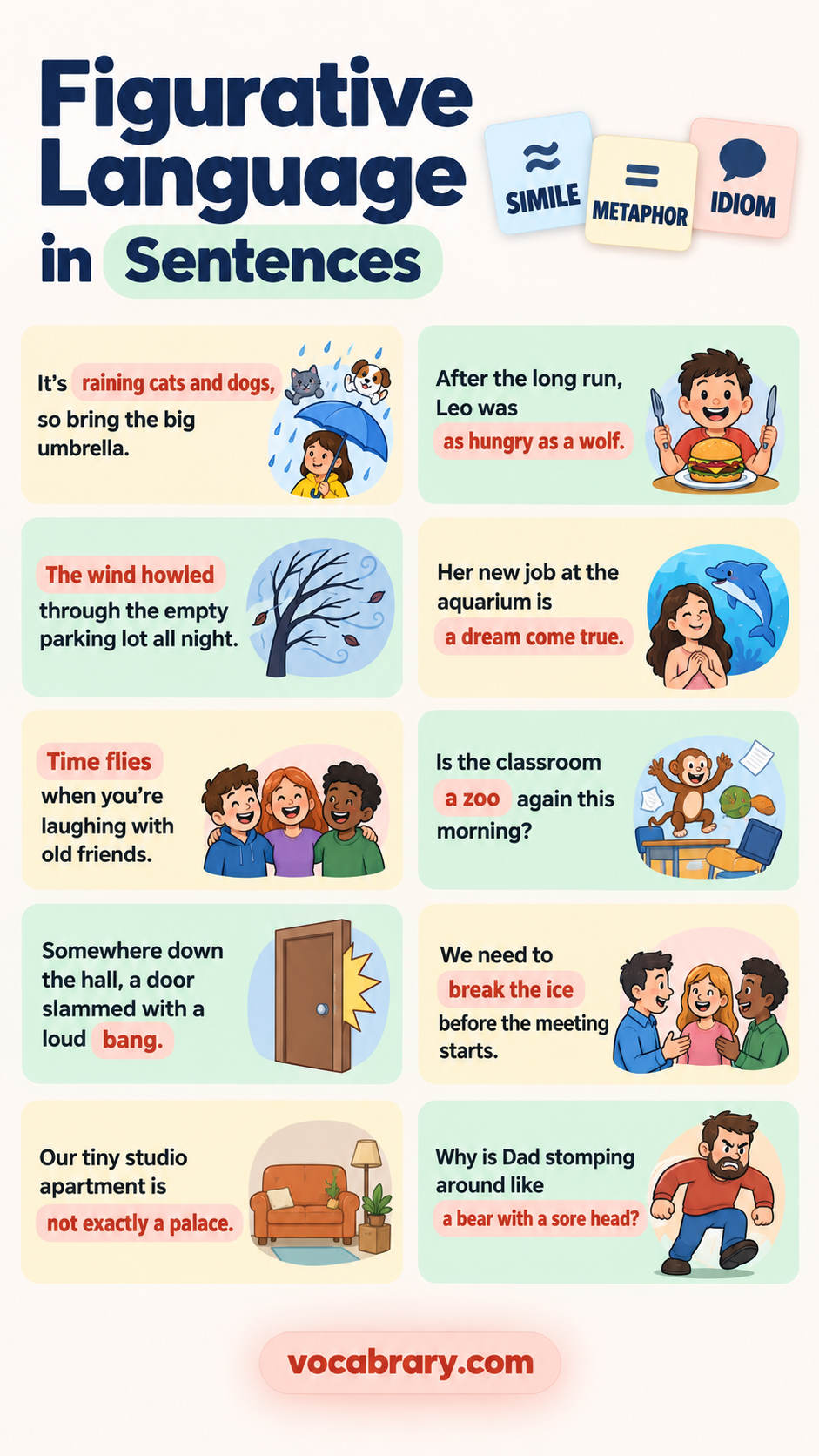
- It’s raining cats and dogs, so bring the big umbrella. (idiom)
- My grandmother has a heart of gold and bakes a pie for every new neighbor on the street. (metaphor)
- This backpack weighs a ton with three textbooks and a laptop inside. (hyperbole)
- After the long run, Leo was as hungry as a wolf. (simile)
- The wind howled through the empty parking lot all night. (personification)
- I’ve told you a million times to lock the back door when you leave. (hyperbole)
- Her new job at the aquarium is a dream come true. (idiom)
- Time flies when you’re laughing with old friends. (idiom)
- The alarm clock screamed at six, and Priya rolled out of bed. (personification)
- Is the classroom a zoo again this morning? (metaphor)
- Somewhere down the hall, a door slammed with a loud bang. (onomatopoeia)
- Marcus stayed as cool as a cucumber during the job interview, even when the panel asked about his weakest skill. (simile)
- We need to break the ice before the meeting starts. (idiom)
- Our tiny studio apartment is not exactly a palace. (understatement)
- Why is Dad stomping around like a bear with a sore head? (simile)
Figurative Language About Love
Hearts that melt, a grandfather calling his wife the sunshine of his life, and knees that turn to jelly show how figurative language about love describes a feeling nobody measures in numbers.
- When Sam smiled at her, Julia felt her heart melt. (metaphor)
- You are the sunshine of my life, Grandpa told Grandma on their fiftieth anniversary. (metaphor)
- Every time Omar walks into the room, Ana’s knees turn to jelly. (idiom)
- Their love stayed as steady as a lighthouse through thirty years of marriage. (simile)
- Kai fell head over heels for the new girl in his chemistry class. (idiom)
- I would swim across the ocean just to have coffee with you. (hyperbole)
- Cupid’s arrow found Mateo at a friend’s birthday party in March. (allusion)
- After the breakup, Nora said her heart was broken into a thousand pieces. (hyperbole)
- Love is a rose with sharp thorns, Aunt Lucia warned her niece. (metaphor)
- The two of them are like two peas in a pod, finishing each other’s sentences. (simile)
- Ben lost his heart to a violinist he met in Vienna. (idiom)
- Their goodbye at the train station was sweet sorrow, since he left for the army the next morning. (oxymoron)
- Is it true that you only have eyes for your husband? (idiom)
- The moon smiled on the couple as they walked along the beach. (personification)
- For forty years, their marriage weathered every storm. (metaphor)
Figurative Language About Weather
Rain falling in sheets, a sun that bakes the parking lot, and snow like a thick white blanket are figurative weather lines, because people describe the sky in pictures rather than degrees.
Rain and Storms
Thunder that growls, raindrops that drum on a tin roof, and a storm that throws a tantrum describe rainy days through animal noises, music, and a child’s bad temper.
- The rain came down in sheets all afternoon in Seattle. (idiom)
- Thunder growled over the hills like an angry dog. (personification)
- Raindrops drummed on the tin roof of the garden shed. (metaphor)
- Outside, the storm threw a tantrum, tossing patio chairs across the yard. (personification)
- We got soaked to the bone walking home from the bus stop. (hyperbole)
- Drip, drip, drip went the leaky gutter all night long. (onomatopoeia)
- Is it still raining buckets out there? (idiom)
- By noon the sky was as gray as an old sweatshirt, and the forecast promised no relief. (simile)
- Lightning split the sky in two over the stadium. (metaphor)
Heat and Sunshine
Sidewalks hot enough to fry an egg, a car that turns into an oven, and a Houston street that feels like soup describe summer heat through exaggeration and comparison.
- It’s hot enough to fry an egg on the sidewalk today. (hyperbole)
- The sun baked the parking lot until the asphalt went soft. (metaphor)
- Walking through Houston in August feels like swimming through soup. (simile)
- My car turned into an oven after an hour in the mall parking lot. (metaphor)
- Sunlight danced on the surface of the lake. (personification)
- We were melting by the time the bus finally arrived. (hyperbole)
- Isn’t this afternoon a real scorcher, even for Phoenix? (idiom)
- By two o’clock the town was as quiet as a sleeping cat, since everyone was hiding from the heat. (simile)
Cold and Snow
Fingers turned into icicles, snow like a white blanket, and a wind that bites describe winter cold in terms of ice, bedding, and pain.
- Snow covered the village like a thick white blanket. (simile)
- The wind bit at our cheeks on the walk to school. (personification)
- My fingers turned into icicles while I scraped the windshield. (metaphor)
- It was so cold that my breath froze in midair. (hyperbole)
- Jack Frost painted ferns on the kitchen window overnight. (personification)
- Icy branches crackled in the wind outside Leah’s window. (onomatopoeia)
- Aren’t you chilled to the bone in that thin jacket? (idiom)
- Shoveling two feet of snow in a blizzard, Grandpa called the weather a bit nippy. (understatement)
Figurative Language About Nature and Seasons
Whispering oaks, a lake as smooth as glass, and autumn leaves that pirouette to the ground describe plants, water, and the changing year as if they were alive.
Nature
Old oaks that whisper, rivers that snake through valleys, and peaks that touch the clouds describe trees, water, and mountains as if they were people or animals.
- The old oak whispered secrets to the wind. (personification)
- A silver river snaked through the green valley. (metaphor)
- Near Kathmandu, the peaks touched the clouds. (hyperbole)
- That morning the lake was as smooth as glass, without a single ripple. (simile)
- Wildflowers carpeted the hillside in yellow and purple. (metaphor)
- Bees buzzed lazily between the lavender bushes. (onomatopoeia)
- Have you ever seen the Amazon rainforest from the air, an ocean of green in every direction? (metaphor)
- Angry waves punched the rocks along the Cornish coast. (personification)
- Millions of stars winked at the campers from a moonless sky. (personification)
- At noon the desert is a furnace, but at midnight it turns into an icebox. (metaphor)
Spring and Summer
Cherry trees that wake up in April, summer days as long as a year, and a garden that explodes with color describe the two warm seasons through growth and exaggeration.
- In April the cherry trees woke up in a burst of pink. (personification)
- Spring tiptoed into the valley after a long, gray winter. (personification)
- Every summer day felt as long as a year when we were children. (simile)
- Grandma’s garden exploded with color by early June. (metaphor)
- The summer holidays flew by in the blink of an eye. (idiom)
- Crickets chirped in the tall grass every evening in July. (onomatopoeia)
- Last June, the public pool was a crowded soup of kids and inflatables. (metaphor)
- Why does spring arrive like a shy guest, a warm day here and a warm day there? (simile)
- Robins sang the sun up each morning of our camping trip in Vermont. (hyperbole)
Autumn and Winter
Leaves that pirouette to the ground, maple trees reduced to bare skeletons, and a winter that overstays its welcome describe the cold half of the year.
- Red and gold leaves pirouetted to the ground. (personification)
- By November the maple trees were bare skeletons against the sky. (metaphor)
- Autumn painted the hills in orange and red. (personification)
- The pumpkin patch was a sea of orange on Halloween weekend. (metaphor)
- Crunch, crunch, crunch went the dry leaves under our boots. (onomatopoeia)
- Winter overstayed its welcome this year and hung around until April. (personification)
- Our cabin felt as snug as a bug in a rug during the January storm. (simile)
- Isn’t it strange how the first frost turns every lawn into a field of diamonds? (metaphor)
- In December the days are so short that the sun barely gets out of bed. (personification)
Figurative Language About School
A math final that is a monster, a teacher with eyes in the back of her head, and a hallway as loud as a stadium are how students describe school life.
- The math final was an absolute monster. (metaphor)
- Mrs. Patel must have eyes in the back of her head, because she catches every note we pass. (idiom)
- Between classes, the hallway is as loud as a football stadium. (simile)
- I have a mountain of homework to finish before Monday. (hyperbole)
- Jordan passed the chemistry quiz with flying colors. (idiom)
- The school bell shrieked, and thirty kids raced for the door. (personification)
- Professor Lin’s history lecture was as dry as the Sahara. (simile)
- Lina’s brain was fried after six hours of revision. (metaphor)
- Our classroom is a melting pot of students from twelve countries. (metaphor)
- Did the teacher really hit the ceiling when nobody did the reading? (idiom)
- Failing three subjects in one term is not ideal, Tomás admitted. (understatement)
- During exam week, the library was as silent as a grave. (simile)
- Every morning the school bus swallows a line of sleepy kids at the corner. (metaphor)
- Priya is a walking dictionary, so everyone asks her to check their essays. (metaphor)
- Nobody wants to burn the midnight oil before a test, yet half the class did exactly that last night. (idiom)
Figurative Language About Work
An office that turns into a beehive, an inbox that explodes, and a manager who runs a tight ship describe the workday in terms of insects, disasters, and sailing.
- On Monday mornings, the office is a beehive. (metaphor)
- My inbox exploded after I came back from vacation. (hyperbole)
- Our manager runs a tight ship, so meetings start at nine sharp. (idiom)
- Dana has been working like a dog to finish the quarterly report. (simile)
- Let’s touch base after lunch to go over the budget. (idiom)
- The coffee machine died halfway through the morning shift. (personification)
- We’re drowning in paperwork since the audit started. (hyperbole)
- Getting a raise out of this company is like squeezing water from a stone. (simile)
- Everyone agrees the new intern is a breath of fresh air in marketing. (idiom)
- I’ve been glued to my desk for nine hours straight. (metaphor)
- Rafael was let go in the spring layoffs. (euphemism)
- Why does every project here turn into a marathon? (metaphor)
- The old printer coughed, wheezed, and finally spat out the contract. (personification)
- Signing the biggest client in company history was no small feat for a team of four. (litotes)
- After the merger, the break room became a battlefield of rumors and whispered complaints. (metaphor)
Figurative Language About Sports
A striker as fast as lightning, a goalkeeper who is a brick wall, and a crowd that roars like thunder describe a match with more drama than any score line.
- The striker was as fast as lightning on the counterattack. (simile)
- Their goalkeeper was a brick wall in the second half. (metaphor)
- When the ball hit the net, the crowd roared like thunder. (simile)
- Serena crushed her opponent in straight sets. (metaphor)
- Our coach told us to leave everything on the field tonight. (idiom)
- With one second left, the basketball swished through the hoop. (onomatopoeia)
- After losing ten to nothing, the captain admitted it was not our best game. (understatement)
- That rookie quarterback has a cannon for an arm. (metaphor)
- It’s a whole new ball game now that the rain has stopped. (idiom)
- Tired legs screamed for rest in the final mile of the Boston Marathon. (personification)
- Did you see Ahmed fly down the wing in the last minute? (metaphor)
- The veteran pitcher threw a million pitches in practice this week. (hyperbole)
- Victory tasted sweet after three losing seasons. (metaphor)
- Only a player with ice in his veins scores a penalty in a World Cup final. (metaphor)
Figurative Language About Food
Soup that is heaven in a bowl, a stomach that growls, and chili that turns into a volcano describe meals through taste, sound, and wild exaggeration.
- Grandma’s chicken soup is heaven in a bowl. (metaphor)
- My stomach growled loudly during the silent reading hour. (personification)
- I’m starving, so let’s order the pizza now. (hyperbole)
- The steak was as tough as an old boot. (simile)
- Bacon sizzled in the pan while Dad cracked the eggs. (onomatopoeia)
- That chili was a volcano in my mouth. (metaphor)
- Jess has a sweet tooth and never says no to dessert. (idiom)
- Isn’t this lasagna to die for? (hyperbole)
- Fresh from the oven, the bread was as soft as a cloud. (simile)
- Leftover pizza called my name from the fridge at midnight. (personification)
- After Thanksgiving dinner, Uncle Ray was as stuffed as the turkey. (simile)
- My roommate’s cooking is not exactly gourmet. (understatement)
- Those chocolate chip cookies disappeared in seconds at the school bake sale. (hyperbole)
- The spicy ramen set Kenji’s mouth on fire, and he reached for three glasses of milk. (hyperbole)
Figurative Language About Emotions
Being on cloud nine, feeling blue, seeing red, and having butterflies in the stomach link each emotion to a height, a color, or an insect.
Happiness
Cloud nine, a heart that sings, and a smile as wide as the Mississippi describe joy as height, music, and size.
- When she got the scholarship, Amara was on cloud nine. (idiom)
- My heart sang when I heard the good news. (metaphor)
- Leo’s smile was as wide as the Mississippi. (simile)
- We were over the moon about the new baby. (idiom)
- Happiness bubbled up inside Rosa like soda in a shaken bottle. (simile)
- Isn’t Dev walking on air since the promotion? (idiom)
- The joke left the whole family in stitches. (idiom)
- Winning the lottery would be nice, but a sunny Saturday with friends is pure gold. (metaphor)
Sadness
Feeling blue, a heart as heavy as lead, and tears that fall like rain describe sadness through color, heaviness, and weather.
- Tom has been feeling blue since his best friend moved away. (idiom)
- After the funeral, Mia’s heart was as heavy as lead. (simile)
- Her tears fell like rain on the letter. (simile)
- A cloud of sadness hung over the house for weeks. (metaphor)
- Grief knocked on his door every night that winter. (personification)
- Why are you down in the dumps today? (idiom)
- Losing the final was the end of the world for the ten-year-olds on the team. (hyperbole)
- Grandpa passed away peacefully last spring. (euphemism)
Anger
Seeing red, blowing a fuse, and a temper like a volcano describe anger as color, electricity, and fire.
- When the referee ignored the foul, Coach Diaz saw red. (idiom)
- Dad blew a fuse when he saw the phone bill. (idiom)
- Her temper is a volcano waiting to erupt. (metaphor)
- Marco was as mad as a hornet after someone scratched his car. (simile)
- Steam was coming out of her ears by the end of the meeting. (hyperbole)
- Why is the neighbor fuming about the parked car again? (metaphor)
- Anger boiled in Kwame’s chest as he read the unfair review. (metaphor)
- Priya shot her brother a look that melted steel. (hyperbole)
Fear and Nerves
Butterflies in the stomach, knocking knees, and blood that runs cold describe fear and nerves through the body.
- Before her first speech, Kim had butterflies in her stomach. (idiom)
- My knees were knocking as I walked onto the stage. (hyperbole)
- Hearing footsteps upstairs, Sofia felt her blood run cold. (idiom)
- Fear wrapped its fingers around Noah’s throat. (personification)
- The lost puppy was shaking like a leaf. (simile)
- I nearly jumped out of my skin when the balloon popped. (hyperbole)
- Why is Ravi as jumpy as a cat before exams? (simile)
- Ten minutes in the haunted house felt like ten years. (hyperbole)
Figurative Language About People and Appearance
Eyes as blue as the ocean, an uncle who is a gentle giant, and hair like a bird’s nest describe faces, bodies, and personalities through comparison.
- Her eyes were as blue as the ocean. (simile)
- My uncle is a gentle giant who coaches the kids’ soccer team. (metaphor)
- After the windy boat ride, Lucy’s hair looked like a bird’s nest. (simile)
- Mr. Okafor is a night owl who answers emails at two in the morning. (metaphor)
- The toddler’s cheeks were as red as apples after playing in the snow. (simile)
- At six foot eight, Jamal is a skyscraper next to his classmates. (metaphor)
- Grandpa’s face is a road map of wrinkles. (metaphor)
- Stella is all ears when someone mentions travel. (idiom)
- Our neighbor has a smile that lights up the whole street. (hyperbole)
- Your brother is as stubborn as a mule. (simile)
- Is the new manager really a snake in the grass? (idiom)
- Every summer, the studios go looking for a fresh face to star in their action movies. (synecdoche)
- Aunt Carmen calls herself pleasantly plump. (euphemism)
- Everyone at the gym calls the 150-kilo weightlifter Tiny. (irony)
- Hannah has a memory like an elephant, so she never forgets a birthday. (simile)
Figurative Language in Everyday Conversation
Spilling the beans, paying an arm and a leg, and feeling under the weather are phrases people use in daily chat without noticing they are figurative.
- Come on, spill the beans about the party. (idiom)
- That new phone cost an arm and a leg. (idiom)
- I’m feeling under the weather, so I’ll skip the gym. (idiom)
- Relax, it’s not rocket science. (idiom)
- I’m dead tired after that double shift. (hyperbole)
- Give me a hand with these bags, will you? (synecdoche)
- We waited forever for the bus this morning. (hyperbole)
- Let’s grab a bite before the movie. (idiom)
- My phone is on its last legs. (personification)
- Your room is a pigsty. (metaphor)
- Mom said the lasagna turned out not bad at all, which from her means it was excellent. (litotes)
- Why are you such a couch potato this weekend? (metaphor)
- Honestly, that’s the best news I’ve heard all year. (hyperbole)
- Traffic was a nightmare, so sorry I’m late. (metaphor)
- The kettle is singing, so the tea is almost ready. (personification)
Figurative Language in Poetry
Wordsworth’s lonely cloud, Dickinson’s feathered hope, and Frost’s two roads show how poets turn a whole feeling into one comparison.
- In a poem published in 1807, William Wordsworth describes himself wandering as lonely as a cloud high over valleys and hills. (simile)
- Later in the same poem, Wordsworth’s daffodils dance in the breeze beside the lake. (personification)
- Emily Dickinson describes hope as a bird with feathers that perches in the soul. (metaphor)
- Robert Burns tells his beloved that his love is like a red, red rose in a 1794 poem. (simile)
- Robert Frost’s "The Road Not Taken" turns two roads in a yellow wood into a picture of life’s choices. (metaphor)
- Carl Sandburg’s poem "Fog" says the fog arrives on little cat feet. (metaphor)
- Langston Hughes asks whether a dream put off dries up like a raisin in the sun in his poem "Harlem." (simile)
- Hughes’s "Mother to Son" has a mother tell her son that her life has been no crystal stair. (metaphor)
- Emily Dickinson’s speaker rides in a carriage beside Death, a courteous driver who stops for her. (personification)
- John Donne speaks directly to Death and tells it not to be proud in his Holy Sonnet 10. (personification)
- Alfred Noyes calls the moon a ghostly galleon in "The Highwayman" (1906). (metaphor)
- Maya Angelou’s "Still I Rise" (1978) promises that the speaker will rise like dust however she is treated. (simile)
- Walt Whitman’s "O Captain! My Captain!" mourns Abraham Lincoln as the captain of a ship that reached port after a fearful trip. (metaphor)
- Shakespeare calls the sun the eye of heaven in Sonnet 18. (metaphor)
- Edgar Allan Poe’s "The Bells" (1849) imitates their ringing with words such as tinkle and clang. (onomatopoeia)
Figurative Language in Songs
Elvis Presley’s hound dog, Simon & Garfunkel’s bridge over troubled water, and Katy Perry’s firework show how songwriters base a whole song on one figure of speech.
- In "Hound Dog" (1956), Elvis Presley calls a no-good companion a hound dog. (metaphor)
- Simon & Garfunkel’s "Bridge over Troubled Water" (1970) has the singer promise to be a bridge for a friend in hard times. (metaphor)
- Katy Perry’s "Firework" (2010) tells listeners that each of them is a firework, full of bright potential. (metaphor)
- Bruno Mars’s "Grenade" (2010) claims the singer would catch a grenade for the woman he loves. (hyperbole)
- The Beatles’ "Eight Days a Week" describes a love so strong that it needs an eight-day week. (hyperbole)
- Johnny Cash’s "Ring of Fire" (1963) describes falling in love as falling into a ring of fire. (metaphor)
- Elton John’s "Candle in the Wind" (1973) compares Marilyn Monroe’s short life to a candle in the wind. (metaphor)
- Rihanna’s "Diamonds" (2012) urges listeners to shine like diamonds. (simile)
- Stevie Wonder’s "You Are the Sunshine of My Life" calls a loved one the sunshine of the singer’s life. (metaphor)
- Pink Floyd’s "Another Brick in the Wall" (1979) presents students as bricks in a wall built by a strict school system. (metaphor)
- Taylor Swift’s "Love Story" (2008) retells the tale of Romeo and Juliet with a happy ending. (allusion)
- Taylor Swift’s "Shake It Off" (2014) takes its title from the idiom shake it off, meaning to ignore criticism. (idiom)
- Survivor’s "Eye of the Tiger" (1982), written for Rocky III, uses the eye of the tiger as a picture of a fighter’s hunger to win. (metaphor)
- Simon & Garfunkel’s "I Am a Rock" has the singer call himself a rock and an island, cut off from love. (metaphor)
Figurative Language in Advertising
Red Bull’s wings, the Skittles rainbow, and the snap, crackle, and pop of Rice Krispies show how brands use a single figure of speech to make a product memorable.
- Red Bull’s slogan claims the drink gives you wings. (metaphor)
- Skittles invites customers to taste the rainbow, as if each bag of fruit candy tasted like every color in the sky. (metaphor)
- Kellogg’s describes the sound of Rice Krispies in milk as snap, crackle, and pop. (onomatopoeia)
- Alka-Seltzer’s classic jingle promised relief with plop, plop, fizz, fizz. (onomatopoeia)
- De Beers has told couples since 1947 that a diamond is forever. (hyperbole)
- State Farm’s jingle compares the insurer to a good neighbor who is always there. (simile)
- Chevrolet advertised its pickup trucks as like a rock through the 1990s. (simile)
- Allstate reminds customers that they are in good hands. (idiom)
- Coca-Cola asked drinkers to open happiness in its 2009 campaign. (metaphor)
- Visa claimed its card was everywhere you want to be. (hyperbole)
- Mattress ads promise buyers the feeling of sleeping on a cloud. (metaphor)
- One coffee shop’s chalkboard sign read, "Espresso yourself before your first meeting." (pun)
- A local gym’s billboard urged passersby to turn fat into fuel. (alliteration)
- Wouldn’t a sports drink that makes you run like the wind sell itself? (simile)
Figurative Language in Speeches
Churchill’s iron curtain, Kennedy’s torch, and King’s bad check show how leaders turn a political argument into a picture a crowd remembers.
- In his 1946 speech at Fulton, Missouri, Winston Churchill warned that an iron curtain had come down across Europe. (metaphor)
- John F. Kennedy’s 1961 inaugural address said the torch had been passed to a new generation of Americans. (metaphor)
- Martin Luther King Jr. described the nation’s broken promise of equal rights as a bad check in his 1963 "I Have a Dream" speech. (metaphor)
- King’s same speech pictured Black Americans on a lonely island of poverty amid a vast ocean of prosperity. (metaphor)
- Abraham Lincoln warned in 1858 that a house divided against itself was unable to survive. (metaphor)
- Speaking in Memphis in April 1968, Martin Luther King Jr. said he had been to the mountaintop. (allusion)
- Ronald Reagan’s 1989 farewell address pictured America as a shining city upon a hill. (metaphor)
- Nelson Mandela’s 1994 inaugural address vowed that South Africa would never again be the skunk of the world. (metaphor)
- Theodore Roosevelt praised the man in the arena in his 1910 speech in Paris, meaning the person who actually tries. (metaphor)
- Winston Churchill offered the House of Commons nothing but blood, toil, tears and sweat in his first speech there as prime minister in 1940. (metonymy)
- At the wedding, the best man said the couple fit together like a hand in a glove. (simile)
- In the locker room, Coach Reyes told her players they had a mountain to climb in the second half. (idiom)
- Opening the town meeting, the mayor joked that everyone had a million better places to be on a Friday night. (hyperbole)
- A retiring teacher told the crowd that her forty years in the classroom had passed in a heartbeat. (hyperbole)
Figurative Language for Kids
A kitten as soft as a pillow, a little brother who is a monkey, and six silly snakes sliding down a slide give young readers short sentences where the comparison is obvious at once.
- The kitten is as soft as a pillow. (simile)
- Ella is as busy as a bee in her garden. (simile)
- Grandpa was as happy as a clam at the beach, building sandcastles with us until the sun went down. (simile)
- At the farm, the cow said moo when we walked past. (onomatopoeia)
- My little brother is a monkey on the playground. (metaphor)
- The teddy bear smiled at me from the shelf. (personification)
- Six silly snakes slid slowly down the slide. (alliteration)
- I ate a hundred pancakes this morning! (hyperbole)
- At bedtime, the moon peeked through my window. (personification)
- My bike bell goes ring-a-ling all the way down the street. (onomatopoeia)
- Is your room a jungle again? (metaphor)
- Max ran like the wind to catch the ice cream truck. (simile)
- Mom says my feet are ice cubes in winter. (metaphor)
- Tiny ants marched across the picnic blanket in a long, straight line. (personification)
- Papa’s snoring is louder than a train. (hyperbole)
Figurative Language for Students and Essays
Essay lines that call the Industrial Revolution an engine, social media an echo chamber, and Hamlet’s hesitation his Achilles’ heel show how students add figurative language to arguments and literary analysis.
- The Industrial Revolution was the engine that pushed Britain into the modern age. (metaphor)
- Social media has become an echo chamber in which users hear only opinions they already share. (metaphor)
- In "Romeo and Juliet," the feud between the families is a poison that kills the young lovers. (metaphor)
- Climate change is a ticking time bomb for coastal cities. (idiom)
- Macbeth’s ambition grows like a weed until it chokes his conscience. (simile)
- Scout Finch’s childhood innocence crumbles during the trial in To Kill a Mockingbird. (metaphor)
- The Great Depression swept across America like a dust storm. (simile)
- Rising sea levels knock at the door of island nations. (personification)
- Many historians argue that the Treaty of Versailles planted the seeds of the next war. (metaphor)
- Gatsby’s green light is a symbol of the dream he never reaches. (symbolism)
- Is a smartphone a window to the world or a wall between friends? (metaphor)
- Gandhi’s Salt March in 1930 was a spark that lit a nationwide movement. (metaphor)
- Hamlet’s hesitation is his Achilles’ heel. (allusion)
- Losing a third or more of its people to the Black Death was no small blow to medieval Europe. (litotes)
Literal vs Figurative Sentence Pairs
A tall boy called a giraffe, a hard test called a nightmare, and a cold room compared to a fridge state one fact twice, once plainly and once with a figure of speech.
- Literal: Jake is very tall. Figurative: Jake is a giraffe next to his classmates. (metaphor)
- Literal: The test was very hard. Figurative: The test was a nightmare. (metaphor)
- Literal: This room is very cold. Figurative: This room is as cold as a fridge. (simile)
- Literal: I am very hungry. Figurative: I am hungry enough to eat a whole cow. (hyperbole)
- Literal: She told everyone the secret. Figurative: She let the cat out of the bag. (idiom)
- Literal: The leaves moved in the wind. Figurative: The leaves danced in the wind. (personification)
- Literal: The door closed loudly. Figurative: The door shut with a bang. (onomatopoeia)
- Literal: He died last year. Figurative: He passed away last year. (euphemism)
- Literal: The family car is old and unreliable. Figurative: The family car is a dinosaur. (metaphor)
- Literal: The movie was good. Figurative: The movie was not bad at all. (litotes)
- Literal: The storm was very strong. Figurative: The storm roared all night. (personification)
- Literal: Everyone looked at the new student. Figurative: All eyes were on the new student. (synecdoche)
- Literal: The city government passed a new law. Figurative: City Hall passed a new law. (metonymy)
- Literal: We waited a long time. Figurative: We waited for ages. (hyperbole)
- Literal: The baby is sleeping peacefully in her crib after the long drive home. Figurative: The baby is sleeping like a log. (simile)
Related
FAQs
Most teachers name ten to twelve main types of figurative language, although no official total exists. The most common are simile, metaphor, personification, hyperbole, idiom, onomatopoeia, alliteration, oxymoron, understatement, euphemism, metonymy, and synecdoche.
Five everyday examples of figurative language are "as cool as a cucumber" (simile), "a heart of gold" (metaphor), "the wind howled" (personification), "I’ve told you a million times" (hyperbole), and "raining cats and dogs" (idiom). Each one means something different from what its words say literally.
Literal language means exactly what its words say, while figurative language means something beyond the dictionary sense of its words. "The room is cold" is literal, and "the room is an icebox" is figurative, because nobody believes the room is an actual icebox.
Yes, an idiom is a form of figurative language, because its meaning differs from the meaning of its separate words. "Spill the beans" has nothing to do with beans; it means to reveal a secret, and speakers learn that meaning as a fixed phrase.
Figurative language and figures of speech are closely related but not identical, because figurative language is the general practice and figures of speech are the individual devices that make it up. A simile, a metaphor, and a pun are each a figure of speech, and using any of them produces figurative language. Sentences for each device one by one appear in our figures of speech examples.
Only one type of figurative language, the simile, relies on "like" or "as" to make its comparison, as in "as busy as a bee." Metaphor, personification, hyperbole, and idioms work without either word, so a missing "like" does not mean a sentence is literal. More simile examples show the "like" and "as" pattern at length.
The phrase "he had a heart of gold" is a metaphor, because it describes a kind person as having a heart made of gold without using "like" or "as." It is also a fixed idiom in English, and more metaphor examples follow the same pattern.
Imagery is not always figurative language, because imagery is any description that appeals to the senses, and plenty of it is literal. "The bread was warm and golden" is literal imagery, while "the bread was as soft as a cloud" combines imagery with a simile.
Verbal irony counts as figurative language, because the speaker means the opposite of the literal words, as in calling a 150-kilo weightlifter "Tiny." Situational and dramatic irony depend on events and audience knowledge rather than word choice, so most teachers treat them as literary devices instead.
Writers use figurative language to make descriptions vivid, to express emotions that a plain statement leaves out, and to help readers remember a line. A sentence such as "Grief knocked on his door" uses personification to make a feeling concrete.
You identify figurative language by asking whether the sentence is literally true. If a backpack does not actually weigh a ton, or a classroom is not actually a zoo, the words are figurative. The next step is to name the device, such as hyperbole for the backpack and metaphor for the zoo.
Figurative language and literary devices are not the same, because literary devices is the wider term. Foreshadowing and flashback are literary devices too, yet they work on plot and structure rather than on the meaning of words, so they are not figurative language.

Leave a Comment